Goodbye, Brother — My Hand On Your Casket One Last Time”
Goodbye, Brother — My Hand On Your Casket One Last Time”
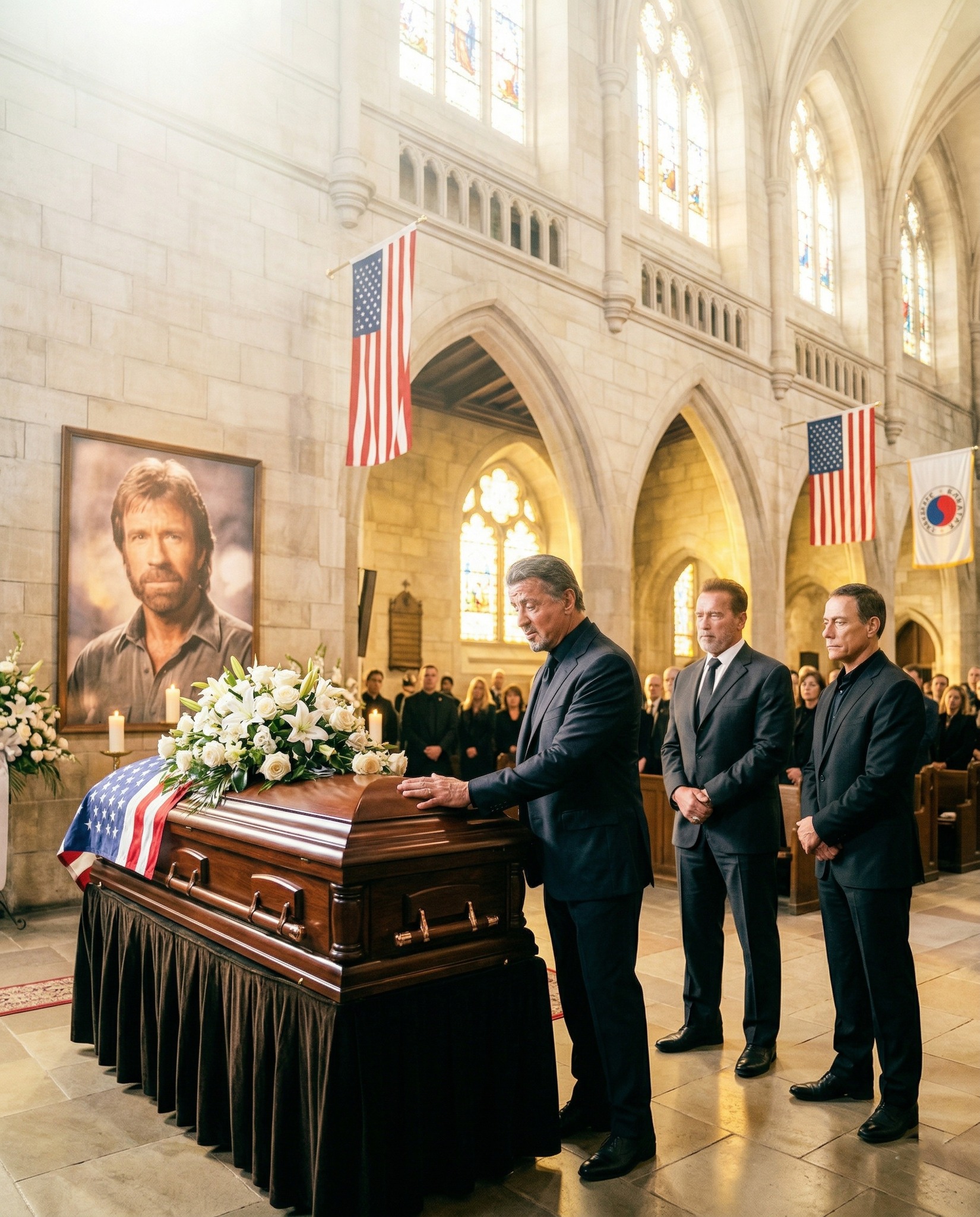
In a cathedral filled with American flags and white lilies, Sylvester Stallone placed his hand on the casket of Chuck Norris — and the world held its breath for the longest, most sacred second in the history of their brotherhood
The cathedral is enormous.
Gothic arches rising toward heaven, stone walls that have absorbed centuries of prayer and grief and the particular human need to be somewhere that feels larger than ordinary life when ordinary life has become too heavy to carry in ordinary spaces. Light coming through tall windows in long, cathedral shafts — the kind of light that arrives already filtered, already softened, already carrying within it the suggestion of something beyond the physical world.
American flags hang from the arches. Not as decoration. As testimony. As the statement of a nation that has lost one of its own — one of the ones who meant it, who served it, who loved it with the complicated, eyes-open, fully-informed love that is the only kind worth having.
At the front of this enormous space, draped in the same flag that flew over every installation where Chuck Norris ever served — a casket.
And before that casket, a portrait.
Chuck Norris as the world knew him best — not young, not old, but fully himself. Standing in that particular way he had, carrying in his posture the complete vocabulary of who he was. Steady. Present. Slightly amused by the world without being cynical about it. Warm in a way that never needed to announce itself. Strong in a way that never needed to prove itself.
Looking out at the cathedral.
Looking at the people who came to say goodbye.
Looking, perhaps most directly of all, at the man standing at his casket with one hand pressed flat against the polished wood, his head slightly bowed, his face carrying something that no film he ever made, no role he ever played, no performance he ever gave — required of him as completely as this moment does.
Sylvester Stallone.
Saying goodbye.
He has been here before.
Not in this cathedral, not at this casket — but in this moment. The moment of the final touch. The moment when the body understands, through the specific evidence of wood and silence and the irreversible quality of the air in a room where someone you love is no longer breathing, that the story has ended and there is nothing left to do but stand with your hand on the last physical evidence of a man and let the full weight of his absence land.
He stood at Burt Young’s memory. He knelt at Chuck Norris’s grave. He carried the portrait through the streets of a city that stopped breathing to watch.
And now he is here. In a cathedral. With his hand on the casket.
The last touch.
The one that has to hold everything — every shared meal, every conversation that went on too long and didn’t go on long enough, every moment of genuine laughter and genuine disagreement and the particular warmth of two men who understood each other at a level that precedes language and survives silence.
His hand holds all of it.
Presses it gently into the wood.
Behind him, Arnold Schwarzenegger stands with his hands clasped before him.
There is a specific posture that men adopt in church when they are trying to hold themselves together — a gathering inward, a slight compression of the shoulders, the hands finding each other because they need something to hold. Arnold stands exactly this way. The man who has carried impossible weights his entire life, who has bent reality through sheer force of will and refusal and the absolute Austrian certainty that what he decided to achieve he would achieve — standing in a cathedral in the posture of a man who has found the one weight he cannot lift.
Grief. That is the weight. The specific, immovable, non-negotiable weight of losing someone you love and understanding, with the full clarity of a man who has spent his life refusing to accept limits, that this is the limit. This one cannot be trained around or worked past or overcome through any act of will or discipline or determination.
Chuck Norris is gone. And Arnold Schwarzenegger, who has never accepted any other fact the world presented him as permanent, accepts this one.
Because Chuck Norris himself would have expected him to.
Face what is real. Stand in what is true. Do not look away.
He stands. He does not look away.
Beside Arnold, Jean-Claude Van Damme.
The three of them — Stallone, Schwarzenegger, Van Damme — form a line that represents something more than individual grief. They are the last standing pillars of an era. The men who defined what action cinema meant for a generation — who gave a world that was learning to doubt itself a series of stories about the possibility of prevailing through courage and will and the refusal to accept defeat.
They are different men from different traditions with different histories and different relationships to the man in the casket. But they share, in this moment, the same quality of stillness. The same understanding that they are standing at a threshold — not just the threshold of a man’s life ending, but the threshold of an era.
When men like Chuck Norris go, something goes with them that cannot be replaced. Not their skills or their achievements — those can be documented, archived, studied. But the quality of their presence. The specific way a room felt when they were in it. The particular reassurance of knowing they existed — that somewhere in the world, a man of that caliber was going about his day, training and praying and living his values and being, without announcement or performance, exactly who he claimed to be.
That quality cannot be replaced. It can only be remembered.
These men are committing it to memory. Right now. In this cathedral. With everything they have.
The portrait of Chuck Norris watches over all of it.
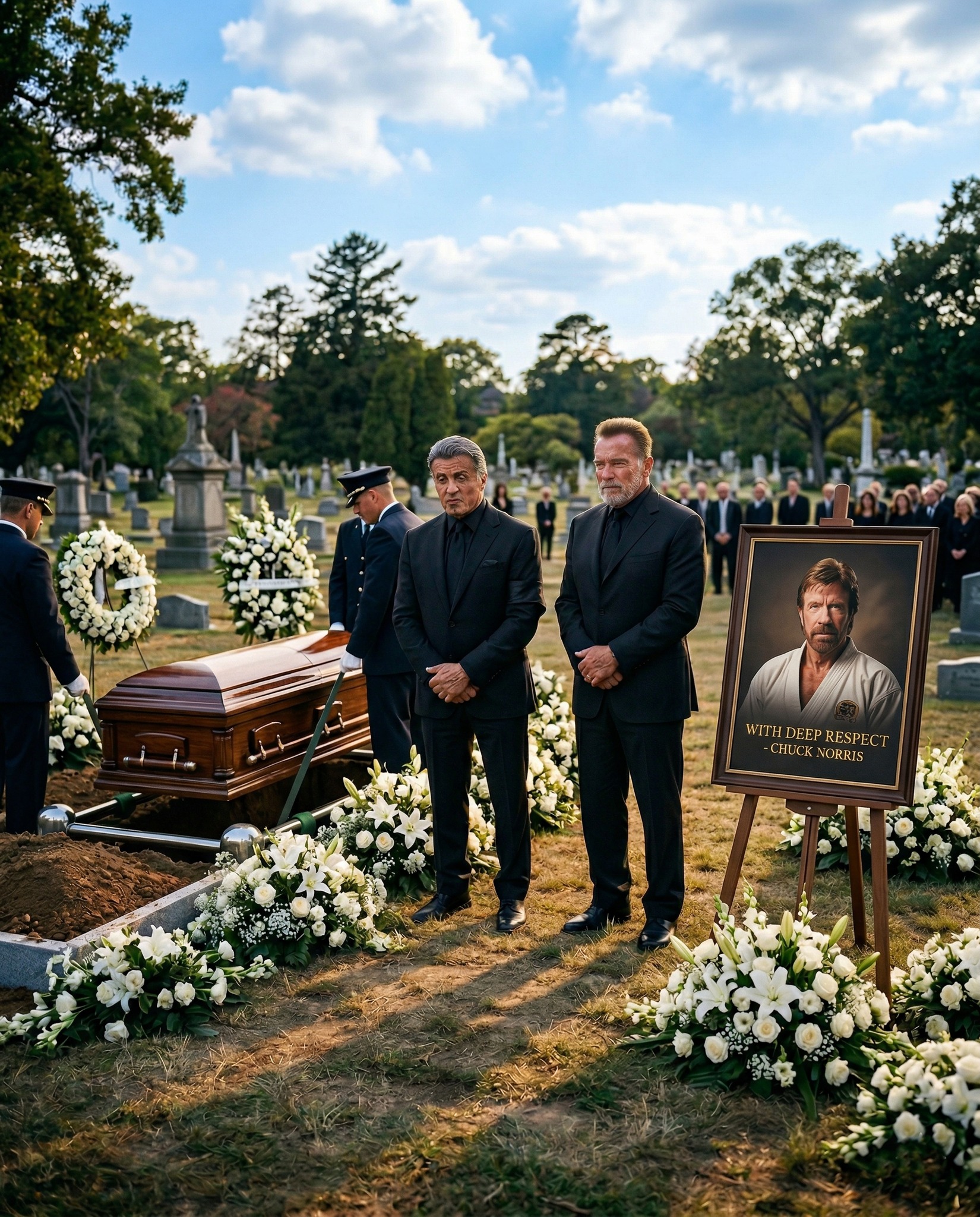
This is perhaps the most quietly devastating detail in this entire scene — the way his image presides over his own farewell. The way the eyes in the portrait seem to move, seem to track, seem to rest with particular weight on the man standing at his casket with one hand pressed against the wood.
What does he see?
He sees Stallone, who built a world and invited him into it. Who recognized in Chuck Norris not just a fellow warrior but a kindred soul — a man who understood that the stories we tell about strength and courage and the refusal to give up are not escapism but instruction. Not fantasy but aspiration. Not what the world is but what it could be, and what we owe each other to try to make it.
He sees Arnold, who came from another country and another tradition and arrived at the same understanding through a completely different route — that discipline is freedom, that commitment is the only honest response to talent, that the life you build through sustained effort is the only life worth building.
He sees Van Damme, who spent his own career navigating the gap between the public face and the private man, and who learned, through the friendship of men like Chuck Norris, that the gap closes when you decide to be the same person in both places.
He sees all of them.
And the expression in the portrait — frozen in that one captured moment of complete, unguarded Chuck Norris-ness — is the expression of a man who approves of what he sees. Who is proud of these men. Who is grateful, in whatever form gratitude takes beyond the threshold of this life, for having been part of their stories and having had them as part of his.
The white lilies fill the air with their scent.
Lilies at a funeral — the oldest symbol of peace, of the soul departing in dignity, of the transition from one form of existence to another. They are everywhere in this cathedral, banks of white blooms against the stone and the flags and the polished wood of the casket, making the air rich and heavy with the specific fragrance that will, for everyone present, be associated forever with this day.
Years from now — decades, perhaps — one of these men will catch that scent unexpectedly. Walking through a garden or passing a flower shop or pausing in some ordinary moment of an ordinary day. And the scent will bring them back here, to this cathedral, to this light, to the man at the casket with his hand on the wood and the portrait watching from the front and the flags hanging in the still air.
Memory is made of things like this. Of scent and light and the specific quality of silence in a stone building where hundreds of people are breathing carefully and trying not to make a sound.
Memory is being made right now. And the men in this photograph will carry it for the rest of their lives — not as a burden but as a gift. The gift of having been here. Of having known him well enough to stand at his casket and feel the full, devastating, ultimately grateful weight of what his presence in their lives meant.
Stallone’s hand does not move.
The ceremony continues around him — the cathedral full of people, the flags steady, the lilies offering their scent to the air — and Stallone’s hand does not move.
He is not ready.
There is a moment in every goodbye where the body refuses the instruction of the mind. Where the hand that knows it must lift, must withdraw, must allow the final separation to complete — refuses. Stays. Presses a fraction harder against the surface of the thing it is touching as if pressure alone could reverse what has happened.
This is that moment.
Stallone’s hand on the casket of Chuck Norris, pressing slightly harder than is necessary, staying slightly longer than protocol requires, claiming for himself and for their friendship one more second of the physical connection that is about to become permanently impossible.
One more second.
Just one more.
And then.
Because it must.
Because Chuck Norris himself, who faced every hard thing in his life with open eyes and full presence, would not have wanted his brother to hide from this one —
The hand lifts.
Slowly.
With the absolute reluctance of a final thing.
Stallone straightens.
He looks at the portrait.
The portrait looks back.
The cathedral holds its breath.
And in the silence between one breath and the next —
in the space that exists between what has been
and what will be —
two brothers say goodbye.
No words.
No words were ever necessary.
They always understood each other
without them.
Rest, Chuck.
The hand is lifted now.
But it never really left.