“Six Men, One Candle Circle, And The Portrait That Looked Back At Them”
“Six Men, One Candle Circle, And The Portrait That Looked Back At Them”
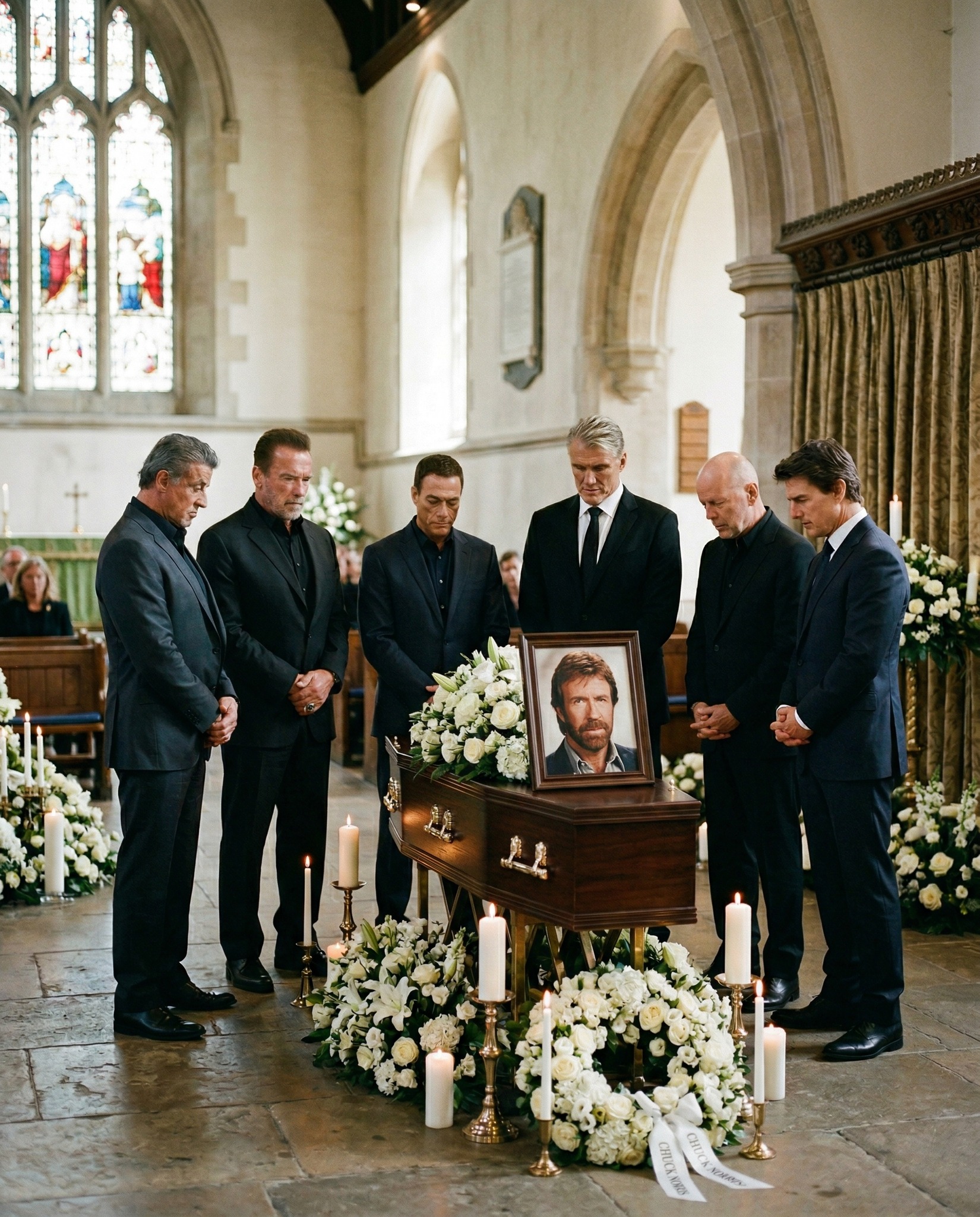
In the candlelight of an ancient stone church, the greatest warriors of a generation bowed their heads around the man who taught them what it truly meant to be strong
The candles were lit before they arrived.
Someone — a church elder, a family member, a person who understood that this particular farewell required something older and more elemental than electricity — had placed them in a circle around the casket before the men came in. Gold candlesticks. White candles burning with the steady, patient flame that does not flicker unless something moves through the air. The kind of light that has been used for this purpose for a thousand years in a thousand stone churches in a thousand moments when words ran out and only flame remained.
It was the right choice.
Because what happens in this photograph exists in the space before language — in the wordless place where six men stand around a casket and look at the portrait of their friend and feel something so total, so complete, so beyond the reach of any sentence that the candles are the only honest witnesses. They burn. They give light. They ask nothing in return.
The ancient stone walls absorb it all. The stained glass holds its colors in the pale light coming through from outside. The church — old, solid, rooted in centuries of exactly this — holds the moment without judgment and without end.
And six men bow their heads.
Look at who they are.
Sylvester Stallone on the far left. The architect. The man who built the world that brought most of them together — who looked at a generation of warriors and said you deserve to stand in the same frame and then spent fifteen years making that vision real. He stands now with his hands clasped before him in the posture of a man who has run out of things to build and is left with only the grief of having built them alongside someone who is no longer here.
Arnold Schwarzenegger beside him, in black, his massive frame somehow smaller in this space — not diminished, but humbled. Humbled by the stone and the candles and the casket and the portrait and the accumulated weight of understanding that the most powerful man in any room is still subject to the same final arithmetic as everyone else. Arnold has spent his life defying limits. This one he cannot defy. He bows his head and accepts it with the grace of a man who learned, somewhere along the extraordinary journey of his life, that acceptance is not surrender.
Jean-Claude Van Damme, slightly forward, his face angled toward the portrait with an expression that contains entire conversations — everything he said to Chuck Norris across the years and everything he never got around to saying and everything he is saying now, in the only language available, which is silence and presence and the willingness to stay.
Dolph Lundgren — tall, silver-haired, the quiet intellectual giant of this generation — stands with his head bowed and his hands clasped and his face carrying the specific expression of a man thinking. Not performing thinking. Actually thinking. Working through something. Perhaps the mathematics of mortality. Perhaps the inventory of what Chuck Norris meant to him specifically — the private accounting of a friendship that the public never fully saw because it existed in the spaces between the public moments, in the conversations that no camera recorded and no journalist documented and no archive holds.
Another brother beside him — someone whose grief is no less real for being less recognized. Because Chuck Norris drew people to him from every direction, from every tradition, from every corner of the world that had ever produced someone committed to excellence and integrity and the daily practice of being exactly who they said they were. This man is here because Chuck Norris mattered to him. That is sufficient. That is everything.
Tom Cruise on the right. The inheritor. The one who carries forward into a new era the philosophy that Chuck Norris embodied — that real matters, that the gap between performance and truth is a gap worth closing, that you owe the people who trust you with their attention your genuine self and your genuine effort and your genuine willingness to be hurt in the service of something true.
He bows his head like a student at the grave of his teacher.
Because that is what he is.
And at the center of all of them — the portrait.
Chuck Norris looks out from the frame with an expression that is unmistakably, completely, irreducibly himself. The directness of the gaze. The slight warmth that lived always just below the surface of his public face, visible to people who looked carefully enough. The quality of presence that photographs capture but cannot fully contain — the sense that the man in the image is aware, is here, is seeing you as clearly as you are seeing him.
He looks at the six men bowing their heads around his casket.
What does he see?
He sees the friends who came. Who canceled whatever they were doing and traveled whatever distances were required and put on their dark suits and walked into this ancient stone church because the alternative — staying away, sending a message, marking his passing from a comfortable distance — was not an option their hearts would allow.
He sees the grief they are carrying and he recognizes it because he would have carried the same grief for any of them. He was that kind of friend — the kind who shows up fully, who feels fully, who does not manage his emotional responses to the people he loves but allows those responses their full, unmedicated, completely sincere expression.
He sees, perhaps, something else as well.
He sees men who are going to be alright.
Not immediately. Not soon, perhaps. But eventually, in the way that people who have been genuinely loved always become alright — because love, even when the person who gave it is gone, does not stop working. It continues in the values it transmitted and the standards it set and the example it provided and the quiet voice it left behind in the conscience of everyone it touched.
Get up. Keep going. Do not quit. Be real. Serve. Love. Stand.
He spent eighty-five years saying this in every possible way. They heard him. They will continue to hear him.
The portrait looks at them and knows this.
The candles burn in their circle.
White wax. Gold holders. The steady, patient, ancient flame.
In many traditions, candles at a funeral serve a specific purpose — they are lit for the soul in transition, to provide light for the journey, to mark the passage from one form of existence to another with something warm and visible and real. They are the living reminder that light continues even after the source that sparked it is gone.
The candles around Chuck Norris’s casket burn with this intention, whether anyone present consciously holds it or not. They burn because he deserves light. Because his life was light — the specific, particular, absolutely reliable light of a man who knew who he was and lived it every day without apology and without performance.
That light does not go out because the candles will eventually be extinguished.
It goes into the men standing around them. Into everyone who ever watched him on screen and felt something shift. Into the young people whose lives were redirected by Kick Start Kids. Into the soldiers he honored and the faith he practiced and the family he built and the friendship he kept with a fidelity that never wavered.
The candles burn.
The light continues.
It always will.
The stained glass above them holds its colors.
Centuries old, those windows — made by hands long returned to the same ground that will shortly receive Chuck Norris, depicting stories of faith and sacrifice and the human need to believe that what we do here matters beyond the span of our individual lives.
The light that comes through them now, on this morning, falls across the casket and the portrait and the six bowed heads in patterns of color that no designer planned and no director choreographed. It simply falls — red and blue and gold and green, the accidental beauty of light passing through old glass on an ordinary extraordinary morning in a stone church where something irreplaceable is being said goodbye to.
Chuck Norris would have noticed the light. He noticed things. He was, beneath all the other dimensions of who he was, a man who paid attention — to the world and to the people in it and to the small, beautiful, unrepeatable details that most people walk past without seeing.
He would have noticed the light on this morning and found it beautiful.
He would have been right.
The six men stand.
The candles burn.
The portrait watches.
The stained glass holds its ancient colors.
The stone walls hold the silence.
And in the silence — in the space between one candle flame and the next, in the gap between one bowed head and another — something passes.
Not words.
Not ceremony.
Not the managed, public expression of grief that the world will see in the photographs.
Something private.
Something between the men and the man.
A conversation conducted entirely in the language of presence.
Of having shown up.
Of having stayed.
Of having been, for each other, across decades of shared history and genuine friendship, exactly what was needed.
The candles burn.
The portrait smiles.
Slightly.
The way Chuck Norris always smiled —
as if he knew something you were about to figure out.
As if the punchline was coming
and it was going to be worth the wait.
Rest, friend.
We are figuring it out.
Slowly.