“I’ll See You on the Other Side, Brother” Stallone leans close, one last time, to the man he could never quite beat — and never wanted to
“I’ll See You on the Other Side, Brother”
Stallone leans close, one last time, to the man he could never quite beat — and never wanted to.
The room is almost unbearably quiet.
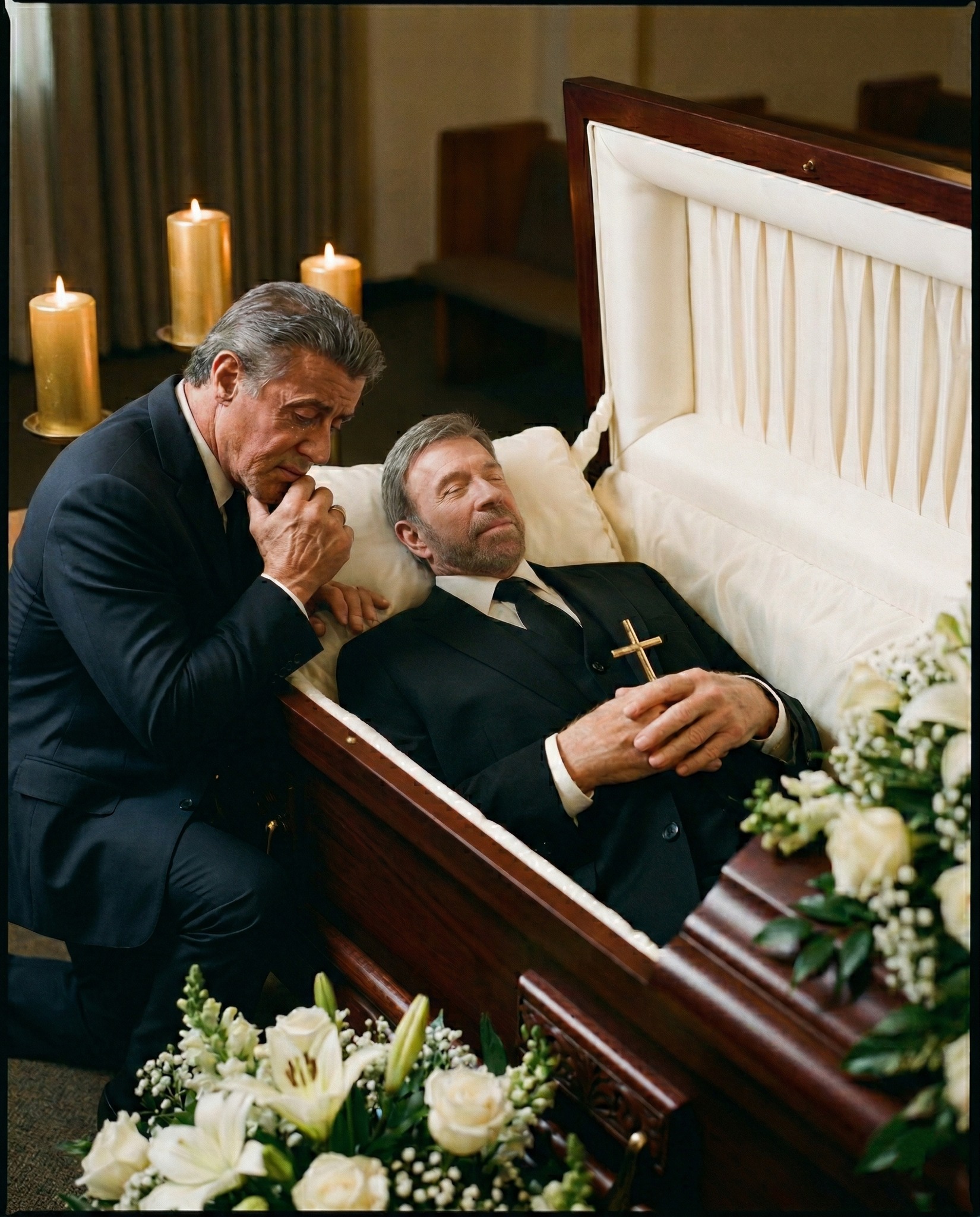
Candles burn on either side, their warm gold light falling across white lilies, across polished wood, across a face that has finally — after eighty-six years of refusing to surrender to anything — surrendered to peace. And beside the casket, leaning in close with his fist pressed gently against his mouth, is Sylvester Stallone.
He is not performing grief. There is no camera worth performing for in a moment like this. He is simply a man sitting beside his friend, doing the oldest and most human thing there is — showing up at the end, because that is what you do for the people who mattered.
He leans close, as if he is about to say something. As if Chuck might still hear him. Perhaps he believes he will.
These two men were never supposed to be friends. They were competitors first — two titans carved from the same stubborn American clay, fighting for the same cinematic territory, each one the other’s most credible rival in a decade that belonged to both of them. The 1980s action era was not big enough for two legends of this size. And yet somehow it held them both, and somehow the rivalry never curdled into bitterness, because underneath the competition was a recognition too honest to ignore.
They saw each other clearly. And what they saw, they respected.
Chuck Norris had built himself from absolute nothing — a shy, poor boy from Oklahoma who turned martial arts into a career, a career into a mythology, and a mythology into something rarer still: a life that actually matched the image. He was, in every room he ever entered, exactly who he appeared to be. No gap between the man on screen and the man at home. No performance, no pretense, no armor that came off at night.
Stallone knew what that kind of integrity cost. He had spent his own career chasing it.
When they finally shared the screen together — older, heavier, undeniable — the audience felt something beyond entertainment. They felt the proof. Two men who had been told they were finished, who had outlasted every prediction and every dismissal, standing side by side and still throwing everything they had. The cinema did not just cheer for the action. It cheered for the survival.
And now Stallone sits in the candlelight with his fist against his mouth, and there is no more screen, and there is no more action, and the survival has finally, quietly, reached its last frame.
The cross rests between Chuck’s folded hands — gold against black, small and certain. It was never decoration. Faith was the bedrock beneath everything Chuck Norris ever built, the thing that held when the body tired and the years accumulated and the world changed around him faster than anyone could track. He held the cross and the cross held him, all the way to the end.
Stallone sees it. Leans a little closer. His eyes carry the full, undefended weight of a man who is calculating — perhaps for the first time in his life without flinching — what the world is going to feel like from here.
Smaller. The answer is always smaller.
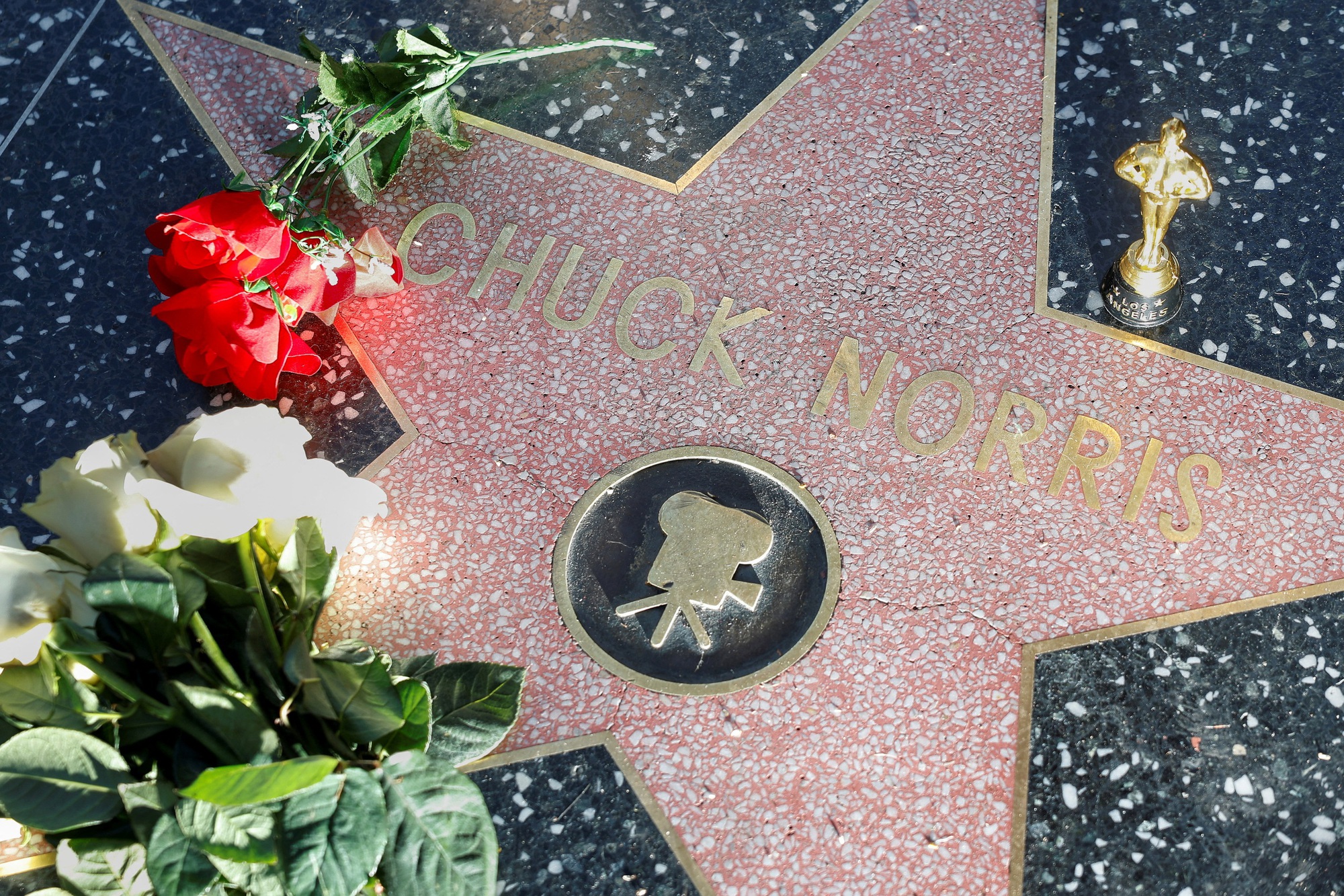
The candles burn. The lilies hold their white silence. And two legends share one last quiet moment together in a room that the rest of the world has not yet entered.
Whatever Stallone says in this moment — whispered or unspoken, prayer or farewell or simply a name — it belongs only to them.
As it should.
Rest easy, Chuck. Your brother is right here.
Carlos Ray “Chuck” Norris — March 10, 1940 – March 19, 2026. Forever