We Brought Everything You Left Behind”
We Brought Everything You Left Behind”
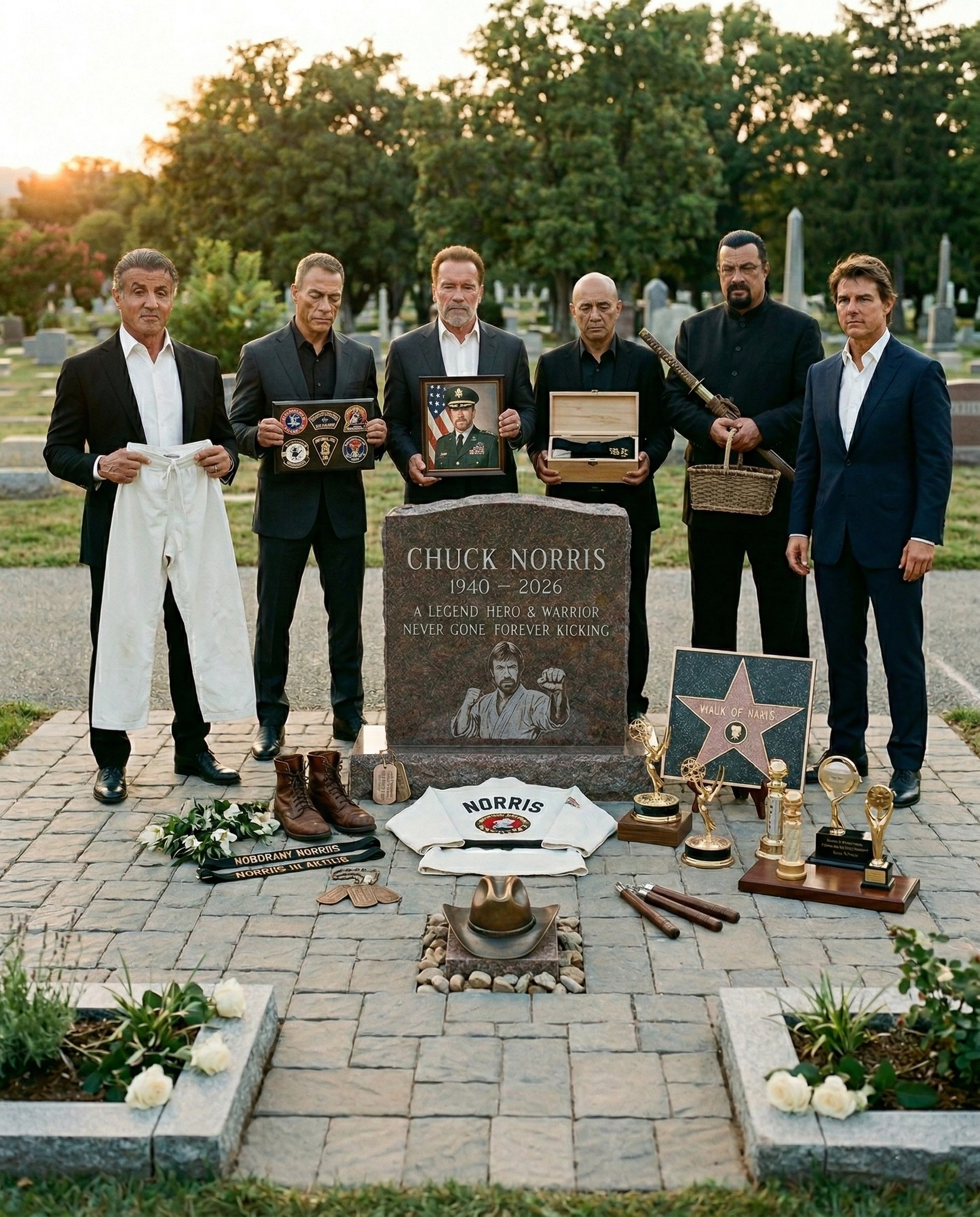
As the sun died over the cemetery, six legends stood in silence with the relics of a man they could not save from time — only from being forgotten
The light is going.
That specific, irretrievable golden light that arrives in the last twenty minutes before the sun disappears — the light that photographers chase and painters chase and poets have been trying to describe since the first human being looked west at dusk and felt something they could not name but could not ignore.
It falls now across a cemetery. Across six men in dark suits. Across a headstone carved with a name the world knows and a pair of dates that bracket eighty-five years of the most complete, most disciplined, most authentically lived life that any of them have ever witnessed up close.
Across the objects spread on the ground before that headstone — the championship belts and the karate gi and the boots and the nunchaku and the trophies and the Walk of Fame star and the honorary ranger badge — the complete physical vocabulary of a man who is no longer here to speak for himself.
Chuck Norris. 1940 — 2026.
And six men whose faces carry something that none of them have ever had to carry before. Not in all their decades of hard living and harder work and the particular discipline that their different traditions demanded of them.
They carry the specific grief of people who have lost the person they did not believe they could lose.
Look at their faces.
This is the detail that makes this photograph different from every other gathering of these men that has ever been documented. The red carpets and the film premieres and the bar tables and the dinner parties — in all of those photographs, the faces are performing. Not dishonestly. But performing the version of themselves that public life requires — the confidence, the charisma, the easy projection of men who have spent decades being watched and have learned, without thinking about it, to give the camera something it can use.
Not here.
Here the faces have forgotten the camera entirely.
Sylvester Stallone on the left, holding the championship belts that Chuck Norris earned before either of them had ever heard the word Hollywood — and his face is the face of a man in the middle of a conversation with the past. Going back through the years. Counting the moments. Measuring the distance between the first time he stood next to Chuck Norris and this last time, and finding that distance both impossibly long and heartbreakingly short.
Jean-Claude Van Damme beside him, his expression stripped of every layer of performance until what remains is simply a man who loved his friend and is standing at his grave in the dying light trying to understand how this is the world now. How the world is simply continuing — the birds still moving overhead, the trees still holding their leaves, the ground still solid underfoot — as if Chuck Norris being gone from it is something the world can absorb without consequence.
It cannot. These faces know it cannot.
Arnold Schwarzenegger holds the military portrait.
Of all the objects assembled at this grave, this one carries perhaps the most concentrated weight. Because it shows Chuck Norris before everything. Before the films and the championships and the cultural mythology that turned his name into a punchline that was really a compliment — before all of that, there was this young man in uniform. Clear-eyed. Set-jawed. Already, unmistakably, himself.
This is what Arnold is looking at. Not at the camera. Not at the crowd. At the young soldier in the frame — at the beginning of everything — and tracing the line from that beginning to this ending and finding in that line something so complete, so fully realized, so whole that the grief and the awe are indistinguishable from each other.
Chuck Norris became everything he was going to become. He did not leave things undone. He did not leave promises unkept or potential unrealized or love unexpressed. He used every year he was given and gave back more than he took and stood for something real until the last possible moment.
Arnold holds the portrait and his face says: I have known many great men. I have been fortunate beyond any reasonable expectation in the company I have been given. But this one. This one was different.
The man beside Arnold — the brother in arms, the figure whose presence here speaks to a dimension of Chuck Norris’s life that the public rarely saw — holds an open box. Inside it, objects of personal significance. Private things. The kind that exist at the intersection of a man’s public identity and his private self — the place where who you are in the world meets who you are when the world has gone home.
He holds it with both hands. Carefully. Like something fragile, though fragility was never part of Chuck Norris’s vocabulary.
But grief makes everything fragile. Even the strongest memories. Even the most solid legacies. In the immediate aftermath of loss, everything you thought was permanent reveals its contingency. Everything you thought would always be there shows you its edge.
And so the box is held carefully.
With the tenderness that men of their generation were not taught to show but learned anyway, through the irresistible instruction of loving people and losing them.
Steven Seagal stands in the background, his face in partial shadow, holding a basket — another collection of objects, another set of things that belonged to the man in the ground.
Seagal came from the same world as Chuck Norris in the most fundamental sense. The world of the mat. The world where your rank is not assigned but earned, where your skill is not claimed but demonstrated, where the hierarchy is established through genuine practice and genuine testing and the kind of honest reckoning with your own limitations that produces, eventually, if you stay with it long enough, genuine mastery.
In that world, Chuck Norris was the measure.
Not one measure among several. The measure. The standard against which everything else was calibrated. And to stand at the grave of the standard — to look at the ground above the man who set the bar that everyone else was reaching for — is to feel the particular vertigo of a world whose fixed point has shifted.
Seagal stands in the shadow and holds his basket and is simply, completely present in this moment. Not managing it. Not framing it. Just in it.
Tom Cruise stands on the right — the youngest energy, the one who represents the inheritance rather than the foundation. His face is the face of a man old enough to understand what he is losing but young enough to feel it as a first encounter with this particular quality of loss. The loss not just of a person but of an era. The closing of a chapter in the story of cinema and courage and the specific American mythology that these men embodied and carried and passed on.
Cruise did his own stunts because he believed, at a level that preceded conscious decision, that realness mattered. That audiences deserved the genuine thing. That the gap between performance and truth was a gap worth closing through whatever effort it required.
Chuck Norris taught him that. Not directly — through the example of a life that said, loudly and without equivocation, that authentic commitment was not optional but essential.
He stands at the grave of his teacher and his face is the face of someone taking an inventory of what has been passed to him. What he now carries. What he owes.
The objects on the ground between the men and the headstone.
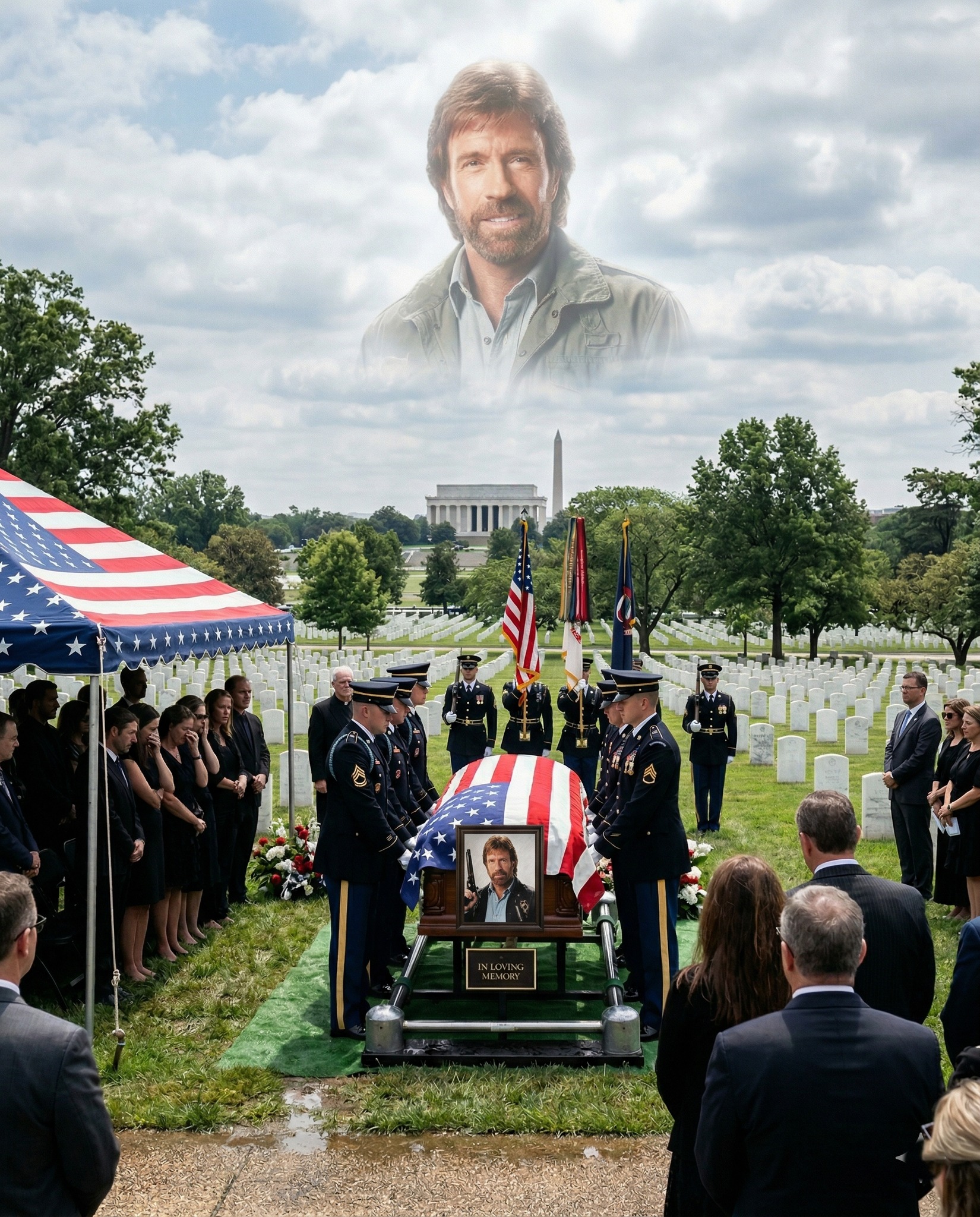
The karate gi with NORRIS across the chest — white cotton that has absorbed sixty years of honest work, that carries in its fibers the invisible record of every early morning and every late session and every moment when the body said stop and the spirit said one more.
The combat boots — heavy, real, the boots of a man who walked his entire life in the direction of what he believed.
The nunchaku lying in the grass — the weapon of a master, requiring everything you have to wield properly and giving nothing back except the truth of your own preparation.
The trophies catching the last of the light — gold and silver, the world’s attempt to put a physical form to what cannot really be measured.
The Walk of Fame star — his name embedded in Hollywood Boulevard, permanent as the sidewalk, marking the place where the world said: you passed through here and we want everyone who comes after to know it.
The honorary ranger badge — because Walker was not just a character. Walker was Chuck Norris distilled into weekly television, the essential philosophy made accessible, the core belief that one good man standing firm could make the difference.
All of it here. All of it laid out before his name in stone.
Everything he was.
Everything he left.
The sun drops below the tree line.
The golden light that has held this moment together begins to let go.
Six men stand in the cooling air with their hands full of a life they cannot keep.
Their faces say what their voices cannot.
The grief is real.
The love is real.
The man was real.
And real things —
the true ones,
the ones built on faith and discipline and the refusal to be anything less than completely yourself —
do not disappear when the light goes.
They simply change form.
They become the standard.
They become the measure.
They become the reason the rest of us
get up tomorrow
and try again.
Rest, Chuck.
We have everything from here.