Even the fiercest warriors, no matter how unyielding their spirit, must one day surrender to time and find their final peace
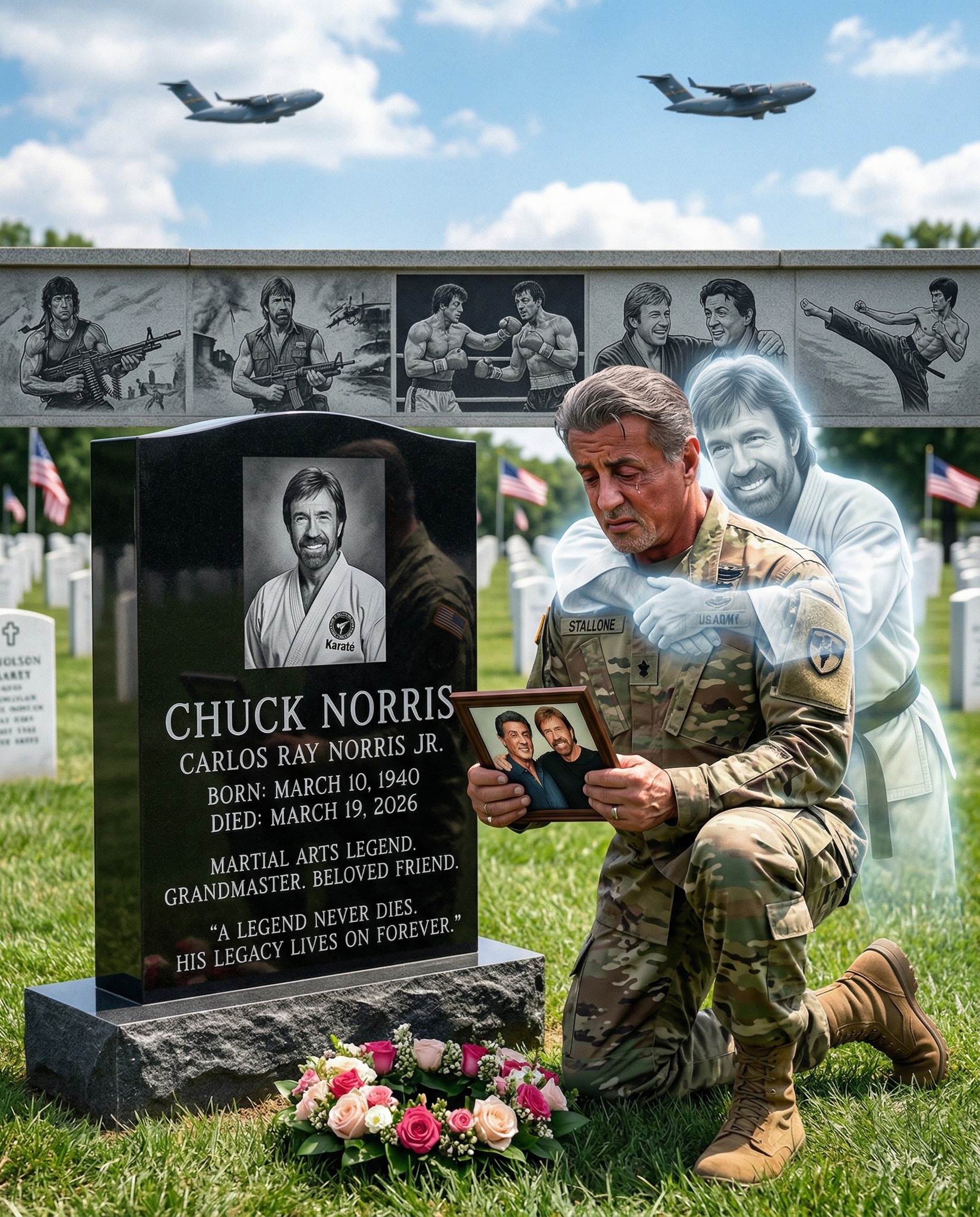
In Eternal Tribute to Chuck Norris (1940–present)
“Even the fiercest warriors, no matter how unyielding their spirit, must one day surrender to time and find their final peace.”
Kneeling quietly before a polished black gravestone, Sylvester Stallone held a photograph close to his chest—an image frozen in time, capturing a moment of friendship between two legends. The world knew them as icons of strength, symbols of resilience, and titans of action cinema. But here, in this solemn place, Stallone was not “Rocky” or “Rambo.” He was simply a man mourning a friend.
The name etched into the stone read clearly: Chuck Norris. Beneath it, the dates marked a life that had transcended generations. Around the grave, silence stretched gently, broken only by the whisper of wind across the grass and the distant hum of aircraft overhead. It was a peaceful scene, yet heavy with emotion—a place where memory and legacy intertwined.
In Stallone’s hands, the photograph told a story words could not fully capture. It showed two men standing side by side, smiling—not as rivals, but as brothers in a shared journey. Their careers had intersected in a world of action films, where discipline, physical strength, and unwavering determination defined their craft. But beyond the cameras and choreography, there had been respect—deep, genuine respect.
Stallone’s eyes lingered on the image, as if searching for something just beyond reach. Perhaps he was remembering conversations long past, moments of laughter on set, or the quiet understanding between two men who had carried the weight of fame and expectation for decades. His expression was one of quiet grief, but also gratitude.
The gravestone itself bore not just a name, but a legacy. Above it were engraved scenes reminiscent of a life spent in motion—martial arts, combat, discipline. Chuck Norris had not simply acted in films; he had embodied a philosophy. His presence in movies like *The Delta Force* and *Missing in Action* made him a symbol of courage, while *Lone Wolf McQuade* showcased the lone warrior archetype that audiences would never forget. And perhaps most enduring of all was *Walker, Texas Ranger*, where he became more than a character—he became a moral compass, a figure of justice in an uncertain world.
For Stallone, who himself had defined generations through *Rocky* and *Rambo*, the loss felt deeply personal. He understood the rare kind of dedication it took to build such a legacy. He understood the sacrifices, the discipline, and the relentless pursuit of excellence. And in Chuck Norris, he had found not just a peer, but a kindred spirit.
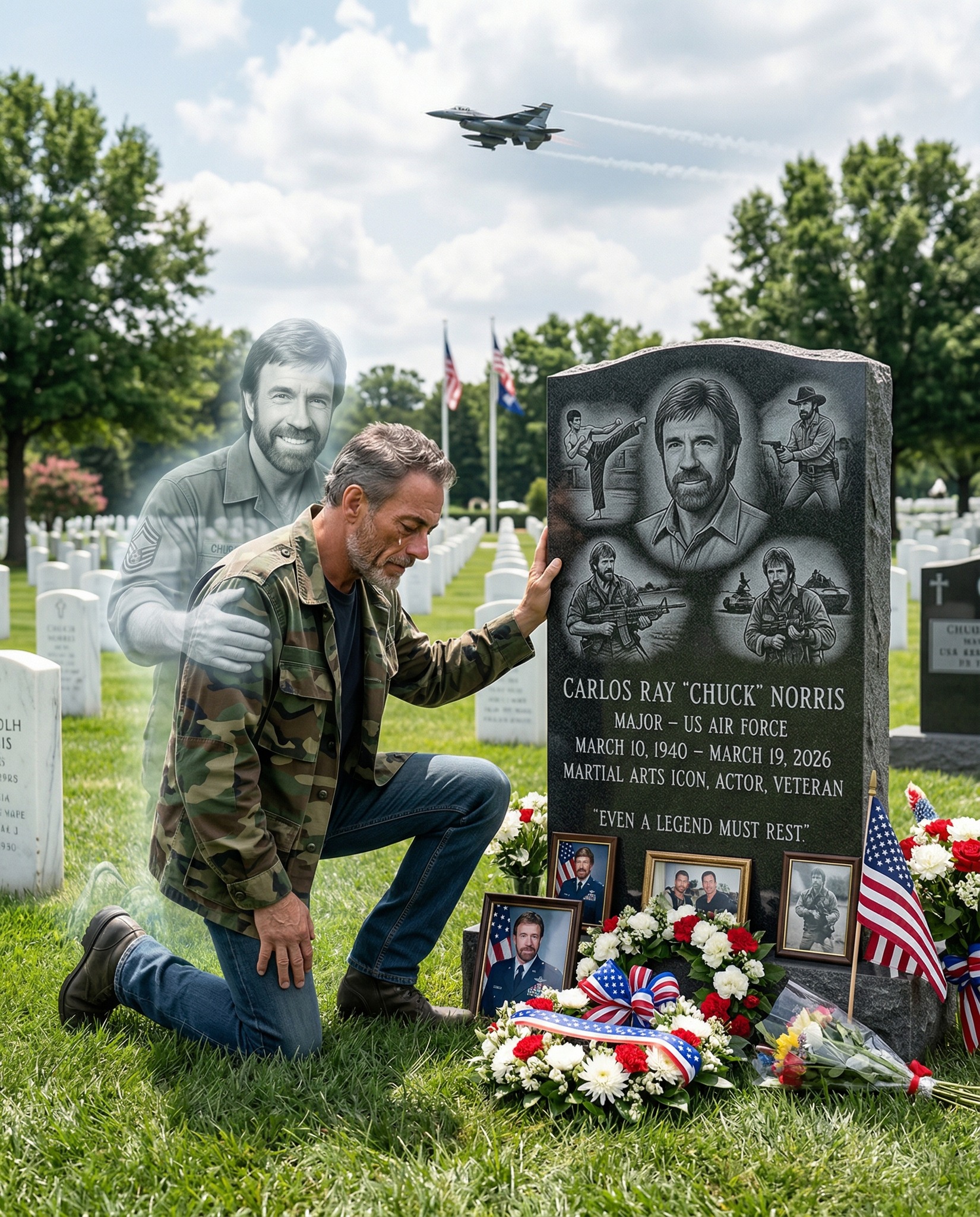
Behind him, the cemetery stretched into the distance, rows of stones standing as silent witnesses to countless stories. Yet this grave felt different. It carried a presence—a sense that the man beneath it was not truly gone. Because legends, as people often say, never truly disappear.
And in that moment, something extraordinary seemed to linger. A faint, almost imagined presence stood behind Stallone—a gentle hand on his shoulder, a quiet reassurance. Whether real or simply a manifestation of memory, it brought a sense of comfort. It was as if Chuck Norris himself was there, reminding his friend that strength was not only found in fighting—but also in remembering.
Stallone lowered his head slightly, gripping the photograph tighter. The weight of the moment pressed down, yet it did not break him. Instead, it revealed something deeper: the humanity behind the legend. The vulnerability behind the strength.
In the world of action cinema, heroes rarely fall. They endure explosions, battles, impossible odds. They rise again and again. But real life follows a different path. Even the greatest must one day step away from the spotlight, leaving behind not just films, but memories, influence, and inspiration.
Chuck Norris had done exactly that. He had inspired generations—not only through his performances, but through his discipline, his philosophy, and his unwavering sense of right and wrong. His impact could be seen in every martial artist who trained harder, every actor who pushed further, and every fan who believed in the idea of strength guided by honor.
As Stallone slowly placed the photograph at the base of the gravestone, alongside a small arrangement of flowers, the gesture felt final, yet not an ending. It was a continuation—a passing of memory from one moment to the next.
The sky above remained clear, vast, and endless. And in its quiet expanse, there was a comforting thought: that somewhere, beyond what could be seen or understood, the spirit of Chuck Norris endured.
Not as a distant memory, but as a living force—carried in stories, in films, and in the hearts of those who would never forget.
Because true legends are not defined by how they leave the world…
…but by how deeply they remain within it.