Farewell to a Legend: Hollywood Icons Gather to Honor Chuck Norris One Final Time
* Remembering Chuck Norris (1940–2026).*
* Even the strongest warriors, no matter how legendary their strength, must one day lay down their final fight and rest in eternal peace.*
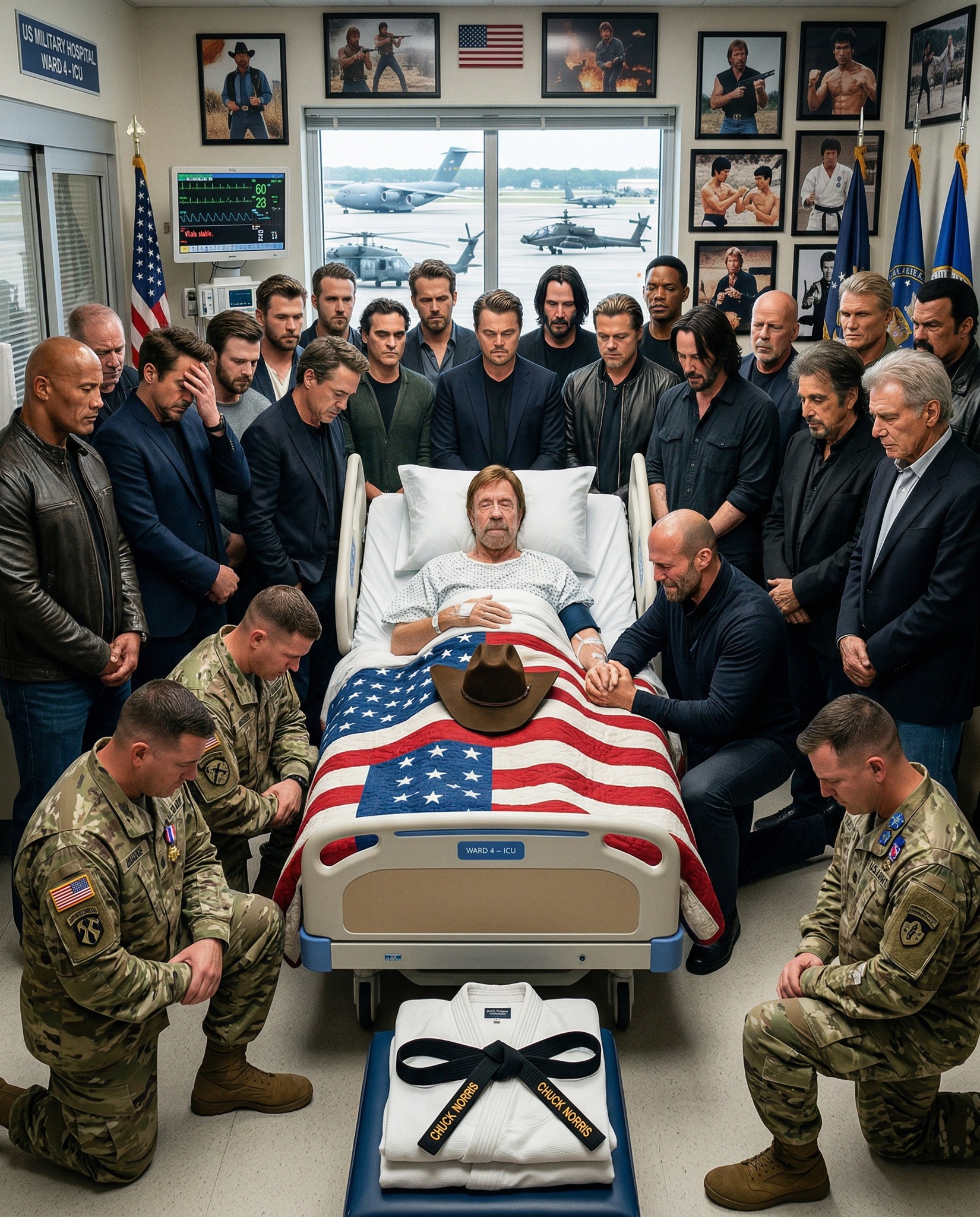
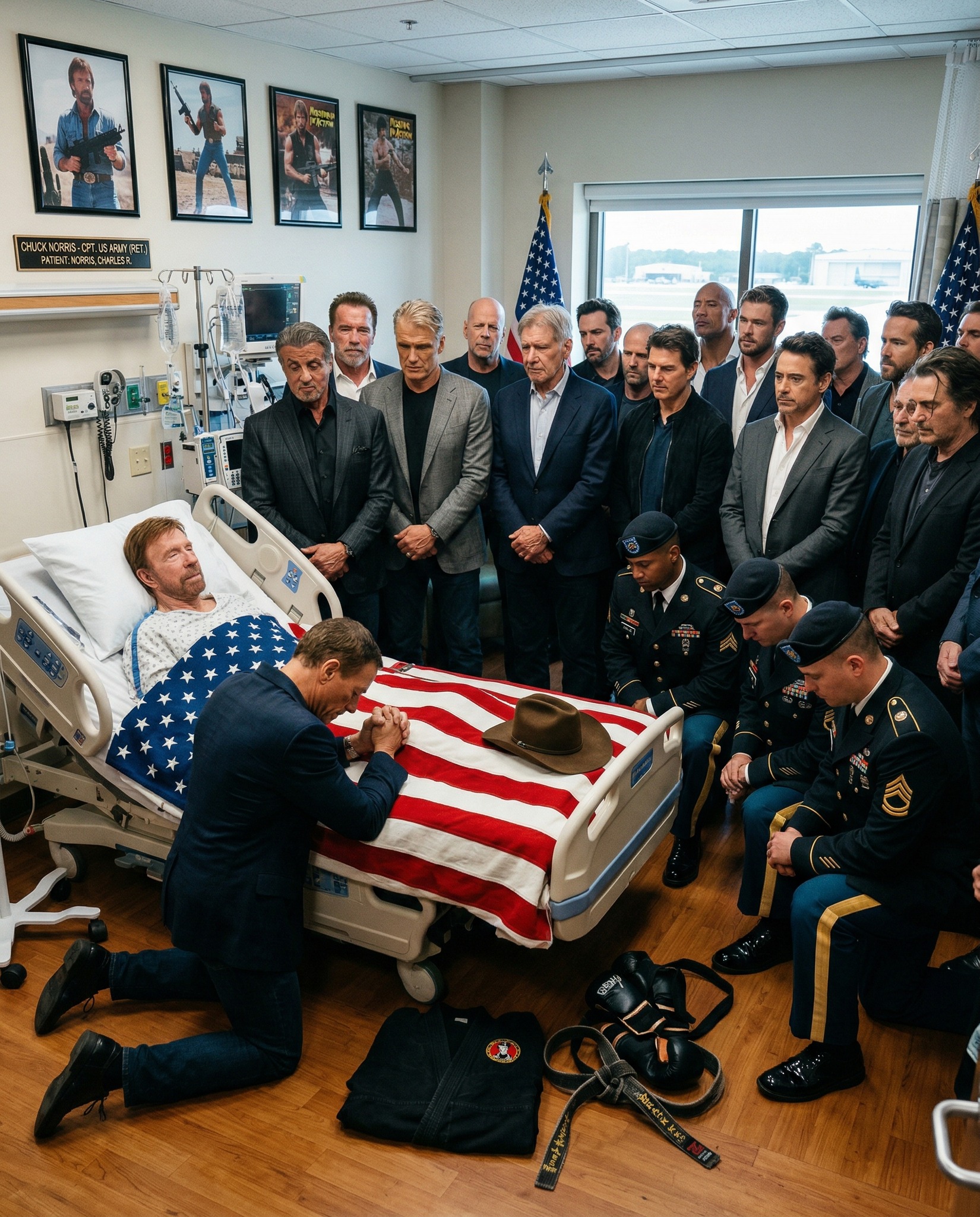
Inside a quiet hospital room, where the soft hum of machines blended with the distant echo of rotor blades outside, time seemed to stand still. The atmosphere was heavy, not with noise, but with emotion—deep, unspoken, and shared among those who stood gathered around the bed of a man who had once seemed unstoppable. Chuck Norris lay peacefully, covered with the American flag, his iconic cowboy hat resting gently upon his chest—a symbol of identity, honor, and legacy.
Surrounding him were some of the greatest names in cinematic history, men who had defined generations of storytelling and heroism. Dwayne Johnson stood at the edge of the room, his powerful frame still, his expression softened by grief. Nearby, Robert Downey Jr., known for *Iron Man*, lowered his gaze, the usual spark in his eyes replaced by quiet reflection.
Chris Hemsworth (*Thor*) and Chris Evans (*Captain America: The First Avenger*) stood shoulder to shoulder, representing a new generation shaped by the legacy of men like Chuck Norris. Ryan Reynolds (*Deadpool*) remained uncharacteristically silent, his humor replaced with reverence.
Among them, Joaquin Phoenix (*Joker*) stood with his head slightly bowed, while Tom Cruise (*Mission: Impossible*) remained focused, his presence steady and respectful. Tom Hanks (*Forrest Gump*) watched quietly, his face filled with empathy.
Further back, Brad Pitt (*Fight Club*), Leonardo DiCaprio (*Titanic*), Johnny Depp (*Pirates of the Caribbean*), and Keanu Reeves (*The Matrix*) stood in solemn silence, each carrying their own memories and respect.
Near the center of the room, Jason Statham knelt beside the bed, gently holding Chuck Norris’s hand. His posture—firm yet vulnerable—spoke louder than words. This was not the action hero seen on screen; this was a man saying goodbye to someone who had inspired him.
Around the bed, several American soldiers knelt on one knee, their heads bowed in respect. Their uniforms bore medals and insignias, each one representing sacrifice and honor. At the foot of the bed lay a carefully placed martial arts uniform and black belt—symbols of mastery, discipline, and a lifetime dedicated to the art Chuck Norris had perfected. Nearby, a case of military medals reflected the light softly, honoring not just a performer, but a figure of strength admired by warriors as well.
Standing among the group were legends of an earlier era: Sylvester Stallone (*Rocky*), Arnold Schwarzenegger (*The Terminator*), Bruce Willis (*Die Hard*), Jean-Claude Van Damme (*Bloodsport*), Dolph Lundgren (*Rocky IV*), and Steven Seagal (*Under Siege*), each representing a chapter of action cinema influenced by Chuck Norris.
Further still stood giants of dramatic storytelling—Clint Eastwood (*Unforgiven*), Al Pacino (*The Godfather*), Robert De Niro (*Taxi Driver*), Jack Nicholson (*The Shining*), Dustin Hoffman (*Rain Man*), and Harrison Ford (*Indiana Jones*). Their presence turned the room into a living tribute to cinema itself.
Chuck Norris had not only entertained audiences—he had shaped ideals. In *Way of the Dragon*, his duel with Bruce Lee became legendary. In *Missing in Action*, he embodied courage. In *The Delta Force*, he represented heroism. And in *Walker, Texas Ranger*, he became a symbol of justice and discipline known across the world.
These were more than roles.
They were values.
And now, those values lived on in the men standing around him.
No one spoke.
No one needed to.
Because in that quiet room, filled with legends and heroes, one truth was deeply understood:
Strength does not last forever.
But legacy does.
As Jason Statham gently held Chuck Norris’s hand, and the soldiers remained kneeling in honor, the moment became something greater than loss. It became a passing of strength—from one generation to the next.
And as the light from the window touched the American flag, the martial arts uniform, and the medals below, it felt as though the world itself was offering a final salute.
Chuck Norris was not just a man.
He was a symbol.
And though his body rested, his spirit—his discipline, his honor, his legacy—would never fade.
Because legends do not disappear.
They endure.
Forever.