
A QUIET RETURN HOME: JOHN JOSEPH PREVOST AND POPE LEO XIV RECONCILE IN A MOMENT THAT HEALED YEARS OF SILENCE
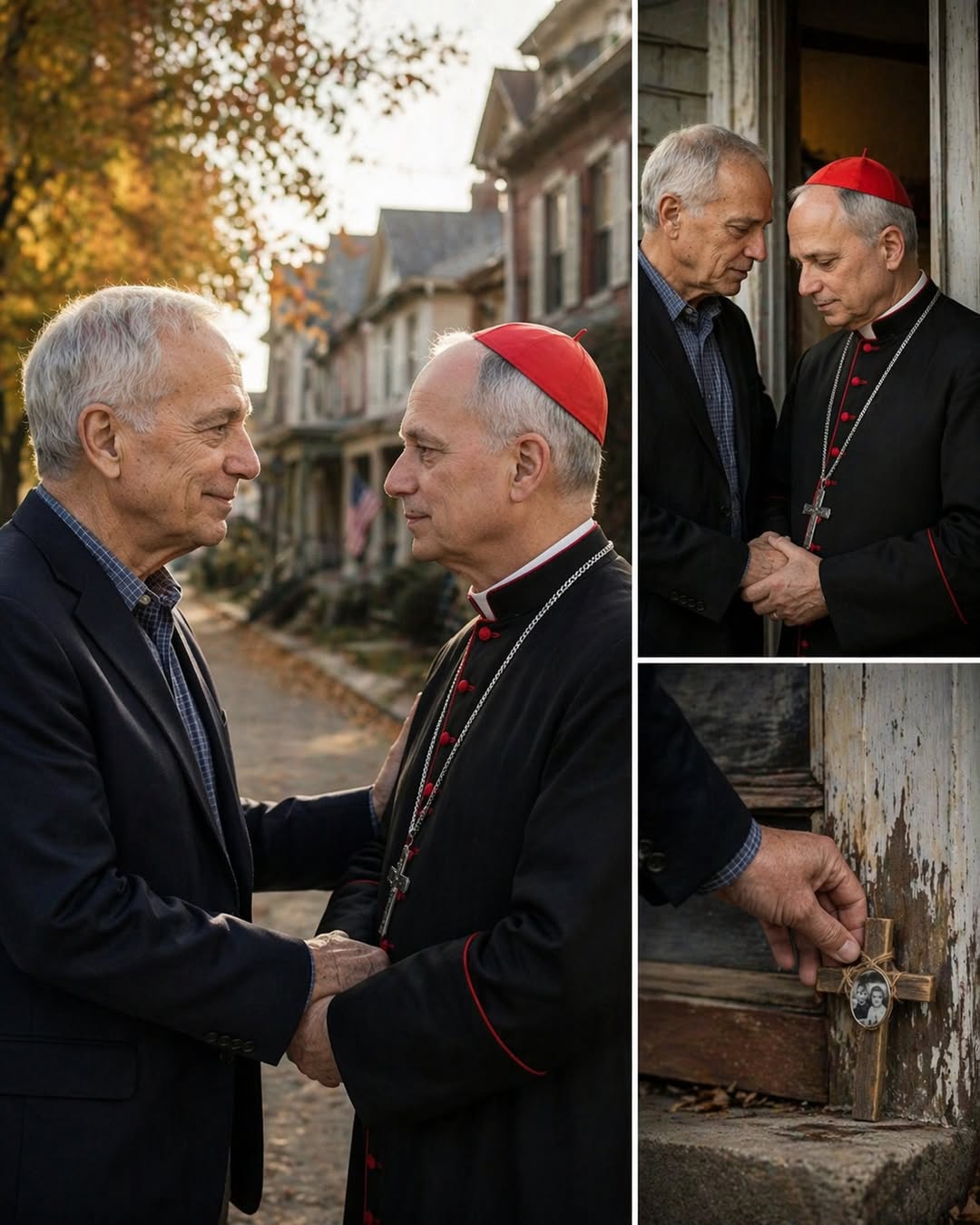
After years defined by distance, responsibility, and unspoken words, John Joseph Prevost and his brother, Pope Leo XIV, shared a moment in their hometown that would quietly redefine their relationship.
The visit was not planned as a public event, nor was it announced to the press or followers of the Pope.
Their hometown, small and unassuming, had not changed much over the years, preserving the same narrow streets, modest homes, and quiet atmosphere that once shaped their childhood.
It was early autumn when they arrived, the air crisp and the trees lining the streets painted in shades of gold and amber.
There were no crowds waiting, no cameras documenting their arrival, only the gentle rhythm of a town continuing its ordinary day.
For John Joseph Prevost, the return carried a weight that had been building for years.
Unlike his brother, whose life had become defined by global responsibility and spiritual leadership, John had remained largely outside the public eye.
Their paths had diverged long ago, not because of conflict, but because of circumstance, ambition, and the quiet complexities that often grow between siblings over time.
Communication between them had become infrequent, and when they did speak, it was often brief and careful, as though both were aware of the distance that had settled between them.
Yet beneath that distance remained a shared history that neither of them could fully leave behind.
As they walked side by side through the streets, there was a noticeable silence between them.
It was not uncomfortable, but it was heavy with everything that had gone unsaid for years.
They passed familiar landmarks, a small bakery that once sold their favorite bread, a corner where they used to play as children, and a narrow path that led toward their old home.
Each step seemed to bring back fragments of memory, creating a quiet bridge between the past and the present.
When they finally reached the house where they had grown up, both men slowed their pace.
The building stood unchanged, its exterior worn slightly by time but still recognizable in every detail.
John stopped just before the doorway, his gaze fixed on the entrance as if trying to reconcile the image in front of him with the memories in his mind.
For a moment, neither of them spoke.
Then John turned slightly toward his brother and reached out, gently taking his hand.
It was a simple gesture, but one that carried years of unspoken emotion.

There was no audience to witness it, no expectation attached to it, only the sincerity of the moment itself.
John spoke quietly, his voice steady but reflective.
He acknowledged the time that had passed, the choices they had made, and the distance that had grown between them.
He did not assign blame or seek explanation, but instead expressed a recognition of everything they had endured, both separately and together.
Pope Leo XIV listened without interruption.
His expression remained calm, but there was a subtle shift in his eyes that suggested the words were reaching deeper than they appeared on the surface.
When John finished speaking, there was another pause.
The silence that followed felt different from the one before.
It was no longer defined by distance, but by understanding.
The Pope responded simply, acknowledging that while their lives had taken different directions, the bond they shared had never truly disappeared.
He spoke of responsibility, of the weight of leadership, and of the difficulty of maintaining personal connections while carrying global expectations.
But he also spoke of regret, not in a dramatic sense, but in a quiet recognition of what had been lost over time.
The conversation did not resolve every detail of their past, nor did it attempt to rewrite it.
Instead, it created space for acceptance.
As they stood together at the doorway, both men seemed to understand that reconciliation does not always come through grand gestures or perfect words.
Sometimes, it begins with simply showing up.
Before leaving, John reached into his coat pocket and took out a small object.
It was an old wooden token, worn at the edges, something they had shared as children during a game they used to play in the yard behind the house.
The gesture was deliberate and deeply personal.
It was not meant to be seen by others or interpreted by an audience.
It was an offering, a symbol of their shared past and a quiet acknowledgment that some parts of their connection had remained intact despite the years apart.
Pope Leo XIV looked at the object and understood immediately.
No explanation was needed.
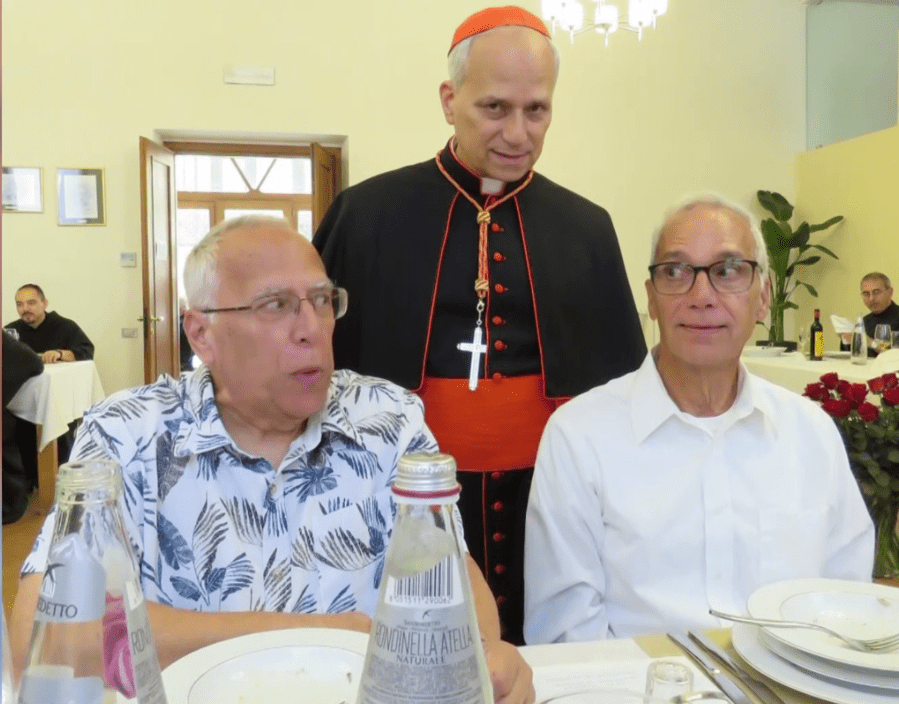
The meaning was clear, rooted in memories that only the two of them fully shared.
They stood there for a final moment, not speaking, but no longer needing to.
Then, together, they turned and began to walk away.
There was no dramatic conclusion, no public statement, no attempt to define the moment in words.
Yet something had shifted.
The distance that once defined their relationship had softened, replaced by a renewed sense of connection.
In the days that followed, the visit remained largely unknown to the public.
There were no official reports detailing what had happened, no images capturing the moment.
But for those who understand the complexity of human relationships, the significance of that quiet return was clear.
It was not about resolving every difference or reclaiming lost time.
It was about acknowledging the past, accepting the present, and creating the possibility for a different future.
For John Joseph Prevost and Pope Leo XIV, the visit to their hometown was more than a journey back in time.
It was a step forward.
A reminder that even after years of silence, connection can still be found.
And sometimes, the most meaningful gestures are the ones that are never meant to be seen.