
A Clash of Perspectives: Donald Trump vs. Pope Leo XIV on American History and Values
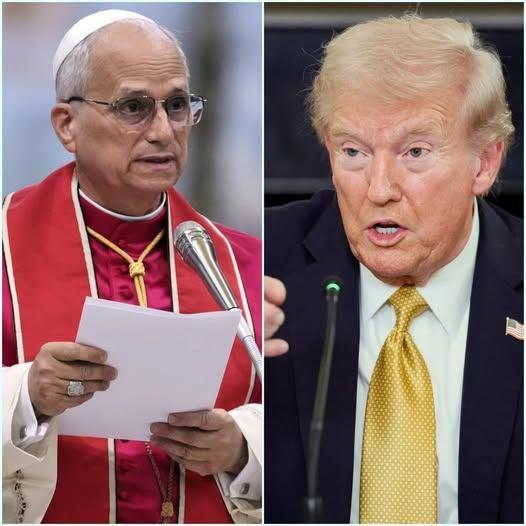
In a world where political and ideological divisions often seem insurmountable, there are moments that force us to reflect on the values that bind us as a society. Recently, a shocking exchange between former President Donald Trump and Pope Leo XIV captured the world’s attention, igniting a fierce debate on the nature of history, power, and morality. The clash began when Trump, known for his combative rhetoric and blunt critiques, accused Pope Leo XIV of “distorting American history.” However, it was the Pope’s measured and thoughtful response that shifted the conversation from confrontation to a deeper reflection on society’s responsibility to engage with the past honestly and constructively.
Trump’s criticism of Pope Leo XIV was not just a personal attack—it was part of a broader critique that has long been a hallmark of his public persona. For years, Trump has positioned himself as a defender of American values, often framing his rhetoric in opposition to those who he believes misrepresent the nation’s history and core principles. His comments about Pope Leo XIV seemed to be a continuation of this narrative, accusing the Pope of revising history to suit his own ideological purposes.
But in the face of this provocative statement, Pope Leo XIV did something few would expect: he remained calm, composed, and unwavering in his response. Rather than escalating the situation with anger or personal attacks, the Pope chose to shift the focus away from individual grievances and toward a broader, more philosophical discussion.
The Pope’s Response: A Call for Reflection
“I’ve heard the claim that my voice distorts history,” Pope Leo XIV began, speaking during a public discussion. “But perhaps we should take a step back and ask—what does history actually teach us?”
This simple but profound question changed the tone of the conversation entirely. Instead of engaging in a back-and-forth battle over facts or opinions, the Pope invited the audience—and by extension, the world—to reflect on the very nature of history and its role in shaping our collective understanding of the present.

“What history shows us, time and again, is that societies are judged not only by power but by how they treat people—especially those most in need,” he continued. In a single sentence, Pope Leo XIV redirected the conversation from political rhetoric to a moral imperative. By focusing on how societies treat the vulnerable and marginalized, he reminded the audience of the universal values that transcend political ideologies and the shifting sands of history.
This wasn’t just a philosophical argument—it was a call to action. Pope Leo XIV was asking everyone to look beyond the headlines and partisan conflicts and consider how their actions, policies, and beliefs align with the moral lessons that history offers. For the Pope, the key to a just society lies not in amassing power or rewriting narratives to serve those in power, but in acting with integrity, empathy, and a commitment to truth.
A Broader Conversation: The Dangers of Rewriting History
Pope Leo XIV’s remarks quickly evolved from a defense of his own views to a broader critique of how history is used and abused in political discourse. “When we ignore facts, when we rewrite narratives to serve power, and when we dismiss the lessons of the past, we risk repeating the very mistakes history warns us about,” the Pope warned.
In this statement, the Pope highlighted a central issue of contemporary political life: the tendency to reshape history in ways that justify current power structures or political agendas. Whether through the revision of textbooks, selective historical narratives, or the distortion of facts to fit particular viewpoints, the act of rewriting history is a dangerous one. It erodes trust in the past and diminishes the value of the lessons that history can teach.
The Pope’s words seemed to resonate with a growing number of people who are concerned about the current state of political discourse in America and around the world. In a time when history is increasingly contested and political polarization runs deep, the importance of understanding history as it truly happened has never been greater. For Pope Leo XIV, the refusal to engage with history honestly is not just a political issue—it’s a moral one.