The Little Girl, the Scary Farmer, and the Dance That Changed a Town
The Little Girl, the Scary Farmer, and the Dance That Changed a Town
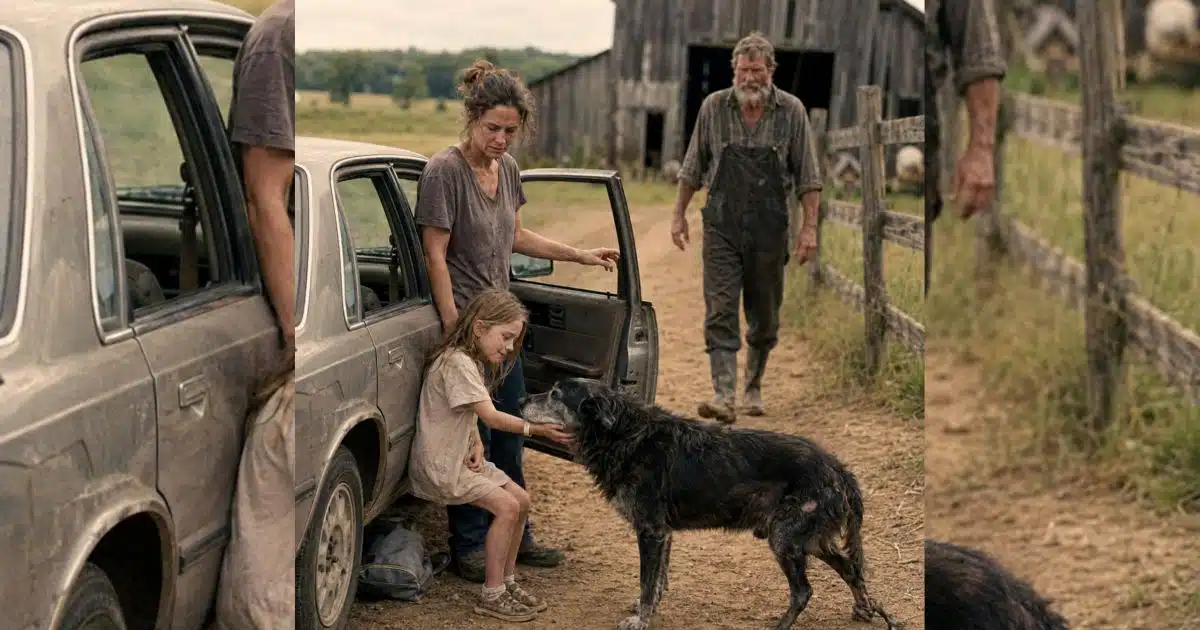
My daughter’s voice was barely louder than the coughing engine.
“Mom, stop the car. That dog looks like he knows I’m scared.”
We had broken down on a back road, right in front of the farm everyone in town warned people about.
Hollis Crain’s place.
People said he was angry. Said he chased strangers away. Said he wanted to be left alone.
I only knew my eight-year-old girl, Elowen, had just left another hospital visit. Her medicine bag sat on the floor. My phone was dead. And the only house nearby belonged to a man nobody wanted to meet.
Then the dog appeared at the fence.
Big, old, black and gray, with a cloudy eye and a silver muzzle. One back leg dragged, but he came straight to Elowen like he had been waiting.
She reached out her small hand.
“Are you friendly?”
The dog pushed his nose through the wire and rested his chin in her palm.
Elowen closed her eyes.
For the first time all day, her face relaxed.
“Mom,” she whispered, “he’s warm.”
The barn door opened.
Hollis Crain walked toward us.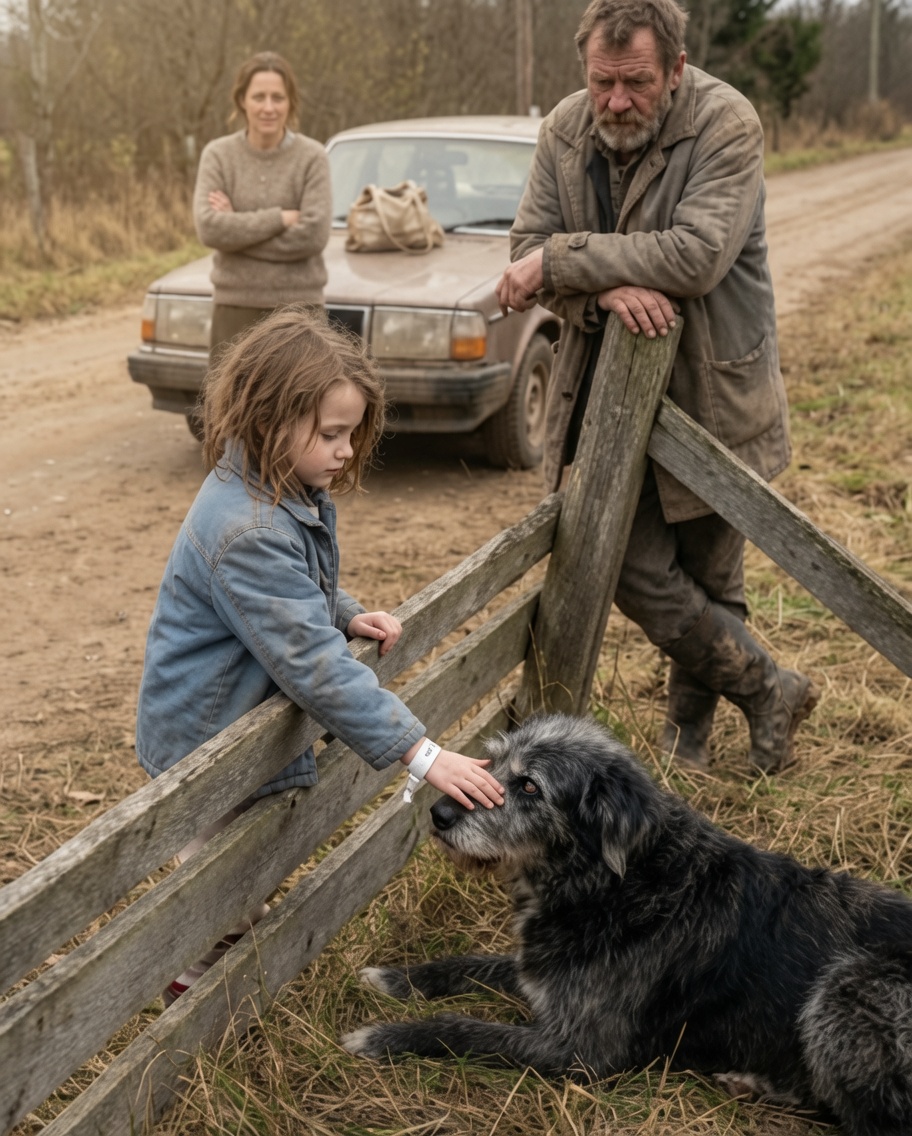
Tall, broad, bent from hard years. Gray beard, mud on his boots, hands cracked and rough from work.
I stepped in front of my daughter.
“I’m sorry,” I said fast. “Our car died. We didn’t mean to bother you.”
Hollis didn’t answer me right away.
He looked at the hospital bracelet on Elowen’s wrist.
Then at his dog, still pressing against her hand.
“Rook doesn’t go to strangers,” he said.
His voice was deep and tired.
Elowen smiled up at him anyway.
“Is Rook your dog?”
Hollis nodded once.
“He’s the only family I’ve got left.”
That sentence hit me harder than I expected.
Elowen had no father. He left right after the doctors told us she would be sick for most of her life.
He said he couldn’t handle the hospitals.
So I handled them alone.
The appointments. The surgeries. The crushed pills in applesauce. The nights on cold bathroom floors. The fear that never really left.
Lately she talked about one thing more than anything else.
Not toys. Not trips.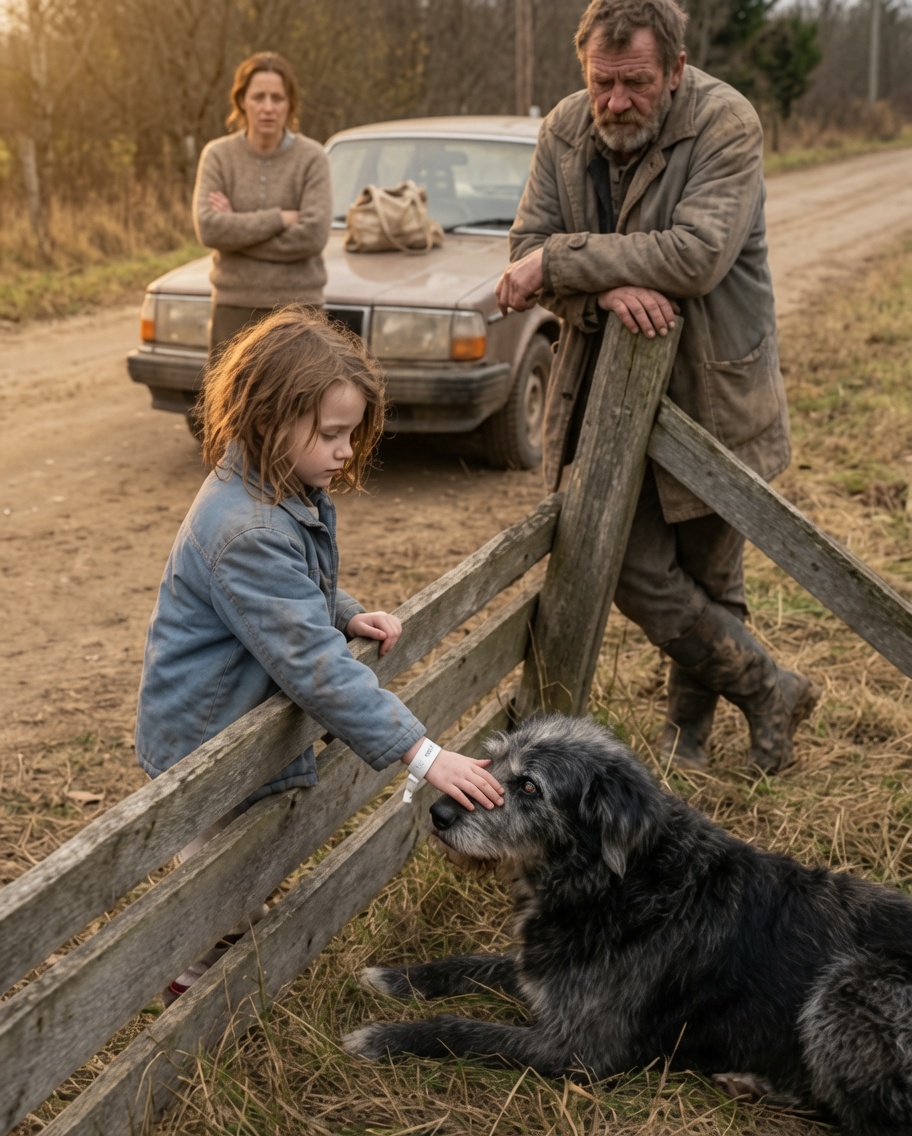
Just a dad.
A hand bigger than mine.
A voice that would say, “That’s my girl.”
Someone who would dance with her, like the father-daughter dance she saw in a movie once and never forgot.
Elowen looked at Hollis and said softly, “Your dog feels like a dad dog.”
I wanted the ground to open up.
“Elowen,” I whispered, “sweetheart, don’t say things like that.”
But Hollis went very still.
His face changed.
Not angry.
Just… broken open.
He crouched slowly on the other side of the fence.
“My boy used to say Rook was better at parenting than I was,” he said.
Elowen blinked.
“You have a boy?”
Hollis looked toward the barn.
“I had one.”
The quiet that followed felt too heavy for a child.
But sickness had made Elowen gentle in ways that broke my heart.
“I’m going soon too,” she said.
I grabbed her shoulder.
“Elowen.”
“It’s okay, Mom,” she answered, still petting Rook. “Mr. Hollis already looks like he knows.”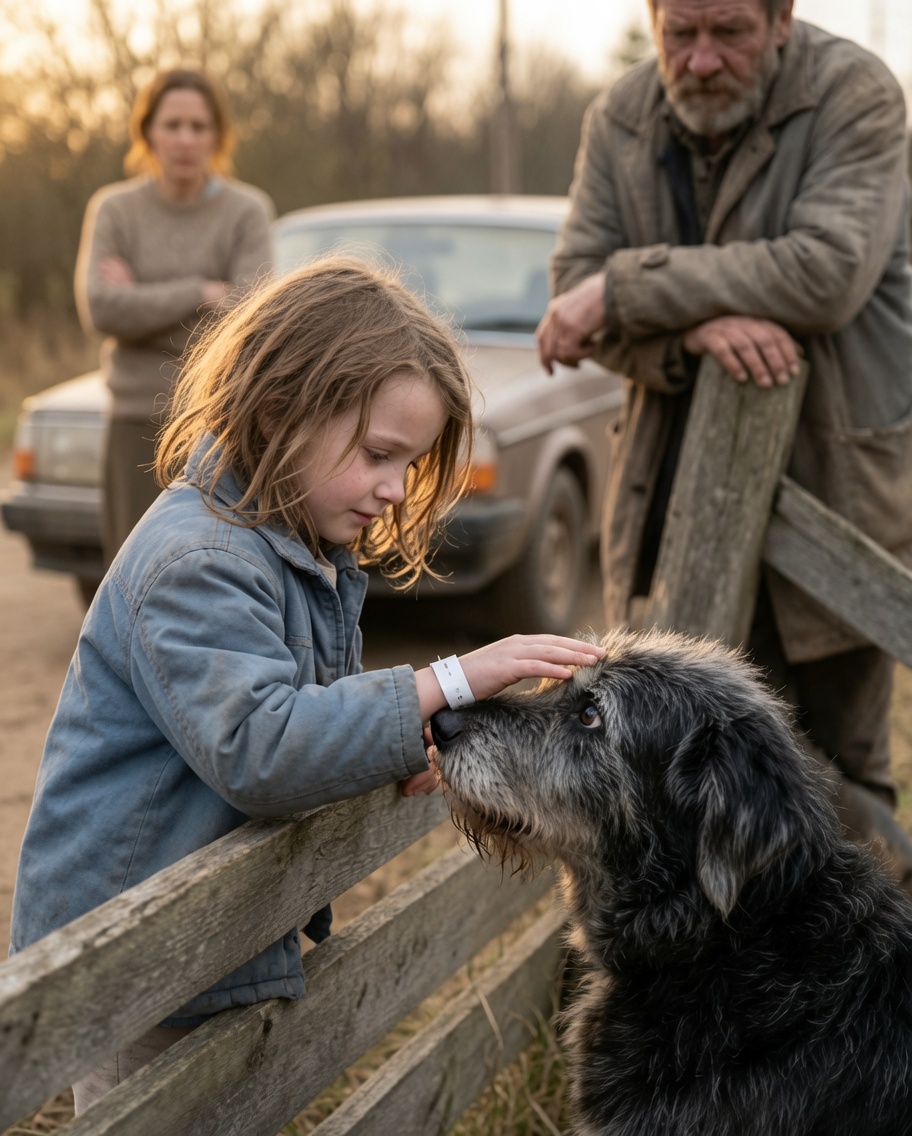
Hollis lowered his eyes.
“What do you want before you go?” he asked.
I almost told him not to ask.
But Elowen answered before I could stop her.
“I want one father-daughter dance.”
Hollis looked up.
Her voice got smaller.
“I know it sounds silly. I don’t need a party or a dress. I just want to know what it feels like when a dad holds you and says he’s proud.”
My throat closed.
I had found that wish written in her notebook two nights earlier. I had cried over it where she couldn’t hear.
Hollis stared at his old dog.
Rook gave one slow wag of his tail.
Then Hollis cleared his throat.
“You got a song picked out?”
Elowen’s whole face lit up.
“Really?”
“Yes, ma’am,” he said. “But first I better get your car running.”
He fixed it in twenty minutes and wouldn’t take a cent.
Before we left, he wrote his number on the back of a feed receipt.
“For the dance,” he said.
That night Elowen made me call him.
She sat in bed under her faded quilt, holding her wish notebook.
When Hollis answered, she asked, “Can Rook come too?”
There was a pause.
Then his voice came back softer.
“Wouldn’t be much of a dance without him.”
After that, Hollis started showing up.
Not loud. Not trying to be anyone’s hero.
He brought fresh eggs, apples from his trees, and once a jar of honey because Elowen said her tea tasted too bitter.
Rook always came with him.
That old dog would go straight to Elowen’s bed and rest his chin beside her hand.
On days she wouldn’t eat, Rook refused his biscuit too.
She would scold him gently.
“You’re old, Rook. You have to eat.”
Then she would take two bites of soup just to prove she was braver.
Hollis would turn away, pretending to study the wallpaper.
But I saw his shoulders shake.
People in town started noticing.
The nurse said the dog eased her pain better than half the medicine in her bag.
Even my mother, who trusted no strange man near her granddaughter, watched Hollis sit on our porch for two hours just because Elowen was asleep and he didn’t want to wake her.
Afterward she whispered, “I was wrong about him.”
One afternoon Hollis stood in our kitchen holding a tiny pair of old blue work gloves.
“My son Auden wore these,” he said. “He used to follow me around the barn telling everyone he was the boss.”
His thumb rubbed the worn fabric.
“Rook was his dog first. Slept outside his door every night. After Auden passed, Rook wouldn’t leave that bed for a week.”
I stood there with a dish towel and no words.
Hollis looked toward Elowen’s room.
“I thought losing my boy meant I was done being useful to anyone,” he said. “Then your girl showed up at my fence and asked my dog if he was friendly.”
The dance was planned for a Saturday.
Elowen got worse on Thursday.
By Friday morning she could barely stand.
I called Hollis and said we had to cancel.
He went quiet for a long moment.
Then he said, “No, ma’am. We’re not canceling. We’re moving it.”
That evening he arrived at our door wearing a white shirt that had clearly been ironed by a man who never ironed. His boots were clean. His beard was trimmed. His hands shook when he held his hat.
Beside him stood Rook, freshly brushed, wearing a blue bandana.
Behind them, three neighbors waited with lanterns, flowers, blankets, and a homemade pie.
Elowen looked at me.
“Mom?”
Hollis swallowed.
“Every little girl deserves a proper dance.”
He had cleaned the old hay barn until it looked like a chapel made of wood and light.
Lanterns hung from the beams.
A rug covered the center.
Wildflowers sat in tin cups.
But this time there were more chairs.
More blankets.
More room.
A table near the door held paper cards where children could write the name of someone they missed.
Some wrote fathers.
Some wrote mothers.
Some wrote grandparents.
One little boy wrote “My old dog Pepper.”
Hollis saw it and had to step outside for a minute.
Rook stayed near the door, greeting every child like it was his job.
Some kids were shy.
Some ran straight to him.
One little girl in a yellow dress knelt in front of him and whispered, “My dad didn’t come.”
Rook placed his chin in her hands.
She started crying right away.
Her grandmother cried too.
Hollis came over and crouched beside them.
“What’s your name, miss?”
“Macy,” she whispered.
“Well, Miss Macy, Rook here is a fine judge of people. Seems he picked you.”
She wiped her face.
“Can dogs dance?”
Hollis looked at Rook’s bad leg.
“This one mostly leans.”
Macy gave a tiny smile.
“That counts.”
“Yes, ma’am,” Hollis said. “Sometimes leaning is the whole dance.”
The music started.
People were unsure at first.
No perfect pairs.
No one clear picture of what family was supposed to look like.
Just a barn full of people who loved children and children who needed love.
Hollis stood near the center in his white shirt.
Rook stood beside him in the blue bandana.
He didn’t use a microphone.
“Evening,” he said.
The barn went quiet.
“I’m not much for talking.”
A few people smiled.
“Elowen Voss came to my fence one day and asked if my dog was friendly. That was the beginning of the best gift this farm ever got.”
He looked down at Rook.
“She wanted one dance. We gave her one. Tonight isn’t about replacing anybody. It’s about making sure no child stands at the edge of the room thinking love is only for somebody else.”
Then he held out his hand to Macy.
“Miss Macy, would you and your grandmother start us off?”
Macy looked terrified.
Her grandmother pressed a hand to her mouth.
Then Macy nodded.
She took Hollis’s hand on one side and her grandmother’s on the other.
Rook limped between them.
The barn laughed softly.
They made one slow circle.
Then another child stepped forward.
Then another.
A boy danced with his aunt.
A girl with her older brother.
A teenager danced with his foster mother.
A grandfather held a baby who would never remember the night but would one day know he had been held.
A mother danced with two children at once, laughing and crying so hard she could barely turn.
The room filled slowly.
Not with perfection.
With people trying.
That was better.
Across the barn I saw Caleb.
Elowen’s father.
He had kept his word and stayed in the shadows.
No one seemed to know who he was.
He watched Hollis.
Not with jealousy.
With something harder.
Recognition.
He was watching the man his daughter had chosen.
And seeing exactly what he had missed.
Halfway through the night the music cut out.
The teenage boy by the sound system panicked.
My mother pointed at him.
“I believe you, but fix it anyway.”
People chuckled.
Then the system gave up completely.
No music.
For a few seconds everyone stood awkwardly.
Then Macy began humming.
Softly. Off-key.
A simple tune.
Her grandmother joined.
Then another person.
Then another.
Soon the whole barn was humming together.
No words.
Just sound.
Human and imperfect.
Hollis looked at me from across the floor.
His face was wet.
I stepped forward without thinking.
He met me in the middle.
For the first time since Elowen died, I danced.
Not like a woman who was healed.
Like someone still standing.
Hollis held one of my hands.
His other rested carefully at my shoulder.
Rook leaned against both our legs.
We barely moved.
But it counted.
Sometimes leaning is the whole dance.
I closed my eyes.
For one impossible second I could feel Elowen there.
Not as a ghost.
Just as love.
The kind that stays in the walls after the person is gone.
The kind that changes how a room breathes.
When I opened my eyes, Caleb was watching us.
He wiped his face.
Then he turned to leave.
I followed him outside.
“Caleb.”
He stopped near the fence.
The barn hummed behind us.
“I’m sorry,” he said.
“For what?”
“For coming.”
I folded my arms.
“You behaved.”
He laughed once, sadly.
“That’s a low bar.”
“Yes,” I said. “It is.”
He turned then.
His face was wet.
“I thought I wanted to see where I fit,” he said. “But I don’t fit anywhere.”
I looked back at the barn.
At Hollis.
At Rook.
At all those children turning under the lanterns.
“No,” I said. “You don’t fit in the spot you left empty.”
He nodded.
“But that doesn’t mean there’s no place at all.”
His eyes lifted.
“You can come by the cemetery sometimes,” I said.
He swallowed.
“Not my house. Not Hollis’s farm unless he says. Not as her dad.”
“As what?”
I looked at him for a long moment.
“As someone who should have known her.”
That hurt him.
I saw it.
But he nodded.
“That’s fair.”
“No,” I said. “It’s not fair. Fair would be her alive. This is just what we have.”
He covered his mouth.
Then whispered, “Thank you.”
I turned to go back inside.
Behind me he asked, “Was she happy?”
I stopped.
Was she happy?
What kind of answer could hold eight years of pain and light?
I thought of hospital rooms.
I thought of pancakes.
I thought of Rook’s chin in her palm.
I thought of Hollis whispering, “I’m proud of you.”
I thought of my daughter smiling with her eyes closed.
“She was loved,” I said.
Then I went back into the barn.
The dance became a yearly thing.
Not because we planned it.
Because the town would not let it disappear.
People started asking about next year before the first one even ended.
Hollis pretended to grumble.
My mother told him he was fooling no one.
The second year, twice as many children came.
By then we had rules.
No child had to explain why they were there.
No adult could ask for details.
Every child left with a wildflower.
Every grown-up who came alone was expected to dance with whoever needed them.
And every year, the first dance was for Rook.
He leaned with Macy the first year.
With a boy named Jonah the second.
By the third year he leaned mostly against Hollis because his legs were failing.
His muzzle was almost white.
His cloudy eye saw less.
But he still knew when a child was crying.
He still found the one standing alone.
He still placed his heavy head into small hands like he had been born for that job.
Hollis aged too.
Grief does that.
Love does too.
But he changed in other ways.
The fence got painted every spring.
The barn doors stayed open more often.
People stopped whispering about him like he was a ghost story.
Children waved from car windows.
Some left drawings in his mailbox.
A stick figure farmer.
A black-gray dog.
A little girl with wings.
Elowen had never wanted to fly away.
She wanted to stay.
But children draw what they can understand.
So I kept them.
Caleb came to the cemetery four times that first year.
He always texted first.
Just one sentence.
“I’m going to visit today, if that’s okay.”
Sometimes I answered.
Sometimes I didn’t.
He never pushed.
Once I found a small bouquet there.
No card.
Just flowers the same soft blue as the socks Elowen had worn to the dance.
I stood there staring at them for a long time.
Then I left them.
That was all the forgiveness I had that day.
Some days, that is enough.
In the third year after Elowen died, Rook stopped eating.
Hollis called me on a Tuesday morning.
He didn’t say hello.
He just said, “I think it’s time.”
I drove to the farm with my mother.
Rook was lying under Elowen’s apple tree, beside the bench.
His blue bandana rested loose around his neck.
Hollis sat on the ground next to him.
One hand on Rook’s side.
The other holding Auden’s old blue work gloves.
I sat on the grass.
Rook lifted his head when he saw me.
His tail moved once.
Only once.
But he tried.
“Oh, handsome boy,” I whispered.
I placed my hand on his gray head.
“You took such good care of my girl.”
Hollis made a broken sound.
My mother turned away.
Rook breathed slowly.
The farm was quiet.
Not empty.
Quiet in the way a room gets when everyone knows love is doing its hardest work.
Hollis bent close to Rook’s ear.
“You find Auden,” he whispered. “You find Elowen too. She’ll be the one bossing everybody.”
I pressed my hand over my mouth.
Rook’s cloudy eye blinked.
Then he let out one long breath.
And the old dog who had known my daughter was scared finally rested.
We buried Rook under the apple tree, near Elowen’s bench.
Hollis carved the stone himself.
Rook Crain.
Old Dog.
Good Dad.
When I saw those words, I almost lost my knees again.
Good Dad.
Some people would not understand that.
Let them not understand.
Rook had earned it.
At the next dance we placed his blue bandana over the back of Elowen’s bench.
Macy, taller now, brought a yellow flower and tucked it into the knot.
She stood beside Hollis and held his hand.
“I can still feel him leaning,” she said.
Hollis looked down at her.
“Me too.”
That year the first dance happened without music.
On purpose.
Everyone stood in the barn and hummed the same simple tune Macy had started years before.
Hollis stood in the center alone at first.
Then I joined him.
Then Macy.
Then my mother.
Then one child after another.
Nobody replaced Rook.
Nobody tried.
Some loves leave a space that should stay open.
That is how you honor them.
Not by filling the hole too fast.
By letting it remind you who was there.
Caleb came that year too.
He stood in the back again.
Older.
Quieter.
Still careful.
After the dance he approached Hollis.
I watched from near the pie table, ready to step in.
But Caleb only held out his hand.
Hollis looked at it.
Then took it.
Caleb said something I could not hear.
Hollis listened.
Then nodded.
Later I asked what Caleb had said.
Hollis rubbed Rook’s old bandana between his fingers.
“He said thank you.”
“For what?”
“For being brave where he wasn’t.”
I waited.
“What did you say?”
Hollis looked toward the apple tree.
“I told him loving her was never brave. It was easy.”
That was Hollis.
Always making the hardest love sound simple.
Years passed.
Not quickly.
People say time flies when you’re grieving.
No.
Time crawls.
Then it limps.
Then one day you look back and realize it crossed a field while you were watching your own feet.
Elowen would have turned twelve.
Then thirteen.
Then fourteen.
Every birthday I made pancakes.
Every birthday I brought one plate to the farm.
Hollis and I would sit on the bench under the apple tree.
Sometimes we talked.
Sometimes we didn’t.
The bench weathered.
The carved letters softened.
The apple tree grew thick and full.
Children from the dances grew older.
Some stopped coming.
Some came back as volunteers.
Macy became the girl in charge of wildflowers.
Jonah fixed the sound system every year and warned everyone not to breathe near the cord.
My mother kept terrifying teenagers into doing useful work.
And Hollis…
Hollis kept the barn doors open.
Kept the fence painted.
Kept a blue bandana folded on the bench.
And every year, when the humming started and the children stepped forward, he would look toward the apple tree, smile a little, and say the same quiet thing.
“Alright then. Let’s dance.”