The Grocery Clerk Who Saved a Forgotten Veteran and Redefined Family Forever
The Grocery Clerk Who Saved a Forgotten Veteran and Redefined Family Forever
My knees hit the dirt floor hard.
The July heat pressed the air from my lungs like a physical weight.
“Get up, Silas,” I grunted to the empty barn, but my arms shook and refused to hold me.
I am eighty-two years old.
A veteran who survived foreign jungles and decades of hard labor.
But an Ohio heatwave was going to be the thing that finally took me out.
My farm had always been my sanctuary.
A quiet retreat from a loud world I no longer understood.
But as the edges of my vision went black, I realized this isolated piece of land was about to become my tomb.
I had lived alone for fifteen years since my wife Martha passed.
Independence was my pride.
The only thing keeping me going day after day.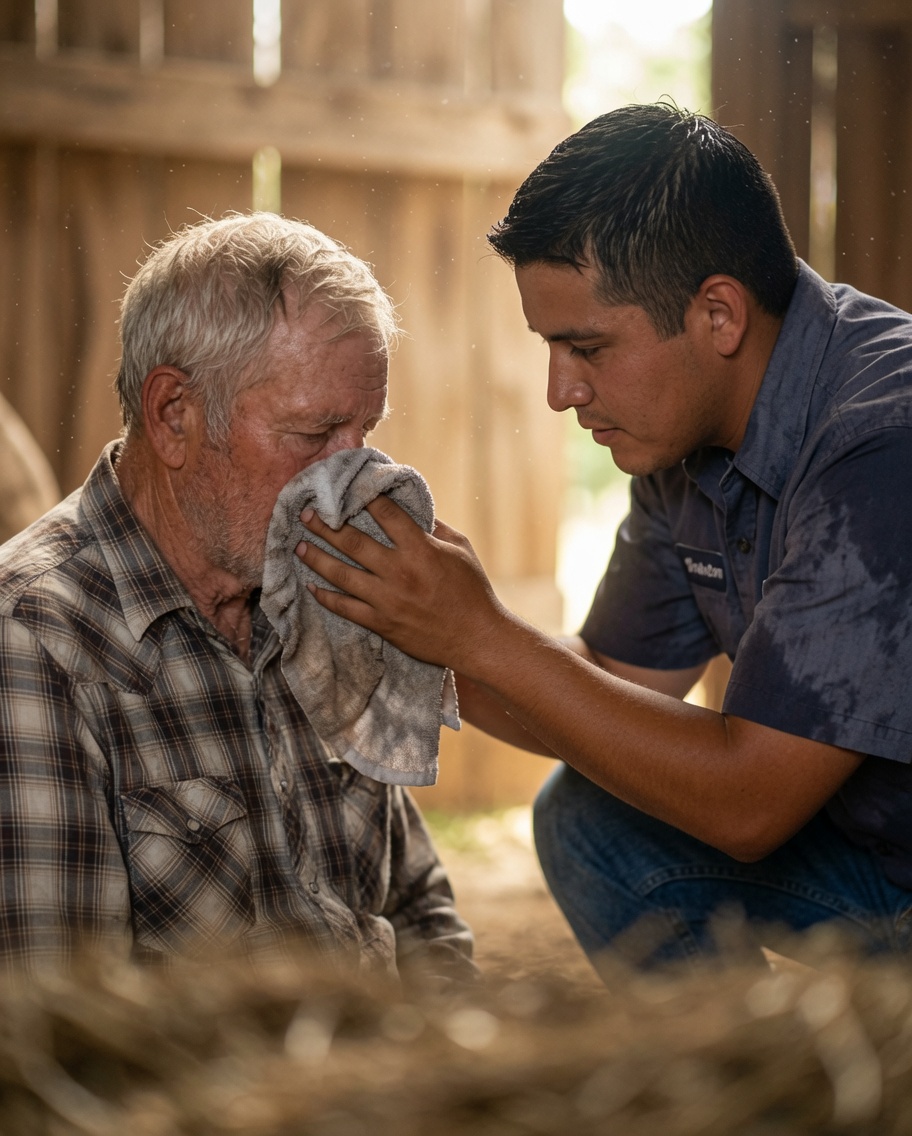
But pride doesn’t dial 911 when your heart is racing and your phone is sitting on the kitchen counter fifty yards away.
Earlier that morning I had called the local grocery market to order a few essentials, knowing I felt too dizzy to drive into town.
I expected a driver to drop the bags on the porch and speed off.
I certainly didn’t expect anyone to come looking for a stubborn old man.
As I lay in the dirt, the crunch of gravel echoed in the distance.
A rusty car door slammed.
“Hello? Grocery delivery!” a young voice called out over the cicadas.
I tried to shout back, but my throat was too parched.
All that escaped was a dry wheeze that barely reached past the tractor tires.
I closed my eyes, resigned to the fact that he would leave the bags and drive away.
Then footsteps crunched closer, moving toward the outbuildings.
The barn door groaned open.
A silhouette stood in the doorway, freezing when he saw me crumpled in the shadows.
“Sir?” the kid gasped, dropping his clipboard in the dirt.
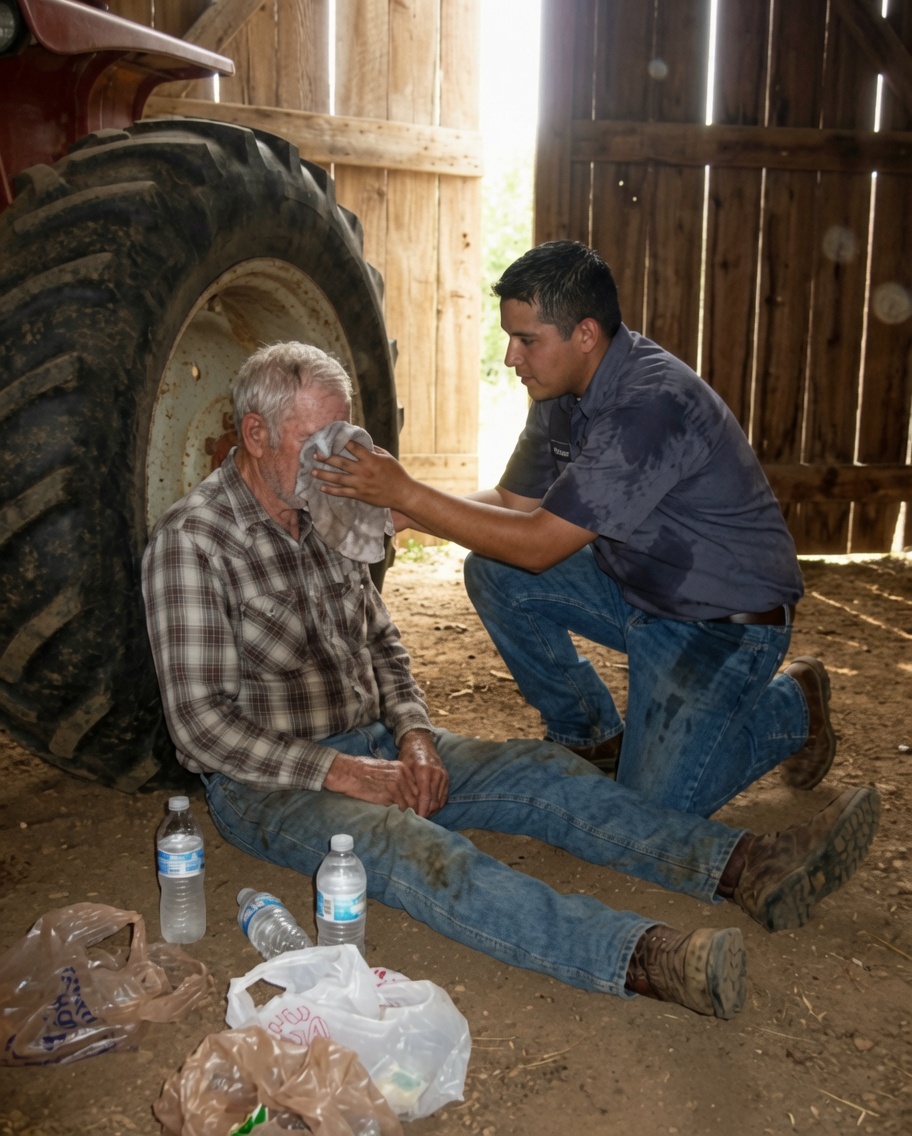
In seconds he was kneeling beside me, ripping open a case of bottled water he had grabbed from his trunk.
“Hey, stay with me, man. I’ve got you,” he said, voice cracking with raw panic.
He didn’t run away.
He didn’t just call an ambulance and stand back to wait.
Without hesitating, the kid soaked his own uniform shirt with cold water and pressed it firmly against my forehead and neck.
“My name is Mateo,” he kept repeating, carefully holding my heavy head up so I could take tiny sips.
“I’m nineteen. I just started at the market a few weeks ago. You’re going to be okay, sir. The paramedics are on the way. Just keep looking at me.”
I woke up hours later in a sterile hospital room hooked up to IV lines.
The doctor told me my core temperature had reached critical levels.
I was minutes away from fatal heatstroke when I was found.
“You’re incredibly lucky your grandson found you when he did,” the nurse smiled, adjusting my blanket.
“He stayed in the waiting room until we told him you were stable.”
I swallowed hard.
“I don’t have a grandson.”
The kid who saved my life was an absolute stranger making minimum wage.
Just a teenager trying to finish his delivery route.
I spent three days recovering before a neighbor drove me home.
Walking up the wooden steps, I expected the heavy isolation of the farmhouse to swallow me again.
Instead I found a fresh case of water and a handwritten note on the porch swing.
“Glad you’re tough. Let me know if you need anything else. —Mateo.”
At the bottom he had scribbled his personal cell number.
I called him that evening just to say thank you, expecting a quick conversation.
We ended up talking for over an hour.
I learned he was working two jobs to help his single mother pay rent, sacrificing his own free time to keep their heads above water.
We were a stubborn aging war veteran and a tired teenager in a faded graphic tee.
We had nothing in common on paper.
The world constantly tells us we are supposed to misunderstand each other.
Society expects a massive generational gap.
But the very next Sunday, Mateo’s rusty sedan pulled into my driveway again.
He didn’t come to drop off a delivery.
He came with a wrench in his hand, asking if I still needed help fixing the broken latch on the barn door.
That was six months ago.
Mateo has come over every single Sunday since.
We don’t just fix things around the property.
We sit on the porch, drink iced tea, and actually talk.
I teach him how to use power tools, how to check the oil in his car, and tell him stories about a world he never got the chance to know.
In return, he brings life, laughter, and youthful energy back into a house that had been dead silent for over a decade.
We are so quick to assume the younger generation is lost, that they only care about glowing screens and themselves.
But a nineteen-year-old kid saved my life when it wasn’t his job.
When it would have been easier to just drop the groceries and drive away.
He didn’t just save me from the brutal heat that day.
He saved me from the crushing loneliness that was slowly eating me alive.
True friendship doesn’t care about age.
Basic human kindness is never outdated.
Sometimes family isn’t blood.
It’s just the person who refuses to leave you in the dark.
The first time I called Mateo my family out loud, my actual relatives showed up with a deputy, two worried neighbors, and a folder full of nursing home brochures.
That is how fast people remember you exist when they think a stranger might get something they wanted.
It was a Sunday morning.
The kind that had become sacred around my farm.
I had already set two glasses of iced tea on the porch rail.
One for me.
One for Mateo.
The July heat had finally broken, but the memory of that barn floor still lived in my bones.
I could not walk past the tractor tires without remembering the taste of dust in my mouth.
I could not hear gravel crunch without remembering a nineteen-year-old kid running toward me when the rest of the world had forgotten I was alive.
Mateo usually arrived at ten.
He was never early.
Never late.
That boy had two jobs, one exhausted mother, a car that coughed like an old mule, and still he showed up more reliably than blood ever did.
At 9:47 I heard tires on the gravel.
Too many tires.
I looked out the kitchen window and saw three vehicles crawling up my drive like a funeral procession.
A county cruiser.
A blue sedan.
And a silver SUV so clean it looked offended by my dirt road.
My stomach tightened before anyone even stepped out.
Because old men know.
We know when people arrive to visit.
And we know when people arrive to take inventory.
My nephew Carl climbed out of the SUV first.
I had not seen Carl in nearly nine years.
Not for Christmas.
Not for my birthday.
Not when Martha died.
Not when I spent that winter with pneumonia and my neighbor had to shovel my walk.
But there he was, smoothing down his shirt like a man preparing to speak at a bank meeting.
Behind him came his wife Denise, holding a paper folder against her chest.
My younger cousin Ellen stepped out of the sedan.
Then Deputy Harris got out of the cruiser with the exhausted face of a man who had been dragged into family business before breakfast.
I opened the front door before they could knock.
“Silas,” Carl said, forcing a smile. “We need to talk.”
I looked at the folder in Denise’s hands.
“No,” I said. “You need something.”
Carl’s smile twitched.
Deputy Harris cleared his throat.
“Morning, Mr. Reed. I’m just here because a wellness concern was called in.”
“A wellness concern,” I repeated.
Denise gave me a soft, careful look.
The kind people use when they already decided you are confused.
“We’re worried about you,” she said.
That was almost funny.
I nearly laughed.
Because for fifteen years, worry had not driven them up my driveway once.
Not when the gutters sagged.
Not when the tractor broke.
Not when Martha’s side of the bed stayed empty so long I stopped sleeping in the room altogether.
But now worry had a full tank of gas.
Carl looked past me into the house.
“Can we come in?”
“No.”
His face changed.
Just a little.
Enough.
“Uncle Silas, don’t make this difficult.”
There it was.
Not concern.
Control.
I stepped out onto the porch and pulled the door shut behind me.
At eighty-two, you learn that a doorway is a line.
And sometimes you have to stand in it.
“What is this about?” I asked.
Denise opened the folder.
“We heard there’s a young man coming around every week.”
I stared at her.
“That’s not a crime.”
Carl’s jaw tightened.
“He works at the grocery market, right? He delivered to you the day you collapsed?”
“Yes.”
“And now he comes here alone? Every Sunday?”
“Yes.”
“And does repairs?”
“Yes.”
“And you pay him?”
“Sometimes.”
“Sometimes?” Denise asked, like she had caught me hiding gold bars in the flour tin.
“When he lets me.”
Ellen stepped forward.
She was softer than Carl.
Always had been.
But soft people can still carry sharp messages.
“Silas, nobody is saying he’s done anything wrong. We just think you’re vulnerable.”
That word hit harder than I expected.
Vulnerable.
Not stubborn.
Not independent.
Not lonely.
Not still here after everything.
Vulnerable.
A neat little word people use when they want to move your choices out of your hands and into theirs.
“I fell down in a barn,” I said. “I did not lose my mind.”
Carl sighed.
“That’s exactly what we’re trying to figure out.”
The porch went quiet.
Even the birds seemed to stop.
I looked at him.
Really looked.
He had my brother’s eyes and none of my brother’s shame.
“What did you just say to me?”
Denise touched his arm.
“Carl.”
But Carl had already decided he was the brave one.
“We found out you’ve been spending time with this kid. Giving him access to the property. Letting him use tools. Maybe money. Maybe more. And we all know how these things happen.”
“These things,” I said.
“You’re isolated,” Carl continued. “You’re grieving. You nearly died. Some people take advantage of that.”
I heard another engine then.
A rough little rattle coming up the road.
Mateo.
His rusty sedan turned into the drive and slowed when he saw the cruiser.
Then it stopped.
For one second I saw his face through the windshield.
Confused.
Worried.
Then ashamed.
As if he had walked into a room where people had already been discussing him and voted.
He got out slowly.
He wore faded jeans, work boots I had helped him resole, and a plain gray shirt with a tear near the collar.
He looked nineteen.
Not dangerous.
Not calculating.
Just tired.
Just young.
Just the boy who once held my head up in a barn and begged me to keep breathing.
“Mr. Reed?” he called.
Carl turned toward him.
Denise clutched the folder tighter.
Deputy Harris shifted his weight.
Mateo saw every bit of it.
People think young folks don’t notice.
They notice everything.
Especially when adults look at them like a problem.
“You should go home, son,” Carl said.
Mateo froze.
I stepped off the porch.
“No, he should not.”
Carl gave me a warning look.
“Uncle Silas.”
I kept my eyes on Mateo.
“You came to fix the pump?”
He nodded, but his voice was thin.
“Yes, sir. But I can come back another time.”
“No,” I said. “You came when you said you would. That means you belong here more than anybody who arrived with paperwork.”
Carl’s face flushed.
“That’s exactly what I mean. Listen to yourself.”
I turned to him.
“I am listening.”
Denise pulled out a brochure.
There was a smiling gray-haired man on the cover, sitting beside a fake plant in a room too clean to be lived in.
“We toured a place,” she said gently. “It’s very nice. Private rooms. Meals provided. Activities. Safety checks.”
“I have meals.”
“You eat canned soup half the time,” Carl said.
“I like soup.”
“You almost died alone.”
That one landed.
Because it was true.
Cruel and true often wear the same coat.
For a moment nobody spoke.
Mateo looked down at the dirt.
I saw his hands curl at his sides.
He was not angry.
That would have been easier.
He looked guilty.
As if saving me had caused all this.
As if kindness was a bill he had accidentally sent to my family.
Deputy Harris finally spoke.
“Mr. Reed, nobody can make you go anywhere today. I just need to confirm you’re safe and not being coerced.”
“Coerced,” I said.
His eyes flicked to Mateo.
I understood.
The word had found its target.
I walked down the steps slowly.
My knees were not what they used to be, and I hated that everyone watched me descend like I was crossing a frozen pond.
I stopped beside Mateo.
He whispered, “I can leave, Mr. Reed.”
I said, “You can also stay.”
Carl made a frustrated sound.
“Silas, you’re proving our point. You barely know him.”
I looked at my nephew.
“I know he came into a barn when he didn’t have to.”
Carl opened his mouth.
I kept going.
“I know he poured cold water on his own shirt and put it on my neck. I know he rode with me to the hospital because nobody knew who to call. I know he sat in a waiting room until a nurse told him I was breathing steady.”
Carl looked away.
“I know he fixed the latch on the barn door, the porch step you nearly tripped on just now, the loose rail by Martha’s rose bed, and the pump you never knew was broken.”
Denise’s face softened, but not enough.
“I know he drinks his tea with too much sugar,” I said. “I know his mother’s name is Rosa. I know he pretends he isn’t hungry when he is. I know he wants to go to trade school but keeps delaying because rent comes before dreams.”
Mateo’s head snapped toward me.
I had not meant to say that last part.
But some truths escape once the door opens.
Carl folded his arms.
“And how much money has he asked you for?”
Mateo flinched.
That was when my temper finally stood up taller than my body.
“He has asked me for nothing.”
Carl said, “Maybe not yet.”
The silence after that was ugly.
Mateo took one step back.
“Mr. Reed, I’m sorry.”
I turned to him.
“For what?”
“For causing trouble.”
“You didn’t.”
He looked past me at Carl, Denise, Ellen, the deputy, the folder, the porch, the whole farm suddenly feeling like a courtroom.
Then he nodded once.
That small, polite nod young people give when they have decided to disappear before anybody has to push them.
“I’ll come another day.”
“No,” I said.
But he was already walking to his car.
I could have ordered him to stop.
I could have made a scene.
Instead I watched a good kid leave my driveway with his shoulders bent under an accusation he had not earned.
That is the thing about suspicion.
It does not need proof to leave a bruise.
Mateo’s car rattled away.
And my farm, which had only recently started sounding alive again, went quiet.
Carl exhaled like he had won something.
That was his mistake.
I turned back to him.
“You wanted to know if I’m still competent?”
Deputy Harris looked uncomfortable.
Carl said, “We want what’s best.”
“No,” I said. “You want what’s easiest to explain.”
Denise blinked.
I pointed at the road where Mateo had gone.
“That boy looked like family because he acted like family. That makes you uncomfortable because it means family is not a title. It is a job.”
Carl’s mouth tightened.
“You’re going to regret trusting strangers.”
I nodded.
“Maybe. But I already know what it costs to wait on relatives.”
Nobody had much to say after that.
Deputy Harris asked me a few questions.
My name.
The date.
Who the president was.
Simple things.
I answered every one without hesitation.
Then he looked at Carl.
“Mr. Reed is clearly competent. There’s no evidence of coercion or danger. I can’t force him to do anything he doesn’t want to do.”
Carl’s face went red.
Denise closed the folder.
Ellen looked at the ground.
Deputy Harris tipped his hat to me.
“Sorry for the trouble, Mr. Reed. Have a good Sunday.”
He got back in his cruiser and drove away.
Carl, Denise, and Ellen stood on my porch like people who had come to a meeting that ended early.
I looked at my nephew.
“You can keep the brochures,” I said. “I already have a family.”
Carl opened his mouth, then closed it.
They got back in their cars without another word.
I stood on the porch until the dust settled.
Then I went inside, poured the two glasses of iced tea down the sink, and sat at the kitchen table with my hands flat on the wood.
The house felt bigger than it had in years.
And emptier.
I picked up my phone and stared at Mateo’s number for a long time.
I didn’t call.
Some things you don’t fix with a phone call.
You fix them by showing up.
The next Sunday I was the one waiting at the end of the driveway when Mateo’s rusty sedan appeared.
He slowed when he saw me.
I walked over to the driver’s side.
He rolled the window down but didn’t look at me right away.
“I’m sorry about last week,” he said quietly.
“You have nothing to be sorry for.”
He finally looked up.
His eyes were tired in a way no nineteen-year-old should be.
“They think I’m using you.”
“I know.”
“And you don’t?”
I shook my head.
“I think you’re the only person who has treated me like I still matter since Martha died.”
Mateo swallowed hard.
“I don’t want to cause problems with your family.”
“You’re not the problem,” I said. “The problem is that they only remembered I existed when they thought someone else might get close to what they want.”
He was quiet for a moment.
Then he asked, “Do you still want me to come around?”
I looked at this boy who had once held my head up in a barn and begged me to keep breathing.
Who had fixed my broken things without being asked.
Who drank too much sugar in his tea and pretended he wasn’t hungry when he was.
Who showed up every Sunday even when he had two jobs and a tired mother and a car that coughed like an old mule.
“I don’t just want you to come around,” I said.
“I need you to.”
Mateo’s eyes filled.
He didn’t cry.
But he came close.
He nodded once, the same small nod he had given on the porch the week before.
Only this time it meant something different.
This time it meant he was staying.
We walked up to the house together.
I had already set two glasses of iced tea on the porch rail.
One for me.
One for him.
The July sun was warm but not brutal.
The cicadas sang in the trees.
Mateo picked up his glass, took a long drink, and made a face.
“Too much sugar again?”
He grinned.
“Never enough.”
We sat in the old wooden chairs and watched the light move across the fields.
Neither of us spoke for a long time.
We didn’t need to.
Sometimes family isn’t the people who share your blood.
Sometimes it’s the person who refuses to let you die alone in a barn.
And then refuses to let you live alone in the silence afterward.
That Sunday, and every Sunday after, Mateo kept coming.
My actual relatives never did again.
And I never once missed them.