Katie stood in front of my father with that folded piece of paper held carefully in both hands.
- LongVo
- June 29, 2026
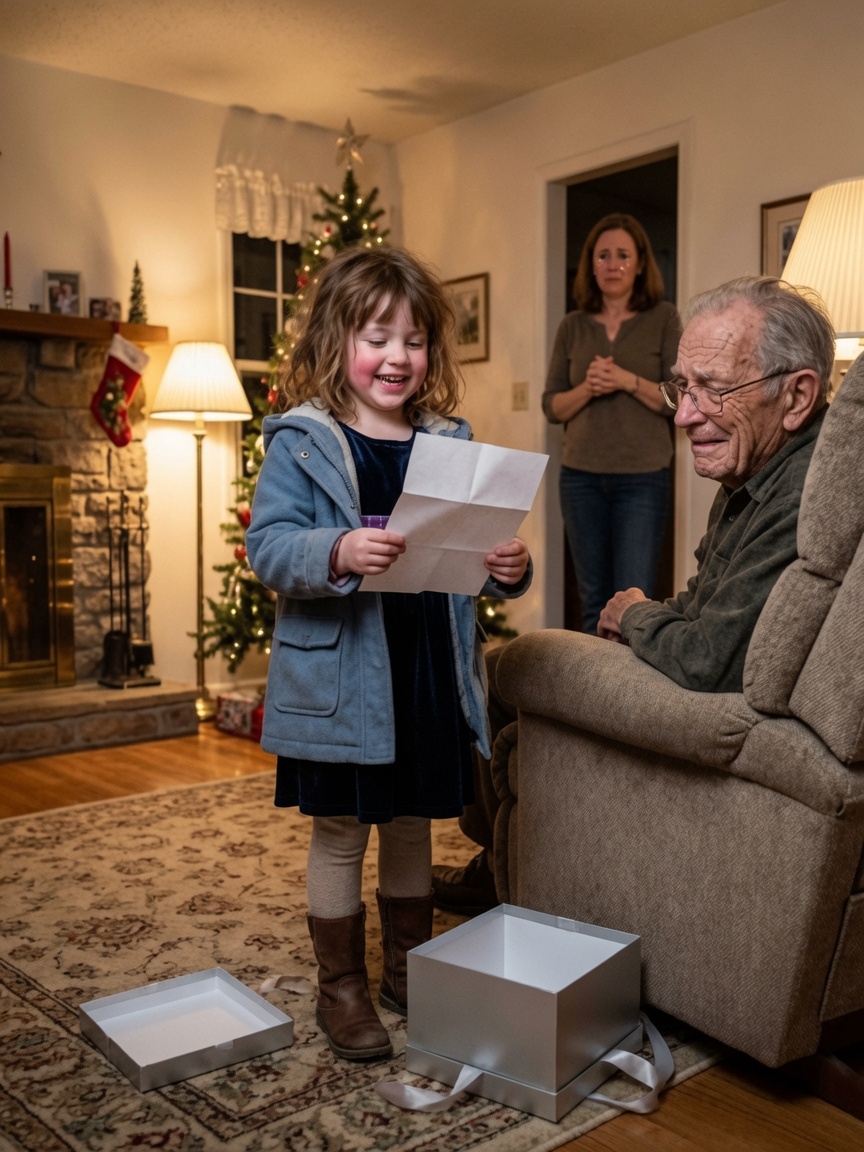
Katie stood in front of my father with that folded piece of paper held carefully in both hands.
Not like a toy.
Not like a drawing.
Like something fragile that might disappear if she gripped it too hard.
The room, for once, had lost its appetite for laughter.
Even Sandra stopped smiling.
Even my father—who always seemed to have something ready, some sharp comment lined up like ammunition—watched her a little more closely than before.
Katie reached him.
She didn’t rush.
She didn’t hesitate either.
She simply placed the paper into his hand like she was returning something that belonged to him.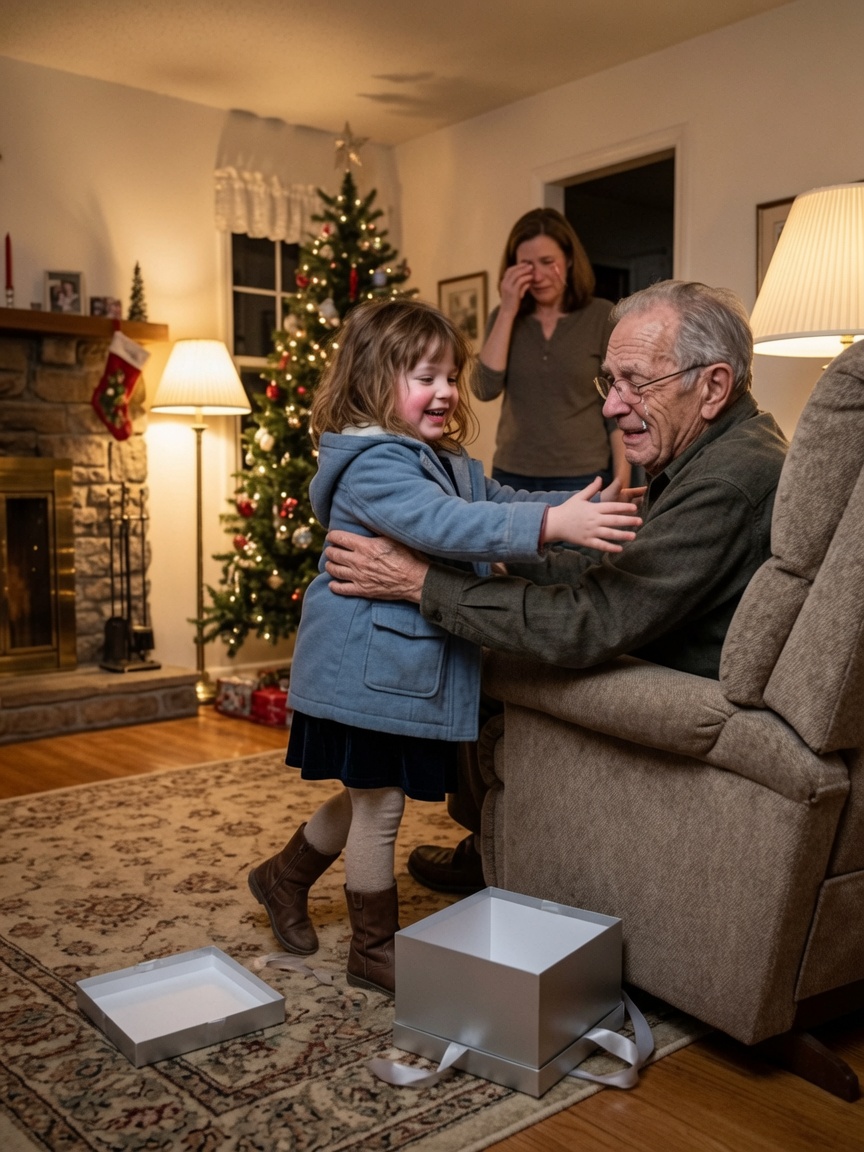
My father glanced down at it.
Then he gave a small, amused exhale.
“What’s this supposed to be?” he said.
Katie tilted her head slightly.
“It’s for you,” she answered.
He didn’t open it right away.
He turned it between his fingers, like it was an inconvenience someone had mistaken for a gift.
Then, finally, he unfolded it.
At first, nothing changed.
Just a quiet scan of lines and colors drawn by a child.
A house.
A tree.
A stick figure holding hands with another stick figure that was clearly meant to be taller.
Then I saw his eyes pause.
Not dramatically.
Not like in movies.
Just a tiny break in rhythm—like his mind had hit something it didn’t immediately know how to step over.
Katie had drawn our family.
But not the version sitting in this living room.
In her drawing, there were no sharp mouths.
No folded arms.
No cold recliners.
There was just a small house under a wide sky.
And in front of it, a version of my father holding Katie’s hand while she smiled up at him like he was the safest thing in the world.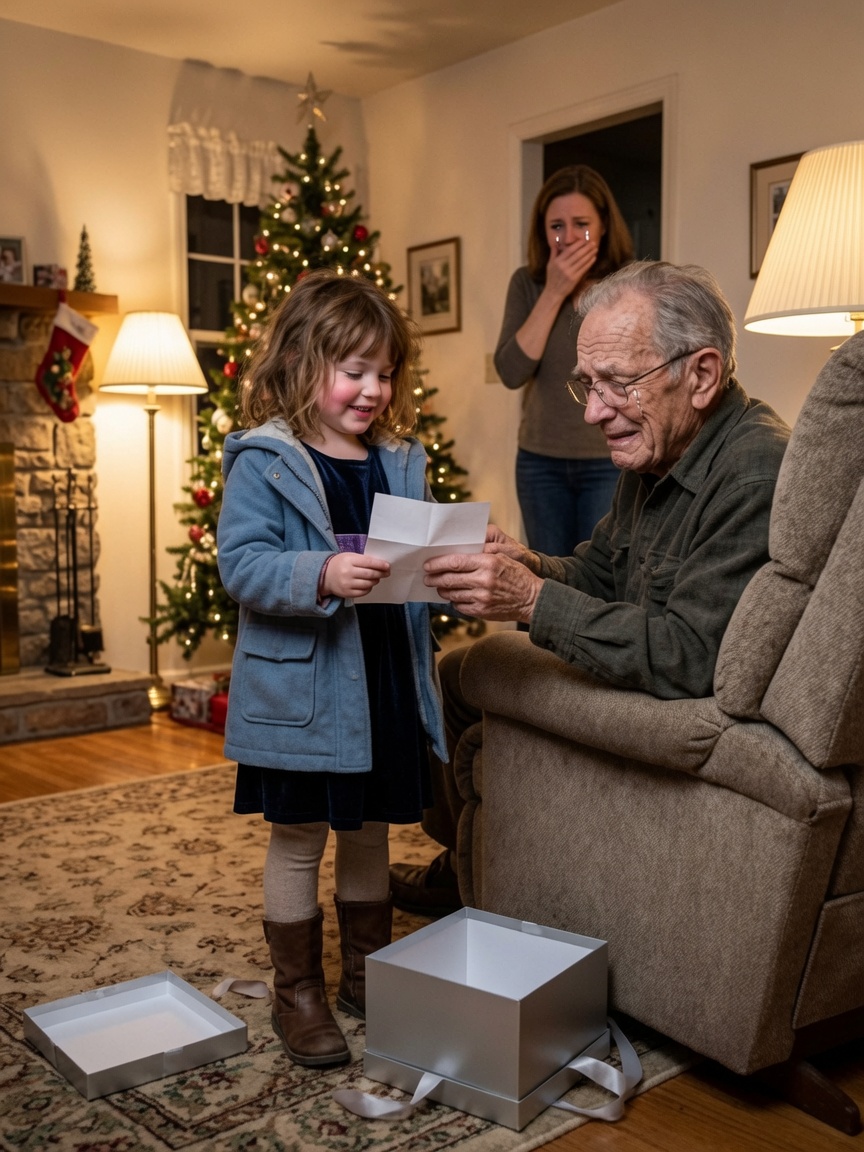
Below it, in uneven letters carefully spelled out with a child’s patience, she had written:
“Grandpa, I saved you a seat in my heart.”
The silence after that was different.
It wasn’t awkward.
It wasn’t tense.
It was… suspended.
Like the room itself didn’t know whether it was allowed to move.
My father cleared his throat.
Once.
Then again.
But he didn’t speak.
That was the first crack.
Small.
Almost invisible.
Katie rocked back on her heels, watching him carefully now, like children do when they’re trying to read grown-ups the way grown-ups read them.
“Mom said I shouldn’t be scared of meeting you,” she added softly. “So I made you a picture so you’d know me already.”
That did it.
Not the drawing.
Not the words.
That sentence.
Because for the first time since I had walked back into that house, my father didn’t have anything immediate to say.
He looked down at the paper again.
And something in his grip changed.
Not softer exactly.
But less certain.
The same man who had once corrected me for crying too loudly at thirteen was now staring at a crayon drawing like it had asked him a question he couldn’t answer quickly enough.
Sandra shifted on the couch.
“This is… sweet,” she said, too fast. Too careful.
But my father didn’t react to her.
He was still looking at the stick figure labeled “Grandpa.”
Then, quietly—almost too quietly to hear—he said, “She drew me wrong.”
Katie blinked.
“No I didn’t,” she said, simple and sure. “That’s you. You just haven’t smiled at me yet.”
Something inside my chest tightened so sharply I had to look away for a second.
Because children don’t say things like that to be cruel.
They say them because they assume the world is fixable.
My father exhaled through his nose.
A familiar sound.
Dismissive.
But weaker now.
He folded the paper halfway.
Then stopped.
Unfolded it again.
Like he couldn’t decide what to do with something that didn’t behave like a problem.
“Kids say things,” he muttered, mostly to himself.
But Katie wasn’t finished.
She reached into her pocket again.
This time she pulled out something else.
A second drawing.
Smaller.
Folded even tighter.
“I made another one,” she said. “In case you didn’t like the first.”
She held it out.
And for the first time all evening, my father hesitated before taking it.
The room didn’t move.
Even the fireplace seemed to burn quieter.
He took the second drawing.
Unfolded it.
And this one—
This one made him stop completely.
It wasn’t a family.
It wasn’t a house.
It was just a single figure.
A man sitting alone in a chair.
Surrounded by a big empty room.
And beside him, in careful child handwriting:
“If you are lonely, you can sit with us.”
My father’s hand lowered slightly.
Not dramatically.
Just enough for the paper to tremble.
And in that moment, something I had never seen in him before flickered across his face.
Not anger.
Not sarcasm.
Not control.
Confusion.
The kind that doesn’t know where to stand.
Katie reached up and touched his sleeve.
Very lightly.
Like you would touch someone you weren’t sure had ever been touched gently before.
“You don’t have to be scary,” she said.
“I saved you a seat anyway.”
My father didn’t answer.
He just stood there.
Holding two crayon drawings like they were heavier than anything he had ever carried.
And then, without saying a word to anyone in the room—
he walked past us.
Past the fireplace.
Past the Christmas tree.
Past the entire version of himself he had built for decades.
And out the front door.
The cold air rushed in when it opened.
And then—
silence.
Real silence.
Katie looked up at me.
“Did I do something wrong?” she asked.
And I couldn’t answer right away.
Because outside, I could hear footsteps on the porch.
Slow.
Uneven.
Like someone who had forgotten how to leave a room properly.
And for the first time that night, I realized:
my father wasn’t walking away from us.
He was walking away from something in himself that he had just been forced to see clearly.