She Was the “Package” That Made Frank Martin Break His Rules — What Happened to Shu Qi After The Transporter?
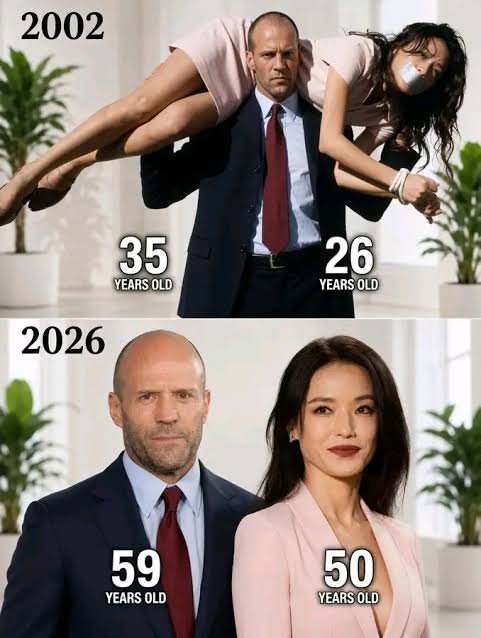
Frank Martin had built his entire life around three rules: never change the deal, no names, and never open the package.
Then one of his packages started moving.
That simple twist gave 2002’s The Transporter its central hook. Frank, played by Jason Statham, opens the bag in the trunk of his car and discovers that his cargo is not an object at all. Inside is Lai, a bound young woman played by Taiwanese star Shu Qi. The moment Frank looks inside, the carefully controlled life he has created begins to unravel.
More than two decades later, The Transporter is remembered largely as the movie that helped establish Statham as a leading action star. But Shu Qi’s presence was just as important to the first film’s particular dynamic — and her career after playing Lai went in a very different direction.
Rather than trying to build a Hollywood action résumé alongside Statham, Shu returned largely to Asian cinema, where she developed an acclaimed body of work that eventually carried her from major acting prizes to the director’s chair.
Lai Was the Problem Frank’s Rules Couldn’t Solve
At the beginning of The Transporter, Frank is designed to function almost like a machine.
He drives precisely. He negotiates precisely. He asks as little as possible about the people paying him. His rules allow him to keep morality at a distance: deliver what he has agreed to deliver and do not become emotionally involved.
Lai makes that arrangement impossible.
After Frank discovers her inside the package, he initially tries to continue treating the job professionally. But the situation eventually exposes a human-trafficking operation, pulling him into a conflict that can no longer be solved by driving away after a successful delivery.
That is what makes Lai more than simply the woman Frank rescues.
She is the character who forces him to see what his philosophy of “no questions asked” can actually mean when the cargo is human. The movie gradually turns Frank from a detached contractor into someone actively fighting the people behind the trafficking operation.
The contrast also gives Statham and Shu Qi their screen dynamic. Frank is restrained, clipped and controlled; Lai is more emotionally expressive, unpredictable and willing to push into the life he has tried to seal off.
Their relationship adds warmth to a movie otherwise built around car chases, martial arts and Frank’s almost obsessive professionalism.
The Film Changed Jason Statham’s Career
Before The Transporter, Statham was already recognizable from Guy Ritchie’s Lock, Stock and Two Smoking Barrels and Snatch. But those movies placed him inside larger ensembles.
The Transporter was different.
It gave him a movie built around his physical presence: the shaved head, dark suit, precise driving, dry delivery and hand-to-hand fighting that would become familiar elements of his screen persona. GQ later noted that his work in the two Ritchie films helped persuade Luc Besson that Statham could carry The Transporter. The Guardian has described the movie as his first true star vehicle.
The combination proved durable.
Statham returned as Frank Martin in Transporter 2 in 2005 and Transporter 3 in 2008. From there, he built one of the most recognizable action careers of his generation through films and franchises including Crank, The Mechanic, The Expendables, The Meg and the Fast & Furious universe.
Frank Martin was not Statham’s first memorable character, but he helped establish the template audiences would recognize for years afterward.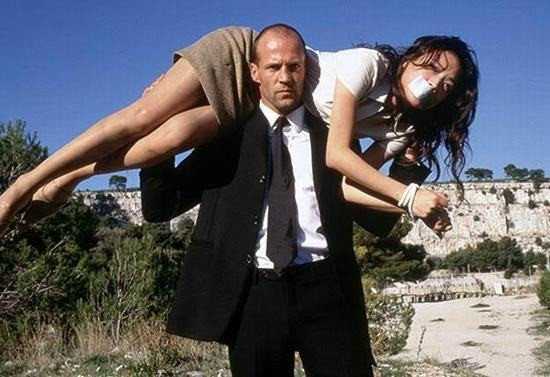
So Why Didn’t Lai Come Back?
Lai’s story, however, remained confined to the first movie.
When Transporter 2 arrived three years later, the setting had shifted to Miami and Frank was working as a driver for the young son of a wealthy family. Shu Qi was not part of the sequel’s cast, and new characters played by actors including Amber Valletta and Kate Nauta surrounded Statham’s Frank Martin instead.
The original Statham trilogy continued without Lai.
There does not appear to be a reliable public explanation from Shu Qi or the filmmakers establishing a specific behind-the-scenes reason for her absence, so attaching one to her departure would be speculation.
What is clear is that Shu Qi did not need The Transporter franchise to give her a career.
She already had one.
Hollywood Was Only One Chapter of Shu Qi’s Story
For viewers who first encountered Shu Qi as Lai, it can be easy to think of The Transporter as her breakthrough.
In Asian cinema, that picture is almost reversed.
By the time the movie opened in 2002, Shu had already built a substantial career. Her performance in Viva Erotica had brought major recognition at the Hong Kong Film Awards, while Portland Street Blues earned her supporting-actress honors at both the Golden Horse Awards and Hong Kong Film Awards. She had also starred in Hou Hsiao-hsien’s Millennium Mambo, which competed at Cannes in 2001.
After The Transporter, she continued working across Chinese-language and Asian cinema rather than pursuing a conventional Hollywood-star trajectory.
One of the most important films came in 2005, when she reunited with Hou for Three Times. Her performance won the Golden Horse Award for Best Leading Actress. Golden Horse records also show her earlier Best Supporting Actress victory for Portland Street Blues.
Her career continued through romances, crime films, comedies and major commercial productions, while her collaboration with Hou became especially important. In 2015, she took the title role in his visually acclaimed martial-arts drama The Assassin, another Cannes competition film.
The actress who some Western viewers remembered as “the package” had long since demonstrated that her international résumé extended far beyond one English-language action movie.
More Than 20 Years Later, She Moved Behind the Camera
Shu Qi’s career eventually took another turn.
In 2025, she presented Girl, her feature directing debut, in competition at the Venice International Film Festival. The film marked a major transition for an actress who had spent decades in front of the camera.
By 2026, that new chapter had produced another major honor: Shu won Best New Director at the 44th Hong Kong Film Awards for Girl.
It creates an unusual contrast with the movie through which many international audiences first knew her.
Jason Statham left The Transporter and kept expanding the kind of action hero that Frank Martin had helped create. Shu Qi left the franchise after one film and returned to a cinematic career that was already flourishing — winning major acting honors, working with celebrated filmmakers and eventually directing a film of her own.
Lai may have disappeared from Frank Martin’s story after 2002.
Shu Qi never disappeared at all.