One Detail in Russell Crowe and Connie Nielsen’s ‘Gladiator’ Scenes Stayed Unspoken for 24 Years
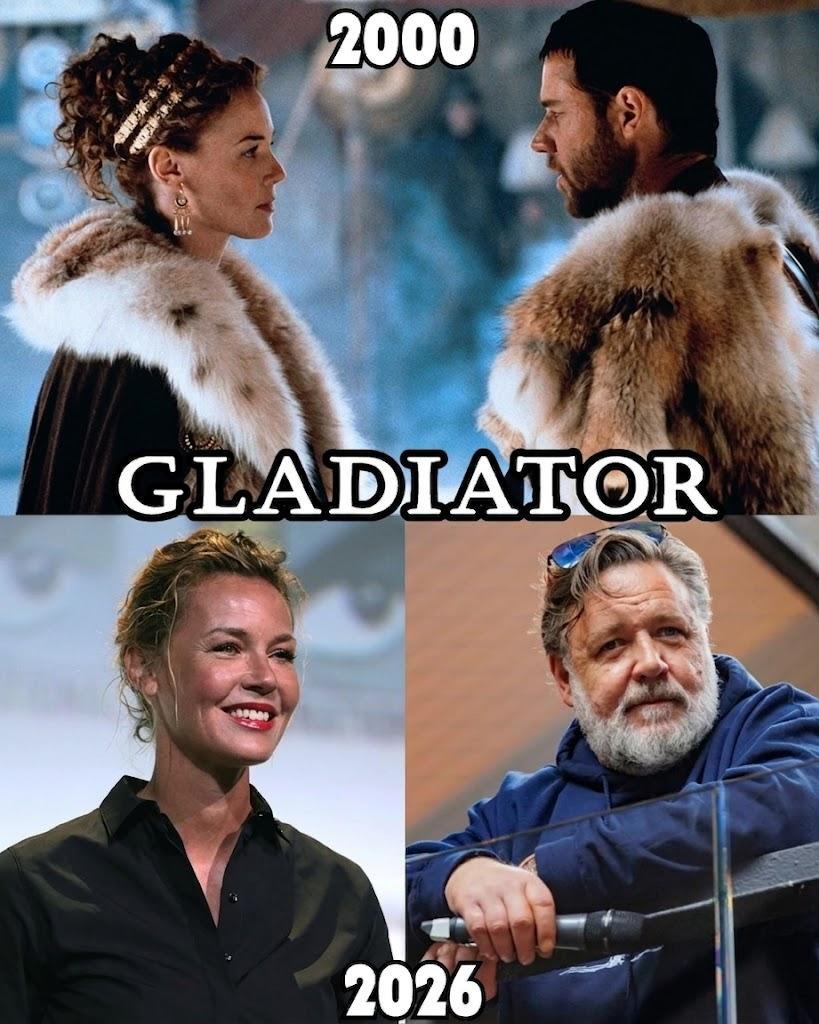
When Maximus and Lucilla see each other again in Gladiator, almost nothing needs to be explained.
Russell Crowe’s Roman general has just helped win a brutal campaign in Germania. Connie Nielsen’s Lucilla arrives carrying all the political complications of Rome with her. Their conversation is controlled and formal, but the restraint is exactly what makes it feel so personal.
They clearly have history.
Lucilla reminds Maximus that there was once a time when he did not address her so formally. Later, she admits that she still remembers him in her prayers. Maximus, in turn, offers condolences for the death of her husband.
Then the conversation turns to their children.
Lucilla says her son, Lucius, is almost eight years old.
Maximus replies that his own son is almost eight too.
In 2000, it could play as little more than an unusually intimate exchange between two people who once loved each other and had since built separate lives.
Twenty-four years later, it plays very differently.
‘Gladiator’ Never Completely Explained What Happened Between Them
The original movie eventually removes any doubt that Maximus and Lucilla once had a serious romantic relationship.
When Commodus questions his sister about Maximus, he observes that Maximus once hurt her deeply. Lucilla’s response is revealing: she says she wounded him too.
Much later, as Lucilla risks everything to help Maximus escape, the emotional history becomes explicit. She tells him Commodus hates him not simply because Marcus Aurelius favored him, but because their father loved Maximus — “and because I loved you.”
Maximus answers that it was a long time ago.
Lucilla says she has felt alone throughout her life except when she was with him, and the scene ends with a kiss.
What Gladiator does not explain is exactly when their relationship occurred, why it ended, or how far it went.
And that ambiguity becomes important because of Lucius.
The boy himself appears to settle the question of his parentage in the original film. When he meets Maximus, then known publicly as the Spaniard, Lucius says his father is dead. Asked his name, he identifies himself as Lucius Verus, named after his father.
For decades, that was enough for most viewers.
Then Gladiator II changed the meaning of nearly every one of those scenes.
Lucius Is Maximus’ Son
The 2024 sequel makes its central bloodline revelation unmistakable.
The adult Lucius, now played by Paul Mescal, eventually learns from Lucilla that his biological father was not the man whose name he carried.
It was Maximus Decimus Meridius.
Lucilla tells her son to draw strength from his father and identifies Maximus directly. By the end of the film, Lucius himself publicly calls Maximus his father.
That turns Gladiator II into something more than another story taking place in Ridley Scott’s version of ancient Rome.
Lucius is not simply a child who once admired Maximus from the imperial box.
He is continuing his father’s story.
Screenwriter David Scarpa said that when he became involved, the basic direction was already clear: the story would center on “Maximus’ son, Lucius.” The sequel was built around Lucius rejecting, then gradually rediscovering, the values represented by his father.
But that creates an irresistible question when returning to the first movie.
Was Ridley Scott quietly planting this idea in 2000?
Or did Gladiator II reinterpret an ambiguity that happened to be useful 24 years later?
Connie Nielsen Had Her Own Secret Answer
There is one fascinating piece of evidence for the first interpretation — and it comes from Nielsen herself.
While promoting Gladiator II, Nielsen revealed that when she performed one of Lucilla’s scenes with Maximus in the original movie, she gave herself a private piece of character information.
Actors sometimes create secrets their characters know even when those details are never spoken aloud.
Nielsen’s secret was that Maximus was Lucius’ father.
She specifically pointed back to the moment involving Maximus and her young son, explaining that she played the scene with that belief in her mind.
That does not prove Scott or the original screenwriters intended the same answer.
It does mean that at least one of the two performers at the center of those scenes was playing Lucilla as though the secret already existed.
Suddenly, Nielsen’s looks toward Crowe and the strange tension surrounding the two boys become even more interesting.

But There Is a Strong Case for Calling It a Retcon
Scarpa himself has offered perhaps the best reason not to overstate the evidence.
Discussing the first movie, he said its creators had “sort of left” Lucius’ parentage ambiguous — and characterized that ambiguity as something that may have happened unconsciously.
That distinction matters.
The original Gladiator never says Maximus fathered Lucius.
In fact, Lucius explicitly associates his name with his deceased father, Lucius Verus. Maximus also speaks lovingly and repeatedly about his own wife and son, whose murders drive much of his story.
Viewed only through the 2000 film, there is no requirement to conclude that Lucius is secretly his child.
The sequel simply creates a new distinction: Lucius Verus can be the father Lucius knew publicly while Maximus was his biological father.
That works within the gaps left by the first movie, but it is still information supplied decades later.
So “retcon” is not an unreasonable description.
Neither is “foreshadowing.”
The more interesting answer may sit somewhere between them.
Ridley Scott Always Had Lucius in the Back of His Mind
What is clear is that Scott did not suddenly discover Lucius in 2024.
As early as 2003, he was publicly discussing a follow-up focused on Lucilla’s son rather than resurrecting Maximus as the lead.
“It’s the next generation,” Scott said at the time, identifying Lucius as the character who would carry the story forward.
Decades later, Scott said the question that finally unlocked the new movie was simple: what happened to Lucius?
The answer transformed Maximus from a dead hero into the foundation of a family legacy.
Crowe does not physically return in Gladiator II. Maximus died in the Colosseum at the end of the original, and Scott ultimately built the sequel around the generation that survived him.
Nielsen, however, returned as Lucilla, making her the emotional bridge between the two stories.
That is why the first film now rewards another viewing.
The nearly eight-year-old boys.
Lucilla and Maximus measuring every word around each other.
The admission that they once loved each other.
Lucius staring in awe at the gladiator he does not realize is his father.
Even Maximus’ final concern for the boy takes on added weight.
Whether Scott planted the bloodline deliberately in 2000 or Gladiator II brilliantly used an opening the original left behind, the effect is the same.
Twenty-four years later, Russell Crowe and Connie Nielsen’s quietest scenes are telling a completely different story.