‘A Second Life’: 2 Workers Miraculously Rescued Alive After Spending 9 Days Trapped in Flooded Nepal Tunnel
‘A Second Life’: 2 Workers Miraculously Rescued Alive After Spending 9 Days Trapped in Flooded Nepal Tunnel
By American News Desk
Published on September 04, 2026
Against all cosmic odds, a desperate search-and-rescue mission in the Himalayas has produced a absolute miracle.
Nine long days after catastrophic flash floods and landslides turned a Nepalese hydroelectric tunnel into a subterranean tomb, emergency responders have pulled two workers alive from the pitch-black abyss.
The extraordinary rescue at the Trishuli 3A hydropower project site in Rasuwa district has ignited a fierce beacon of hope across a nation grieving more than 1,200 flood fatalities—especially as rescuers confirm more voices are echoing from deep within the mud-choked tunnels.
:max_bytes(150000):strip_icc():focal(749x0:751x2):format(webp)/two-people-nepal-rescue-090426-2-06cc0cd724fc47d2b600dc67f7978ea1.jpg) The Nightmare Begins 170 Meters Underground
The Nightmare Begins 170 Meters Underground
The terrifying ordeal began on August 26 when a suspected glacier collapse near the Nepal-Tibet border triggered a tidal wave of roaring water, mud, and heavy boulders down the Trishuli River valley.
Inside the Trishuli 3A plant, mechanical engineers Sanjay Sah (30) and Kabir Maharjan (45) were working in the control room alongside dozens of colleagues when the deluge struck.
“My first instinct wasn’t to run—my responsibility was to save everyone,” Sanjay Sah recalled shortly after his rescue, explaining how he yelled at workers to flee. “I told everyone to run. But in making sure others made it out, I lost my own window to escape.”
As hundreds of thousands of tons of mud sealed the main entrances, Sah and Maharjan found themselves pinned nearly 170 meters (approx. 550 feet) underground in absolute pitch darkness, with no food, no fresh water, and a rapidly dwindling air supply.
:max_bytes(150000):strip_icc():focal(749x0:751x2):format(webp)/two-people-nepal-rescue-090426-1-6fa7e47fc1874e0794224d79ff73f3ab.jpg) Chanting Mantras in the Pitch Dark
Chanting Mantras in the Pitch Dark
How does one survive nine full days inside a collapsed mountain? For Sanjay Sah, survival was a mental battle against disorientation, cold, and sheer terror.
Experts note that after 48 hours trapped in complete darkness, humans typically suffer severe hallucinations and cognitive breakdown. But trapped inside a small oxygen pocket, Sah turned to his faith to stay tethered to reality.
“I spent all nine days constantly chanting the Hare Krishna Mahamantra,” Sah revealed. “That holy mantra was the only thing that gave me the strength to keep breathing in the dark.”
Meanwhile, above ground, families endured an agonizing wait. For nine days, Kabir Maharjan’s wife, Hira Shobha, refused to give up hope. “We couldn’t eat, we couldn’t sleep,” she said through tears. “We just believed in our hearts that he was still in there, holding on.”
The Miracle Breakthrough: ‘Don’t Panic, We Are Rescuing You!’
The dramatic breakthrough came early Friday morning. After days of heavy machinery and army units clearing mountain debris, rescue workers boring into the structural shaft froze—they heard faint human voices yelling back from the depths.
“Don’t panic! We are rescuing you!” a soldier shouted into the small opening.
From the pitch-black darkness, a voice clearly replied: “We are here!”
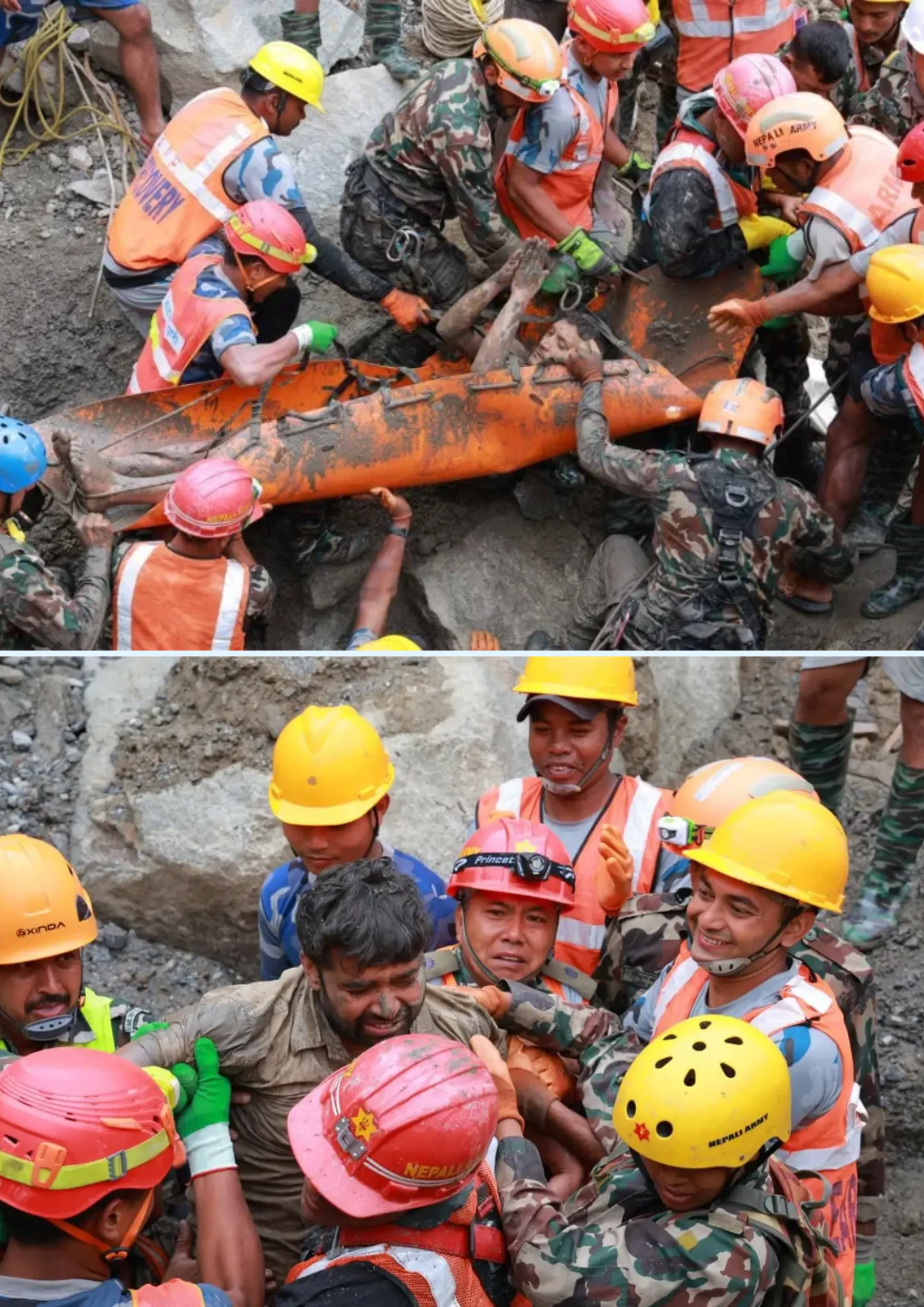
Visuals from the scene captured the emotional moment Nepali Army personnel pulled mud-caked survivors through a narrow ground opening. Cheers erupted from the crew as one survivor was carried out on a soldier’s back and another brought out on a stretcher, before both were airlifted via military helicopter to a specialized hospital in Kathmandu.
The Race Against Time Continues
While the rescue of Sah and Maharjan is being hailed as “a second life,” the emergency is far from over.
Authorities estimate that as many as 500 workers remain unaccounted for across 12 different hydropower projects affected by the devastating floods, with roughly 115 still believed to be trapped inside the Trishuli 3A tunnel complex alone.
Upon emerging, Sah informed military officers that at least 3 to 4 other workers were alive in his immediate vicinity before his extraction—and potentially dozens more further down near the main powerhouse.
“I can’t explain what we are feeling right now. We are just profoundly grateful to God,” said Amir Maharjan, brother of rescued supervisor Kabir.
As medical teams work around the clock in Kathmandu, specialized rescue crews—armed with heat sensors and sound-amplifying equipment—are diving back into the treacherous mud-filled tunnels, determined to bring every remaining worker home alive.