THREE ULTRASOUNDS SHOWED NO WARNING SIGNS, THEN THIS MOM GAVE BIRTH TO A BABY WITH A RARE TWO-FACED CONDITION THAT LEFT HER STUNNED

Identical conjoined twins are already extremely rare, but this condition is even more unusual, occurring in only around 1 in 2.5 million births.
Doctors did not recognize the unusual development of Gilang Andika until the baby was born.
Like any expectant mother, Ernilasari, who lives in Batam, Indonesia, was incredibly excited to meet her baby. Throughout her pregnancy, she felt healthy and experienced no signs that anything was unusual. She visited the hospital for three ultrasound scans, but doctors did not identify any concerns.
“The doctors only said the baby’s head was slightly large and that he was in a breech position, so I needed to have a C-section,” Ernilasari said.
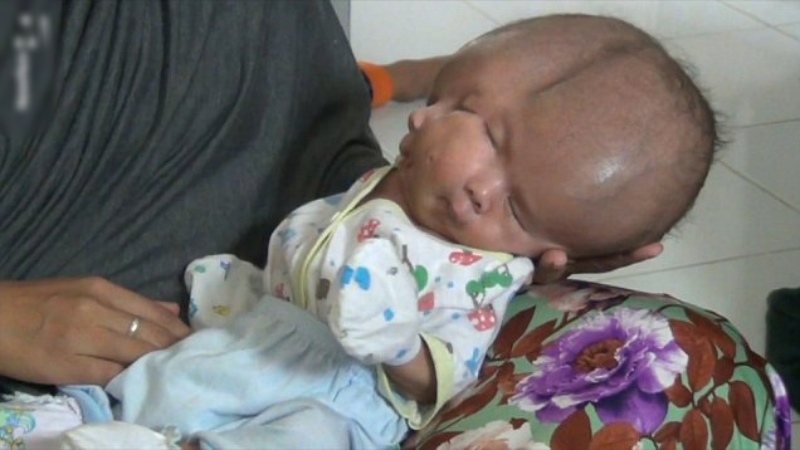
Yet when Ernilasari and her family saw the baby for the first time after his birth two months ago, they were deeply shocked to discover that he appeared to have two faces.
And as if that were not challenging enough, Andika was also born with other serious medical conditions, most notably hydrocephalus. This condition can place significant pressure on the brain and may later affect development, including learning, hearing, memory, speech and movement.
At present, the baby’s parents are hoping that doctors may be able to find a way to help him. Unfortunately, this is an exceptionally complex medical case where even access to significant financial resources may not make treatment possible.
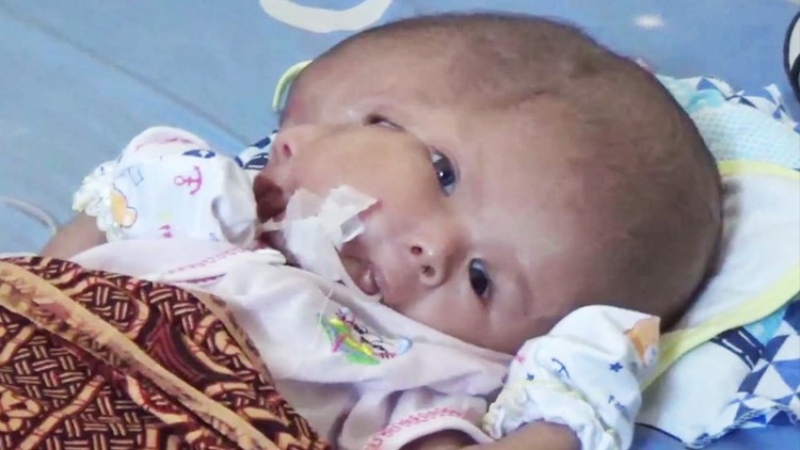
Helping Andika would require an extremely high-risk operation involving the removal of one side of the brain, one face and part of the skull. According to the latest reports, however, doctors are currently unable to perform such an operation.
In reality, baby Gilang Andika, Ernilasari’s son, does not simply have two faces. He also has two brain structures within a single body, which otherwise developed like that of a typical baby. The condition occurred because an additional face and brain structure from an incompletely developed twin became attached to his head.
Because of his rare condition, Gilang is unable to breastfeed and must receive formula through a feeding tube.

The baby also has hydrocephalus, a condition caused by an accumulation of fluid around the brain. Doctors have described his chances of survival as very limited.
Ernilasari and her husband are now doing everything they can to seek medical care for their son, but financial difficulties have made the situation even more challenging. Doctors in their local area have also explained that even with the necessary funds, they may not have the ability to perform the required operation.
Dr. Nenden Ismawati, who is caring for Gilang at Awal Bros Hospital in Batam, said: “We recommended that the family transfer the baby to a hospital in Jakarta, where more advanced medical equipment is available. However, that does not mean he would immediately undergo surgery, because doctors in Jakarta are still discussing his case.”

Conjoined twin pregnancies such as Gilang’s are estimated to occur in approximately 1 in 250,000 births. They can happen when a fertilized egg begins dividing into two embryos several weeks after conception, but the process does not completely separate. The most common forms of conjoined twins involve the chest or abdomen.
A case involving two faces like Gilang’s is known as Diprosopus, sometimes described as craniofacial duplication. Diprosopus is associated with a signaling protein known as “Sonic hedgehog homolog.” Despite its unusual name, this molecule plays an important role in determining facial development. When its signaling is unusually increased or duplicated during development, additional facial structures can form.

Whether conjoined twins can be separated surgically depends largely on where and how their bodies are connected. If they do not share major internal organs, the chances of a successful separation may be higher. In Gilang’s case, however, the complexity of his condition makes any surgical procedure exceptionally challenging, with a very limited possibility of success.
Source: Metro