THE HOUSE THEY HAD NO RIGHT TO SELL
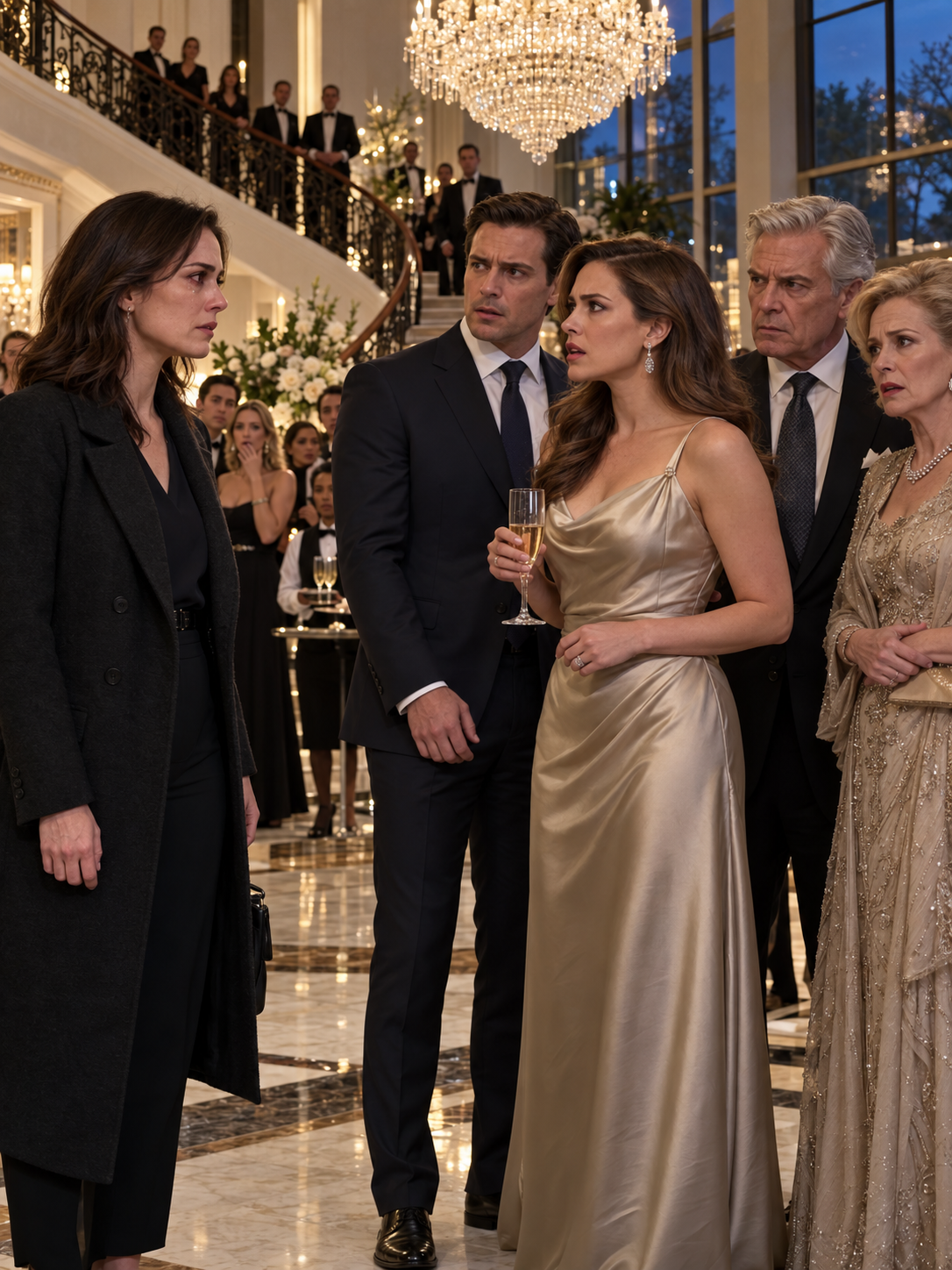
My sister was standing beneath a chandelier the size of a small car when I walked into her housewarming party and told her that part of her dream mansion had been paid for with stolen money.
Not money stolen from a bank.
Not money taken from some anonymous investor.
Money from the sale of the small house my late husband had left to me.
A house my parents had absolutely no legal right to sell.
For one extraordinary second, nobody moved.
The jazz quartet near the living room windows went silent mid-song.
A waiter froze with a silver tray balanced against one palm.
Across the marble foyer, half a dozen champagne glasses remained suspended halfway to expensive smiles.
And my father, Thomas Whitmore, stared at me with the same expression he had used since I was a teenager whenever I embarrassed him in public.
Not like I was his daughter.
Like I was an accounting error.
An inconvenience.
Something that needed to be corrected before anybody important noticed.
He smoothed the front of his charcoal suit and adjusted his tie.
“Vanessa,” he said calmly, “you’re a widow. At some point, you have to stop clinging to the past.”
I had expected anger.
I had expected denial.
I had even expected him to pretend he had no idea what I was talking about.
I had not expected that.
The sentence entered me like a blade.
For a moment, I saw Daniel again.
Not sick.
Not gone.
Alive.
Barefoot in our kitchen on a Sunday morning, holding two coffee cups and smiling because he had somehow managed to burn toast while doing absolutely nothing else.
Daniel had been dead for four years.
There were still days when my mind refused to understand the permanence of that fact.
And now my father was using my grief as evidence against me.
Before I could answer, my mother rushed across the foyer.
Cynthia Whitmore had always moved quickly when something threatened appearances.
She caught my forearm.
Her manicured nails pressed through the sleeve of my coat.
“Not tonight,” she whispered.
Her perfume was the same one she had worn to Daniel’s funeral.
“Please, Vanessa. Whatever this is, we can talk about it tomorrow.”
I looked down at her hand.
Then at her face.
She wasn’t worried about me.
She wasn’t worried about what had happened.
She was worried about the room.
The guests.
The photographs.
The people who might go home and tell someone that the Whitmores had family problems.
“Don’t ruin your sister’s special evening,” she added.
I gently removed her fingers from my arm.
Then I looked across the room.
Olivia was standing beside her husband, Terrence, beneath the chandelier.
My younger sister had always understood our parents better than I did.
She knew what made them proud.
Visibility.
Status.
Proximity to the right people.
She wore a champagne-colored designer dress that matched the drink in her hand. Her dark hair had been professionally styled into loose waves. Diamond earrings caught the light whenever she turned her head.
Behind her stretched the Oak Brook mansion my parents had spent months bragging about.
Nearly nine thousand square feet.
Six bedrooms.
A wine cellar.
A gym.
Heated floors.
A kitchen larger than the entire first floor of Daniel’s old house.
Outside, luxury cars filled the circular driveway while valets moved between them beneath portable heaters.
Inside, a photographer drifted through carefully arranged groups of guests.
Country club friends.
Business partners.
People my father golfed with.
People my mother wanted invitations from.
This was the sort of night my parents lived for.
Expensive.
Visible.
Photographable.
Then Olivia gave a small laugh.
It was light.
Casual.
Cruel.
“Daniel is gone, Vanessa.”
She slowly rotated the champagne flute between her fingers.
“At least his house finally did something useful.”
The room changed.
Not dramatically.
Nobody gasped.
Nobody shouted.
But the silence became different.
Sharper.
Even people who knew almost nothing about me knew enough to understand that Olivia had stepped over something.
I looked at her.
Then at my parents.
Then at the enormous staircase curling upward behind them.
For several seconds, all I could see were symbols of everything my family valued.
Imported marble.
Custom millwork.
Crystal.
Art selected by a designer because it matched the furniture.
A house purchased to prove something to people who would forget the evening by next month.
They were standing inside what they thought was their victory.
And suddenly, I started laughing.
Quietly.
I couldn’t help it.
Olivia’s smile vanished.
“What?”
I looked toward her.
“I was just wondering who would be stupid enough to buy that property without checking it first.”
That changed the atmosphere completely.
Terrence looked at me.
Really looked at me.
Until then, he had remained near Olivia’s shoulder, one hand in his pocket, wearing the restrained expression of a man determined not to become involved in a family argument.
Terrence Reed was an investment broker.
Successful.
Methodical.
The sort of man who read contracts before signing them.
The sort of man who knew that one page of paperwork could destroy millions of dollars.
My comment reached him in a way it didn’t reach anyone else.
“What do you mean?” he asked.
My father stepped forward.
“That’s enough.”
But I kept my eyes on Terrence.
“Ask Thomas what he actually sold.”
My father’s jaw tightened.
“I said that’s enough.”
“No,” I replied.
My voice was quiet.
That seemed to irritate him more than if I had yelled.
“I think it’s finally enough.”
Four weeks earlier, I had left Chicago for a forensic accounting assignment in Manhattan.
That was my work.
I followed money.
Not ordinary bookkeeping.
Not tax returns or payroll.
I reconstructed transactions people didn’t want reconstructed.
Corporate fraud.
Asset concealment.
Internal theft.
Procurement schemes.
Shell companies.
Insurance deception.
My job was to take financial activity someone had intentionally made complicated and make it simple again.
People imagined major fraud as some brilliant criminal architecture.
Usually it wasn’t.
Usually the truth was buried under confidence.
A missing disclosure.
An altered date.
A signature copied from another document.
A transfer routed through an entity nobody expected anyone to research.
A property sold without somebody reading the attachment buried twelve pages behind the deed.
Daniel used to joke that I could interrogate a spreadsheet until it confessed.
He understood details too.
He had been an urban planner.
Not glamorous.
Not wealthy.
But brilliant in the way that mattered.
Daniel could stand in front of a derelict building everyone else wanted demolished and see twenty possible futures.
He noticed land.
Drainage.
Foot traffic.
History.
Old infrastructure.
Where other people saw decay, Daniel saw systems.
Where they saw empty lots, he imagined parks.
Where they saw abandoned factories, he imagined affordable housing.
Where they saw a weathered wooden house outside Chicago, Daniel saw peace.
He bought that house two years before we married.
It wasn’t much to look at.
Faded green siding.
A narrow porch that leaned slightly east.
A detached garage with a roof he promised to repair every spring.
An apple tree that produced terrible fruit.
Daniel adored it.
He said one day we would restore it.
Not renovate it into something expensive.
Restore it.
There was a difference.
He wanted the original wood floors repaired.
The old kitchen opened toward the backyard.
A porch swing.
A small garden.
A long desk under the front window where I could work.
“We’ll disappear out there on weekends,” he once told me.
“No phones. No clients. No people asking you to find twenty million dollars before lunch.”
I had laughed.
“You wouldn’t survive without city planning meetings.”
“I’d survive beautifully.”
We never got to find out.
Daniel died at thirty-four.
An undiagnosed heart condition.
One ordinary Tuesday morning he kissed me goodbye.
By that evening, I was sitting in a hospital consultation room listening to a doctor explain why my husband was never coming home.
The house passed to me through Daniel’s estate.
I couldn’t sell it.
For years, I barely visited.
But I paid the taxes.
Kept the insurance.
Maintained the title.
Stored the probate records.
Eventually, the pain around the property became quieter.
Not gone.
Just quieter.
My parents never understood why I kept it.
Especially my father.
“Dead capital,” Thomas called it.
“An emotional liability.”
Once, at Thanksgiving, he actually suggested I sell it and invest the money through one of Terrence’s contacts.
I declined.
He brought it up again six months later.
Then again the following Christmas.
Eventually he stopped asking.
I thought he had accepted my answer.
I was wrong.
When my assignment in New York ended, I returned to Chicago late on a Thursday afternoon.
Instead of driving home from O’Hare, I headed toward Daniel’s property.
No special reason.
I had been thinking about him during the flight.
That still happened.
Sometimes grief arrived through obvious doors.
Birthdays.
Anniversaries.
Songs.
Sometimes it came because a man three rows ahead had the same hands Daniel had.
I wanted to see the house.
Maybe sit on the porch.
Maybe finally decide whether I was ready to start restoring it.
Instead, when I turned onto the road, I thought I had missed the address.
The landscape looked wrong.
I slowed.
Then stopped completely.
The house was gone.
Not damaged.
Not boarded up.
Gone.
Construction fencing surrounded the lot.
Daniel’s apple tree was gone.
The porch was gone.
The garage was gone.
The grass had been reduced to brown earth compressed beneath heavy machinery.
A yellow excavator stood near the back of the property.
Stacks of drainage pipe lay beside a trailer.
At the roadside, a sign displayed the logo of Halcyon Urban Development.
For several seconds I sat gripping the steering wheel.
My brain did something strange.
It refused the evidence.
Wrong street.
Wrong parcel.
Wrong address.
Then I saw the mailbox.
Daniel’s mailbox.
Still leaning beside the road.
Still painted dark green.
Still carrying the crooked metal numbers he had installed himself because he refused to use a level.
I got out of the car.
The air was brutally cold.
I barely noticed.
A man in a reflective jacket emerged from behind the site trailer.
“Can I help you?”
I pointed toward the dirt.
“What happened to the house?”
He frowned.
“The residence?”
“Yes.”
“Demolition was completed last week.”
The sentence was absurd.
Completed.
Like the destruction of Daniel’s last dream had been a scheduled line item.
“Why?”
He glanced toward the project sign.
“The site was purchased for redevelopment.”
My stomach tightened.
“Purchased when?”
“About three weeks ago, I think.”
Three weeks.
I had been in Manhattan.
I stepped closer.
“Purchased from whom?”
The man shifted his clipboard.
“I’m not really involved in acquisition.”
“Whose name was on the seller documents?”
He looked uncomfortable.
That was enough.
Because very few people had ever had access to Daniel’s estate records.
During probate, while I had barely been functioning, my mother had helped organize documents.
My father had taken copies of several property files to “help with administration.”
At the time, I had been grateful.
I had no memory of exactly what he copied.
But I remembered one thing perfectly.
Years earlier, Daniel had created a limited power-of-attorney authorization connected to the house when we were planning a renovation.
It had expired before he died.
And my father had seen it.
That detail surfaced in my mind with frightening clarity.
I didn’t cry.
I didn’t call my parents.
I didn’t drive home.
I walked back to my car, opened my laptop, connected through my phone, and pulled the county recorder database.
Twenty minutes later, I was staring at the transaction.
The seller listed was me.
Vanessa Hart.
The signature looked like mine.
It wasn’t.
Attached to the transaction was a notarized authority document claiming Thomas Whitmore had been legally empowered to execute the sale on my behalf.
That document was false.
And the sale price made everything worse.
The property had sold for $1.86 million.
Far more than the old house itself could possibly have been worth.
I immediately understood why.
They hadn’t bought the house.
They had bought the land.
I downloaded every available filing.
The purchaser was an entity called HFD Holdings IV.
A quick corporate search connected it to Halcyon Urban Development.
The transfer had closed eleven days earlier.
The house had been demolished six days after closing.
Fast.
Very fast.
Then I saw a second transfer.
$1.2 million from the closing escrow had gone to a family trust administered by Thomas Whitmore.
Two days later, $950,000 had been transferred from that trust toward the acquisition of Olivia and Terrence’s new house.
I stared at the numbers.
The rest had been divided into fees, taxes, and another transfer I didn’t recognize.
My father hadn’t simply sold my property.
He had used the proceeds to fund my sister’s mansion.
I shut my laptop.
Then drove to Oak Brook.
By the time I entered Olivia’s party, I knew enough to be dangerous.
But not enough to understand how much danger they were in.
Back in the foyer, my father stepped toward me.
“The property was deteriorating. You were doing nothing with it.”
“So you forged my authorization?”
His eyes flicked toward the guests.
“Keep your voice down.”
“That’s not an answer.”
My mother moved between us.
“It wasn’t like that.”
“Then explain it.”
She glanced at Thomas.
That glance told me everything about the hierarchy of my parents’ marriage.
My father made decisions.
My mother explained them afterward.
Olivia folded her arms.
“Dad said there were old estate powers still in place.”
“There weren’t.”
“You never used the house.”
“I owned it.”
“You’re one person, Vanessa. We’re family.”
I almost smiled.
Family.
The word had been used against me so many times it barely sounded like language anymore.
Whenever Olivia needed something, family meant I should sacrifice.
Whenever I needed something, family meant I should understand why everyone was too busy.
Dad lifted his chin.
“It was the responsible financial decision.”
“You sold property that didn’t belong to you.”
“I handled a dormant asset.”
“You forged authorization.”
“I did not forge anything.”
“Then who signed my name?”
His silence lasted less than two seconds.
But I saw it.
And so did Terrence.
Terrence moved away from Olivia.
“What exactly did you give the title company?”
Dad turned.
“This has nothing to do with you.”
“It paid for my house.”
Terrence’s voice had changed.
No longer son-in-law.
Professional.
“What document did you use?”
My mother whispered, “Thomas.”
Then someone knocked on the front door.
Hard.
Once.
Every conversation nearby stopped.
A second knock followed.
One of the catering staff looked uncertainly toward Olivia.
She nodded irritably.
The door opened.
A man stood outside wearing a dark official jacket.
Not local police.
Not a courier.
Federal identification was visible near his chest.
In his hand was a thick manila package sealed across one edge with red evidence tape.
Behind him, the American flag beside Olivia’s front porch shifted in the winter wind.
He stepped into the foyer.
“Terrence Reed?”
Terrence’s face tightened.
“Yes.”
“Olivia Reed?”
My sister looked annoyed.
“Yes?”
The man held out the envelope.
“You’ve been served with an emergency federal preservation notice and notice of claim affecting this residence.”
Nobody moved.
Terrence took the package.
His fingers pressed against the red seal.
“What agency?”
“Read the first page, sir.”
Terrence broke the seal.
Pulled out the documents.
His eyes moved across the page.
Once.
Then again.
The color left his face.
Olivia finally stopped staring at me.
“Terrence?”
He didn’t answer.
She stepped closer.
“What is it?”
His hands began to shake.
My father’s expression changed.
My mother gripped the edge of a console table.
Terrence looked up slowly.
“Thomas…”
My father said nothing.
Terrence lifted the document.
“What the hell did you sell?”
That was the moment the party truly ended.
Because the federal notice did not concern Daniel’s house.
It concerned the land underneath it.
And the one thing my parents had never bothered to discover before they forged my name and sold it.
Daniel’s property wasn’t entirely his to sell either.
Not anymore.
Years before his death, he had placed part of it into a federally recognized conservation and infrastructure program connected to an abandoned underground water system running beneath three neighboring parcels.
The property carried federal environmental restrictions.
Development prohibitions.
Disclosure requirements.
And a preservation covenant.
But that was only the beginning.
Because according to the document in Terrence’s shaking hands, someone had demolished a protected structure, disturbed restricted ground, and transferred title using an apparently fraudulent instrument.
Federal investigators had already frozen the redevelopment.
And because proceeds from the disputed sale had been traced into Olivia and Terrence’s new home…
The mansion itself had just become part of the investigation.
Olivia stared at Terrence.
Then at me.
“What does that mean?”
Terrence swallowed.
“It means…”
He looked toward the hundreds of thousands of dollars in furniture, marble and glass around us.
“…we might not actually own this house the way we think we do.”
PART 2 — WHAT DANIEL BURIED IN THE PAPERWORK
The guests left quickly.
People who had spent the previous hour pretending they wanted to stay until midnight suddenly remembered babysitters, early meetings, long drives, migraines and dogs that apparently required immediate medical attention.
Within twenty minutes, the mansion had emptied.
The catering staff quietly packed trays.
The photographer disappeared.
The jazz quartet loaded their instruments without making eye contact with anyone.
The magnificent party my sister had planned for three months ended with half-finished champagne abandoned across the house.
I remained.
Not because Olivia wanted me there.
She didn’t.
But because Terrence did.
He carried the federal documents into his home office and closed the door behind us.
My parents followed.
Olivia came last.
She was furious now.
Not frightened.
Not yet.
Fear would come later.
For the moment, she still believed this was something a lawyer could make disappear.
Terrence spread the pages across his desk.
I stood opposite him.
Dad remained near the window.
Mom sat on the sofa.
Olivia paced.
“What is this?” she demanded.
Terrence ignored her.
He looked at me.
“Did you know about the covenant?”
“I knew Daniel had restrictions connected to the property. I didn’t know the exact current status.”
“What restrictions?”
“Daniel participated in an urban watershed rehabilitation program about eight years ago.”
My father gave a dismissive snort.
Terrence immediately turned.
“Thomas, stop.”
The authority in his voice surprised everyone.
Dad’s eyes narrowed.
Terrence tapped the document.
“This is not a zoning dispute.”
“What exactly is it?” Mom asked.
I leaned toward the pages.
The preservation notice had been issued through a joint enforcement action involving the Environmental Protection Agency, the Army Corps of Engineers and the United States Attorney’s Office.
That explained the speed.
Halcyon had begun excavation near a mapped subterranean water conduit linked to an old municipal drainage network.
Daniel had discovered that system while researching historical land use.
Decades earlier, part of the area had been considered for industrial expansion. Contamination from two former manufacturing sites had entered portions of the underground soil and water channels.
The environmental program restricted excavation until remediation could be completed.
Daniel’s parcel contained an access point.
Not visible.
Not obvious.
But legally significant.
“Halcyon should have discovered this,” Terrence said.
“They probably did,” I answered.
He looked at me.
“What?”
“The federal notice was issued too fast for this to be new information.”
I pointed to a reference number.
“Look at the investigation date.”
Terrence read it.
His face tightened.
The inquiry had opened two months before the sale.
Olivia stopped pacing.
“So the developer knew?”
“Possibly.”
My father spoke.
“They assured me everything was fine.”
The room fell silent.
I turned slowly.
Terrence looked at him too.
“You spoke directly to them?”
Dad realized his mistake.
“Of course I did. I negotiated the sale.”
“With who?”
“I don’t remember.”
“Dad.”
“Some acquisition manager.”
I opened my bag and removed the folder I had printed before driving over.
“You sold a property worth maybe four hundred thousand dollars based on improvements for one point eight six million, and you don’t remember who negotiated it?”
He looked at me coldly.
“The land had development value.”
“Not legally.”
“You don’t know that.”
“I know enough.”
I pulled out the deed.
Then another document.
“Halcyon paid four times the likely residential value for land under an environmental restriction.”
Terrence stared at the papers.
I continued.
“They also demolished the house almost immediately after closing.”
“Meaning?” Mom whispered.
“Meaning whoever purchased it may have wanted something destroyed.”
Olivia laughed nervously.
“That sounds ridiculous.”
I looked at her.
“Fraud often does.”
Dad slammed his palm against the desk.
“Enough of this amateur detective performance.”
I met his stare.
“Amateur?”
He knew exactly what I did for a living.
That was why the insult was almost funny.
I opened another page.
“The notary who allegedly witnessed my authorization works in Indiana.”
Dad said nothing.
“The document says I signed it in Illinois.”
Still nothing.
“On the date listed, I was in New York.”
His expression remained rigid.
“I gave a sworn deposition in federal court that morning. There’s video.”
Mom covered her mouth.
Olivia stopped moving.
I leaned closer.
“So whoever prepared this document didn’t just forge my signature.”
I tapped the page.
“They created provably false evidence.”
For the first time, my father looked genuinely uncertain.
Terrence sat back slowly.
“Thomas, tell me exactly what happened.”
Dad remained silent.
“Everything,” Terrence said.
Mom looked at her husband.
“Tell them.”
Dad’s jaw moved.
Then he spoke.
He claimed he had received a call six weeks earlier from a property acquisition consultant named Martin Vale.
Vale said Halcyon was assembling parcels for a redevelopment project.
Daniel’s property was strategically valuable.
Dad had apparently told him the owner—me—was emotionally attached and unlikely to sell.
Vale asked whether there were estate arrangements allowing another family member to handle the property.
That should have ended the conversation.
Instead, my father remembered the old power-of-attorney document.
According to him, Vale said it might still provide authority depending on how Daniel’s estate had been structured.
My father sent him a copy.
I felt physically sick.
“You sent a stranger Daniel’s estate documents?”
“He represented a major development company.”
“You didn’t verify that?”
“I verified enough.”
Terrence laughed once.
There was no humor in it.
“No, you didn’t.”
Dad glared at him.
Vale later produced what he described as an updated authorization derived from the original estate authority.
Dad insisted he had believed it legitimate.
I didn’t.
Not completely.
He might have believed the legal theory was convenient.
He could not possibly have believed my signature appeared magically on a document I had never seen.
“Who signed my name?” I asked.
He looked away.
“Thomas,” Mom whispered.
I waited.
Finally, he said, “Vale said their legal department handled execution.”
My stomach dropped.
“You knowingly submitted a document with my signature even though you knew I hadn’t signed it.”
“I was told it was legally sufficient.”
“That wasn’t my question.”
He said nothing.
There it was.
The first complete truth of the night.
My father knew.
Maybe he didn’t understand the federal restrictions.
Maybe he didn’t know what Halcyon intended.
But he knew I had never signed authorization.
And he proceeded anyway.
Olivia dropped into a chair.
“Why?”
Dad looked toward her.
Because despite everything, this part was simple.
“The bank wouldn’t approve the amount you needed.”
Olivia’s face changed.
Terrence turned toward his wife.
“What?”
She closed her eyes.
My father continued.
“The additional financing fell through. Olivia needed nine hundred thousand dollars to close.”
Terrence stood.
“You told me the family trust was covering it.”
“It did.”
“With stolen money.”
“Watch your language.”
Terrence stared at him.
“I work in regulated finance. My name is now connected to an asset funded through proceeds of a fraudulent real estate transaction currently under federal investigation.”
He lowered his voice.
“You have no idea what you’ve done to me.”
Olivia stood quickly.
“Terrence, I didn’t know.”
He looked at her.
“Did you know the money came from Vanessa’s property?”
She hesitated.
One second.
Two.
Three.
Enough.
Terrence closed his eyes.
“Jesus Christ.”
“It was Dad’s decision.”
“You knew?”
“I knew they were selling it.”
“You knew Vanessa hadn’t agreed?”
“I thought Dad had authority.”
“You joked about Daniel’s house finally being useful.”
Her face crumpled with anger.
“That doesn’t mean I knew all the legal details.”
“No,” I said quietly.
“It means you didn’t care.”
Olivia looked at me with pure hatred.
“Don’t act superior.”
“I don’t need to.”
She stepped toward me.
“You have always looked down on me.”
I almost laughed.
“No, Olivia. I spent thirty years cleaning up after you.”
Her mouth opened.
I continued before she could speak.
“When you wrecked Dad’s car at nineteen, I picked you up before Mom arrived.”
“That has nothing to do with this.”
“When you maxed out your first credit card, I loaned you six thousand dollars.”
“I paid that back.”
“Dad paid it back.”
Her cheeks flushed.
“When you quit your first job because your manager criticized you, I rewrote your résumé.”
“Stop.”
“When Terrence’s mother died, I spent three days arranging food and travel because you said grief made you uncomfortable.”
Terrence looked at her.
I hadn’t intended to say that.
But now it was out.
Olivia shook her head.
“You’re obsessed with being the martyr.”
“No.”
For the first time that evening, my voice broke.
“I’m tired.”
The room went quiet.
“I’m tired of being called independent whenever nobody wants to show up for me.”
My mother looked down.
I swallowed.
“I’m tired of hearing that Olivia needs help while Vanessa can handle it. I’m tired of being expected to lose gracefully so she can win comfortably.”
Mom whispered my name.
I looked at her.
“And I’m tired of pretending you didn’t know.”
She began crying.
That did not affect me the way it once would have.
“Did you know Dad was selling Daniel’s house?”
“Yes.”
The answer was barely audible.
“Did you know I hadn’t agreed?”
She covered her face.
“Yes.”
Olivia looked toward her.
“Mom?”
Cynthia cried harder.
My father said sharply, “This is pointless.”
“No,” Terrence said.
“It’s evidence.”
The word silenced him.
Terrence gathered the federal pages.
“I’m calling counsel.”
Dad immediately replied, “We should coordinate one attorney.”
“No.”
Terrence looked straight at him.
“We absolutely should not.”
That was the first crack in the family alliance.
It would not be the last.
I returned home shortly after midnight.
The apartment was exactly as I had left it before New York.
Clean.
Quiet.
Daniel’s photograph beside the bookshelf.
His old ceramic coffee mug still in the kitchen cabinet because I had never been able to throw it away.
I stood in the dark for several minutes.
Then I did what I always did when life became unbearable.
I worked.
I created a timeline.
Daniel purchased property.
Daniel recorded conservation restriction.
Daniel died.
Estate transferred ownership to me.
Expired power of attorney retained in probate records.
Thomas gained access.
Halcyon inquiry began.
Martin Vale contacted Thomas.
False authorization prepared.
Sale executed.
Funds transferred.
Property demolished.
Federal site investigation escalated.
Funds traced to Reed residence.
Then I created another list.
Questions.
Who was Martin Vale?
Why had Halcyon approached my father instead of me?
Why pay $1.86 million for restricted property?
What had they hoped to gain?
What had been destroyed during demolition?
And what was the unexplained transfer from the closing escrow?
I logged into a professional corporate records database.
Martin Vale existed.
Sort of.
He had worked for three consulting companies over twelve years.
Every one of them had connections to land acquisition.
Two had been sued.
One had dissolved after a federal bid-rigging investigation.
His current company, Vale Strategic Property Solutions, shared an address with six unrelated entities.
That address was a mailbox service.
I searched deeper.
Forty minutes later, I found a connection.
Vale’s firm had received consulting payments from Halcyon.
I kept going.
At 2:17 a.m., I found something that made me sit upright.
The unexplained $143,000 payment from the closing proceeds had gone to Vale Strategic Property Solutions.
Seller-side consulting fee.
My father had paid Martin Vale.
That made no sense.
Vale supposedly represented Halcyon.
Why would the seller pay him?
Unless he wasn’t simply arranging the purchase.
Unless the payment bought something else.
At 2:46, I found an email address associated with an old state licensing filing.
At 3:02, I sent one message.
Martin,
My name is Vanessa Hart.
You were involved in the unauthorized sale of my property.
I’m giving you one opportunity to contact me before federal investigators do.
At 3:11 a.m., my phone rang from a blocked number.
I stared at it.
Then answered.
Silence.
“Martin?”
A man breathed on the other end.
Then said five words.
“You need to find Daniel’s files.”
My skin went cold.
“What files?”
“Your husband knew about the site.”
“What are you talking about?”
“He knew more than anyone.”
“About what?”
A pause.
Then:
“Ask why they wanted the house demolished before anyone could inspect the basement.”
The call disconnected.
I sat completely still.
Daniel’s house had no finished basement.
Only an old stone foundation and a narrow utility cellar.
But I remembered something.
Two months before Daniel died, he had come home one evening covered in dust.
I teased him about crawling under the house.
He had smiled.
“Found something weird.”
I had barely listened.
I had been working late.
“What?”
“Old municipal access structure.”
“Is that bad?”
“Potentially interesting.”
That was Daniel.
Potentially interesting.
Everything was interesting to him.
I remembered asking whether we needed to worry.
He had kissed my forehead.
“No. I’m documenting it.”
Documenting it.
I stood so quickly my chair hit the floor.
Daniel had kept records of everything.
Maps.
Surveys.
Photographs.
Notes.
Copies.
Some digital.
Some paper.
After he died, I had packed his planning materials into storage.
Not at my apartment.
At a climate-controlled facility outside the city.
My parents didn’t know about it.
Neither did Olivia.
At seven the next morning, I was standing in front of storage unit 418.
Inside were twelve boxes with Daniel’s handwriting.
I opened the first.
Then the second.
The fifth box contained property files.
At the bottom was a black archival binder.
Across the cover Daniel had written:
HARPER ROAD — SUBSURFACE ACCESS / WATER CORRIDOR
Inside were maps.
Historical surveys.
Photographs of the cellar.
Government correspondence.
And one sealed envelope.
Written on the front:
VANESSA — IF THE PROPERTY IS EVER SOLD, READ THIS FIRST.
My hands began shaking.
I opened it.
Inside was a handwritten letter from my husband.
And halfway through the first page, I realized Daniel had anticipated almost everything.
Not my father.
Not Olivia.
Not the forgery.
But the possibility that one day someone would try to acquire that land without understanding what was under it.
The final sentence on the page made me stop breathing.
If anyone offers far more than the house is worth, Ness, they aren’t buying the house.
They’re buying silence.
PART 3 — DANIEL’S MAP
I read Daniel’s letter three times.
The first time, I read it as his widow.
The second time, as a forensic accountant.
The third time, I read it as evidence.
The handwriting was unmistakably his.
Slight rightward slant.
Capital letters too large.
Numbers written with military precision.
He explained that while researching drainage and redevelopment history in the area, he had discovered an undocumented branch of an early municipal industrial-water system.
The corridor crossed beneath several parcels.
Most had been filled or sealed decades earlier.
His property retained one of the last accessible maintenance entries.
That alone mattered environmentally.
But Daniel had found something else.
Historical sampling records suggested contamination near an abandoned chemical-processing site two parcels north.
A developer had previously attempted to acquire several surrounding properties.
Daniel believed they hoped to gain control of the corridor before new environmental mapping made the contamination public.
He had reported what he found.
Quietly.
Properly.
Not dramatically.
The Environmental Protection Agency had opened a preliminary review.
The county had added restrictions.
Then the matter slowed.
Budgets changed.
Ownership changed.
Other investigations took priority.
Daniel continued documenting the site.
His letter ended with instructions.
Do not authorize excavation without counsel.
Do not remove the old cellar wall.
Do not sell through an intermediary.
And if anyone tries to rush a transaction, assume they know something you don’t.
I lowered the paper.
My father had violated every instruction.
My phone rang.
Unknown number.
I almost ignored it.
Then answered.
“Vanessa Hart?”
“Yes.”
“This is Special Agent Rebecca Sloan with the EPA Criminal Investigation Division.”
I stood very still.
“I’d like to speak with you regarding the Harper Road property.”
I looked down at Daniel’s files.
“When?”
“As soon as possible.”
“I have documents you may want.”
There was a brief pause.
“What kind?”
“My husband’s original environmental research.”
This time, her pause was longer.
“Ms. Hart, please do not copy, alter, reorganize or provide those documents to anyone.”
“I’m an auditor. I know evidence handling.”
“I understand.”
Something in her voice suggested she knew exactly who I was.
“We’ll send someone.”
Two agents arrived ninety minutes later.
Rebecca Sloan was in her early forties, compact, controlled, with the habit of listening longer than most people found comfortable.
The second was Daniel Kim, an investigator from the U.S. Attorney’s Office.
The coincidence of his first name hit me harder than I expected.
We worked at a folding table inside the storage facility office while they reviewed the binder.
When Sloan reached Daniel’s letter, she stopped.
“Did you know he was communicating with the EPA?”
“Generally. Not in detail.”
“Why not?”
“Because I was married to an urban planner.”
For the first time, she smiled faintly.
“That explains it?”
“Daniel discussed stormwater systems the way normal people discuss television.”
Kim almost laughed.
Sloan continued reading.
Then she turned to one of Daniel’s old photographs.
It showed the cellar wall before the house was demolished.
A metal panel sat low behind an old utility shelf.
Stamped onto it was a municipal insignia.
Sloan looked up.
“This access point is gone.”
“The entire house is gone.”
“We know.”
“Why is it important?”
She exchanged a glance with Kim.
“We can’t discuss everything.”
“Then discuss what you can.”
Sloan leaned back.
“Halcyon Urban Development is part of a broader investigation.”
My stomach tightened.
“For what?”
“Potential environmental fraud, false disclosures, unlawful excavation and financial crimes connected to land acquisition.”
“How broad?”
“We’re still determining that.”
“Was Daniel’s property already involved?”
“Yes.”
The answer was immediate.
“So they knew.”
“Certain individuals associated with the developer knew restrictions existed.”
My anger sharpened.
“And they bought it anyway.”
“They acquired it using an ownership document we now believe was fraudulent.”
“Why?”
“That’s one of our questions.”
I pointed toward Daniel’s photograph.
“What was behind that wall?”
“We don’t know.”
I stared at her.
“Halcyon demolished it before your team could inspect?”
“Yes.”
There it was.
The real shape of the problem.
The house had not merely been inconvenient.
It had contained access.
Potential evidence.
The demolition had erased a physical location investigators had intended to examine.
“Did Martin Vale know?”
Both agents became still.
Sloan asked, “Why are you asking about him?”
“He called me.”
That changed everything.
I told them.
Every word.
Kim immediately began taking notes.
Sloan’s expression hardened when I repeated Vale’s statement about the basement.
“Has he contacted you again?”
“No.”
“If he does, don’t meet him.”
“I wasn’t planning to.”
“Don’t warn him either.”
“What is he?”
“Someone we would very much like to speak with.”
Before they left, I gave them Daniel’s binder under receipt.
I kept his handwritten personal letter only after they scanned it.
Sloan stopped at the doorway.
“There’s something else you should understand.”
I waited.
“Your family may not be the primary target of the federal investigation.”
I felt no relief.
“But?”
“But the fraudulent transfer creates serious exposure.”
“My father knowingly used a signature I didn’t provide.”
“That matters.”
“And my mother?”
“If she participated, that matters.”
“Olivia?”
“We follow evidence, Ms. Hart.”
I understood the phrase.
I had used versions of it myself.
Facts first.
Emotions later.
“What about Terrence?”
“Same answer.”
Then Sloan added, “For what it’s worth, his attorney contacted us this morning.”
That surprised me.
“Already?”
“He disclosed the source of the funds voluntarily and offered financial records.”
Terrence was protecting himself.
Smart.
But perhaps not only himself.
By noon, my family had split into separate camps.
Terrence retained independent counsel.
My father retained a criminal defense attorney.
My mother called me seventeen times.
Olivia sent one message.
LOOK WHAT YOU’VE DONE.
I stared at it for several seconds.
Then blocked her.
Not because I hated her.
Because for once, I understood that access to me was not a family right.
It was something people had to deserve.
Three days later, Halcyon Urban Development filed a civil action claiming it had purchased the Harper Road property in good faith.
Their position was aggressive.
They blamed the seller.
Meaning my father.
According to the complaint, Thomas Whitmore represented that he had full legal authority to execute the transaction.
Halcyon claimed it had no reason to suspect fraud.
That was interesting.
Because Daniel’s files suggested the opposite.
So did the federal investigation.
But Halcyon had lawyers.
Expensive ones.
And they understood the oldest rule in institutional wrongdoing.
If enough people participated, everyone could point at someone else.
My father called from another number after I blocked his first.
I answered because I wanted to hear what he would say.
“We need to meet.”
“No.”
“Vanessa.”
“You sold my property.”
“I made a mistake.”
“You forged authority.”
“I relied on professionals.”
“You knew I didn’t sign.”
Silence.
Then his voice softened.
I had almost never heard my father sound vulnerable.
“I could go to prison.”
I closed my eyes.
There was a time when that sentence would have broken me.
Maybe that was why he used it.
“What do you want me to do?”
“Clarify that you had previously discussed selling the property.”
“We did.”
Relief entered his voice.
Then I finished.
“And I repeatedly said no.”
He exhaled sharply.
“You could tell investigators I had reason to believe you would eventually agree.”
“That would be a lie.”
“I am your father.”
There it was again.
Family.
The emergency key people pulled out whenever consequences arrived.
“You were my father when you stole from me.”
He went quiet.
I continued.
“You were my father when you used Daniel’s death to justify it.”
“Vanessa—”
“You were my father when Olivia laughed about his house in front of strangers.”
“She was upset.”
“No. She was comfortable.”
That distinction mattered.
Cruelty spoken under pressure was one thing.
Cruelty spoken while holding champagne was another.
Dad’s voice became cold again.
“If you pursue this, you will destroy this family.”
I looked at Daniel’s photograph on my shelf.
“No.”
I said it calmly.
“You already did.”
I ended the call.
My hands shook afterward.
Strength, I learned, rarely felt strong.
Most of the time it felt like nausea, grief and choosing not to reverse yourself.
Terrence came to see me that evening.
Alone.
He looked exhausted.
No suit.
No tie.
Just dark pants and a sweater.
I almost didn’t let him inside.
Then I remembered how quickly he had cooperated with investigators.
I opened the door.
“What do you want?”
“To apologize.”
That was unexpected.
“For what?”
“For not asking enough questions.”
I leaned against the doorframe.
“You didn’t forge anything.”
“No. But I accepted nine hundred fifty thousand dollars from Thomas without asking where it really came from.”
“He said family trust.”
“He did.”
“And?”
“And I wanted to believe him.”
There it was.
Not innocence.
Not guilt.
Something more ordinary.
Convenience.
Terrence looked toward the apartment.
“Can I come in?”
I stepped aside.
He sat at my kitchen table.
The same table where Daniel and I had once argued about paint colors.
Terrence folded his hands.
“Olivia and I separated this morning.”
I stared at him.
“What?”
“She thinks my cooperation with investigators is betrayal.”
“That was fast.”
“It wasn’t.”
His expression became tired.
“This situation was fast.”
“The marriage wasn’t.”
I said nothing.
He continued.
“For years, I convinced myself her family dynamic was harmless.”
“Because you benefited from it.”
“Yes.”
I appreciated the answer.
He didn’t defend himself.
“I benefited from Thomas opening doors. Introductions. Clients. Clubs. Opportunities.”
“And the house.”
“And the house.”
He looked around my small apartment.
“Daniel liked you being an auditor?”
The question surprised me.
“He loved it.”
“He wasn’t threatened?”
I almost smiled.
“Daniel used to send me news articles about fraud cases during breakfast.”
Terrence nodded.
“Olivia hates my work.”
“Why?”
“She thinks rules are things nervous people hide behind.”
That sounded exactly like my sister.
He took a breath.
“There’s something you need to know.”
I waited.
“Thomas didn’t give us nine hundred fifty thousand.”
I frowned.
“The records show—”
“He gave Olivia nine hundred fifty thousand.”
My stomach tightened.
“What’s the difference?”
“The house purchase required only seven hundred thousand from her family contribution.”
I sat down.
“Where did the rest go?”
“I asked her yesterday.”
“And?”
“She claims Dad told her she could keep it.”
“Keep two hundred fifty thousand dollars?”
Terrence nodded.
“For what?”
“She won’t say.”
The forensic part of my mind took over.
“Account?”
He slid a page toward me.
I looked at it.
A wire transfer.
$250,000.
From a personal account in Olivia’s name.
To Vale Strategic Property Solutions.
I stopped breathing.
“Martin Vale?”
“Yes.”
“Why did she pay him?”
“She says she doesn’t remember.”
I looked at Terrence.
He looked back.
We both knew the answer.
People remembered quarter-million-dollar transfers.
“I gave this to federal investigators,” he said.
“When?”
“Two hours ago.”
“Does Thomas know?”
“No.”
“Olivia?”
“She knows I found it.”
I leaned back.
The family betrayal had changed shape.
My father had paid Vale $143,000 at closing.
My sister had paid him another $250,000 afterward.
Nearly four hundred thousand dollars.
Martin Vale wasn’t merely an acquisition consultant.
He was being compensated by both sides of the family.
Why?
Terrence stood.
“At first I thought Thomas was the person who got us into this.”
He looked toward the paper.
“Now I’m not sure Olivia was as uninvolved as she claims.”
Neither was I.
The next morning, Special Agent Sloan called.
“We found Martin Vale.”
“Alive?”
A pause.
“Yes.”
That pause frightened me.
“Where?”
“Wisconsin.”
“Did he talk?”
“We’ll be interviewing him.”
“Was he hiding?”
“We’re not characterizing it yet.”
I understood.
Then she said, “Ms. Hart, there’s another reason I called.”
“What?”
“We recovered electronic communications from a Halcyon employee.”
I sat down.
“And?”
“One message references your property.”
My mouth went dry.
“What does it say?”
Sloan hesitated.
Then gave me only the part she was authorized to disclose.
“Clear residence immediately after transfer. Priority is access point removal before review.”
I closed my eyes.
The demolition had been deliberate.
Daniel’s house had been destroyed because of what it contained.
Then Sloan added one more sentence.
“The message was sent before your father ever signed the sale agreement.”
That meant Halcyon knew exactly what they wanted.
And someone had helped them get it.
PART 4 — THE FAVORITE DAUGHTER
Olivia disappeared for two days.
Not physically.
She remained in Chicago.
But she stopped answering her parents, Terrence, attorneys and eventually federal investigators.
That was a mistake.
On the third morning, two agents arrived at the Oak Brook mansion with a warrant for electronic devices.
By afternoon, they had her phone.
Laptop.
Tablet.
And access to a cloud account Olivia apparently believed deleting messages had erased.
Deletion is a comforting myth.
Anyone who works around financial investigations learns that quickly.
Modern life leaves fossils everywhere.
Backups.
Metadata.
Mirrors.
Server logs.
Receipts.
Notifications.
Shared attachments.
And people always forget someone else may still have their copy.
I didn’t know what investigators found until later.
But I learned enough.
Olivia had met Martin Vale before my father did.
Six months earlier.
At a charity event.
He had overheard her discussing difficulty financing the Oak Brook house.
She complained that her wealthy family had assets but refused to “liquidate anything useful.”
Vale asked what kind of assets.
Olivia mentioned Daniel’s property.
Not by address initially.
Just “my dead brother-in-law’s worthless old house.”
Eventually she showed Vale photographs.
He recognized the location.
That changed everything.
Vale knew Halcyon had been trying to acquire access to the area.
He contacted a Halcyon executive named Garrett Shaw.
Shaw offered a substantial “consulting incentive” if Vale could deliver the parcel quickly and quietly.
Vale then approached Olivia.
According to the recovered messages, he told her the property could be worth far more than her sister realized.
Olivia wanted to know how quickly it could be sold.
Vale asked whether I would agree.
Her response appeared in the federal affidavit months later.
Vanessa never agrees to anything that helps me.
Find another route.
That sentence hurt more than I expected.
Not because it was insulting.
Because it reduced our entire relationship to one belief:
Anything I kept for myself was something I denied her.
Vale asked about estate paperwork.
Olivia told him my father had handled documents when Daniel died.
Everything after that became a conspiracy assembled from entitlement and greed.
Vale found the expired power of attorney.
A document service altered dates.
A notary associated with one of his prior companies authenticated a signature.
Thomas received the new document and asked questions.
Not enough.
Then he called Olivia.
According to phone records, they spoke for forty-seven minutes.
Afterward, he proceeded with the sale.
Was my father manipulated?
Partially.
Did he understand every element?
No.
Did he know I had never signed?
Yes.
And that destroyed his favorite defense.
My mother’s role was smaller.
But not nonexistent.
She had witnessed Thomas searching old estate boxes.
She knew they planned to sell Daniel’s property.
When she asked if I had agreed, my father told her, “Vanessa will be angry, but she’ll get over it.”
Cynthia said nothing.
Later, she signed a statement for the title file claiming I had discussed disposition of the property with the family.
Technically true.
Deeply misleading.
In families like ours, complicity often wore the clothes of keeping peace.
My mother had spent decades avoiding conflict with my father.
Eventually, avoidance became participation.
Olivia called me the night after agents searched her house.
I nearly ignored it.
Then I answered.
She was crying.
Not elegantly.
Not quietly.
I had never heard her like that.
“They think I planned everything.”
I said nothing.
“I didn’t know about the federal site.”
“That doesn’t excuse stealing my property.”
“I didn’t steal it.”
“You connected Vale to Dad.”
Silence.
“How do you know?”
I almost laughed.
“You’re worried about the wrong thing.”
“Vanessa, please.”
That word sounded strange coming from her.
Please.
For most of our lives, Olivia had asked for things as though the universe had already approved them.
“Did you know the authorization was fake?”
“I thought there was a legal workaround.”
“Did you know I hadn’t signed it?”
She began crying harder.
I waited.
“Yes.”
There it was.
Simple.
Small.
Devastating.
“Why?”
“I needed the house.”
I stared at the wall.
Of all the possible answers, that one made me the angriest.
Not because it was complicated.
Because it wasn’t.
She needed the house.
Therefore my house could disappear.
“You needed a nine-thousand-square-foot mansion?”
“You don’t understand.”
“No. I really don’t.”
“Everyone expected us to buy it.”
“Who?”
“Our friends. Terrence’s clients. Dad’s circle.”
I closed my eyes.
“Olivia, do you hear yourself?”
“Terrence’s career depends on perception.”
“No. Yours does.”
She stopped crying for a moment.
I continued.
“You built your entire life around being envied.”
“That’s unfair.”
“Is it?”
“You think because you had Daniel, you were better than me.”
The sentence stunned me.
“What does Daniel have to do with this?”
“Everything!”
Her voice cracked.
“You had someone who actually loved you without needing anything.”
The room around me seemed to disappear.
For the first time, Olivia was not talking about property.
“I married Terrence and suddenly everyone expected everything to look perfect. The house. The clothes. The dinners. Dad kept saying I represented the family. Mom kept comparing us to people at the club.”
“And Daniel?”
“You didn’t care.”
“About what?”
“Any of it!”
She was shouting now.
“You lived in that normal apartment. You drove that stupid old Volvo for ten years. Daniel didn’t care if you wore the same dress twice.”
Despite everything, I almost smiled.
Daniel definitely had not cared.
“He thought all those people were ridiculous.”
“He mostly thought zoning boards were ridiculous.”
Olivia gave a broken laugh.
Then she cried again.
“I hated you.”
The words were soft.
“I know.”
“No, you don’t.”
She breathed shakily.
“I hated how little you needed them.”
Them.
Our parents.
“You left home. You built your career. You married someone who liked you exactly the way you were. And every time Mom or Dad criticized you, you just kept going.”
I sat down.
“I didn’t keep going because I wasn’t hurt.”
She became quiet.
“You think independence meant they couldn’t hurt me?”
No answer.
“It meant I learned there was no point asking them to stop.”
For nearly a minute, neither of us spoke.
Then Olivia whispered, “I’m going to prison.”
“I don’t know.”
“Terrence is divorcing me.”
“I heard.”
“He hates me.”
“I don’t think he hates you.”
“He won’t even stay in the same house.”
“That might be because federal agents seized your electronics from the kitchen.”
She gave another strange, tearful laugh.
Then she asked, “Can you make this stop?”
“No.”
She inhaled sharply.
“You could tell them you don’t want charges.”
“This isn’t only about me anymore.”
“But the forgery—”
“Halcyon destroyed a protected site.”
“That wasn’t me.”
“No. But you helped them access it.”
“I didn’t know.”
“That matters.”
I paused.
“But it doesn’t erase what you did know.”
Her voice became small.
“What am I supposed to do?”
It was the first honest question my sister had asked me in years.
So I gave her an honest answer.
“Tell the truth.”
“They’ll use it against Dad.”
“Yes.”
“And Vale.”
“Yes.”
“And me.”
“Yes.”
She began crying again.
I did not rescue her from that.
Some pain teaches nothing if someone always arrives early enough to remove it.
“Tell the truth anyway.”
Two weeks later, Olivia agreed to cooperate.
Not heroically.
Not immediately.
Her attorney negotiated.
Federal prosecutors offered consideration based on the extent of her assistance.
She surrendered messages.
Explained meetings.
Identified financial transfers.
Confirmed Thomas knew I had not signed the authorization.
And most importantly, she identified Garrett Shaw of Halcyon as the man Vale repeatedly referenced as “G.”
That cooperation widened the case.
Federal agents executed warrants at two Halcyon offices.
Several executives were placed on administrative leave.
A vice president resigned.
Then accountants found what investigators had suspected.
Daniel’s property was not unique.
Halcyon had spent years acquiring environmentally sensitive land through intermediaries.
In some cases, restrictions were disclosed.
In others, records were altered, compartmentalized or buried through subsidiary entities.
Why?
Because contamination creates liability.
But control creates leverage.
If Halcyon could acquire enough of a redevelopment zone before environmental findings became public, they could influence remediation plans, access federal and municipal funds, reshape zoning decisions and profit from future redevelopment.
Daniel’s property contained something especially dangerous to them.
Not contamination itself.
Proof.
The cellar access led toward an underground sampling chamber.
Historical records stored in Daniel’s binder suggested samples taken years earlier had shown industrial solvents at levels inconsistent with public filings from one of Halcyon’s predecessor companies.
If confirmed, those records could connect current redevelopment interests to legacy environmental liability worth tens of millions.
The old wooden house had stood above a doorway into the past.
So they removed it.
Fast.
What they didn’t realize was that Daniel had photographed everything.
Measured everything.
Copied everything.
And trusted his paranoid forensic-accountant wife enough to preserve his boxes after he died.
My father’s attorney requested a meeting.
I refused twice.
On the third request, the message came through my mother.
Your father wants to apologize without lawyers.
I almost deleted it.
Then I thought about the years ahead.
Not his.
Mine.
There is a difference between forgiveness and unfinished business.
I agreed to meet him in a quiet coffee shop near Lincoln Park.
When I arrived, Thomas was already there.
He looked smaller.
My father had always filled rooms.
Not because he was large.
Because he expected rooms to notice him.
Now he sat alone in a corner wearing an old navy coat.
No suit.
No tie.
No performance.
I sat opposite him.
For several seconds, he stared at the table.
Then he said, “I was wrong.”
Not enough.
But I let him continue.
“I believed I was solving a problem.”
“You were solving Olivia’s problem with my property.”
“Yes.”
“Why?”
He rubbed his hands together.
“I don’t know how to answer that without sounding worse.”
“Try.”
He looked toward the window.
“When you were children, Olivia needed us.”
“And I didn’t?”
“You seemed not to.”
I laughed once.
Quietly.
There it was.
The family mythology.
Olivia cried, therefore Olivia hurt.
Vanessa coped, therefore Vanessa didn’t.
“You were always capable,” he continued.
“School. Work. Money. Everything.”
“So you gave her more.”
“We thought you didn’t need it.”
“Love isn’t emergency funding, Dad.”
He closed his eyes.
I had never called him Dad while angry before.
Only Father.
Maybe he noticed.
Maybe not.
“After Daniel died,” he said, “I didn’t know what to do with you.”
“You could have asked.”
“You wouldn’t talk.”
“I was grieving.”
“I know.”
“No, you knew I was inconvenient.”
He flinched.
I continued.
“You wanted grief to have a timeline because mine made family dinners uncomfortable.”
“That’s fair.”
“No. It isn’t fair. It’s true.”
He nodded slowly.
Then he looked at me.
“When Vale told me the property could help Olivia and that the documents gave me authority…”
“You knew they didn’t.”
“Yes.”
The answer came without defense this time.
“I knew you hadn’t signed.”
I felt something inside me settle.
Not heal.
Settle.
Truth is heavy, but uncertainty is heavier.
“Why did you do it?”
“Because I thought once it was done, you wouldn’t undo it.”
I stared at him.
He swallowed.
“I thought you would be angry. I thought maybe you would stop speaking to us for a few months.”
“And then?”
“You’d forgive us.”
“Why?”
“Because you always did.”
That hurt more than his excuses.
Because it was true.
Every family trains each other.
My parents trained Olivia to believe rescue would come.
I trained my parents to believe forgiveness would.
“I confused your forgiveness with permission,” he said.
I looked away.
For the first time since the house disappeared, I nearly cried in front of him.
He continued.
“I’m pleading guilty.”
I turned back.
“What?”
“My attorney finalized discussions yesterday.”
The charges would include wire fraud conspiracy, use of fraudulent property documents and obstruction-related conduct.
His cooperation against Vale and Halcyon had reduced his exposure.
But he would likely serve time.
“How much?”
“We don’t know.”
His voice shook.
“Possibly eighteen months. Possibly more.”
I stared at him.
My father, who had spent his life believing consequences were things other families encountered, might go to prison.
I expected satisfaction.
I felt none.
Only sadness.
He reached into his coat.
For one frightening second I wondered what he was doing.
Then he placed a small object on the table.
A key.
Daniel’s old brass house key.
I recognized the blue plastic tag immediately.
HARPER.
My throat closed.
“I found it in the estate file box.”
I picked it up.
The house no longer existed.
The key opened nothing.
And somehow that almost destroyed me.
Dad whispered, “I’m sorry.”
I looked at him.
Not as a villain.
Not as a victim.
As a flawed man who had done something terrible because years of entitlement had convinced him his judgment mattered more than my consent.
“I believe you’re sorry now.”
Hope appeared in his eyes.
Then I finished.
“But being sorry does not restore what you destroyed.”
His face fell.
“I know.”
“I’m not going to lie for you.”
“I know.”
“I’m not asking prosecutors for anything.”
He nodded.
“And I don’t know what our relationship will look like.”
This time, his eyes filled.
“I know.”
I closed my hand around Daniel’s key.
“But if you tell the complete truth, accept whatever happens, and stop asking Mom or Olivia to protect you…”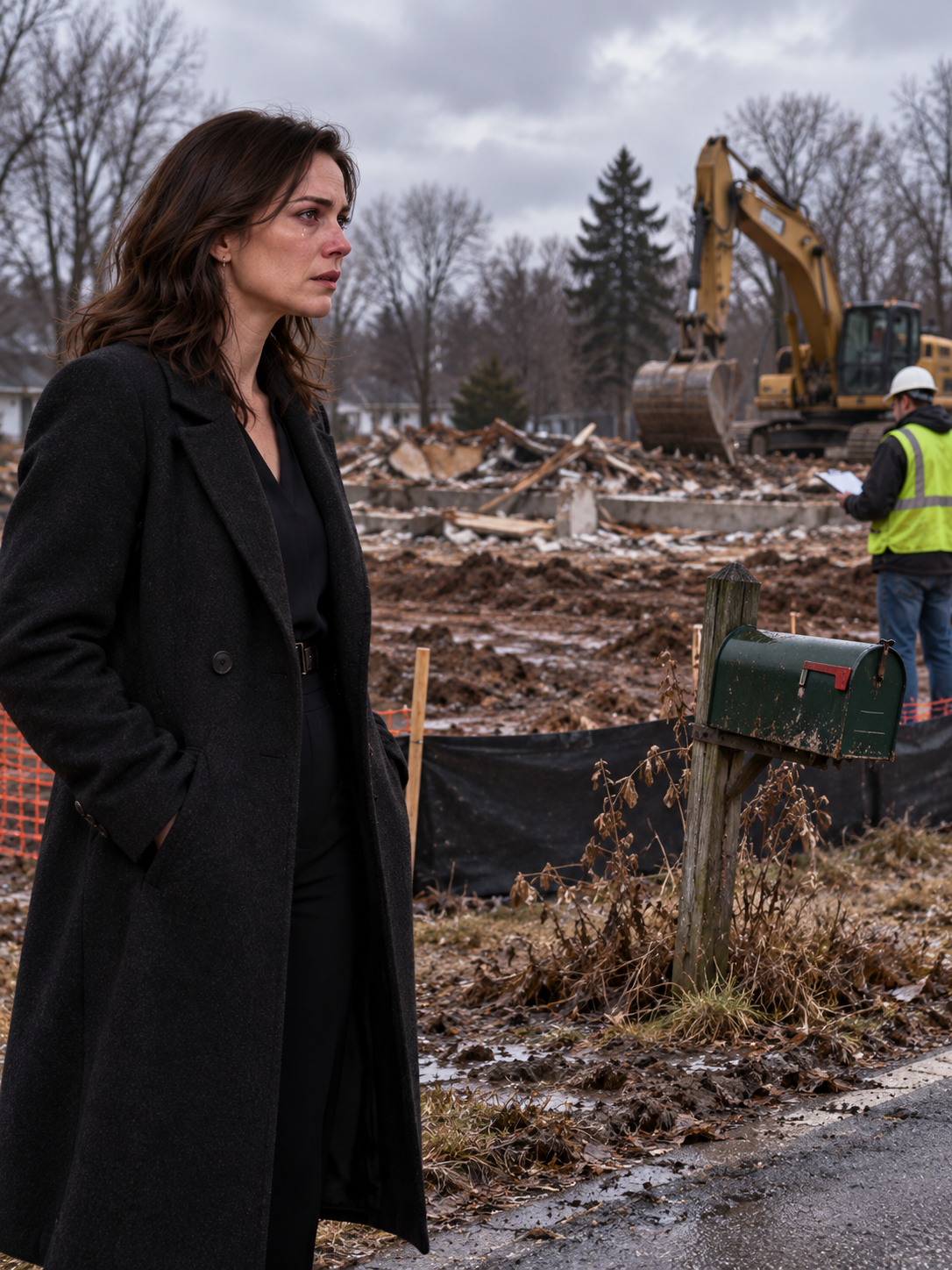
I took a breath.
“…then maybe someday there will be something left to rebuild.”
My father cried.
Quietly.
It was the first time I had ever seen him do that.
PART 5 — THE SECOND FOUNDATION
Winter became spring.
Federal investigations move differently from family arguments.
Slowly.
Methodically.
Without caring how desperately people want closure.
Halcyon’s project remained frozen.
Environmental teams returned to Harper Road.
The demolished foundation was excavated under supervision.
Daniel’s old cellar access structure had been damaged but not completely destroyed.
Beneath the rubble, engineers located the original corridor.
Samples were collected.
Historical contamination was confirmed.
More importantly, the chemical profile matched records connected to a manufacturing subsidiary absorbed years earlier by one of Halcyon’s legacy corporate partners.
The discovery triggered remediation orders and civil claims.
Halcyon’s stock dropped after public disclosures.
Executives were removed.
Garrett Shaw was indicted.
Martin Vale pleaded guilty to conspiracy, wire fraud and document fraud.
The notary who authenticated my false signature surrendered her license and entered a plea agreement.
My father pleaded guilty as promised.
My mother was not criminally charged.
She entered a civil settlement and admitted providing a misleading statement during the transaction.
That admission mattered more to me than the fine.
For once, Cynthia did not say she had been confused.
Or pressured.
Or merely supporting her husband.
She said:
I knew Vanessa had not agreed, and I chose not to stop it.
When she told me that, I believed her apology for the first time.
Olivia received the most surprising outcome.
Because she cooperated early enough and provided evidence connecting Vale to Halcyon, prosecutors did not seek incarceration on the most serious potential charges.
She pleaded guilty to a lesser conspiracy count involving the fraudulent property transfer.
She received probation, community service, financial penalties and mandatory restitution.
The Oak Brook mansion was sold.
Not seized permanently.
Sold.
Because the purchase had been partially funded with disputed proceeds, lawyers negotiated a complicated settlement.
After the mortgage, costs and restitution, Olivia walked away with almost nothing.
The house she had sacrificed so much to obtain lasted less than one year.
Terrence filed for divorce.
Then paused it.
That surprised everyone.
Including Olivia.
They didn’t reconcile immediately.
Terrence moved into a condo.
Olivia rented a modest townhouse thirty minutes away.
For the first time in her adult life, she paid for nearly everything herself.
She found a job with a nonprofit event organization.
Not glamorous.
Not high-status.
But real.
Months later, she told me she liked it.
I didn’t know whether to believe her.
Eventually, I did.
Not because she said it.
Because she stopped posting photographs designed to prove she was happy.
The financial settlement on Daniel’s property became complicated too.
Since my title had been transferred through fraud, the sale was voidable.
Halcyon’s subsidiary relinquished its claim as part of the federal resolution.
The land returned to my ownership subject to the original environmental restrictions and an expanded remediation agreement.
I also received civil damages.
Significant damages.
Enough that my father’s original description of Daniel’s property as “dead capital” became almost darkly funny.
But money did not restore the house.
That mattered.
For weeks I avoided Harper Road.
Then, one Saturday in May, I drove there.
The construction fences were different now.
Government environmental notices replaced the Halcyon signs.
Wild grass had begun pushing through disturbed soil.
Daniel’s mailbox was still there.
Bent.
Crooked.
Impossible.
I stood beside it for a long time.
Then a woman approached from one of the environmental trailers.
“Vanessa Hart?”
“Yes.”
She introduced herself as Dr. Elena Marquez, the project remediation manager.
She had known Daniel.
Not well.
But enough.
“He was persistent,” she said.
I laughed.
“That’s polite.”
“He sent nine emails about historical stormwater maps in one month.”
“That sounds more like him.”
She smiled.
Then she handed me a rolled site plan.
“We’ve been reviewing long-term use options.”
I frowned.
“For what?”
“After remediation.”
I unrolled it.
The plan showed the property.
Not as a commercial development.
Not as a house.
As a small public environmental education site.
A restored wetland corridor.
Walking paths.
Native plants.
A preserved marker showing the original water-system access.
A modest building near the road.
Community classroom.
Planning archive.
Daniel Hart Urban Watershed Center.
I couldn’t speak.
“Elena…”
“This isn’t approved.”
She pointed quickly.
“It’s just a concept. The county is interested. The university may partner. Federal remediation funding could cover part of the site work.”
I kept staring at Daniel’s name.
“Who proposed this?”
She smiled.
“Actually?”
“Yes.”
“You did.”
I looked at her.
She pointed toward Daniel’s letter copied in the project records.
“He spent years trying to protect this corridor. You preserved his research. Without those files, the site would probably have been destroyed beyond recovery.”
My eyes blurred.
“No.”
I shook my head.
“Daniel did that.”
“Then maybe both of you did.”
I looked across the empty ground.
For years I had believed keeping the property meant preserving Daniel.
But land doesn’t preserve people.
Love doesn’t live inside wood.
Or siding.
Or nails.
The house had mattered because Daniel had mattered.
That was different.
And perhaps rebuilding exactly what had been destroyed was not the only way to honor him.
“What would the building look like?” I asked.
Elena smiled.
“We were hoping you might have ideas.”
I did.
Immediately.
A long desk beside a window.
A porch.
A garden.
And somewhere near the entrance, Daniel’s crooked mailbox.
My father was sentenced in July.
Fourteen months in federal custody.
When the judge announced it, my mother cried.
Olivia cried.
I didn’t.
Not until that evening.
Then I sat alone in my car and cried for almost an hour.
Not because I wanted the sentence changed.
Because justice and grief can coexist.
You can believe someone deserves consequences and still mourn the person you wished they had been.
Before Dad reported to custody, he asked to see me.
This time I agreed without hesitation.
We met at Harper Road.
He had not visited since the demolition.
When he saw the empty property, he stopped beside the gate.
For the first time, I think he understood the physical reality of what he had done.
Not paperwork.
Not money.
Absence.
He walked slowly across the site.
Then looked toward me.
“Where was the house?”
I pointed.
“About there.”
He stood in the place where Daniel’s kitchen had once been.
After a while, he said, “I never asked you about him.”
“What?”
“After he died.”
He looked toward the ground.
“I asked whether you had handled insurance. Probate. Taxes.”
I remembered.
“You never asked what I missed.”
“No.”
I waited.
Dad took a breath.
“What do you miss?”
That question arrived four years late.
I answered anyway.
“His terrible singing.”
Dad smiled faintly.
“He sang?”
“Constantly.”
“What else?”
“The way he read menus like legal documents.”
Dad laughed.
“He took twenty minutes ordering breakfast.”
“What else?”
I looked toward the old cellar location.
“He made everything feel possible.”
My voice broke.
“Even bad things.”
Dad nodded.
“I’m sorry I treated his memory like an asset.”
I looked at him.
“Thank you.”
It wasn’t forgiveness.
Not fully.
But it was the beginning of something truthful.
Before he left, I showed him the proposed center.
He studied the rendering.
Then said, “He would have liked that.”
“Yes.”
Dad pointed to the porch.
“That thing leaning?”
I smiled.
“It will be.”
He laughed softly.
Daniel would have appreciated the joke.
PART 6 — THE THINGS WE CHOOSE TO REBUILD
One year later, the Daniel Hart Urban Watershed Center opened on a warm Saturday morning.
Nothing about the day looked like Olivia’s mansion party.
There were no valets.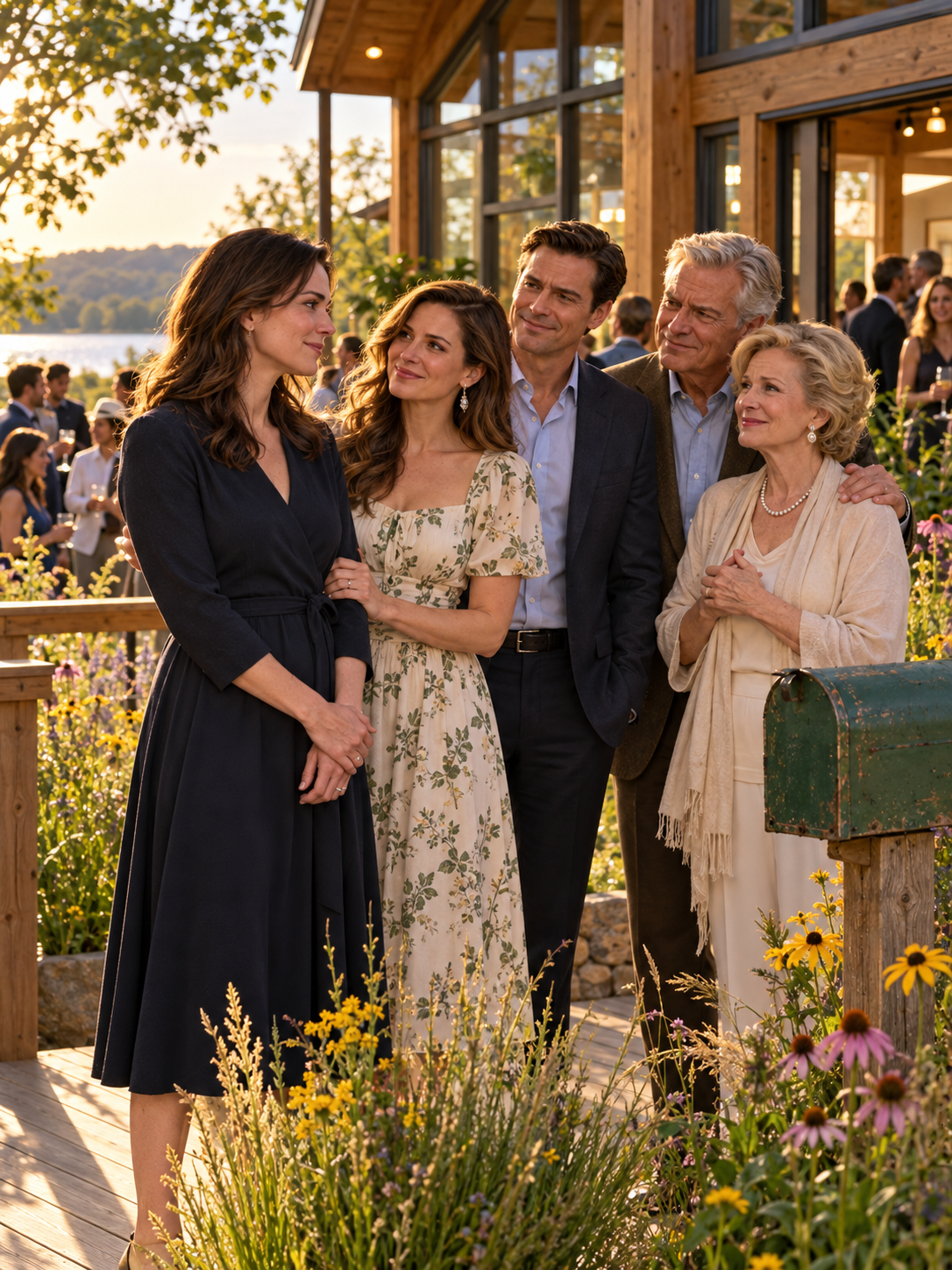
No crystal chandeliers.
No photographers hired to capture expensive people beside expensive furniture.
Children from a local school painted small wooden signs identifying native plants.
University students staffed environmental exhibits.
Neighbors brought folding chairs.
A food truck parked near the road.
Someone’s dog escaped its leash twice.
Daniel would have loved everything about it.
The center itself was modest.
Cedar siding.
Large windows.
A deep front porch.
Inside, one wall displayed historic maps from Daniel’s archive.
Another explained the environmental remediation project.
The original municipal access plate recovered after demolition had been cleaned and mounted behind protective glass.
Near the front desk was a photograph of Daniel.
Not one from our wedding.
Not the polished professional portrait my mother once suggested.
My favorite.
Daniel in muddy boots.
Hair terrible.
Holding a rolled map under one arm and smiling like he had just discovered something nobody else understood yet.
Below it was a small plaque.
DANIEL HART
HE BELIEVED EVERY PLACE DESERVED A FUTURE.
I stood in front of it before the ceremony.
Then Olivia appeared beside me.
For a moment, neither of us spoke.
She looked different.
Not physically, exactly.
She still looked like Olivia.
But the performance had faded.
Simple blue dress.
No diamonds.
No phone in her hand.
“I brought something,” she said.
She gave me a box.
Inside was Daniel’s old porch light.
I stared at it.
“How?”
“Dad had it.”
My head snapped toward her.
“What?”
“When he arranged the sale, he asked the demolition crew to save a few things.”
I didn’t know whether to laugh or become furious.
Olivia raised both hands.
“I know.”
“Why didn’t he tell me?”
“He was ashamed.”
I lifted the old brass fixture.
Daniel had bought it at an architectural salvage shop.
Twenty dollars.
He spent six hours rewiring it.
“It still works,” Olivia said.
“How do you know?”
“I had it checked.”
I looked at her.
She became nervous.
“I thought maybe you could put it somewhere.”
I swallowed.
“Thank you.”
She nodded.
Then stood awkwardly beside me.
Our relationship had not magically healed.
That only happens in bad stories.
Trust returned slowly.
In millimeters.
A birthday call.
Coffee.
A conversation without accusation.
Olivia apologized more than once.
I did not always accept immediately.
Sometimes I told her exactly why I was still angry.
For the first time, she listened without turning my pain into an attack on her.
That mattered.
Terrence eventually returned to counseling with her.
Six months after separating, they withdrew the divorce petition.
Not because everything was fixed.
Because both of them decided they wanted to find out whether something real existed beneath the life they had constructed for other people.
They moved into a three-bedroom house.
Olivia joked that her old walk-in closet had been larger than their entire kitchen.
Then she said something I never expected.
“I like this one better.”
I asked why.
She looked toward Terrence, who was struggling to assemble a bookshelf.
“Because nobody had to steal anything for me to live here.”
That was the first time I believed my sister had truly changed.
My mother arrived at the center carrying flowers.
Not an extravagant arrangement.
Wildflowers.
Daniel liked wildflowers.
She remembered.
That almost made me cry.
Dad came last.
He had been released after serving most of his sentence with credit for good conduct.
He looked older.
Thinner.
But calmer.
Prison had not transformed him into a saint.
Consequences rarely do.
But losing control had forced him to examine himself in ways comfort never had.
He no longer belonged to the country club.
Financially, the legal settlements had changed my parents’ lives dramatically.
They sold their large house.
Moved into a condo.
My father volunteered twice a week with a financial literacy program through a reentry nonprofit.
When he first told me, I laughed.
“You?”
“I know.”
“The man who called emotional property dead capital?”
“I have developed range.”
Daniel would have liked that answer too.
Dad stopped beside me on the porch.
“Big day.”
“Yes.”
He looked toward the crowd.
“You nervous?”
“Terrified.”
“Good.”
I frowned.
“Why good?”
He smiled.
“Daniel said nervous people usually care about the outcome.”
I stared at him.
“When did Daniel say that?”
“Your wedding.”
Of course he did.
The ceremony was short.
I insisted.
A county representative spoke.
Dr. Marquez explained the remediation.
A university dean announced a student research fellowship in Daniel’s name.
Then it was my turn.
I stood behind a simple wooden podium.
For several seconds, I looked at the faces in front of me.
My mother.
My father.
Olivia.
Terrence.
Agents Sloan and Kim standing near the back.
Neighbors.
Students.
People I had never met.
Then I began.
“Four years ago, I believed I lost everything Daniel and I were supposed to build together.”
The crowd became quiet.
“A year ago, I believed I lost the last physical piece of that future too.”
I looked toward the grounds where his house had once stood.
“The building that used to be here mattered to me. It still does.”
I paused.
“But this story taught me something Daniel understood long before I did.”
I looked toward his photograph through the window.
“A structure is not the same thing as a future.”
My voice almost broke.
I continued.
“A future is what we choose to build after something is gone.”
I did not talk about my family’s crimes.
Everyone already knew enough.
I did not humiliate my father.
Justice had already happened.
Humiliation was not the same thing.
Instead, I talked about Daniel.
His obsession with forgotten infrastructure.
His belief that neglected places deserved another chance.
His certainty that good planning should serve ordinary people.
Then I said the sentence that mattered most.
“This center exists because one person cared enough to look beneath the surface.”
I smiled.
“That is also a fairly accurate description of my marriage.”
People laughed.
I stepped away from the podium.
And for the first time since Daniel died, speaking his name in public did not feel like reopening a wound.
It felt like opening a door.
Late that afternoon, after everyone left, I remained alone.
Sunlight stretched across the new wooden floor.
The old porch light had been installed beside the front door.
I switched it on.
Warm amber light spread across the porch.
For a second, I imagined Daniel beside me.
Hands in his pockets.
Inspecting the craftsmanship.
Complaining that someone had used the wrong screws.
I smiled.
“I know,” I whispered.
Wind moved through the native grasses.
Then I walked down the porch steps and toward the road.
Daniel’s mailbox stood beside the entrance.
Restored.
Still crooked.
I had insisted.
Inside it was one envelope.
My name appeared across the front.
I recognized the handwriting immediately.
Not Daniel’s.
My father’s.
I opened it.
Vanessa,
I spent most of your life admiring your strength because it allowed me to ignore your needs.
I told myself you were independent when what I meant was that I expected you to survive whatever we failed to give you.
I treated Olivia’s dependence as love and your resilience as distance.
Both judgments were unfair to both of you.
I cannot restore Daniel’s house.
I cannot undo my decision.
I cannot ask you to forget.
But I can spend whatever remains of my life refusing to make the same mistake again.
You once told me love is not emergency funding.
You were right.
I hope someday I learn what it actually is.
Dad.
I read it twice.
Then folded it.
For years, I had believed healing would arrive when someone finally understood exactly how badly they had hurt me.
It didn’t.
Understanding helped.
Apologies helped.
Consequences helped.
But healing had begun before any of those things.
It began the first time I stopped negotiating my own boundaries to keep everyone else comfortable.
It began when I told investigators the truth.
When I refused to protect my father from a choice he made.
When I stopped rescuing Olivia.
When I finally understood that forgiveness could not require self-erasure.
The sun was setting.
I walked back toward the center.
My phone rang.
Olivia.
I answered.
“What?”
“Very warm greeting.”
“I’m improving.”
“Mom wants everyone over Sunday.”
I groaned.
“Why?”
“Dinner.”
“Who’s cooking?”
A pause.
Then Olivia said, “Me.”
I stopped walking.
“You?”
“Yes.”
“Should I alert the fire department?”
“Vanessa.”
“I’m just assessing risk.”
She laughed.
Not the laugh from the mansion.
Not cruel.
Not polished.
Just my sister.
“Seven o’clock?”
I looked back at Daniel’s photograph through the window.
“Okay.”
“And Vanessa?”
“What?”
Another pause.
“I’m glad you came to the party that night.”
I smiled faintly.
“You definitely weren’t at the time.”
“No.”
She laughed.
“Definitely not.”
Then her voice softened.
“But if you hadn’t…”
She didn’t finish.
She didn’t need to.
If I hadn’t walked into that mansion, maybe the fraud would still have surfaced.
The federal investigation was already moving.
Halcyon was already under scrutiny.
Consequences were coming whether my family understood them or not.
But something else might never have happened.
We might have remained exactly who we were.
My father believing control was leadership.
My mother believing silence was peace.
Olivia believing love meant being chosen first.
Me believing strength meant needing nothing.
That family was gone.
It had broken completely.
And strangely, that was what finally gave us a chance to build something better.
“I’ll see you Sunday,” I said.
I ended the call.
Before leaving, I turned off the lights inside the center.
All except one.
Daniel’s porch light.
It glowed beside the door as dusk settled over Harper Road.
The house he loved was gone.
The future we imagined there was gone too.
But the ground remained.
The truth remained.
And so did I.
I locked the door.
Then I looked at the crooked mailbox, the restored land, and the building bearing my husband’s name.
For the first time in four years, the memory of Daniel did not feel like something behind me.
It felt like something I was carrying forward.
And that, I finally understood, was the difference between clinging to the past…
and building from it.
THE END