He Choked My Little Sister After She Tapped—Then My Special Forces Brother Said, “I’m Next.”
PART 1 — THE MAN WHO WOULDN’T LET GO
My older brother drove into town to help me move.
He arrived at my martial arts gym ten minutes early.
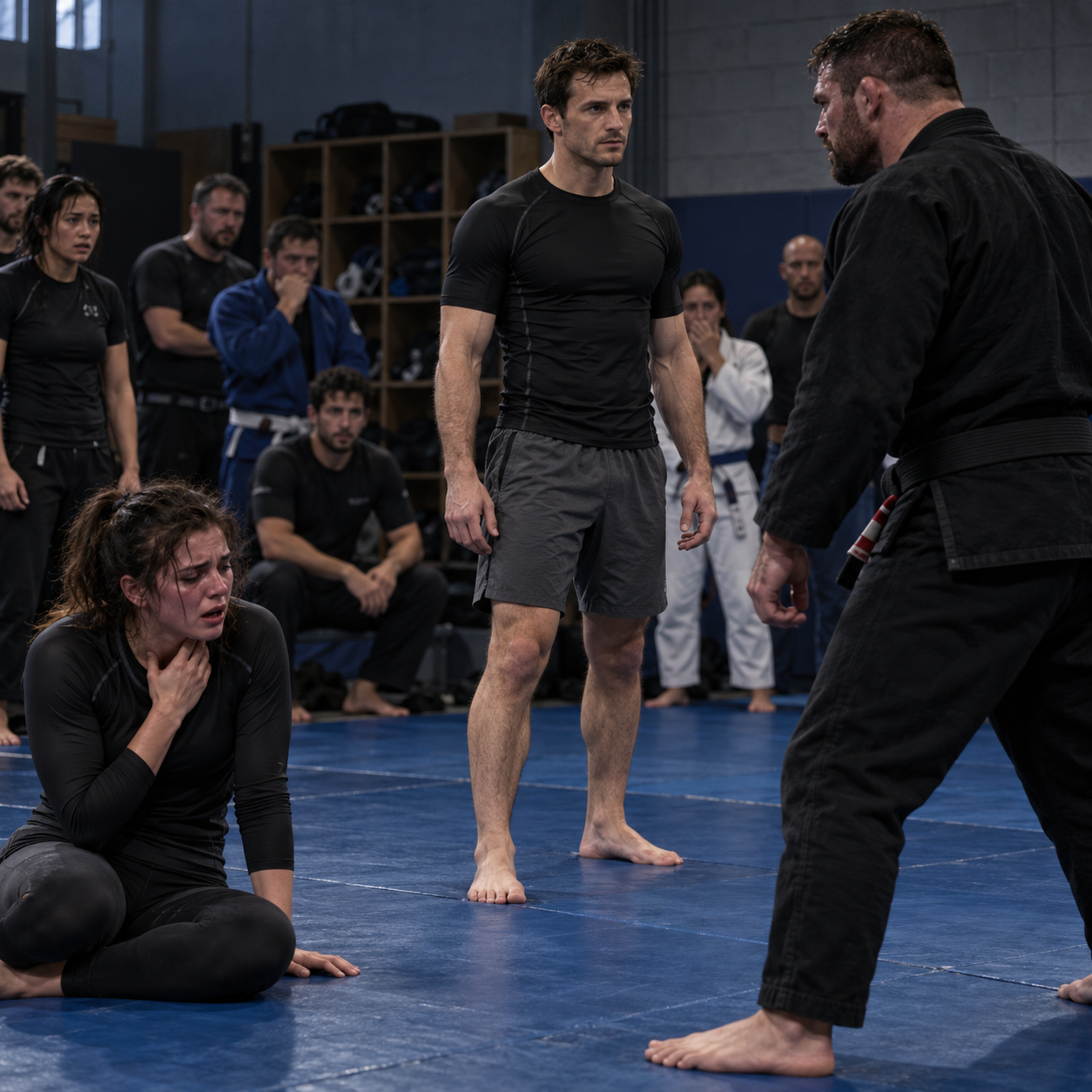
And instead of finding me packing up after class, he watched a 210-pound black belt deliberately choke me unconscious after I had already tapped.
When I finally woke up gasping on the mat, the man who had done it was laughing.
Then my quiet, lean brother stepped forward.
“I’m next.”
My brother’s name is Cole.
He spent more than a decade in the United States Army, including years in an elite special operations unit.
He trained under conditions most people would never willingly experience.
He operated in places he almost never talked about.
But if you met him on the street, you would never guess any of that.
Cole didn’t brag.
He didn’t wear shirts covered in unit logos.
He didn’t tell strangers where he had served.
He was calm.
Disciplined.
Almost unnervingly quiet.
Most people saw a lean man in his late thirties with an easy expression and assumed there was nothing especially dangerous about him.
That weekend, Cole had exactly one mission.
Help his little sister move apartments.
Instead, he walked into Apex Grappling and found me fighting for air.
I was twenty-six.
I had never been naturally athletic.
I joined jujitsu because I wanted to become the kind of person who didn’t freeze every time life pushed back.
Most of the people at the gym were good to me.
Patient.
Helpful.
Encouraging.
Derek was different.
He was around thirty-five.
Second-degree black belt.
Two hundred ten pounds.
Broad shoulders.
Cauliflower ears.
And permanently amused by anyone weaker than him.
He almost never taught.
He just showed up to spar.
Then picked smaller, less experienced students and called it “tough love.”
Nobody challenged him.
He was close friends with the gym owner.
So people learned to stay out of his way.
That evening, our instructor called for six-minute rounds.
I was adjusting my belt when Derek walked over.
He dropped one heavy hand onto my shoulder.
“Let’s go, Sarah.”
It wasn’t a question.
We started.
Within seconds, he blasted through my guard.
Then dropped all of his weight onto my chest.
I couldn’t move.
It felt like someone had parked a car on top of me.
I tried to frame against his shoulders.
He isolated my right arm.
I defended.
Then his forearm slid across my throat.
Too hard.
Too fast.
He tightened the choke with a violent jerk.
Immediately, I knew something was wrong.
This wasn’t controlled training anymore.
It felt like punishment.
My airway compressed.
Panic hit all at once.
I slapped the mat.
Tap.
Tap.
Tap.
He didn’t stop.
I hit his shoulder.
Harder.
Again.
Nothing.
Derek pulled tighter.
My lungs started burning.
The edges of the room blurred.
The fluorescent lights above me became gray halos.
My arms felt weak.
Then useless.
My last clear thought was terrifyingly simple.
He’s going to kill me.
Then everything went black.
When I came around, I was curled on my side.
Coughing.
Trying desperately to breathe.
Air tore back into my lungs.
My throat felt raw.
My chest heaved.
For several seconds, I had no idea where I was.
Then I heard Derek.
He was standing over me, casually retightening his belt.
“You’ve got to tap earlier, Sarah.”
He said it loudly enough for the whole room to hear.
“Don’t let your ego get in the way.”
I stared at him.
“In a real fight, nobody stops.”
I had tapped immediately.
He knew it.
Everyone knew it.
Nobody said anything.
People looked away.
That humiliation burned worse than my throat.
I pushed myself up onto one elbow.
Then into a seated position.
Derek cracked his knuckles.
Looked around the room.
“Who’s next?”
“I am.”
The voice was quiet.
But every head turned.
Cole stepped away from the cinderblock wall near the cubbies.
I hadn’t even realized he was there.
He wore a plain black rash guard and gray athletic shorts.
No military insignia.
No unit logos.
No tattoos announcing what he had once done for a living.
Nothing about him explained that the quiet man standing against the wall had spent years inside an elite U.S. Army special operations unit.
Cole stepped barefoot onto the mat.
Derek looked him over.
Then smirked.
“Sorry, buddy. Class is full.”
Cole didn’t react.
“She tapped.”
The room went silent.
Derek’s smile shifted.
Cole continued.
“You held it for four more seconds.”
He looked directly at him.
“You put her out on purpose.”
Nobody moved.
Derek folded his arms.
“It’s a contact sport. People get caught.”
Cole took another step.
“Then let’s see how you handle it.”
Derek laughed.
Actually laughed.
“You even know how to grapple, tough guy?”
Cole said nothing.
That seemed to amuse Derek even more.
What Derek didn’t know was that Cole had spent years learning how to stay calm while everyone around him lost control.
He had been tested under exhaustion.
Fear.
Pressure.
Situations where mistakes meant far more than losing a sparring round.
And after leaving the Army, he had deliberately buried that part of himself.
He had not come to Apex Grappling looking for trouble.
He had come to help his sister move.
Then he watched a man deliberately choke her unconscious after she surrendered.
Derek dropped into a wide stance.
“All right.”
His grin returned.
“Timer’s running.”
He raised his hands.
“Let’s go.”
Cole slowly lifted his own.
No anger.
No shouting.
Nothing on his face at all.
And somehow, that was the part that made me nervous.
Derek exploded forward.
One massive hand shot toward my brother’s neck.
And for the first time that night—
Cole moved.
PART 2 — THE MAN WHO KNEW WHEN TO STOP
Derek’s hand never reached my brother’s neck.
One moment, the black belt was charging forward with the confidence of a man who had spent years frightening everyone smaller than himself.
The next, he was stumbling sideways, his momentum redirected so cleanly that he almost collided with the wall.
Cole hadn’t struck him.
He hadn’t even looked particularly hurried.
He had simply stepped away from the attack, controlled Derek’s reaching arm, and released it before Derek could regain his balance.
A few students gasped.
Derek turned around.
His expression had changed.
Not much.
Just enough.
“Lucky,” he muttered.
Cole stood in the center of the mat.
“Again, if you want.”
Derek lunged.
This time he tried to overpower my brother with his weight, pressing forward like a bulldozer.
Cole allowed the pressure for half a second.
Then Derek’s feet disappeared from beneath him.
He landed on his back with a thunderous slap.
The impact rattled the water bottles lined against the wall.
Before Derek could scramble upright, Cole established control beside him.
There was nothing flashy about it.
No dramatic slam.
No theatrical submission.
Cole simply made Derek’s strength irrelevant.
Derek shoved against his shoulders.
Cole adjusted his position.
Derek twisted.
Cole followed.
Derek attempted to bridge his hips and throw my brother away.
Nothing happened.
For the first time since I had joined Apex Grappling, I watched Derek struggle beneath someone he couldn’t intimidate.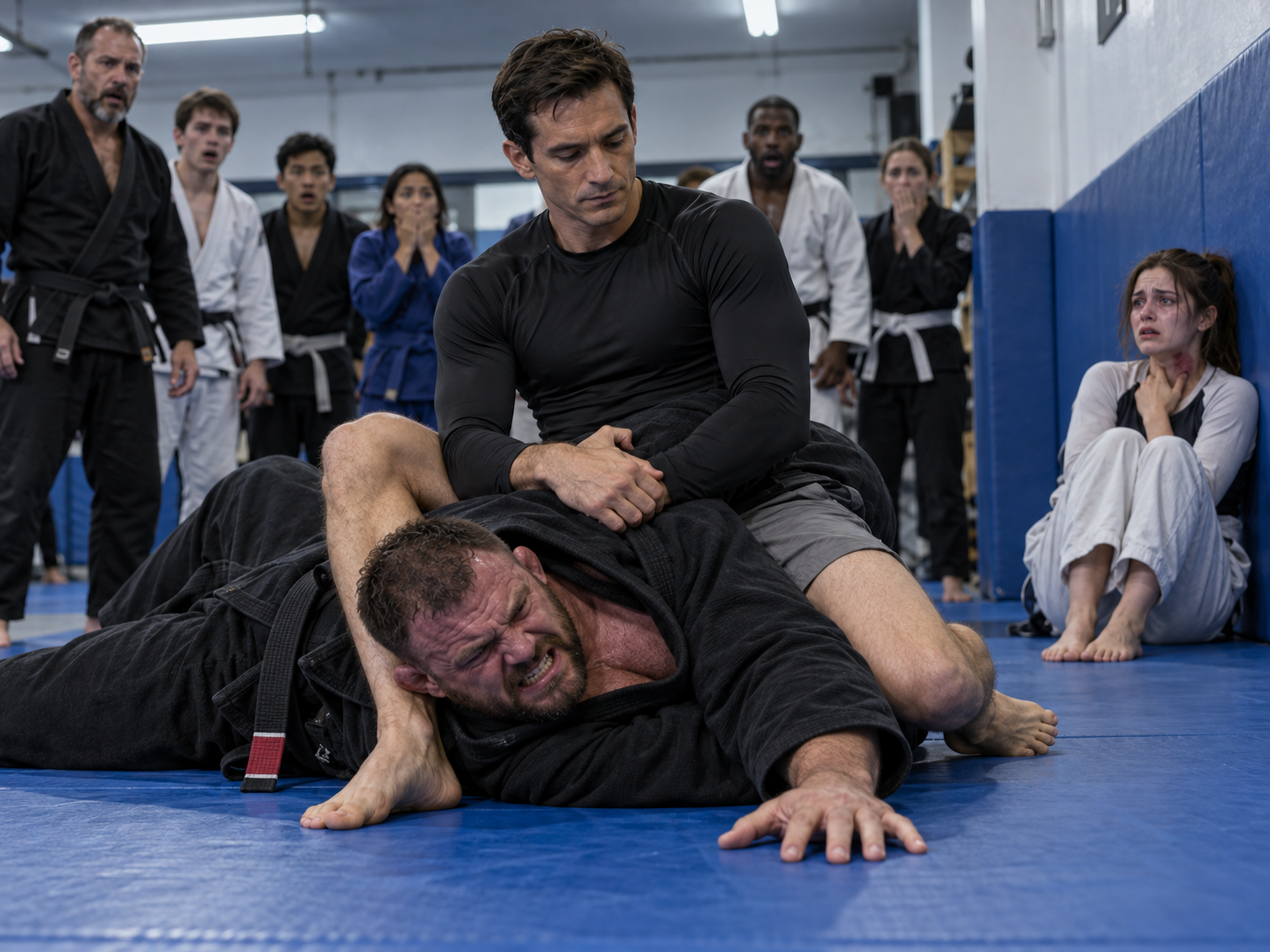
He was breathing harder.
His face reddened.
“Get off me!”
Cole immediately stood and stepped backward.
Derek scrambled up.
“What’s your problem?”
“You asked me to get off.”
“That wasn’t a tap!”
Cole glanced at him.
“You asked me to stop.”
A murmur passed around the room.
I almost smiled.
Then a sharp pain twisted through my throat, and I doubled over coughing.
Cole’s head turned immediately.
The change in him was so sudden that it startled me.
A second earlier, he had been utterly focused on Derek.
Now it was as if the black belt had ceased to exist.
“Sarah?”
“I’m okay,” I croaked.
Cole wasn’t convinced.
He looked toward our instructor, Marcus Bell, who had been standing near the timer with a face drained of color.
“She lost consciousness?”
Marcus nodded reluctantly.
“Briefly.”
“Did anyone call emergency services?”
Nobody answered.
Cole stared at him.
“Call now.”
Derek laughed.
“Oh, come on. People go out in grappling all the time.”
Cole turned.
“No. A student who loses consciousness following a choke needs medical attention. You don’t get to dismiss that because it makes you uncomfortable.”
Derek opened his mouth.
Cole continued.
“And if someone taps, you release.”
His voice never rose.
“Immediately.”
The room fell quiet again.
I had seen my brother angry exactly three times in my life.
Once when a drunk driver nearly hit our mother.
Once when our father died.
And once when a stranger grabbed my arm outside a grocery store when I was seventeen.
Each time, his anger had looked less like an explosion and more like a door closing.
That was what I saw now.
Derek rolled his shoulders.
“We weren’t finished.”
Cole faced him.
“We are.”
“Scared?”
“No.”
“Then prove it.”
Cole glanced toward me again.
I was sitting with my back against the wall, holding a cold water bottle against my throat.
He hesitated.
And I understood something.
He wanted to walk away.
Not because he feared Derek.
Because he knew the consequences of staying.
That realization frightened me more than the fight itself.
But Derek wasn’t finished.
He walked toward me.
“Your brother thinks he’s some kind of hero,” he said. “Maybe next time you’ll learn to defend yourself instead of crying for help.”
I looked up.
My throat hurt too much to answer.
Derek smiled.
“Or maybe this sport just isn’t for you.”
Cole stepped between us.
“Don’t speak to her.”
Derek spread his arms.
“What are you going to do about it?”
Cole took one slow breath.
“Nothing you’re asking me to do.”
“Then quit acting tough.”
Cole looked at Marcus.
“Is he allowed to spar after deliberately ignoring a tap?”
Marcus swallowed.
“Derek, maybe we should call it a night.”
Derek barked out a laugh.
“You’re kidding.”
Then he pointed at Cole.
“One more round. Submission only. Unless you’re afraid.”
I watched my brother consider him.
Finally, Cole nodded.
“One condition.”
Derek grinned.
“What’s that?”
“Marcus watches the entire round. If either of us taps or verbally stops, the other releases immediately.”
“Fine.”
“And no one interferes.”
“Fine.”
Cole turned to me.
“Sarah, stay where you are. The paramedics are coming.”
I wanted to argue.
Instead, I nodded.
Because even sitting there, still dizzy and humiliated, I sensed that something larger than an ordinary sparring round was happening.
Derek wasn’t simply trying to win.
He was trying to restore something.
His reputation.
His control.
The invisible hierarchy that made everyone else look away when he crossed a line.
He couldn’t tolerate the idea that a quiet stranger had made him look ordinary.
The timer beeped.
Derek attacked immediately.
He tried to drag Cole into a violent exchange, pulling and shoving and using every pound of his considerable weight.
Cole remained composed.
Twice, Derek attempted to force a dominant position.
Twice, Cole escaped without panic.
When Derek finally managed to get behind him, several students leaned forward.
I felt my stomach tighten.
Derek hooked an arm around my brother’s upper body and tried to drag him backward.
Cole lowered his center of gravity.
There was a brief struggle.
Then the positions reversed.
Derek hit the mat again.
This time, Cole maintained a stable position while Derek thrashed beneath him.
“Move!” Derek shouted.
Cole didn’t answer.
Derek tried to wrench free.
Nothing.
My brother wasn’t squeezing his throat.
He wasn’t twisting his joints.
He wasn’t trying to hurt him.
He was controlling him.
That distinction was obvious even to me.
Derek finally slapped the mat.
Once.
Cole released instantly.
He stood.
Held out a hand.
Derek stared at it.
Then slapped it away.
A few people around the room exchanged glances.
Someone near the entrance whispered, “He tapped.”
Another voice answered, “Yeah. And the guy let go.”
It shouldn’t have been remarkable.
That was the terrible part.
Safety should have been ordinary.
Respecting another person’s surrender should have been the most basic rule in the building.
Instead, watching Cole obey it felt revolutionary.
Derek rose slowly.
His face had turned dark red.
“You think that makes you better than me?”
Cole picked up his water bottle.
“No.”
“Then why are you smiling?”
Cole wasn’t smiling.
“I came here for my sister.”
Derek took a step closer.
“You’re not walking out of here like that.”
Marcus finally moved between them.
“Derek. Enough.”
For a moment, I thought it was over.
Then Derek shoved Marcus aside.
His expression had changed from humiliation to something uglier.
He looked at Cole’s exposed back.
And he charged.
There was no warning.
No restart of the round.
No referee’s signal.
Just a furious man attacking someone who had already disengaged.
Cole turned as Derek crashed into him.
They struck the mat.
I screamed.
The sound scraped through my damaged throat.
Students scrambled backward.
Derek was swinging now, throwing punches in a frenzy that had nothing to do with grappling.
One caught Cole near his eyebrow.
Blood appeared.
And suddenly I wasn’t watching a sparring match.
I was watching an assault.
Cole covered, created distance, and brought Derek back under control without returning the punches.
Derek continued struggling.
“Get off!”
Cole released and backed away.
This time he didn’t remain close enough for another attack.
“Call the police,” he told Marcus.
Derek froze.
“What?”
Cole looked straight at him.
“You attacked me after the round ended.”
“That’s ridiculous!”
“Then let the cameras tell us what happened.”
Something changed in Derek’s face.
It happened so quickly I might have missed it if I hadn’t been watching.
The anger remained.
But beneath it was fear.
Real fear.
Derek looked toward a small black security camera mounted above the entrance.
Then toward the office door.
Marcus followed his gaze.
And for the first time all evening, our instructor looked frightened too.
Not of Cole.
Not of Derek.
Of something behind that office door.
Two paramedics entered moments later.
One crouched beside me while the other asked about my loss of consciousness and began assessing my breathing, swallowing, and neck.
As they helped me toward the exit, I heard Derek whisper to Marcus.
“Tell Grant to shut it down.”
Cole heard him too.
He turned.
“Shut what down?”
Derek said nothing.
Marcus looked away.
My brother glanced once more at the camera.
Then at the office.
And I realized that the fight everyone had just witnessed might have been the smallest part of what was happening inside Apex Grappling.
Because Derek wasn’t afraid of being beaten.
He was afraid of what the cameras had recorded.
PART 3 — THE FOOTAGE THEY TRIED TO ERASE
The first thing the emergency physician told me was that I was lucky.
The second was that luck wasn’t a medical diagnosis.
Dr. Elaine Porter stood beside my hospital bed with a tablet tucked beneath one arm. She was in her fifties, with tired blue eyes and the kind of voice that made frightening information sound manageable without making it sound unimportant.
“Sarah, you lost consciousness during neck compression. You also have significant tenderness, difficulty swallowing, and a persistent headache. We need to make sure there’s no damage we haven’t identified.”
I nodded.
Even that small movement hurt.
Cole sat beside the bed.
He had a butterfly bandage above his eyebrow, courtesy of Derek’s punches, and a darkening bruise along his cheek.
He hadn’t complained once.
But every few minutes, his eyes returned to my face.
As if he needed to verify that I was still breathing.
Dr. Porter ordered imaging and continued monitoring me for complications.
When she left, I stared at the ceiling.
“I’m sorry.”
Cole looked up.
“For what?”
“Ruining your weekend.”
He didn’t answer immediately.
Then he leaned forward.
“Sarah.”
I turned toward him.
“Do you remember when you were nine and you fell through the ice behind the Miller farm?”
Of course I remembered.
The shallow pond had looked solid.
It wasn’t.
Cole had been twenty.
Home on leave.
He’d pulled me out before the water reached my shoulders, then carried me half a mile through the snow with his jacket wrapped around me.
Our mother had cried.
Our father had shouted.
Cole had simply made me hot chocolate.
“You apologized that day too,” he said.
“I remember.”
“You apologized because my boots got wet.”
Despite the pain, I laughed.
He smiled faintly.
“I came to help you move. That’s still what I’m going to do.”
I looked at the bloodstained bandage above his eye.
“You didn’t have to fight him.”
“No,” Cole said. “I didn’t.”
There was no defensiveness in his voice.
He looked down at his hands.
“I made a choice to step onto that mat. Once I saw how he treated you, I wanted to make him understand what it felt like to have less control than the person across from him.”
“Did you?”
He considered the question.
“No.”
I frowned.
“Really?”
“I showed him he couldn’t intimidate me. That’s different from teaching him anything.”
The distinction stayed with me.
Cole leaned back.
“And when he attacked after the round, I had a responsibility to keep it from getting worse.”
“You could have hurt him.”
“Yes.”
His answer was immediate.
That frightened me.
But what he said next mattered more.
“That’s why I didn’t.”
For a while, we sat quietly.
Then I asked the question that had been turning over in my mind since the gym.
“Why was Marcus so scared when you mentioned the cameras?”
Cole’s expression changed.
“I don’t know yet.”
“You think they’re hiding something?”
“I think Derek believed there was something worth hiding.”
A knock sounded at the door.
A woman in a dark blazer stood outside.
She introduced herself as Detective Maya Torres of the local police department.
She was short, with cropped black hair and an expression that suggested she had little patience for people who wasted her time.
“Miss Mitchell?”
I nodded.
“I’m following up on the incident at Apex Grappling. Your brother gave a preliminary account at the scene.”
She pulled up a chair.
“Would you be willing to tell me what happened?”
I described the sparring round.
Derek’s weight.
The choke.
The taps.
The terrifying realization that he wasn’t releasing.
Then I told her what I remembered after waking up.
His laughter.
His accusation.
The room’s silence.
By the time I finished, my hands were trembling.
Detective Torres noticed.
“We can stop.”
“No.”
I swallowed painfully.
“I want it written down.”
She nodded and continued taking notes.
When I described Derek’s attack on Cole after the round, her expression tightened.
“Your brother reported that too.”
Then she hesitated.
“There’s something you should know.”
Cole straightened.
“The gym owner contacted us.”
“Grant?” I asked.
“Grant Whitaker. He claims you became upset after an ordinary training accident, and that your brother entered the facility without permission and initiated a confrontation.”
I stared at her.
“That’s not what happened.”
“I understand that’s your account.”
“He was there to pick me up.”
“He also claims your brother injured Derek during an unauthorized challenge.”
Cole remained still.
Torres looked at him.
“Mr. Mitchell, you were asked to leave after the first exchange?”
“No,” Cole answered. “Marcus stopped the first exchange to get medical help for Sarah. Derek challenged me to another round. Marcus supervised. After Derek tapped, I released and turned away. Derek then attacked me.”
“Did you know Grant Whitaker before tonight?”
“No.”
“Have you ever trained at Apex?”
“No.”
She made another note.
“Grant provided us with a video.”
My pulse quickened.
“Then you can see what Derek did.”
Torres shook her head.
“The clip begins after your brother steps onto the mat.”
I stared.
“What?”
“It shows part of their exchange. It does not show your original sparring round.”
Cole’s jaw tightened.
“That’s convenient.”
Torres didn’t respond.
Instead, she asked, “Are there other cameras?”
“At least two,” I said. “One above the entrance. Another over the main training floor.”
She nodded.
“We’ve requested the complete footage and preservation of all recordings. We’re also interviewing witnesses.”
She turned to Cole.
“Mr. Mitchell, I’m going to be clear. You did the right thing by requesting police intervention after the attack. But I need you to avoid contacting Derek or Mr. Whitaker directly while we investigate.”
Cole nodded.
“Understood.”
Torres rose.
At the door, she paused.
“One more question, Sarah. Has Derek ever hurt another student?”
I opened my mouth.
Then closed it.
A dozen memories surfaced.
A teenage boy crying in the locker room.
A woman leaving practice with a swollen wrist.
A man who canceled his membership after Derek repeatedly targeted him.
Each incident had been explained away.
An accident.
A bad roll.
A misunderstanding.
“I think so,” I whispered.
Torres looked back at me.
“Can you give me names?”
And for the first time, I realized this wasn’t just about what had happened to me.
It was about all the things I had trained myself not to notice.
By midnight, the doctors had completed the initial examinations.
The imaging showed no major vascular injury or fracture, which was a relief, but Dr. Porter warned that I still needed rest, monitoring, and prompt medical attention if my symptoms worsened.
My voice had become a strained whisper.
Cole helped me into his truck and drove me to my apartment.
The building was almost empty.
Most of my belongings were already packed in cardboard boxes.
A stack of dishes waited by the door.
My houseplants occupied the windowsill, each pot marked with a strip of masking tape.
It was an ordinary scene.
And somehow that made the evening more unreal.
Cole carried my overnight bag inside.
“You hungry?”
I shook my head.
“Something soft? Soup?”
“Maybe.”
He went into the kitchen.
I sat on the couch beneath the yellow blanket our mother had knitted before she died.
Three years had passed since we buried her.
Five since our father.
And although Cole and I spoke regularly, we rarely spent more than a few days together.
His military career had kept him moving.
My life had kept me pretending I didn’t need anyone.
I watched him search the cupboards.
He found a can of soup, examined the expiration date, and nodded with the seriousness of someone approving a tactical plan.
“Acceptable.”
I smiled.
Then my phone vibrated.
A message from an unknown number.
You need to stop talking to the police.
I froze.
Another message appeared.
You don’t know what you’re getting involved in.
“Cole?”
He looked over.
I showed him the screen.
His face went still.
“Don’t answer.”
A third message arrived.
Ask Marcus what happened to the last girl who complained.
Cole placed the saucepan on the counter.
“Screenshot everything.”
I did.
He called Detective Torres.
Then he stood beside the window, looking down at the street while he explained what had happened.
I wanted to believe the messages were just Derek trying to scare me.
But the wording bothered me.
The last girl who complained.
Who was she?
And what had happened to her?
The next morning, I woke to the sound of someone knocking.
Cole had slept on the couch.
He was already standing when the second knock came.
Through the peephole, he saw a young woman holding a paper grocery bag.
“Who is it?”
“My name’s Natalie. I train at Apex.”
I recognized her voice.
Natalie Brooks.
Twenty-nine.
Purple belt.
One of the few women who occasionally partnered with me during class.
Cole opened the door but remained beside it.
Natalie stood there wearing jeans and a loose sweatshirt. Her dark hair was pulled into a messy ponytail.
Her eyes were red.
“Sarah?”
“I’m here.”
She stepped inside.
The moment she saw the bruising around my neck, she covered her mouth.
“Oh, God.”
I tried to smile.
“Looks worse than it is.”
It was a lie.
We both knew it.
Natalie placed the grocery bag on the table.
“Soup. Tea. Some other stuff.”
“Thank you.”
She sat across from me.
For almost a minute, she said nothing.
Then she whispered, “I saw you tap.”
My chest tightened.
“I know.”
“No. I mean, I saw all of it.”
She looked toward Cole.
“At first, I thought Derek hadn’t realized. But then you slapped his shoulder, and he looked down at you.”
I felt cold.
“He looked at me?”
Natalie nodded.
“He knew.”
My eyes filled.
I had spent the night replaying that moment, wondering whether I was exaggerating what happened.
Wondering whether panic had distorted my memory.
Natalie’s words settled something terrible inside me.
Derek had known.
He had seen me surrender.
And he kept going.
“Why didn’t you say anything?” I asked.
Natalie looked down.
“Because I was scared.”
The admission came out so quietly that I almost missed it.
She wiped her eyes.
“Six months ago, a student named Rebecca Sloan complained about him.”
Cole pulled up a chair.
“What happened?”
Natalie hesitated.
“Derek injured her shoulder during a private training session. She said he kept applying pressure after she tapped. Rebecca wanted to file a formal complaint.”
“What did Grant do?” I asked.
“He told her she was misunderstanding advanced training.”
Natalie twisted her fingers together.
“Then Derek started telling people she was unstable. That she had been flirting with instructors. That she wanted attention.”
I stared.
“That’s horrible.”
“Her membership was terminated. Grant said she was creating a hostile environment.”
Natalie looked directly at me.
“She wasn’t the first.”
The room fell silent.
“How many?” Cole asked.
“I know of three. Maybe more.”
She reached into her pocket.
“And there’s something else.”
She placed her phone on the table.
“I recorded part of your round.”
My heart stopped.
“Why?”
“I was recording drills for my training journal. You were in the background.”
She opened a video.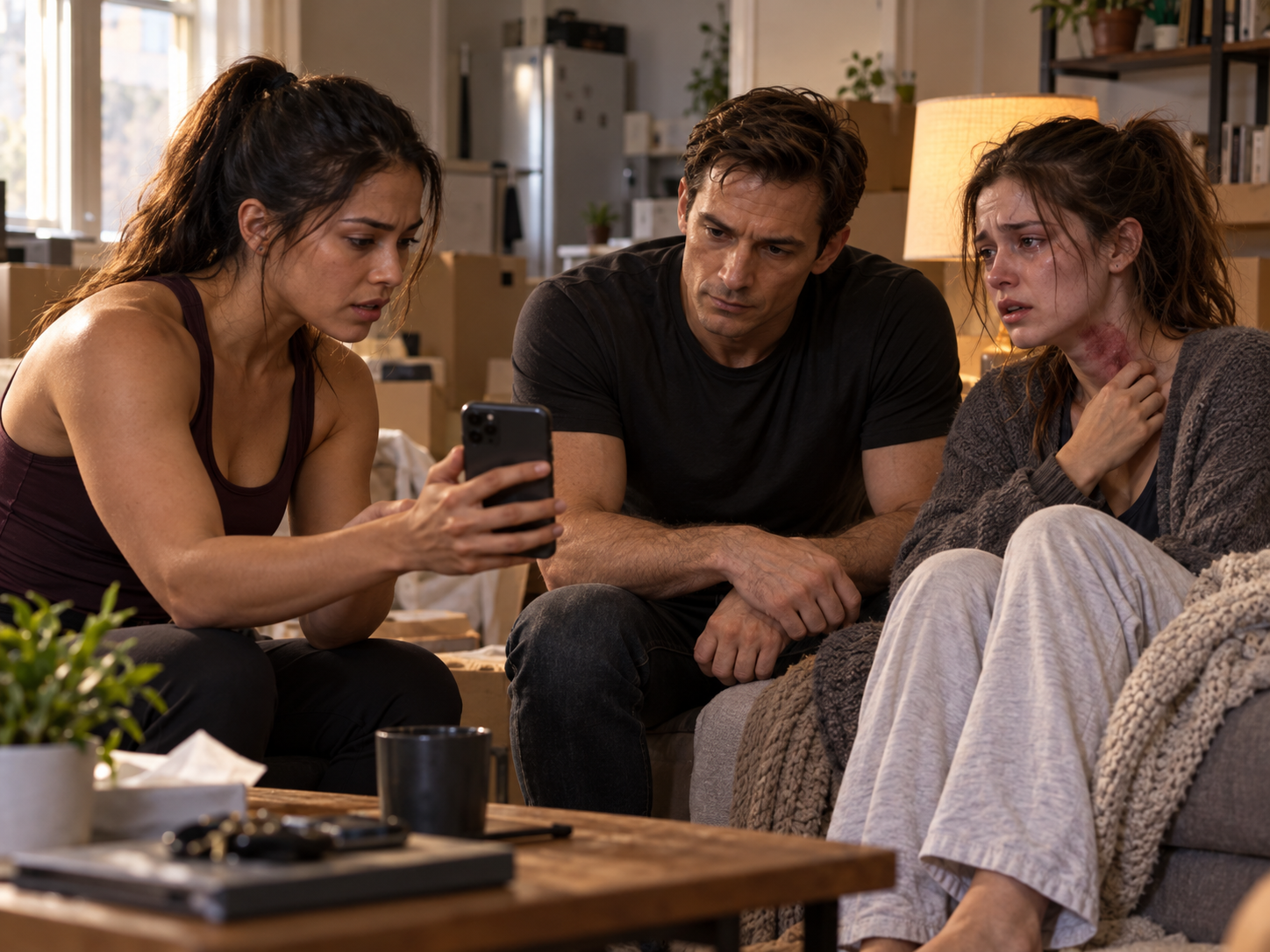
The screen showed the Apex mats.
Students moved in pairs.
Music played faintly.
Then Derek passed in front of the camera.
He grabbed my shoulder.
The recording followed us as we started.
I watched myself struggle beneath him.
My stomach twisted.
There it was.
My hand slapping the mat.
Once.
Twice.
Three times.
Then my hand striking his shoulder.
And Derek—
Derek looking directly at my face.
His arm tightening.
Natalie’s phone jerked as someone walked past.
When the image cleared, my body had gone limp.
A few seconds later, Derek released me.
Natalie stopped the video.
Nobody spoke.
I was shaking so hard I couldn’t hold my tea.
Cole gently slid the phone away.
“Natalie, have you sent this to anyone?”
“No.”
“Keep the original. Don’t edit it. Can you share it directly with Detective Torres?”
She nodded.
Then she began crying.
“I’m sorry, Sarah.”
I reached for her hand.
“I needed someone to say something.”
“I know.”
She gripped my fingers.
“And I should have.”
Cole looked at her.
“You’re saying something now.”
Natalie wiped her cheeks.
“But that’s not all.”
She hesitated.
“Last night, after the ambulance left, Grant made everyone stay.”
My skin prickled.
“He told us there’d been a misunderstanding. He said anyone who posted about it would be violating the gym’s confidentiality policy.”
Cole frowned.
“Did you sign a confidentiality agreement?”
“No.”
“Then what did he mean?”
“He said our memberships could be canceled. He also said Derek’s lawyer would be contacting people who spread false accusations.”
I looked at her.
“And the cameras?”
Natalie nodded.
“Marcus asked Grant about the recording.”
“What did he say?”
“He told Marcus the system had malfunctioned.”
Cole’s eyes narrowed.
“Before or after Derek asked him to shut it down?”
Natalie stared.
“You heard that?”
“Yes.”
She swallowed.
“Grant went into the office. When he came out, he said the main camera had been offline for maintenance.”
She leaned forward.
“But I know it wasn’t.”
“How?”
“Because I work at the front desk on Saturdays. I used the security monitor that morning to find a lost wallet. Every camera was working.”
Cole glanced at me.
I could see the calculation behind his eyes.
But he said only one thing.
“Tell the detective exactly that.”
Natalie nodded.
Then she showed us another message.
It had arrived from Grant at 2:17 that morning.
The footage is gone. As far as Apex is concerned, the matter is closed.
I stared at the screen.
“The footage is gone?”
Natalie nodded.
“That’s what he says.”
Cole’s phone rang.
Detective Torres.
He answered on speaker with my permission.
“Mr. Mitchell, we received your report about the threatening messages. We’re documenting them.”
Cole thanked her.
Then Torres continued.
“There’s another development.”
I sat straighter.
“We served a preservation demand on Apex’s security provider this morning. The gym’s local recorder appears to have been accessed and several files removed after the incident.”
Cole glanced at Natalie’s phone.
“Can deleted files be recovered?”
“Possibly. We’re working with the provider.”
She paused.
“But the account access history shows something interesting.”
“What?”
“The deletion wasn’t performed by Derek.”
I held my breath.
Torres continued.
“It was performed under Grant Whitaker’s administrator credentials.”
That afternoon, Marcus Bell called me.
I almost didn’t answer.
He had watched Derek choke me.
He had watched me lose consciousness.
And he had done nothing until my brother demanded help.
But something in me needed to hear what he had to say.
“Sarah?”
His voice sounded exhausted.
“It’s Marcus.”
“I know.”
A long silence followed.
“I heard you went to the hospital.”
“Yes.”
“Are you okay?”
I stared at the cardboard boxes stacked along my wall.
“No.”
He exhaled.
“I’m sorry.”
I had imagined those words so many times during the night.
Now that I heard them, they seemed painfully small.
“Why didn’t you stop him?”
Marcus said nothing.
“Why didn’t anyone stop him?”
“I thought he’d release.”
“After the first tap?”
Silence.
“After the second?”
“Sarah—”
“After the third?”
His breathing became audible.
“I froze.”
The answer surprised me.
He was a brown belt.
An instructor.
A man who spent four evenings a week teaching other people how to remain calm under pressure.
And he had frozen.
“Why?” I whispered.
Marcus sounded close to tears.
“Because I’ve seen what happens when someone challenges Derek.”
He told me Grant owned Apex with Derek’s help.
Not financially, exactly.
Derek had introduced wealthy clients, helped attract competitive students, and used his local connections to keep the academy profitable.
Grant had built his business around him.
And whenever students complained, Grant protected the arrangement.
“I kept telling myself I could manage him,” Marcus said.
“But you couldn’t.”
“No.”
His voice broke.
“And now you got hurt.”
I closed my eyes.
“Marcus, I’m going to cooperate with the police.”
“You should.”
“And I won’t tell them you tried to protect me.”
“I know.”
I heard him take a shaky breath.
“That’s why I’m calling.”
“What do you mean?”
“There’s something I need to show you.”
A pause.
Then he added, “Something Grant doesn’t know I kept.”
“What is it?”
Marcus swallowed.
“A folder with the names of every student Derek hurt—and the complaints Grant told me to destroy.”
PART 4 — THE PRICE OF SILENCE
The folder arrived at Detective Torres’s office the next morning.
Marcus didn’t bring it to me.
Cole had insisted that any evidence should go directly to the investigators, where it could be properly documented and preserved.
I was relieved.
Some part of me still wanted to confront Grant myself.
I imagined walking into his expensive office, placing the folder on his polished desk, and demanding that he explain every page.
But another part of me knew what would happen.
He would smile.
He would minimize.
He would tell me I didn’t understand how difficult running a martial arts academy could be.
And when that failed, he would threaten me.
That was how Apex worked.
I just hadn’t recognized it until I became the person standing on the wrong side of its power.
By Monday morning, the bruising around my neck had darkened.
Speaking still hurt.
Sleeping was worse.
Every time I closed my eyes, I felt Derek’s forearm pressing across my throat.
I’d wake up reaching for something that wasn’t there.
Air.
Space.
The right to say stop and have someone listen.
Cole never mentioned the nightmares.
He simply left the hallway light on.
And when I woke coughing at three in the morning, there was always a glass of water on the table beside my bed.
The moving truck was scheduled for Tuesday.
We should have spent Monday loading boxes.
Instead, we went to see Detective Torres.
The police department’s interview room was small and cold.
A square table occupied the center.
There were three chairs, a clock, and a box of tissues beside a recording device.
Torres entered carrying a thick folder.
She placed it on the table.
“Marcus Bell came in voluntarily,” she said. “He provided documents and gave us a detailed statement.”
I stared at the folder.
“How many people?”
“We’re still verifying the records.”
“Please.”
Torres looked at me.
“Seven written complaints over four years. Several other incidents appear in informal notes.”
My stomach dropped.
Seven.
Seven people who had complained.
Seven chances for Grant to stop Derek.
Seven opportunities to protect his students.
And somehow I had ended up unconscious on the floor.
“Did they all involve Derek?”
“Most did. Two involved other instructors. The common issue is that safety complaints were allegedly suppressed.”
Cole leaned forward.
“What exactly was Marcus told to destroy?”
“Complaint forms, correspondence, and injury reports. He kept copies because he disagreed with how they were handled.”
I stared at the table.
“Why didn’t he tell anyone?”
Torres considered her words.
“I can’t answer for him. But his statement indicates he was afraid of losing his job.”
I felt anger rise in my chest.
“He was afraid of losing his job. I was afraid I was going to die.”
“I understand.”
“No. I don’t think anyone understands.”
My voice cracked.
A sharp pain ran down my throat.
Cole placed a hand near mine, not touching until I reached for him.
Torres waited.
Finally, I whispered, “Sorry.”
“You don’t need to apologize.”
She opened the folder.
“Sarah, one of the complainants has agreed to speak with us. Her name is Rebecca Sloan.”
I remembered Natalie mentioning her.
The woman with the shoulder injury.
“She’s willing to testify?”
“She’s willing to provide a statement. We still have to determine what charges, if any, can be supported by the evidence.”
Torres studied me.
“And I need you to know something. There’s a difference between what we suspect and what we can prove.”
Cole nodded.
“Understood.”
“The original security system was accessed after the incident. We have an access log. That doesn’t automatically establish who physically deleted the recordings, or whether every file can be recovered.”
“What about Natalie’s video?” I asked.
“It’s important evidence. We have the original file and are examining it alongside witness statements and the medical records.”
She paused.
“More witnesses are coming forward.”
I looked up.
“Who?”
“A student named Javier Ruiz has given us an account of Derek ignoring a verbal stop during an earlier sparring session. Two others have confirmed hearing you tap.”
I stared at her.
“They’re actually talking?”
“Yes.”
It was such a small word.
But it loosened something inside my chest.
For the first time since Friday night, I felt less alone.
We met Rebecca Sloan two days later.
Not at the gym.
Not at the police department.
At a little coffee shop near the river, after Torres confirmed there was no investigative reason we couldn’t speak privately.
Rebecca arrived wearing a green cardigan and carrying her purse tightly against her body.
She was thirty-two, with pale blonde hair and a thin scar near one eyebrow.
She glanced around the coffee shop before sitting down.
“I’m sorry,” she said. “I’m still not used to talking about this.”
I nodded.
“Neither am I.”
Cole went to the counter to give us some privacy.
Rebecca watched him leave.
“That’s your brother?”
“Yeah.”
“He’s the one who fought Derek?”
I nodded.
She gave a humorless smile.
“Good.”
Then her smile disappeared.
“I don’t mean that I wanted someone hurt.”
“I know.”
“It’s just… I spent so long imagining someone finally standing up to him.”
I looked down.
Rebecca stirred a cup of coffee she hadn’t touched.
“Derek was different with me at first.”
She told me she’d joined Apex after her divorce.
She wanted confidence.
Structure.
A community.
The same reasons I had started.
At first, Derek praised her improvement.
Then he began making remarks about her weight.
Her strength.
Her attitude.
When she asked him to stop, he accused her of being sensitive.
When she challenged him about an unnecessarily rough round, he began pairing with her more often.
“I thought if I got better, he’d respect me,” Rebecca said.
Her fingers tightened around the spoon.
“That’s what people like him want you to believe.”
One evening, during a private session, Derek applied a shoulder lock.
She tapped.
He kept going.
By the time he released, she had suffered a significant injury that required months of treatment and rehabilitation.
She filed a complaint.
Grant told her it was an accident.
She requested the security footage.
Grant said the camera hadn’t been recording.
I felt cold.
“Same excuse.”
Rebecca nodded.
“When I pushed harder, he said I was damaging the academy’s reputation.”
“What happened?”
“They canceled my membership.”
She pulled her sleeve down over her wrist.
“And then people stopped answering my messages.”
I looked at her.
“Why?”
“Grant told them I was threatening a lawsuit because I couldn’t handle losing.”
Her eyes shone.
“I had trained with those people for almost three years, Sarah. I thought some of them were my friends.”
I swallowed.
“I’m sorry.”
Rebecca shook her head.
“You know what’s the worst part?”
I waited.
“Not the injury.”
She stared into her coffee.
“It was wondering whether I was the problem.”
My eyes filled.
Because I understood.
I understood so completely it hurt.
When Derek had laughed over my unconscious body, part of me had wondered whether I deserved it.
Whether I’d been too weak.
Too slow.
Too inexperienced.
Whether there was some secret rule everyone else understood and I had failed to learn.
Rebecca reached across the table.
“You’re not weak because you tapped.”
I started crying.
Quietly at first.
Then hard enough that my shoulders shook.
She held my hand.
“That’s the rule. That’s the one thing everyone is supposed to respect.”
I nodded through tears.
When Cole returned with a glass of water, neither of us tried to hide what had happened.
Rebecca looked at him.
“Thank you for standing up for her.”
He placed the water in front of me.
“She deserved to be safe before I got there.”
Rebecca went quiet.
Then she nodded.
“Yes,” she whispered. “She did.”
That night, Apex Grappling posted a public statement.
Grant had apparently decided that silence was no longer protecting the business.
The statement appeared on Facebook and the academy’s website.
It described the incident as an unfortunate misunderstanding involving a novice student, an experienced competitor, and an unaffiliated visitor.
It claimed that Derek had followed standard training practices.
It expressed concern about misleading online narratives.
And it announced that Cole had been permanently banned from the academy for aggressive behavior.
My brother read it at the kitchen table.
He didn’t laugh.
Didn’t swear.
Didn’t even look particularly surprised.
“Well,” he said, “that saves me the cost of a membership.”
I stared at him.
“That’s not funny.”
“No.”
He put the phone down.
“It isn’t.”
My own phone began vibrating.
Messages.
Comments.
People tagging me.
Some were supportive.
Others weren’t.
One stranger called me a liar.
Another claimed I’d staged the incident to embarrass Derek.
A man whose profile picture showed him holding a championship belt wrote that women who couldn’t handle pressure shouldn’t train combat sports.
I stopped reading.
Cole gently took the phone from my hand.
“You’re allowed to put this down.”
“But people are saying—”
“I know.”
“They think I’m lying.”
“Some people will believe whatever story lets them avoid changing their minds.”
He looked at me.
“You don’t have to convince the internet tonight.”
I wanted to believe him.
But it was hard.
Apex was more than a business in our city.
Grant sponsored youth tournaments.
He donated uniforms to underprivileged children.
He hosted charity events.
He posed for photographs with local officials and spoke at community gatherings about discipline and respect.
The more I learned about his public image, the more frightened I became.
Derek wasn’t protected by one man.
He was protected by a reputation people wanted to believe in.
Then, at 9:42 p.m., I received a message from an unfamiliar woman.
My name is Emily Vance. My son trained at Apex last year. Please don’t let them silence you.
Attached was a photograph.
A teenage boy sat in a hospital bed with his right arm in a sling.
He couldn’t have been older than sixteen.
I showed Cole.
He read the message.
Then his face went very still.
I typed back.
What happened to your son?
The response arrived almost immediately.
Derek hurt him during a training session. Grant told us it was our son’s fault. We tried to report it, but nobody at the gym would talk to us.
Another message followed.
I still have the emails.
And then:
There’s something else. Grant offered to refund our membership fees if we signed a document promising not to discuss what happened.
Cole looked at the screen.
“Send it to Torres.”
I did.
By morning, three more former students had contacted me.
One described being pressured to train through an injury.
Another claimed Derek had threatened to ruin his competitive opportunities if he complained.
The third had witnessed Rebecca’s final session and admitted he’d been afraid to speak up.
The stories were different.
The pattern wasn’t.
Fear.
Silence.
Retaliation.
And the same man standing at the center of it all.
On Thursday afternoon, Grant called me.
I didn’t recognize the number until I heard his voice.
“Sarah, this is Grant Whitaker.”
I nearly dropped the phone.
Cole sat across the room repairing a loose handle on one of my moving boxes.
He looked up immediately.
I put the call on speaker.
“What do you want?”
Grant sighed.
“To resolve this like adults.”
I said nothing.
He continued.
“This whole situation has gotten out of control. People are making accusations. Business is suffering. Employees are worried about their livelihoods.”
“And I’m worried about breathing normally.”
A pause.
“I’m sorry you were injured.”
The words sounded rehearsed.
“But you have to understand, this is a physically demanding sport. There are inherent risks.”
“I tapped.”
“Sarah—”
“I tapped three times.”
“That’s your recollection.”
I stared at the phone.
“It’s on video.”
Silence.
Then Grant’s voice changed.
Only slightly.
“Video can be misleading without context.”
Cole stopped working on the box.
Grant continued.
“I don’t want to make things difficult for you. We could arrange a refund, perhaps cover some medical expenses, provided we can all agree to stop escalating this.”
“What does that mean?”
“A mutual resolution. Nothing complicated.”
“Are you asking me not to talk about what happened?”
“I’m asking you to consider everyone’s future.”
I felt something inside me harden.
For days, I had been frightened.
Of Derek.
Of the investigation.
Of online strangers.
Of walking into another gym and being touched by someone bigger than me.
But hearing Grant speak as though my unconscious body were an inconvenient business expense changed something.
“No,” I said.
Grant paused.
“Excuse me?”
“No. I won’t agree to be quiet.”
His voice cooled.
“I hope you understand there can be consequences when people make damaging allegations.”
Cole rose from his chair.
But he didn’t interrupt.
I looked at him.
At the brother who had spent his life protecting me without demanding that I remain helpless.
And for the first time, I realized I didn’t need him to speak for me.
“I understand,” I said.
“Good.”
“And I’m preserving this call information and telling Detective Torres you contacted me.”
Grant went silent.
Then the line disconnected.
My hands shook.
Cole watched me.
“You okay?”
I nodded.
Then shook my head.
Then laughed through sudden tears.
“I have no idea.”
He came over and pulled out the chair beside me.
“That’s allowed.”
For a moment, neither of us spoke.
Then Cole smiled.
“You sounded like Mom.”
I looked at him.
“What?”
“That tone.”
He imitated our mother.
“Don’t you mistake my patience for permission, young man.”
I laughed so hard my throat hurt.
And for the first time since the attack, the pain didn’t feel like the only thing I could carry.
The investigation changed direction the following week.
Detective Torres called to explain that investigators had obtained additional evidence from the security provider, including archived data relevant to the incident.
Some of the material had been retained outside the gym’s local recording system.
The full recordings weren’t immediately available, but the provider had preserved portions of the footage and account records for forensic review.
Torres also confirmed that multiple former students had submitted statements.
I asked whether Derek would be arrested.
She refused to make promises.
“These decisions depend on the evidence and the prosecutor’s assessment, Sarah. We’re documenting everything carefully.”
Then she asked if I would be willing to participate in another interview.
I agreed.
Cole drove me downtown.
We were halfway there when his phone rang.
He answered through the truck’s speaker.
A male voice filled the cab.
“Cole Mitchell?”
“Speaking.”
“This is Andrew Keller.”
Cole’s expression shifted.
I recognized the name.
Keller was a former military colleague.
One of the few men Cole still spoke to regularly.
“Andrew.”
“I heard what happened to your sister.”
Cole glanced at me.
“She’s recovering.”
“Good.”
A pause.
Then Andrew said something that made Cole’s hands tighten around the steering wheel.
“There’s a reason I called.”
“What reason?”
“I know Derek Harlan.”
I turned toward the speaker.
Cole remained silent.
Andrew continued.
“We crossed paths years ago. Not in the Army. At a civilian training event.”
“What happened?”
“Derek was removed after multiple complaints about unsafe conduct. He tried to intimidate one of the instructors who reported him.”
Cole’s expression didn’t change.
“Do you have documentation?”
“Yes.”
“Then give it to the detective.”
“I already contacted her office.”
Cole exhaled.
Andrew hesitated.
“And Cole?”
“Yeah?”
“Be careful. Derek doesn’t handle humiliation well. He threatened the instructor after he was removed.”
“I understand.”
“No, listen. That was the part that worried me. He didn’t seem angry about being accused.”
Andrew’s voice lowered.
“He seemed angry that someone had finally made him accountable.”
Two days later, Detective Torres called again.
This time her voice was different.
More measured.
More deliberate.
“Sarah, I want to give you an update before you hear rumors.”
I was standing in the kitchen packing mugs.
Cole was carrying boxes down to the truck.
“What happened?”
“Derek Harlan has been arrested in connection with the assault at the gym.”
I sat down.
The room seemed to tilt.
“Arrested?”
“Yes. The investigation is continuing, and the charges will have to proceed through the court.”
I pressed my hand against my mouth.
For nearly a week, I had imagined this moment.
I expected triumph.
Vindication.
Maybe relief so overwhelming I’d cry.
Instead, I felt terrified.
“What happens now?”
“There’s a court process. You’ll be kept informed through the victim services office. We can also discuss protective measures if you have concerns about retaliation.”
I nodded even though she couldn’t see me.
“Okay.”
Torres paused.
“Sarah, there is one more thing.”
My stomach tightened.
“What?”
“Your brother’s actions were reviewed as part of the incident. Based on the available evidence, investigators are not pursuing charges against him.”
I closed my eyes.
“Thank you.”
“Don’t thank me. We follow the evidence.”
She paused.
“And the footage shows something important.”
“What?”
“The recovered recording confirms that Derek continued applying the choke after visible taps.”
My eyes filled.
Torres continued.
“We’re also reviewing the circumstances surrounding the removal of security files and the handling of earlier complaints. Grant Whitaker’s conduct remains under investigation.”
I gripped the phone.
For the first time, someone with authority was saying what I had known from the beginning.
I had tapped.
Derek had known.
And what happened afterward wasn’t a misunderstanding.
It was a choice.
When Cole came back upstairs, he found me crying at the kitchen table.
He immediately set down the empty moving dolly.
“Sarah?”
I looked up.
“They arrested him.”
Cole stopped.
I repeated it.
“They arrested Derek.”
He sat across from me.
For a moment, he didn’t speak.
Then he reached for my hand.
“Good.”
I shook my head.
“Why don’t I feel better?”
He looked at me with an expression I couldn’t name.
“Because an arrest doesn’t erase what happened.”
I wiped my face.
“What if I never want to train again?”
“Then don’t.”
I stared at him.
He shrugged.
“Jujitsu isn’t a debt you owe anyone.”
“But I joined because I wanted to stop being scared.”
Cole leaned forward.
“Sarah, courage isn’t the absence of fear.”
I smiled faintly.
“That’s very inspirational. Did they teach you that in the Army?”
“No. Mom did.”
I laughed.
He squeezed my hand.
“You’re allowed to be scared. You’re allowed to be angry. And you’re allowed to decide what comes next.”
I looked toward the moving boxes.
My life, packed into cardboard.
My apartment nearly empty.
My body bruised.
My sense of safety shattered.
Yet somewhere beneath all of it, another feeling had begun to grow.
Not confidence.
Not yet.
Something quieter.
Possibility.
Then Cole said, “There’s something I haven’t told you.”
I looked at him.
His expression had become serious.
“After I left the Army, I had a hard time adjusting.”
I waited.
Cole almost never talked about those years.
“I thought if I stayed busy enough, I wouldn’t have to think about some of the things I’d seen.”
He looked toward the window.
“I kept moving. Kept working. Kept telling everyone I was fine.”
My throat tightened.
“What changed?”
He took a breath.
“One of the men I served with asked me a question.”
“What question?”
Cole turned back to me.
“He asked whether I was trying to build a life or just avoid remembering the old one.”
I sat very still.
“I didn’t know how to answer him.”
“What did you do?”
“I got help. It wasn’t quick. And it wasn’t easy.”
He smiled without humor.
“But eventually I learned something.”
“What?”
“Being able to win a fight doesn’t mean you’ve learned how to live in peace.”
He looked directly at me.
“I don’t want you spending your life proving Derek didn’t break you. I want you building a life that belongs to you.”
I started crying again.
But this time the tears felt different.
Because somewhere between the hospital visits, the police interviews, and the cardboard boxes, I had forgotten why Cole had come to town.
He hadn’t come to fight Derek.
He hadn’t come to expose Grant.
He hadn’t come to become a hero in someone else’s story.
He had come because his little sister was moving apartments.
And she had asked for help.
The next morning, we loaded the truck.
My new apartment was forty minutes away, in a quieter neighborhood near a park.
It had tall windows, a narrow balcony, and a kitchen large enough for two people to cook without constantly bumping elbows.
Cole carried the heavy furniture.
I handled the smaller boxes.
Our friend Natalie arrived with coffee and pastries.
Rebecca came by later with a small houseplant.
For a few hours, the investigation seemed far away.
We laughed.
We argued about where the couch should go.
Cole insisted that my crooked bookshelf was a structural hazard.
Natalie accused him of having the interior design instincts of a military barracks.
Even Rebecca laughed.
Then, just before sunset, I found a small envelope tucked beneath the windshield wiper of Cole’s truck.
There was no stamp.
No address.
Only my name.
SARAH.
Inside was a photograph.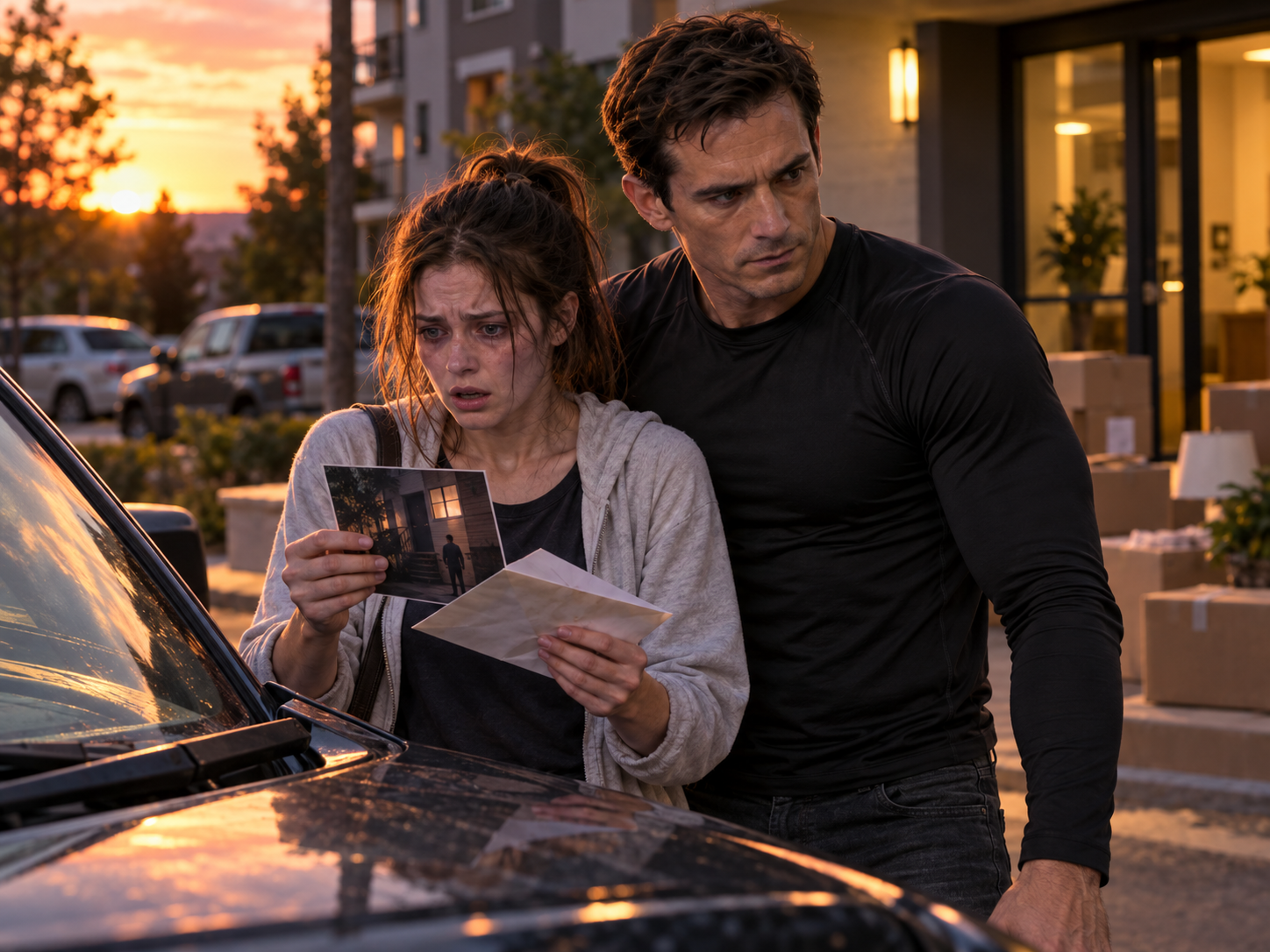
It showed me on the Apex mat, unconscious beneath Derek’s arm.
The image had clearly been taken from a different angle than Natalie’s video.
Someone had circled my face in red marker.
And beneath it, in thick black letters, someone had written:
YOUR BROTHER CAN’T PROTECT YOU FOREVER.
I stood frozen beside the truck.
The sounds of the neighborhood seemed to recede.
Children playing.
Traffic moving.
A dog barking behind a fence.
All of it disappeared beneath the roar of blood in my ears.
Then Cole stepped out of the building.
He saw my expression.
He saw the envelope.
And he stopped.
“Sarah?”
I couldn’t speak.
I held out the photograph.
He took one look.
Then he reached for his phone.
This time, there was no anger on his face.
Only determination.
“We’re calling Torres.”
I stared at the picture.
Derek was in custody.
Grant was under investigation.
The gym was falling apart.
And yet someone had found my new home.
Someone had watched us move.
Someone wanted me afraid again.
The worst part wasn’t the threat itself.
It was realizing that Derek might not have been the only person who wanted me silent.
PART 5 — THE STRENGTH TO WALK AWAY
For the second time in ten days, my brother stood between me and a threat he couldn’t simply fight.
The first had weighed 210 pounds and worn a black belt.
The second was a photograph.
A message.
A promise that someone could reach me whenever they wanted.
And I hated how effectively it worked.
I hated that my hands trembled as Detective Torres photographed the envelope.
I hated that every car passing my new apartment made me look toward the window.
Most of all, I hated that some part of me wanted to pack everything again and run.
Cole noticed.
Of course he noticed.
He had always been good at recognizing the things I tried to hide.
But he didn’t tell me to be brave.
He didn’t promise that nobody could hurt me.
He simply asked whether I wanted him to stay until the police finished their preliminary work.
“Yes,” I whispered.
“Then I’m staying.”
Torres examined the photograph without touching its surface.
“Do you recognize where this was taken?”
I shook my head.
She held it beneath the kitchen light.
The angle was low.
Closer to the floor than the ceiling-mounted security cameras.
My unconscious body occupied the center of the frame.
Derek’s arm was still locked around my neck.
Beyond him, several students stood watching.
One person near the wall was holding a phone.
Torres studied the image.
“Who was recording that night?”
“Natalie,” I said. “But her recording looked different.”
“Anyone else?”
I looked harder.
There was a man standing near the cubbies.
A tall man with a shaved head.
I recognized him.
“That’s Travis.”
“Full name?”
“Travis Mercer. He’s Derek’s friend.”
Torres took notes.
“Did he train there?”
“Sometimes. Mostly he watched.”
Cole stood beside the kitchen counter.
“Sarah, do you remember anyone taking pictures while the paramedics were there?”
“No.”
“Think about the beginning of the round.”
I closed my eyes.
Derek grabbing my shoulder.
The timer starting.
Music playing.
A few people laughing.
Then I remembered something.
A brief flash.
Not a camera flash exactly.
A phone screen illuminating in the dim corner near the lockers.
“Travis had his phone out,” I whispered.
Torres nodded.
“We’ll look into it.”
I looked toward my front door.
“But how did he find me?”
“That’s one of the things we’re investigating.”
Cole spoke.
“Her former address was available through her gym membership records. Does Grant have access to her updated information?”
I shook my head.
“I never gave Apex my new address.”
Torres looked at me.
“Who knew you were moving here?”
I began listing names.
My landlord.
The moving company.
A few coworkers.
Natalie.
Rebecca.
Cole.
Then I stopped.
“Marcus.”
Torres looked up.
“What about him?”
“I mentioned the neighborhood to him before everything happened. He asked where I was moving.”
“Did you give him the address?”
“No. Just the general area.”
Torres made another note.
“Don’t jump to conclusions. We’ll follow up.”
I nodded.
But the uncertainty remained.
For the rest of the evening, I felt as though the walls of my new apartment were made of glass.
Cole slept on the couch that night.
Again.
At two in the morning, I found him sitting by the window with a mug of tea.
He wasn’t holding a weapon.
He wasn’t pacing.
He wasn’t doing any of the things television taught people to expect from a former special operations soldier.
He was reading.
The book was about gardening.
I stared.
“Gardening?”
He looked up.
“Apparently, tomatoes are dramatic.”
I almost laughed.
“You’re unbelievable.”
“That’s what every tomato-growing forum says.”
I sat beside him.
For a while, we watched the empty street.
Then I asked, “Are you ever scared?”
Cole closed the book.
“Of course.”
“Really?”
He gave me a look.
“Sarah, I’m a person.”
“I know. It’s just…”
“You don’t remember me being scared?”
I shook my head.
He considered that.
“When Dad was sick, I was terrified.”
My eyes stung.
“You never showed it.”
“I thought I was helping everyone by staying calm.”
“Weren’t you?”
“Sometimes.”
He looked down at the book.
“Other times, I was just making it harder for anyone to know what I needed.”
I leaned back.
Our father had died of cancer five years earlier.
Cole had been deployed for much of the final year.
He’d managed to return for the last weeks, but afterward he’d carried a guilt he rarely discussed.
“I remember you sitting beside his hospital bed,” I said.
Cole nodded.
“You held his hand for hours.”
“Yeah.”
“You looked so strong.”
He smiled sadly.
“I was trying not to fall apart.”
I rested my head against his shoulder.
He let me.
Then I whispered the thought I’d been too ashamed to admit.
“I don’t think I’m strong enough to do this.”
Cole turned toward me.
“Do what?”
“Go through a trial. See Derek again. Listen to people question me.”
He was quiet for a moment.
Then he said, “You don’t have to make every decision tonight.”
“But what if I can’t?”
“Then we’ll find the support you need. And whatever happens, you won’t be less worthy because something was hard.”
I closed my eyes.
He continued.
“You know what the strongest thing you did that night was?”
I gave a bitter laugh.
“Get strangled unconscious?”
“No.”
He waited until I looked at him.
“You tapped.”
I stared.
“That’s not strength.”
“It is when you’ve been taught that asking for mercy makes you weak.”
He shook his head.
“You recognized danger. You communicated a boundary. You did exactly what you were supposed to do.”
My eyes filled.
“The failure wasn’t yours, Sarah.”
I had heard similar words from doctors.
From Rebecca.
From Natalie.
But something about hearing Cole say them in our new living room, while the city slept outside, finally allowed me to believe them.
Not completely.
Not all at once.
But enough.
The next morning brought an unexpected visitor.
Marcus Bell.
He stood outside my door holding a small cardboard box.
Cole opened it only after confirming who was there.
Marcus looked exhausted.
His face was pale, and he wore the same navy sweatshirt I’d seen him wearing at Apex dozens of times.
“Sarah,” he said. “I know I probably shouldn’t have come without calling.”
I stood behind Cole.
“What do you want?”
Marcus glanced at the box.
“I brought your training things.”
I frowned.
“My things?”
“Your spare gi. Knee brace. Water bottle. They were still in your locker.”
He looked embarrassed.
“I thought you might want them back.”
Cole took the box.
“Thank you.”
Marcus didn’t leave.
He looked at me.
“I also came to apologize.”
I felt myself stiffen.
He swallowed.
“I told the detective everything. Including the times I saw Derek go too far and convinced myself it wasn’t my business.”
I said nothing.
“I kept thinking if I stayed at Apex, I could make things better from inside.”
His voice cracked.
“But I didn’t make things better.”
I watched him struggle with the words.
“I made it easier for Grant to pretend everything was fine.”
The admission was painful to hear.
Because it was true.
“Why are you telling me this now?” I asked.
Marcus looked directly at me.
“Because I should have told you before you ever stepped onto that mat.”
For several seconds, I couldn’t answer.
Finally, I said, “I believe you’re sorry.”
His shoulders loosened.
“But I’m not ready to forgive you.”
His face fell.
I continued.
“You were the instructor. You were supposed to keep us safe.”
“I know.”
“And when I tapped, you watched.”
He nodded.
Tears shone in his eyes.
“I know.”
I took a breath.
“It matters that you’re telling the truth now. But it doesn’t erase what happened.”
Marcus lowered his head.
“You’re right.”
There was no argument.
No attempt to explain.
He accepted what I’d said.
And strangely, that made me respect him more than any apology could have.
Before leaving, he told us he had resigned from Apex.
He was cooperating with investigators and helping former students locate their old training records.
Then he hesitated.
“There’s something else.”
Cole straightened.
Marcus looked at me.
“I heard about the photograph.”
My stomach tightened.
“How?”
“Natalie told me someone had threatened you. Not the details.”
He shook his head.
“Sarah, I’ve been thinking about who had access to the surveillance system.”
“Grant,” I said.
“Yes. But Travis also helped with the cameras sometimes.”
Cole and I exchanged glances.
Marcus continued.
“Grant gave him access last year because Travis used to install security systems.”
I felt cold.
“Did Travis have access to the membership database?”
“Not officially.”
Marcus hesitated.
“But he sometimes worked on the front desk computer.”
I looked at Cole.
His phone was already in his hand.
“Call Torres,” I whispered.
The police identified Travis Mercer as a person of interest in the intimidation report.
Within days, investigators obtained evidence connecting him to the threatening photograph.
According to Torres, security footage from a neighboring property showed his vehicle near my apartment around the time the envelope was delivered.
Additional records supported the connection.
When questioned, Travis initially denied everything.
Then investigators confronted him with the evidence.
He admitted leaving the photograph.
He claimed he’d done it without Derek’s knowledge.
His explanation was almost insulting.
He said he’d only wanted to scare me into dropping the complaint.
As if that made it harmless.
As if a woman who had recently lost consciousness during an assault would find a threatening photograph of herself merely inconvenient.
Torres informed me that the intimidation would be handled through the appropriate legal process.
She also explained that investigators were examining whether information obtained through the academy had been used to locate me.
Grant’s role remained under scrutiny.
For the first time, I understood how much harm could be done by people who never personally touched a victim.
Derek had hurt my body.
But Grant and Travis had helped create the fear that followed me home.
One had protected the man who hurt people.
The other had tried to frighten me into silence.
Different choices.
Same message.
Your safety matters less than our comfort.
I was finished accepting that message.
Three months later, the courtroom smelled of old wood and floor polish.
I sat between Cole and Rebecca.
Natalie occupied the row behind us.
Marcus sat farther back.
He hadn’t asked to join us, and I was grateful for that.
The criminal case involving Derek had moved forward.
The prosecutor explained the charges arising from the assaults and reviewed the evidence that could be presented.
Derek’s attorney had initially disputed the accusations, portraying the events at Apex as ordinary risks of competitive training.
But the available recordings, medical documentation, witness testimony, and Derek’s actions after the supervised round presented serious problems for that defense.
The process took time.
There were hearings.
Legal arguments.
Delays.
Moments when I wondered whether justice was simply another word for exhaustion.
Then Derek entered a guilty plea to charges arising from the assaults on me and Cole.
The agreement spared me a full contested trial, though I was still offered the chance to give a victim impact statement before sentencing.
I had prepared one.
Six pages.
Rewritten eleven times.
Every version sounded either too angry or too forgiving.
Too emotional.
Too clinical.
Too much.
Not enough.
The night before the hearing, I almost threw it away.
Cole found me sitting on the bedroom floor surrounded by crumpled pages.
“Trouble?”
I nodded.
“I don’t know how to say it.”
He sat on the floor across from me.
“Say what?”
“Everything.”
Cole considered that.
“Then don’t.”
I looked up.
“What?”
“You don’t have to explain your entire life. Just tell the truth about what happened and what it cost you.”
I stared at the pages.
“What if I cry?”
“Then you cry.”
“What if my voice shakes?”
“Then it shakes.”
“What if Derek laughs?”
Cole’s expression became serious.
“Then that tells the room something about Derek. Not you.”
I looked down.
For months, I had imagined standing in front of him and delivering some perfect speech.
Something clever.
Something devastating.
Words that would finally make him feel as small as he’d made me feel.
But I realized I didn’t want revenge anymore.
I wanted my voice back.
When the judge called my name, my knees trembled.
Cole rose slightly as if he intended to help.
I shook my head.
He sat back down.
I walked to the front.
Derek sat beside his attorney.
His broad shoulders filled the dark suit he wore.
He looked smaller than I remembered.
Not physically.
He was still enormous.
But the authority I’d once imagined surrounding him was gone.
He wasn’t a king on a mat.
He was a defendant answering for his choices.
I unfolded my statement.
My fingers shook.
“Your Honor, I joined Apex Grappling because I wanted to become stronger.”
My voice sounded strange in the quiet courtroom.
“I wasn’t good at jujitsu when I started. I was slow, awkward, and nervous. But I kept showing up because I believed that courage was something I could practice.”
I looked down.
“On the night of the assault, I did exactly what every student is taught to do when they are in danger.”
I paused.
“I tapped.”
The room was silent.
“Three times on the mat. Then against Derek’s shoulder.”
My throat tightened.
“He didn’t stop.”
I swallowed.
“When I woke up, I couldn’t understand why everyone was looking away.”
My eyes filled.
“I thought the worst thing was that I couldn’t breathe.”
I took a slow breath.
“But afterward, I learned something worse.”
I lifted my eyes.
“I had trusted people to keep me safe, and some of them had decided protecting a reputation mattered more than protecting a person.”
Derek stared at the table.
I continued.
“For months, I’ve had nightmares. I’ve been afraid to go into gyms. I’ve been afraid of strangers standing too close behind me. I’ve struggled with the idea that asking someone to stop might not be enough.”
My hands steadied.
“But I also learned that I wasn’t the only person hurt.”
I looked toward Rebecca.
“Other students had spoken up before me. They were dismissed. Some were humiliated. Some were made to feel as though they deserved what happened.”
I faced the judge.
“I don’t want this case to be remembered as a story about my brother beating a black belt.”
Cole lowered his head.
“This isn’t about which man was stronger.”
I drew a breath.
“It’s about what strength is supposed to mean.”
The courtroom was completely still.
“Strength should mean knowing when to stop. It should mean respecting someone who trusts you. And when you’ve done something wrong, it should mean taking responsibility.”
I lowered the paper.
“That night, my brother let go the moment Derek tapped.”
I turned slightly toward the defense table.
“Derek had been given the same chance with me.”
My voice broke.
“He chose not to.”
For a moment, I couldn’t continue.
Then I remembered something Cole had said.
That I didn’t need to be fearless.
I just needed to tell the truth.
I looked at the judge again.
“I can’t change what happened to me. But I hope what happens here helps make it harder for someone else to be silenced.”
I folded my statement.
“Thank you.”
When I returned to my seat, Cole was crying.
Not loudly.
Not dramatically.
Just two quiet tears running down the face of a man I’d once believed was incapable of being afraid.
He took my hand.
And whispered, “I’m proud of you.”
The judge imposed a sentence consistent with the plea agreement and the applicable law, including a period of incarceration, supervision, and conditions restricting Derek’s contact with me.
The court also addressed restitution for documented losses.
It didn’t fix everything.
No sentence could return the nights I’d spent frightened.
No court order could erase the memory of losing consciousness.
But it mattered.
Derek had been required to answer for something he’d once laughed about.
Grant’s business faced a separate reckoning.
As the investigation and former students’ complaints became public, Apex lost members, instructors, and several commercial partnerships.
Civil claims followed.
Authorities continued reviewing evidence related to the handling of complaints and the deletion of recordings. Not every allegation resulted in a criminal charge, but the documents and testimony established how consistently warning signs had been ignored.
Grant eventually closed the academy.
The announcement appeared on the same website where he’d once described my assault as a misunderstanding.
This time there was no photograph of him smiling beside a tournament trophy.
Only a short notice explaining that Apex would cease operations.
I read it once.
Then closed the page.
For months, I’d imagined feeling victorious when the gym closed.
Instead, I felt sad.
Not for Grant.
For what Apex could have been.
For the students who had come looking for confidence.
For the friendships that had formed on those mats.
For the instructors who had wanted to teach.
For everyone who had trusted the place to make them stronger.
Apex hadn’t failed because jujitsu was dangerous.
It had failed because the people responsible for safety allowed fear to become part of its culture.
That was a choice.
And choices had consequences.
Six months after Derek attacked me, I stood outside a different martial arts academy.
It was called Harbor Jujitsu.
A modest building beside a grocery store.
No giant photographs of champions.
No banners celebrating dominance.
Just a blue sign above the door and a handwritten notice advertising beginner classes.
My hands were sweating.
I’d driven there three times before.
Each time, I’d remained in the parking lot and eventually left.
This time, Cole sat in the passenger seat.
“You don’t have to go in,” he said.
“I know.”
“We can get lunch instead.”
“I know.”
He looked at the building.
“Actually, I vote lunch. There’s a barbecue place down the road.”
I laughed nervously.
“You’re not helping.”
“That’s what big brothers are for.”
I stared through the windshield.
“What if I panic?”
“Then you step outside.”
“What if I can’t do it?”
“Then you’ve learned something about what you’re ready for today.”
I turned toward him.
“Do you ever get tired of being reasonable?”
“Constantly.”
I laughed again.
Then I opened the door.
The academy smelled like clean mats and fresh paint.
A woman in her forties stood behind the front desk.
She had short brown hair and wore a purple belt over a faded training uniform.
“Can I help you?”
I swallowed.
“My name’s Sarah. I emailed about the beginners’ class.”
Her expression softened.
“Sarah Mitchell?”
I nodded.
“I’m Lena Ortiz.”
She stepped out from behind the desk.
“Thank you for coming.”
I glanced toward the mat.
Several adults were warming up.
A young man practiced a movement slowly with an older partner.
Two women laughed as they adjusted their belts.
Everything looked so ordinary.
And that made it frightening.
Lena noticed.
“We can just talk today,” she said.
“You don’t have to train.”
I looked at her.
“Really?”
“Of course.”
She gestured toward a bench.
We sat.
I told her I’d had a bad experience at another gym.
She didn’t ask for details.
She didn’t demand proof.
She simply listened.
Then she explained how Harbor handled safety.
New students could decline any round.
Training partners were expected to respect verbal stops and taps immediately.
Instructors monitored sessions.
Students could report concerns directly, including in writing.
And if someone repeatedly ignored safety rules, they would not be allowed to train there.
It all sounded so obvious.
So simple.
Yet hearing it spoken plainly nearly made me cry.
Lena smiled.
“There’s something I tell every beginner.”
“What?”
“A tap isn’t failure. It’s communication.”
I looked down.
She continued.
“Nobody learns anything if they don’t feel safe enough to try.”
I wiped the corner of my eye.
“Can I watch today?”
“Absolutely.”
So I watched.
For forty minutes, I sat beside the mat and observed people training.
They struggled.
They laughed.
They tapped.
And every single time someone tapped, the other person released.
Immediately.
Without complaint.
Without humiliation.
Without making it personal.
Near the end of class, Lena approached me.
“Would you like to try a few basic movements? No sparring.”
I hesitated.
Then nodded.
She paired me with a woman named Priya, who was close to my age.
Priya had a yellow hair tie around her wrist and a friendly expression.
“I’m new too,” she admitted.
We practiced simple positioning drills.
Nothing intense.
Nothing frightening.
At first, I was stiff.
Every unexpected movement made my shoulders tighten.
Lena encouraged me to slow down.
Then Priya accidentally pressed too much weight against my chest.
Panic flashed through me.
Instant.
Violent.
Unreasonable.
I tapped her shoulder.
Once.
Priya released immediately.
“Sorry! Are you okay?”
I stared at her.
She backed away.
“Do you want a break?”
My chest rose and fell.
I looked toward Lena.
She nodded.
“Take your time, Sarah.”
Nobody laughed.
Nobody rolled their eyes.
Nobody called me weak.
Priya waited.
And suddenly I was crying.
I sat on the mat, covering my face with both hands.
“I’m sorry.”
Lena crouched nearby.
“You have nothing to apologize for.”
I shook my head.
“It’s just…”
I couldn’t finish.
She didn’t make me.
After a while, I wiped my eyes.
Then I looked at Priya.
“Can we try again?”
She smiled.
“Whenever you’re ready.”
I took a breath.
And started.
By the end of the year, I’d returned to regular training twice a week.
Not every session was easy.
Sometimes I still became anxious when someone moved too quickly.
Sometimes I needed to step off the mat.
Sometimes I drove home feeling frustrated that progress wasn’t happening faster.
But slowly, my body began learning a new pattern.
Training.
Pressure.
Communication.
Release.
Trust.
I also began seeing a counselor who helped me work through the fear and the way my memories had changed after the assault.
Cole never treated that as weakness.
He celebrated it.
He said asking for help was something he’d had to learn too.
Our relationship changed in other ways.
Before that weekend, we’d loved each other but lived in separate worlds.
He had his quiet life, his work, and the memories he rarely shared.
I had my job, my apartment, and a stubborn habit of pretending I could manage everything alone.
Now we talked more.
Not only when something was wrong.
Sometimes he called to ask how my plants were doing.
Sometimes I called to ask whether his tomatoes had survived.
They usually hadn’t.
He insisted he was improving.
I insisted his garden needed a rescue mission.
We began having dinner together every other Sunday.
Nothing fancy.
Pasta.
Takeout.
Occasionally an overambitious recipe that left my kitchen looking like a disaster zone.
One evening, Cole arrived carrying a small wooden frame.
Inside was a photograph of us from childhood.
I was eight.
He was twenty.
We were sitting on the tailgate of our father’s old truck, eating ice cream cones.
My face was covered in chocolate.
Cole had one arm around my shoulders.
On the back of the frame, he’d written:
You never had to earn a place beside me.
I cried.
He pretended not to notice.
The following spring, Harbor Jujitsu hosted a community self-defense workshop.
Lena asked whether I would be comfortable speaking briefly about the importance of safe training environments.
I almost refused.
Public speaking terrified me.
But then I thought about Rebecca.
About Natalie.
About the other students who had spent years believing their experiences didn’t matter.
So I agreed.
The workshop took place on a Saturday morning.
About forty people attended.
Some were experienced martial artists.
Others had never stepped onto a mat.
Cole sat in the back row.
He wore jeans and a plain gray T-shirt.
Nothing remarkable.
Exactly as always.
When Lena introduced me, my heart hammered.
I stepped forward holding a small note card.
For a moment, I saw Apex again.
The white fluorescent lights.
The cinderblock wall.
Derek’s enormous shadow.
My body on the floor.
Then I looked at the faces in front of me.
People waiting to listen.
And I remembered the courtroom.
The new gym.
Every person who had believed me.
I began.
“Last year, I was seriously injured during a martial arts training session.”
The room grew quiet.
“I tapped, and my training partner didn’t release.”
I paused.
“The experience changed how I thought about strength. For a long time, I believed being strong meant never needing help.”
I looked toward Cole.
He smiled.
“But I’ve learned that strength also means recognizing your limits, respecting the limits of others, and making it safe for people to speak up.”
I continued.
“Good training isn’t about making someone afraid of you. It’s about giving them the confidence to face difficult situations without losing respect for themselves or others.”
The words came more easily than I expected.
When I finished, people applauded.
Not wildly.
Not like spectators celebrating a knockout.
It was a warm, steady sound.
The kind that made me feel welcome.
Afterward, a young woman approached.
She couldn’t have been older than nineteen.
She held her hands tightly together.
“Can I ask you something?”
“Of course.”
She looked at the mat.
“I quit a gym last year because one of the instructors kept making me uncomfortable.”
I waited.
“Everyone told me I was overreacting.”
My chest tightened.
She looked up.
“Was I wrong to leave?”
I thought about all the answers people had given me.
All the lectures about toughness.
All the excuses.
Then I smiled.
“No.”
Her eyes filled.
“You were allowed to leave.”
She nodded.
Then, very quietly, she said, “Thank you.”
And in that moment, I understood something extraordinary.
My experience hadn’t become meaningful because it happened.
The harm itself was never necessary.
But I could choose what I did afterward.
I could help someone else recognize that their safety mattered.
I could refuse to participate in a culture that confused cruelty with discipline.
I could build something better.
That was enough.
Two weeks later, Harbor held its first belt promotion ceremony of the year.
I stood in line beside Priya, trying not to fidget.
Lena moved down the row, calling names and congratulating students.
When she reached me, she smiled.
“Sarah Mitchell.”
I stepped forward.
My heart thudded.
Lena handed me a stripe for my white belt, recognizing the progress I’d made since joining the academy.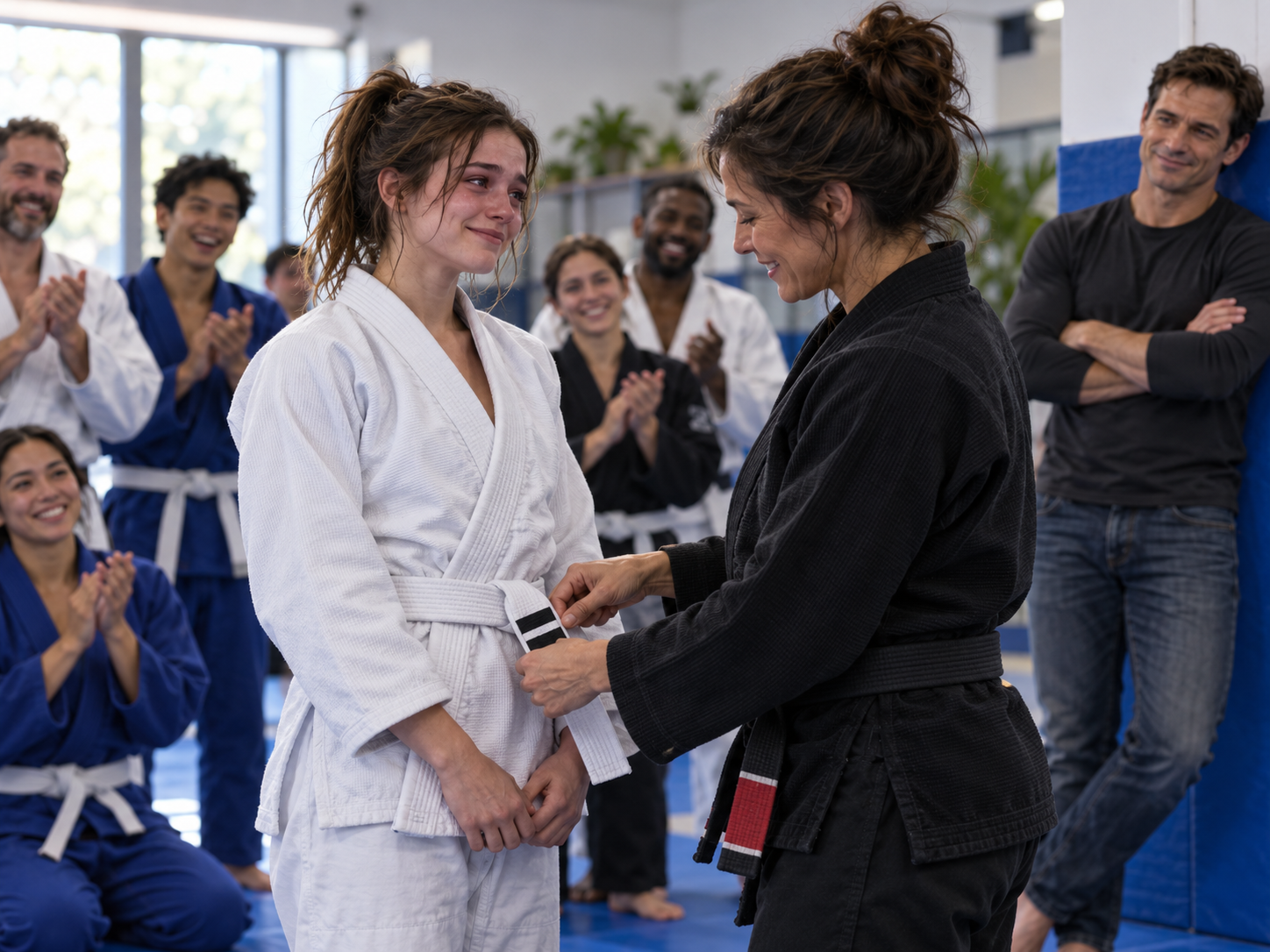
It was small.
Just a narrow piece of tape.
Nothing compared to the black belts that decorated Apex’s walls.
But when I looked at it, my eyes burned.
Lena lowered her voice.
“You’ve worked hard.”
I nodded.
“Thank you.”
She smiled.
“Keep showing up.”
Behind her, students applauded.
And from the back of the room came a familiar voice.
“That’s my sister!”
I closed my eyes.
“Cole.”
The entire room laughed.
He stood beside the wall, grinning like an idiot.
My quiet, disciplined, almost unnervingly calm older brother had apparently decided that embarrassing me at martial arts events was now his responsibility.
I laughed so hard I nearly dropped my belt.
After the ceremony, he met me near the entrance.
“Nice work.”
I held up the stripe.
“It’s not exactly a championship.”
Cole studied it.
“Looks important to me.”
I shrugged.
“I still have a long way to go.”
“Yeah.”
He smiled.
“That’s the good part.”
We walked outside together.
The sun was setting behind the buildings.
Warm air carried the smell of freshly cut grass from a nearby park.
For a moment, we stood beside his truck without speaking.
Then I asked the question I’d carried for months.
“Cole?”
“Yeah?”
“That night at Apex, when you said ‘I’m next’… were you angry?”
He considered it.
“Very.”
“Were you afraid?”
He looked at me.
“Yes.”
I blinked.
“Of Derek?”
“No.”
He leaned against the truck.
“I was afraid I’d already gotten there too late.”
My throat tightened.
“I remember seeing you on the floor,” he continued. “You weren’t moving. For a few seconds, I didn’t know if you were going to wake up.”
He looked away.
“I’ve been in dangerous situations before. But watching you lie there…”
His voice faded.
I stepped closer.
“You got there.”
He shook his head.
“Sarah, I couldn’t undo those four seconds.”
“I know.”
“I couldn’t erase what he did.”
“I know.”
He turned toward me.
“All I could do was help you afterward.”
I reached for his hand.
“And you did.”
We stood there quietly.
Then I smiled.
“Actually, you did more than that.”
He raised an eyebrow.
“Oh?”
“You helped me move.”
Cole laughed.
A real laugh.
The kind that made his shoulders shake.
“Best moving job I’ve ever had.”
I looked at him.
“Terrible customer service, though.”
“Excuse me?”
“Driver got into a fight. Boxes were delayed. Very unprofessional.”
He shook his head.
“One star.”
“Definitely.”
He opened the passenger door.
I climbed in.
As we drove away from Harbor Jujitsu, I watched the academy disappear in the side mirror.
A year earlier, I had believed that courage meant becoming someone who never froze.
Someone who never needed protection.
Someone strong enough that nobody could ever make her feel small.
I knew better now.
Courage was returning to a place that frightened me.
It was speaking when silence would have been easier.
It was trusting someone again after trust had been broken.
It was recognizing that asking for help didn’t make me weak.
And sometimes, it was as simple as tapping.
Knowing when to stop.
Knowing when to let go.
Knowing that your life was worth protecting.
Derek had spent years believing that strength meant making other people surrender.
Cole had spent years learning that real strength meant controlling himself when it mattered most.
And I had finally learned that I didn’t have to become either of them.
I could become myself.
That night, we stopped at a diner on the way home.
Cole ordered a cheeseburger.
I ordered pancakes.
Halfway through dinner, he reached across the table and stole a piece of bacon from my plate.
I slapped his hand.
He immediately pulled it back.
“Okay, okay. I surrender.”
We both laughed.
Then he lifted his hands dramatically.
“Look. I respected the tap.”
I groaned.
“You’re going to make that joke forever, aren’t you?”
“Probably.”
I threw a napkin at him.
He caught it.
And for a brief, beautiful moment, there was no courtroom.
No hospital.
No threatening photograph.
No man who had tried to convince me that surrender was weakness.
There was just my brother.
My best friend.
The person who had driven into town to help me move and somehow helped me find my way back to myself.
I looked at him across the table.
“Hey, Cole?”
“Yeah, Sarah?”
“Thank you.”
He smiled.
“For what?”
I thought about everything.
The night at Apex.
The hospital.
The police station.
The nightmares.
The court hearings.
The moving boxes.
The second gym.
The first time someone tapped and I watched their partner release immediately.
Then I thought about the little girl who had fallen through the ice years ago, frightened and freezing, certain the world was about to swallow her.
And the young soldier who had carried her home without once making her feel ashamed.
I smiled through sudden tears.
“For always coming when I call.”
Cole reached across the table.
He squeezed my hand.
“Always.”
Then he grinned.
“But next time you ask me to help you move, maybe we can skip the martial arts gym.”
I laughed.
“Deal.”
Outside, the evening lights glowed against the diner windows.
My brother went back to stealing my bacon.
And I let him have the last piece.
Not because I was afraid.
Not because I couldn’t stop him.
But because, after everything we’d survived, some things were finally safe enough to let go.
THE END.