They Released a 95-Pound Military K9 to Humiliate Me—Then One Secret Word Stopped Him Mid-Attack
Part 1 — The Dog They Had Already Condemned
“That dog needs to be euthanized. There’s nothing left to save.”
Those were the first words I heard when I arrived at the military K9 training facility in Virginia.
The second thing the operators did was laugh when I asked to examine him.
And the third?
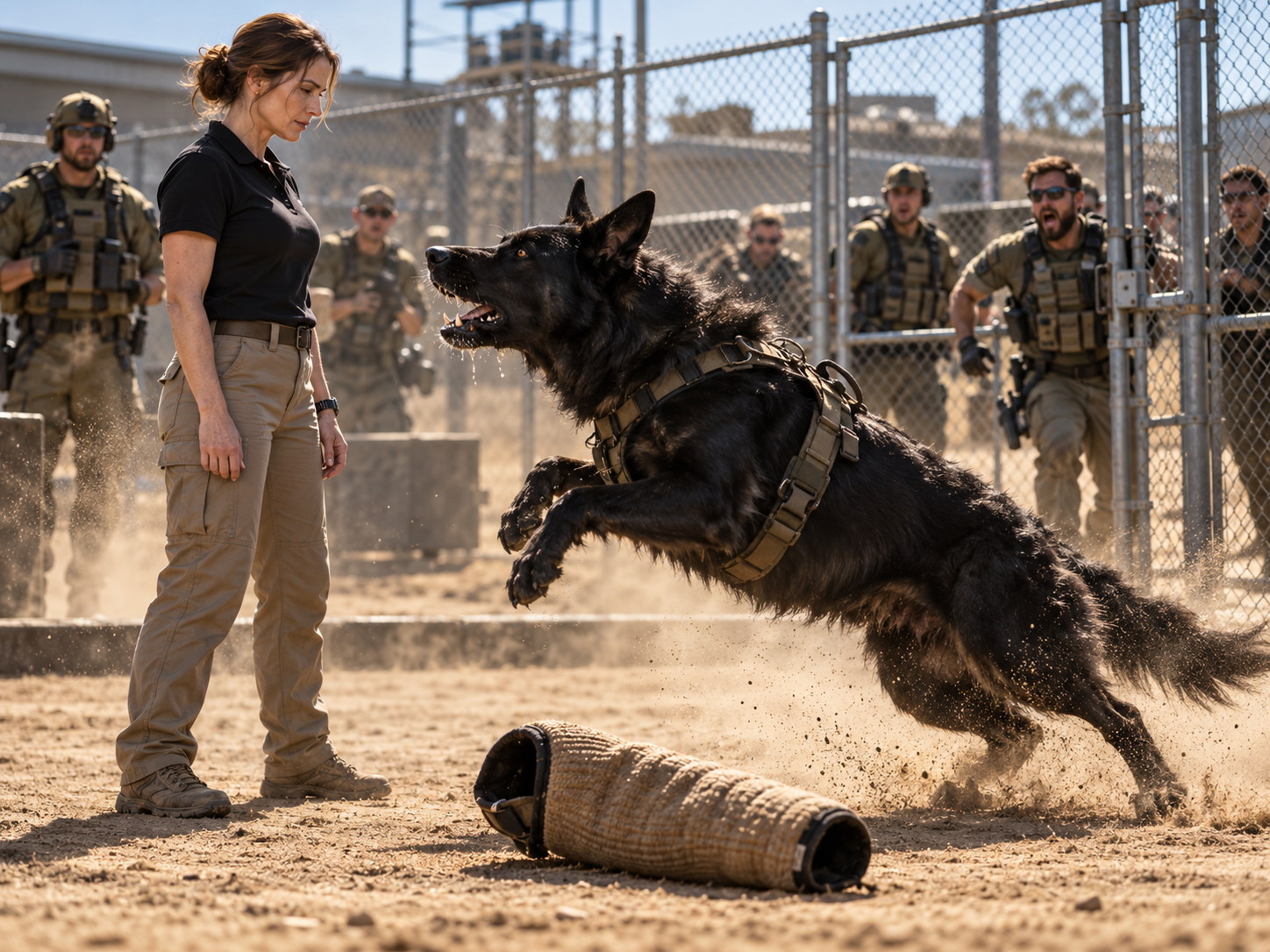
They released ninety-five pounds of furious, military-trained German Shepherd directly toward me.
They thought I was just a small civilian woman with a clipboard.
They had no idea I’d spent sixteen years developing combat dogs for classified military operations.
They didn’t know I’d trained Titan when he was still a puppy.
And they certainly didn’t know that beneath his aggression was a dog mourning the only handler he’d ever truly trusted.
When Titan charged, everyone expected me to scream.
Instead, I removed my protective sleeve and let it fall to the ground.
Then, with his teeth only seconds from reaching me, I spoke a single word.
A word none of the men behind that fence had ever heard before.
And Titan stopped in the middle of his attack.
My name is Dr. Claire Bennett.
For sixteen years, I’d worked with military working dogs trained to operate in environments where conventional equipment and even advanced technology had limitations.
Some of those dogs had capabilities that could save lives when human instincts, machinery, and drones weren’t enough.
I’d devoted much of my career to understanding how they learned, how they formed bonds, and what happened when those bonds were destroyed.
But when I arrived at Atlantic Special Operations Annex in Virginia, nobody seemed particularly interested in my experience.
I stood five feet four inches tall.
I wore khaki pants, a black polo shirt, and boots that had seen better days.
Under one arm, I carried a leather clipboard.
There was nothing about my appearance that suggested authority to the men gathered in the training yard.
To them, I looked like an administrative employee who had wandered into the wrong place.
That assumption would prove to be their first mistake.
The afternoon heat was oppressive.
Sunlight beat down on the training enclosure.
A dry breeze shook the chain-link fencing, carrying dust across the ground.
Several men in tactical equipment stood near the kennels.
They had the confidence of experienced operators who’d served in dangerous environments.
I could respect that experience.
What I couldn’t respect was the scene unfolding in front of me.
Inside the enclosure, a massive black German Shepherd had pinned a Navy operator to the dirt.
The man wore protective training equipment.
A reinforced bite sleeve covered one arm.
But Titan wasn’t biting the sleeve.
His jaws were locked onto the padded shoulder of the operator’s jacket.
The man struggled beneath him.
His boots dug deep grooves into the dirt as he tried to move.
“Get him off me!”
Two Navy operators rushed toward the dog with control lines and break sticks.
Titan resisted violently.
He twisted.
Pulled.
Refused to release his grip.
It took nearly three minutes before the men finally managed to separate him from the operator.
They dragged Titan toward his tether.
But he didn’t settle.
He hurled himself against the steel restraint with such force that the post began bending.
Foam gathered at the corners of his mouth.
His amber eyes moved frantically.
To the men surrounding him, he looked dangerous and uncontrollable.
But I saw something different.
I saw grief behind the teeth.
Senior Chief Daniel Voss slammed the cage door shut.
Then pulled off his gloves.
“That’s it. He’s finished.”
His voice was sharp with frustration.
“Third incident this week.”
He gestured angrily toward Titan.
“He ignores every command. Corrections don’t work. The collar doesn’t work. He’s become a liability.”
A broad-shouldered operator named Briggs stood nearby.
He nodded grimly.
“Ever since Hale died, something’s been wrong with him.”
Then he looked toward the pacing dog.
“It’s like something inside him snapped.”
Hale.
The name struck me harder than I’d expected.
Staff Sergeant Ethan Hale.
Titan’s handler.
His partner.
The person he’d been trained to trust above everyone else.
Ethan was dead.
And the dog standing behind that fence had been with him when it happened.
I’d read the incident report twice during my flight to Virginia.
An overseas ambush.
Smoke.
Confusion.
Gunfire.
And a single fatal round.
Ethan had fallen during the attack.
Titan remained beside his handler’s body until the extraction team arrived.
He refused to let anyone approach.
Even when the danger had passed, he wouldn’t abandon the man who’d been his entire world.
After that mission, every attempt to control Titan seemed to provoke another confrontation.
The operators believed he’d become unstable.
I believed they were misunderstanding him.
Titan wasn’t simply disobeying commands.
He was still searching for the person who would never return.
“Excuse me.”
My voice drew the attention of three men standing near the enclosure.
Voss turned.
His eyes traveled from my boots to my clipboard.
Then back to my face.
His expression was openly dismissive.
“Administration building’s about half a mile that way, ma’am.”
I held his gaze.
“I know where I am.”
He raised an eyebrow.
“I’m here for Titan.”
Briggs laughed.
“They sent you to evaluate that animal?”
“I requested the assignment.”
The laughter faded slightly.
Voss stepped closer.
He was tall and heavily built, with scars and tattoos visible beneath his tactical equipment.
Everything about his posture suggested he was accustomed to being obeyed.
“Ma’am, that dog has put two men in the hospital this month.”
He pointed toward the medic bench.
“He nearly destroyed Lawson’s shoulder ten minutes ago.”
I glanced toward the injured operator.
Then back toward Titan.
Voss continued.
“He’s scheduled to be euthanized at seventeen hundred.”
Five o’clock.
The decision had apparently already been made.
I looked through the fence.
Titan was pacing again.
Back and forth.
Back and forth.
But his movement didn’t seem random.
He paused at certain points.
Lifted his head.
Watched the people outside.
Then resumed his pattern.
He was searching.
Evaluating.
Trying to understand a world that no longer contained the person he trusted.
I turned toward Voss.
“He’s not feral.”
The senior chief’s jaw tightened.
“He’s grieving.”
For a moment, nobody spoke.
Then I continued.
“You keep treating him like a defective weapon.”
Briggs shook his head.
“You cannot seriously believe that’s all this is.”
I faced him.
“Titan isn’t an ordinary working dog.”
I glanced toward the enclosure.
“His training centered on a very specific bond with one handler.”
Ethan Hale.
The human being who represented safety, trust, and command.
That relationship had been torn away in the middle of combat.
And everything that followed had been an attempt to make Titan accept unfamiliar people under increasingly aggressive conditions.
“You lost his trust,” I said. “Then tried to replace it with force.”
Voss folded his arms.
I continued before he could interrupt.
“Every correction tells him he’s being threatened. Every attempt to overpower him confirms that belief.”
I looked toward the tethered dog.
“He doesn’t recognize the authority you’re trying to impose.”
Briggs exhaled sharply.
Voss stepped closer.
Then bent until his face was only inches from mine.
“I was handling military dogs before you finished college.”
I didn’t move.
Didn’t look away.
“And I was preparing dogs for classified deployments before you earned those stripes.”
The training yard went silent.
Even Briggs stopped smiling.
Voss stared at me.
His eyes narrowed.
I could almost see him deciding whether I’d just challenged his authority.
Then his mouth tightened.
“If you know so much, go inside and prove it.”
I looked at the enclosure.
Then back at him.
The challenge was obvious.
He expected me to hesitate.
To realize how dangerous Titan could be.
To admit that the operators were right.
Perhaps even to apologize for questioning their methods.
The men nearby watched with expressions that suggested they were waiting for me to retreat.
They expected the small woman with the clipboard to return to the administrative building.
Sign the termination paperwork.
And leave the dangerous work to them.
Instead, I walked toward the medic bench.
Placed my clipboard on it.
Then turned around.
“All right.”
Voss blinked.
I extended my hand.
“Give me a bite sleeve.”
Nobody moved.
For the first time since I’d arrived, the men seemed uncertain what to say.
On the medic bench, Lawson struggled to sit upright.
His shoulder had just been injured during Titan’s last attack.
“Chief, she doesn’t have protective armor.”
I kept my eyes on Voss.
“I asked for a sleeve.”
The senior chief hesitated.
His expression had changed.
The challenge he’d intended as a humiliation was becoming real.
“Listen,” he said more quietly. “I was making a point.”
I nodded.
“So am I.”
I bent beside my canvas duffel bag.
Unzipped it.
And removed a Kevlar-lined bite sleeve.
It wasn’t new.
The material was worn.
The surface carried marks from years of training.
But I knew every inch of it.
And so had Titan.
Long before he became a powerful military K9, he’d been an oversized puppy with paws that looked far too big for his body.
His ears had never seemed able to agree on which direction they should point.
Back then, he’d trained with this exact sleeve.
I remembered his clumsy movements.
His enthusiasm.
The way he’d gradually learned to channel that energy into disciplined work.
Now the same dog stood sixty feet away, trapped in a cycle of fear and aggression.
I slipped the familiar sleeve over my left arm.
Secured it carefully.
Then looked toward the gate.
Voss watched me.
He clearly hadn’t expected me to bring my own protective equipment.
“You go five feet past that gate,” he warned.
“If Titan charges, drop the sleeve. We’ll pull you back out.”
I met his stare.
“That won’t be necessary.”
His expression suggested he didn’t believe me.
I didn’t try to convince him.
Briggs approached the gate.
Then opened it just wide enough for me to enter.
I stepped through.
The steel door slammed shut behind me.
Sixty feet away, Titan stopped pacing.
His head turned sharply.
For the first time, his attention was entirely focused on me.
A low growl rose from his chest.
It was deep enough that I felt the sound vibrating through the hot air.
The fur along his spine lifted into a dark ridge.
He lowered his body.
His muscles tightened.
His amber eyes fixed on my chest.
I remained still.
Behind the fence, I heard Voss speak.
“Let her learn.”
Then came a metallic sound.
A sharp, unmistakable click.
Clack.
I knew that sound.
I had worked around restraint equipment for too many years to mistake it.
The tether had just been released.
I hadn’t authorized anyone to release Titan.
And I certainly hadn’t asked for an uncontrolled approach.
But suddenly, the ninety-five-pound German Shepherd was free.
Someone shouted.
Another operator cursed.
The gate latch rattled behind me as the men scrambled to react.
Titan exploded forward.
He crossed the dirt with terrifying speed.
His body stretched low as powerful legs drove him toward me.
This wasn’t an ordinary run.
He was accelerating into a full attack.
I watched the distance disappear.
Forty feet.
Thirty.
Twenty.
Every instinct in my body told me to raise the Kevlar sleeve.
To brace for impact.
To protect my face and chest.
But I knew what that movement might mean to Titan.
Another unfamiliar person presenting an object for him to seize.
Another confrontation.
Another attempt to overpower a dog who no longer trusted the people surrounding him.
I had not come to fight him.
So I did something nobody behind the fence expected.
I loosened the sleeve.
Pulled my arm free.
And let the protective equipment fall beside my boots.
I stood completely unprotected.
Lawson shouted from the medic bench.
“NO!”
Titan kept coming.
Ten feet.
His eyes remained locked on me.
The sound of his growl filled the enclosure.
Behind me, boots struck the ground as the operators rushed toward the gate.
But there was no longer enough time to stop him.
Titan gathered his powerful body.
Then leaped.
Ninety-five pounds of muscle and teeth launched toward my chest.
I could see his jaws.
His raised fur.
The tension in his shoulders.
I knew exactly what an impact from a dog that size could do.
And I knew that everyone watching believed I was about to be badly injured.
But I didn’t run.
I didn’t lift my arms.
I didn’t reach for the sleeve lying beside my boots.
I stood where I was.
Because the dog flying toward me wasn’t simply a dangerous animal.
He was the same puppy I’d once trained.
The same dog who had trusted Ethan Hale.
The same loyal partner who’d refused to abandon his handler’s body after an overseas ambush.
The operators saw aggression.
I saw a dog who had lost the one person he understood.
And I was relying on something that existed long before he’d learned to attack on command.
Something none of those men had ever heard.
Titan was almost upon me.
His body filled my vision.
The distance between us had vanished.
Behind the fence, someone screamed.
I remained perfectly still.
Then, in the final instant before impact, I spoke.
One word.
Not one of the standard commands Voss and his team had been shouting.
Not a correction.
Not a threat.
It was a word Titan had known long before this training yard.
A word connected to a part of his life the men surrounding him knew nothing about.
And the reaction was immediate.
Titan stopped in the middle of his lunge.
His attack broke off so abruptly it seemed as though some invisible force had seized him.
The massive dog who’d ignored every command suddenly halted at the sound of my voice.
For a heartbeat, the entire training yard appeared frozen.
Nobody shouted.
Nobody moved.
And the men who’d been so certain Titan was beyond saving were staring at something they couldn’t explain.
The dog they had scheduled to euthanize at five o’clock had just responded to a single word from the woman they’d laughed at.
Part 2 — The Word That Brought Him Home
“Harbor.”
That was the word.
Not an attack command. Not a military instruction.
Just Harbor.
Seven years earlier, when Titan was a gangly puppy at my training facility in North Carolina, I had chosen that word for a reason.
A harbor was somewhere a frightened creature could find safety.
Somewhere the storm could rage outside without following him in.
I’d used it during his earliest exercises, long before Ethan Hale entered his life. Whenever Titan became overwhelmed, I would speak that word softly and give him space to settle.
Ethan had loved the idea.
“Every soldier deserves somewhere safe to come home to,” he’d told me.
Eventually, Harbor became something more than a familiar sound. It was part of a ritual shared by three individuals: Ethan, Titan, and me.
And now, after everything Titan had endured, that sound had reached him through the chaos.
The German Shepherd landed awkwardly less than two feet from me.
Dust rose around his paws.
His body remained rigid, his muscles trembling from the force of his interrupted charge.
I did not mistake his hesitation for complete safety.
A familiar cue could interrupt a reaction. It could not erase months of trauma in a heartbeat.
I remained still, breathing slowly.
“That’s right, big boy,” I whispered.
Titan’s ears flickered.
His amber eyes moved from my face to the sleeve on the ground.
Then back again.
For one terrible second, I thought he might resume his attack.
Instead, his nose lifted.
He sniffed.
Once.
Twice.
A faint whine escaped his throat.
I felt my chest tighten.
“Harbor,” I repeated.
This time, I lowered my voice.
“It’s Claire.”
Titan took one uncertain step.
Then another.
He stopped close enough to smell my boots.
His tail hung low.
Behind the fence, Briggs whispered something I couldn’t hear.
Titan moved toward my hand.
I kept it relaxed at my side, allowing him to choose whether to approach.
His nose touched my fingers.
A long moment passed.
Then the dog who had nearly torn through a trained operator’s protective jacket lowered his head against my thigh.
And began to tremble.
I had seen exhausted dogs collapse after difficult deployments.
I’d seen injured animals remain silent through pain that would make a grown man scream.
But there was something unbearable about the way Titan leaned against me.
He wasn’t celebrating.
He wasn’t suddenly healed.
He was exhausted.
For weeks, perhaps months, he had been fighting a world that no longer made sense.
And for the first time since Ethan died, something familiar had returned.
I swallowed against the ache in my throat.
“Oh, Titan.”
His ears folded back.
“I know,” I whispered. “I know.”
Then he made a small, broken sound.
It was barely louder than a breath.
And I started crying.
I hadn’t cried when I read Ethan’s death report.
I hadn’t cried during the flight to Virginia.
I hadn’t cried when Voss told me Titan was scheduled to die.
But that sound brought everything crashing through me.
Because it reminded me of the puppy who used to whimper when Ethan left the room.
And of Ethan himself, grinning as he told me that Titan had become the only creature in the world who could tell when he was having a bad day.
“Dogs don’t care about your rank,” he’d said. “They just want to know whether you’re coming back.”
Ethan hadn’t come back.
Titan had never understood why.
A voice shattered the moment.
“What the hell just happened?”
Senior Chief Voss stood outside the gate.
His face had lost its color.
I slowly raised my head.
“Someone deliberately released a dangerous dog into an occupied enclosure.”
Voss’s expression hardened.
“Watch your accusation.”
“Then explain the tether.”
Briggs looked away.
I noticed.
So did Voss.
“Equipment malfunction,” the senior chief replied.
I glanced toward the release mechanism.
“I’ve examined that model before. The latch doesn’t simply disengage because someone wishes it would.”
Voss didn’t answer.
I continued, keeping my voice measured.
“Preserve the equipment. Preserve the camera recordings. And nobody touches Titan until I finish evaluating him.”
“You don’t give orders here.”
“No,” I said. “But I know someone who does.”
I reached into my pocket and removed my phone.
Voss laughed once, without humor.
“Who are you calling? Your supervisor?”
“Rear Admiral Thomas Mercer.”
The laughter stopped.
Mercer commanded the regional program overseeing several specialized training and operational-support units.
He was also the officer who had authorized my evaluation.
Voss stared at me.
“You know Admiral Mercer?”
I looked him directly in the eyes.
“He requested that I report my findings to him personally.”
For the first time, the senior chief seemed genuinely uncertain.
I called.
Mercer answered after the second ring.
“Bennett. You’re early.”
“Sir, I need the euthanasia order suspended immediately.”
His tone changed.
“What happened?”
“Titan was released without authorization while I was inside the enclosure. I’ve established an initial response to a familiar cue, but he requires a proper medical and behavioral assessment before anyone makes a final decision.”
There was a pause.
“Were you injured?”
“No, sir.”
“Who released him?”
“That’s what I intend to find out.”
Mercer’s answer came without hesitation.
“Put the senior chief on.”
I handed the phone through the fence.
Voss accepted it reluctantly.
“Senior Chief Voss speaking, sir.”
His posture changed almost instantly.
“Yes, sir.”
Another pause.
“Understood, sir.”
Then:
“No, sir. There will be no further training exercises.”
He handed the phone back.
I took it.
Mercer’s voice returned.
“Dr. Bennett, the order is suspended pending independent review. I’ll have an investigator and veterinary team there within the hour. Maintain safe control of the dog. Don’t take unnecessary risks.”
“Thank you, Admiral.”
“And Claire?”
“Yes?”
“Find out what happened to Ethan’s partner.”
The call ended.
Voss looked as though someone had taken a hammer to his confidence.
I turned my attention back to Titan.
“Let’s get you somewhere quiet.”
He followed me toward the gate, hesitant but attentive.
When Briggs moved forward to help, Titan immediately stiffened.
I raised a hand.
“Stop.”
Briggs froze.
“Don’t approach him.”
“He needs a leash.”
“He needs distance first.”
I waited until Titan relaxed, then used the familiar lead I’d brought in my bag.
There were no dramatic commands.
No struggle.
Only quiet movements, patience, and a dog trying desperately to understand whether he could trust the person standing beside him.
When we reached the kennel building, Titan refused to enter his old enclosure.
He stopped at the doorway.
His breathing quickened.
His eyes moved toward something mounted on the wall.
A metal cabinet.
A shelf of training equipment.
And beneath it, a black electronic correction collar.
Titan backed away.
I noticed the reaction immediately.
“What happened in this room?” I asked.
Voss followed my gaze.
“Standard rehabilitation.”
I looked at him.
“That’s not an answer.”
He said nothing.
I crouched to inspect the kennel threshold without forcing Titan closer.
There were deep claw marks along the lower door.
The interior padding had been torn away.
And just inside, near the drain, lay something that made my stomach turn.
A narrow strip of faded green fabric.
I recognized the stitching.
I’d seen it hundreds of times.
It belonged to the old tactical harness Ethan had customized for Titan.
A harness that had supposedly been destroyed after the ambush.
I pointed toward it.
“Where did that come from?”
Voss glanced inside.
“Old equipment.”
“Ethan Hale’s equipment?”
His expression shifted.
“Maybe.”
I looked at Titan.
He was staring at the fabric.
Not growling.
Not lunging.
Just staring.
Then he released a low, aching whimper.
There was something about that sound I couldn’t dismiss.
“Why is his deceased handler’s equipment inside a kennel you use for corrective training?”
Voss crossed his arms.
“Because it’s property. We store property.”
“Then why is it torn?”
No answer.
I turned to Briggs.
“Do you know?”
He looked toward Voss before speaking.
That single glance told me more than his eventual words.
“Not really, ma’am.”
I stood.
“Then we’re going to start with the records.”
Voss stepped into my path.
“You’ve seen one incident. You don’t know what we’ve dealt with.”
“No,” I replied. “And neither will anyone else until I examine what actually happened.”
He leaned closer.
“You think one word means you understand this animal better than everyone who’s spent the last three months dealing with him?”
“No.”
I held his stare.
“I think one word proves he can still respond. The rest requires evidence.”
His jaw tightened.
But he stepped aside.
I arranged a quiet observation room away from the main training yard, with veterinary staff responsible for safe containment and monitoring.
Titan entered cautiously.
He inspected the corners, circled twice, and finally lay down near my chair.
Within minutes, his breathing slowed.
I watched his eyelids grow heavy.
Then he slept.
It was the first uninterrupted sleep I had personally witnessed him take since arriving.
I sat beside him and opened my notebook.
The official incident summary claimed Titan had become progressively aggressive without an identifiable trigger.
But I’d already identified several possible triggers.
Unfamiliar handlers.
Physical restraint.
The old kennel.
Correction equipment.
And something associated with Ethan’s torn harness.
I wrote them all down.
Then I requested his complete training records.
What arrived forty minutes later was not complete.
There were missing dates.
Contradictory signatures.
Repeated entries marked behavioral failure.
And an unusual notation written beside one of the earliest incidents.
Handler transition attempt unsuccessful. Subject became aggressive following auditory stimulus.
I read the sentence twice.
Auditory stimulus.
“What stimulus?” I muttered.
I turned the page.
The following section had been blacked out.
Not because it contained classified operational information.
Because somebody had physically covered the original text before photocopying it.
I held the paper toward the light.
Beneath the thick black marker, I could faintly make out a handwritten notation.
Two words.
Hale recording.
I went completely still.
At that moment, Titan lifted his head.
His ears turned toward the corridor.
Footsteps approached.
A young sailor appeared at the doorway.
He couldn’t have been older than twenty-four.
His name patch read ELLIS.
“Dr. Bennett?”
“Yes?”
He glanced behind him.
Then lowered his voice.
“I’m Petty Officer First Class Noah Ellis. I worked with Sergeant Hale before his last deployment.”
I closed the folder.
“What can I do for you?”
He hesitated.
“I don’t think you have the real records.”
My pulse quickened.
“Why?”
“Because I saw what happened the first time they played the recording.”
“What recording?”
Ellis swallowed.
“The one where Sergeant Hale was screaming.”
The room seemed to shrink around me.
Titan was fully awake now.
His ears stood rigid.
Ellis looked at him with something close to shame.
“They said it would help him accept that Hale was gone.”
He paused.
“But every time they played it, he went crazy.”
My fingers tightened around the folder.
“Where did they get the audio?”
“I don’t know. Something recovered from the mission.”
“Who ordered them to use it?”
Ellis hesitated again.
Then whispered:
“Chief Voss.”
I looked at the sleeping mat, at Titan’s worn paws, at the scars beneath his dark coat.
Suddenly, the pattern made terrible sense.
They hadn’t merely failed to help him grieve.
They had repeatedly exposed him to the sound of his dying handler.
And then punished him for reacting.
Ellis glanced over his shoulder.
“There’s something else, ma’am.”
I waited.
He stepped closer.
“Sergeant Hale left a message before that mission.”
“For whom?”
Ellis looked directly at me.
“For you.”
My breath caught.
“Where is it?”
His face went pale.
“That’s the problem.”
He lowered his voice until it was almost inaudible.
“Someone deleted it from the official system after he died.”
Then he reached into his pocket.
And placed a small silver data drive on the table.
“I made a copy.”
I stared at it.
Ellis took one step backward.
“Please don’t tell Chief Voss I gave you that.”
Before I could respond, the hallway door opened.
Senior Chief Daniel Voss stood on the other side.
His eyes moved from Ellis to the silver drive.
Then slowly to me.
“What,” he asked, “is going on here?”
Part 3 — The Message Ethan Never Got to Deliver
For several seconds, nobody moved.
Voss stood in the doorway, one hand resting against the frame, his expression unreadable.
Ellis looked like a man who had just realized he’d stepped into a minefield.
The silver drive lay on the table between us.
And beneath my chair, Titan had begun to growl.
Not loudly.
Not aggressively.
It was a warning.
His eyes were fixed on Voss.
I placed my hand beside Titan without touching him.
“Easy, big boy.”
Then I looked up.
“Petty Officer Ellis was explaining a discrepancy in the training records.”
Voss’s gaze shifted to the drive.
“Is that so?”
“Yes.”
“Funny. Because I don’t recall authorizing him to distribute operational material.”
Ellis stiffened.
“Chief, I—”
“Dismissed.”
The word cracked through the room.
Ellis looked at me.
I shook my head slightly.
“Petty Officer Ellis is assisting an authorized review,” I said. “He can remain.”
Voss turned toward me.
“You seem to have forgotten whose facility this is.”
“And you seem to have forgotten that Admiral Mercer suspended your authority to conduct further exercises involving Titan.”
“That’s not the same thing.”
“No,” I agreed. “It isn’t.”
I picked up the drive.
“But interfering with an official review is something the investigators will want to know about.”
His face darkened.
“You have no idea what you’re getting involved in.”
That sentence disturbed me more than an outright threat would have.
Because it sounded less like anger than fear.
“Then perhaps you should explain it,” I replied.
Voss opened his mouth.
Before he could answer, another voice sounded from the corridor.
“Senior Chief Voss.”
A woman in a dark-blue uniform approached with two military police personnel behind her.
She carried a black document case and wore the expression of someone who had spent her entire career separating excuses from evidence.
“Commander Rachel Morgan. Naval Criminal Investigative Service.”
Voss straightened immediately.
“Commander.”
Morgan looked at him.
“I understand there was an unauthorized release of a military working dog into an occupied enclosure.”
“Possible mechanical failure.”
“Then we’ll examine the mechanism.”
She glanced toward me.
“Dr. Bennett?”
“Yes.”
“Admiral Mercer asked us to coordinate with you. Are you injured?”
“No.”
“And the dog?”
“Stable for now. He needs veterinary assessment and a controlled rehabilitation environment.”
Morgan nodded.
“Good.”
Then she looked at the silver drive in my hand.
“What’s that?”
“Potential evidence relating to Staff Sergeant Ethan Hale.”
Voss interrupted.
“That material may be classified.”
Morgan turned toward him.
“Then my investigators will handle it accordingly.”
For the first time, Voss had nothing to say.
Within minutes, the room was secured.
Ellis gave an initial statement.
The drive was documented and transferred for examination on an authorized system.
Titan remained with me under veterinary supervision while Commander Morgan arranged for the relevant personnel and equipment to be interviewed or inspected.
The following morning, she invited me into a secure conference room.
I hadn’t slept much.
Titan had woken repeatedly during the night, startled by noises in the corridor.
Each time, I had waited quietly nearby until he settled again.
His first proper medical examination had revealed old pressure sores, inflammation around the neck, and a partially healed injury to his left hind leg.
None of those findings proved deliberate cruelty by themselves.
But they proved that Titan’s suffering had been greater than the training summaries suggested.
Morgan stood beside a monitor.
“Dr. Bennett, we’ve reviewed the material Ellis provided. You’re authorized to see the portions relevant to your evaluation.”
I sat down.
On the screen appeared Ethan Hale.
Alive.
Smiling.
My heart seemed to stop.
He was wearing a faded green T-shirt, sitting on the edge of a military bunk.
Titan lay beside him, younger and leaner than the dog I’d encountered in Virginia.
Ethan scratched behind the shepherd’s ears.
“Hey, Claire.”
Two words.
And suddenly I was back in North Carolina, watching a twenty-six-year-old soldier arrive at my training facility with the same crooked smile.
He’d been serious about his work but terrible at hiding his affection for Titan.
He had asked more questions than any handler I’d ever trained.
He’d wanted to understand everything.
Why dogs became fearful.
Why trust broke down.
What happened when the handler made a mistake.
I used to joke that he was studying for my job.
Now his face filled the screen.
And he was dead.
Ethan continued.
“If you’re watching this, I probably found a way to make you do paperwork you didn’t volunteer for.”
He laughed.
I pressed my fingertips against my mouth.
Then his expression changed.
“I’m recording this because Titan’s getting close to retirement age, at least from the work we’ve been doing. The last deployment was harder on him than I expected.”
He looked down at the dog.
Titan lifted his head.
Ethan smiled sadly.
“He still wants to work. You know how he is. But I don’t want people confusing his loyalty with an unlimited ability to keep going.”
There was a pause.
Then Ethan looked directly into the camera.
“If something happens to me, promise you’ll fight for him.”
My eyes filled.
“Don’t let them turn him into a problem they can dispose of because they don’t understand him.”
He took a breath.
“He’s given us everything.”
Titan placed one enormous paw against Ethan’s leg.
Ethan chuckled.
“Yeah, buddy. I know.”
Then he spoke softly.
“Harbor.”
The dog immediately settled, lowering his head onto Ethan’s knee.
I began crying before the recording ended.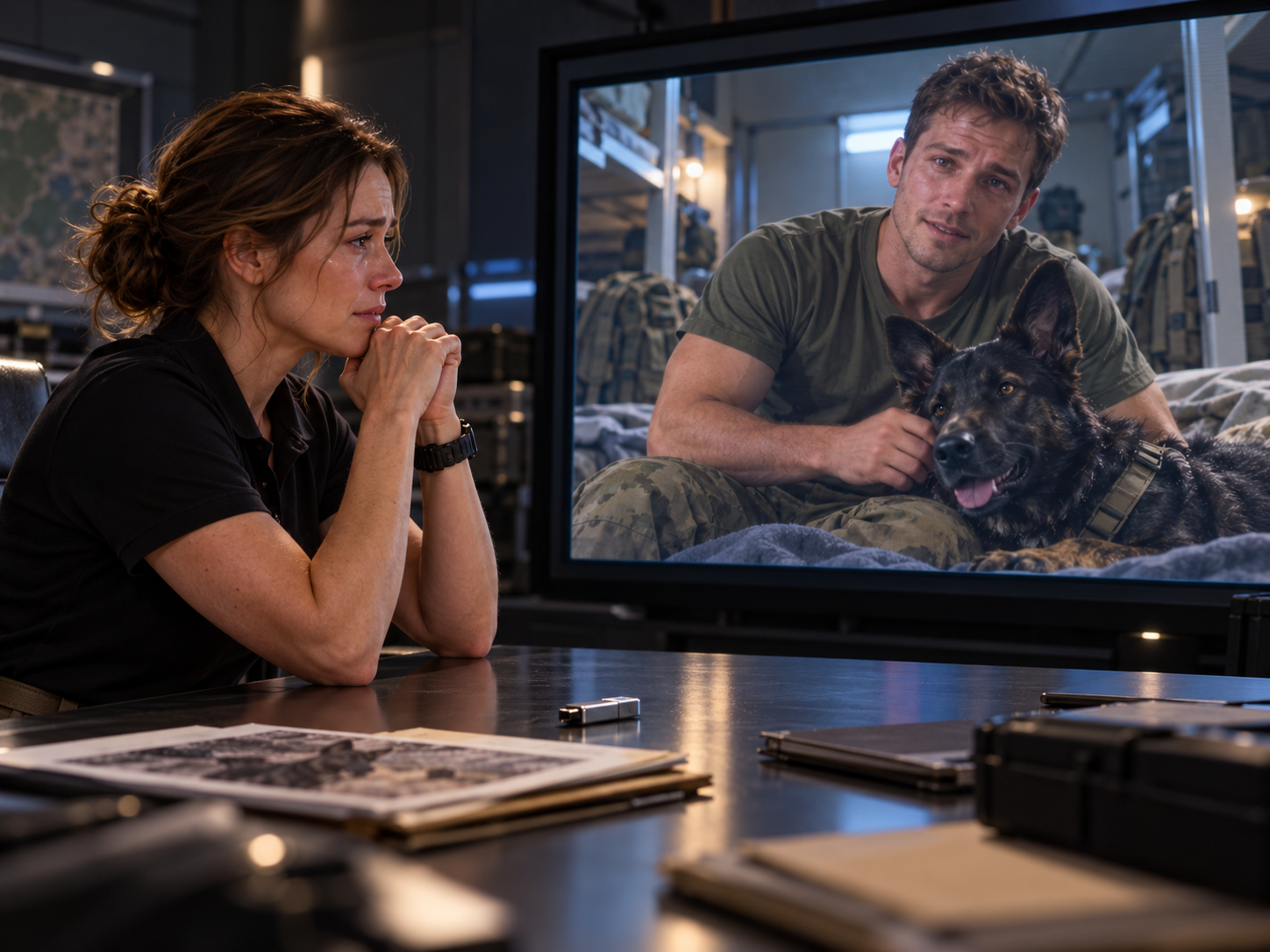
There was no dramatic battlefield revelation.
No hidden enemy.
Just a young soldier asking someone he trusted to protect his dog.
And somehow, that simple request hurt more than anything else.
Morgan waited until I could speak.
“When was this recorded?” I asked.
“Eleven days before Hale’s final deployment.”
“Why wasn’t it forwarded to me?”
“That’s one of the questions we’re investigating.”
She changed the display.
A series of timestamps appeared.
“The recording was uploaded to Hale’s authorized personal-effects file. It was later marked for transfer to the unit’s administrative archive.”
“What happened?”
“Someone removed the transfer entry from the local records.”
“Who?”
Morgan hesitated.
“We’re still establishing responsibility. The access history points to a shared administrative account.”
I looked at her.
“Voss?”
“His section had access. That’s not yet proof he deleted it.”
I nodded reluctantly.
Morgan continued.
“The more urgent issue is a separate audio file recovered from the mission.”
She played a short segment at low volume after warning me what it contained.
There was static.
A burst of distant gunfire.
Then Ethan’s voice.
“Titan! Stay!”
Another burst of noise.
A strained shout.
And silence.
I flinched.
Even through the speakers, I recognized the terror of those final seconds.
Morgan stopped the playback.
“That file was included in the materials returned after the operation. We have evidence it was used repeatedly in the kennel during what the records call conditioning sessions.”
I closed my eyes.
Titan had spent his last moments with Ethan surrounded by gunfire and fear.
Then, back in Virginia, unfamiliar handlers had forced him to listen to the same terrible sounds.
Again.
And again.
Trying to make him stop reacting.
When he panicked, they punished him.
When he resisted, they restrained him.
When he became defensive, they called him dangerous.
And when he finally fought back, they decided he was beyond saving.
“Why would anyone do that?” I whispered.
Morgan folded her hands.
“According to the preliminary statements, they believed repeated exposure would reduce his response.”
“Without appropriate clinical oversight?”
“That’s what we’re examining.”
I stared at the blank screen.
It wasn’t just a failure of technique.
It was a failure to recognize the living creature behind the training designation.
Then Morgan showed me another document.
“This may interest you.”
It was a veterinary referral request.
Dated six weeks earlier.
The signature belonged to a civilian veterinarian who had recommended Titan be removed from aggressive training and examined for pain and trauma-related responses.
The recommendation was clear.
Suspend bite-work assessments pending comprehensive medical and behavioral evaluation.
Below it was a handwritten response.
Request denied. Operational readiness priority.
I felt a cold sensation move through my body.
“Who denied it?”
Morgan looked at me.
“Senior Chief Voss.”
Before I could answer, someone knocked.
An investigator entered carrying a tablet.
“Commander, we’ve recovered footage from the training-yard cameras.”
Morgan looked up.
“Did it capture the tether release?”
“Yes, ma’am.”
“And?”
The investigator glanced toward me.
“It wasn’t an equipment malfunction.”
A still frame appeared on the screen.
Briggs stood beside the restraint post.
His hand was on the release lever.
Voss stood several feet away, watching.
Then Briggs pulled it.
Deliberately.
There could be no reasonable misunderstanding of what happened next.
The video showed Titan charging.
It showed me dropping the sleeve.
And it showed Voss remaining motionless until other operators began rushing toward the gate.
Morgan watched the recording twice.
Then she turned toward the investigator.
“Locate Petty Officer Briggs.”
The man hesitated.
“That’s another problem, Commander.”
“What problem?”
“Briggs signed out of the annex forty minutes ago. He told the gate personnel he was going to Portsmouth for a medical appointment.”
Morgan frowned.
“Was there an appointment?”
“No, ma’am.”
A heavy silence filled the room.
“Find him,” she ordered.
The investigator left.
I stared at the frozen image on the monitor.
Briggs had deliberately released Titan toward me.
But the expression on his face didn’t look triumphant.
It looked frightened.
As though he’d been following an order he didn’t want to question.
Morgan closed the file.
“Dr. Bennett, until we’ve interviewed Briggs, I need you to avoid discussing the investigation with other personnel.”
“Understood.”
I rose to leave.
Then something occurred to me.
“Commander, did you review the entire drive?”
“Yes.”
“Was there anything else?”
She hesitated.
“There was a second video.”
“Of Ethan?”
Morgan nodded.
“It was recorded two days after the message you just watched.”
I looked at her.
“What did he say?”
Morgan’s expression softened.
“He was talking about you.”
For a moment, I couldn’t breathe.
She opened the file.
Ethan appeared again.
This time, Titan was standing beside his bunk with a battered red rubber ball in his mouth.
“Claire, there’s something I never got around to telling you.”
He smiled.
“You once told me the hardest part of training dogs was learning when to let them stop working.”
He glanced down at Titan.
“I used to think that was ridiculous. Soldiers work. Dogs work. That’s what we’re here for.”
Then his smile faded.
“But you were right.”
He swallowed.
“If we come home from this deployment, I’m requesting his retirement.”
A pause.
“And when the paperwork goes through, I’d like to ask whether you’d consider giving him a home.”
My eyes filled again.
Ethan laughed softly.
“I know you’re going to say your house is too small, and you’ve got that ridiculous old cat who hates everyone.”
He looked into the camera.
“But Titan loves you.”
My throat tightened.
“And I think,” Ethan continued, “after everything he’s done, he deserves a place where nobody asks him to be brave anymore.”
The video ended.
For several seconds, I couldn’t move.
Morgan quietly stepped away from the desk.
I stared at Ethan’s frozen face.
Seven years earlier, I’d placed a clumsy German Shepherd puppy into his hands.
And now, from a recording made before his death, Ethan was asking me to take that dog home.
I wiped my eyes.
“Commander?”
“Yes?”
“I want to apply to adopt Titan when he’s medically and administratively cleared.”
Morgan studied me.
“That’s going to be complicated.”
“I know.”
“He’s been classified as dangerous, and the investigation is ongoing. There may be legal restrictions, medical concerns, and personnel who oppose it.”
“I know.”
She paused.
“Then you understand this won’t happen because of one remarkable moment in a training yard.”
I nodded.
“Good,” she said. “Because saving him is going to require more than proving someone mishandled him.”
I looked toward the door.
Somewhere across the annex, Titan was waiting.
Waiting for a person who would never return.
Waiting for another unfamiliar command.
Waiting for the next moment someone decided he had failed.
“No,” I replied.
“It requires teaching him that his life isn’t over.”
I walked out with Ethan’s final words echoing in my mind.
He deserves a place where nobody asks him to be brave anymore.
But when I reached the veterinary building, I found two military police officers standing outside Titan’s room.
Inside, a veterinary technician was studying his monitoring chart.
And the moment she saw me, her expression changed.
“Dr. Bennett,” she said urgently.
“Something’s wrong with Titan.”
Part 4 — The Battle to Save Titan
The veterinary technician stepped aside as I entered.
Titan was lying on his right side, breathing rapidly.
His eyes followed me, but he made no attempt to stand.
My stomach tightened.
“What happened?”
“His temperature is elevated, and he refused his morning meal. When we tried to examine his left hind leg, he cried out.”
I moved closer.
“Has he been sedated?”
“Not since his initial examination.”
I turned toward the veterinarian standing beside the examination table.
Captain Sarah Whitmore was an Army veterinary officer with fifteen years of military working-dog experience.
Unlike Voss, she hadn’t dismissed my concerns.
She had spent the previous evening reviewing Titan’s medical history.
Now her expression was grim.
“Dr. Bennett, I think we’ve found something.”
She placed an X-ray on the illuminated display.
My eyes immediately moved toward Titan’s left hip.
There was evidence of an old injury.
But that wasn’t what caught my attention.
A small abnormal area appeared near the joint.
Whitmore pointed toward it.
“There’s a possibility of a retained foreign fragment and associated inflammation. We need advanced imaging to determine exactly what we’re dealing with.”
I stared at the image.
“Was this documented after the ambush?”
“Not in the medical records we’ve received.”
Titan made a faint sound behind us.
I turned toward him.
He had lifted his head.
His ears were lowered.
He was watching me with the same exhausted expression I’d seen in the kennel.
For weeks, people had interpreted his reluctance to obey as defiance.
His refusal to remain in certain positions had been called stubbornness.
His reactions during physical restraint had been labeled aggression.
And all that time, he might have been suffering from an untreated injury.
I looked back at Whitmore.
“How soon can we get the imaging?”
“Today. I’ve already arranged transportation to the veterinary surgical facility.”
“Then let’s do it.”
There was a pause.
Whitmore looked toward the corridor.
“There’s one complication.”
I knew before she said it.
“Voss.”
She nodded.
“He submitted a recommendation this morning to reinstate the euthanasia order on public-safety grounds.”
My hands went cold.
“After Admiral Mercer suspended it?”
“He’s arguing that Titan remains too dangerous for transfer or treatment.”
I stared at her.
“Even with evidence of an untreated medical condition?”
“His recommendation predates the imaging findings.”
I looked at Titan.
Then at the metal table.
“He’s not going to die because someone doesn’t want to admit they made a mistake.”
Whitmore held my gaze.
“I agree. But we still have to follow the process.”
I drew a slow breath.
“Then we’ll follow it. Every step.”
By noon, Titan had been transported under carefully controlled veterinary supervision.
Advanced imaging confirmed a small metallic fragment near his hip, surrounded by irritated tissue. The surgical team believed it had likely been present since his final deployment.
The fragment was not the sole explanation for his behavioral deterioration.
Trauma rarely offered such simple answers.
But it was another source of pain that had never been adequately addressed.
The veterinarians recommended surgery and a structured recovery plan.
I authorized nothing outside my role.
I provided the behavioral history, answered questions, and allowed the medical professionals to do their work.
The operation lasted nearly two hours.
I spent every minute sitting in a waiting room beneath a television showing a cheerful morning cooking program.
The contrast was almost unbearable.
While strangers discussed lemon cakes, I remembered Ethan.
His laugh.
The way he used to sneak an extra tennis ball into Titan’s training bag.
The letter he’d sent after their first deployment.
Titan did great. I made mistakes. He forgave me anyway.
My phone vibrated.
Commander Morgan.
“Claire, we found Briggs.”
I stood.
“Is he all right?”
“He’s safe. He came voluntarily to our office after contacting legal counsel.”
“And?”
“He’s admitted releasing Titan.”
I closed my eyes.
“Did Voss order it?”
“He says Voss told him to demonstrate that the dog could not be controlled. Briggs understood what that meant and chose to pull the release anyway.”
“Why?”
Morgan’s voice softened.
“He believed Titan would attack you. He thought that would settle the evaluation.”
For a moment, I couldn’t speak.
It was one thing to suspect cruelty.
Another to hear that a grown man had deliberately risked a person’s life to win an argument.
“Does he understand what he did?”
“I believe he does now. He was visibly shaken when we showed him the footage.”
“Was anyone else involved?”
“We’re still interviewing personnel. But we’ve established that several staff members objected to the earlier conditioning sessions. Their concerns weren’t reflected accurately in the summary reports.”
I looked down at my hands.
“Ellis tried to tell someone, didn’t he?”
“Yes.”
“What happened?”
“His first complaint was dismissed as a misunderstanding of training procedures.”
I remembered the young sailor standing nervously in Titan’s room, clutching a silver drive.
He’d been afraid.
But he’d spoken anyway.
“Please tell him he did the right thing.”
“I will.”
After the call, I sat down.
I had thought the worst part of this assignment would be confronting a damaged dog.
Instead, I was discovering how easily a system could dismiss warnings when the people responsible for listening refused to be challenged.
An hour later, Whitmore emerged from surgery.
I rose so quickly my chair scraped against the floor.
“How is he?”
She smiled.
“Titan did well.”
My knees nearly gave way.
“The fragment was removed successfully. We’ll watch for complications, and he’s going to need rest and rehabilitation.”
I pressed a hand against my mouth.
“Thank you.”
“Don’t thank me yet,” she said kindly. “The physical recovery is one thing. Restoring his confidence will take longer.”
“I know.”
Whitmore studied me.
“Then I think you understand him better than most.”
That evening, Titan lay in a quiet recovery room.
His breathing was steady.
A bandage covered the surgical site.
I sat beside him, reading the veterinary instructions for the third time.
Eventually, his eyes opened.
His nose moved.
He recognized my scent.
I smiled.
“Hey, big boy.”
He blinked.
“No more work today.”
A small movement stirred beneath the blanket.
His tail.
Only once.
But it was enough.
For the first time since arriving in Virginia, I allowed myself to believe we might truly save him.
The following weeks were neither simple nor miraculous.
Titan had good days.
He had terrible days.
Sometimes he ate normally and rested without incident.
Sometimes a slamming door sent him scrambling toward the corner, his body shaking as though he were back overseas.
He occasionally growled at unfamiliar personnel.
He resisted certain handling procedures.
And on one difficult afternoon, he became so frightened by an unexpected metallic crash that he knocked over a chair trying to escape.
The rehabilitation team documented everything.
No one pretended his behavior was harmless.
No one demanded that he become a perfect dog overnight.
Instead, we worked with veterinary behavior specialists to develop a plan centered on medical recovery, predictable routines, gradual exposure to manageable situations, and positive experiences.
His surroundings were changed.
Unnecessary noise was reduced.
New people approached only through carefully managed introductions.
Progress was measured in small, meaningful ways.
The first night he slept without startling awake.
The first time he accepted an unfamiliar veterinarian’s presence without withdrawing.
The first time he chose to lie beside me instead of watching every door.
And one afternoon, nearly five weeks after his surgery, something happened that brought me to tears.
I was sitting outside the rehabilitation building beneath an old oak tree.
Titan lay on the grass beside me.
A warm breeze moved through the branches.
For several minutes, he watched a squirrel run along the fence.
Then he stood, walked toward a faded red rubber ball lying nearby, and nudged it with his nose.
I stared.
The ball rolled a few inches.
Titan looked at it.
Then looked at me.
It was the first time I’d seen him show an interest in play since his arrival.
I picked it up.
“You remember this?”
His ears lifted.
I gently rolled it across the grass.
He followed.
Not with the frantic intensity of a working dog pursuing a target.
Just a dog following a ball.
He stopped beside it.
Lowered his head.
And picked it up.
When he returned, his tail moved.
Slowly at first.
Then again.
I began laughing.
A strange, breathless sound.
“That’s my boy.”
Titan dropped the ball near my boot.
For one beautiful moment, there were no incident reports.
No military classifications.
No commanders.
No disciplinary hearings.
Only an aging German Shepherd and an ordinary red ball.
He had remembered how to play.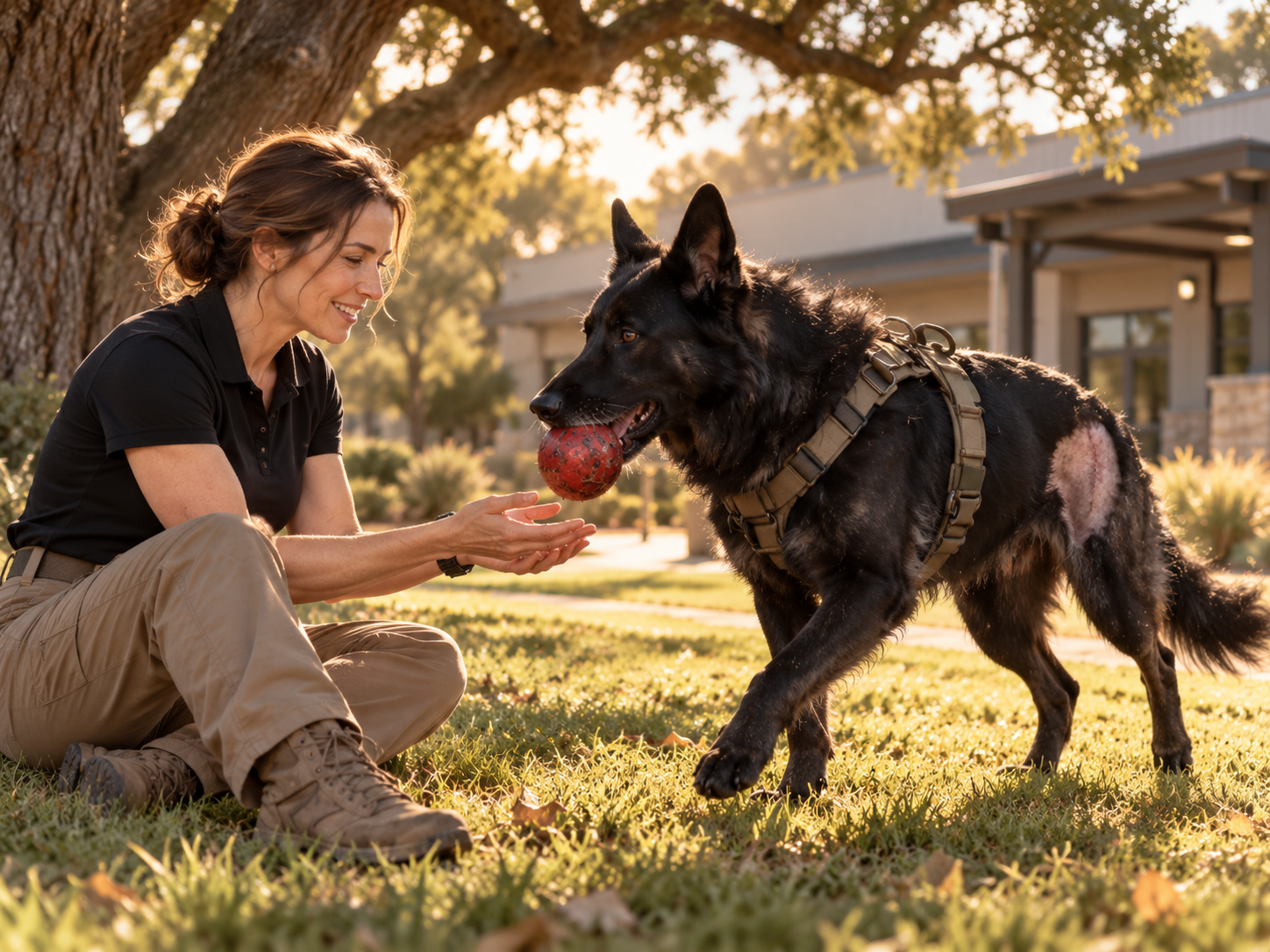
And I understood then that rehabilitation wasn’t about making Titan the dog he’d been before Ethan died.
It was about helping him become a dog who could live after that loss.
But the battle wasn’t finished.
Two days later, I was summoned to a formal review meeting.
The invitation listed three officials from the military working-dog program, a legal adviser, two veterinarians, and a senior operations officer.
The subject line read:
FINAL DISPOSITION REVIEW — MILITARY WORKING DOG TITAN.
I opened the attached memorandum.
My heart sank.
Despite his progress, an administrative panel was considering whether Titan should be permanently classified as unsuitable for release.
The recommendation cited his history of serious aggression.
His age.
His medical needs.
And the possibility that his behavior could deteriorate again.
I understood those concerns.
I couldn’t dismiss the people he’d injured.
Their suffering was real.
Their safety mattered.
But I also knew the panel had not yet heard the full story.
The hearing was scheduled for Friday.
Three days away.
That night, I stayed late at the rehabilitation facility.
Titan was sleeping beside his water bowl.
I sat on the floor outside his resting area with Ethan’s photograph in my hands.
“You asked me to protect him,” I whispered.
The photograph showed Ethan smiling beside Titan on a sunny training field.
For weeks, I’d been angry.
Angry at Voss.
Angry at the careless decisions.
Angry that Ethan had died before he could give Titan the peaceful retirement he’d planned.
But beneath all that anger was something harder to admit.
I was afraid.
Afraid the panel would reject every improvement.
Afraid the injuries Titan had caused would outweigh the suffering he’d endured.
Afraid that, after finally beginning to trust again, he would lose another person who cared about him.
I looked through the glass.
Titan opened one amber eye.
Then closed it again.
He trusted me enough to sleep.
That had to mean something.
I placed Ethan’s photograph beside my notebook.
And began preparing the most important report of my career.
Part 5 — The Last Command
Friday morning arrived beneath a gray Virginia sky.
Rain tapped against the windows of the review building.
I stood outside the conference room wearing a navy suit I’d owned for nearly eight years.
My shoes were polished.
My hair was tied back.
In my hands, I carried a folder containing medical findings, behavioral observations, rehabilitation records, veterinary recommendations, and a photograph of Ethan Hale with Titan.
For sixteen years, I’d given briefings about military working dogs.
I’d explained their capabilities to senior officers.
I’d defended training proposals before committees.
I’d testified about animal behavior in professional proceedings.
But I had never felt as nervous as I did that morning.
Because this wasn’t an argument about a program.
It was about a living creature who had already given everything he had.
Commander Morgan met me outside the door.
“Ready?”
“As much as I can be.”
She nodded toward the folder.
“You have the evidence. Focus on that.”
“Any word about Voss?”
“He’s been relieved of his responsibilities involving military working dogs pending the administrative and disciplinary proceedings. The investigation isn’t finished.”
“And Briggs?”
“He’s facing consequences for the unauthorized release. He’s also cooperating with investigators.”
I looked down.
“Did either of them ever ask about Titan?”
Morgan paused.
“Briggs did.”
That surprised me.
“He asked whether the surgery went well,” she continued. “And whether you’d been hurt.”
“What did you tell him?”
“That Titan survived. And that you were fortunate not to have been injured.”
I nodded slowly.
Morgan placed a hand against the conference-room door.
“Claire, don’t make this hearing about punishing them. Let the investigators handle that.”
I took a breath.
“It’s about Titan.”
“Then make sure they see him.”
Inside, the panel sat behind a long wooden table.
Rear Admiral Thomas Mercer occupied the center seat.
To his right sat Colonel Andrew Sullivan, a senior officer responsible for military working-dog program oversight.
Two veterinarians sat nearby, along with a legal adviser and an independent animal-behavior specialist.
I took my seat.
The hearing began.
The initial discussion was technical.
The panel reviewed Titan’s operational history.
His deployments.
His certifications.
The injuries he had caused.
The circumstances surrounding Ethan’s death.
Then the medical findings.
Sullivan leaned forward.
“Dr. Bennett, you agree that Titan has demonstrated behavior capable of causing serious injury?”
“Yes, Colonel.”
“And you agree that a familiar cue interrupted one incident but does not establish that he’s safe around other people?”
“Absolutely.”
He studied me.
“Then explain why you believe retirement into an appropriate home is preferable to continued permanent institutional containment.”
I opened my folder.
“Because his risk needs to be assessed in the context of his present medical condition, environment, history, and rehabilitation progress—not solely through incidents that occurred while he was in pain and under practices now being investigated.”
I presented the imaging.
The surgical report.
The history of his untreated injury.
Then the documentation of repeated exposure to distressing audio.
I explained that the training responses had likely compounded Titan’s fear.
But I was careful not to claim certainty where none existed.
“I cannot promise that Titan will never react defensively again,” I said.
Sullivan nodded.
“That’s an important distinction.”
“Yes, sir. It is.”
I looked around the table.
“He is not a machine that can be reset. He is an animal with a history of trauma, and any responsible placement would require substantial safeguards, professional follow-up, and an owner who understands those limitations.”
One of the veterinarians asked about his progress.
I described the first uninterrupted night of sleep.
The improvement in his tolerance of veterinary care.
His reduced reactivity in controlled settings.
His willingness to engage in play.
And the continuing difficulties we were still addressing.
Then I placed Ethan’s photograph on the table.
“This was Staff Sergeant Ethan Hale.”
The room quieted.
“He was Titan’s handler. They served together through multiple deployments. And before Ethan’s final mission, he made a recording explaining what he wanted for his partner.”
Mercer glanced toward the photograph.
I continued.
“He wanted Titan to retire before age and accumulated stress made the work too difficult. He understood that the dog deserved a future outside operational service.”
Sullivan studied the image.
“Do you have the recording?”
“Yes, Colonel.”
With the panel’s permission, I played the relevant portion.
Ethan appeared on the screen.
His voice filled the room.
If we come home from this deployment, I’m requesting his retirement.
No one spoke.
And when the paperwork goes through, I’d like to ask whether you’d consider giving him a home.
The recording ended.
I folded my hands.
“Ethan never got the chance to submit that request.”
My voice tightened.
“But his wishes are consistent with what we’re seeing now. Titan is no longer an appropriate candidate for operational work. That does not automatically mean he cannot have a safe, meaningful life.”
The independent behavior specialist reviewed the proposed placement conditions.
Titan would need continuing veterinary care.
A controlled home environment.
No exposure to the public without appropriate precautions.
Further professional assessment.
And a detailed management plan covering visitors, emergency care, and any signs of deteriorating behavior.
I accepted every condition.
Then Sullivan asked the question I’d been expecting.
“Dr. Bennett, why are you willing to assume this responsibility?”
I looked at Ethan’s photograph.
“Because I knew Titan before he became a military working dog.”
I paused.
“I knew him when he was a puppy who couldn’t keep both ears standing upright. I knew him when he was frightened by thunder. I knew him when he first learned to trust Ethan.”
My eyes burned.
“And I saw what happened when we stopped looking at him as a living animal and started looking at him as a defective piece of equipment.”
I drew a breath.
“Sir, I’m not asking you to overlook the danger. I’m asking you to recognize that we have evidence of significant improvement and a professional plan for addressing the risk.”
Sullivan was silent.
I continued.
“Titan served when he was asked to serve. He stayed beside Ethan when everything around them was falling apart. He endured injury, fear, and the loss of his handler.”
I placed my hand over the photograph.
“He has nothing left to prove to us.”
For several seconds, the only sound was the rain against the glass.
Mercer finally spoke.
“Thank you, Dr. Bennett.”
The panel recessed.
I waited outside.
An hour passed.
Then another.
I walked down the corridor twice, drank half a cup of coffee, and read the same paragraph of Titan’s veterinary report until the words stopped making sense.
Finally, the door opened.
Commander Morgan appeared.
“They’re ready.”
I entered.
Mercer looked at me.
“The panel has reached its determination.”
I stood perfectly still.
“Military Working Dog Titan is permanently withdrawn from operational duties.”
My heart began pounding.
“Based on the available veterinary assessments and the proposed safeguards, the panel supports his retirement and placement under an approved adoption and management arrangement, subject to final administrative clearance.”
I stared at him.
For a moment, the words didn’t register.
Then they did.
Titan was going to live.
And if the remaining approvals were completed, he was going to come home with me.
I pressed my fingers against my mouth.
Mercer’s expression softened.
“Dr. Bennett, we cannot undo what happened to Staff Sergeant Hale.”
My eyes filled.
“But we can make a better decision for his partner.”
I nodded.
“Thank you, sir.”
Sullivan stood.
“I want to be clear that this decision is not based on sentiment alone.”
“Understood.”
“Titan’s progress must continue. If the risk becomes unmanageable, the placement will have to be reconsidered.”
“I understand.”
He paused.
“Then I hope you both get the peaceful future Staff Sergeant Hale wanted.”
I could no longer speak.
I simply nodded.
And for the first time since arriving at Atlantic Special Operations Annex, I walked out of the building without feeling that I was racing against a death sentence.
The Homecoming
Seven weeks later, on a bright November morning, Titan walked through the front door of my small house in North Carolina.
He stopped just inside.
His nose lifted.
He examined the unfamiliar furniture, the wooden floor, and the sunlight stretching across the living room.
I stood beside him, holding his lead loosely.
“Welcome home, big boy.”
He glanced at me.
Then slowly stepped forward.
My house wasn’t impressive.
Two bedrooms.
A modest kitchen.
A small fenced backyard surrounded by tall pine trees.
There were books stacked beside nearly every chair and a crooked porch step I kept promising myself I’d repair.
But it was quiet.
There were no sirens.
No training collars.
No men shouting commands.
No metallic gates slamming shut.
Just a home.
Titan moved into the living room and discovered the large orthopedic dog bed I’d placed beside the fireplace.
He sniffed it.
Circled once.
Then looked at me.
I smiled.
“That’s yours.”
He stepped onto it.
Turned around.
And lay down.
For the next several minutes, he simply watched the room.
I sat on the floor nearby.
Neither of us needed to do anything.
We had spent months fighting for the possibility of an ordinary afternoon.
Now we finally had one.
Of course, living with Titan wasn’t always easy.
His recovery continued.
He still startled at certain noises.
Unfamiliar visitors required careful planning.
Some days, his hip bothered him.
And there were evenings when he stood at the window for a long time, watching headlights pass along the road.
I sometimes wondered whether those lights reminded him of military vehicles.
Or whether he was still waiting for Ethan.
I never pretended to know exactly what he remembered.
But whenever he became unsettled, I stayed nearby.
I didn’t force him to accept affection.
I didn’t demand obedience to prove that he had changed.
I gave him routines.
Predictability.
Space.
And the chance to make choices he’d rarely been permitted to make during his working life.
Slowly, something beautiful happened.
Titan began acting like a dog who expected tomorrow to be safe.
He discovered that squirrels were fascinating.
He learned the sound of my car pulling into the driveway.
He developed an unreasonable affection for a blue blanket on the couch.
And every morning, he carried his red rubber ball into the kitchen while I made coffee.
Sometimes he placed it beside my feet.
Sometimes he simply held it while watching me.
I came to understand that joy could be quiet.
It didn’t always announce itself with dramatic victories.
Sometimes it looked like a dog sleeping peacefully in a patch of sunlight.
The Letter
Three months after Titan came home, I received an envelope from a woman named Grace Hale.
Ethan’s mother.
We had spoken briefly after his death, but grief had made those early conversations difficult.
I had sent her updates about Titan’s recovery.
She had responded with short, kind messages.
This time, the envelope contained a handwritten letter.
And a photograph.
In the picture, Ethan was seventeen years old, kneeling in a backyard beside an elderly golden retriever.
Both were smiling.
I unfolded the letter.
Dear Dr. Bennett,
Ethan used to tell me that his first dog taught him more about loyalty than any person ever could.
When he joined the military, I worried about him constantly. He always told me not to.
Then he met Titan.
After that, nearly every phone call included a story about his dog.
Titan stole his breakfast. Titan refused to go outside in the rain. Titan learned something new. Titan saved him from making a mistake.
Even when Ethan was tired, talking about that dog made him happy.
I stopped reading.
My eyes blurred.
I wiped them and continued.
For a long time after Ethan died, I couldn’t bear to look at his photographs.
I thought that seeing Titan again would only remind me of what I’d lost.
But when you sent me the picture of him sleeping beside your fireplace, something changed.
I realized that a part of Ethan’s love was still here.
Not because Titan could replace my son. Nothing ever could.
But because Ethan gave that animal years of kindness, patience, and trust. And now you are giving those things back to him.
Thank you for keeping your promise.
Love, Grace.
I sat at the kitchen table for a long time.
Titan rested his head against my knee.
I looked down at him.
“Your mom wrote us a letter.”
He blinked.
I laughed through my tears.
“Well, Ethan’s mom. But I think she’d like it if you visited.”
Two weeks later, Grace came to North Carolina.
She arrived carrying a small bag of homemade biscuits and a framed photograph of Ethan in uniform.
I met her on the porch.
She was in her sixties, with soft gray hair and eyes so much like her son’s that looking at her hurt.
For a moment, neither of us knew what to say.
Then she hugged me.
“Thank you for taking care of him.”
I held her tightly.
“Ethan took care of him first.”
When we entered the house, Titan was resting on his bed.
Grace stopped.
“Oh,” she whispered.
Her hand rose toward her mouth.
“There he is.”
I had prepared carefully for the visit, with guidance from Titan’s veterinary behavior team.
Grace remained at a comfortable distance while Titan observed her.
She sat quietly, allowing him time to become familiar with her presence.
For several minutes, nothing happened.
Then Grace began talking.
Not to Titan.
To me.
She told me about Ethan as a little boy.
How he’d rescued a bird with a broken wing.
How he’d cried when the family dog died.
How he’d once insisted on sleeping on the kitchen floor because a sick puppy shouldn’t have to be alone.
I laughed.
“So he was always like that?”
Grace smiled.
“Always.”
Then she told me something I’d never known.
“When Ethan was ten, he made me promise that if anything happened to him, I’d take care of his dog.”
Her voice broke.
“He was only ten years old.”
I reached for her hand.
Across the room, Titan lifted his head.
He watched Grace.
She smiled at him through her tears.
“Hello, sweetheart.”
Titan stood.
He approached slowly, stopping several feet away.
Grace remained still.
He sniffed the air.
Then he lowered his head and lay down near her chair.
Grace covered her mouth.
I watched silently.
After a while, she looked at me.
“He’s so different from what I imagined.”
“In what way?”
“I thought he’d be frightening.”
I glanced at the enormous German Shepherd resting peacefully beside her.
“He can still be frightened himself.”
Grace nodded.
Then she whispered:
“Ethan would have loved seeing him like this.”
I looked at Titan.
“Yes,” I said.
“He would.”
One Year Later
The first anniversary of Titan’s homecoming arrived on a cool autumn afternoon.
By then, the official investigation had concluded.
The review had identified serious failures in supervision, documentation, training practices, and the handling of Titan’s medical and behavioral needs.
Voss had been removed from his working-dog leadership position and faced disciplinary consequences.
Briggs had been held accountable for deliberately releasing Titan toward me.
Other personnel received corrective training or administrative action according to their involvement.
The unit had implemented additional safeguards requiring appropriate veterinary and behavioral oversight for dogs showing significant distress after traumatic deployments.
Those reforms mattered to me.
Not because they could erase what Titan had endured.
But because they might prevent another dog from enduring the same thing.
Petty Officer Ellis had written to me once.
He told me he’d transferred to a different assignment and was considering applying to become a veterinary technician when he left the service.
At the bottom of his letter, he had written:
I used to think being brave meant never questioning someone above you. Titan taught me otherwise.
I kept that letter in my desk.
Beside Ethan’s photographs.
And the original training picture of Titan as a puppy.
That afternoon, I drove with Titan to a quiet field near the edge of town.
The trees had begun turning gold.
The grass was still green beneath the autumn sunlight.
There were no crowds.
No ceremonies.
No cameras.
Just the two of us.
I spread a blanket under a large oak tree.
Titan explored the grass, following scents carried by the breeze.
He was older now.
A little slower.
His muzzle had begun showing silver around the edges.
But he was healthy.
Comfortable.
And happy.
I watched him investigate a fallen leaf with the seriousness of a dog examining a suspicious package.
Then he sneezed.
I laughed.
“Still the world’s finest investigator.”
He looked at me.
His tail moved.
I took the old red rubber ball from my bag.
Titan’s ears rose immediately.
“Oh, you remember this?”
He stepped closer.
I rolled it gently across the grass.
He followed it, picked it up, and returned.
Then he settled beside me.
I pulled a photograph from my pocket.
Ethan and Titan.
Together in uniform.
I placed it carefully against the bag.
For a moment, I allowed myself to remember every part of the journey.
The training yard in Virginia.
The terrible sound of the tether releasing.
Ninety-five pounds of muscle charging directly toward me.
The laughter behind the fence.
The look in Titan’s eyes when he heard a word from his past.
Then Ethan’s recording.
The surgery.
The hearing.
The first peaceful night at home.
And the day Titan remembered how to play.
I rested one hand on his back.
“You know something, big boy?”
He looked up.
“I think Ethan would be proud of you.”
Titan lowered his head onto my leg.
I smiled.
“He’d probably be proud of both of us.”
The wind moved softly through the oak branches.
For a while, we sat without speaking.
Then I remembered something Ethan had told me years earlier.
We’d been standing beside the training field, watching Titan chase a ball through the grass.
Ethan had asked me how I knew when a dog truly trusted someone.
I’d given him a technical explanation involving predictability, confidence, and voluntary behavior.
He’d listened patiently.
Then he’d smiled.
“That’s a lot of science for something pretty simple.”
I’d raised an eyebrow.
“Oh? Enlighten me.”
He pointed toward Titan, who had abandoned the ball and curled up in the shade.
“A dog trusts you when he knows he doesn’t have to keep proving himself.”
At the time, I’d laughed.
Now, sitting beneath that oak tree, I finally understood how much truth was contained in those words.
Titan had spent his life proving himself.
He had proven his courage.
His intelligence.
His loyalty.
His strength.
He had worked through exhausting deployments.
He had protected his handler.
He had remained beside Ethan even when everything around them had collapsed.
And when he came home broken by loss, people had demanded that he prove himself again.
Prove that he could obey.
Prove that he could attack on command.
Prove that his usefulness outweighed his pain.
When he couldn’t, they decided his life was finished.
But they were wrong.
Because Titan’s value had never depended on his ability to follow an order.
He had always been worth saving.
I looked down at him.
His eyes were closing.
His breathing was slow and peaceful.
I brushed my fingers along his dark fur.
Then I whispered the word that had saved his life.
“Harbor.”
One amber eye opened.
His tail moved once.
He didn’t jump to attention.
He didn’t stand.
He didn’t prepare to work.
He simply closed his eye again and rested his head against me.
And that was exactly what I wanted.
The dog who had once been trained to run toward danger no longer needed to move at the sound of my voice.
He knew he was safe.
He knew he was loved.
He knew he was home.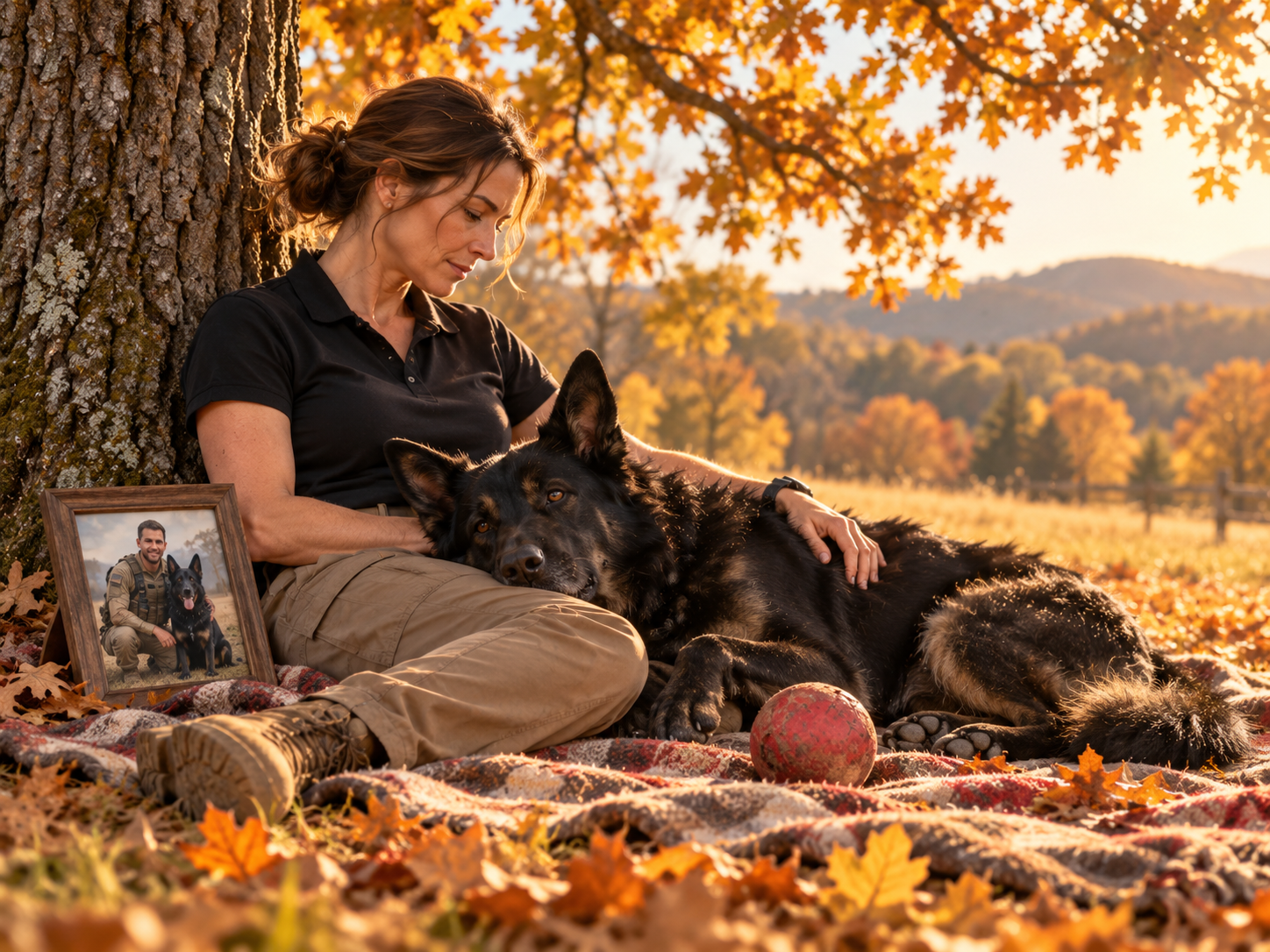
As the afternoon sunlight stretched across the grass, I leaned back against the old oak and watched the leaves drift slowly toward the ground.
Somewhere in my memory, I could still hear Ethan laughing.
I imagined him kneeling beside the gangly puppy he’d once loved, telling me that Titan would grow into something extraordinary.
He had been right.
But not in the way either of us expected.
Titan’s greatest achievement wasn’t a successful mission.
It wasn’t a perfect training score.
It wasn’t the strength that had once made experienced operators fear him.
It was this.
An ordinary afternoon.
A red rubber ball.
A quiet field.
And the freedom to close his eyes without being afraid of what might happen next.
I laid my hand gently against his shoulder.
“Good boy, Titan.”
His tail thumped against the blanket.
“Your work is done.”
And for the first time in his life, that wasn’t a command.
It was a promise.
THE END.