My Family Called Me a Disappointment at My Brother’s Navy SEAL Ceremony—Then a Dead Admiral Walked In and Revealed My Secret
PART 1 — THE DAUGHTER NOBODY WAS PROUD OF
My mother asked security to remove me from the front row at my younger brother’s Navy SEAL Trident ceremony.
“She’s the disappointing one,” she told the attendant loudly enough for everyone nearby to hear. “Please seat her somewhere she won’t cause a scene.”
My father chuckled.
My brother looked me in the eyes and warned, “Emily, don’t embarrass me today.”
I said nothing.
I had spent sixteen years letting my family believe I was a college dropout with an unimpressive government job. I wasn’t about to explain myself at my brother’s proudest moment.
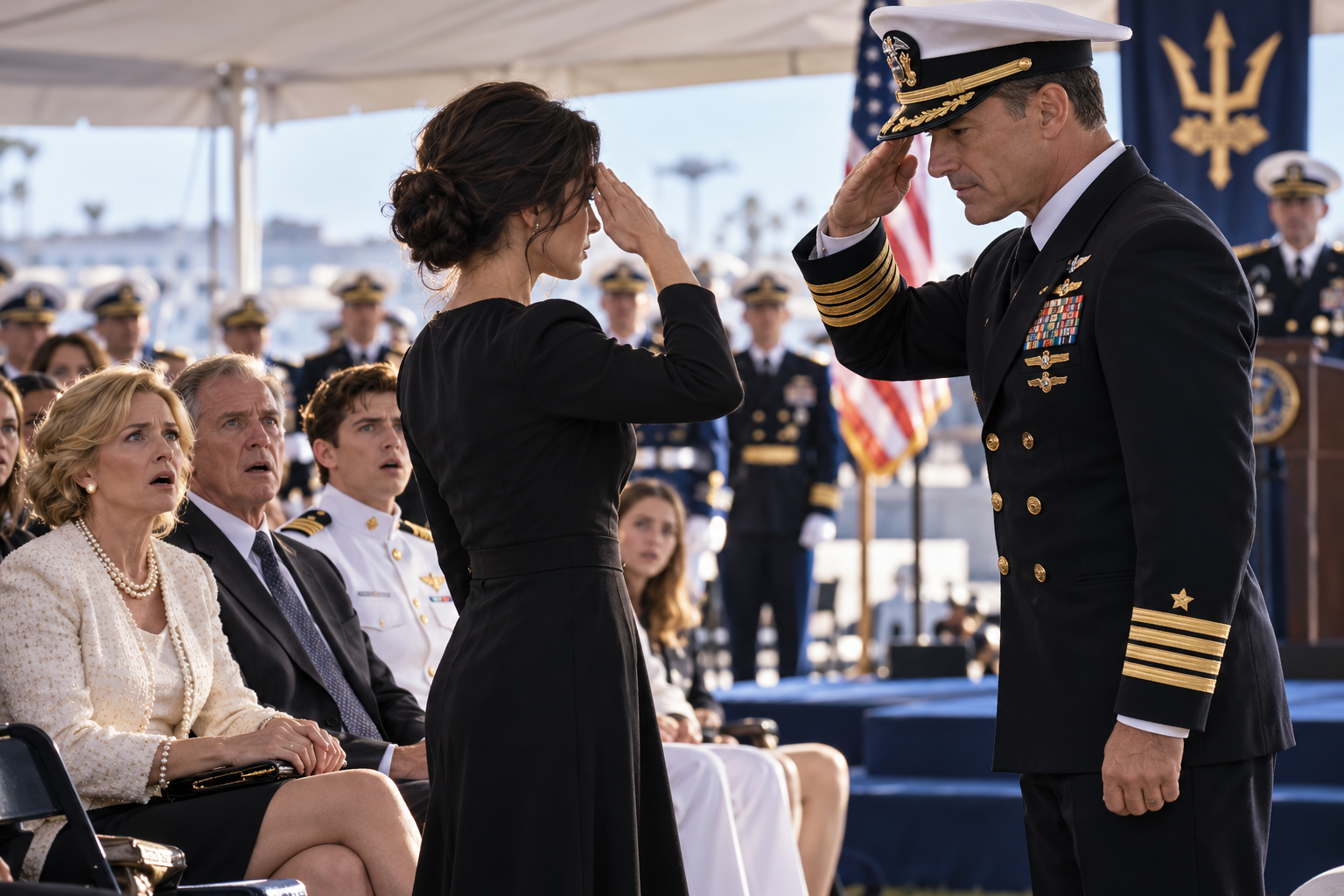
But minutes later, his commanding officer stepped off the platform, walked past my parents, and stopped directly in front of me.
He snapped to attention.
Raised his hand.
And saluted.
“We’ve been waiting for you, Commander Carter.”
The entire ceremony tent went silent.
My mother nearly dropped her purse.
And when a black government vehicle arrived at the checkpoint, I realized that a secret the Pentagon had protected for twelve years was finally about to be revealed.
My name is Emily Carter.
I’m thirty-nine years old, unmarried, and, according to my family, the daughter who never managed to make anything of herself.
My parents liked to remind people that I’d left college without graduating.
They told relatives I’d spent the next sixteen years doing some kind of government contracting.
They never seemed particularly interested in what that meant.
To them, it was a convenient explanation for a life they considered disappointing.
And I never bothered correcting them.
That morning, I arrived at Naval Amphibious Base Coronado in California wearing a simple black dress.
The sun was bright, and the ceremony tent was already filling with military personnel and proud families.
My younger brother, Ryan, was receiving his Navy SEAL Trident.
It was an extraordinary accomplishment.
I knew how much work he’d put into reaching that moment.
The exhausting training.
The physical demands.
The determination required to keep going when quitting would have been easier.
Whatever my family thought of me, I was genuinely proud of him.
Ryan stood with the other sailors in his dress whites, his newly earned Trident shining against the fabric.
Our mother couldn’t take her eyes off him.
She looked as though she’d been waiting her entire life for this day.
Dad stood beside her, smiling broadly and shaking hands with anyone who approached.
They were both practically glowing.
Then Mom noticed me.
Her expression changed.
She glanced at my dress and leaned toward my father.
“Of course Emily would wear black to her brother’s celebration.”
I heard her.
I pretended I hadn’t.
I took my seat near the front, where the immediate family members had gathered.
I’d barely settled in when my cousin Madison turned around.
She looked at me with a thin smile.
“Emily, why are you sitting here?”
I glanced at her.
“What do you mean?”
“This section is reserved for immediate family.”
I held her gaze.
“I am immediate family.”
Madison’s smile sharpened.
“I meant family members who actually support Ryan.”
The words stung.
Not because I believed them.
But because I knew exactly where she’d learned to speak to me that way.
My parents were sitting close enough to hear every word.
Neither objected.
Mom simply adjusted the pearls around her neck.
Then she raised her hand toward a nearby security attendant.
“Excuse me.”
The attendant approached politely.
“Yes, ma’am?”
My mother gestured toward me.
“Would you mind finding another seat for my daughter? Somewhere farther back?”
I looked at her.
“Mom?”
She ignored me.
“She’s the disappointing sister. We really don’t need any distractions during such an important ceremony.”
Several people turned toward us.
I felt their eyes settle on my face.
Some looked uncomfortable.
Others appeared curious.
At thirty-nine, I should have been used to my mother’s judgment.
I’d heard variations of those words for years.
Disappointing.
Unsuccessful.
Unfocused.
The daughter who never lived up to her potential.
Yet hearing her dismiss me in front of strangers still hurt more than I expected.
The security attendant hesitated.
Before he could respond, Ryan approached.
For one brief moment, I felt hopeful.
Surely my brother would understand.
Surely he’d tell Mom that I had every right to sit with the family.
After all, I had come all this way to celebrate him.
But Ryan leaned toward me instead.
His expression was tense.
“Emily, please don’t embarrass me today.”
I stared at him.
For a second, I couldn’t find the words to answer.
This was the same little boy I’d once carried home after he crashed his bicycle.
The same brother whose hospital bed I’d sat beside when he was fourteen.
The same seventeen-year-old who’d listened while I promised that no matter where life took me, I’d always come back when he truly needed me.
And now he was standing in front of me, worried that my presence might somehow spoil his celebration.
I swallowed.
“Congratulations, Ryan,” I whispered.
He glanced away.
Then returned to the other sailors.
I folded my hands in my lap.
I’d survived experiences my family couldn’t begin to imagine.
I’d faced situations where fear had to be controlled because other people’s lives depended on it.
But watching my younger brother treat me like a stranger was unexpectedly painful.
I hadn’t come to Coronado to demand recognition.
I hadn’t come to reveal anything.
I’d come because Ryan was still my little brother.
And I wanted to be there when he earned his Trident.
The ceremony began shortly afterward.
Commander Nathaniel Hayes stepped onto the platform.
He carried himself with the quiet authority of someone accustomed to leading people through difficult circumstances.
His voice carried across the tent as he spoke about the meaning of the Navy SEAL Trident.
Service.
Sacrifice.
Loyalty.
Discipline.
And the responsibility that came with earning a place among those who wore it.
He also spoke about families.
The parents, spouses, siblings, and loved ones whose support helped sailors endure the demands of training.
Mom dabbed at her eyes.
Dad placed an arm around her shoulders.
I watched them quietly.
Then something near the platform caught my attention.
Among the chairs reserved for senior officers, one remained empty.
A white name card rested against its back.
I couldn’t make out every letter from where I sat.
But something about the arrangement made my pulse quicken.
Nobody in my family seemed to notice.
They were too focused on Ryan.
Commander Hayes continued his remarks.
Then, in the middle of a sentence, he stopped.
The pause was subtle at first.
He looked toward the audience.
His gaze passed over the officers seated near the front.
Then the families.
Then my parents.
Finally, his eyes settled on me.
His expression changed.
It wasn’t surprise.
It was recognition.
The kind that comes from shared history.
The kind that doesn’t need an explanation.
For a moment, he simply stood there.
Then he stepped down from the platform.
A few people exchanged puzzled glances.
My father straightened in his chair.
I could almost see what he was thinking.
Perhaps Commander Hayes was coming to congratulate Ryan’s family personally.
Dad adjusted his jacket.
Mom sat a little taller.
But Hayes walked straight past them.
Past Madison.
Past the other relatives.
And stopped directly in front of my chair.
His heels came together.
His shoulders squared.
Then Commander Nathaniel Hayes raised his hand in a formal salute.
The entire tent seemed to freeze.
I stood automatically.
Years of discipline took over before I had time to think.
My hand rose.
And I returned his salute.
For one suspended moment, nobody moved.
Then Hayes lowered his arm.
“Ma’am,” he said, “we’ve been waiting for you.”
My father stared at him.
“Waiting for what?”
Hayes didn’t look away from me.
He gestured toward the empty chair near the platform.
“Your seat is up front, Commander Carter.”
Mom’s hand froze against her pearls.
“Commander?”
Ryan stepped forward.
“Sir, there must be a mistake. Emily isn’t a commander.”
Hayes turned toward him.
His expression hardened.
“Candidate Carter, I suggest you remember where you are.”
Ryan immediately fell silent.
I could feel the confusion spreading through my family.
For sixteen years, they’d accepted the idea that I worked in some vague government position.
They never asked where I went during my long absences.
They never questioned why certain phone calls ended when they entered the room.
They never wondered why I couldn’t discuss assignments or explain where I’d been.
They’d simply decided my life wasn’t worth understanding.
And I’d allowed them to believe it.
But standing in front of Commander Hayes, I knew this moment had nothing to do with their opinions.
He leaned closer.
His next words were barely audible.
“They arrived twenty minutes ago.”
My stomach tightened.
“Both?”
He nodded.
“Both.”
I stared at him.
That shouldn’t have been possible.
I searched his face for any sign that I’d misunderstood.
There was none.
Then he added something that made my blood run cold.
“The Pentagon authorized disclosure at 0530.”
I stopped breathing for a moment.
Behind me, Dad spoke in a confused whisper.
“Disclosure of what?”
I ignored him.
My attention remained fixed on Hayes.
“How much?” I asked.
He hesitated.
Then answered with a single word.
“Everything.”
I felt my carefully controlled composure falter.
Everything.
Twelve years.
That was how long the truth had remained buried.
Twelve years of classified records.
Twelve years of official accounts that concealed what had actually happened.
Twelve years of allowing the world to believe something that wasn’t true.
And now Hayes was telling me that the Pentagon had authorized the entire story to come into the open.
I tried to speak.
But before I could ask another question, movement near the security checkpoint caught my attention.
A black government vehicle was passing through the entrance.
The conversations beneath the tent began to fade.
Several senior officers turned toward it.
Then every senior chief on the platform rose to their feet.
The vehicle approached slowly.
It stopped near the ceremony entrance.
For a moment, nothing happened.
Then the rear passenger door opened.
I saw a polished shoe touch the pavement.
Next came the tip of a cane.
Then a man carefully emerged from the vehicle.
He stood slowly, using the cane to support his weight.
As he began walking, his left leg dragged slightly behind him.
My heart seemed to stop.
I knew that walk.
I knew it before I could clearly see his face.
My hand moved instinctively toward the scar across my palm.
A scar I’d carried for twelve years.
The last time I’d seen that man, I’d been kneeling beside him, pressing both hands against his wounds.
There had been blood everywhere.
Far too much blood.
His breathing had been shallow.
His face had been pale.
And through the pain, he’d begged me to make sure his daughter didn’t grow up without him.
I’d never forgotten those words.
Never forgotten the desperation in his voice.
Never forgotten the weight of that moment.
And I’d never forgotten what happened afterward.
For twelve years, I’d carried those memories in silence.
Now the man from that day was walking toward the ceremony tent.
Alive.
I could barely process what I was seeing.
Ryan followed my gaze.
“Who is that?”
Mom leaned forward.
“Emily, what’s happening?”
I couldn’t answer.
The man stopped just outside the entrance.
Then slowly removed his sunglasses.
My father rose halfway from his chair.
His mouth opened.
But no words came out.
He recognized the man.
So did several of the senior officers.
The atmosphere changed instantly.
What had begun as a proud military celebration was now filled with stunned silence.
And I finally understood why Hayes had told me the Pentagon had authorized disclosure.
Because the man standing beneath the California sun wasn’t supposed to be alive.
Admiral Thomas Vance had officially been dead for twelve years.
Yet there he stood.
Older.
Leaning heavily on a cane.
His left leg still bearing the consequences of whatever he’d survived.
And his eyes were fixed directly on me.
He began walking again.
Past the silent officers.
Past my stunned parents.
Past my brother, who seemed unable to move.
Straight toward me.
I stood perfectly still.
Twelve years of buried memories rushed back at once.
The blood.
The desperate plea.
The scar on my hand.
And the secret I’d spent more than a decade protecting.
Admiral Vance stopped only a few steps away.
He looked at me as though he’d been waiting twelve years for this exact moment.
And suddenly, I knew my family was about to learn why Commander Nathaniel Hayes had saluted the woman they’d always called a disappointment.
PART 2 — THE MAN WHO RETURNED FROM THE DEAD
Admiral Thomas Vance looked older than the man I remembered.
His hair, once dark and closely cropped, had turned almost entirely silver. Deep lines framed his mouth, and the cane in his right hand trembled slightly beneath his weight.
But his eyes hadn’t changed.
They were the same steady gray eyes I’d seen through smoke and darkness twelve years earlier, when he’d been certain he was going to die.
For several seconds, neither of us spoke.
Then he smiled.
“Hello, Emily.”
Two words.
That was all it took.
The carefully constructed wall I’d built around those memories began to crack.
“Sir,” I managed.
He shook his head.
“Not today.”
He extended his free hand.
I took it.
His fingers closed around mine, and I felt something hard beneath his palm.
A familiar metal ring.
The same ring I’d removed from his finger before the evacuation, afraid it would be lost if he died.
I’d returned it to him at a medical facility three days later.
Or at least, I had believed that was the last time I would ever see him.
“I promised you something,” he said quietly.
I looked down.
“You promised you’d live.”
His smile faltered.
“And you made certain I kept that promise.”
Before I could answer, he pulled me into an embrace.
I hadn’t expected it.
Thomas Vance had never been a man given to public displays of emotion. Even during the worst moments of our operation, his voice had remained measured and his orders precise.
Now his shoulders shook.
I closed my eyes.
For an instant, I was twenty-seven again.
There was sand beneath my knees.
Smoke in my lungs.
And the terrible sound of someone screaming my name over a failing radio.
When he finally stepped back, tears were shining in his eyes.
“Thank you for bringing me home, Commander.”
Behind us, someone gasped.
My mother.
“Bringing you home?”
Her voice was sharp with confusion.
“Excuse me, but what exactly is going on?”
Vance turned toward her.
His expression changed.
Not dramatically.
But enough that I recognized the admiral who had once commanded an entire operation while the world around him fell apart.
“You must be Mrs. Carter.”
Mom straightened automatically.
“Yes. Margaret Carter. And this is my husband, Richard.”
Dad stepped forward and extended his hand.
“Admiral Vance. It’s an honor. I remember reading about your death. The whole country mourned you.”
Vance didn’t take his hand immediately.
Instead, he looked at me.
“Emily, would you like me to explain?”
That question nearly undid me.
For sixteen years, my family had made decisions about who I was without ever asking my permission.
They had decided I was unsuccessful.
Decided I was unreliable.
Decided I had wasted my opportunities.
And now a man whose name had once appeared on national memorial broadcasts was asking whether I wanted my story told.
I swallowed.
“Only what has been cleared, sir.”
He nodded.
“Of course.”
Then he shook my father’s hand.
“Your daughter is one of the finest officers I’ve ever served with, Mr. Carter.”
Dad blinked.
“Officers?”
“Yes.”
“But Emily never finished college.”
The words escaped him before he could stop them.
A silence followed.
Vance studied him.
“Is that what you believe?”
My father looked toward me.
“Well, she left Stanford after her second year. We were told she couldn’t handle the pressure.”
I almost laughed.
Not because it was funny.
Because I’d forgotten how casually he repeated that story.
Vance’s expression grew colder.
“Your daughter left Stanford because she was selected for a highly competitive federal service program. She completed her degree through an accredited military education pathway while serving. She later earned a graduate degree in strategic security studies.”
Mom made a small, strangled sound.
“That’s impossible.”
“No, ma’am,” Vance replied. “It’s documented.”
He glanced toward Hayes.
“Commander?”
Hayes stepped forward with a dark blue folder.
My name was embossed on the cover.
EMILY A. CARTER.
UNITED STATES NAVY.
Mom stared at it as though it might explode.
I knew what was inside.
A carefully prepared summary of my service record.
The public portions, at least.
My commissioning date.
My assignments.
My qualifications.
A list of decorations that had never appeared in family photographs.
And the official announcement that the Department of Defense had approved the release of information relating to Operation Lantern.
Vance didn’t open the folder.
Instead, he handed it to me.
“Your record,” he said. “Your choice.”
I held it against my chest.
Across the aisle, Ryan stood motionless.
He was still wearing his dress whites, his Trident newly pinned, his expression caught somewhere between disbelief and humiliation.
“Emily,” he said.
I turned.
He glanced at Vance, then Hayes.
“Are you really in the Navy?”
“Yes.”
“What rank?”
I hesitated.
“Commander.”
He swallowed.
“How long?”
“Sixteen years.”
His face changed.
Sixteen years.
The same sixteen years he’d spent listening to our parents describe my career as a collection of temporary government jobs.
The same years he’d joked about my supposed inability to commit to anything.
He looked at the floor.
Then back at me.
“Why didn’t you tell me?”
I wanted to answer.
I wanted to tell him about the letters I’d written and never sent.
About the birthday calls I’d made from unfamiliar places, sometimes after going two nights without sleep.
About the time I’d watched his high school graduation through a grainy recording because I couldn’t leave an assignment.
But before I could speak, a woman appeared at the entrance.
She was perhaps twenty years old.
Tall, with dark hair pulled into a simple braid.
She wore a pale blue dress and carried a small leather-bound notebook.
The moment I saw her, my breath caught.
I knew those eyes.
Vance followed my gaze.
His face softened.
“Emily,” he said, “there’s someone else who wanted to come.”
The young woman approached slowly.
She looked nervous.
Not frightened.
Overwhelmed.
She stopped in front of me.
“Commander Carter?”
I nodded.
She smiled through tears.
“My name is Sophie Vance.”
I couldn’t move.
Sophie.
The little girl in the photograph.
The daughter whose name her father had whispered while blood soaked through my gloves.
She was no longer a child.
She was standing in front of me.
Alive.
Healthy.
With her whole future ahead of her.
“I’ve wanted to meet you for most of my life,” she said.
My throat tightened.
“Sophie…”
She opened her notebook.
Inside was an old photograph.
A little girl with missing front teeth, sitting on her father’s shoulders at a county fair.
I recognized it immediately.
Thomas had kept a copy folded inside his uniform during the operation.
He’d shown it to me one evening while we waited for an intelligence update.
“My dad told me about you,” Sophie whispered.
I looked at Vance.
He nodded.
“Not everything. Not until recently. But enough.”
Sophie turned the photograph over.
On the back, in a child’s uneven handwriting, were five words.
Please bring my daddy home.
I pressed a hand over my mouth.
“I wrote that when I was eight,” she said. “Mom told me Dad was going somewhere dangerous. I didn’t understand what that meant.”
Her voice trembled.
“Then they told us he’d died.”
The words struck me like a physical blow.
I remembered that announcement.
I remembered seeing it on a television in a secure facility while a physician changed the dressing on my injured hand.
Admiral Thomas Vance killed during an overseas security operation.
I had stared at the screen knowing it was a lie.
Knowing he was alive.
Knowing I couldn’t tell his family.
Sophie looked at me.
“For three years, I thought he was dead.”
I closed my eyes.
Three years.
I’d known the separation had lasted longer than anyone expected.
But hearing it from her made the cost unbearable.
“He came home when I was eleven,” she continued. “We couldn’t tell anyone outside a very small circle. We moved. We changed our names. He couldn’t attend public events.”
She paused.
“And he told me that if I ever had the chance to meet you, I should thank you for giving me my father back.”
I couldn’t speak.
So I did the only thing I could.
I embraced her.
She held on tightly.
For a moment, the ceremony tent disappeared.
There were no uniforms.
No ranks.
No cameras.
No parents staring in disbelief.
Only a daughter who had once begged the universe to return her father.
And the woman who had tried desperately to make that possible.
When Sophie stepped back, she wiped her cheeks.
“He’s here because of you.”
I shook my head.
“He’s here because a lot of people refused to give up.”
Vance smiled faintly.
“Still refusing to take credit, I see.”
Before I could respond, Hayes’s radio crackled.
He listened.
His expression hardened.
Then he moved toward Vance.
“Sir. We have a problem.”
Vance’s smile vanished.
“What kind?”
Hayes glanced at the families.
Then at me.
“The disclosure package has been compromised.”
A cold sensation spread through my chest.
“Compromised how?” I asked.
Hayes lowered his voice.
“Someone accessed the restricted annex before the release window. Three files were copied.”
I looked toward the checkpoint.
Two military security vehicles were moving into position.
“Which files?”
Hayes hesitated.
Then said the words I had dreaded for twelve years.
“The original casualty report. The extraction recording.”
He paused.
“And the identity of the person who ordered the team abandoned.”
My fingers tightened around the folder.
Because there had been one detail about Operation Lantern that even Admiral Vance didn’t know.
One decision.
One voice on the radio.
One order that had nearly killed everyone.
And I’d spent twelve years believing the man responsible had died before he could ever answer for it.
Apparently, I had been wrong.
PART 3 — THE OPERATION THEY ERASED
Commander Hayes led us into a secure conference room inside the administrative building.
The ceremony had been temporarily paused.
The official explanation was a security coordination issue involving visiting personnel.
Outside, families remained beneath the tent, confused but cooperative.
Inside, the atmosphere had changed completely.
Two security officers stood beside the door.
A civilian woman in a charcoal suit introduced herself as Special Agent Rebecca Sloan, assigned to a joint Defense Department investigative team.
She placed a tablet on the table.
“Commander Carter, Admiral Vance, we’ve confirmed unauthorized access to three archival files at 0612 this morning.”
“Who accessed them?” I asked.
“An account belonging to retired Rear Admiral Charles Mercer.”
My blood turned cold.
“Mercer is dead.”
Sloan watched me carefully.
“His death certificate was issued eight years ago.”
“Then someone stole his credentials.”
“That’s what we initially believed.”
She tapped the screen.
A photograph appeared.
An older man in a baseball cap entering a private office building outside Washington.
The image was dated eleven days earlier.
I recognized him instantly.
Charles Mercer.
The man who had commanded the intelligence coordination cell during Operation Lantern.
The man who had ordered our evacuation aircraft to stand down.
The man whose voice I’d heard over the radio while twelve people fought to survive.
He was alive.
Vance leaned forward.
“Where was this taken?”
“Arlington, Virginia.”
“Has he been located?”
“Not yet.”
I stared at the photograph.
For twelve years, I’d told myself there were things I would never understand.
Why our intelligence had been wrong.
Why our communications had been compromised.
Why an operation designed to evacuate endangered civilians had become a slaughter.
And why the rescue aircraft had been ordered away when we needed them most.
Now the man responsible had resurfaced on the very morning the government intended to reveal what happened.
That wasn’t coincidence.
Sloan turned toward me.
“We believe Mercer may attempt to release selected documents in order to discredit the official findings before they’re published.”
“Selected documents?”
“Enough to make it appear that you disobeyed orders and caused the casualties.”
I felt a familiar anger rising.
Not loud.
Not explosive.
Something colder.
“Of course he would.”
Vance looked at me.
“Emily, what aren’t you telling us?”
I studied his face.
He had survived because of decisions I’d made.
But he’d never known all of them.
He’d been unconscious during the final extraction.
And by the time he’d recovered, the operation had been buried beneath layers of classification.
“Sir,” I said, “there’s something you need to hear.”
Sloan activated an audio file.
Static filled the room.
Then a younger version of my own voice emerged.
“Lantern Actual, this is Echo Three. We have multiple casualties. Request immediate extraction.”
A pause.
Then another voice.
Mercer.
“Echo Three, extraction authorization denied.”
My stomach tightened.
I remembered every second.
Every sound.
Every breath.
Twelve years earlier, Operation Lantern had begun as a classified evacuation mission.
Our assignment was to remove Admiral Vance, three intelligence specialists, and a group of civilian witnesses from a compromised coastal facility overseas.
The witnesses possessed evidence of a trafficking network that had supplied weapons and military technology to violent organizations.
Several officials had been implicated.
The intelligence was politically explosive.
The extraction was supposed to be quiet.
A short helicopter flight.
A transfer to a secure vessel.
Then home.
Instead, someone had sold our route.
We were ambushed before reaching the landing zone.
The first explosion destroyed our lead vehicle.
The second killed our communications specialist.
Within minutes, our twelve-person team was scattered among burning wreckage while hostile fighters advanced from three directions.
I had been a lieutenant then.
Twenty-seven years old.
Experienced enough to understand how quickly plans could fail.
Young enough to believe that if I followed every procedure correctly, someone would eventually come.
Our team leader, Lieutenant Commander Daniel Reeves, was killed during the first attack.
I assumed command.
We moved the surviving civilians into an abandoned medical compound and established a defensive position.
Admiral Vance had been wounded by shrapnel.
His left leg was shattered.
He’d lost an alarming amount of blood.
And we were running out of medical supplies.
I remembered kneeling beside him.
His hand had closed around my wrist.
“Emily.”
“Don’t talk, sir.”
“My daughter.”
“You can tell her yourself.”
He shook his head.
“Promise me.”
I pressed harder against his wound.
“Sir, listen to me. You are going home.”
His eyes filled.
“She’s only eight.”
I had no answer for that.
So I lied with absolute conviction.
“Then you’d better survive, because I’m not explaining to an eight-year-old why her father broke his promise.”
He laughed once.
A terrible, painful sound.
Then he lost consciousness.
The recording continued.
My younger voice was strained but controlled.
“Lantern Actual, we have six survivors at the secondary site. Three critical. Requesting extraction immediately.”
Mercer answered.
“Negative. The operational environment is no longer viable.”
“Sir, we have wounded personnel and civilians.”
“Your orders are to maintain position.”
“For how long?”
There was silence.
Then Mercer spoke.
“Until further notice.”
I remembered looking around the compound.
A medic named Sarah Kim was treating a civilian with a collapsed lung.
Chief Petty Officer Marcus Bell was holding a doorway with the last of our ammunition.
And seventeen-year-old interpreter Amir Haddad was trying to keep two terrified children quiet.
Maintain position.
Those words had sounded almost reasonable over the radio.
Inside the compound, they were a death sentence.
I pressed the transmit button.
“Lantern Actual, respectfully, maintaining position will result in total loss of personnel.”
Mercer’s reply was immediate.
“Lieutenant Carter, you are not authorized to alter the mission.”
I looked at the wounded.
At Vance.
At the children.
Then I made the decision that changed my life.
“Understood, sir.”
I switched frequencies.
“Echo team, prepare to move.”
Sloan paused the recording.
The room was silent.
Vance stared at me.
“You disobeyed a direct order.”
“Yes, sir.”
“To save us.”
“To try.”
He looked down.
“What happened next?”
I took a breath.
“We moved through the drainage network beneath the compound. We reached the coast six hours later.”
I touched the scar across my palm.
“During the final crossing, a steel hatch collapsed. My hand was caught beneath it. Marcus pulled me free.”
“Marcus Bell?” Vance asked.
I nodded.
“He died twenty minutes later.”
The words hung between us.
Marcus had been forty-two.
Married.
The father of twin boys.
He’d made terrible jokes.
Loved terrible coffee.
And carried a photograph of his family inside a waterproof pouch.
He had stayed behind to cover our movement while I dragged Vance toward the extraction point.
When I went back for him, he was already gone.
For twelve years, I’d carried the sound of his final radio transmission.
Get them home, Lieutenant.
Nothing more.
Just four words.
Sloan lowered her eyes.
“We found something in the newly recovered communications archive,” she said.
I looked at her.
“What?”
She opened another file.
A second recording began.
Mercer’s voice.
But this time, he wasn’t speaking to our team.
He was speaking to someone else.
“The witnesses cannot reach the vessel.”
A pause.
Then an unfamiliar voice asked, “What about Vance?”
Mercer answered.
“Collateral consequences.”
I felt the air leave my lungs.
Sloan stopped the recording.
Vance sat perfectly still.
For years, we’d believed Mercer had made a cowardly decision.
That he’d abandoned us because the operation had become too dangerous.
Now the truth was worse.
He hadn’t merely refused to rescue us.
He’d intended for us to die.
“Who was he speaking to?” I asked.
“We believe it was a private defense contractor involved in the trafficking network. The investigation is ongoing.”
Vance’s hand tightened around his cane.
“Why wasn’t this discovered twelve years ago?”
“Because the recording was removed from the official archive. A duplicate survived on an encrypted recorder recovered from the extraction vessel.”
I stared at the screen.
“Who found it?”
Sloan hesitated.
Then turned toward Hayes.
He answered.
“Ryan.”
For a moment, I thought I’d misheard.
“My brother?”
Hayes nodded.
“During an advanced intelligence-familiarization exercise, his training group reviewed sanitized historical material. Candidate Carter identified a discrepancy in a timestamp sequence.”
I stared at him.
“He recognized something was missing?”
“He did.”
“How?”
Hayes exchanged a glance with Sloan.
Then said, “Because he recognized your voice.”
The room seemed to tilt.
Ryan.
My little brother.
The same man who’d asked me not to embarrass him.
He’d heard me on an old recording.
And somehow, he’d known.
Sloan continued.
“He filed a formal discrepancy report. That report led investigators to the surviving archive.”
I pressed my fingers against the table.
“Does he know what he found?”
“Only part of it.”
Vance exhaled slowly.
“Then he deserves to know the rest.”
Before anyone could respond, Sloan’s tablet vibrated.
She read the incoming message.
Her face tightened.
“What is it?” Hayes asked.
“Mercer has contacted a national news outlet.”
She turned the tablet toward us.
A headline had appeared on a developing story.
LEAKED NAVY RECORDS SUGGEST DECORATED OFFICER DEFIED ORDERS IN FATAL OPERATION
Beneath it was my photograph.
Not a recent one.
A photograph taken twelve years earlier.
I was standing beside Marcus Bell.
We were both smiling.
The article identified me by name.
Commander Emily Carter.
It claimed that my unauthorized decisions had resulted in multiple deaths.
I stared at the screen.
Then at the photograph.
Someone had cropped Marcus out of the original image.
They had erased the man who’d saved my life.
And used the remaining half to make me look like a criminal.
Sloan’s phone rang.
She answered.
Listened.
Then went pale.
“There’s another problem.”
I looked up.
“Tell me.”
She swallowed.
“The leaked documents include an address.”
“Whose address?”
She met my eyes.
“Marcus Bell’s family.”
For the first time that morning, I truly lost my composure.
Because Marcus’s widow and children had spent twelve years believing he’d died in an unavoidable enemy attack.
And now someone was using his memory as a weapon.
I stood.
“We need to protect them.”
Sloan nodded.
“Security is already being arranged.”
I reached for my phone.
There was one person I needed to call.
One person I had avoided contacting for twelve years because I couldn’t bear to face the grief in her voice.
Marcus Bell’s widow.
Anna.
But before I could dial, my phone lit up.
An unfamiliar number.
I answered.
“Commander Carter.”
A man’s voice spoke.
Calm.
Measured.
Almost amused.
“Hello, Emily.”
I knew that voice.
Charles Mercer.
“Still disobeying orders, I see.”
PART 4 — THE PRICE OF THE TRUTH
For several seconds, I said nothing.
I could hear faint traffic behind Mercer’s voice.
A car horn.
Footsteps.
The distant rumble of an engine.
He wasn’t calling from a secure location.
He wanted me to know he was moving freely.
“Charles,” I said.
“Commander Carter. I hear congratulations are in order.”
I looked at Sloan.
She immediately signaled to the security technician beside the door.
“Where are you?” I asked.
Mercer chuckled.
“Still asking questions you aren’t authorized to ask.”
“You’re twelve years too late for that line.”
His laughter stopped.
“Careful, Emily.”
I walked toward the window.
Outside, the California sky was impossibly blue.
Families were still waiting beneath the ceremony tent.
Some were taking photographs.
Some were checking their phones.
A few had already discovered the leaked story.
I could see their expressions changing.
“Why now?” I asked.
“Because your friends at the Pentagon have decided to turn a complicated operation into a morality play.”
“You ordered us abandoned.”
“I made a strategic decision.”
“You ordered witnesses killed.”
Silence.
Then he spoke softly.
“You should understand better than anyone that the world is not divided into heroes and villains.”
“No,” I replied. “But it is divided into people who accept responsibility and people who sacrifice others to protect themselves.”
His breathing changed.
“You have no idea what I was protecting.”
“Then tell the investigators.”
“I don’t intend to spend my remaining years in a courtroom.”
The line crackled.
Then Mercer said something that made my stomach tighten.
“Your brother is having quite a day, isn’t he?”
I stopped moving.
“What did you say?”
“New Trident. Proud parents. Famous sister. Such a beautiful family.”
Sloan’s expression sharpened.
She stepped closer.
I forced my voice to remain steady.
“Leave my family out of this.”
Mercer laughed quietly.
“You should have thought about that before deciding you were entitled to rewrite history.”
The call ended.
I lowered the phone.
Sloan was already speaking into her radio.
“Increase protective coverage at the ceremony site. Immediately.”
Hayes moved toward the door.
“I’ll secure the candidates.”
“Wait,” I said.
He stopped.
“Ryan needs to hear this from me.”
Hayes studied my face.
Then nodded.
“Five minutes.”
I found my brother in a small waiting room behind the ceremony platform.
He was alone.
His dress jacket lay across a chair.
He stood near the window, staring at his phone.
When I entered, he looked up.
His face was pale.
“Emily.”
I closed the door.
For a moment, neither of us moved.
Then he held up his phone.
“Is this true?”
I glanced at the headline.
“Parts of it.”
His jaw tightened.
“Did you disobey orders?”
“Yes.”
“Did people die?”
“Yes.”
He looked away.
I could see the conflict in his face.
He had been trained to respect the chain of command.
To understand discipline.
To recognize that individual decisions could endanger entire teams.
And now his own sister stood before him admitting she’d violated a direct order during a classified operation.
“Why?” he asked.
I took a seat.
“Because the order would have killed everyone who was still alive.”
Ryan stared at me.
“That’s not how it works.”
“Sometimes,” I said quietly, “that’s exactly how it works.”
He paced once across the room.
“Commander Hayes told me I shouldn’t have questioned your rank.”
“He was right.”
Ryan winced.
“I know.”
I waited.
He sat opposite me.
“I heard your voice six months ago.”
My chest tightened.
“On the recording?”
He nodded.
“We were reviewing a training case about command decisions under uncertainty. The names were removed. Most of the audio was distorted.”
He rubbed his hands together.
“But there was one moment when the lieutenant told her team to prepare to move.”
He looked at me.
“I knew it was you.”
“How?”
His eyes filled.
“Because you used to say it to me.”
I frowned.
“What?”
“Prepare to move.”
A memory surfaced.
Ryan at fourteen.
Sitting in a hospital bed after an emergency appendectomy.
Frightened.
Trying not to cry.
I’d stood beside him, holding his shoes.
“Come on, soldier. Prepare to move.”
He’d laughed.
I’d helped him into the wheelchair.
It had become our private joke.
Whenever he was nervous before a school exam or a football game, I’d say those words.
Prepare to move.
And he’d grin.
I’d forgotten.
He hadn’t.
“I filed the report because the timestamps didn’t make sense,” Ryan continued. “The official summary said the team was extracted before midnight. But the recording showed movement hours later.”
He swallowed.
“I thought maybe there was an error.”
“There wasn’t.”
“I didn’t know what I’d started.”
“You did the right thing.”
He shook his head.
“Then why does it feel like I ruined everything?”
I leaned forward.
“Because doing the right thing doesn’t always feel good.”
He stared at me.
“Did you know I was involved?”
“Not until ten minutes ago.”
He looked down.
“I’m sorry.”
I waited.
He took a breath.
“For what I said outside. For the way I treated you.”
“Ryan—”
“No. Let me finish.”
His voice broke.
“I knew Mom and Dad were unfair to you. I knew it for years. But I liked being the one they were proud of.”
I said nothing.
He wiped his eyes angrily.
“When I got accepted into training, Dad told everyone I was the first person in the family to do something important. And I believed him.”
He looked at me.
“I wanted to believe him.”
That hurt more than I expected.
Not because he was cruel.
Because he was honest.
“I thought if I defended you, they’d stop being proud of me,” he whispered.
I stared at my little brother.
For years, I’d believed Ryan had simply outgrown the bond we’d shared.
Now I understood something sadder.
He had learned to survive our parents by accepting the role they’d given him.
The successful child.
The golden boy.
The one who must never disappoint.
And I had accepted the opposite role because it seemed easier than fighting.
“Ryan,” I said, “you don’t have to earn love by helping someone else feel small.”
He covered his face.
For a long moment, the only sound was his breathing.
Then he looked up.
“Did you really save Admiral Vance?”
“Yes.”
“And other people?”
“Some.”
“How many?”
I hesitated.
“Enough to be grateful.”
He understood what I wasn’t saying.
Not everyone had come home.
Ryan stood.
Then, slowly, he came around the table.
“I’m proud of you, Em.”
I closed my eyes.
I’d heard praise from admirals.
From generals.
From people whose names appeared in history books.
But those five words from my little brother reached somewhere none of those honors ever had.
I stood.
He embraced me.
For a moment, he was fourteen again.
And I was the older sister who promised she would always come back.
Then the door opened.
Hayes entered.
His expression told me the moment was over.
“Commander Carter. We have confirmation.”
“Mercer?”
“Federal agents located him at a private airfield in Virginia. He’s in custody.”
Relief washed through me.
But Hayes wasn’t finished.
“He had a second set of documents.”
I stepped back from Ryan.
“What documents?”
“Financial records. Communications. Payments made before the ambush.”
I felt my stomach tighten.
“Payments to whom?”
Hayes hesitated.
“Several people.”
“Names?”
He glanced at Ryan.
Then at me.
“One of them is someone you know.”
I felt a strange pressure in my chest.
“Who?”
Hayes answered quietly.
“Your father.”
The room went silent.
Ryan stared at him.
“What?”
I shook my head.
“That’s impossible.”
Hayes didn’t respond.
He didn’t need to.
I knew my father’s history.
Richard Carter had worked for a defense logistics company for nearly thirty years.
He’d traveled overseas.
Managed procurement contracts.
Attended conferences with military suppliers.
He’d retired early after receiving what he called a generous executive settlement.
I’d never questioned it.
Why would I?
He was my father.
But suddenly, memories began connecting in ways I didn’t want to understand.
His sudden retirement.
The expensive new house.
The unexplained money.
And the way he’d reacted when Admiral Vance appeared at the ceremony.
Not merely surprised.
Terrified.
I looked at Hayes.
“Where is he?”
“In a private interview room. Investigators are speaking with him.”
Ryan grabbed the back of a chair.
“Are you saying Dad helped set up the ambush?”
“We don’t know that,” Hayes replied. “His name appears in financial records associated with a company under investigation. The payments may have an innocent explanation.”
But I was already moving.
I reached the corridor before Hayes caught up.
“Emily.”
I stopped.
He lowered his voice.
“You cannot participate in this investigation.”
“I know.”
“You’re personally connected to the subjects.”
“I know.”
“Then let the investigators do their work.”
I turned toward him.
“Nathaniel, twelve years ago, people died because someone sold our location.”
His expression softened.
“I remember.”
“Marcus died.”
“I remember.”
“And now you’re telling me my father may have been connected to the people who betrayed us.”
Hayes stepped closer.
“I’m telling you we found a financial link. Nothing more.”
I stared at him.
He was right.
I hated that he was right.
I had spent my career insisting that facts mattered more than assumptions.
I couldn’t abandon that principle because the truth had reached my own family.
I stepped back.
“You’re right.”
He nodded.
“Good.”
Then his radio crackled again.
A security officer spoke.
“Commander Hayes, we have an issue with Mrs. Carter.”
Hayes closed his eyes briefly.
“What issue?”
“She’s demanding to speak to the press.”
I looked toward the end of the corridor.
Of course she was.
My mother had spent years controlling our family’s image.
Now that image was collapsing.
And she was going to do what she’d always done.
Try to control the story.
PART 5 — THE HONOR THAT MATTERED MOST
I found my mother near the building entrance.
She was standing beside a public affairs officer, speaking rapidly.
“This is all a misunderstanding. My husband has served his country through private industry for decades. Our family has always supported the military.”
The officer remained polite.
“Ma’am, I understand your concerns, but you cannot make a statement inside the restricted area.”
Mom noticed me.
Her expression hardened.
“Emily. Finally.”
I stopped several feet away.
“Mom.”
She glanced at the officer.
“Could we have a moment?”
The officer stepped aside but remained within sight.
Mom lowered her voice.
“What have you done?”
I stared at her.
“What?”
“Your father is being questioned like a criminal. Reporters are calling my phone. Madison says people are posting photographs of us online.”
I waited.
“And you think I caused that?”
“Well, none of this was happening before you arrived.”
The words were so familiar that I almost smiled.
There it was.
The old accusation.
Whenever something went wrong, I was somehow responsible.
When Ryan failed a math test, I hadn’t helped him enough.
When Dad lost a business opportunity, my supposed lack of ambition had embarrassed the family.
When Mom felt uncomfortable at a holiday gathering, my absence had been disrespectful.
And now, with federal investigators examining financial records linked to a deadly operation, she was still searching for a way to blame me.
“Mom,” I said quietly, “Dad’s being questioned because investigators found records they need to examine.”
She waved a hand.
“Your father would never do anything wrong.”
“I hope you’re right.”
Her eyes narrowed.
“You hope?”
“Yes.”
She stared at me.
Then her expression shifted.
For the first time, I saw uncertainty.
“Emily, are you really a Navy commander?”
“Yes.”
“And Admiral Vance…”
“Is alive.”
“And you saved him?”
I nodded.
She looked away.
A long silence followed.
Then she whispered, “Why didn’t you tell us?”
I considered the question.
There were many answers.
Classification.
Operational security.
The danger of exposing protected identities.
The promises I’d made.
But none of those explained the entire truth.
“Because you never asked me who I was,” I said.
Her face tightened.
“That’s unfair.”
“Is it?”
“We asked about your work.”
“You asked whether I’d found a real job yet.”
“Emily—”
“You asked whether I was embarrassed to attend family reunions. You asked why I wasn’t married. You asked why I couldn’t be more like Ryan.”
Her eyes filled.
“We wanted you to succeed.”
“No,” I said gently. “You wanted me to succeed in a way you could explain to your friends.”
She looked as though I’d struck her.
I continued.
“You didn’t have to know my rank to treat me with respect. You didn’t have to know about my service to let me sit beside my brother.”
She opened her mouth.
Nothing came out.
I glanced toward the ceremony tent.
“Today was supposed to be Ryan’s day. I came because I love him. And you asked security to remove me.”
A tear slipped down her cheek.
“I didn’t know.”
I shook my head.
“You didn’t need to know.”
For the first time in my life, I wasn’t angry when I said it.
I was simply tired.
Tired of trying to earn something that should never have required proof.
Behind us, a door opened.
Special Agent Sloan approached.
“Commander Carter, may I speak with you?”
Mom straightened.
“Is this about my husband?”
“Yes, ma’am.”
Her face drained of color.
Sloan turned toward me.
“We’ve completed the initial review of the financial records.”
I held my breath.
“The payments to your father were legitimate consulting fees from a company that was later used as a financial intermediary by Mercer.”
Relief struck so suddenly that I had to grip the back of a chair.
“You’re certain?”
“The records we’ve reviewed support that conclusion. Your father has provided documentation and is cooperating fully. He is not currently considered a suspect.”
Mom began crying.
I closed my eyes.
Thank God.
But Sloan wasn’t finished.
“However, we found something else.”
I opened my eyes.
“What?”
“Your father received an internal warning about suspicious transactions shortly before the operation. He forwarded the warning to his supervisor, but he never reported it outside the company.”
My relief faded.
“Why not?”
“He says he was told the matter had been resolved.”
I looked at Mom.
She was staring at the floor.
“Did he know what happened afterward?” I asked.
Sloan hesitated.
“He knew there had been an investigation into the company. He did not know it was connected to Operation Lantern.”
I exhaled.
It wasn’t the betrayal I’d feared.
But it wasn’t nothing.
My father had seen something suspicious.
He’d trusted the wrong people.
And he’d allowed the matter to disappear.
I knew how easily ordinary decisions could become part of extraordinary tragedies.
That didn’t make him responsible for Mercer’s crimes.
But it meant he would have to live with questions about whether he could have done more.
Sloan touched my arm.
“There’s one more thing.”
I looked at her.
“Mercer has agreed to cooperate.”
“Why?”
“The financial records connect him directly to the trafficking network. He’s trying to negotiate.”
I felt no satisfaction.
Only exhaustion.
For twelve years, I’d imagined confronting the man who abandoned us.
I’d imagined demanding an explanation.
I’d imagined telling him the names of the people who never came home.
But now that he was in custody, I realized I didn’t need to see him.
I needed the truth to survive.
I needed Marcus Bell’s family to know he hadn’t died because of incompetence.
I needed the civilians we’d saved to understand that their lives had mattered.
And I needed the men and women who had served beside me to have their names restored.
That was enough.
An hour later, the ceremony resumed.
The atmosphere beneath the tent had changed.
News of the investigation had spread, but the commanding officers made it clear that the day’s primary purpose remained unchanged.
The candidates had earned their Tridents.
Their achievement deserved to be honored.
I returned to the audience.
Not the reserved seat near the platform.
Not the front row where my family sat.
I chose a chair near the middle.
For once, I wanted to watch without being watched.
But before the ceremony began, Admiral Vance approached the microphone.
He stood carefully, one hand resting on his cane.
“Before we continue,” he said, “I’d like to address something that happened here today.”
The tent became silent.
“I spent much of my career believing that courage was easiest to recognize in moments of extraordinary danger.”
He paused.
“I was wrong.”
His gaze moved toward me.
“Sometimes courage is a young officer refusing to abandon wounded people when every reasonable expectation says survival is impossible.”
I lowered my eyes.
“Sometimes it’s a sailor who recognizes a discrepancy in an old record and chooses to report it, even when doing so may create difficult questions.”
Ryan stood a little straighter.
“And sometimes,” Vance continued, “courage is accepting that the people we love may be more complicated, more accomplished, and more wounded than we ever understood.”
He looked toward my parents.
Neither moved.
“Today, we honor a new generation of Naval Special Warfare operators. But we also acknowledge a debt that has remained unpaid for twelve years.”
Hayes stepped onto the platform carrying a small wooden case.
My stomach tightened.
I knew what it was.
I’d been informed months earlier that a review board was reconsidering the awards associated with Operation Lantern.
But I hadn’t expected anything to happen today.
Vance opened the case.
Inside rested a Navy Cross.
The decoration gleamed beneath the California sunlight.
“Commander Emily Carter,” he said, “please join me.”
I remained seated for half a second.
Then I stood.
Every eye in the tent turned toward me.
I walked toward the platform.
My heels sounded unnaturally loud against the temporary flooring.
When I reached Vance, he smiled.
“Still trying to hide in the audience?”
“Yes, sir.”
“Not today.”
A ripple of gentle laughter moved through the crowd.
Then his expression became solemn.
He read the citation.
It described a lieutenant who had assumed command after her superior officer was killed.
A leader who organized the evacuation of wounded personnel and civilians under sustained attack.
An officer who repeatedly exposed herself to danger while assisting the injured.
A woman who refused to leave until the final surviving member of her group had reached safety.
It mentioned the six people who survived.
It mentioned the extraordinary circumstances.
It mentioned courage.
But the words I remembered most were not in the citation.
They were Marcus Bell’s.
Get them home, Lieutenant.
Vance lifted the medal.
Because I wasn’t in uniform, he placed it in its presentation case and handed it to me.
“On behalf of a grateful nation,” he said, “thank you.”
I accepted it with trembling hands.
The audience rose.
Applause filled the tent.
I heard it.
But I barely registered it.
I was looking at the empty space beside the platform.
For one impossible moment, I imagined Marcus standing there.
His crooked grin.
His terrible jokes.
His coffee cup.
I imagined him nudging me and whispering that I’d finally found a way to get out of paperwork.
My eyes filled.
Vance leaned closer.
“He’d be proud of you.”
I nodded.
“I wish he were here.”
“So do I.”
Then another voice spoke.
“He is.”
I turned.
A woman stood near the aisle.
She was in her early fifties, with dark hair streaked silver.
Beside her stood two young men.
Both tall.
Both broad-shouldered.
Both with their father’s eyes.
Anna Bell.
Marcus’s widow.
I couldn’t move.
She approached slowly.
The young men followed.
I looked toward Hayes.
He nodded.
“They arrived this morning.”
Anna stopped in front of me.
For twelve years, I’d rehearsed what I would say if I ever saw her again.
I’d imagined apologizing.
Explaining.
Begging forgiveness for surviving when Marcus hadn’t.
But when the moment came, I couldn’t remember a single word.
“I’m sorry,” I whispered.
Anna shook her head.
“No.”
Tears streamed down my face.
“Anna, I tried—”
“I know.”
“He stayed behind because—”
“Because that’s who he was.”
Her voice trembled.
“He was always going to protect the people beside him.”
I looked at the two young men.
They were no longer the little boys from Marcus’s photograph.
Anna placed a hand on the taller one’s shoulder.
“This is Benjamin.”
Then the other.
“And this is Lucas.”
Benjamin stepped forward.
“My dad talked about you in his letters.”
I stared at him.
“His letters?”
Anna nodded.
“He wrote them whenever he deployed. Some were meant to be opened if he didn’t come home.”
My knees felt weak.
Lucas reached into his jacket.
He removed a folded envelope.
The paper was yellowed with age.
Across the front, in Marcus’s unmistakable handwriting, were three words.
For Lieutenant Carter.
I stared at it.
“I didn’t know…”
Anna pressed it into my hand.
“We weren’t allowed to give it to you before. Not while the investigation was classified.”
My fingers trembled as I opened the envelope.
Inside was a single page.
Marcus had written it during the early days of Operation Lantern.
His handwriting was hurried.
The ink had faded.
But the words were clear.
Lieutenant,
If you’re reading this, something probably went sideways.
Don’t spend the rest of your life trying to figure out how you could have saved everybody. That’s not how this works, and you know it.
You always carry more than your share. You think every mistake belongs to you and every success belongs to the team.
Maybe that’s why we trust you.
But if I don’t make it home, I want you to promise me something.
Live.
Not just survive.
Go somewhere beautiful. Laugh at something stupid. Fall in love if you want to. Build a life that doesn’t require you to apologize for being alive.
And when you think about us, remember the good days too.
Your friend,
Marcus.
I read the letter twice.
Then a third time.
By the time I looked up, I was crying openly.
Anna embraced me.
For years, I’d believed that grief was something I had to carry alone.
Now I understood that Marcus had left behind something stronger than guilt.
He had left love.
And somehow, after twelve years, it had finally found its way back to me.
The applause that followed wasn’t loud at first.
It began with a few people.
Then spread.
Until the entire tent was standing.
I looked toward my family.
Ryan was crying.
Mom stood beside him, one hand pressed over her mouth.
Dad’s face was wet with tears.
But this time, their reactions didn’t define the moment.
I wasn’t looking for their approval.
I had something better.
I had the truth.
And I had the people who understood what it had cost.
The ceremony continued.
Ryan and his fellow candidates received their formal congratulations.
Photographs were taken.
Families embraced.
The familiar rhythm of celebration slowly returned.
When Ryan approached me afterward, he was holding his Trident between two fingers.
“Can I show you something?”
I smiled.
“Of course.”
He turned it over.
On the back, almost invisible, was a tiny engraving.
E.C.
I frowned.
“What is that?”
He looked embarrassed.
“Your initials.”
My heart tightened.
“I had it done before the ceremony,” he said. “Before I knew everything.”
“Why?”
He swallowed.
“Because even when I was angry with you, even when I acted like an idiot, I remembered you were the one who taught me not to quit.”
I stared at him.
“You used to make me run with you when I was little,” he continued. “Remember? I hated it.”
I laughed through my tears.
“You complained the entire time.”
“Every single time.”
He smiled.
“But you never left me behind.”
I looked at the Trident.
Then at my brother.
“Ryan, you earned that. Not me.”
“I know.”
He took a breath.
“But I wanted something on it that reminded me where I came from.”
I embraced him.
And for the first time in years, it didn’t feel like I was reaching across an impossible distance.
It felt like coming home.
My father’s investigation continued for several months.
He cooperated fully.
The evidence ultimately showed that he had not knowingly participated in the trafficking network or the ambush.
But the experience changed him.
He retired from the consulting work he’d continued after leaving his former company.
He began volunteering with an organization that helped veterans transition into civilian employment.
At first, I wondered whether it was another attempt to repair his reputation.
Then I watched him spend an entire Saturday helping a wounded veteran prepare for a job interview.
There were no cameras.
No photographs.
No audience.
Just my father sitting across from a nervous young man, patiently explaining how to describe military experience to a civilian employer.
I realized people could change.
Not instantly.
Not perfectly.
But genuinely.
My mother had a harder journey.
For weeks, she called almost every day.
At first, she apologized in ways that still centered her own embarrassment.
She said she hadn’t known.
She said she’d been shocked.
She said people were talking.
Eventually, I told her something she’d never heard from me before.
“Mom, I need you to stop explaining why you hurt me and start understanding that you did.”
She was silent for a long time.
Then she said, “I don’t know how.”
“Then learn.”
And to my surprise, she did.
She began seeing a counselor.
She stopped making jokes about my personal life.
She stopped comparing Ryan and me.
When relatives asked about my medals, she no longer turned the conversation into a performance.
She simply said, “Emily can tell you about her work if she wants to.”
It was a small change.
But small changes mattered.
I didn’t suddenly forget sixteen years of hurt.
Forgiveness wasn’t a switch I could flip.
Trust had to be rebuilt.
And for the first time, my parents seemed willing to do the work.
Six months after the ceremony, I received an invitation to a private memorial service in Virginia.
The Department of Defense had completed the public review of Operation Lantern.
The revised historical record acknowledged the betrayal that had compromised the mission.
Charles Mercer had entered a guilty plea to multiple federal offenses related to corruption, obstruction, and the unlawful disclosure of protected information.
The surviving witnesses had been informed.
The families of the fallen had received corrected accounts.
And the names of the men and women who’d died were finally being honored without the shadow of a false narrative.
The memorial took place on a cold November morning.
A light wind moved through the trees.
The sky was pale gray.
I wore my dress uniform.
The Navy Cross rested above my other decorations.
Beside me stood Ryan.
He had received his first operational assignment and was preparing to leave for training overseas.
Mom and Dad sat several rows behind us.
Admiral Vance stood near the memorial with Sophie at his side.
Anna Bell and her sons were there too.
When the ceremony ended, I walked toward the wall bearing the names of the fallen.
Marcus Bell.
Daniel Reeves.
Sarah Kim.
And the others who had given everything.
I placed a small folded letter beneath Marcus’s name.
It contained only three sentences.
We got them home.
I’m learning how to live.
Thank you for reminding me.
I stood there for a long time.
Then Ryan approached.
“Em?”
I turned.
He looked nervous.
“Can I ask you something?”
“Anything.”
He glanced at the memorial.
“Do you ever stop missing them?”
I considered the question.
“No.”
He nodded slowly.
“Does it get easier?”
“Different,” I said. “Not necessarily easier.”
He looked down.
“I’m scared.”
I smiled sadly.
“Good.”
He frowned.
“Good?”
“Fear means you understand what’s at stake. The important thing is what you do with it.”
He was quiet.
Then he asked, “How do you know when you’re ready?”
I looked at the names on the wall.
At the families.
At Admiral Vance standing beside the daughter he’d almost lost.
At Anna Bell holding the hands of her grown sons.
And finally, at my little brother.
“You don’t,” I said. “You prepare as well as you can. You listen to the people beside you. You make the best decisions you can with the information you have.”
I touched his shoulder.
“And you remember that being brave doesn’t mean you have to carry everything alone.”
Ryan nodded.
Then he smiled.
“Prepare to move?”
I laughed.
For the first time in years, the sound came easily.
“Prepare to move.”
A year later, I bought a small house near the coast.
Nothing extravagant.
Two bedrooms.
A porch overlooking a narrow garden.
A kitchen with windows that caught the morning sunlight.
For most of my adult life, I’d lived out of suitcases and temporary apartments.
I’d measured time in deployments, assignments, and classified deadlines.
Now I wanted something ordinary.
A place where I could leave books on the table.
Where I could grow flowers.
Where I could invite friends to dinner without wondering whether I’d be called away before dessert.
I planted rosemary beside the front steps because Marcus had once claimed it was the only herb capable of improving military food.
I hung a photograph of our team in the hallway.
Not the cropped photograph used in the leaked article.
The original.
All of us together.
Smiling.
Alive.
On the mantel, I placed the Navy Cross beside Marcus’s letter.
Not because I needed a reminder of what I’d accomplished.
But because I needed a reminder of what mattered.
One Sunday afternoon, my family came for lunch.
Ryan was home on leave.
Mom brought a lemon cake.
Dad carried a box of gardening tools.
Sophie and Admiral Vance joined us later.
Anna Bell arrived with Benjamin and Lucas.
The house filled with conversation.
Laughter.
The clatter of dishes.
The ordinary, beautiful noise of people who were glad to be together.
At one point, I stepped onto the porch.
The sun was setting over the water.
Behind me, Ryan was telling an exaggerated story about training.
Dad was laughing.
Mom was arguing with Sophie about the proper way to make coffee.
And Admiral Vance was sitting beside Anna, listening to Benjamin describe his plans for graduate school.
I stood quietly.
Then I felt someone beside me.
Ryan.
He handed me a glass of lemonade.
“You’re doing it,” he said.
I looked at him.
“Doing what?”
He nodded toward the house.
“Living.”
I smiled.
“I guess I am.”
He leaned against the porch railing.
“Do you ever think about what would’ve happened if Admiral Vance hadn’t shown up that day?”
I considered it.
For years, I’d believed my family would never know who I really was.
I’d imagined growing old while they continued to see me as the daughter who’d failed.
And perhaps, if the admiral hadn’t walked into that ceremony tent, they would have.
But something had changed inside me long before the truth came out.
I had stopped believing their judgment was the measure of my worth.
“I think,” I said slowly, “I would’ve been okay.”
Ryan looked surprised.
“Really?”
I nodded.
“Because I was already proud of the life I’d lived. I just hadn’t learned how to say it.”
He smiled.
Then he slipped an arm around my shoulders.
“I’m glad he came anyway.”
I looked toward the ocean.
“So am I.”
Inside, Mom called us for dessert.
Ryan started toward the door.
Then stopped.
“Hey, Em?”
“Yeah?”
He grinned.
“For the record, you were never the disappointing one.”
I shook my head.
“Ryan, there was never supposed to be a disappointing one.”
His smile softened.
“Yeah,” he said. “I think I’m finally starting to understand that.”
He went inside.
I stayed on the porch for another moment.
The evening breeze carried the scent of rosemary from the garden.
Somewhere in the distance, waves broke gently against the shore.
I thought about the woman I’d been at twenty-seven.
Kneeling in the dirt.
Hands covered in blood.
Terrified that every decision she made would be the wrong one.
I thought about the woman I’d been at thirty-nine.
Sitting alone at her brother’s ceremony.
Trying not to cry while her own mother asked security to move her away.
And I thought about the woman I was becoming.
Someone who could honor the past without being imprisoned by it.
Someone who could love her family without surrendering her dignity.
Someone who understood that medals were symbols of service, not proof that she deserved respect.
I had spent sixteen years allowing my family to believe I was a failure.
Twelve years carrying a secret that almost destroyed me.
And far too long confusing silence with strength.
But that day at Coronado had taught me something I would never forget.
The truth doesn’t always arrive when you’re ready.
Sometimes it walks through a crowded ceremony tent, leaning on a cane, wearing the face of a man the world believes is dead.
Sometimes it brings painful questions.
Sometimes it exposes wounds you’ve spent years hiding.
And sometimes, if you’re fortunate, it gives you the chance to begin again.
I looked through the open doorway.
My family was waiting.
Not the perfect family I’d once wished for.
Not a family without mistakes.
But a family learning, slowly and imperfectly, how to love one another without conditions.
I touched the scar across my palm.
For years, it had reminded me of the worst day of my life.
Now it reminded me of something else.
Six people had come home.
A little girl had grown up with her father.
Two boys had learned the truth about their dad’s courage.
My brother had become the man I’d always hoped he would be.
And I had finally found my way back to a life I wanted to live.
I stepped inside.
Mom smiled from the kitchen.
“Emily, sweetheart, we’re waiting for you.”
I looked around the room.
At Ryan.
At Dad.
At Sophie.
At Admiral Vance.
At Anna and her sons.
Then I smiled.
“I’m here.”
And this time, I knew I belonged.
THE END