THE GENERAL WHO WAS SUPPOSED TO BE DEAD — THE SECRET BEHIND THE MISSING REPORT- Part 2
Previously in Part 1:
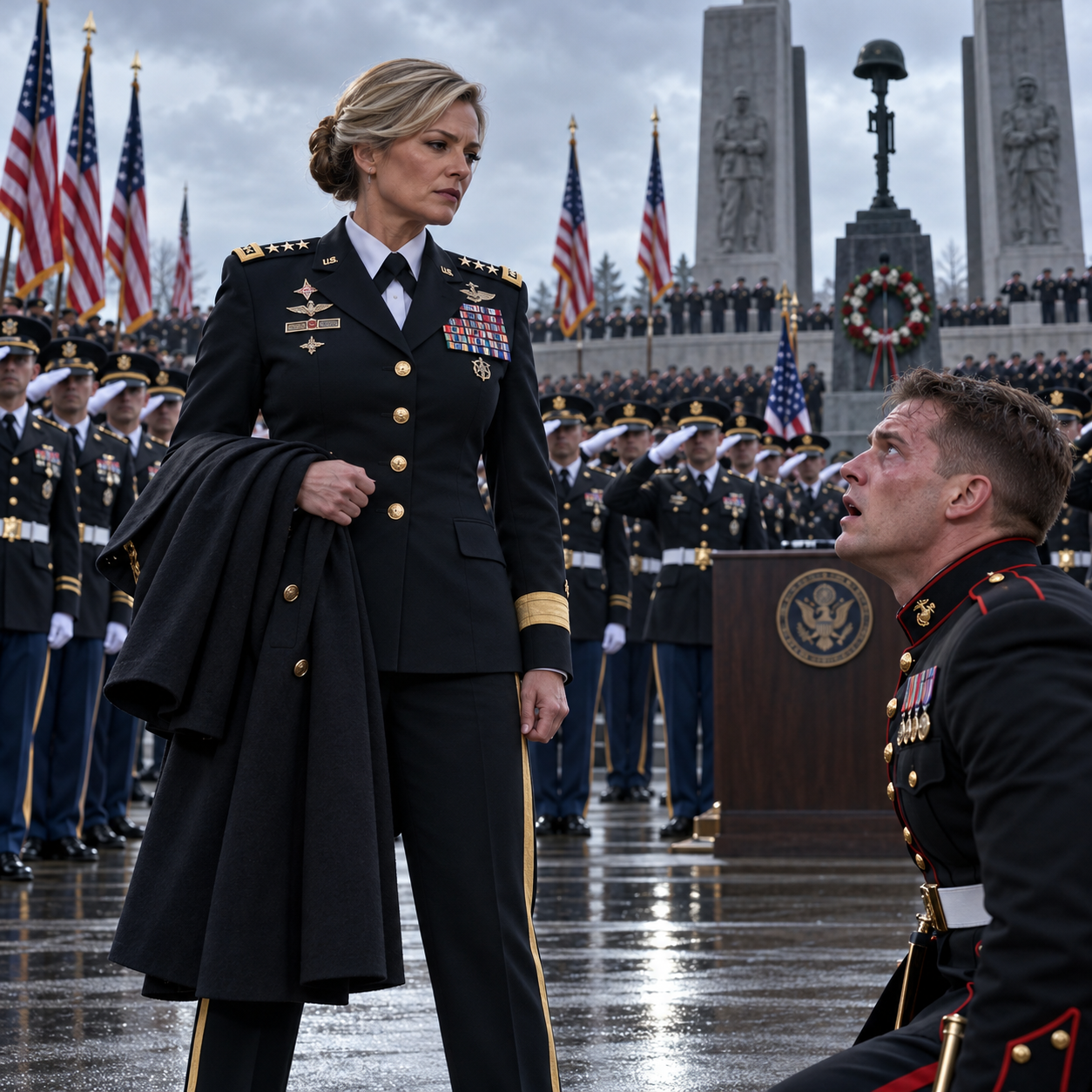
A mysterious woman arrived at a military ceremony wearing a dark trench coat, only to be publicly humiliated by a Marine major who accused her of standing where she didn’t belong. When she revealed the general’s stars on her uniform and the name MERCER, hundreds of soldiers snapped to attention. The major was horrified. General Mercer had supposedly died years earlier during a classified military operation. Yet she was standing before him, alive. And when a young soldier questioned who had authorized the official death report, the major’s reaction revealed something far more disturbing: someone powerful had deliberately buried the truth.
The last soldier lowered his salute.
But the silence that followed was more unsettling than the thunder of hundreds of boots striking concrete.
I stood in the center of the parade ground, holding my trench coat over one arm, watching Major Daniel Whitcomb struggle to find an answer to a question he clearly wished he had never asked.
Who had authorized the report declaring me dead?
For almost seven years, that question had followed me into every classified briefing room, every sleepless night, and every quiet moment when the faces of people I had lost returned without warning.
I knew part of the answer.
I had come here to discover the rest.
“Major Whitcomb,” I said, keeping my voice level. “Who is commanding this ceremony?”
He swallowed.
“Brigadier General Richard Voss, ma’am.”
There it was.
The name I had been waiting to hear.
I studied his face.
“And where is General Voss?”
Whitcomb glanced toward the headquarters building beyond the parade ground.
“He’s… expected shortly.”
“Expected?”
“Yes, General.”
“Then perhaps someone should inform him that his guest of honor has arrived.”
The major looked as though I had struck him.
“Guest of honor?”
I slowly turned toward the podium.
A large memorial photograph stood beside it, partially concealed beneath a dark blue ceremonial covering.
Fresh flowers surrounded the base.
A folded American flag rested inside a glass display case.
And beneath the photograph was a brass plaque bearing a name I had spent years trying to reclaim.
GENERAL ELIZABETH A. MERCER
I walked toward it.
Nobody moved to stop me.
As I approached, I could make out the inscription.
In Honor of Extraordinary Courage and Ultimate Sacrifice.
My breathing remained steady.
My hands did not shake.
But something inside me tightened.
They had built a memorial to a woman who was still alive.
And the man organizing the ceremony had been one of the last people to see her before she supposedly died.
I stopped in front of the plaque.
For several seconds, I simply stared.
Then I heard footsteps behind me.
Major Whitcomb approached cautiously.
“General, with respect, this event was arranged months ago. There are senior officials attending, military families, members of the press. If your appearance wasn’t coordinated—”
“Major.”
He stopped.
“Do you know what happened during Operation Silent Meridian?”
His expression changed.
“I know the official account.”
“Tell me.”
He hesitated.
“Seven years ago, a classified joint task force was conducting an evacuation in the northern mountain corridor. Enemy forces ambushed the convoy. Communications were lost. The commanding general and several personnel were declared killed in action.”
“And who commanded that task force?”
He looked directly at me.
“You did, ma’am.”
I nodded.
“According to the official report, how many soldiers died?”
“Twenty-three.”
The number struck harder than I expected.
Twenty-three.
I remembered each of their names.
I remembered Sergeant Thomas Bell joking about his daughter’s obsession with dinosaurs.
I remembered Lieutenant Sofia Ramirez carrying extra medical supplies because she never trusted the inventory sheets.
I remembered Captain Aaron Price telling me that his wife was expecting their second child.
Twenty-three people.
Except the report was wrong.
Terribly wrong.
“Major,” I said, “there were thirty-one people in that convoy.”
Whitcomb frowned.
“Thirty-one?”
“Yes.”
“But the records—”
“The records have been altered.”
His mouth closed.
I looked back at the memorial.
“And eight of those people were alive when I last saw them.”
A gust of cold wind swept across the ceremonial platform.
Whitcomb stared at me.
“General, are you saying there were survivors?”
“I’m saying that whoever wrote the official account wanted the world to believe there weren’t.”
Before he could respond, a voice came from behind us.
“General Mercer?”
I turned.
A young Marine stood several paces away.
He appeared no older than twenty-four. His face was pale, and his hands were clenched so tightly at his sides that the knuckles had turned white.
He was the same soldier I had noticed in the rear rank.
Whitcomb immediately straightened.
“Corporal! Return to your position.”
The young man didn’t move.
His eyes remained fixed on me.
“General Mercer,” he repeated, his voice unsteady. “My name is Corporal Nathan Bell.”
Everything inside me went still.
Bell.
I recognized the surname immediately.
I looked more closely at his face.
The dark eyebrows.
The narrow jaw.
The serious eyes that seemed older than the rest of him.
I had seen those eyes before.
On a man lying beside a burning transport vehicle, trying desperately to tell me where his men had gone.
“Thomas Bell,” I whispered.
The corporal’s expression broke.
“He was my father.”
I felt the cold air enter my lungs.
For the first time that morning, maintaining my composure required actual effort.
Nathan stepped closer.
“My mother told me you died with him.”
I said nothing.
“She said the Army told her you refused evacuation and stayed behind to protect your men.”
His voice trembled.
“Is that true?”
I looked at him for a long moment.
“Your father was one of the bravest soldiers I ever commanded.”
Tears gathered in his eyes.
“Did he suffer?”
There are questions military leaders prepare themselves to answer.
Questions about decisions.
Questions about casualties.
Questions about why one route was chosen over another.
But nothing prepares you for standing in front of a son who wants to know whether his father died afraid.
I took a careful breath.
“Your father was wounded during the final evacuation. I stayed with him until we were forced to move.”
Nathan’s face tightened.
“Was he conscious?”
“Yes.”
“What did he say?”
I remembered Thomas gripping my sleeve.
I remembered blood on the snow.
I remembered the distant noise of gunfire echoing between the mountains.
And I remembered his last request to me.
“He asked me to tell his family that he loved them.”
Nathan lowered his head.
A tear slipped down his cheek.
For several seconds, neither of us spoke.
Then he looked up.
“General… that’s not what the Army told us.”
My eyes narrowed.
“What did they tell you?”
He swallowed.
“They said my father died before the ambush reached the convoy.”
The words landed like a warning shot.
I turned fully toward him.
“Who told your mother that?”
“I don’t know. Some colonel came to our house. I was seventeen.”
“Do you remember his name?”
Nathan hesitated.
Then he reached inside his uniform jacket.
Major Whitcomb immediately stepped forward.
“Corporal, what are you doing?”
Nathan withdrew a small folded piece of paper.
“My mother kept everything,” he said. “Every letter, every notification, every report they gave her.”
He unfolded it carefully.
“Last month, when I found out I was assigned to this ceremony, she gave me a copy of the original casualty notification.”
He handed it to me.
The document was old, its edges worn from years of handling.
Near the bottom was a signature.
COLONEL RICHARD VOSS.
I stared at it.
The same man now serving as the brigadier general responsible for the ceremony.
The same man who had been my deputy commander during Silent Meridian.
The same man who had assured me that every surviving soldier would be recovered.
I looked at Nathan.
“Did your mother ever meet him again?”
Nathan nodded.
“Last week.”
My head lifted.
“What?”
“He called her personally. Said he was arranging a special memorial and wanted to make sure she attended.”
A strange pressure settled behind my ribs.
“Is she here?”
Nathan glanced toward the visitors’ seating area.
“Yes, ma’am.”
I followed his gaze.
Rows of civilians sat beneath a temporary canopy near the edge of the parade ground.
Some wore dark suits.
Others held small American flags.
Several elderly veterans sat beside relatives.
And in the third row, a woman with silver-streaked brown hair held a framed photograph against her lap.
I recognized her immediately.
Margaret Bell.
Thomas’s wife.
I hadn’t seen her since before the mission.
She looked older, of course.
Seven years of grief will do that.
But it was unmistakably her.
I began walking toward the seating area.
“General?” Whitcomb called.
I didn’t stop.
Nathan followed several steps behind me.
As I approached, Margaret looked up.
Our eyes met.
The framed photograph slipped from her hands.
She stood so abruptly that her chair scraped loudly against the concrete.
For one breathless moment, she simply stared.
Then her hand flew to her mouth.
“Oh, dear God.”
I stopped in front of her.
“Margaret.”
Her face crumpled.
“No.”
She shook her head.
“No, they told me…”
“I know.”
“They told me you were dead.”
“I know.”
She reached for my hand.
Her fingers were cold.
For a moment she looked at me as though touching me might make me disappear.
Then she pulled me into an embrace.
I held her tightly.
Around us, conversations stopped.
Several people rose from their seats.
I heard someone whisper my name.
Margaret stepped back, tears streaming down her cheeks.
“Elizabeth, what happened to you?”
I opened my mouth.
But before I could answer, she whispered something that changed everything.
“Richard told me you were the reason Thomas died.”
I felt my expression harden.
“What?”
She wiped her eyes.
“General Voss. He came to my house after the mission. He said you ignored an evacuation order. That you pushed the convoy into dangerous territory because you wanted to complete the operation.”
Nathan stared at his mother.
“Mom, you never told me that.”
Margaret’s voice cracked.
“Because I didn’t believe him.”
I looked at her.
She continued.
“Thomas wrote me a letter before he deployed. He said if anything happened, I should know he trusted you with his life.”
My throat tightened.
Margaret gripped my hand.
“But Voss came back three months later. He said the investigation had confirmed that your decisions caused the casualties. He told me the report was classified, and that discussing it would only hurt the families.”
I stared at her.
Seven years.
For seven years, I had believed the lie was designed only to conceal what happened during the operation.
But now I understood.
Someone had done more than declare me dead.
Someone had made sure the families blamed me.
Margaret lowered her voice.
“Elizabeth, why would he lie?”
I looked toward headquarters.
The building’s upper windows reflected the darkening sky.
“That’s what I’m here to find out.”
Then the loudspeakers crackled.
“Ladies and gentlemen, please return to your seats. The ceremony will begin momentarily.”
A black military vehicle appeared at the far end of the road.
Behind it came two additional SUVs.
Major Whitcomb hurried toward us.
“General Mercer,” he said urgently, “the command party is arriving.”
I gently released Margaret’s hand.
“Stay with your son.”
She looked frightened.
“Elizabeth, please be careful.”
I gave her a small smile.
“That’s why I came in person.”
Then I turned.
The black vehicle stopped beside the ceremonial platform.
Its rear door opened.
A tall man stepped out wearing Army dress blues.
His silver hair was neatly combed.
His posture remained rigid despite the years.
A single star gleamed on each shoulder.
Brigadier General Richard Voss.
For a moment, he appeared exactly as I remembered.
Confident.
Controlled.
A man who knew how to make a room turn toward him without raising his voice.
He adjusted his jacket.
Then looked toward the podium.
An aide stepped forward and whispered something.
Voss frowned.
The aide spoke again.
Whatever he said made the general’s expression change.
Voss turned toward the center of the parade ground.
And saw me.
He stopped walking.
His right hand remained suspended near the button of his jacket.
For a few seconds, neither of us moved.
Across the distance, I watched recognition spread across his face.
Then came disbelief.
Then something I recognized much more clearly.
Fear.
His aide leaned closer.
“Sir?”
Voss didn’t answer.
I began walking toward him.
Each step echoed against the concrete.
The soldiers near the platform straightened instinctively.
Several officers saluted.
I returned the gestures without taking my eyes off Voss.
When I stopped three feet away, I saw a faint tremor in his jaw.
“Richard.”
He stared.
“Elizabeth?”
I tilted my head.
“You look surprised.”
His mouth opened.
Then closed.
“That’s… impossible.”
“I’ve heard that several times this morning.”
His eyes moved toward the soldiers.
Toward the families.
Toward the cameras positioned near the podium.
“Where have you been?”
“Alive.”
He flinched.
I continued.
“Something your casualty report neglected to mention.”
His expression became rigid.
“General Mercer, this is neither the time nor the place.”
“Really?”
I looked around.
“Hundreds of soldiers. Families of the fallen. A memorial bearing my name.”
I turned back toward him.
“Seems like the perfect place.”
His voice dropped.
“You don’t understand what you’re interfering with.”
“Then explain it.”
He said nothing.
I stepped closer.
“Explain why you signed a report declaring thirty-one soldiers dead when you knew eight had survived.”
His eyes widened.
I caught the reaction immediately.
He knew.
Not merely that the casualty figures were wrong.
He knew exactly which eight I meant.
“Lower your voice,” he hissed.
“Why?”
“Because you could jeopardize national security.”
I almost laughed.
The words were familiar.
I had heard them from men who believed secrecy was a shield they could hide behind forever.
“National security didn’t require you to lie to Thomas Bell’s widow.”
His face tightened.
“Careful, Elizabeth.”
The warning was quiet.
But unmistakable.
I looked at his shoulder stars.
Then into his eyes.
“Are you threatening me, General?”
For a moment, the old Richard Voss returned.
The man who had once challenged my orders behind closed doors.
The man who believed that rank made him immune to accountability.
But the expression vanished almost immediately.
He glanced toward the cameras.
Then forced a smile.
“Of course not. We should discuss this privately.”
“No.”
His smile froze.
“No?”
“I’ve spent seven years having conversations behind closed doors.”
I gestured toward the memorial.
“Today, we can start with the truth.”
Before he could answer, the senior public affairs officer approached us.
“General Voss, sir. We’re ready for your opening remarks.”
Voss straightened immediately.
“Thank you, Colonel.”
The officer glanced at me.
Then looked at my stars.
His expression shifted into confusion.
“Ma’am, I apologize. I wasn’t informed that another general officer would be attending.”
“Neither was I,” Voss said sharply.
I looked at him.
“That makes two of us.”
The public affairs officer shifted uncomfortably.
Voss took a slow breath.
“Colonel, please escort General Mercer to the command conference room. I’ll join her after the ceremony.”
The officer hesitated.
I answered before he could move.
“That won’t be necessary.”
Voss’s eyes hardened.
“Elizabeth.”
I turned to the colonel.
“What’s your name?”
“Colonel Andrew Foster, ma’am.”
“Colonel Foster, is the ceremony being recorded?”
“Yes, General. Official documentation and a live feed for remote military families.”
“Excellent.”
Voss’s face drained.
I looked toward the podium.
“Then I suggest we begin.”
For several seconds, nobody spoke.
Finally, Foster nodded.
“Yes, General.”
He turned toward the microphone.
Voss caught my arm.
Not hard enough to hurt.
But firmly enough to stop me.
I looked down at his hand.
Then slowly back at his face.
“Remove your hand, Richard.”
He released me immediately.
His voice dropped to a harsh whisper.
“You have no idea what you’ve walked into.”
I leaned closer.
“On the contrary.”
I let the words settle.
“I think I’ve finally found the right door.”
The ceremony began beneath a sky that seemed ready to break open.
A military band played a solemn march.
Families rose.
Officers stood at attention.
And the American flag moved steadily in the cold wind.
I took a seat in the front row of the command section.
Voss sat three chairs away.
He hadn’t looked at me since the opening salute.
But I could feel him watching.
Every few minutes, he leaned toward his aide.
Every time, the aide stepped away and spoke urgently into a phone.
I knew the pattern.
Containment.
That was what intelligence professionals called it when unexpected information threatened an established narrative.
First, control the people.
Then control the records.
Finally, control the story.
Voss was attempting all three.
Unfortunately for him, I had spent most of my career recognizing exactly that behavior.
Colonel Foster approached the podium.
“Today, we gather to honor the extraordinary service and sacrifice of the soldiers of Operation Silent Meridian.”
I looked toward the families.
Margaret Bell sat beside her son.
She was watching me.
I gave her a small nod.
Foster continued.
“Seven years ago, a courageous joint task force entered hostile territory to protect American personnel and prevent a catastrophic loss of life.”
I closed my eyes briefly.
That much was true.
At least at the beginning.
Our mission had been simple on paper.
Secure a compromised intelligence facility.
Evacuate its personnel.
Recover sensitive materials before hostile forces reached the compound.
We were supposed to have air support.
We were supposed to have a clear withdrawal route.
And we were supposed to be gone before dawn.
But at 02:17, everything changed.
Our extraction coordinates were transmitted over an unsecured channel.
Enemy forces reached the eastern pass before we did.
The first vehicle exploded.
The second overturned.
And within minutes, our convoy was trapped between two ridgelines.
I remembered shouting into my radio.
Requesting immediate air support.
Requesting emergency evacuation.
Requesting confirmation that headquarters understood our position.
And then came the answer.
Not from my pilots.
Not from my rescue team.
From Colonel Richard Voss.
Negative extraction. Hold current position.
I had questioned the order.
He repeated it.
Hold position, General. That’s a direct instruction from theater command.
But there was something wrong with his voice.
Something I hadn’t understood until much later.
He sounded rehearsed.
As though he had expected the emergency.
As though he already knew where the enemy would strike.
On the podium, Foster began reading the names of the fallen.
One by one.
Every name reopened a memory.
Sergeant Thomas Bell.
Lieutenant Sofia Ramirez.
Captain Aaron Price.
Staff Sergeant Daniel Reeves.
I listened without moving.
Then a name appeared that made me open my eyes.
“Major Jonathan Hale.”
My head turned sharply.
Hale?
No.
That couldn’t be right.
Jonathan Hale had survived the ambush.
He was one of the eight.
I remembered dragging him into the reinforced communications shelter after a mortar strike.
I remembered his broken ankle.
The blood soaking his sleeve.
I remembered him helping me rebuild a damaged transmitter with equipment salvaged from the wreckage.
He was alive when the secondary evacuation team arrived.
I knew because I had helped lift him onto the aircraft.
Yet his name was being read as one of the dead.
I leaned toward Colonel Foster, who had stepped down after introducing the chaplain.
“Colonel.”
He approached.
“Yes, General?”
“Where did the list of casualties come from?”
“The official final report, ma’am.”
“Who provided it?”
“General Voss’s office.”
I stared at him.
“Did anyone independently verify the names?”
Foster hesitated.
“Ma’am, this is a classified historical operation. We relied on the approved documents.”
I looked back toward the podium.
Jonathan Hale.
Declared dead.
Another survivor erased.
“How many names are on that list?” I asked.
“Twenty-three, ma’am.”
I nodded slowly.
“Colonel, I need you to do something.”
“Of course.”
“Keep a copy of that list exactly as it exists right now.”
He frowned.
“General?”
“Do not allow anyone to alter it, remove it, or replace it.”
Foster studied my face.
Then nodded.
“Understood.”
From the corner of my eye, I saw Voss lean toward his aide.
The aide immediately stood and hurried toward the rear of the platform.
I knew something was happening.
I simply didn’t yet know how far Voss intended to go.
Then the band fell silent.
Colonel Foster returned to the microphone.
“And now, to deliver the memorial address, we welcome Brigadier General Richard Voss.”
Applause rose across the parade ground.
Voss stood.
He adjusted his jacket.
Smiled toward the families.
And walked toward the podium with the practiced confidence of a man who had delivered hundreds of speeches.
I watched him carefully.
He placed his notes on the lectern.
Looked over the crowd.
Then began.
“Seven years ago, our nation lost some of its finest warriors.”
His voice carried across the field.
“Among them was a remarkable leader whose courage and dedication inspired everyone who served under her command.”
He paused.
I felt the soldiers around me become very still.
“General Elizabeth Mercer gave her life so that others might live.”
The words were almost surreal.
I sat less than twenty feet away.
Alive.
Listening to the man who had falsified my death explain my sacrifice.
Voss continued.
“She represented the highest ideals of military leadership. Duty. Honor. Sacrifice.”
His voice strengthened.
“Although the circumstances of that mission remain classified, we can say with certainty that General Mercer made the ultimate sacrifice while attempting to protect her soldiers.”
I stood.
The movement was quiet.
But every officer in the front row noticed.
Voss stopped speaking.
Our eyes met.
For a second, he looked almost pleading.
I walked toward the podium.
Colonel Foster shifted aside.
Voss gripped the edges of the lectern.
“General Mercer,” he said through clenched teeth, “I’m in the middle of an address.”
“I noticed.”
A faint murmur moved through the audience.
I stepped beside him.
“Richard, there’s something you forgot to mention.”
His face hardened.
“What?”
I turned toward the microphone.
“That I’m not dead.”
Silence.
Absolute silence.
Then whispers erupted across the seating area.
A few families stood.
Someone gasped.
I heard a camera shutter.
Voss leaned toward me.
“Elizabeth, stop.”
I ignored him.
“My name is General Elizabeth Mercer.”
I let the words carry across the parade ground.
“Seven years ago, I commanded the joint task force assigned to Operation Silent Meridian.”
Several soldiers snapped upright.
“I was told that my death had been recorded to protect ongoing intelligence operations.”
I paused.
“But this morning, I discovered that the official account contains information I know to be false.”
Voss stepped forward.
“Ladies and gentlemen, General Mercer has recently returned from a highly sensitive assignment, and there appears to be some confusion regarding—”
“Richard.”
My voice cut through his explanation.
“Please don’t insult these families a second time.”
The crowd fell quiet again.
Voss stared at me.
I turned back toward the microphone.
“Twenty-three names were read today.”
I scanned the audience.
“Some belong to courageous men and women who gave their lives serving this country. Their sacrifice is real. Their families deserve our gratitude.”
My throat tightened.
“But at least one of the people listed as dead was alive when I last saw him.”
An audible murmur spread across the front rows.
I continued.
“Major Jonathan Hale survived the initial ambush. I personally witnessed him being placed aboard an evacuation aircraft.”
Behind me, Voss took a step backward.
I turned toward him.
“Would you care to explain why his name is on the casualty list?”
His expression became unreadable.
Then he said something I hadn’t expected.
“Because Major Hale died two hours after you last saw him.”
I froze.
The words struck with startling force.
“What?”
Voss lowered his voice.
“You didn’t know?”
I stared at him.
He looked genuinely surprised.
And that frightened me more than his earlier lies.
“Hale’s evacuation helicopter never reached the designated medical facility,” Voss said.
I felt my heartbeat quicken.
“That isn’t possible.”
“It was diverted.”
“By whom?”
Voss didn’t answer.
“Richard. By whom?”
He looked toward the audience.
Then whispered:
“The same people who ordered your extraction canceled.”
A terrible silence opened between us.
For seven years, I had believed Voss was the architect of the cover-up.
But something in his expression suggested he was only one part of it.
I lowered my voice.
“Who gave that order?”
Voss stared at me.
Then glanced toward the administrative building.
“Not here.”
I looked at him coldly.
“You’ve had seven years to tell me the truth.”
“Elizabeth, if you force this in public, people will die.”
I studied his face.
It wasn’t arrogance anymore.
It was desperation.
And before I could answer, Colonel Foster approached quickly.
“General Mercer, we have a situation.”
I turned.
“What kind?”
He held out a phone.
“Someone from Army Criminal Investigation wants to speak with you.”
I took it.
“Mercer.”
A woman’s voice answered immediately.
“General, this is Special Agent Rebecca Shaw. I’m calling from the Department of the Army Criminal Investigation Division.”
“Go ahead.”
“Ma’am, are you currently on the parade ground with Brigadier General Richard Voss?”
“Yes.”
There was a brief silence.
Then Shaw spoke again.
“General, I need you to step away from him immediately.”
My gaze shifted toward Voss.
“Why?”
“Because we have reason to believe someone is attempting to compromise the evidence related to Operation Silent Meridian.”
I felt my jaw tighten.
“What evidence?”
“A secured archive containing the original communications and casualty records.”
My mind raced.
“Where is it?”
“Building Twelve. Lower-level records vault.”
I looked toward headquarters.
“And why are you telling me this now?”
Shaw’s voice dropped.
“Because we received a request this morning to destroy those records under an emergency classification review.”
My stomach went cold.
“Who authorized it?”
Another pause.
Then she answered.
“General Voss.”
I slowly turned.
Richard was watching me.
His face had gone completely pale.
“General,” Shaw continued, “do not allow him access to the records facility.”
I looked directly into Voss’s eyes.
“It’s too late.”
Shaw’s voice sharpened.
“What do you mean?”
“His aide left the platform ten minutes ago.”
There was sudden movement on the other end of the call.
Then Shaw spoke with terrifying urgency.
“General Mercer, listen carefully. We believe the documents in that vault include the original transmission ordering your convoy to remain in the kill zone.”
I stopped breathing for half a second.
“Who transmitted it?”
“We don’t know. The electronic signature was removed from the official archive.”
I closed my eyes.
Of course it was.
“But,” she continued, “we have a partial backup.”
“What does it say?”
Shaw hesitated.
“Ma’am, the transmission was authenticated using command credentials belonging to someone who should not have had operational authority over your task force.”
I gripped the phone.
“Whose credentials?”
Before she could answer, an explosion shattered the morning.
The sound erupted from beyond the headquarters building.
The ground seemed to tremble beneath my boots.
A column of black smoke rose into the gray sky.
Screams broke out among the visitors.
Soldiers began moving.
Security personnel shouted orders.
The band scattered from its formation.
I spun toward the sound.
Building Twelve.
Black smoke poured from the lower windows.
The records vault.
Voss stared at the smoke.
And something in his expression told me he hadn’t expected the explosion.
“Richard,” I said quietly.
He didn’t answer.
“Did you order that?”
He shook his head.
Slowly.
“No.”
His voice was almost inaudible.
“No, no, no…”
For the first time, I believed him.
And that realization was worse than anything else that had happened.
Because if Richard Voss hadn’t ordered the explosion, then someone else had decided that the secrets buried inside Building Twelve were worth killing to protect.
I handed the phone back to Foster.
“Get emergency responders moving. Establish a perimeter. Keep the families away from the smoke.”
“Yes, General.”
I turned toward Whitcomb.
“Major, secure every exit from this installation. No unauthorized departures.”
He snapped to attention.
“Yes, General.”
Then I looked at Nathan Bell.
“Corporal.”
He stepped forward.
“Ma’am!”
“Stay with your mother. Help the other families move to safety.”
He hesitated.
“General, I want to help.”
“You are helping.”
His jaw tightened.
Then he saluted.
“Yes, ma’am.”
I returned the salute and turned back toward Voss.
He was still staring at the smoke.
“Richard.”
He looked at me.
“We need to talk.”
He shook his head.
“You don’t understand.”
“Then make me understand.”
His eyes moved toward the surrounding officers.
He stepped closer.
“Elizabeth, I didn’t know you were coming today.”
“I gathered that.”
“No. You don’t understand. The moment your identity appeared on the installation’s access system, someone initiated a containment protocol.”
I felt the blood drain from my face.
“What protocol?”
He swallowed.
“Black Lantern.”
The name hit me like a physical blow.
I hadn’t heard those words in seven years.
Not since the night I had been given the final order that sent my convoy into the mountains.
I stared at him.
“That’s impossible.”
Voss gave a bitter, frightened laugh.
“I thought so too.”
I moved closer.
“Black Lantern was terminated.”
“Officially.”
“By direct order of the Secretary of Defense.”
“That’s what we were told.”
My mind raced.
Black Lantern wasn’t a rescue plan.
It wasn’t a standard contingency.
It was a compartmentalized intelligence protocol designed to erase compromised operations from accessible records.
Its existence had been known to fewer than a dozen people.
And it had been shut down after Silent Meridian.
Or so I had believed.
“Richard,” I said carefully, “what exactly did the protocol authorize?”
He looked at me with exhausted eyes.
“Removal of all evidence connected to the operation.”
“Documents?”
“Yes.”
“Communications?”
“Yes.”
I felt a terrible certainty forming.
“Personnel?”
He said nothing.
I stepped closer.
“Richard.”
His voice broke.
“Everyone.”
The word seemed to drain the sound from the world.
Everyone.
I turned toward the smoke.
Toward the soldiers rushing across the parade ground.
Toward the families still being escorted from their seats.
And suddenly I understood the significance of Voss’s fear.
Whoever had activated Black Lantern wasn’t simply trying to hide an old crime.
They were attempting to erase everyone who could expose it.
Including me.
Twenty minutes later, the installation was in lockdown.
Emergency vehicles surrounded Building Twelve.
Military police established security checkpoints.
The ceremony had been suspended, and civilians were moved to a nearby reception facility.
I stood inside the headquarters command center watching live camera feeds of the damaged records building.
Smoke continued rising from the eastern stairwell.
The explosion had destroyed part of the lower level.
Two security personnel had been injured.
A records technician was missing.
And the digital archive containing the original Silent Meridian documents had gone offline seconds before the blast.
Not afterward.
Before.
That detail mattered.
Someone had shut down the system in advance.
I leaned over the operations table.
“Show me the access logs.”
A young captain hesitated.
“General, the system is still recovering.”
“Then show me what you have.”
He pulled up a partial record.
Rows of timestamps appeared.
At 09:41, an administrative user had requested access to the lower-level vault.
At 09:43, the main archive went offline.
At 09:44, the explosion occurred.
I studied the entry.
The user identification field had been replaced by a string of encrypted characters.
“Can you recover the account name?”
“We’re trying, ma’am.”
I pointed to the first timestamp.
“Who was physically inside the building at 09:41?”
The captain opened another screen.
“Three authorized employees. Two security guards. One visiting officer.”
I looked at him.
“Which officer?”
He hesitated.
“Colonel Adrian Keller.”
The name meant nothing to me.
“Assignment?”
The captain checked.
“Office of Strategic Readiness, Pentagon.”
I frowned.
That was unusual.
Why would an officer from the Pentagon be inside a classified records vault during a memorial ceremony?
“Where is Keller now?”
The captain’s expression changed.
“His access badge was last recorded entering the lower level.”
“And after the explosion?”
“No exit recorded.”
I looked toward the security feeds.
“Was his body recovered?”
“No, General.”
A chill moved through me.
A missing Pentagon colonel.
A destroyed archive.
A protocol supposedly terminated years ago.
Nothing about this was accidental.
The door opened.
Major Whitcomb entered with Special Agent Rebecca Shaw.
She was a woman in her early forties, wearing a dark suit and carrying a thick black evidence folder.
Her expression was controlled, but her eyes were sharp.
“General Mercer.”
“Agent Shaw.”
She shook my hand.
“I’m glad you’re alive, ma’am.”
The words caught me off guard.
Most people had spent the morning expressing disbelief.
Shaw sounded relieved.
I studied her.
“You expected to find me?”
“Yes.”
“Why?”
She glanced toward the other personnel.
“May we speak privately?”
I led her into the adjacent briefing room.
Whitcomb followed.
Shaw placed the folder on the table.
Then removed a photograph.
It showed a younger version of me standing beside a transport aircraft.
My uniform was dusty.
My face was bruised.
And beside me stood Major Jonathan Hale.
Alive.
The date printed along the bottom was three days after the reported destruction of our convoy.
I stared at it.
“Where did you get this?”
“From a military hospital archive that was never incorporated into the official investigation.”
I looked closer.
The photograph was genuine.
I remembered the day.
I remembered the medical personnel.
I remembered Hale telling me that he intended to testify about the canceled evacuation.
“What happened to him?” I asked.
Shaw’s expression grew serious.
“That’s what we’ve been investigating.”
“Investigating for how long?”
“Fourteen months.”
I looked up sharply.
“Fourteen months?”
She nodded.
“General, a year ago, several classified files began appearing in places they shouldn’t have existed.”
“What kind of files?”
“Medical records. Transportation manifests. Personnel transfers. Documents showing that at least four members of your original task force survived beyond the dates listed in their casualty reports.”
Four.
My pulse quickened.
“Names.”
Shaw opened the folder.
“Jonathan Hale. Sofia Ramirez. Daniel Reeves. And Thomas Bell.”
The room seemed to tilt.
I gripped the edge of the table.
“Thomas?”
Whitcomb looked between us.
Shaw continued carefully.
“Sergeant Bell was documented as receiving emergency treatment at a secured medical facility forty-eight hours after the date of his reported death.”
I stared at her.
“No.”
She slid a photocopied record across the table.
A medical admission form.
Patient name: Thomas Bell.
Blood type.
Service number.
Treatment details.
And a date two days after the ambush.
I read it twice.
Then a third time.
My voice came out barely above a whisper.
“He was alive.”
Shaw nodded.
“At least for forty-eight hours.”
I thought of Margaret.
Of Nathan.
Of the family that had spent seven years believing Thomas died in the mountains.
I remembered holding his hand.
Promising I would get him home.
And now I was being told someone had taken him somewhere else.
“Where was the facility?”
Shaw hesitated.
“That’s classified.”
I looked directly at her.
“Agent Shaw, I have spent seven years living under an assumed identity because someone convinced the military I was dead. I stood beside a memorial carrying my own name this morning.”
My voice hardened.
“Do not tell me I don’t have clearance to know where my soldiers were taken.”
She held my gaze.
Then slowly nodded.
“Fair enough.”
She pulled another document from the folder.
The location was printed near the top.
CROWS NEST FACILITY — SECTOR NINE.
I froze.
The name meant something.
Not because I had ever been there.
But because, during Silent Meridian, I had intercepted a fragment of enemy communications referencing a place called Crows Nest.
At the time, intelligence analysts had dismissed it as an unrelated transmission.
Now it was appearing on an American military medical record.
I stared at Shaw.
“Who controlled that facility?”
She hesitated.
Then answered.
“A private defense contractor operating under federal authorization.”
“Which contractor?”
She turned the page.
And showed me a corporate name.
VANGUARD STRATEGIC SYSTEMS.
I felt the first true flash of anger since arriving on the installation.
I knew that company.
Its executives had attended classified procurement meetings.
Its technology had been integrated into our communications network before Silent Meridian.
And its chairman had once stood inside my office, assuring me that their systems were impossible to compromise.
“Who owns Vanguard?” I asked.
Shaw didn’t answer immediately.
Instead, she removed another photograph.
A corporate reception.
Five executives standing beside military officers.
I recognized two of the generals.
One of the civilian executives.
And then I saw the man in the center.
My stomach tightened.
“No.”
Shaw watched my reaction.
“You recognize him.”
I reached for the photograph.
The man was older than I remembered.
His hair had gone completely white.
But the eyes were the same.
Cold.
Calculating.
Familiar.
“Of course I recognize him.”
I looked up.
“That’s General William Mercer.”
Whitcomb frowned.
“Mercer?”
Shaw nodded.
“Your father.”
The words hung in the room.
I hadn’t spoken to my father in almost a decade.
General William Mercer had spent forty years building one of the most respected careers in military intelligence.
He was decorated.
Connected.
Admired.
And feared.
Growing up, I had believed he represented everything honorable about military service.
Then I became an officer.
And I discovered that a reputation and a character were not always the same thing.
My father had opposed my promotion to general.
He had warned me against questioning senior commanders.
And just before Silent Meridian, we had argued bitterly over the private contractors being granted access to operational intelligence.
I remembered his final words to me.
Elizabeth, you don’t understand how this system works. Some decisions are above your authority, no matter how many stars you wear.
Three weeks later, my convoy was ambushed.
And the world was told I had died.
I lowered the photograph.
“Where is he now?”
Shaw’s expression tightened.
“General Mercer, your father has been retired for several years.”
“That wasn’t my question.”
She took a breath.
“He’s currently serving as chairman of Vanguard’s national security advisory board.”
I stared at her.
Of course.
Of course he was.
The company that supplied our communications systems.
The facility that received my surviving soldiers.
The protocol that erased their existence.
And my father.
A man who had never forgiven me for refusing to obey him.
Whitcomb looked deeply uncomfortable.
“General, are you suggesting your father was involved in the operation?”
I didn’t answer.
Because something else had caught my attention.
At the bottom of the photograph was a date.
Three days before Silent Meridian.
I looked at Shaw.
“Where was this taken?”
“Washington, D.C.”
“Who else attended?”
She opened another document.
“Senior officers, defense contractors, intelligence officials.”
I pointed at one person in the photograph.
A man standing partially behind my father.
“Who is that?”
Shaw studied the image.
“Colonel Adrian Keller.”
My blood went cold.
The missing Pentagon officer.
The man whose access badge had entered the records vault minutes before the explosion.
He had been standing beside my father three days before the mission that supposedly killed me.
I looked toward Whitcomb.
“Major, find General Voss.”
“Yes, ma’am.”
“Bring him here. Immediately.”
Whitcomb hurried out.
Shaw watched me carefully.
“General, there’s something else.”
I looked at her.
“What?”
She hesitated.
“Last night, we received an encrypted message through an internal intelligence channel.”
“From whom?”
“Unknown source.”
“What did it say?”
Shaw opened her folder and handed me a printed page.
There were only five words.
MERCER MUST NOT REACH CROWS NEST.
I read the message.
Then looked up.
“When was it sent?”
“02:17 this morning.”
I went completely still.
02:17.
The exact time our extraction coordinates had been compromised seven years earlier.
The exact minute everything went wrong.
Whoever sent that message wasn’t merely aware of Silent Meridian.
They were recreating its timeline.
And they knew I was coming.
The briefing room door opened.
Major Whitcomb entered alone.
His expression was grim.
“General, we have a problem.”
I turned.
“Where’s Voss?”
“He’s gone.”
I stared at him.
“Gone?”
“He was escorted toward headquarters after the explosion. But security cameras show him entering the east corridor. He never reached the command center.”
Shaw moved immediately.
“Could he have left the installation?”
Whitcomb shook his head.
“All gates are locked down.”
“Then he’s still here,” I said.
Whitcomb hesitated.
“General… we found something in his office.”
He handed me a small black notebook.
The cover was worn.
No title.
No insignia.
I opened it.
Most of the pages were blank.
But near the middle, several lines had been written in hurried handwriting.
If Mercer returns, tell her I tried.
I stopped reading.
Below that sentence was another.
The survivors were never meant to leave Crows Nest.
And beneath it, written more heavily, as though the pen had nearly torn through the paper:
Her father knows why.
I stared at the words.
For seven years, I had imagined confronting the people responsible for Silent Meridian.
I had rehearsed questions.
I had collected fragments of evidence.
I had studied records under names that didn’t belong to me.
But I had never allowed myself to seriously consider that my father might have helped destroy my command.
The idea felt like stepping onto ground that had suddenly disappeared beneath my feet.
Shaw approached.
“General?”
I closed the notebook.
“Where was this found?”
“Inside Voss’s locked desk.”
“Was anything else missing?”
Whitcomb nodded.
“His personal firearm. His phone. And a sealed envelope marked with your name.”
I looked up.
“Where is the envelope?”
Whitcomb swallowed.
“We didn’t find it.”
“Then how do you know it existed?”
“His secretary saw it yesterday. She said he placed it inside his desk and told her not to touch it.”
I looked toward the hallway.
“Find the secretary.”
“Yes, ma’am.”
As Whitcomb turned, the lights flickered.
Once.
Twice.
Then the entire room went dark.
For half a second, there was absolute silence.
Emergency lights illuminated the walls in dim red.
An alarm began sounding somewhere in the building.
Shaw reached for her radio.
“Security, report.”
Static answered.
Then a voice.
“Command center, we have an unauthorized access alert on the internal network.”
I moved toward the door.
“Location?”
“Communications wing. Second floor.”
Another burst of static.
Then the voice returned, urgent.
“General, someone’s broadcasting over the installation’s emergency alert system.”
A loud electronic tone echoed through the building.
Every wall-mounted screen flickered.
Then went black.
A moment later, white letters appeared.
BLACK LANTERN ACTIVATED.
My stomach dropped.
Across the entire installation, the same message appeared.
Then a second line.
FINAL CONTAINMENT AUTHORIZED.
Shaw stared at the screen.
“What does that mean?”
I knew.
I wished I didn’t.
“It means someone has decided we are all expendable.”
The emergency speaker crackled.
A distorted voice filled the hallway.
“General Elizabeth Mercer.”
I froze.
The voice was electronically altered.
But the words were unmistakable.
“You were instructed to remain dead.”
Shaw drew her weapon.
Whitcomb stepped toward the door.
The voice continued.
“You have endangered people who were never supposed to know the truth.”
I moved closer to the speaker.
“Who are you?”
There was a pause.
Then the voice said something that made my chest tighten.
“Your father warned you about this.”
The speaker went silent.
I stood motionless.
Shaw turned toward me.
“General, we need to evacuate.”
But I was no longer looking at her.
I was looking at the screen.
Because a new message had appeared.
ONE SURVIVOR REMAINS INSIDE CROWS NEST.
Then another line.
YOU HAVE SIX HOURS.
I stepped closer.
The screen flickered once more.
And displayed a photograph.
A man sitting in a dimly lit room.
His wrists restrained.
His face bruised.
His hair streaked with gray.
But I recognized him immediately.
Sergeant Thomas Bell.
Alive.
Seven years older.
Looking directly into the camera.
I felt my breath catch.
Behind me, Shaw whispered:
“Oh my God.”
Thomas lifted his head.
His lips moved.
At first, there was no sound.
Then the speakers crackled.
His voice was weak.
But unmistakable.
“General Mercer…”
I stepped forward.
“Thomas?”
He looked straight into the camera.
Tears filled his eyes.
“Don’t come for me.”
My stomach tightened.
He swallowed painfully.
Then whispered:
“It’s a trap.”
The screen shook.
Someone outside the camera’s view spoke sharply.
Thomas flinched.
Then he forced out four final words.
“Your father is here.”
The transmission cut.
The screen went black.
For several seconds, nobody moved.
I stood staring at my own reflection in the dark monitor.
My father.
At Crows Nest.
With Thomas Bell.
A man the military had declared dead seven years ago.
A man whose son had stood on the parade ground that very morning, grieving a father who was still alive.
I reached for my trench coat.
Shaw stepped in front of me.
“General, whatever you’re thinking, we need to establish a coordinated response.”
I looked at her.
“Then establish one.”
“Where are you going?”
“To find Thomas.”
“General, they specifically warned you not to go there.”
I met her eyes.
“I heard them.”
“Then you understand it’s a trap.”
I buttoned my coat.
“Yes.”
Shaw stared at me.
“Then why would you walk into it?”
I looked toward the dark monitor.
“Because Thomas Bell has spent seven years waiting for someone to come for him.”
I paused.
“And because I made a promise to his family.”
Before Shaw could answer, the door opened.
A military police captain hurried inside, holding a sealed envelope.
“General Mercer!”
I turned.
“What is it?”
“Security found this hidden behind a panel in General Voss’s office.”
He handed me the envelope.
My name was written across the front.
ELIZABETH — OPEN ONLY IF I DISAPPEAR.
I recognized Richard Voss’s handwriting.
I tore it open.
Inside was a single sheet of paper.
And a photograph.
The photograph showed my father standing outside a remote military facility.
Beside him stood Colonel Adrian Keller.
And between them was a younger woman wearing Army intelligence insignia.
A woman whose face I knew better than my own.
My younger sister.
Colonel Catherine Mercer.
My sister had supposedly died in a helicopter crash nine years earlier.
I stared at the photograph.
The date in the corner was only six months old.
My knees almost weakened.
“No…”
Shaw stepped closer.
“General?”
I turned the photograph over.
On the back, Richard had written one sentence.
Elizabeth, your sister never died. She was the one who approved Black Lantern.
I couldn’t move.
Couldn’t speak.
Couldn’t breathe.
Because suddenly, seven years of questions had become something infinitely worse.
My father hadn’t simply hidden the truth about my mission.
He had hidden my sister.
And the two people I had mourned in entirely different ways were connected to the same operation that had destroyed my command.
Then my secure military phone vibrated.
An incoming call.
No caller ID.
I answered slowly.
“Mercer.”
For a moment, there was silence.
Then a woman’s voice spoke.
Calm.
Familiar.
Devastatingly familiar.
“Hello, Elizabeth.”
My hand tightened around the phone.
I knew that voice.
I had heard it in childhood bedrooms.
At family dinners.
During arguments that ended with laughter.
And in the final voicemail Catherine had supposedly left before her death.
My throat went dry.
“Catherine?”
A quiet breath came through the speaker.
“Yes.”
I closed my eyes.
“Oh my God.”
Her voice changed.
The warmth disappeared.
“Listen to me carefully, Elizabeth. Whatever Richard Voss told you, whatever those agents showed you, none of it matters anymore.”
I looked toward the photograph.
“Where are you?”
She didn’t answer.
“Catherine, where are you?”
Then she said something that turned my blood cold.
“I’m the one who authorized your death report.”
Silence.
I stared into the darkness beyond the window.
She continued.
“And if you come to Crows Nest, I’ll have to finish what I started seven years ago.”
The call ended.
I stood completely still, the phone pressed against my ear.
Outside, thunder rolled across the installation.
And in that terrible moment, I understood that Operation Silent Meridian had never truly ended.
It had been waiting for me to return.
Because the person who had erased my life wasn’t an enemy hiding in some distant country.
It was my own sister.
And somewhere inside Crows Nest, she was waiting with my father, a soldier I had sworn to protect, and a secret powerful enough to turn my entire understanding of the past upside down.
But what Catherine didn’t know was that I had kept one thing from everyone.
One piece of evidence that had never appeared in any military archive.
Not in the casualty reports.
Not in the classified investigation.
Not even in Black Lantern’s records.
A recording made during the final minutes of Silent Meridian.
A recording that could reveal who had truly betrayed us.
And why.
I reached inside my uniform jacket and touched the small encrypted drive I’d carried for seven years.
For the first time since the ambush, I knew exactly where I needed to go.
And I knew that before the next sunrise, someone in my family would have to answer for what they’d done.
But I had no idea that the voice recorded on that drive belonged to someone who had been standing beside me on the parade ground that very morning.
To be continued in Part 3…