Part 3: KICKED OUT AT 17, I DISAPPEARED INTO THE FROZEN HILLS — THEN THE TOWN FOUND SMOKE RISING FROM THE GROUND WHERE NO HOUSE EXISTED… 😱❄️
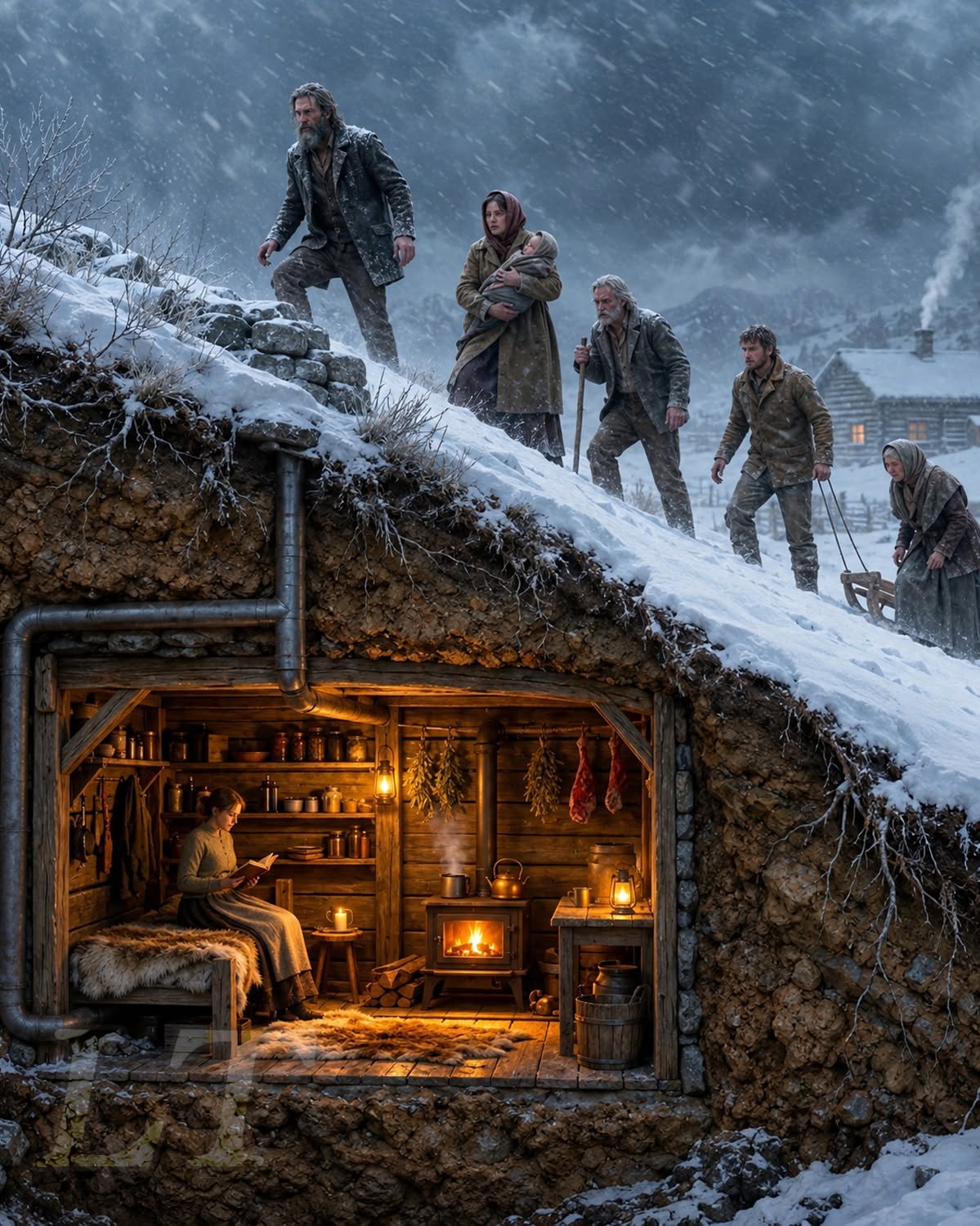
PART 3 — THE SECRET BENEATH THE HILLSIDE
Previously in Part 2:
When a devastating blizzard struck Havenwood, Sena Lindall’s underground shelter became the only refuge capable of protecting the townspeople from the deadly cold. The same people who had mocked her now begged to enter her home. Even her cruel stepmother, Greta, arrived with her young son, Samuel.
But the greatest shock came when Greta revealed a letter written by Sena’s late father. According to the letter, Eric Lindall hadn’t died in an ordinary horse accident. Someone had deliberately caused his death, and Vernon Cobb, the town’s powerful alderman, was involved.
Then Greta accused Niels Bergman, the elderly man who had helped Sena build her shelter, of being present on the morning Eric died.
Niels admitted he had been there.
Before he could explain everything, a terrifying sound came from beneath the shelter.
Three slow knocks.
Someone—or something—was moving beneath the frozen hillside.
And the truth was about to come out.
The knocking came again.
Three times.
Knock.
Knock.
Knock.
Everyone in the shelter stood frozen.
I held my father’s letter against my chest.
“What’s underneath us?” I whispered.
Niels stared at the northern wall.
His face had turned almost white.
“An old mine.”
I looked at him.
“What?”
He swallowed.
“Before Havenwood became a settlement, miners dug a narrow passage through this ridge. Most people believed it had been abandoned and sealed decades ago.”
“Then why didn’t you tell me?”
“Because I thought the entrance had collapsed completely.”
Another three knocks sounded beneath our feet.
This time, they were louder.
A little boy began crying.
Greta pulled Samuel closer.
Cobb suddenly moved toward the entrance.
“We’re leaving.”
Nobody moved.
He shouted again.
“GET OUT OF MY WAY!”
I stepped in front of him.
“You’re not going anywhere until you explain what you know.”
His eyes narrowed.
“You have no idea what you’re dealing with, girl.”
“Then explain it.”
He looked at Niels.
For the first time, I saw genuine fear in his expression.
Niels slowly lowered himself onto a wooden stool.
“Sena, your father discovered that someone had reopened the old mine passage.”
I stared at him.
“Who?”
“Vernon.”
Cobb immediately interrupted.
“That’s a lie!”
Niels continued.
“He had been secretly extracting ore from the eastern ridge. He used workers from outside the settlement and paid them in cash. No permits. No records. No taxes.”
I remembered the sentence in my father’s letter.
He knows about the old survey records, and he knows what lies beneath the eastern ridge.
My voice trembled.
“Papa found out?”
Niels nodded.
“He discovered the mine while repairing a drainage channel near the creek. He also found evidence that Cobb intended to claim the entire ridge through fraudulent property documents.”
I looked at the letter.
“That’s why he was killed.”
Niels closed his eyes.
“Yes.”
The word fell into the room like a stone.
I felt my knees weaken.
“Tell me exactly what happened.”
For a long moment, Niels didn’t speak.
Then he began.
“Your father asked me to meet him at the stable that morning,” Niels said.
“He had found a ledger showing Cobb’s illegal mining operations. He wanted me to help him take it to the county authorities.”
I listened without moving.
“Before I arrived, Cobb was already there. He had threatened my grandson. Said he would make sure the boy disappeared if I refused to cooperate.”
Niels’s voice cracked.
“I was afraid.”
He looked directly at me.
“Cobb told me to hold your father’s horse while he adjusted the bridle. I knew something was wrong. I saw him loosen the fastening.”
My throat tightened.
“You knew?”
Niels nodded.
“I tried to stop him. But he showed me a pistol and told me that if I spoke, you would be next.”
I stepped backward.
“Then you let Papa ride?”
Tears gathered in the old man’s eyes.
“I thought I could warn him before he reached the creek. I followed as quickly as I could.”
He shook his head.
“But the horse bolted before I could catch up.”
I couldn’t look at him.
“He died alone.”
Niels bowed his head.
“Yes.”
Silence filled the shelter.
Then he whispered something that made my heart ache.
“I have hated myself every day since.”
I wanted to scream.
I wanted to tell him that his fear had cost my father his life.
And part of me wanted to believe that the man who had saved me couldn’t possibly have been involved.
But both things were true.
He had failed my father.
And he had saved me.
I wiped my eyes.
“Why did you help me?”
Niels looked up.
“Because your father made me promise that if anything happened to him, I would make sure you survived.”
He reached into his coat.
“I’ve carried something for seventeen years.”
He removed a small brass key.
“Your father gave me this the morning before he died. He said it would lead to the proof.”
“What proof?”
Niels pointed toward the floor.
“The old mine has a storage chamber. Your father hid the original survey records there, along with the ledger Cobb was trying to destroy.”
I stared at the ground.
“Is that where the knocking is coming from?”
Niels nodded.
“Someone is trapped down there.”
Suddenly, Cobb lunged toward him.
“Give me that key!”
Thomas Reed grabbed Cobb’s arm.
The two men crashed into the table.
A lantern toppled.
I caught it before the flame reached the blankets.
“GET HIM AWAY FROM THE DOOR!” I shouted.
Caleb, despite his injured leg, struggled to stand.
The other townspeople moved toward Cobb.
For the first time, he wasn’t surrounded by frightened people.
He was surrounded by witnesses.
And he was losing control.
We couldn’t leave the person beneath the shelter.
I took the brass key from Niels.
“Show me where the passage begins.”
He hesitated.
“Sena, the tunnel could collapse.”
“Then we’ll be careful.”
He pointed toward a section of the northern wall, partly concealed behind a wooden storage shelf.
We moved the shelf aside.
Beneath it was a narrow iron ring embedded in the floor.
I pulled.
Nothing happened.
Niels knelt beside me and inserted the key into a small rusted lock.
It turned with a painful metallic groan.
Together, we lifted a wooden hatch.
A breath of cold, stale air rose from below.
I looked into the darkness.
A narrow ladder descended into the earth.
Then came another sound.
“HELP!”
A man’s voice.
Weak.
Desperate.
“IS ANYONE THERE?”
I leaned over the opening.
“We hear you! What’s your name?”
“Elias! Elias Mercer!”
Niels looked shocked.
“Mercer?”
“Do you know him?” I asked.
“He’s one of Cobb’s miners.”
I turned toward the alderman.
“Why is your worker trapped beneath my house?”
Cobb said nothing.
Then Elias shouted again.
“HE SENT ME DOWN HERE!”
I looked at Niels.
The old man shook his head.
“Vernon must have ordered him to retrieve the records before the storm buried the mine entrance.”
I felt a chill.
Cobb had known exactly where the evidence was hidden.
He had brought his men to the ridge not merely to investigate the smoke.
He had come to destroy everything my father had left behind.
And now one of his own workers was paying the price.
I grabbed a rope.
“Help me get him out.”
Niels caught my wrist.
“We need to reinforce the passage first.”
We gathered timber, a lantern, rope, and two sturdy wooden braces.
Thomas volunteered to help.
So did Caleb.
Even some of the men who had previously mocked me came forward.
For the next thirty minutes, we worked carefully.
Niels descended first.
Thomas followed.
I remained near the opening, holding the rope and directing the lantern.
The tunnel was narrow and damp.
Old wooden supports had begun to rot.
Several sections were covered in fallen earth.
Then I heard Niels shout.
“We found him!”
A few minutes later, Thomas’s voice echoed upward.
“He’s alive!”
They brought Elias up slowly.
His face was bruised.
One arm was bleeding.
But he was conscious.
I helped pull him through the hatch and wrapped him in a blanket.
He immediately looked toward Cobb.
“Tell them,” Cobb snapped.
“Tell them you were stealing from me!”
Elias struggled to sit upright.
Then he pointed at the alderman.
“He’s lying.”
Cobb stepped forward.
Elias continued.
“He ordered us to dig beneath the eastern ridge. When Eric Lindall discovered the operation, Cobb told us to make sure the old man never reached the sheriff.”
A collective gasp swept through the shelter.
Elias looked at me.
“I heard him talking to Niels about the horse. I heard everything.”
Niels lowered his head.
Cobb’s face turned purple.
“YOU’RE A LIAR!”
Elias shook his head.
“I kept quiet because he threatened my family. But I’m done protecting you.”
Then he reached inside his torn coat.
He pulled out a small leather notebook.
“I took this from the storage chamber before the tunnel collapsed.”
I stared at it.
“What is it?”
“The original mining ledger.”
He opened it.
Names.
Dates.
Payments.
Amounts.
And several entries written in Cobb’s unmistakable handwriting.
Near the bottom was a date.
The morning my father died.
Beside it was a payment to a man identified as N. Bergman.
I turned toward Niels.
He looked devastated.
“I never took that money,” he said.
Elias shook his head.
“Cobb wrote your name because he wanted it to look like you had been paid to help him.”
Niels stared at the ledger.
Then he looked at me.
“I swear to you, Sena. I never accepted a single coin.”
I believed him.
But I also knew that believing someone wasn’t the same as having proof.
And now we had something stronger than anyone’s word.
We had the evidence.
Cobb realized it, too.
He suddenly reached for the ledger.
Thomas shoved him backward.
Two other men grabbed his arms.
“Let go of me!” Cobb screamed.
“You can’t touch an elected official!”
I stood in front of him.
“An elected official?”
I pointed toward the injured people lying beneath the hillside.
“Those people trusted you to protect this town. Instead, you sent men to destroy the only shelter keeping them alive.”
His eyes burned with hatred.
“You little fool. You think a notebook can destroy me?”
“No.”
I raised my father’s letter.
“My father can.”
For a moment, Cobb seemed unable to speak.
Then he laughed.
A cold, ugly laugh.
“Your father is dead. Nobody cares what he wrote.”
Greta suddenly stood up.
“I care.”
Everyone turned.
She stepped forward, holding Samuel’s hand.
“And I have something else.”
She reached inside her coat and removed a folded document.
It was the original deed to the Lindall property.
But there was something unusual about it.
A second page had been attached.
My father’s signature appeared at the bottom.
Greta held it out to me.
“Your father made a new will shortly before he died. He left the house, the farmland, and the eastern ridge to you.”
I stared at her.
“What?”
She nodded.
“Vernon knew. He convinced me the document was worthless. He told me your father had changed his mind and that everything belonged to me.”
My hands trembled as I examined the paper.
The document had been properly witnessed and sealed.
Greta lowered her head.
“I knew you were seventeen. I knew you had nowhere to go. But Vernon told me that if I kept the property and helped him obtain the ridge, he would make sure I never lost anything.”
I stared at her.
“You threw me out knowing Papa had left everything to me?”
She began crying.
“Yes.”
“Why?”
“Because I was selfish. Because I was afraid of losing the comfortable life your father had given me.”
She reached toward me.
I stepped away.
“Don’t ask me to forgive you.”
She lowered her hand.
“I won’t.”
For once, she didn’t make excuses.
She simply stood there, admitting what she had done.
Then she looked at Samuel.
“But please understand something. Whatever I did to you, that little boy is innocent.”
I looked at him.
He was holding a small wooden toy horse.
His eyes were frightened.
I remembered being seventeen, standing outside my father’s house with a bundle of clothes.
I remembered how cold the porch had felt.
I remembered waiting for someone to open the door.
Nobody had.
I looked at Samuel.
Then at Greta.
“I won’t punish him for your mistakes.”
She covered her face.
And I turned away.
The storm continued through the following morning.
But something had changed.
The people beneath my hillside were no longer strangers hiding from the cold.
They were working together.
The farmers took turns feeding the stove.
The women organized the food.
The older children helped distribute blankets.
Thomas repaired the damaged entrance.
Caleb, despite his injury, supervised the replacement supports.
Niels stayed near the northern wall, checking the structure every hour.
And I kept my father’s letter beside me.
By midday, the wind finally began to weaken.
The snowfall slowed.
For the first time in nearly thirty hours, sunlight filtered through the small concealed ventilation opening.
A golden line appeared across the wooden floor.
Someone began crying.
Then another person laughed.
We were alive.
All of us.
Twenty-six people had survived the worst blizzard anyone in Havenwood could remember.
And the shelter that the town had once called a grave had become the safest place in the entire settlement.
But our troubles weren’t finished.
Cobb was still waiting for an opportunity to escape.
I discovered it when I went to check the entrance.
The rope that had secured him was lying on the floor.
He was gone.
I rushed outside.
“NIELS!”
The old man appeared immediately.
“What happened?”
“Cobb escaped!”
Thomas grabbed his coat.
“He can’t get far in this snow.”
But I was looking toward the eastern ridge.
There was a narrow path leading down to the old creek.
If Cobb reached the abandoned mining road, he could disappear into the hills.
I noticed footprints.
Fresh ones.
“He’s heading toward the creek!”
We followed them.
The snow was knee-deep.
My lungs burned.
Then I saw him.
Cobb was halfway across the frozen creek, carrying a small leather bag.
He turned when he heard us.
“STOP!”
He kept running.
Then the ice cracked.
His right leg plunged through the surface.
He screamed.
The bag flew from his hand.
For one terrible moment, I watched him struggle in the freezing water.
He looked directly at me.
“HELP ME!”
I stopped.
This was the man who had helped kill my father.
The man who had tried to destroy my shelter.
The man who had spent months telling the town I was dead.
And now he was begging me to save him.
Thomas moved forward.
But I raised my hand.
“Get the rope!”
We threw it toward Cobb.
He caught it.
Together, the men pulled him onto the ice and dragged him to the bank.
He lay there coughing, shaking, and gasping.
When he finally looked up, I was standing over him.
“You saved me,” he whispered.
I shook my head.
“No. I refused to become you.”
He looked away.
I took the leather bag from the snow.
Inside were several folded documents, a small pouch of coins, and another paper bearing my father’s signature.
It was a fraudulent transfer of property.
Cobb had been carrying the final piece of his scheme.
I handed the bag to Thomas.
“Take him back to town.”
For the first time, Vernon Cobb didn’t argue.
Three days later, Havenwood finally saw the sun.
The snow had buried fences, barns, and entire sections of the road.
Several houses had lost their roofs.
The church’s front windows were broken.
But the town had survived.
And the first person to arrive from outside Havenwood was the county sheriff, accompanied by two deputies.
He had received a telegraph warning before the blizzard and had been trying to reach the settlement since the storm began.
When he saw the number of survivors emerging from the hillside, he stopped in disbelief.
“Where have all these people been?”
Thomas pointed toward my shelter.
“Under there.”
The sheriff looked at the rocky ridge.
Then at me.
“You’re Sena Lindall?”
I nodded.
He looked at the concealed entrance.
“You’re telling me all these people survived inside that hill?”
“Yes, sir.”
He removed his hat.
“Then I believe I owe you a thank-you.”
But I wasn’t interested in praise.
I handed him my father’s letter.
Then the mining ledger.
Then the original deed and Cobb’s fraudulent documents.
“I want you to investigate my father’s death.”
The sheriff read the first page.
His expression changed.
He looked at Niels.
Then at Cobb, who was sitting between two deputies with his wrists secured.
“Vernon Cobb,” he said quietly.
“You’re coming with us.”
Cobb tried one final time.
“You can’t arrest me based on the word of a frightened girl and a disgraced old man!”
Elias stepped forward.
“I’ll testify.”
Thomas raised his hand.
“So will I.”
Caleb, leaning on a wooden crutch, joined them.
“And I will.”
Then Mrs. Miller stepped forward.
“I heard Cobb threaten Eric Lindall months before he died.”
One by one, people came forward.
The townspeople who had once remained silent were finally willing to speak.
Cobb looked around.
His confidence disappeared.
For years, he had controlled Havenwood through fear.
But fear had lost its power.
And this time, nobody turned away.
The investigation lasted several weeks.
The mining ledger matched the records of illegal payments made through a neighboring settlement.
Elias identified the workers who had been ordered to reopen the old passage.
The fraudulent deed was examined by the county clerk.
And Niels finally gave a complete statement about the morning Eric died.
He admitted his cowardice.
He admitted that he had failed to stop Cobb.
But he also provided details that helped investigators establish how the horse’s bridle had been deliberately tampered with.
Greta testified, too.
She handed over letters Cobb had sent her, including one threatening to expose her involvement in the fraudulent property transfer if she ever spoke about Eric’s death.
She also admitted that she had knowingly driven me from my father’s home.
There was no excuse for what she had done.
And there would be consequences.
The court eventually found Vernon Cobb guilty of arranging Eric Lindall’s death, fraudulent land seizure, illegal mining operations, and endangering the townspeople during the blizzard.
His property was seized to repay the families he had cheated.
He was sentenced to life imprisonment.
His two principal accomplices received lengthy prison sentences after their involvement was established.
The money taken from the mining operation was recovered and used to compensate the workers and repair damaged property.
Greta lost her claim to my father’s house.
She was ordered to surrender the property and faced punishment for her role in the fraudulent transfer and her false statements.
But she was allowed to remain Samuel’s guardian.
Niels was not charged as a participant in the murder because the investigation found no evidence that he had accepted Cobb’s payment or deliberately assisted in Eric’s death.
However, he publicly admitted his failure to intervene.
He never tried to excuse it.
And neither did I.
Spring arrived slowly.
The snow melted into the creek.
Grass returned to the prairie.
Wildflowers appeared along the ridge.
And the little chimney hidden among the rocks continued to release a thin ribbon of smoke each morning.
But something else had changed.
People began visiting my shelter.
Not to mock it.
Not to search for a strange girl living underground.
They came to learn.
Farmers wanted to understand how the drainage system worked.
Carpenters asked about the wooden supports.
Several families wanted to build similar shelters for emergencies.
The sheriff even requested permission to use my design as a reference for a public storm shelter.
I agreed.
I didn’t want another seventeen-year-old girl to face a winter without somewhere safe to go.
One afternoon, Niels came to visit.
He was carrying a small wooden box.
“I found this while going through your father’s old belongings.”
I opened it.
Inside was a pocket watch.
My father’s pocket watch.
The glass was cracked, but the hands still moved.
Beneath it was a small note.
I recognized his handwriting.
For Sena, when she is old enough to understand.
I unfolded it.
Little sparrow,
One day, someone may tell you that you are not strong enough to survive without them.
Don’t believe them.
You are stronger than you know.
But strength is not measured by how much suffering you can endure alone.
Sometimes strength means building a place where others can find warmth.
If you ever have a home of your own, leave a light burning for someone who has nowhere else to go.
I love you, Papa.
I pressed the letter against my chest.
And for the first time in months, I cried without feeling alone.
Niels sat beside me.
“I’m sorry, Sena.”
I looked at him.
“I know.”
“I don’t expect you to forgive me.”
I studied his weathered face.
“I don’t think I’ll ever forget what happened that morning.”
He nodded.
“But you saved my life,” I continued. “You kept your promise to my father. And you helped me build something that saved twenty-six people.”
His eyes filled with tears.
“I wish I had been braver.”
“So do I.”
I placed my hand over his.
“But I don’t want the rest of my life to be built around that terrible morning.”
He bowed his head.
And we sat together in silence.
Some wounds don’t disappear.
But sometimes, they stop controlling the future.
Six months later, the town held a ceremony on the hillside.
There was no grand building.
No expensive decorations.
Just a wooden sign placed beside the entrance to my shelter.
It read:
THE LITTLE SPARROW HAVEN
Built by Sena Lindall.
May no one ever be left outside in the cold.
Nearly everyone in Havenwood attended.
Thomas brought Annie.
Caleb came with his family.
Mrs. Miller brought a basket of fresh bread.
Elias had returned to honest work and helped build a new support structure around the entrance.
And Niels stood beside me, wearing the same old coat he had worn when we first met beside the creek.
Greta came, too.
She stood at the back with Samuel.
She didn’t approach me.
She didn’t ask for forgiveness.
But Samuel walked forward carrying a little wooden horse.
He held it out.
“I made this for you.”
I knelt.
“It’s beautiful.”
He smiled.
“Mom said you saved me.”
I looked at the boy.
“I was happy to help.”
He hugged me.
I held him for a moment before he ran back to his mother.
Greta watched us with tears in her eyes.
I didn’t tell her everything was forgiven.
But I no longer felt the need to hate her every day.
That was enough for now.
By the following winter, the Little Sparrow Haven had become a permanent emergency shelter.
I added two sleeping chambers, a larger storage room, and an improved ventilation system.
The townspeople helped build a small workshop above ground.
I used it to repair tools, make furniture, and teach young people the skills my father had taught me.
I was still only eighteen.
But I was no longer the frightened girl carrying a bundle of clothes into the frozen hills.
I had a home.
I had work.
I had people who cared whether I was safe.
And I had finally learned that the most valuable thing my father left me wasn’t his land, his house, or the old mining records.
It was the knowledge that I could build a future even after losing everything.
One evening, as the first snow of the new winter began falling, I sat beside the stove.
The little flames danced behind the iron door.
Outside, the Dakota wind swept across the ridge.
I opened my father’s pocket watch.
It was ticking steadily.
I smiled.
“Look, Papa,” I whispered.
“You were right.”
I walked to the entrance and opened the small wooden panel.
A familiar ribbon of smoke rose into the cold evening sky.
Far below, the lights of Havenwood glowed warmly.
And for the first time, I didn’t feel like someone hiding from the world.
I felt like someone who had finally found her place in it.
Then I noticed a little girl standing near the entrance.
She was holding a small bundle of clothes.
Her coat was too thin.
Her cheeks were red from the cold.
She looked up at me with frightened eyes.
“Are you Sena?”
I nodded.
“My mother said you might let me stay here tonight.”
I looked at the little girl.
Then I stepped aside and opened the door wider.
“Come inside, sweetheart.”
She hesitated.
“Are you sure?”
I smiled.
“There’s always room for one more.”
As she stepped into the warmth, I remembered the seventeen-year-old girl who had once stood outside a locked door, begging someone to let her in.
I remembered the cold.
The humiliation.
The loneliness.
And I made myself a promise.
No one who came to my door would ever have to hear the words I once heard.
Then you’d better find somewhere warm.
Because I had found mine.
And now, I would make sure others could find theirs, too.
Above us, the prairie was white with snow.
Below it, a small iron stove continued burning.
And every morning, smoke rose from the frozen hillside where the town had once believed no home could exist.
The place they had called a grave had become a refuge.
The girl they had abandoned had become the person who saved them.
And the greatest revenge she ever took was not destroying the people who had hurt her.
It was building a life so full of love that their cruelty could no longer define her.