FOUR HAUNTING QUESTIONS REMAIN AFTER FLORIDA PRIVATE JET CRASH KILLS NINE — AS INVESTIGATORS UNCOVER A MAJOR CLUE MILES FROM THE WRECKAGE
FOUR HAUNTING QUESTIONS REMAIN AFTER FLORIDA PRIVATE JET CRASH KILLS NINE — AS INVESTIGATORS UNCOVER A MAJOR CLUE MILES FROM THE WRECKAGE
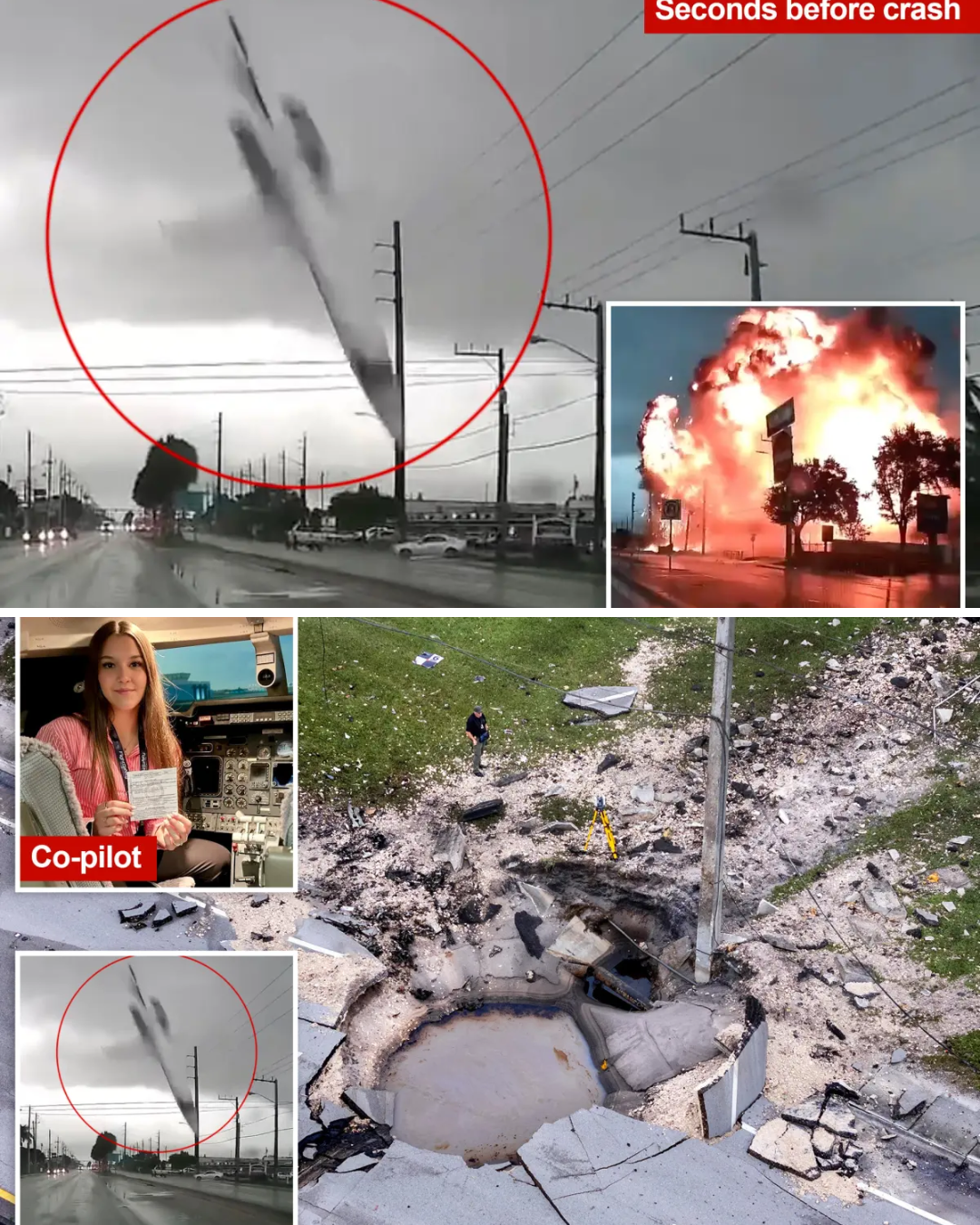
A Learjet 60 plunged into a Florida roadway after encountering severe weather conditions, killing all nine people aboard. Now, investigators are working to uncover what happened during the aircraft’s final moments.
A devastating private jet crash in South Florida has left nine families grieving and investigators facing a series of unanswered questions.
The Learjet 60 went down in Palm Beach County on Sunday, November 1, 2026, shortly after departing Austin, Texas, for North Eleuthera in the Bahamas.
The aircraft crashed in the Greenacres area, near West Palm Beach, creating a massive crater in a roadway and erupting into a fireball.
All nine people aboard — two crew members and seven passengers — lost their lives.
As investigators from the National Transportation Safety Board (NTSB) continue examining the wreckage, new discoveries have raised further questions about what happened before the aircraft struck the ground.
Among the most significant developments was the discovery of a major section of the jet’s tail several miles from the crash site.
Here are four critical questions investigators are still trying to answer.
 1. WHY DID A MAJOR PART OF THE AIRCRAFT’S TAIL BREAK AWAY?
One of the most significant discoveries came when investigators located a large portion of the aircraft’s left elevator — a component of the tail that helps control the plane’s pitch, or the movement of its nose up and down.
According to NTSB member Tom Chapman, the component was recovered in three pieces scattered between approximately 1.3 and 3.8 miles from the main crash site.
The discovery suggests that at least some parts of the aircraft separated while the jet was still in the air.
However, investigators have not determined whether the elevator’s separation contributed to the loss of control or whether it broke away because of the enormous forces acting on the aircraft during its rapid descent.
Former NTSB member John Goglia discussed the possibility that an attempt to pull the aircraft out of its descent could have placed extreme stress on its tail section.
For now, investigators are examining the recovered components to determine the sequence of events.
 2. WHERE IS THE COCKPIT VOICE RECORDER?
Another major question concerns the aircraft’s cockpit voice recorder, commonly referred to as a black box.
Maintenance records indicate that a cockpit voice recorder had been installed on the Learjet.
However, investigators have not confirmed whether it was still aboard the aircraft during its final flight or whether it survived the impact.
The recording could provide valuable information about the pilots’ conversations, their understanding of the developing emergency and the actions they attempted to take.
It could also help investigators establish exactly when the situation began to deteriorate.
Although recovering the recorder would be extremely valuable, officials have emphasized that the investigation can continue even if it cannot be found.
Investigators will also rely on radar information, air traffic control communications, weather data, aircraft components and eyewitness recordings.
3. DID THE AIRCRAFT ENTER THE DANGEROUS ‘COFFIN CORNER’?
Weather conditions are emerging as another major focus of the investigation.
Before the crash, the flight crew reported moderate turbulence and ice forming on the aircraft.
According to preliminary information presented by the NTSB, the pilots were flying at approximately 35,000 feet when they reported that turbulence was causing altitude fluctuations of around 700 feet.
The crew subsequently requested permission to climb to 37,000 feet, and air traffic control approved the request.
Less than 30 seconds later, the aircraft began descending rapidly.
One of the transmissions indicated that the jet was experiencing an overspeed condition.
Aviation experts have raised the possibility that the aircraft may have encountered a dangerous aerodynamic situation known as “coffin corner.”
This occurs at high altitudes when an aircraft’s minimum safe speed and maximum allowable speed become very close to one another, leaving pilots with an extremely narrow margin for safe operation.
Severe turbulence, icing and rapidly changing weather can make an already difficult situation more challenging.
However, this remains a theory, not an established explanation for the crash.
Investigators still need to determine the aircraft’s precise speed, altitude, flight-control conditions and the weather it encountered.
4. WHY DID THE CREW CONTINUE TOWARD THE STORM?
Perhaps one of the most troubling questions is why the aircraft encountered the dangerous weather conditions in the first place.
Reports indicate that the pilots had been navigating around a larger storm system before the crash.
However, the Learjet appears to have encountered another rapidly developing storm cell.
Veteran pilot Justin Crabbe questioned why the crew did not avoid the developing weather more effectively, particularly when air traffic control had reportedly approved a route adjustment.
He also raised the possibility that operational pressures or a desire to reach the destination may have influenced decision-making.
But investigators have not established whether the crew had sufficient information about the storm, what their onboard weather radar displayed or what options were available to them at the time.
No official conclusion has been reached about whether the weather, aircraft systems, maintenance or another factor played a decisive role.
THE FINAL MOMENTS: A FLIGHT THAT TURNED INTO AN EMERGENCY
The Learjet 60, operated by Aurora Aviation under the Upper Jets business name, departed Austin-Bergstrom International Airport at approximately 10:37 a.m. Eastern Time on November 1.
Its destination was North Eleuthera in the Bahamas.
At approximately 12:47 p.m., the crew reported moderate turbulence and light clear icing to air traffic controllers.
The aircraft was experiencing altitude deviations of approximately 700 feet, according to information released by the NTSB.
The pilots requested permission to climb from 35,000 to 37,000 feet.
The request was approved.
But less than half a minute later, the aircraft transmitted that it was descending and experiencing an overspeed condition.
A Mayday emergency call followed.
The jet then entered an extremely rapid descent, eventually striking the ground near Military Trail in Greenacres.
The impact was so powerful that it created a large crater in the roadway and scattered aircraft debris across a wide area.
Authorities confirmed that all nine people aboard had died.
One person in a vehicle near the crash site sustained a leg injury.
A FAMILY OF FOUR AMONG THE NINE VICTIMS
The tragedy also claimed the lives of an entire family traveling together.
According to relatives, Austin entrepreneur Adam Robinson and his wife, Helen Sharp, were aboard the aircraft with their two young children, Emma, 4, and Charlie, 2.
Their children’s caregiver, Anita Maria Cetina, was also among the passengers.
Two family friends, Rachael Reed and Charmi Fehr, were also reported among those killed.
The aircraft’s crew included pilot Jeff Gregory and co-pilot Nathalia Gadelha Filgueiras.
The loss of the family, including two very young children, has added another heartbreaking dimension to an already devastating aviation disaster.
WHAT HAPPENS NEXT?
The NTSB is continuing its investigation, collecting aircraft fragments and examining the components recovered away from the main impact site.
Investigators are also searching for the cockpit voice recorder and reviewing communications between the crew and air traffic controllers.
Weather information, radar data, maintenance records, operational procedures and eyewitness videos will all be examined.
The agency expects to release a preliminary report approximately 30 days after the crash.
However, that report will primarily present established facts rather than identify the cause.
A full investigation typically takes between 12 and 18 months, and complex cases can take even longer.
The final report will explain the NTSB’s findings and identify the probable cause, along with any recommendations intended to prevent similar accidents.
For now, the most important questions remain unanswered.
Why did the aircraft lose control? What caused parts of its tail to separate in midair? Could the cockpit recorder reveal what happened inside the cabin? And was the developing storm a decisive factor?
Until investigators complete their work, the precise circumstances behind the Florida tragedy remain unknown.
Nine lives were lost in a matter of moments. Now, investigators are working to piece together the final minutes of a flight that ended in catastrophe.