“SHE WAS SMALL, BUT HER IMPACT WAS ENORMOUS…” — MILLIONS MOURN BELOVED HIPPO FIONA AFTER HER HEARTBREAKING DEATH AT JUST 9
“SHE WAS SMALL, BUT HER IMPACT WAS ENORMOUS…” — MILLIONS MOURN BELOVED HIPPO FIONA AFTER HER HEARTBREAKING DEATH AT JUST 9
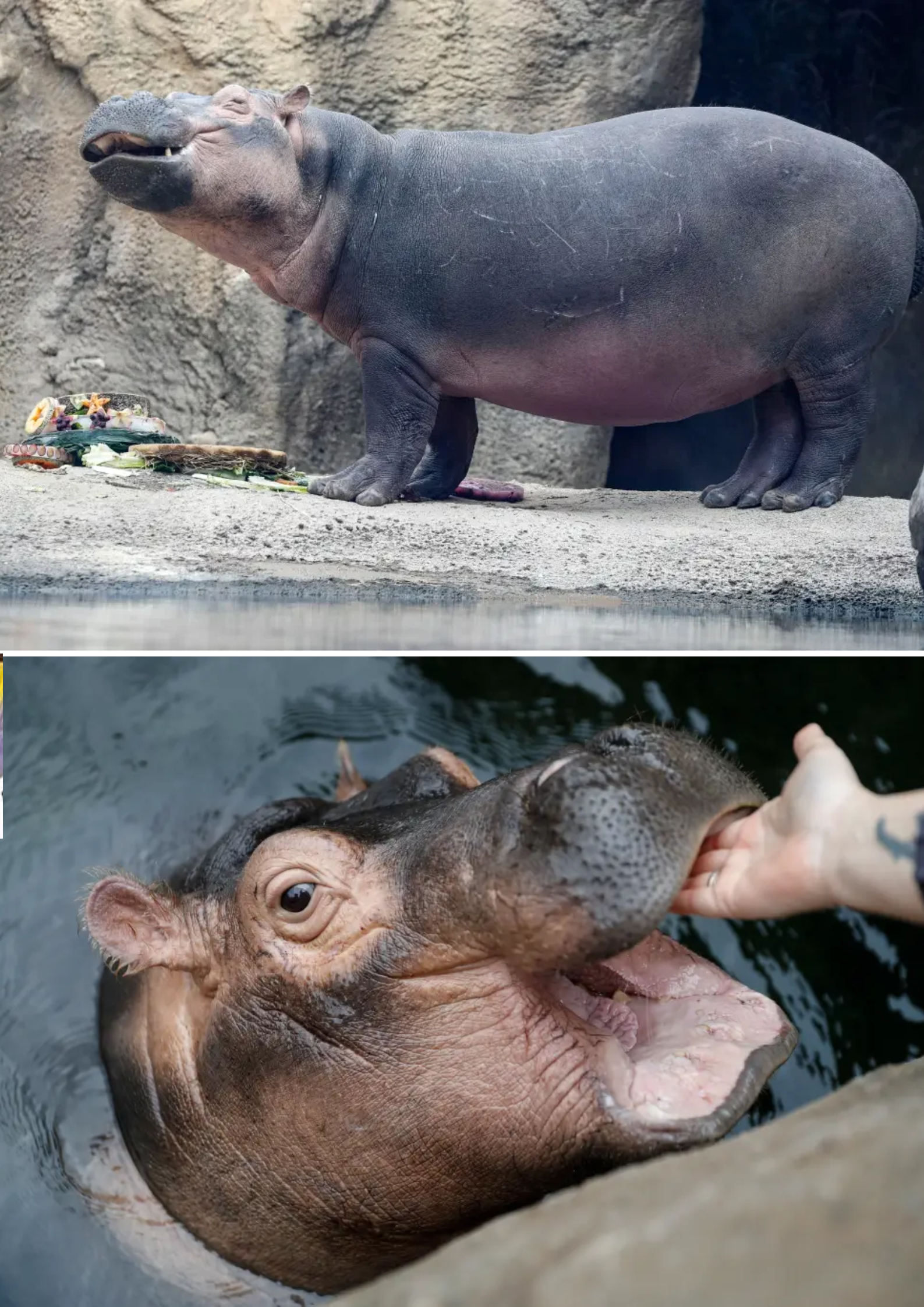
She entered the world six weeks too early, weighing just 29 pounds, and doctors were uncertain whether she would survive. But Fiona the hippo defied the odds, grew into a worldwide sensation and brought happiness to millions. Now, her heartbreaking death at the Cincinnati Zoo has left animal lovers grieving a remarkable life that ended far too soon.
The Cincinnati Zoo & Botanical Garden is mourning the loss of one of its most beloved residents after Fiona, the famous Nile hippopotamus, died on November 19, 2026.
She was just nine years old and would have celebrated her tenth birthday in January.
For nearly a decade, people around the world had followed her extraordinary journey — from a dangerously premature newborn to a healthy, playful hippo who became an international symbol of hope.
Her story inspired children’s books, attracted millions of online followers and made her one of the most recognizable animals in the United States.
But the news of her death came as a devastating shock.
Fiona died after swallowing a visitor’s knitted hat that accidentally entered her enclosure. Despite an extraordinary effort by the zoo’s veterinary and animal-care teams, the object became lodged deep inside her digestive system, and she could not be saved.
The loss has brought an outpouring of tributes from visitors, fans, public figures and people who had followed her life since the beginning.
 BORN SIX WEEKS PREMATURE — A TINY BABY WITH AN UNCERTAIN FUTURE
Fiona was born on January 24, 2017, at the Cincinnati Zoo.
Her arrival was far from ordinary.
She was born approximately six weeks prematurely and weighed only 29 pounds — dramatically smaller than a typical newborn hippo, which generally weighs considerably more.
She was so fragile that she initially struggled to stand and nurse from her mother, Bibi.
Her survival required intensive care.
Zoo keepers and veterinary professionals worked around the clock to monitor her condition, provide nutrition, keep her warm and help her develop the strength she needed.
Medical professionals from Cincinnati Children’s Hospital Medical Center also assisted with her early treatment.
The zoo began sharing updates, photographs and videos documenting her progress.
Soon, people from across the United States and around the world were following every development.
Each milestone brought excitement. Every improvement felt like a victory.
Fiona’s story became much bigger than the life of one baby animal. For many families, she represented determination, resilience and the possibility of overcoming seemingly impossible odds.
 FROM A FRAGILE NEWBORN TO A GLOBAL CELEBRITY
As Fiona grew stronger, she gradually learned to swim, became more independent and eventually reunited with her mother.
Her personality and playful moments quickly made her a favorite among visitors.
Her popularity extended far beyond the zoo.
Millions watched her videos online, celebrated her birthdays and followed her development through regular updates from her keepers.
She inspired children’s books, toys, clothing and countless fan creations.
The Cincinnati Zoo also used her popularity to introduce people to hippopotamuses and encourage interest in wildlife.
Fiona became a symbol of Cincinnati itself, bringing attention to the zoo and creating a connection between people and an animal they might otherwise never have encountered.
For the staff who raised her, however, she was more than an internet sensation.
She was an animal they had cared for since the first fragile days of her life.
THE ACCIDENT THAT CHANGED EVERYTHING
The tragedy began on November 8, 2026.
According to the Cincinnati Zoo, a visitor accidentally caused a knitted hat to enter Fiona’s habitat.
The hat was reportedly tossed into the air by a visitor. It became caught in an overhead ceiling fan, which propelled it through an opening above the viewing windows and into the hippo enclosure.
Fiona swallowed the hat.
Initially, she did not show obvious signs of distress.
However, several days later, her appetite began to decline, raising concerns among her keepers.
Veterinarians began monitoring her closely and introduced supportive treatment in an effort to help her pass the foreign object naturally.
The team provided fluids, conducted examinations and attempted procedures to locate the hat.
They also tried an unusual approach: using a vibration plate borrowed from a horse farm in the hope that the movement might help the object travel through her digestive system.
Her favorite foods and treats were also used during the efforts to encourage her appetite.
The team consulted specialists and continued searching for a way to help her.
But the situation became increasingly serious.
On November 19, the Cincinnati Zoo announced that Fiona had died despite the team’s efforts.
Zoo Director Dave Jenike said:
“We are in shock at the moment. We did not expect this outcome. She fought until she couldn’t anymore.”
THE POST-MORTEM EXAMINATION REVEALED WHY FIONA COULD NOT BE SAVED
The following day, the zoo released the findings of Fiona’s necropsy — the animal equivalent of a post-mortem examination.
The results revealed that the knitted hat had become lodged in the middle of her small intestine.
It was approximately 25 feet beyond the final compartment of her stomach and around 50 feet from the end of her intestinal tract.
Its location made removal extraordinarily difficult.
Veterinarians attempted both upper and lower gastrointestinal endoscopy, but neither procedure could reach the object.
According to Dr. Mike Wenninger, the zoo’s director of animal health, laparoscopic surgery was not possible because of the hat’s location and Fiona’s anatomy.
An open abdominal operation would have required an extremely large incision and carried a potentially fatal risk.
The veterinary team therefore continued supportive care, hoping her body could overcome the obstruction.
Unfortunately, the examination confirmed that the hat could not have been safely removed through the available procedures.
Dr. Wenninger explained that no treatment beyond supportive care could have succeeded.
The zoo emphasized that its veterinary and animal-care teams had done everything possible to save her.
A HEARTBROKEN COMMUNITY LEAVES FLOWERS AND MESSAGES
Following the announcement, visitors began arriving at the Cincinnati Zoo to pay their respects.
Flowers, handwritten cards, drawings, photographs and even watermelons — one of Fiona’s favorite treats — appeared near a hippo statue outside the zoo entrance.
Some visitors came with their children. Others brought personal messages explaining what Fiona had meant to their families.
The sadness was not limited to the zoo.
Several landmarks across Cincinnati, including stadiums, bridges and buildings, were illuminated in purple in her honor on the evening of November 19.
Zoo Director Dave Jenike said the response from the public had been overwhelming.
He reflected on how the worldwide support reminded him of the way people had united to cheer Fiona on when she was born prematurely.
She survived those early struggles and gave people almost a decade of smiles.
The zoo also held a private memorial for the staff members, keepers, veterinarians and volunteers who had cared for her.
HOW ARE FIONA’S MOTHER AND BROTHER DOING?
Fiona’s death also raised concerns about the other hippos at the Cincinnati Zoo.
She is survived by her mother, Bibi, her younger half-brother, Fritz, and Tucker, the adult male hippo.
The zoo temporarily closed the area around Hippo Cove to give the animal-care team time and space following the loss.
It reopened on November 23, with Bibi, Fritz and Tucker returning to public view.
Zoo officials reported that the three hippos were eating and behaving normally.
The habitat also received additional safety modifications.
The zoo removed the overhead ceiling fans and installed netting above the viewing windows to help prevent objects from accidentally entering the enclosure.
Visitors are reminded never to throw anything into an animal habitat and to alert staff immediately if an object falls inside.
CINCINNATI ZOO PLANS A PERMANENT MEMORIAL
On November 24, the Cincinnati Zoo shared an update about plans to honor Fiona.
Zoo Director Dave Jenike said the team was considering a permanent physical memorial, most likely a statue.
The zoo’s hippo-care team is expected to be involved in the process, and officials are also exploring opportunities for the public to gather and remember her.
The zoo has also encouraged people to honor Fiona by spreading kindness and happiness rather than sending material gifts.
Memorial donations can help support the zoo’s ongoing animal-care work.
A week after her death, the zoo continued sharing memories and thanking supporters for the kindness shown to its staff.
The outpouring of affection has demonstrated just how deeply one animal’s life can touch people across generations and continents.
A LIFE THAT WILL NEVER BE FORGOTTEN
Fiona’s journey was filled with extraordinary moments.
She began life as a tiny, fragile newborn whose chances of survival were uncertain.
She grew stronger, learned to swim, reunited with her mother and became one of the most beloved animals in the world.
Her story brought smiles to millions and reminded people of the importance of compassion toward animals.
Her death was heartbreaking, particularly because it followed an accident that the zoo says its team could not overcome despite extensive medical efforts.
But the memories remain.
The photographs of her first days, the videos of her playful moments, the birthday celebrations and the countless messages from people who loved watching her grow will continue to tell her story.
Fiona may have lived only nine years, but her impact reached far beyond her habitat.
She was small when she entered the world, but the love she inspired became enormous.
Rest peacefully, Fiona. You will always be remembered. 💜🦛