“Four Frames Of A Farewell That Broke The World’s Heart”
“Four Frames Of A Farewell That Broke The World’s Heart”
The burial of Chuck Norris — seen from every angle, felt from every direction, remembered from every corner of a generation that grew up in his shadow and was better for it
Some moments are too large for a single photograph.
Some farewells contain so much — so many people, so many layers of meaning, so many simultaneous truths happening at the same time in the same sacred ground — that the camera must circle them. Must approach from different distances and different angles. Must gather the fragments and hold them together in a grid, a mosaic, a portrait assembled from multiple perspectives because no single perspective is sufficient.
This is one of those moments.
Four frames. One farewell. The burial of Chuck Norris — Carlos Ray Norris. 1940 — 2026 — seen from the crowd and from the graveside and from behind the wreath and from above, from the impossible aerial view that shows what the individual mourner cannot see: the complete shape of a love so large it has organized itself into a circle around one man’s grave, holding him at the center where he always belonged.
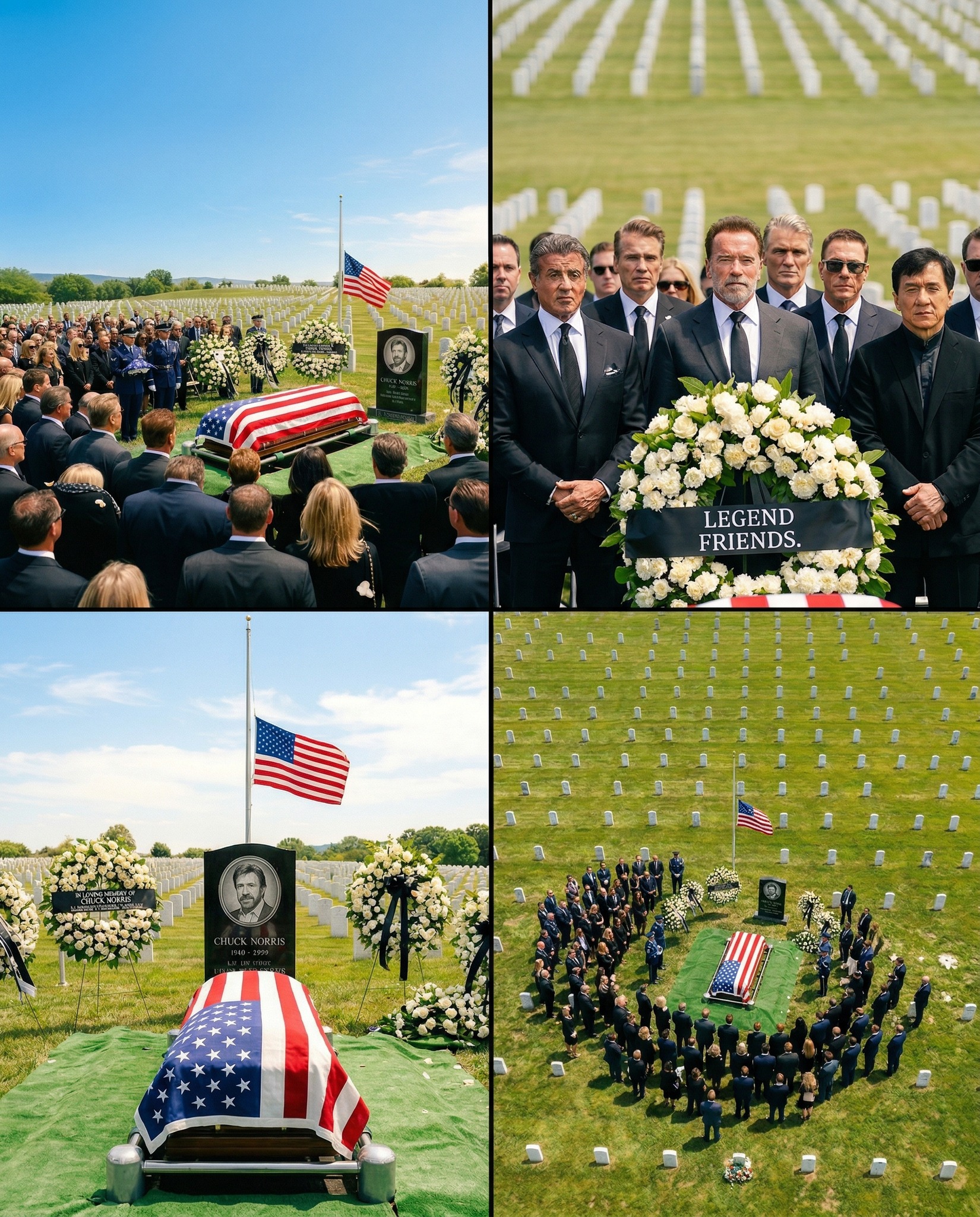
Frame One: The World Comes To Stand With Him
Pull back far enough and this is what grief looks like from a distance.
A flag at half-mast cutting the perfect blue sky in half — the top half still and endless and impossible to look at directly, the bottom half containing everything that matters. The rows of white headstones stretching away in every direction like the organized memory of every sacrifice this ground has ever received. The gathered crowd, dark-suited against the green of Arlington’s impeccable grass, turned toward a casket draped in the red and white and blue of a country saying goodbye to one of its most genuine servants.
From this distance you cannot see faces. You see only shapes — the collective shape of hundreds of people who chose to be here, who made the arrangements and traveled the distances and stood in the summer heat because the alternative — staying away, letting this day pass unmarked in their own lives — was simply not something they could do.
Chuck Norris meant something to every person in this frame. Not the same thing — he never meant the same thing to any two people, because great men are like great stories, yielding different truths to different readers while remaining completely and consistently themselves. But something real. Something that required their physical presence on this particular morning in this particular ground.
The white flowers wreath his headstone in a crown of mourning. Already his name is carved in the stone. Already the permanent record has been made.
Chuck Norris.
The headstone does not say legend or warrior or champion. It says his name. Because his name, alone, is sufficient. It always was.
The flag at half-mast speaks for everything else.
Frame Two: “Legend. Friends.”
In the upper right corner of this grief, four men stand behind a wreath.
The wreath is white — white roses and white lilies in the abundance of people who needed to give something and chose the most honest thing available. And across its ribbon, two words that contain everything:
LEGEND. FRIENDS.
Not legend and friends — not a hierarchy that places one above the other. Just the two words side by side, equal, inseparable. Because for the men standing behind this wreath, the two things were always the same. Chuck Norris was a legend because of how he was a friend. He was the kind of friend he was because of the values that made him a legend. The public man and the private man were identical, and this wreath, with its two-word inscription, understands that completely.
Sylvester Stallone stands at the center.
His face, behind the dark glasses that are doing their limited best to contain what is happening behind them, carries the specific expression of a man who is holding himself together through sheer force of the will that has carried him through every hard thing his remarkable life has thrown at him. Rocky never gave up. Barney Ross never surrendered. And Sylvester Stallone, who created both of them from the raw material of his own experience and philosophy, is not going to collapse today.
But the cost of not collapsing is visible. It lives in the set of his jaw and the particular stillness of his hands and the way he is standing slightly more rigidly than he would stand in any other context — the body’s response to the mind’s instruction to hold.
Arnold Schwarzenegger beside him. Jackie Chan on the right. And another brother in the darkness between them — the architecture of a friendship that spanned decades and continents and the full range of what it means to be human together.
They hold the wreath.
The wreath holds the words.
The words hold the truth.
Legend. Friends.
It is enough. It is everything.
Frame Three: The Headstone Stands Alone With Him
Pull back to a middle distance and find the frame that contains only what is essential.
The headstone. The casket. The flag. The flowers.
No crowd. No ceremony. No human presence to mediate between the viewer and the stark, simple, completely honest fact of what this is.
A man is being buried.
His name is on the stone. His face, carved or placed there in the portrait that marks him for eternity, looks out across Arlington with the expression that people who loved him will carry in their memories for the rest of their lives — the expression that was his default setting, his resting face, the face he wore when he was simply himself and not performing anything for anyone.
Calm. Present. Slightly warm. Completely real.
The flag at half-mast behind the headstone creates a visual that needs no caption and no explanation. The most recognizable symbol of American sacrifice, lowered to the position of mourning, directly above the name of a man who spent his entire life in service to what that flag represents.
It is a composition that history made without knowing it was making it. A alignment of objects and meaning so complete that it feels inevitable — as if this image existed before the moment it documents, waiting for reality to catch up.
The white flowers surrounding the headstone are extravagant in their abundance. People gave and gave and kept giving because there was no other outlet for what they felt. Flowers were the only physical language available and they used it until the headstone was crowned and surrounded and almost overwhelmed by the sheer volume of what people needed to express.
Love. That is what the flowers say.
Only love.
Vast, ungovernable, completely sincere love for a man who earned it one day at a time for eighty-five years.
Frame Four: The Circle From Above
And then — the view from above.
This is the frame that breaks you. Not because it is the saddest — though it carries its own devastating weight — but because it shows you something the other three frames cannot: the shape of the love.
From above, from the aerial distance that transforms individual grief into collective geometry, the people gathered at Chuck Norris’s grave have organized themselves into a circle.
Not deliberately. Not because anyone directed them to stand this way. But because circles are what humans make when they gather around something precious — when they need to protect something or honor something or simply be together around something that matters more than their individual separateness.
The circle. The oldest human formation. The one that says: we close around this. We hold it at our center. We do not let it be alone.
At the center of the circle: the flag-draped casket. The headstone bearing his name. The wreaths of white flowers. The honor guard in their precise formation, doing what honor guards do — standing watch, holding the ceremony together, making sure that every second of this farewell is given the dignity it deserves.
And around them: the people. Dozens of them, forming the circle that says what words cannot.
You are surrounded by love.
You have always been surrounded by love.
You will always be surrounded by love.
We hold you here at our center.
We will not let you be forgotten.
We will not let you be alone.
The flag at half-mast rises at the edge of the frame, the only vertical line in a composition of circles and rows and the careful geometry of a nation’s most sacred ground.
The rows of white headstones march away in every direction — the permanent community that Chuck Norris is joining, the brotherhood of service that was always his deepest identity beneath everything else he was.
From above, Arlington looks like what it is: a garden of sacrifice. Carefully tended, deliberately preserved, holding within its green and white geometry the permanent record of the people who served.
Chuck Norris has taken his place in the record.
Four frames.
One farewell.
The crowd that came from everywhere.
The friends who brought the wreath.
The headstone standing alone with him.
The circle from above.
Together they make the complete picture —
the picture that a single photograph could never hold,
that a single angle could never contain,
that a single moment could never fully capture.
The picture of a man being laid to rest
by a world that loved him
from every direction
at once.
Rest, Chuck.
The circle holds.