“The Last Roundhouse: Tom Cruise Stands in Silence for the Legend Who Never Fell”
“The Last Roundhouse: Tom Cruise Stands in Silence for the Legend Who Never Fell”
At the funeral of Chuck Norris — the man the world believed was immortal — a fellow warrior comes to say the goodbye that no one ever thought they would have to say
There are deaths that the world is prepared for. The long illness announced in advance, the age that makes the loss expected if not easier, the quiet departure of someone who had already, gradually, stepped back from the world’s attention. These deaths are still grief. But they arrive with a kind of gentle warning — a hand on the shoulder before the blow, a moment to brace.
And then there are deaths that feel like a fundamental violation of the natural order. Deaths that the world — not through naivety, but through the sheer force of a legend so large that mortality seemed to have made a special exemption — genuinely did not see coming. Deaths that land not like a loss but like a revision of reality itself.
Chuck Norris dying is that kind of death.
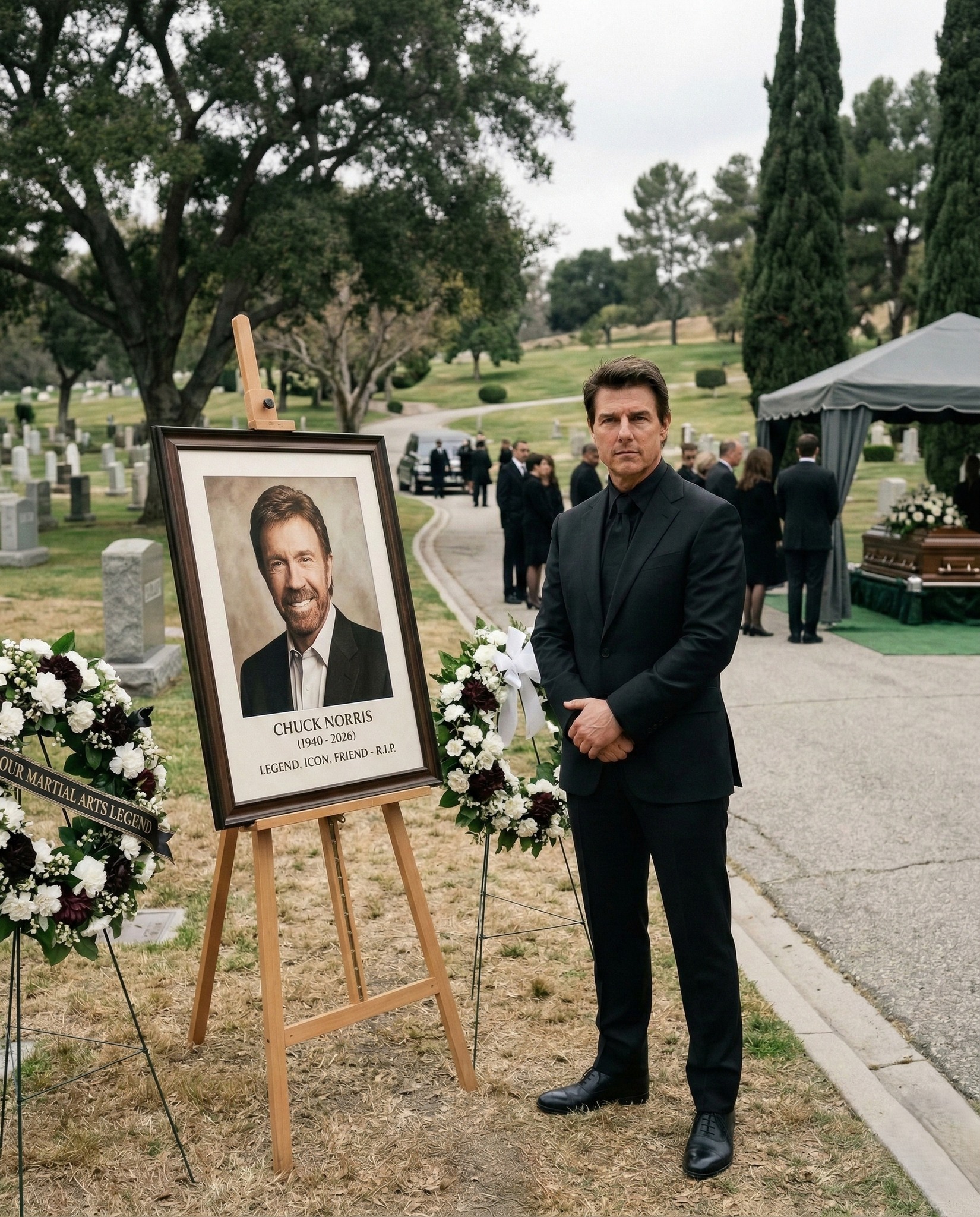
And Tom Cruise, standing alone beside a portrait in a cemetery, dressed in black, hands clasped, face carrying the particular stillness of a man who has not yet fully processed what he is looking at — this photograph is the world’s grief made visible. One legend, standing at the threshold of another legend’s departure. One man who has spent his entire career refusing to accept the limits of the physically possible, paying his respects to the man who defined that refusal for an entire generation before him.
The Portrait on the Easel
Look first at the portrait. Let it hold you for a moment before anything else.
Chuck Norris. That face — broad, warm, carrying in the set of the jaw and the ease of the smile the complete self-possession of a man who has never needed to prove anything to anyone because he proved it long ago and the record stands permanently. The eyes carry what they always carried: a directness that is not aggression but the simple, steady confidence of someone who knows exactly who he is and has no anxiety about whether you approve.
The inscription beneath the portrait:
CHUCK NORRIS
1940 – 2026
Legend. Icon. Friend.
R.I.P.
He was eighty-five years old. In any other context, eighty-five is a long life, a full life, a life that arrived at its natural conclusion with the quiet dignity of completion. And in the factual sense, this is true. Chuck Norris lived eighty-five years and filled them with more living than most people could manage in several lifetimes.
But Chuck Norris was not any other context. Chuck Norris was the man about whom the internet, years ago, constructed an entire mythology of invincibility — jokes that were jokes but also, somewhere beneath the comedy, expressions of something genuine. The sense that this particular person, this particular force of nature, had achieved through discipline and will and the specific, unnameable quality of his presence a kind of permanence that ordinary human beings do not get to have.
Chuck Norris doesn’t do push-ups. He pushes the earth down.
The jokes were jokes. But underneath them was real admiration, real awe, the real feeling of a world that had looked at one man and decided, by consensus, that he represented something beyond the ordinary reach of human capability.
And now he is in a portrait on an easel in a cemetery, surrounded by white flowers, and Tom Cruise is standing beside him in black.
The Wreath That Speaks
Look at the wreath to the left of the portrait. A ribbon runs across it bearing the words: MARTIAL ARTS LEGEND.
Three words that contain an entire universe of sacrifice and dedication and the specific, lifelong devotion that genuine mastery requires. Chuck Norris did not become a martial arts champion by accident or talent alone. He became one through the kind of work that most people encounter in motivational quotes and then set aside, because the actual daily practice of it is harder and lonelier and more demanding than the quotes suggest.
He served in the United States Air Force. He began studying Tang Soo Do in Korea during his service. He returned to America and continued training — not as a hobby, not as a career strategy, but as a vocation, a way of understanding himself and the world through the discipline of the body. He became a six-time undefeated middleweight karate champion. He trained alongside Bruce Lee. He competed, he taught, he built a martial arts system — Chun Kuk Do — that carried his philosophy of discipline and integrity into the lives of thousands of students.
And then Hollywood found him. Or rather — Hollywood was the next arena, and he approached it the way he approached every arena, with the same fundamental seriousness and commitment that had served him in every room he had ever walked into.
Walker, Texas Ranger. Missing in Action. Code of Silence. A filmography built on the same values that built the man: strength, justice, the refusal to stand aside when wrong is being done, the willingness to absorb punishment in the service of something worth protecting.
He was not a sophisticated actor in the technical sense. He was something rarer: a performer whose authenticity was so complete that it made technique irrelevant. You believed him because he was simply, totally, incapably himself in every frame he occupied. And that self was worth believing in.
Tom Cruise — The Man Who Came
Now look at the man standing beside the portrait.
He is in black from collar to shoe — not the theatrical mourning of someone performing grief for an audience, but the simple, direct statement of a man who has come to a funeral and dressed for it with the respect the occasion demands. His hands are clasped in front of him. His posture is upright but not stiff — the uprightness of genuine presence rather than self-consciousness.
His face is what the photograph is really about.
Tom Cruise is one of the last of his kind — a movie star in the classical sense, a performer who has maintained, through decades of the most sustained creative discipline in modern Hollywood, the ability to command a screen through sheer force of committed presence. He does his own stunts not as a publicity strategy but as a philosophical statement: I will not ask the audience to believe what I am not willing to actually do.
In that commitment — that absolute, sometimes reckless, utterly sincere commitment to giving the audience the real thing — he is the direct heir of everything Chuck Norris represented. The belief that physical performance is a form of honesty. That the body is not a tool of illusion but a medium of truth. That showing up fully, risking actually, matters in a way that safety and comfort cannot replicate.
He is standing here because of what Chuck Norris meant — not just to him personally, but to the entire tradition of physical performance that both men have devoted their careers to. He is standing here as a representative of everyone who learned, from watching Norris move through a world that kept sending opponents against him and kept watching them fall, that the body trained with sufficient dedication becomes something that transcends its own limitations.
He is standing here because he loved him. Whatever the specific shape of their relationship, whatever conversations they had or did not have, whatever professional paths crossed and did not — he is here because Chuck Norris mattered to him in the way that pioneers matter to those who follow the paths they cleared.
His face carries something that Tom Cruise’s face does not often carry publicly: stillness. Not the stillness of detachment, but the stillness of a man who is fully, completely present in a moment he wishes were not happening, who is absorbing the reality of it without flinching because flinching would be a kind of disrespect.
He is doing what warriors do at the funerals of warriors. He is bearing witness.
The Casket in the Background
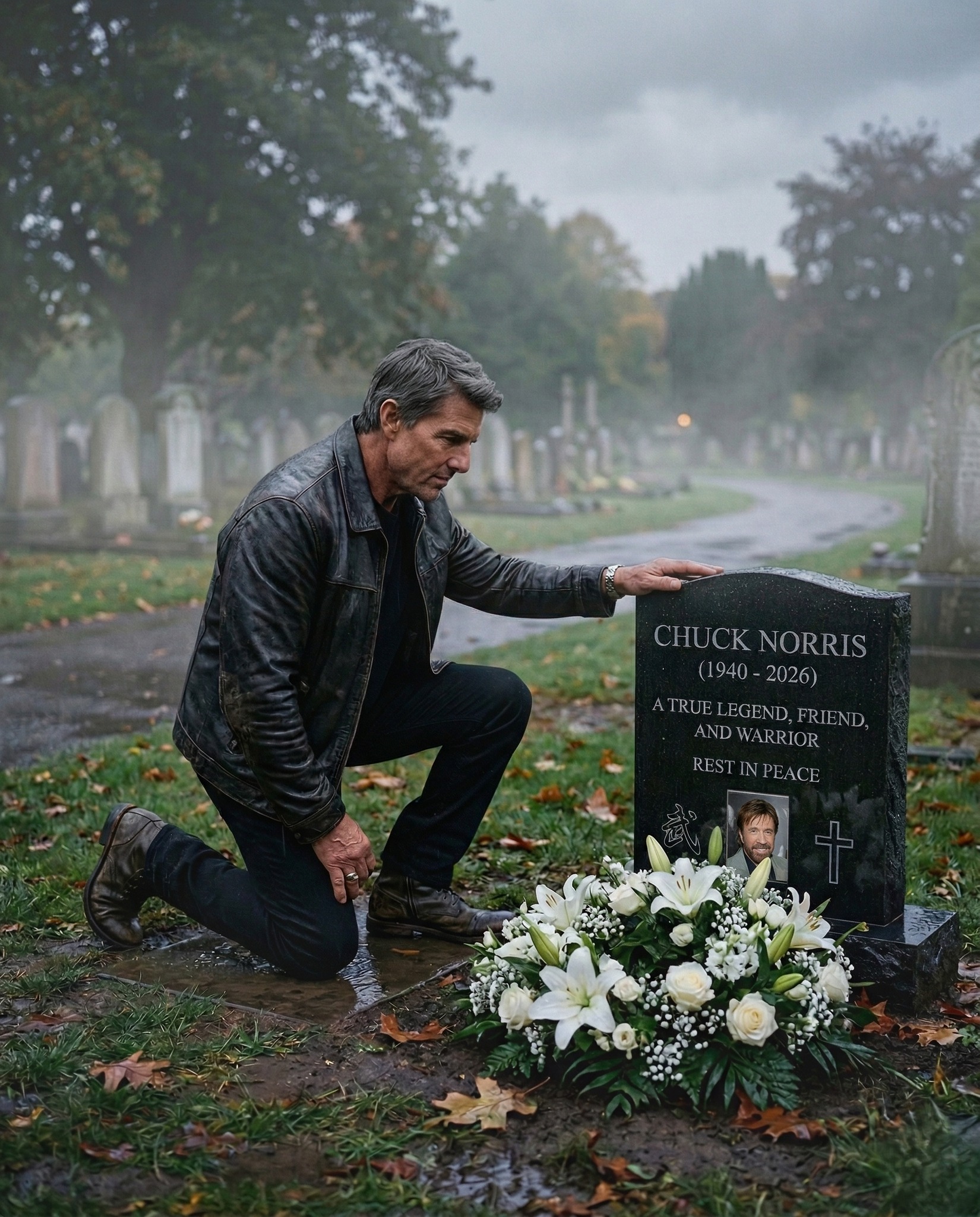
Behind Tom Cruise, slightly out of focus, barely visible at the edge of the frame — the casket. Dark wood, surrounded by mourners in black, sheltered under a grey sky that seems to have arranged itself appropriately for the occasion.
A casket is the most direct object in the world. It does not equivocate. It does not soften the truth or offer consolation or speak of anything beyond what it is: the container of an ending. Whatever metaphysics you hold, whatever you believe about what happens after — the casket is the factual, physical statement that the body is here and will not be going anywhere under its own power again.
Chuck Norris’s body is in that casket.
The man who could not be defeated, who absorbed every blow the world delivered and kept moving forward, who became — across eight and a half decades of relentless forward motion — the living proof that will is stronger than circumstance, that discipline transforms the ordinary into the extraordinary, that the body trained and tended and pushed beyond its apparent limits is capable of things that appear, from the outside, like miracles.
That body is at rest now. The training is finished. The arena is quiet.
What Chuck Norris Gave the World
He gave the world a vision of strength that was not cruel. This matters more than it might seem. In an era — the 1970s, 1980s — when cinematic masculinity was frequently being rewritten toward the brutal and the nihilistic, Chuck Norris offered something different: strength in service of something. Not strength as dominance, not strength as the right to take what you want, but strength as protection. As justice. As the capacity to stand between the vulnerable and those who would harm them.
Walker, Texas Ranger was a weekly argument for that kind of strength — patient, principled, capable of tremendous force but governed by something deeper than force. Walker fought when fighting was necessary and stopped when it was not. Walker was loyal and honest and unglamorous in his goodness, the kind of man who did what was right because it was right rather than because anyone was watching.
This was Chuck Norris’s gift to the audience that loved him. Not invincibility — not really — but a model. A shape for what strength could be when it was rooted in integrity rather than ego.
The Last Roundhouse
The roundhouse kick was his signature. The move that ended fights in film after film, that became so associated with him that his name and the move became interchangeable in the cultural vocabulary. The sudden pivot, the coiled power, the decisive arc — and then stillness. The opponent falling. The fight finished.
He has thrown his last roundhouse now.
But the arc of that kick — the shape it traced through the air across eight decades of a life lived at full commitment — does not disappear when the man who threw it is gone. It persists in the memory of everyone who watched it. It persists in every martial arts school that bears his influence. It persists in the discipline of every student who was told, somewhere along their training, that commitment matters more than talent and will matters more than circumstance.
Tom Cruise knows this. He is standing in a cemetery in black, hands clasped, face still, bearing witness to an ending that is also a permanence. The body in the casket. The legend on the portrait. And between them, the vast, irreducible evidence of a life that happened fully and left the world permanently different for having happened.
A Final Word
Chuck Norris. 1940–2026.
Legend. Icon. Friend.
The jokes were right about one thing: he was unlike anyone else. He was the genuine article — a man who built himself through discipline into something that the rest of us could only watch with a kind of reverent disbelief.
And Tom Cruise stands at the edge of his farewell, one warrior honoring another, carrying in his stillness everything that words in a moment like this cannot quite reach.
Rest, Walker.
The earth is at peace.
And you have more than earned yours.
“A lot of people give up just before they’re about to make it. You know you never know when that next obstacle is going to be the last one.”
— Chuck Norris
For Chuck Norris — who never gave up.
Not once. Not ever.
Until the very end.