The young Chuck Norris looked down one final time — and smiled at the country he spent his whole life defending
“He Watched From The Clouds As They Laid Him Down”
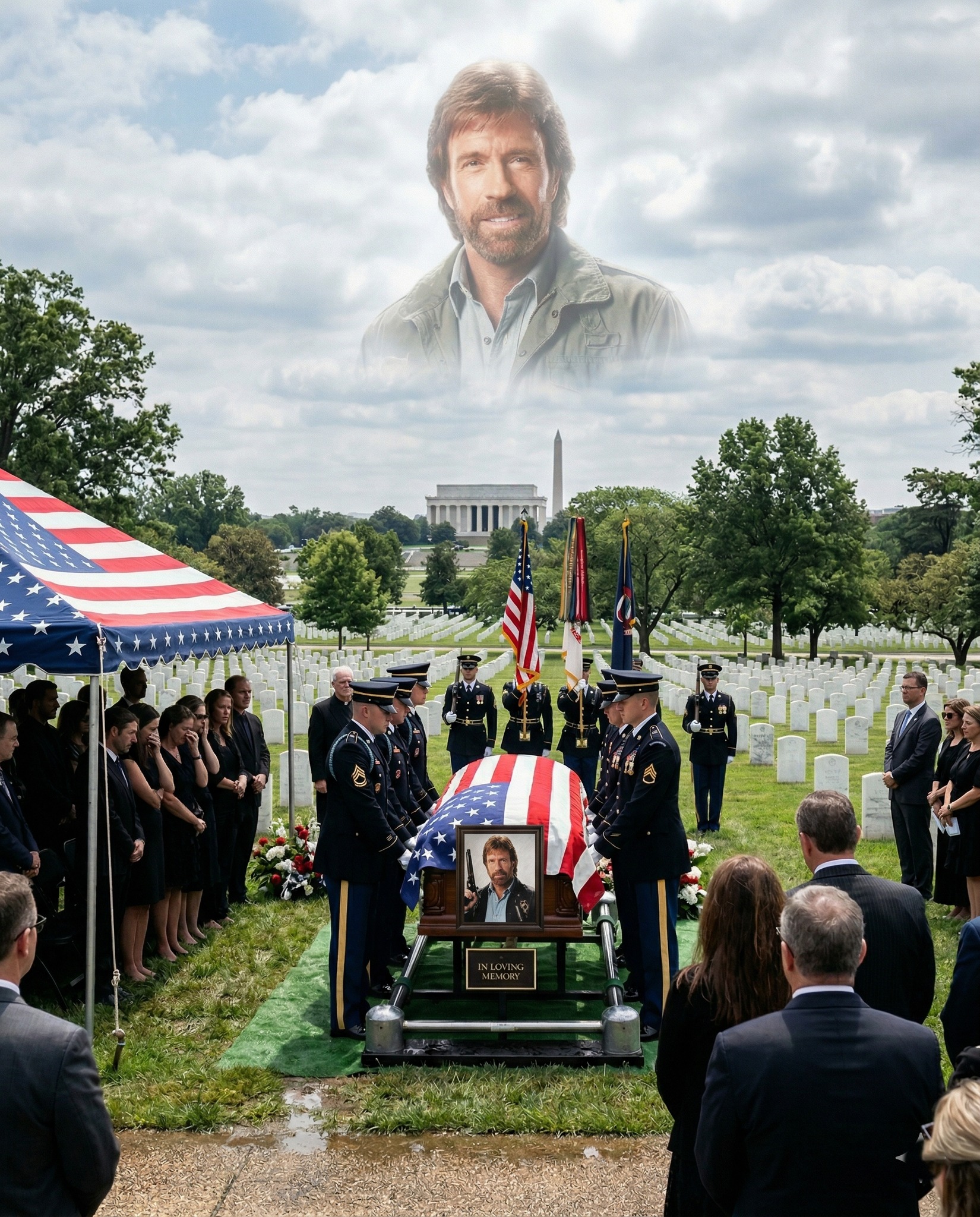
Above Arlington Cemetery, in the space between heaven and earth, the young Chuck Norris looked down one final time — and smiled at the country he spent his whole life defending
The clouds parted.
Not dramatically. Not with thunder or spectacle or any of the cinematic flourishes that his films had made so familiar. Quietly. The way real things happen — without announcement, without preparation, without giving you time to brace yourself for what you are about to feel.
And there he was.
Young. Impossibly, achingly young — the dark hair and the open face and those eyes that always carried something steady in them, something that belonged to a man who had already decided, at an age when most people are still deciding who they are, exactly what he believed and exactly how he intended to live.
Chuck Norris, looking down from the sky above Arlington National Cemetery.
Looking down at the flag-draped casket that carries what remains of the man he became. Looking down at the soldiers who stand at attention with the rigid, ceremonial precision of people who understand that some farewells demand perfection — that the man in this casket earned, through his service and his sacrifice and his eighty-five years of complete commitment to the country they all serve, nothing less than their absolute best.
Looking down at the family gathered beneath the tent. The people who loved him in the private way — not as a legend or a warrior or a cultural icon — but as a father, a husband, a man who came home every night and was simply, completely, present for the people his life was actually built around.
He looks at all of it.
And his expression — the expression of a young man who does not yet know what is coming, who does not yet know the championships or the films or the foundation or the decades of influence and impact — his expression is simply, completely at peace.
Arlington National Cemetery.
There is no ground in America more sacred. No grass more carefully tended, no silence more deliberately preserved, no geography more weighted with the accumulated sacrifice of people who chose, at the most consequential moment of their lives, to put something larger than themselves above their own comfort and safety and survival.
Row after row after row of white headstones stretch into the middle distance, each one a person, each person a story, each story a life given in service of an idea — the idea that this country, with all its imperfections and contradictions and the gap between its promises and its practices, was worth defending. Worth serving. Worth dying for.
Chuck Norris served in the United States Air Force.
He walked this ground as a young man in uniform, carrying the specific weight and pride of someone who has chosen service and means it completely. He understood, at a cellular level, what these rows of white stones represented — not abstractions, not statistics, but people. Specific, irreplaceable people who had stood where he stood and made the same choice he made and paid, in some cases, the full price that choice can demand.
He is coming home to them now.
And from the clouds above, the young man he was watches the man he became be laid to rest among the people he always considered his greatest brothers and sisters — not his fellow actors, not his fellow champions, but his fellow servants. The ones who wore the uniform and meant it.
The honor guard moves with the precision of something rehearsed ten thousand times and felt for the first time.
That is the particular genius of military ceremony — the way repetition and genuine emotion coexist without canceling each other out. These soldiers have folded flags before. They have carried caskets before. They have stood at attention at Arlington before, in the heat and the cold and the rain that falls without consulting anyone’s schedule or emotional readiness.
But this one is different.
They know it is different. You can see it in the extra fraction of a degree of precision in every movement, the slight additional intensity in every face. They are not performing grief — soldiers do not perform grief, they contain it, they channel it into the exactness of the ceremony, they honor the dead through the discipline of their own bodies.
But the discipline today has something behind it that ceremony alone cannot explain.
They knew who Chuck Norris was. Not just as a celebrity — as a soldier. As a man who wore the uniform and served with the same wholehearted commitment he brought to everything else. As one of their own, elevated to a public life that never made him forget where he came from and what it meant to be part of something larger than himself.
They fold his flag as if every crease matters infinitely.
Because it does.
The family sits beneath the tent.
This is the part of loss that the public never fully sees — the private interior of grief, the circle of people for whom the man in the casket was not a legend but a person. The person who made breakfast on Sunday mornings. Who called on birthdays. Who gave advice that was sometimes wrong and sometimes right but always given with complete sincerity and the full force of his attention.
The wives and children and grandchildren who are losing not the icon but the man — and who must somehow carry both losses simultaneously, the public grief of a world that loved him and their own private grief that belongs to no one else, that cannot be shared or distributed or made easier by the sheer volume of people who mourn beside them.
They watch the honor guard with the focused, contained expression of people who have decided to be present for this — completely, fully present, giving this ceremony the dignity of their full attention even though every cell in their bodies is protesting the fundamental wrongness of being here at all.
Chuck Norris would have asked them to be strong.
Not because strength means not feeling. He knew better than almost anyone that genuine strength includes the full capacity for grief, for love, for the vulnerability that comes with caring about something more than you care about your own comfort.
Strength means staying present even when presence is the hardest thing.
They stay present.
Above it all, in the clouds, the young Chuck Norris watches.
He watches with an expression that contains something the people below cannot quite access yet — the long view. The perspective of someone who can see the whole shape of a life from outside of time, who can hold the beginning and the ending simultaneously and understand what the distance between them contains.
He sees the honor guard and he sees the family and he sees the rows of white headstones stretching away in every direction and he sees the Washington Monument in the distance — that slender, improbable finger of stone pointing upward as if to say there is something above all of this, something worth orienting toward, something worth the sacrifice.
And he sees, perhaps, the people who are not in this photograph. The thousands who are watching from a distance. The millions around the country and around the world who heard the news and felt something shift — not just the loss of a celebrity but the loss of a fixed point, a constant, a man whose existence had been background radiation in the culture for so long that the silence where he used to be feels seismic.
He sees all of it.
And the expression on his young face — the face that does not yet know what is coming, that does not yet carry the weight of all those years of all that living — is the expression of a man who understands, somehow, that it was enough.
More than enough.
It was everything.
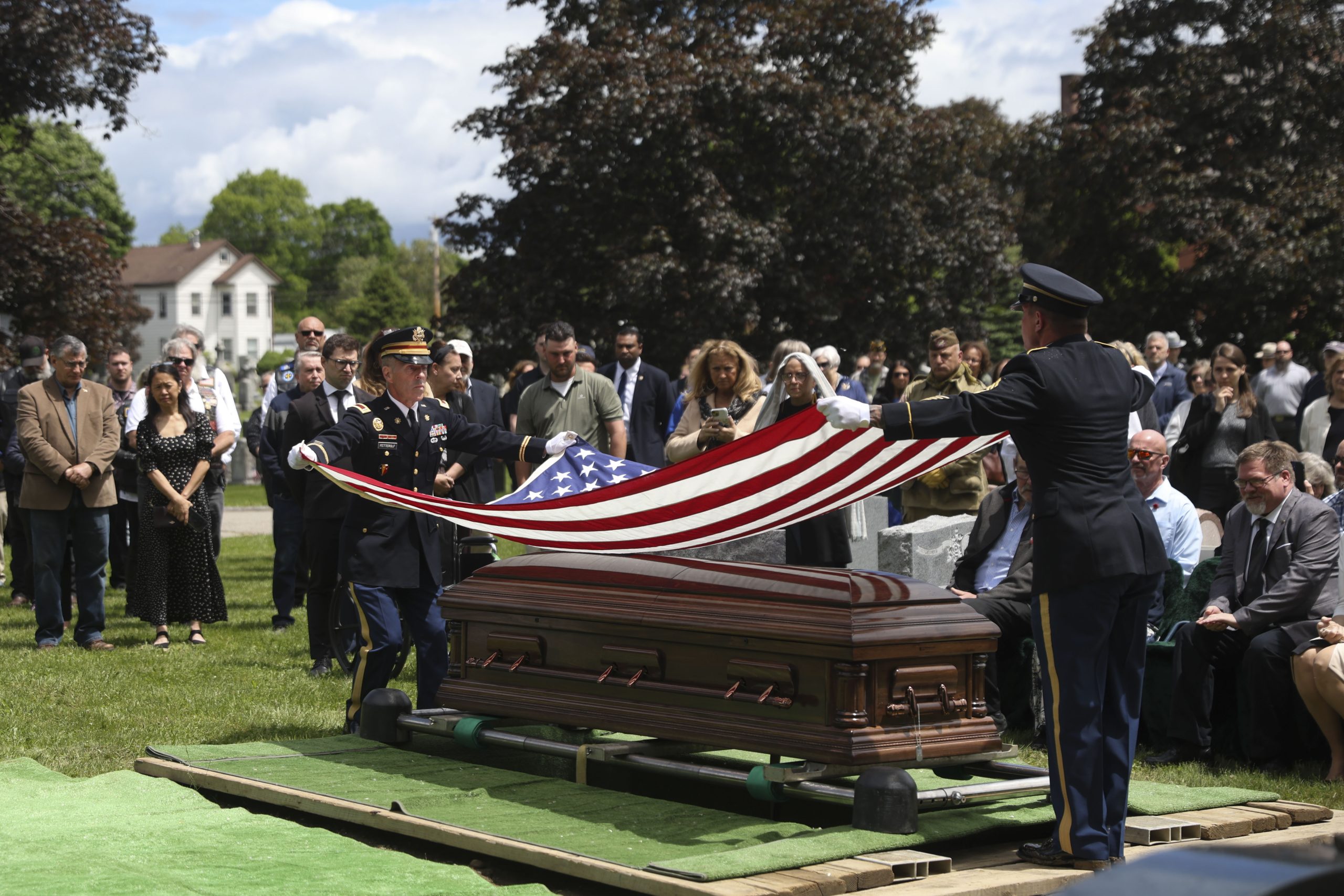
The flag is lifted from the casket with hands that do not tremble.
Full and taut, the red and white and blue of it catching the light above Arlington, above the graves of the people Chuck Norris always considered his truest community — the ones who served, the ones who sacrificed, the ones who chose something larger than themselves and paid whatever price that choice required.
He is among them now.
Carlos Ray Norris. Air Force veteran. Martial artist. Actor. Patriot. Father. Husband. Friend. Teacher. The man who spent his entire public life demonstrating that strength and goodness were not opposites but complements — that the most genuinely powerful people were often the most genuinely gentle, that discipline was the foundation of freedom, that faith was not weakness but the bedrock of everything worth building.
The flag is folded. Thirteen folds. Each one deliberate. Each one a word in the only language adequate to this moment.
We remember. We honor. We do not forget.
And above it all — above the ceremony and the family and the honor guard and the rows of white stones and the distant monument and the gathered crowd — the young Chuck Norris looks down from the clouds with those steady, dark eyes.
He is not sad.
How could he be sad, with a view like this? With the evidence spread before him of a life that meant something — that mattered, in the deepest, most lasting, most undeniable sense of the word?
He is not sad.
He is proud.
Proud of the family that carries his name forward. Proud of the young people whose lives were changed by Kick Start Kids. Proud of the soldiers who stand at attention in his honor, recognizing in him one of their own. Proud of the country he served and loved and refused, even when it was imperfect, to give up on.
Proud of the man he became from the boy he was.
The clouds hold him a moment longer.
The ceremony continues below.
The flag passes to the family.
The honor guard steps back.
The silence settles over Arlington like something permanent.
And in the clouds, the young Chuck Norris —
the boy from Ryan, Oklahoma,
the airman,
the student,
the man who had not yet become the legend —
smiles.
Nods once.
The way a man nods when he sees that everything
he worked for
everything he believed in
everything he gave his life to —
turned out to be exactly
what he thought it was.
Worth it.
All of it.
Worth every single moment.
Rest now, soldier.
Your country has you.