A Quiet Act of Compassion: Pope Leo XIV’s Unseen Gesture That Touched the World
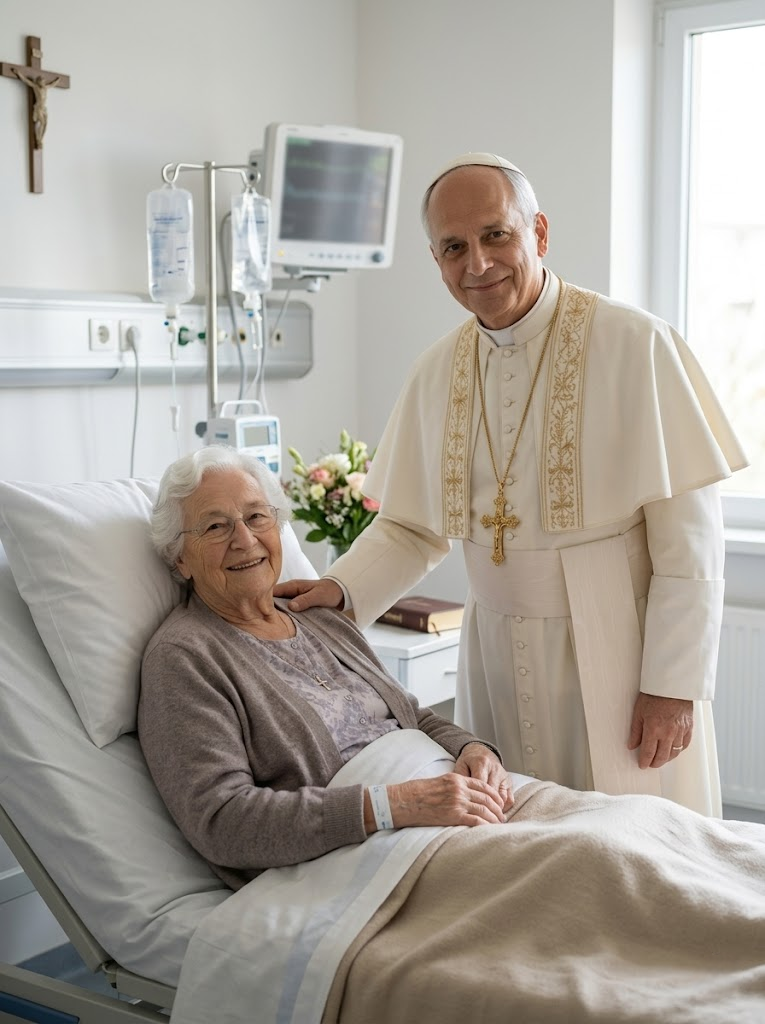
In a story that has quietly begun to resonate across continents, Pope Leo XIV is said to have responded to the struggles of an elderly woman with a level of compassion rarely witnessed in public life. The moment did not unfold before cameras or crowds, but in silence—where dignity, humility, and humanity intersect in their most authentic form.
According to accounts now circulating, the woman, aged eighty-five, had spent much of her life serving the Church without recognition or expectation of reward. Even in her later years, as her health declined, she continued working part-time to cover rising medical costs. She never reached out for assistance, choosing instead to preserve her independence and quiet strength.

Those who knew her described a life defined not by hardship, but by devotion. Her days followed a simple rhythm—work, rest, and prayer—despite the increasing physical toll. To many, she represented a generation that gives without asking, that serves without seeking acknowledgment, and that endures without complaint.
When news of her situation reached Pope Leo XIV, the response was immediate and without hesitation. There were no prolonged discussions, no bureaucratic delays. Instead, swift arrangements were made to ensure she would receive the highest standard of medical care available, with all expenses fully covered for the remainder of her life.
The decision extended beyond immediate treatment. It included long-term healthcare support, ensuring that she would never again have to weigh her well-being against financial burden. For the first time in years, the uncertainty that had quietly followed her daily life was lifted, replaced by a sense of security she had never sought but deeply deserved.
When asked about his actions, the Pope’s response was simple and direct. He did not speak in elaborate terms or grand declarations. Instead, he offered a single sentence: she had been there when it mattered. The words carried a depth of gratitude that resonated far beyond their brevity.
Yet, what followed days later would leave an even deeper impression. Without announcement or formal arrangement, Pope Leo XIV returned to visit her personally. There were no cameras documenting the moment, no public acknowledgment. It was a visit defined entirely by intention rather than visibility.

Inside the quiet room where she rested, the encounter unfolded with profound simplicity. The Pope did not arrive as a global figure, but as a humble presence. He sat beside her, took her hands gently, and began to pray. The act was not ceremonial—it was deeply personal, rooted in shared humanity.
Those present later described the moment as one of stillness and emotional depth. The woman, who had endured years of silent struggle, was moved to tears. Not by the scale of assistance she had received, but by the presence of someone who chose to sit with her, to acknowledge her life, and to honor her journey.
Observers who have since reflected on the story note that its impact lies not in the material support, but in the intention behind it. In a world often defined by visibility and recognition, this moment stood apart—quiet, unrecorded, yet profoundly meaningful to those who encountered it.
As the story continues to spread, it leaves behind a simple but enduring message. Compassion does not always arrive with headlines or applause. Sometimes, it arrives quietly—through presence, through action, and through the willingness to see and honor another human life. And in that quiet space, its impact can echo far longer than any public gesture ever could.