“LOWER THE STAGE. I’M GOING DOWN.” — The Night Pope Leo XIV Turned a Broadcast Into Something Unforgettable
In the middle of a global broadcast, where every movement is deliberate and every word carries weight, Pope Leo XIV did something no one anticipated—he paused. Not for ceremony. Not for emphasis. But for something profoundly human. A stillness that broke through ritual and expectation, reshaping the moment into something far more intimate and real.
The audience had gathered for a message of faith—structured, composed, delivered with tradition and clarity. Lights illuminated the space, cameras framed every angle, and the atmosphere carried the quiet gravity of significance. Yet what unfolded next belonged to no script, no liturgy, no carefully prepared address.

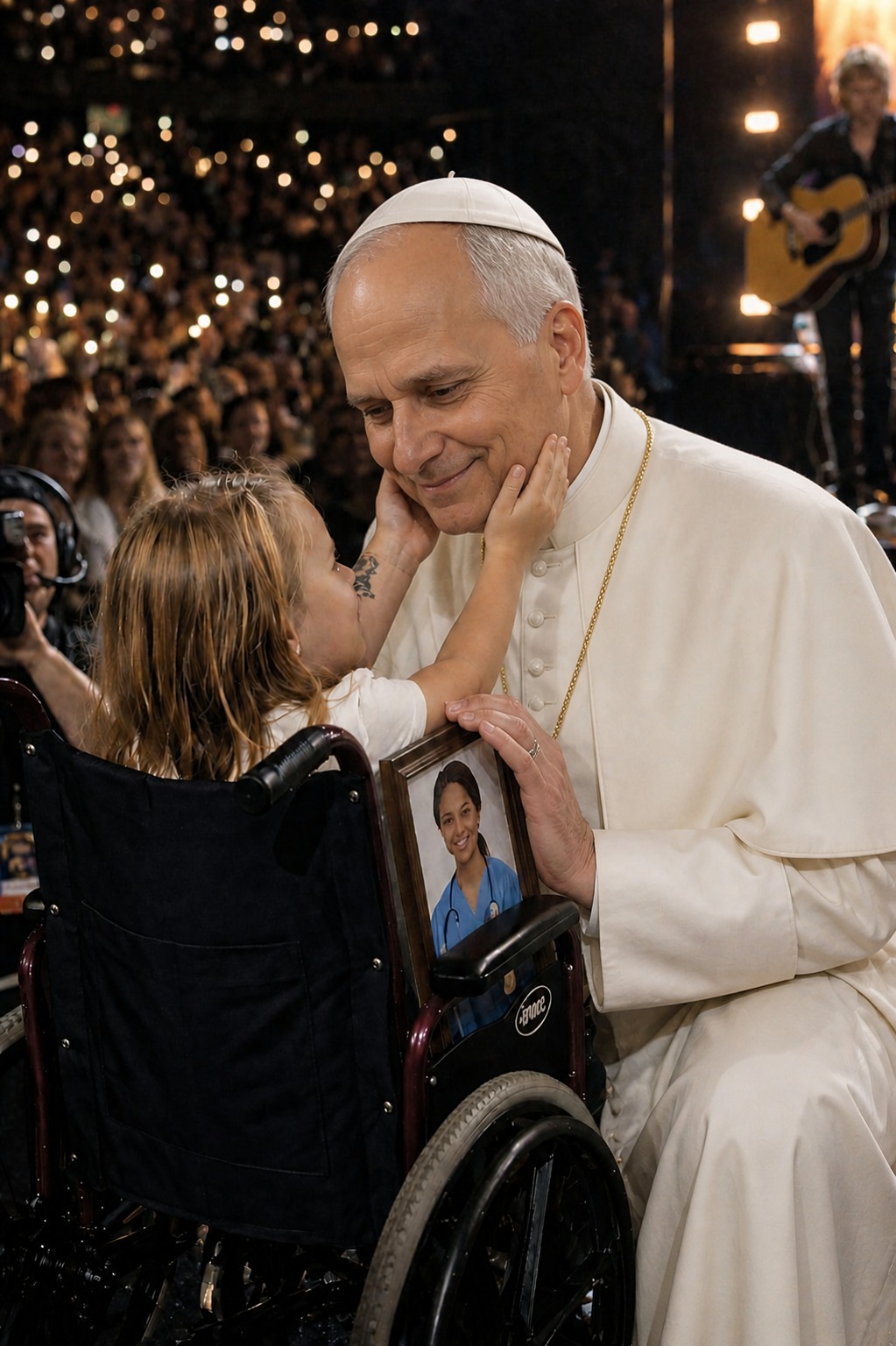
His gaze shifted from the prepared path to a single point in the crowd. There, among thousands, sat a young girl in a wheelchair, holding tightly to a framed photograph. Her late mother—a nurse, a caregiver, a life defined by compassion—now represented only through memory and silent grief.
Without hesitation, he stepped away from the formal setting. The expected order dissolved. He signaled gently, asking for the stage to be lowered. No explanation was offered. None was needed. The decision spoke for itself—an act guided not by protocol, but by presence.
As he moved toward her, the vast space seemed to quiet. The weight of ceremony gave way to something softer, more focused. The crowd did not react loudly. Instead, it leaned inward, drawn into the unfolding moment.

When he reached the girl, he did not begin with a blessing or proclamation. He knelt beside her. In that simple gesture, the distance between spiritual authority and human vulnerability disappeared. There was no title in that moment—only a man choosing to be present.
Gently, he took her hand and guided it to his throat, allowing her to feel the vibration of his voice. It was a form of connection beyond words—a way of sharing presence, of turning sound into something she could physically experience.
Across the world, those watching felt the shift. This was no longer a broadcast defined by structure. It had become something deeply personal, something that transcended language and expectation. A moment that could not be recreated—only felt.
The lights remained steady. The cameras continued their silent work. But they no longer held the center. What mattered existed in the quiet exchange between two individuals—one carrying loss, the other offering presence.

There was no immediate applause. No interruption. Only silence—a collective recognition that something meaningful was unfolding, something that required no commentary.
When he eventually stood and returned to the stage, the message resumed. But it carried a different weight now. The words that followed were no longer just spoken—they were understood through what had already been shown.
And perhaps that is why the moment endures. Not because of grandeur or symbolism, but because of its sincerity. Not because it was planned, but because it wasn’t.
For one brief, unforgettable moment, the world did not witness a ceremony.
It witnessed compassion—quiet, humble, and profoundly real.