How This 1989 Banned-Style Action Masterpiece Redefined Grit Before CGI Took Over
How This 1989 Banned-Style Action Masterpiece Redefined Grit Before CGI Took Over
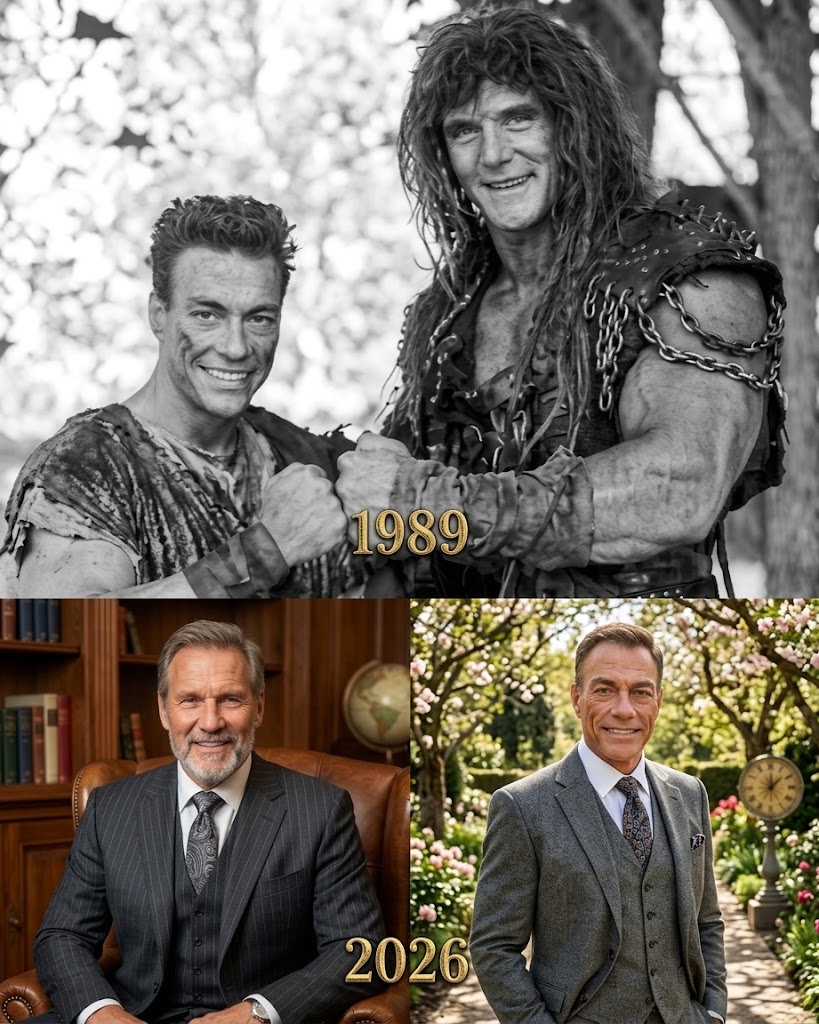
There is something unforgettable about late-1980s action cinema—the way it turned ruined cities, burning skies, and endless deserts into arenas where survival itself felt heroic. The worlds were harsh, violent, and broken, yet inside them stood warriors who refused to surrender. In 1989, Cyborg became one of the clearest examples of that atmosphere: a brutal post-apocalyptic adventure driven not by complicated technology or giant visual effects, but by physical presence, sweat, movement, and raw human endurance. And in this striking black-and-white image, two men stand together as if they were born from that shattered world itself: Jean-Claude Van Damme and Ralf Moeller.
At the center of the frame is Jean-Claude Van Damme, already becoming one of the most recognizable martial arts stars on the planet. By the late 1980s, Van Damme represented a completely different type of action hero compared to the bulky gun-wielding icons dominating Hollywood. He was fast instead of heavy, precise instead of reckless, elegant instead of mechanical. His athletic kicks, impossible flexibility, and calm intensity made him feel almost like a modern gladiator built for cinema. In Cyborg, he played Gibson Rickenbacker—a lone mercenary wandering through a collapsing world consumed by disease, violence, and hopelessness.
Gibson was not a smiling superhero. He was exhausted, haunted, and constantly fighting against despair itself. Van Damme brought to the role a quiet physical sadness beneath the action—the feeling of a man who has already lost almost everything, yet keeps moving because stopping would mean death. That emotional weight helped Cyborg feel darker and more desperate than many action films of its era. Even during its fight scenes, the movie carried the sense that humanity itself was barely surviving.
Standing beside him is Ralf Moeller as Brick Bardo, one of the film’s most intimidating presences. If Van Damme represented speed and technique, Moeller represented overwhelming force. A former bodybuilding champion from Germany, Ralf Moeller looked less like an actor and more like a warrior carved from stone. Towering, muscular, and physically imposing, he brought an almost mythological energy to the screen. Brick Bardo did not need endless dialogue to dominate a scene. His size, posture, and cold expression already told the audience everything they needed to know.
Together, the contrast between the two men became part of what made the world of Cyborg memorable. Van Damme moved like a blade—sharp, quick, controlled. Moeller looked like a battering ram capable of crushing anything in front of him. One embodied martial arts precision; the other embodied raw physical dominance. In a genre built around confrontation, they visually represented two completely different philosophies of strength.
What makes this photograph powerful today is not simply nostalgia for an old science-fiction movie. It is the realization that it captures a specific era of filmmaking that can never truly exist again. Action cinema in the late 1980s depended heavily on the human body. Heroes were not protected by digital effects or computer-generated spectacle. Actors trained, fought, jumped, bled, and physically endured the demands of the production. The danger felt tangible because much of it actually was.
Looking back more than three decades later, both Jean-Claude Van Damme and Ralf Moeller remain symbols of that generation of action stars. Van Damme became an international legend whose spinning kicks and martial arts style influenced countless films and fighters. Moeller continued building a memorable screen career, later earning worldwide recognition through roles like Hagen in Gladiator. Their careers traveled different paths, yet this single image preserves them forever inside the same ruined cinematic universe.
And perhaps that is why photographs like this continue to resonate with audiences today. They are not only reminders of movies. They are reminders of a time when action heroes felt physical, when science-fiction worlds felt dirty and dangerous, and when cinema relied on human presence more than digital illusion. Inside this frame from 1989, the apocalypse still exists. The dust still hangs in the air. The warriors are still standing. And somewhere in that ruined world, Gibson Rickenbacker is still fighting to survive.