The Night Kindness Sat on a Motel Floor Beside My Husband
The Night Kindness Sat on a Motel Floor Beside My Husband
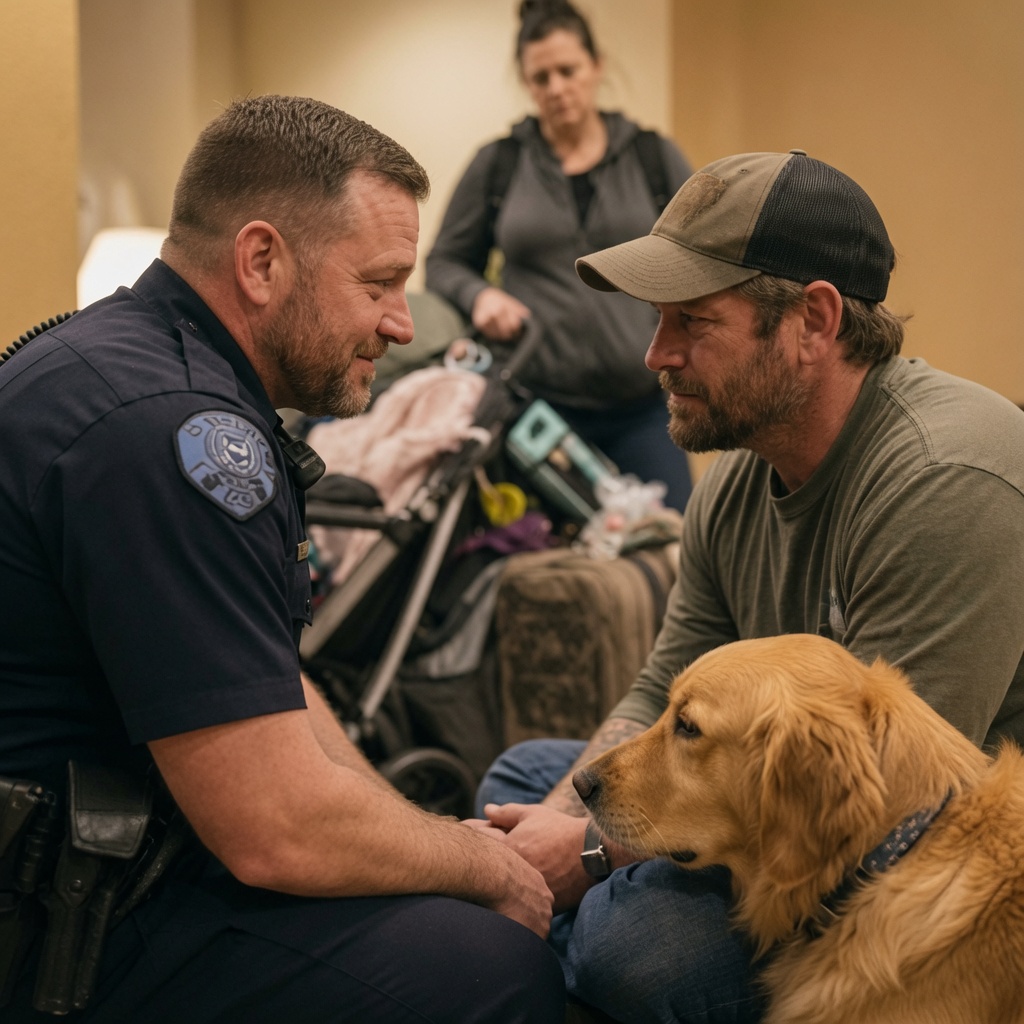
Last Friday my kids watched a police officer with a gun on his hip sit on a cheap motel floor and gently talk my husband out of falling apart.
“We can’t stay here?”
That was the first thing my oldest said when the clerk slid our papers back across the counter like they didn’t matter.
We had driven eight long hours. My husband Tom is a disabled veteran. Long drives, crowds, bright lights, and too many voices at once can push him somewhere I can’t always reach.
He still made the trip for us.
We had our three kids with us — eleven, seven, and our one-year-old — plus Daisy, Tom’s service dog. She wakes him from nightmares, steadies him during panic, and pulls him back when old memories start dragging him under.
I told the clerk that.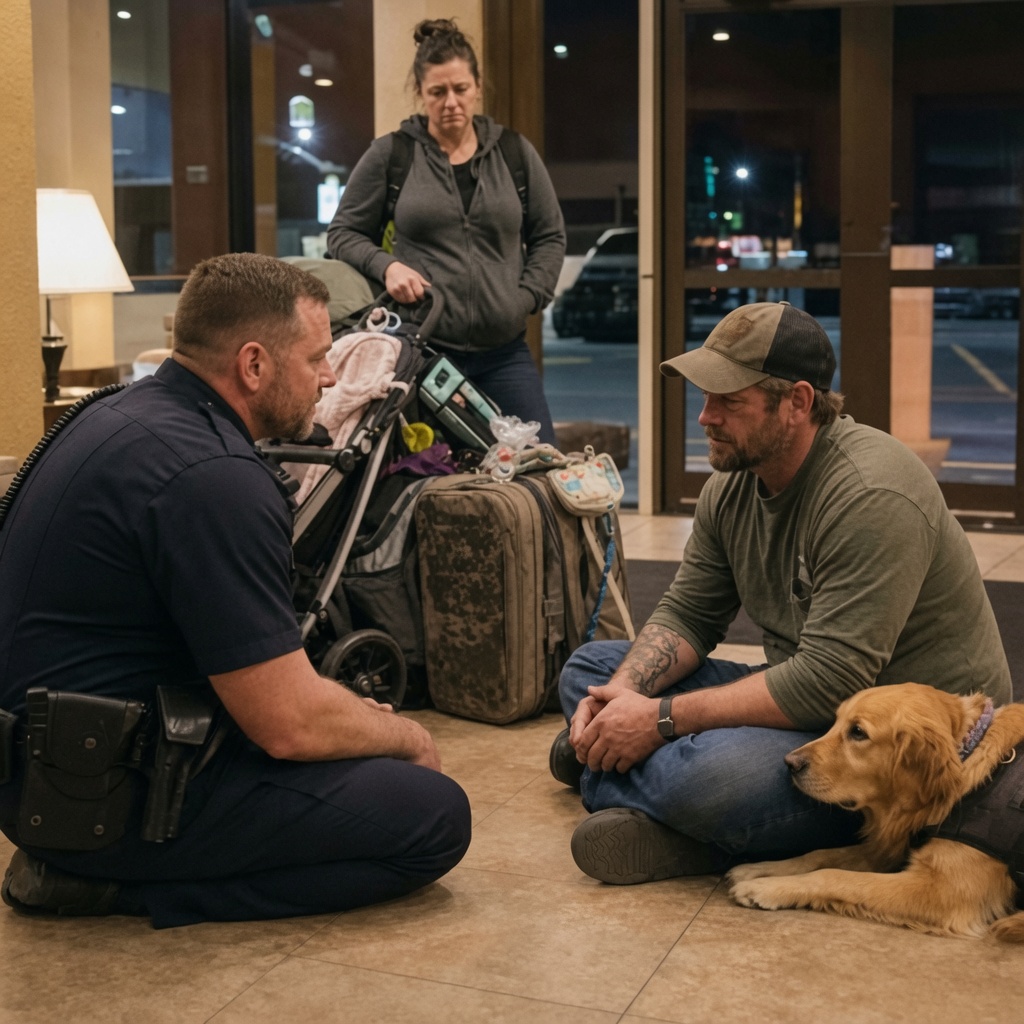
“She’s a service dog,” I said. “We put it on the reservation. We brought all the papers.”
I handed over Daisy’s documents and Tom’s paperwork.
The clerk barely glanced at them.
“We don’t allow animals,” she said. “I’m sorry.”
It was the kind of apology that changes nothing.
I looked at Tom and knew we were in trouble. His breathing had gone sharp. His jaw was tight. His eyes had that faraway look I’ve learned to fear. Daisy pressed hard against his leg before I even said his name.
“We can’t just leave,” I told her. “It’s late. He can’t keep driving. This is medical.”
She looked nervous. “If I make an exception I could lose my job.”
Behind me the baby started crying.
My seven-year-old grabbed my sleeve.
My son whispered, “Are we sleeping in the car?”
That one hit me hard.
I stepped away from the desk, took a breath, and called the non-emergency line. My voice shook the whole time.
“I’m not trying to cause trouble,” I said. “My husband is a disabled veteran. He has a service dog. We have a reservation. They’re refusing us and he’s starting to panic. We just need help.”
Fifteen minutes later an officer walked through the front doors.
Tall, broad, tired-looking. Gun on his hip. Every reason to walk in like he owned the room.
He didn’t.
He went straight to Tom, lowered himself onto the lobby floor so they were eye level, and smiled at Daisy.
“What’s her name?” he asked.
Tom swallowed. “Daisy.”
“She’s beautiful,” the officer said. “Want to tell me what she does for you?”
And somehow, right there under the harsh lights with our bags piled by the door and our kids watching, Tom started talking.
Not smoothly. Just honestly.
Broken pieces about nightmares, panic, and not always being able to come back by himself.
The officer listened like he had nowhere else to be.
Then he stood up and walked to the desk.
His voice stayed calm. No scene. No attitude.
He explained that trained service animals are protected. That turning us away was wrong. That we had a right to the room we reserved.
The clerk called a manager. There was whispering. A lot of “I didn’t know.”
A few minutes later a room suddenly appeared.
But that isn’t the part I keep replaying.
The officer didn’t leave.
He stayed while we carried in the diaper bag, snacks, broken suitcase, dog bed, and stroller. He kept talking to Tom until his hands stopped shaking.
He told him quietly, “I’m glad you made it home.”
That was it. No big speech. Just kindness.
Then he looked at me when I finally started crying and said, “You did the right thing calling before it got worse. That matters.”
When the baby reached for him he took her without hesitation and bounced her on his arm until she laughed.
My oldest stared at me and whispered, “Mom… I didn’t know officers could be like that.”
Neither did I know what to say when the officer knelt to my younger son and pointed at the superhero stickers on his backpack.
“You know who the real hero is tonight?” he said, rubbing Daisy behind the ears. “The one covered in fur.”
For one long awful hour everything had felt like it was closing in.
Then one person chose patience over power and kindness over convenience.
My kids saw that.
My husband felt that.
And I will never forget it.
If getting the room had been the end, I would remember that night differently.
It wasn’t.
The officer handed the baby back, gave Daisy one last scratch, and stepped into the hallway.
The door closed.
And my husband, who had held himself together by one fraying thread in front of our children, came apart.
He made it three steps past the bed.
Then he dropped onto the carpet beside the little dresser like his knees had simply given up.
Daisy went with him so fast it was like she had been waiting.
She pressed against his chest, nose tucked under his chin, body steady and warm.
Tom grabbed fistfuls of her fur and bent over her like a man trying not to drown where his children could see.
I locked the door.
I don’t remember deciding to. I just remember the click.
The baby was still hiccuping.
My seven-year-old stood in the middle of the room with his backpack on like we might still leave.
My oldest had gone so quiet it scared me more than the crying.
There is a kind of silence children make when they stop being children for a second.
That was the silence in that room.
I put the baby on the bed and crouched in front of my son.
“Take your shoes off for me,” I said.
He stared at Tom instead.
“Is Dad sick?”
I swallowed.
“Dad’s overwhelmed.”
“Did we do something wrong?”
That one hit low and hard.
“No, baby,” I said. “Not one thing.”
My oldest still hadn’t moved.
She was watching her father hold on to Daisy like she was the last solid thing left.
Finally she whispered, “Should I take the baby?”
I looked at her.
She had my face when I’m trying not to panic.
“Yes,” I said. “Please.”
She nodded like I had asked her to do something ordinary.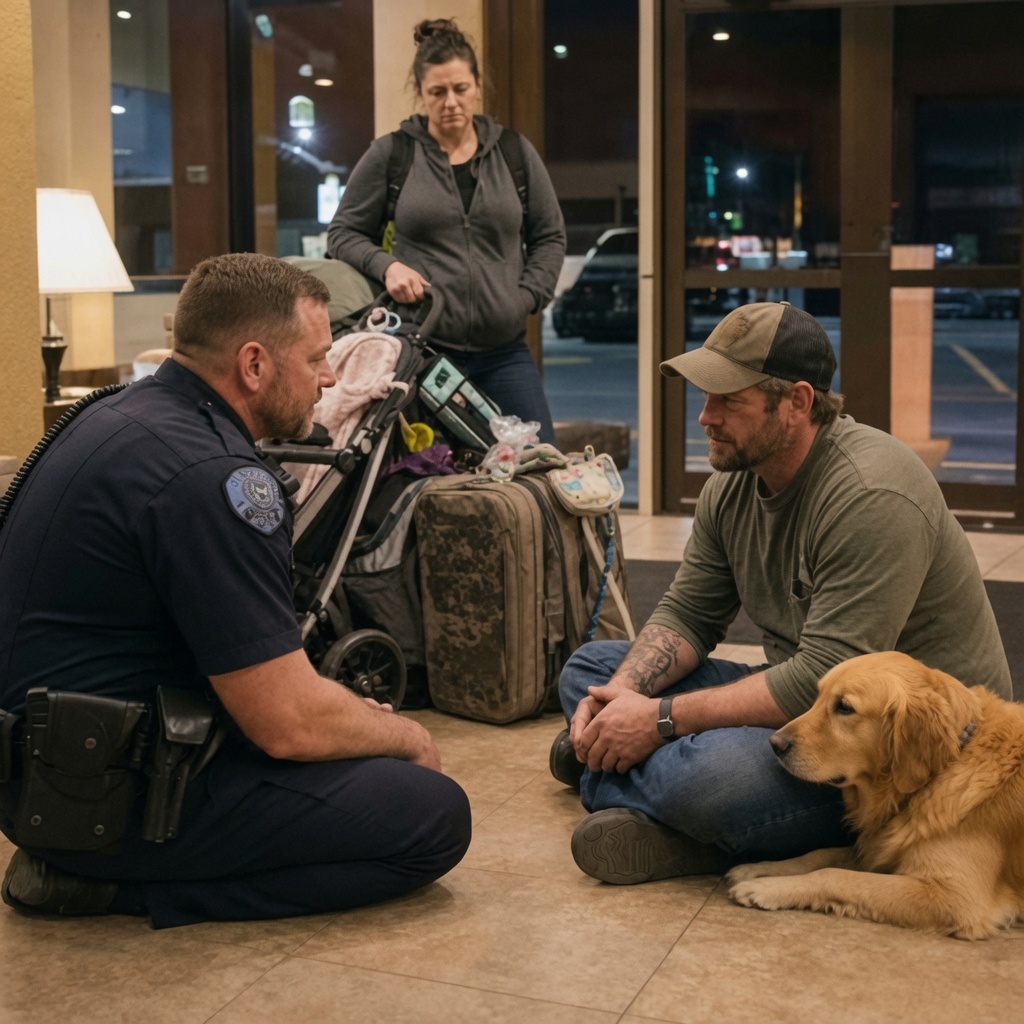
That almost undid me.
I crossed the room and sat on the carpet in front of Tom.
Not touching him yet.
That was something I had learned the hard way.
Sometimes he needed my hands.
Sometimes he needed space more than love.
“Tom,” I said softly.
His breathing was all wrong.
Too fast. Too sharp.
He looked past me instead of at me.
Not because he didn’t know me.
Because some part of him was somewhere else and he was fighting to get back.
Daisy nudged his jaw.
He blinked.
Once.
Then twice.
I kept my voice low.
“You’re here.”
Nothing.
“You’re with me.”
His mouth moved before sound came.
“I know.”
That was something.
I held on to it.
“The kids are safe,” I said. “We’re in the room. You got us here.”
He shut his eyes hard.
“No.”
“Yes.”
“I didn’t.”
His voice cracked.
“You had to call,” he said. “You had to fix it. I couldn’t even—I couldn’t—”
He stopped, like the sentence had teeth.
I knew what he meant.
I couldn’t even get my family a room.
I couldn’t even stand at a desk.
I couldn’t even be the kind of man people think a husband should be.
He didn’t have to say any of it.
I had seen that shame on him before.
Shame is a brutal thing.
It will take a wound that was never your fault and make you apologize for bleeding.
“You do not get to do that tonight,” I told him, and my own voice shook. “You do not get to take what they did and turn it into proof against yourself.”
He looked at me then.
Really looked.
His eyes were red already.
There are nights when pain comes in loud.
This wasn’t one of those.
This kind comes in quiet.
This kind says, You ruined the trip. You scared your kids. You made your wife beg strangers.
This kind sounds almost reasonable.
That is why it is so dangerous.
My oldest was pacing the baby slowly now, bouncing her the way I do.
My son finally sat on the edge of the second bed and started pulling off his sneakers.
His hands were shaking.
I looked back at Tom.
“Can you hear Daisy breathing?” I asked him.
That was what the officer had done in his own way.
Not fixed it.
Not rushed it.
Just found one thread and handed it back.
Tom nodded once.
“Good,” I said. “Match her.”
He tried.
Missed it.
Tried again.
Got closer.
Daisy did not move.
She stayed right there, patient as sunrise.
After a minute his shoulders dropped a little.
Not enough.
But a little.
That was enough for the next minute.
Then the one after that.
The room smelled like wet coats, stale air, and cold french fries.
One lamp buzzed.
The air unit rattled.
It was not a peaceful room.
It was not where anybody would choose to break down.
But it was where we were.
And sometimes surviving is not about the place.
It is about the people who stay in it with you.
After a while Tom lifted one hand from Daisy and pressed the heel of it against his eyes.
“I’m sorry.”
There it was.
The line I hate most.
The line hurt people learn too early and use too often.
For being hard to help.
For needing too much.
For not looking wounded enough until they do.
I moved closer and put my hand over his wrist.
“No.”
He tried again.
“I scared them.”
I looked over at our children.
My oldest was still watching us.
My son had stopped pretending not to listen.
The baby was chewing on her pajama sleeve and drifting toward sleep against her sister’s shoulder.
“You know what scared them?” I said quietly. “Watching strangers act like your life didn’t matter.”
He looked at me.
“That scared them,” I said. “You did not.”
A tear slipped out from under his hand.
Tom does not cry often.
Life trained him to lock down hard and fast.
So when tears come, they come like something has already cracked open deep.
“I heard him,” Tom whispered.
“The officer?”
He nodded.
“He said he was glad I made it home.”
I waited.
His jaw worked.
“I don’t always feel like I did.”
The words sat between us.
Heavy.
Plain.
More honest than most people can handle.
My oldest took one step toward us before she stopped herself.
She had heard.
Of course she had.
Children hear everything that matters.
I reached back and held my hand out to her without looking away from Tom.
She came over and took it.
Then she sat down beside me on the carpet with the baby in her lap.
My son followed a second later.
No one said a word.
The five of us and Daisy sat on that ugly motel carpet in a circle like the room itself had pulled around us.
Tom looked at the kids.
Really looked.
“I’m here,” he said.
My son nodded quickly, like he had been waiting on exactly those words.
My oldest asked, very softly, “Are you going away again in your head?”
Tom flinched.
Not at her.
At the truth of it.
Sometimes children do not have the right language, but they have the right meaning.
He took a shaky breath.
“I almost did.”
She swallowed and looked at Daisy.
“But she got you back?”
He put his hand on Daisy’s side.
“She always tries.”
My son leaned forward then.
“You know what the officer said?”
Tom shook his head.
“He said the real hero was the one covered in fur.”
For the first time since we stepped into the lobby, I saw something in Tom’s face that wasn’t only pain.
It wasn’t a smile.
Not fully.
But it was the memory of one.
“Sounds smart,” he said.
My son nodded like he personally knew that.
A few minutes later there was a knock at the door.
All of us froze.
Daisy lifted her head but did not bark.
I stood up too fast.
My heart kicked hard.
Then the officer’s voice came through the wood.
“It’s me. Just checking in.”
I opened the door a crack.
He stood there holding two bottles of water and a stack of extra towels.
“I figured you might need these,” he said.
For one second I could not speak.
People talk about kindness like it is dramatic.
Most of the time it isn’t.
Most of the time it looks like somebody remembering you might still need help after the hard part should already be over.
“Thank you,” I said.
He glanced past me just enough to see Tom sitting up now against the bed, Daisy pressed to his side, kids gathered around him.
Something in his face softened.
“How’s he doing?”
“Better,” I said. “Not good. But better.”
He nodded.
“That counts.”
Then he lowered his voice.
“If the night turns again, call. Don’t wait for it to get bigger.”
I stared at him.
He had no idea how many people in our life had told us the opposite.
Wait it out.
Let it pass.
Don’t call unless it gets bad.
As if bad has some neat little line around it.
As if families in crisis do better when they are told to suffer quietly first.
“Okay,” I said.
He gave a small nod toward the room.
“You all get some rest.”
Then he looked down at my son’s backpack leaning by the door.
One more superhero sticker had appeared on the front pocket.
I had no idea where it came from.
“Tell your hero I said good night,” he said, meaning Daisy.
My son grinned before I could answer.
“I will.”
The officer left.
This time he really left.
And the hallway swallowed up his footsteps.
Inside the room the quiet settled differently.
Not healed.
Not fixed.
But less sharp.
Like we had made it through the first wave and now just had to survive whatever came after.
I got the kids into pajamas.
Or halfway.
My son fell asleep sideways on top of the blanket with one sock still on.
My oldest refused to change at all.
She said she wanted to be ready in case we had to leave again.
I wanted to tell her not to think like that.
I wanted to promise we were staying.
Instead I just tucked the blanket around her where she sat against the headboard holding the baby’s stuffed rabbit.
I was done lying for the comfort of adults.
Children know when safety feels temporary.
What they need is honesty they can lean on.
“You can sleep in your clothes,” I told her.
She gave me a grateful look so old it hurt to see on her face.
The baby went down last.
She curled against my chest, warm and heavy and smelling like lotion and cracker crumbs.
Tom took the side of the bed closest to the wall.
Daisy curled on the floor beside him, close enough to touch.
I turned off the buzzing lamp.
The room went dim except for the slice of parking lot light through the curtain gap.
For a while I thought maybe sleep would come anyway.
It didn’t.
Tom jerked awake an hour later with a sound that made my whole body go cold.
Not a yell.
Not a word.
Just the raw sound a human being makes when fear gets there before consciousness.
Daisy was on him instantly.
Paws on the mattress.
Nose against his chest.
He thrashed once and then stopped when she pressed harder.
I reached for him.
He was drenched in sweat.
“It’s okay,” I whispered. “You’re here. It’s okay.”
He grabbed my wrist like it was the only thing keeping him from falling through the floor.
Daisy stayed pressed against his chest, breathing steady and loud.
My oldest sat up in the other bed but didn’t speak.
She just watched.
My son stayed asleep, one arm hanging off the side.
The baby never woke.
Tom’s breathing slowly matched Daisy’s again.
Not perfect.
But enough.
He didn’t go back to sleep right away.
Neither did I.
We sat there in the half-dark, his hand still around my wrist, Daisy’s warm weight between us, and listened to the air unit rattle.
After a long time he whispered, so quietly I almost missed it.
“Thank you for not leaving me on the floor alone.”
I swallowed hard.
“I would never.”
He nodded once against the pillow.
“I know.”
But I think he needed to say it out loud anyway.
The rest of the night passed in pieces.
Small stretches of sleep.
Daisy getting up to check on each of us in turn.
My oldest finally changing into pajamas at 3 a.m. because she was too tired to stay ready anymore.
The baby waking once for a bottle and falling back asleep against my chest.
Tom waking twice more.
Each time Daisy was there before I was.
Each time he found his way back faster.
By morning the room looked different in daylight.
Still ugly.
Still not ours.
But no longer the place where everything had almost broken.
We packed slowly.
My son found another superhero sticker on the nightstand and stuck it on his backpack without saying anything.
My oldest carried the baby and kept glancing at Tom like she was making sure he was still there.
Tom carried the dog bed and Daisy’s leash.
His hands were steady.
When we walked out to the car the same clerk was at the desk.
She didn’t look at us.
We didn’t look at her.
Outside in the parking lot, the officer’s cruiser was gone.
I don’t know his name.
I don’t know if he ever thinks about that night.
But I hope he knows what he did.
He didn’t just get us a room.
He showed our children that strength can look like sitting on a dirty floor and listening.
He showed my husband that he was seen.
He showed me that sometimes the people who are supposed to protect you actually do.
And he showed all of us that kindness doesn’t always arrive with sirens.
Sometimes it arrives with extra towels, two bottles of water, and the simple decision to check on a family one more time before the night ends.
We drove the rest of the way home the next day.
Tom was quiet for most of it, but it was a different kind of quiet.
Not the faraway kind.
The kind that comes after something hard has been carried together.
Daisy slept with her head on his leg the whole drive.
My oldest kept one hand on the back of his seat without saying why.
My son counted red cars out the window and announced every time he saw one.
The baby chewed on her rabbit and laughed at nothing.
And somewhere between mile markers, Tom reached over and rested his hand on my knee for a minute.
He didn’t say anything.
He didn’t need to.
We had made it through the night.
All of us.
Together.
That was enough.