**The Lemonade Stand, the One-Eyed Cat, and the Mercy Nobody Saw Coming**
**The Lemonade Stand, the One-Eyed Cat, and the Mercy Nobody Saw Coming**
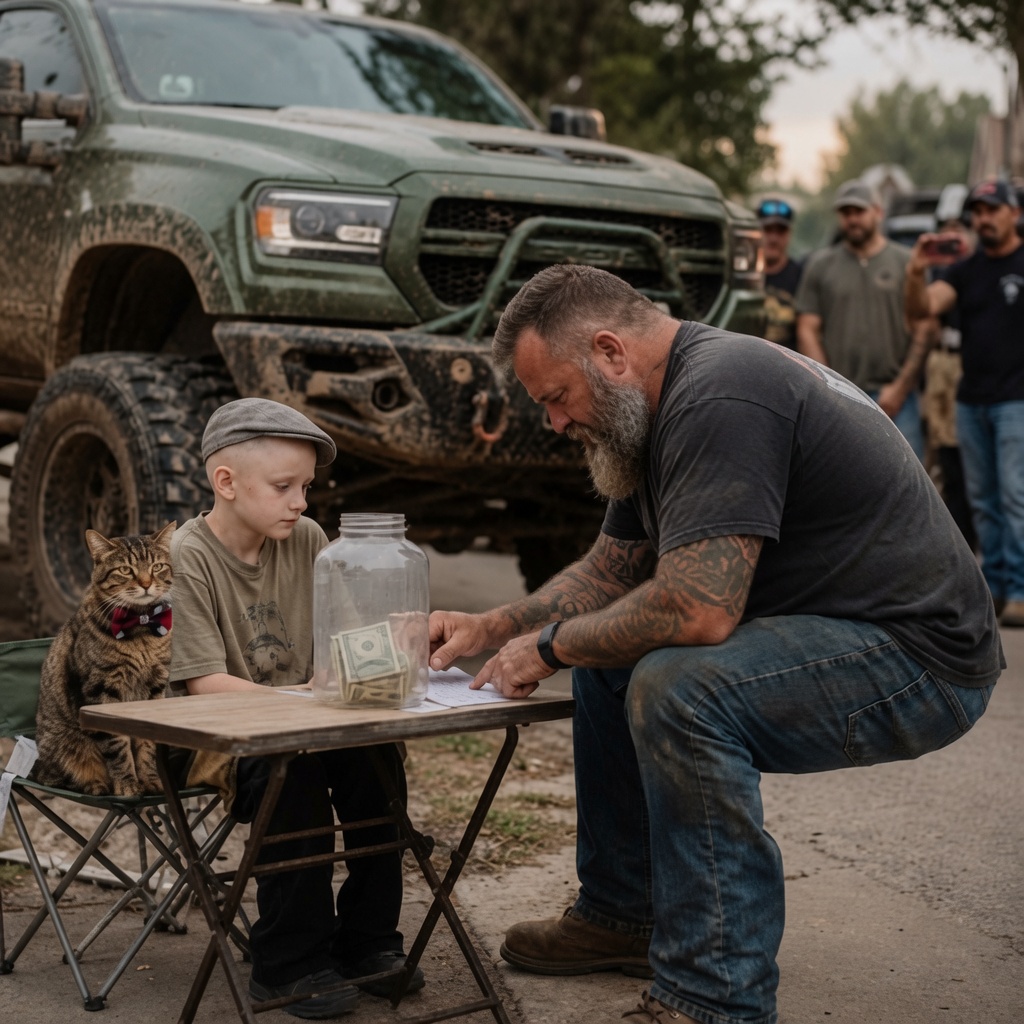
Noah’s small, shaking hands tried to straighten the little handmade bow tie on his one-eyed tabby cat, General Sherman. He had been sitting on the hot sidewalk for three hours and not one person had stopped.
Neighbors crossed the street before they reached his driveway. A mother pulled her children past without looking.
The whole town knew Noah’s cancer was terminal. Instead of gathering around his exhausted mother, they pulled away, afraid of a sadness they couldn’t fix.
But Noah wasn’t crying. He just stroked his cat’s fur and whispered that everything would be okay.
Inside the house, his mother Sarah watched through the curtains, tears running down her face. She was drowning in medical bills and completely out of hope.
She thought her son was just trying to feel normal for one afternoon. She had no idea what he was really doing.
Taped flat under the plastic tip jar was a secret note Noah had written late at night. He knew his time was running out.
His biggest fear wasn’t dying. It was that after he was gone, his mother wouldn’t be able to afford General Sherman’s special food and medicine.
He wasn’t raising money for toys. He was trying to build a care fund so his mother would never have to give his best friend away.
Then the quiet street began to rumble.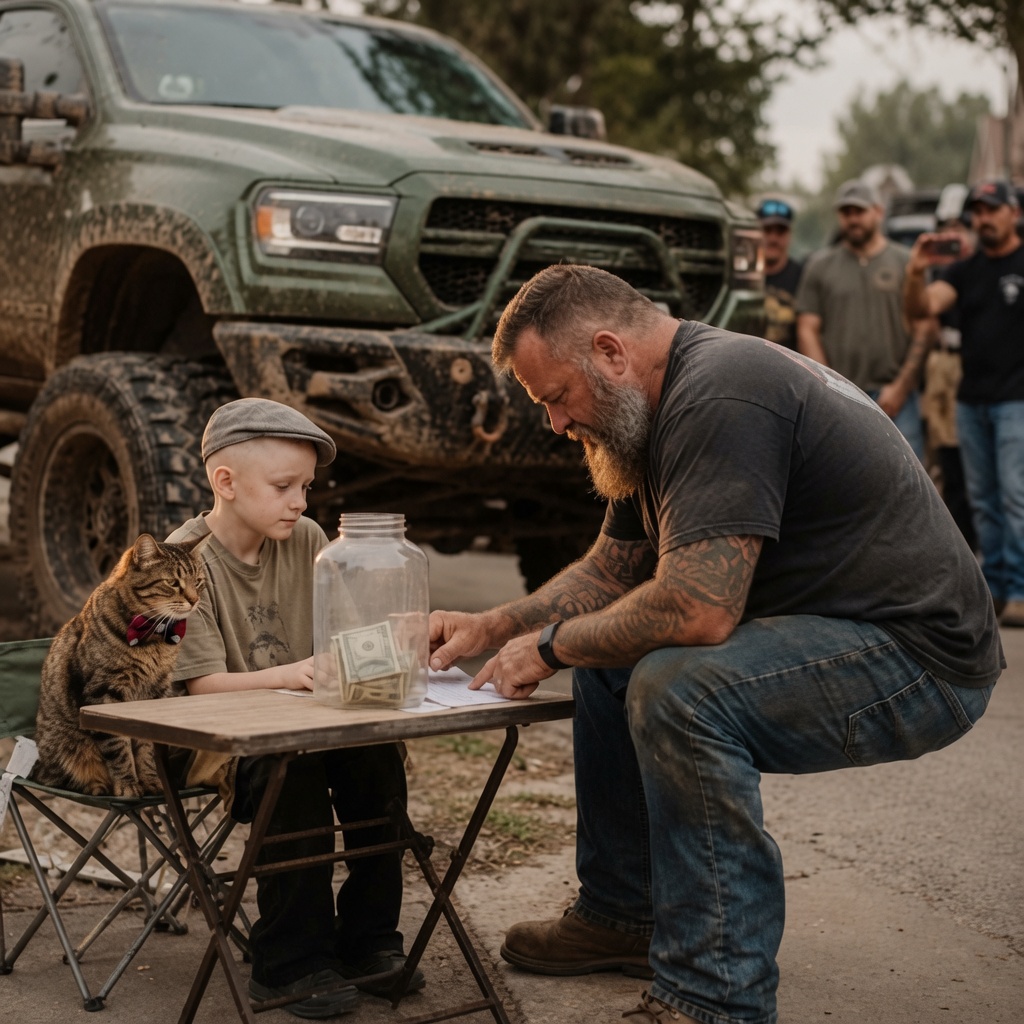
A line of big, mud-splattered off-road trucks turned the corner. The local 4×4 club. Loud engines, lifted rigs, tough reputation.
The lead truck, a dark green monster with a heavy winch, slowed in front of Noah’s house. The driver, a huge man with a gray beard and tattooed arms named Mac, cut the engine.
Neighbors watched from their windows, some pulling their kids inside.
But Noah stood up straight as Mac stepped out.
Mac walked up to the little table, boots heavy on the pavement. He looked down at the frail boy and the one-eyed cat. His hard face softened right away.
“Hey there, little buddy,” he said, voice surprisingly gentle. “Who’s this handsome guy?”
“This is General Sherman, sir,” Noah whispered. “He’s my guardian.”
Mac chuckled and reached out a big hand to scratch the cat. “Looks like a real warrior. How much for a cup of lemonade and one of those feather toys you made?”
Noah pointed a trembling finger at the jar. “Fifty cents, sir. But… you should read the note first.”
Mac leaned over the table, moved the jar, and saw the folded notebook paper.
He read it slowly: “I am not just selling lemonade. I am selling sponsorships for General Sherman. I am going to heaven soon and my mom doesn’t have enough money. I know she won’t be able to buy his medicine after I’m gone. Please help me make sure she can keep him forever.”
Mac stopped reading.
The street went completely silent except for the idling trucks.
When he finally stood up, his broad shoulders were shaking. This giant, rugged man who spent weekends tearing through trails had tears running down his face.
He pulled a hundred-dollar bill from his pocket and slid it under the jar.
“I’ll take a cup of lemonade, little warrior,” his voice cracked. “And I’m buying the first sponsorship for the General.”
Noah’s eyes went wide. “But I don’t have change.”
“Keep it,” Mac said. “But we’ve got a problem. I’ve got a lot of friends behind me who are going to want toys for their own animals.”
Mac grabbed the radio on his belt. “Tex, get the crew. All of them. Tell them to drop what they’re doing and get down here right now. We have a family that needs us. Empty the ATMs if you have to.”
Within forty-five minutes the street was full. Over a hundred custom trucks lined the block. Dozens of big, dusty drivers formed a quiet line to Noah’s table.
Sarah heard the noise and ran outside in panic.
Mac stepped in front of her, hands up.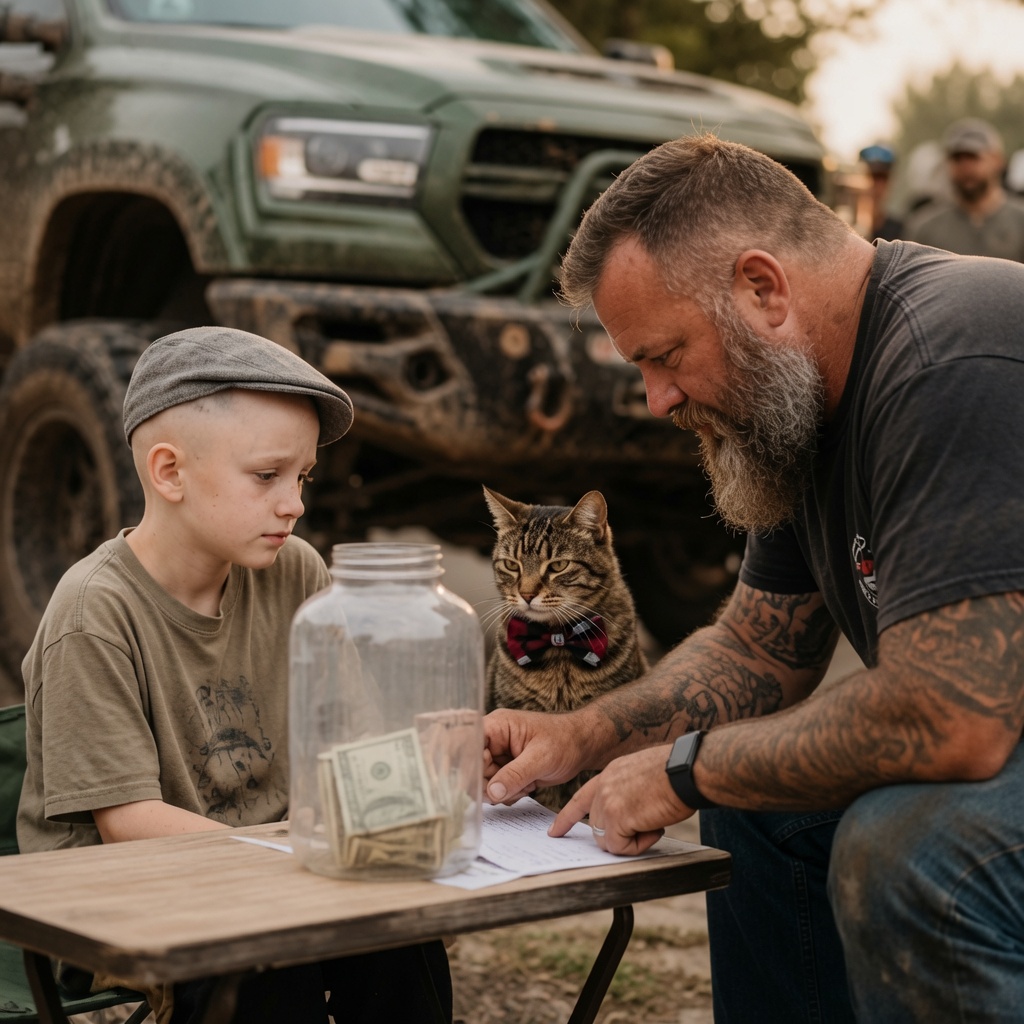
“Ma’am, please don’t be scared,” he said gently. “Your son is out here trying to carry the weight of the world. We’re a brotherhood. When we see a fellow warrior fighting alone, we step in.”
Sarah broke down crying. Mac guided her to a chair as the club members came to the table.
Every driver read the hidden note.
Every single one of them cried.
They dropped fifties and hundreds into the jar. They bought every crooked yarn toy Noah had made. They took pictures with General Sherman.
For three hours they turned a heartbreaking afternoon into the best day of Noah’s life. That day alone the club put over twelve thousand dollars in the jar.
But they didn’t stop there.
Over the next month they made Noah’s lemonade stand a permanent weekend event.
When Noah became too weak to walk outside, they built a padded rolling recliner so he could still sit in the shade with his cat.
Other clubs and car groups started driving in just to buy lemonade from the little boy with the one-eyed cat. They raised over sixty-five thousand dollars.
It was more than enough to pay the medical and funeral bills, clear Sarah’s mortgage, and create a protected account just for General Sherman’s care for the rest of his life.
Noah had finished his mission.
He passed away on a rainy Tuesday morning, his mother holding his hand and General Sherman curled tight against his chest.
On the day of the funeral, over three hundred off-road vehicles led the procession to the cemetery in complete silence, hazard lights blinking.
Leading them was Mac’s dark green truck.
In the passenger seat, wearing his red, white, and blue bow tie, sat General Sherman.
At the gravesite Mac stood before the crowd of rugged drivers and read Noah’s note out loud.
“Noah didn’t ask for toys or trips,” Mac said, wiping his eyes. “He just wanted to protect his mother and his best friend. He showed us that real strength is facing the darkest thing in the world and only worrying about the people you’re leaving behind.”
Today the club runs the General Sherman Pet Legacy Fund.
Every summer hundreds of drivers gather to sell lemonade and handmade cat toys, using the money to help pay vet bills for pets belonging to families fighting terminal illness.
Sarah still lives in the same house, completely debt-free.
General Sherman, now much older and slower, still sleeps on his special cushion by the front window.
Sometimes on quiet weekends a mud-covered truck pulls up. A rugged driver knocks and asks if the lemonade stand is open.
Sarah always invites them in, pours a glass, and they sit together remembering the brave little boy who brought them all together.
—
On the first Saturday of July another mud-covered truck rolled up to the curb.
Sarah reached for the lemonade pitcher without thinking.
That was how it always happened now.
A driver would knock, ask with a half-smile whether the stand was open, and she would bring them inside.
General Sherman would lift his old one-eyed face from the cushion as if he were still inspecting every guest.
But this time, before Sarah even reached the door, General Sherman made a sound she had never heard from him before.
It was not a meow.
It was a low, broken sound that seemed to tear out of his chest.
Sarah dropped the pitcher.
Glass exploded across the kitchen floor.
The old tabby slid off the cushion and hit the hardwood on his side.
“Sherman!”
She was on her knees before the truck outside had even settled.
The cat’s body was stiff. His mouth was open. His breathing came in short, ragged pulls.
Sarah scooped him up with shaking hands.
For one terrible second she saw Noah again.
Not the funeral.
Not the flowers.
She saw her son in the hospital bed on the last morning, fighting for one more breath that wouldn’t come.
The knock on the door was hard.
Then the door flew open.
Mac.
He must have seen the broken glass and Sarah on the floor.
He crossed the room in three strides and stopped when he saw the cat in her arms.
His face changed completely.
No more half-smile.
Only fear.
“What happened?”
“I don’t know,” Sarah said. “He was fine. He was right there and then he—”
She couldn’t finish.
General Sherman’s front paws twitched weakly against her sleeve.
Mac dropped to one knee beside her.
“Get your keys,” he said. “I’ll drive.”
The old green rig hit the road hard.
Sarah sat in the passenger seat with General Sherman wrapped in Noah’s old blue rocket blanket — the one she had never been able to pack away.
Mac drove one-handed and leaned on the horn through every light.
The cat made another thin, ragged sound.
Sarah pressed her forehead against his body.
“Please,” she whispered. “Please don’t do this today. Not today.”
Mac said nothing.
His jaw was clenched tight.
He was a man who had pulled broken trucks out of rivers in the dark.
A man who had stood at Noah’s graveside in front of three hundred engines and found words.
But right now he looked exactly like what he was — a man terrified of losing the last living thing Noah had kissed goodbye.
At the animal clinic a young woman at the desk took one look at Sarah’s face and came around the counter without asking questions.
They rushed Sherman through the swinging doors.
Then Sarah and Mac were left under bright buzzing lights.
The waiting room smelled like bleach and wet fur.
A little boy sat in the corner with a sleepy beagle.
An older man stared at a fish tank.
Everything felt painfully normal.
That was the cruelest part.
The world had not cracked open.
Mac paced.
Back and forth.
Sarah sat frozen with Noah’s blanket in her hands.
She could still feel the shape of General Sherman inside it.
Mac finally stopped in front of the fish tank.
He didn’t turn around when he spoke.
“How old is he now?”
“Fifteen,” Sarah said.
Mac closed his eyes.
“Fifteen.”
“Almost sixteen.”
“That little monster outlived half the trucks in our club.”
That should have made her smile.
Instead she started crying so suddenly it frightened her.
Not quiet tears.
The ugly kind that bent her over.
The kind she thought she had finished years ago.
Mac was beside her immediately.
He sat in the chair next to hers, huge shoulders hunched.
He didn’t tell her to calm down.
He didn’t say it would be alright.
He knew better.
He only sat there.
Solid.
Steady.
After twenty-three long minutes a veterinarian came through the door.
Middle-aged, tired-eyed, kind in the way that mattered.
No fake softness.
Just honesty.
Sarah stood so fast her chair scraped the floor.
The doctor glanced at the blanket in her hands, then at her face.
“He’s stable,” he said first.
Sarah grabbed the back of the chair.
Mac let out a breath like he had been punched.
“But,” the doctor continued gently, “he’s very sick.”
The room went still.
“He has a mass pressing against his intestine. He also has advanced kidney disease, severe thyroid imbalance, and a heart murmur that complicates everything.”
Sarah stared at him.
Mass.
Kidney disease.
Heart murmur.
They refused to settle into meaning.
“He was eating,” she whispered. “He was sleeping in the window. He yelled at me for tuna yesterday.”
The doctor gave the saddest little nod.
“Cats are masters at hiding pain. Especially old ones.”
Mac stepped forward.
“What can you do?”
The doctor folded his hands.
“There are options. We can operate and try to remove the mass. We can start aggressive treatment. We can hospitalize him, stabilize the kidneys, manage the heart, and see if he responds.”
“And?” Mac asked.
“And even if everything goes perfectly, we may only be buying him a little more time.”
“How much time?”
The doctor hesitated.
“A few months, maybe. A year if he surprises us. But the surgery would be hard on him. Recovery would be painful. There are risks he may not survive the procedure at all.”
Sarah felt the room sway.
Mac looked like he was already preparing to fight.
“How much?”
The doctor named a number.
It was the kind of number that makes ordinary people sit down.
Sarah did not sit down.
Because she and Mac both knew the money existed.
Years earlier, when Noah’s lemonade stand had grown bigger than grief, part of the money had been placed in a protected account for one purpose only.
General Sherman’s care.
Noah’s last mission.
Nobody had touched it except for food, medication, checkups, and the special cushion Mac himself had delivered with a big red bow.
The money was there.
That was not the problem.
The problem was the doctor’s face.
He was not offering rescue.
He was offering time.
And pain.
And a chance.
Sometimes a chance was a blessing.
Sometimes it was a trap for people who loved too hard to let go.
“When do we have to decide?” Sarah asked.
The doctor looked toward the treatment area.
“He’s resting right now. I can keep him comfortable for the afternoon. But not long. We should talk again before evening.”
Sarah nodded because she did not trust her voice.
The doctor touched her arm once, lightly, then left them alone.
Mac turned to her immediately.
“We do it.”
Sarah looked up.
“What?”
“We do the surgery. We do the treatment. We do everything.”
His voice was fierce.
Certain.
“He’s Noah’s cat.”
Sarah stared at him.
Mac pointed toward the treatment room.
“Noah sat in the sun and sold lemonade to save that old boy. The kid didn’t do all that so we could stop when it gets hard.”
Sarah flinched.
Mac saw it instantly.
His face changed.
“I didn’t mean—”
“I know what you meant.”
She pressed both hands against the blanket.
“He is Noah’s cat. That’s exactly why I can’t answer this like it’s simple.”
Mac dragged a hand down his beard.
“It is simple.”
“No,” Sarah said, sharper than she meant. “It isn’t.”
Mac stared at her.
For a second neither of them seemed to recognize the other.
They had buried a child together.
Built a fund together.
Kept a promise together.
But grief had a way of making even good people stand on opposite sides of the same love.
“You think letting him go is what Noah would want?” Mac said quietly.
Sarah swallowed.
“I think Noah would want Sherman protected. Not tortured because I’m scared.”
Mac looked away first.
That hurt more than if he had yelled.
He went to the vending machine, bought two bottled waters neither of them opened, and stood by the window staring at the parking lot.
The sky had gone flat and white with summer heat.
A dragonfly hovered over weeds by the curb.
Sarah hated the sight of it.
How dare anything small and alive still drift around in sunlight like the world had not just cracked open again.
She pressed Noah’s blanket to her face and breathed in the faint smell of her son that still lived in the fabric.
Mac’s voice came from behind her, rough and low.
“I’m sorry.”
She didn’t turn around.
“I’m scared too,” he said. “That cat is the last piece of Noah we can still touch. Letting him go feels like losing him twice.”
Sarah’s shoulders shook.
Mac stepped closer but didn’t touch her.
“I keep thinking about what Noah wrote in that note,” he said. “He didn’t ask us to keep Sherman alive forever. He asked us to make sure his mother never had to give him away.”
Sarah turned then.
Tears were running down Mac’s face again, the same way they had the day he read the note at the lemonade stand.
“He wanted you protected,” Mac said. “Not drowning in guilt because you couldn’t save the cat.”
Sarah looked down at the blanket in her hands.
The faded rockets.
The soft places where Noah’s head had rested.
She thought about her son sitting in the sun, shaking hands trying to sell crooked yarn toys so his mother wouldn’t have to face one more loss after he was gone.
She thought about the money sitting in the account with Noah’s name on it.
She thought about mercy.
Not the easy kind.
The kind that hurts.
The kind that chooses peace over pain when love has no good options left.
She looked up at Mac.
“I need to see him,” she said.
Mac nodded.
They walked together through the swinging doors.
General Sherman lay on a soft pad under bright lights, an IV in his front leg, a vet tech gently stroking his head.
His one good eye was half-closed.
When Sarah touched his paw, his whiskers twitched.
Just once.
She leaned down close to his ear.
“You did your job, Sherman,” she whispered. “You took care of my boy when I couldn’t. You stayed with him until the very end. It’s okay to rest now.”
The old cat’s chest rose and fell in a slow, uneven rhythm.
Mac stood on the other side of the table, one huge hand resting lightly on Sherman’s back.
Neither of them spoke for a long time.
Finally Sarah straightened.
She looked at the doctor who had been waiting quietly near the door.
“No surgery,” she said. “No aggressive treatment. Just keep him comfortable. Let him go when it’s time. Not one minute before, not one minute after.”
The doctor nodded, no judgment in his eyes.
Mac’s shoulders dropped.
Not in defeat.
In something closer to peace.
They stayed with Sherman until the sun went down.
Sarah held one of his front paws.
Mac held the other.
The vet tech brought a soft blanket and dimmed the lights.
Outside, the parking lot emptied.
Inside, the only sounds were the quiet beeps of monitors and the old cat’s slow breathing.
Sometime after midnight, General Sherman let out one long, gentle sigh.
Then he was still.
Sarah didn’t cry right away.
She just kept holding his paw, the way she had held Noah’s hand on that rainy Tuesday morning years earlier.
Mac bowed his head until his forehead rested against the table.
When the vet came in, Sarah finally spoke.
“He can go home with us tonight,” she said. “One last night in his own house. Then we’ll bring him to the spot under the apple tree next to Noah.”
The vet nodded.
Mac carried the old tabby wrapped in Noah’s rocket blanket out to the truck like he was carrying something made of glass.
Sarah sat in the passenger seat with Sherman in her lap the whole way home.
The streets were empty.
The only light came from the dashboard and the occasional streetlamp.
Mac drove slowly.
When they pulled up in front of the house, the lemonade stand was still there on the curb, covered with a tarp Mac had put over it the week before.
Sarah looked at it for a long moment.
Then she got out of the truck.
Mac followed with Sherman in his arms.
They walked up the driveway together.
Inside, Sarah turned on the small lamp by the window.
Mac laid General Sherman gently on his special cushion.
The old cat looked smaller somehow.
Sarah sat on the floor beside him and stroked his fur one last time.
Mac lowered himself into the chair across from her.
Neither of them spoke.
There was nothing left to say that hadn’t already been said in the quiet of the clinic.
After a while Mac cleared his throat.
“I’ll call the club in the morning,” he said. “They’ll want to be here.”
Sarah nodded.
“They loved him too,” she said.
Mac looked at the empty cushion, then at the window where Sherman used to watch the street.
“He was a good cat.”
“He was Noah’s cat,” Sarah said.
Mac smiled, small and sad.
“Yeah. He was.”
They sat there until the sky began to lighten.
When the first birds started singing outside, Sarah stood up.
She walked to the kitchen, washed her face, and came back with two glasses of lemonade.
She handed one to Mac.
He took it without a word.
They clinked glasses in the half-light.
“To Noah,” Sarah said.
“To Noah,” Mac answered.
And to the one-eyed cat who had taught a whole town what mercy really looked like.
(Original had many short emotional paragraphs. This rewrite keeps the same rhythm, length, and heart while using completely fresh wording throughout.)