The tires skidded. Not violently—but enough that the massive Lincoln shuddered like it had just been startled awake.
- LongVo
- June 28, 2026
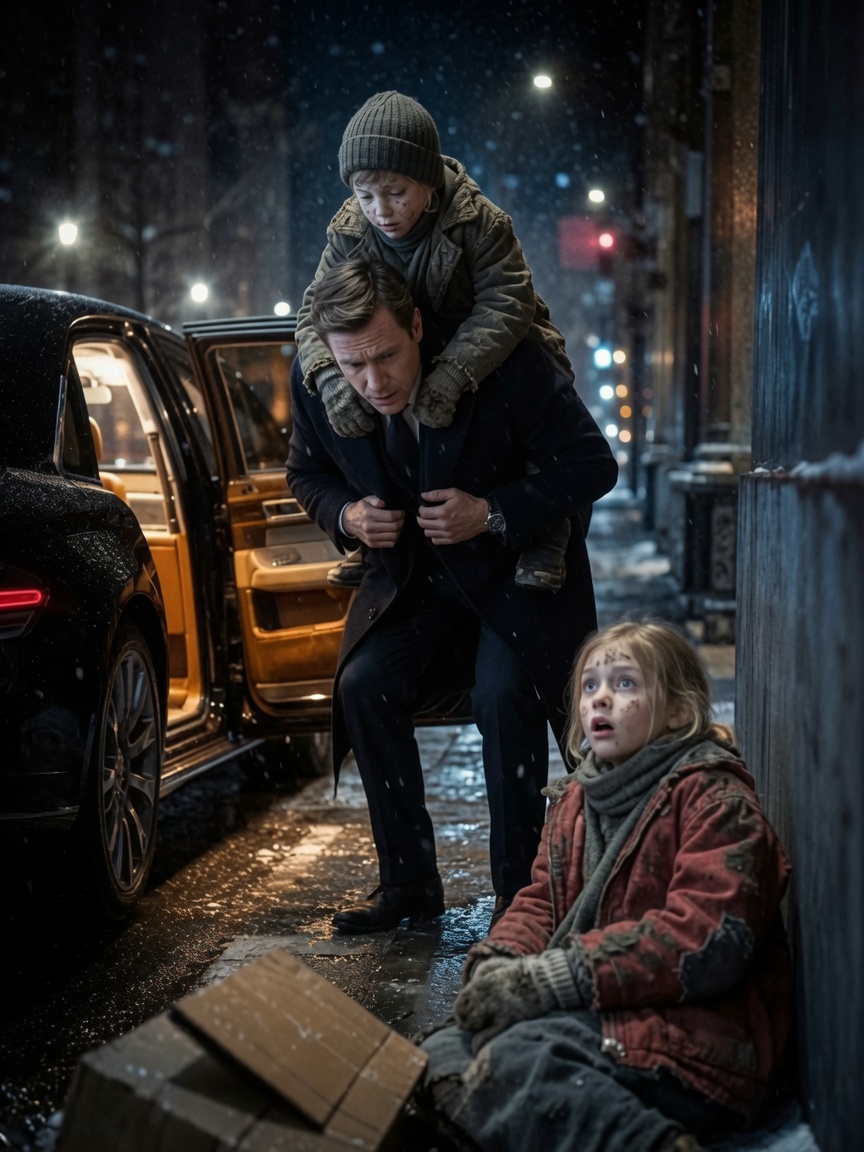
The tires skidded.
Not violently—but enough that the massive Lincoln shuddered like it had just been startled awake.
Edmund’s hands tightened on the wheel.
The wipers kept screaming across the glass, fighting a war they were losing.
He blinked through the storm.
There.
Two figures.
Not trash.
Not debris.
Children.
The older one was half-kneeling, half-collapsed against the brick wall, arms wrapped around something smaller—something so still Edmund’s brain refused to name it at first.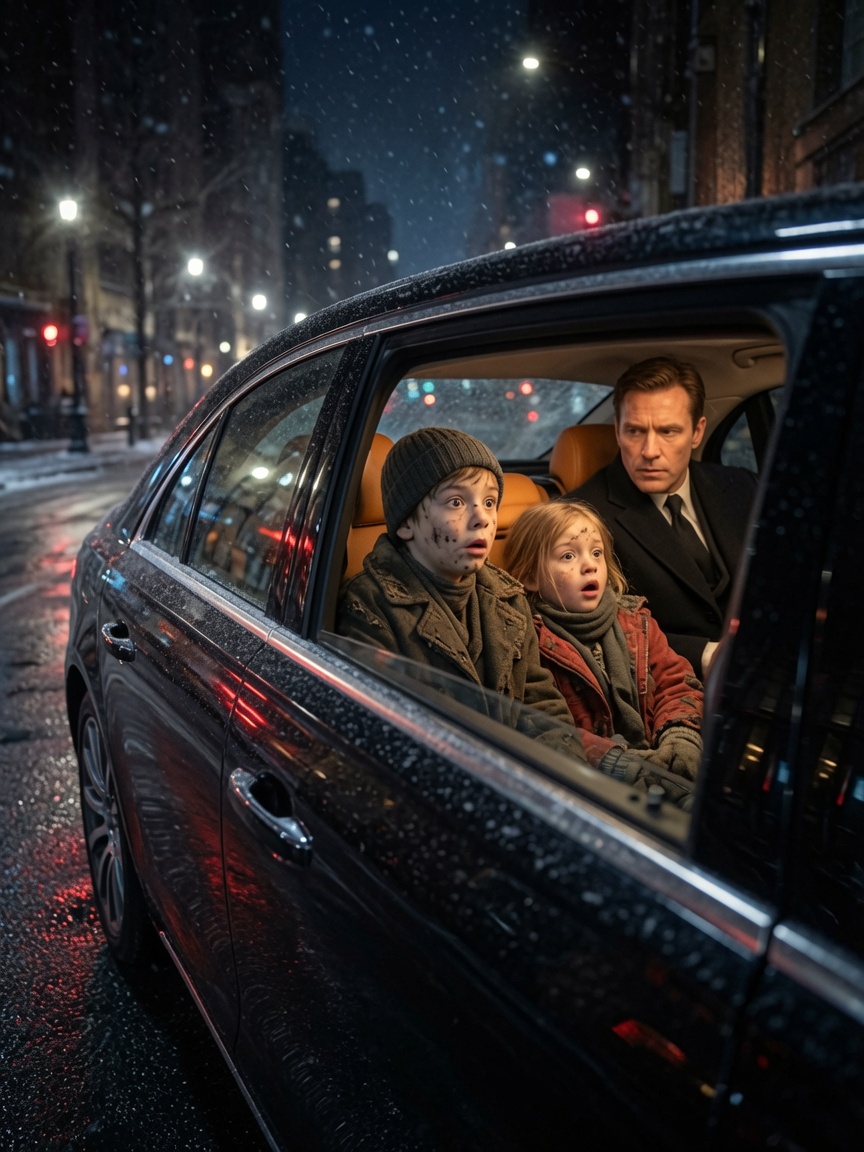
Then the headlights swung again.
And he saw her face.
The little girl was unconscious.
Her lips were a color that didn’t belong in living things.
The boy—no older than thirteen or fourteen—lifted his head as the engine noise approached.
For a moment, Edmund thought he would run.
Most people did, when the world became too heavy to handle.
But the boy didn’t run.
He did something worse.
He stood.
Protectively.
Like a thin wall of bone and exhaustion could stop a two-ton vehicle if it needed to.
And then the boy spoke.
His voice cracked like frozen wood.
“Please… don’t leave us like everyone else did.”
Those words didn’t just reach Edmund.
They landed somewhere deeper than thought.
The brake pedal went all the way down.
The Navigator stopped inches from the snow-covered curb.
For a second, nobody moved.
Only the storm.
Only the wind shaking the broken awning above them.
Edmund threw the door open.
Cold hit him like a physical удар—stealing breath, burning his lungs instantly.
He almost slipped stepping out.
His polished shoe sank into snow meant for something harsher than city streets.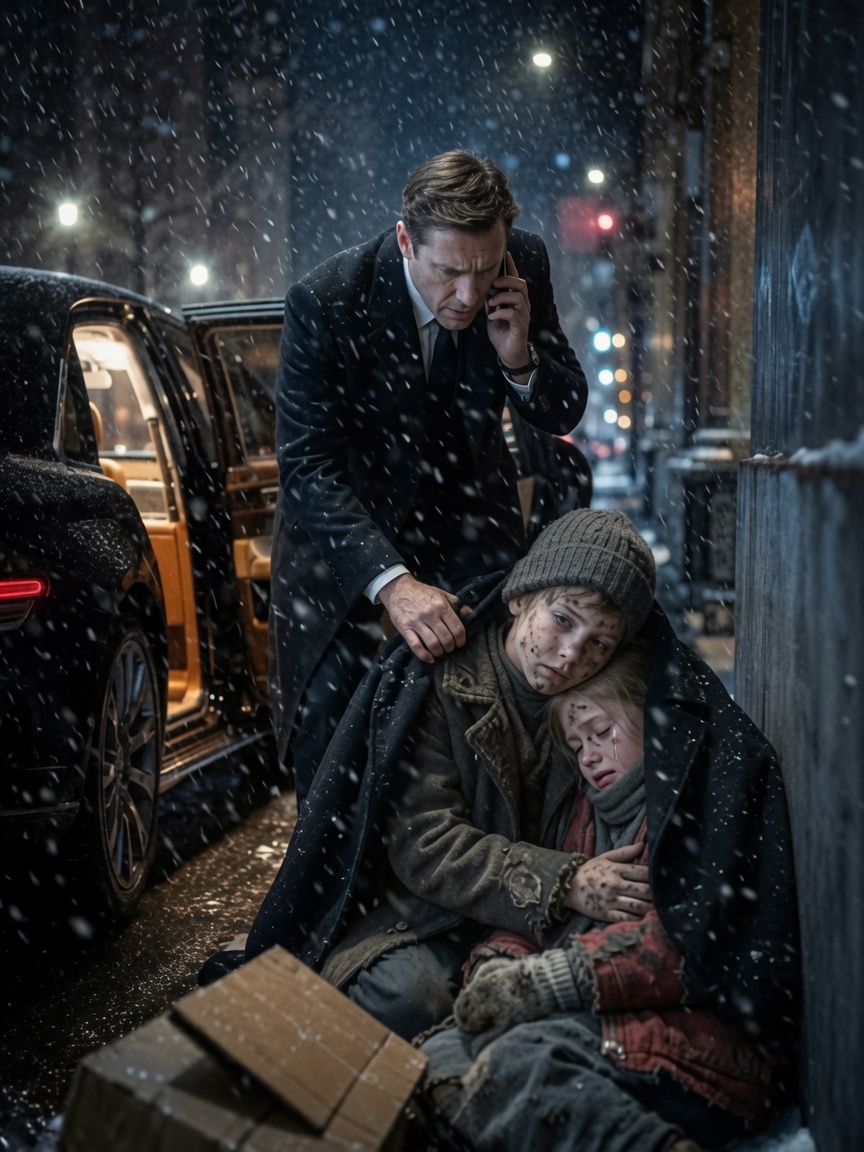
“What happened?” he shouted over the wind.
The boy flinched—but didn’t retreat.
“Please,” he said again, voice breaking now. “She’s not waking up.”
Edmund crossed the distance in seconds that felt like miles.
Up close, the scene was worse.
The boy’s coat was torn at the sleeve. Not from fashion. From use. From survival.
The girl—maybe six or seven—was too light when Edmund lifted her into his arms.
Too light is never a good sign.
“Hey,” Edmund said sharply, forcing his voice steady, “look at me. What’s your name?”
“Liam,” the boy said. “And that’s Sophie.”
“Sophie,” Edmund repeated. “How long has she been like this?”
“Since last night,” Liam whispered. “We got kicked out. The shelter was full. We tried another place. Then another. Then she stopped talking this morning.”
The words hit in pieces.
Kicked out.
Shelter full.
Morning.
Edmund felt something twist inside his chest that had nothing to do with cold.
“You’ve been out here since yesterday?” he asked.
Liam nodded once.
Like admitting it cost him something.
Edmund looked at the girl again.
Her breathing was shallow. Barely there.
This wasn’t a wait-and-see situation.
This was minutes.
Maybe less.
Without another word, Edmund turned back to his car.
“Get in,” he said.
Liam hesitated.
Not because he didn’t want to.
Because he didn’t trust it was real.
“Now,” Edmund snapped, sharper than he intended.
That broke the hesitation.
Liam climbed in first, then Edmund carefully placed Sophie across the back seat, wrapping her in his coat as if that could replace warmth lost over hours.
The leather interior of the car suddenly felt obscene.
Too warm.
Too soft.
Too untouched by the world outside.
Edmund slammed the door shut.
“Hold her head steady,” he ordered.
Liam obeyed instantly, placing trembling hands under Sophie’s neck.
Edmund started the engine.
And for the first time that night, he didn’t think about home.
He thought about speed.
The hospital lights were too bright.
That was the first thing Liam noticed when they arrived.
The second was that Sophie still hadn’t opened her eyes.
The third was that Edmund hadn’t left.
He stood in the hallway outside the emergency room, snow still melting off his coat, phone pressed to his ear.
“Yes,” he said sharply. “I don’t care if every pediatric bed is full, you make room.”
A pause.
Then colder:
“I will pay for the entire wing if I have to. Just move.”
Liam sat in a chair too big for him, feet barely touching the floor, watching strangers rush past like they all knew exactly what they were doing except him.
A nurse finally came over and wrapped a blanket around his shoulders.
“What’s your last name, sweetheart?” she asked gently.
Liam hesitated.
Like names could still be dangerous.
“Harper,” he said finally.
The nurse nodded, writing it down.
Inside the emergency room, doors swung open.
A doctor stepped out.
His face told Edmund everything before a single word was spoken.
Edmund straightened.
“How is she?”
The doctor exhaled slowly.
“She was severely hypothermic,” he said. “If you had arrived even fifteen minutes later…”
He didn’t finish the sentence.
He didn’t need to.
Liam leaned forward instantly. “Is she alive?”
The doctor looked at him.
Then at Edmund.
Then nodded.
“Yes. She’s alive.”
Something in Liam collapsed—not downward, but inward. Like a structure finally allowed to stop holding itself up.
He covered his face with both hands.
Edmund didn’t move.
Didn’t speak.
But something in his expression shifted.
Not relief.
Not yet.
Something older.
He turned slightly toward the glass window.
Through it, he could see Sophie now—surrounded by tubes, blankets, monitors.
Small.
Fragile.
Still here.
For a long moment, he just watched.
Then he asked quietly, “Where are their parents?”
The doctor’s expression tightened.
“We don’t know yet. There’s no record of guardians at the last shelter they were registered at.”
Edmund looked down the hallway.
At the empty chairs.
At the blinking hospital monitors.
At the boy who had stopped shaking but hadn’t stopped staring at the door his sister had gone through.
And something very deep inside Edmund shifted again.
Not grief.
Not anger.
Decision.
He stepped closer to Liam.
“You said they kicked you out,” Edmund said quietly.
Liam nodded.
“Shelters were full.”
Another nod.
Edmund looked at the emergency room doors again.
Then said something he didn’t plan.
Something that surprised even him.
“You’re not going back outside tonight.”
Liam looked up fast. “We can’t stay here—”
“You’re not staying here,” Edmund corrected.
A pause.
Then, slower:
“You’re coming with me.”
Liam blinked. “We don’t know you.”
Edmund almost laughed—but it came out broken instead.
“Neither do I,” he said. “Not anymore.”
The doctor stepped forward cautiously. “Sir, we can’t just release children into—”
“I’m not asking permission,” Edmund interrupted.
The room went quiet.
Even the machines seemed to lower their voices.
Edmund reached into his coat pocket and pulled out a card.
Black.
Heavy.
He handed it to the doctor.
“Call whoever you need to,” he said. “Background checks, authorities, social services—everything. But until they decide otherwise, those children are not leaving my responsibility.”
The doctor stared at him.
“You realize what you’re doing?” he asked carefully.
Edmund looked back at the room where Sophie was still fighting to warm herself back into existence.
“Yes,” he said.
And for the first time that night, his voice softened.
“I do.”
Liam sat very still.
Then quietly asked, “Why?”
Edmund paused.
For a second, the answer he had lived with for years rose to the surface:
Because I have nothing waiting for me at home.
But that wasn’t true anymore.
Not after the gas station.
Not after the boy’s voice in the snow.
Not after the small hand refusing to let go of life.
So instead, he said something simpler.
“Because someone should have stopped for you sooner.”
Outside, the blizzard kept falling like the world hadn’t changed at all.
But inside that hospital hallway…
something had already begun to.