PART 2 The question didn’t sound like rebellion.
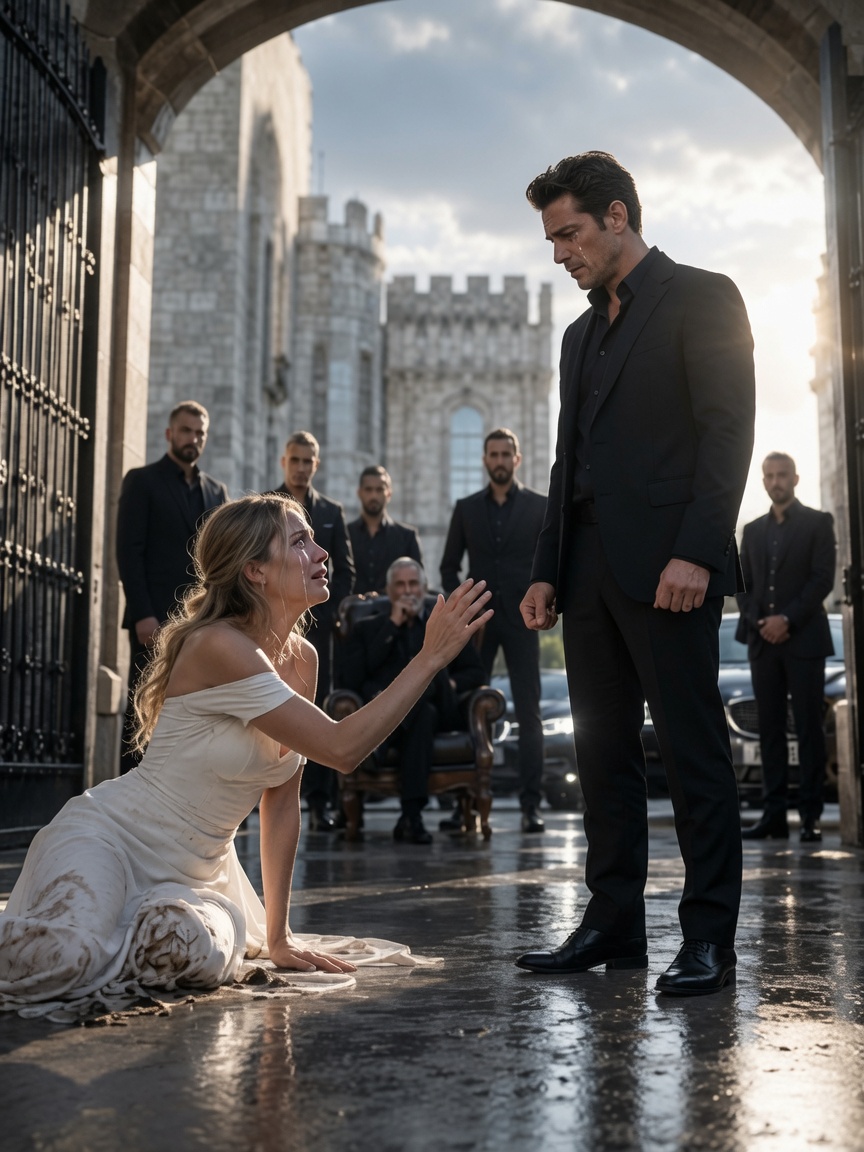
PART 2
The question didn’t sound like rebellion.
It sounded like recalibration.
Vincent Maro didn’t answer immediately.
Not because he didn’t have one.
Because he was measuring what kind of silence would keep the room under control.
Seven men at a table like this didn’t break at arguments.
They broke at doubt.
And doubt, he noticed now, had already begun to spread.
Juno Park was still holding the document.
Not reading it anymore.
Just holding it.
Like he was waiting for something missing from the room to arrive before he continued.
Outside the fortress, Saraphina shifted again.
The cold was sharper now, cutting deeper into the seams of her coat. Her fingers were numb, but she kept them folded calmly in front of her.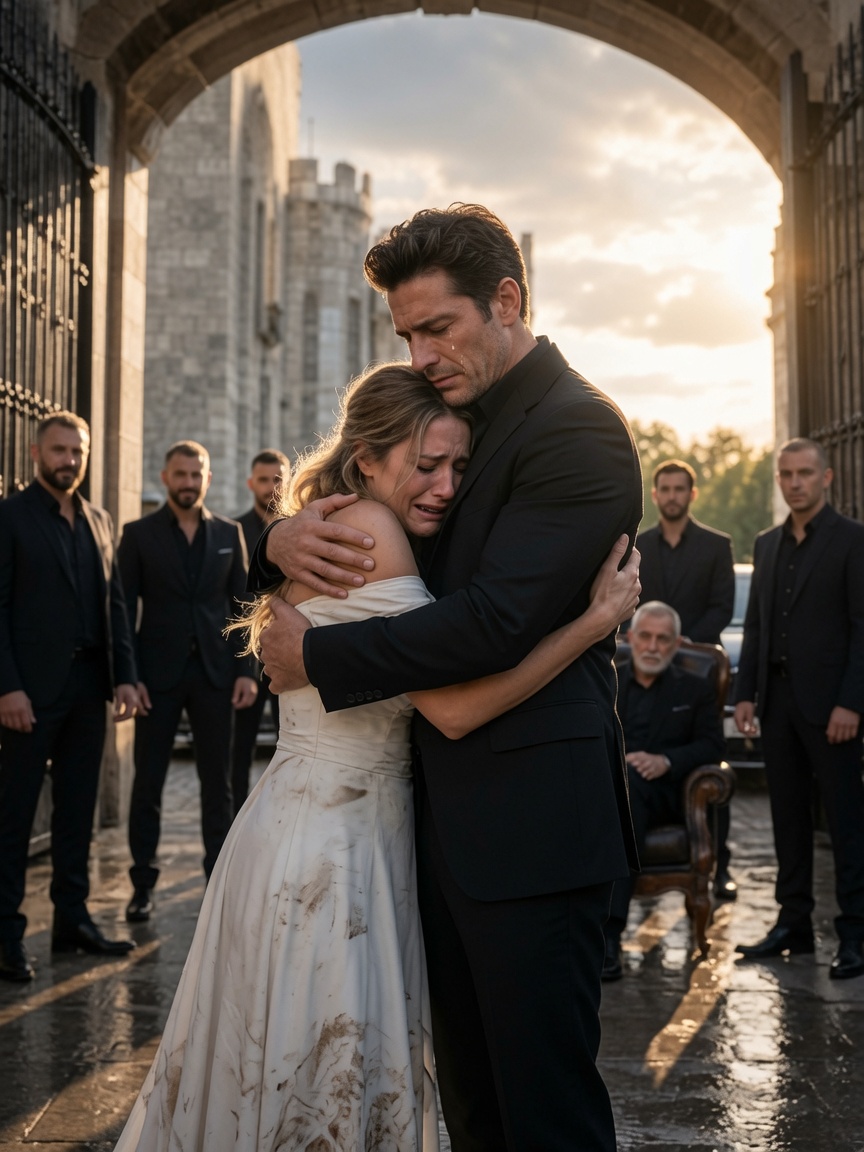
Not pacing.
Not knocking.
Not asking.
That detail mattered more than she wanted it to.
Because silence in her line of work was never neutral.
It was either confidence…
or certainty.
Ethan, the young guard at the gate, finally spoke into his radio.
“He’s still not letting her in,” he muttered.
A pause.
Then a reply came, low and uncertain.
“…is she still there?”
Ethan looked through the glass again.
“Yes.”
Another pause.
Longer this time.
Then:
“…don’t make eye contact with her.”
Ethan frowned. “Why?”
The radio clicked off.
That was worse than an answer.
Inside the fortress, Vincent leaned forward slightly.
“Because we are here to decide the future of the Eastern Corridor,” he said, voice controlled, “not revisit old dependencies.”
Calvetti exhaled slowly.
“That is an interesting word choice.”
Vincent’s gaze sharpened. “Which one.”
“Dependencies,” Calvetti repeated. “Not agreements. Not alliances. Dependencies.”
A quiet shift went through the table.
Dario Mancini smiled again, but this time it had weight behind it.
“You built the structure assuming independence,” Mancini said, tapping the table once. “But the system we’re operating on isn’t independent.”
Vincent’s jaw tightened.
Fuentes finally turned fully toward him.
“It never was,” he said. “Not since the arbitration model was introduced.”
Vincent’s eyes flicked across the table.
“Arbitration,” he said flatly, “is a mechanism. Not a person.”
Juno Park finally looked up.
“Not in your wife’s design,” he said.
The room went still.
That sentence landed differently.
Not as praise.
Not as insult.
As fact.
Vincent’s hand paused near his glass.
Slow.
Measured.
“Explain,” he said.
Park unfolded the document fully now.
The paper was marked, annotated, layered with revisions only visible if you knew where to look.
“She didn’t design a system that requires enforcement through force,” Park said. “She designed one that prevents escalation by requiring mutual dependency on a neutral stabilizer.”
Vincent’s eyes narrowed slightly.
“And that stabilizer,” Park continued, “is not a clause. It is a person who understands all seven networks well enough to prevent misinterpretation from becoming war.”
A beat.
Then Calvetti said it plainly.
“Your wife.”
Vincent didn’t respond immediately.
Outside, Saraphina lifted her gaze toward the high windows of the fortress.
She couldn’t see them.
But she knew the room.
Knew the angles.
Knew which window corresponded to the table.
Knew, instinctively, when conversations shifted in tone.
Her phone stayed untouched in her pocket.
Still dark.
Still ignored.
Because if Vincent had locked her out for strategy…
Then interrupting that strategy would only prove him right.
Inside, Vincent finally spoke.
“That system,” he said carefully, “was always temporary.”
Park shook his head once.
“No,” he said. “It only looks temporary because she prevented every failure condition from activating.”
Fuentes leaned forward slightly.
“In other words,” he said, “she is the reason the summit hasn’t collapsed in eighteen months.”
Silence.
No one disagreed.
That silence was answer enough.
Vincent looked around the table slowly.
For the first time that night, something beneath his control shifted.
Not fear.
Recognition.
Because he could see it now.
The way they were looking at him was changing.
Not toward anger.
Toward evaluation.
As if the question had quietly changed from what does Vincent want? to what happens if Vincent is no longer the stabilizing variable?
Outside, a wind moved through the valley.
Saraphina exhaled into the cold and finally, gently, flexed her fingers again.
Not to beg warmth.
Just to keep circulation from leaving her hands entirely.
Ethan watched her without realizing he was doing it again.
Then his supervisor’s voice returned through the radio, sharper now.
“If she speaks to anyone inside, you let her.”
Ethan blinked. “Even without clearance?”
A pause.
Then:
“Especially without clearance.”
Inside the fortress, Vincent leaned back slightly in his chair.
The first time all night he looked less like a man controlling a summit…
and more like a man realizing the summit had already begun without him.
Calvetti broke the silence.
“We don’t proceed without her,” he said.
Vincent’s eyes snapped to him.
“That is not your decision.”
“It is,” Mancini said softly, “if she is the only reason we are still alive in this room.”
A beat.
Then Fuentes added:
“And she is outside in the cold because you wanted to prove a point.”
Vincent stood.
The chair didn’t scrape.
But the air changed.
“You forget,” he said quietly, “who built this fortress.”
Calvetti didn’t flinch.
“No,” he replied. “We are remembering who holds it together.”
A long silence.
Then, from the far end of the table, Seamus Brandt spoke for the first time.
“If she leaves,” he said, “we leave.”
That was it.
No drama.
No threat.
Just consequence.
Vincent looked at him.
Then at Juno Park.
Then at Fuentes.
Then slowly…
toward the closed doors.
Outside those doors, Saraphina still stood exactly where she had been.
Still not knocking.
Still not asking.
Still waiting for a world she had built to decide whether it remembered her name.
And for the first time since the summit began…
Vincent Maro realized something he had not accounted for.
He had locked his wife outside.
But he had forgotten to lock the room inside.