They Did Not Simulate Weightlessness in Apollo 13—The Actors Filmed Every Scene in 23-Second Falls
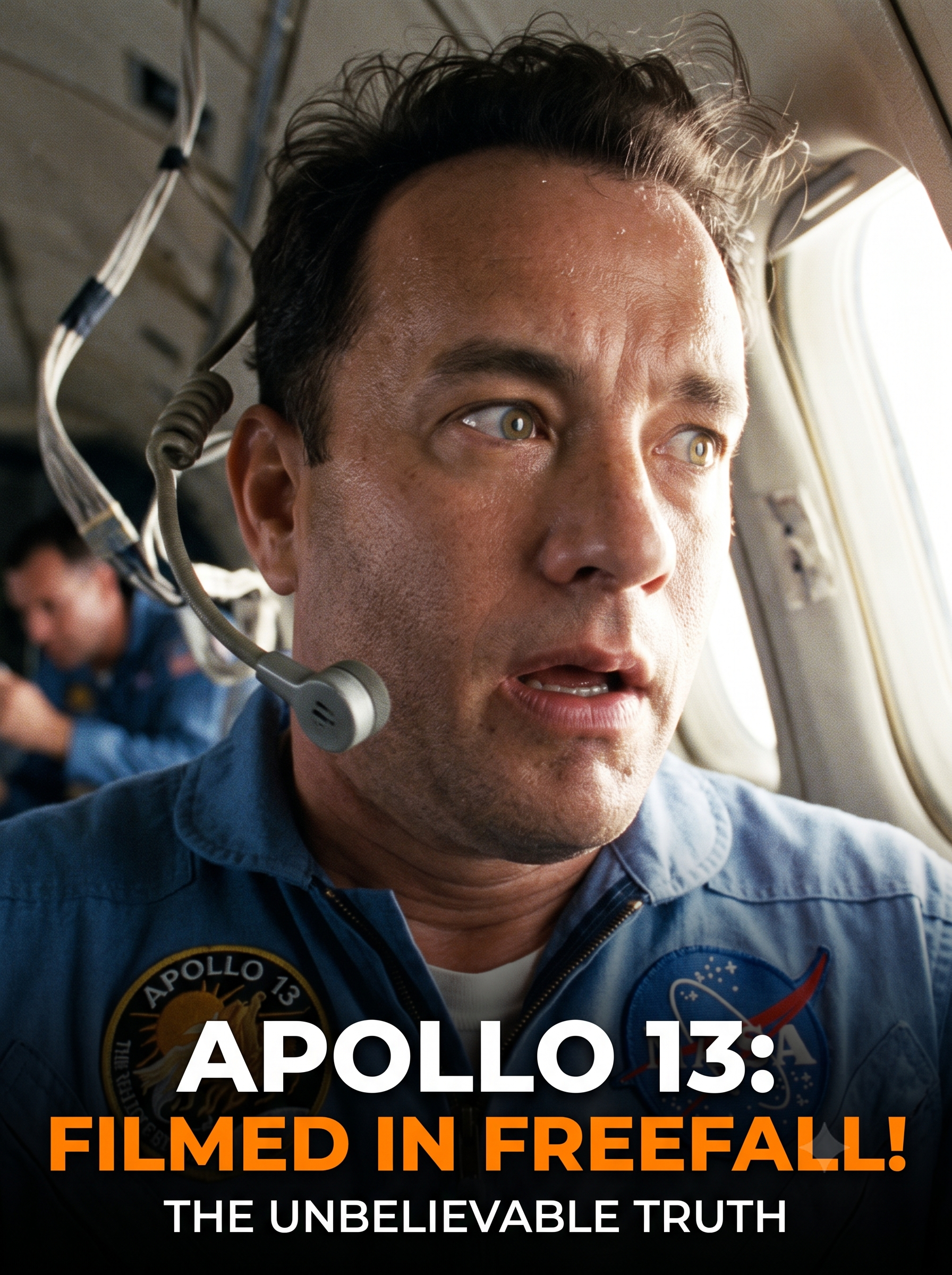
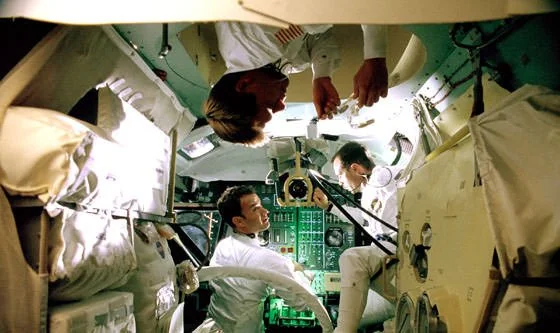
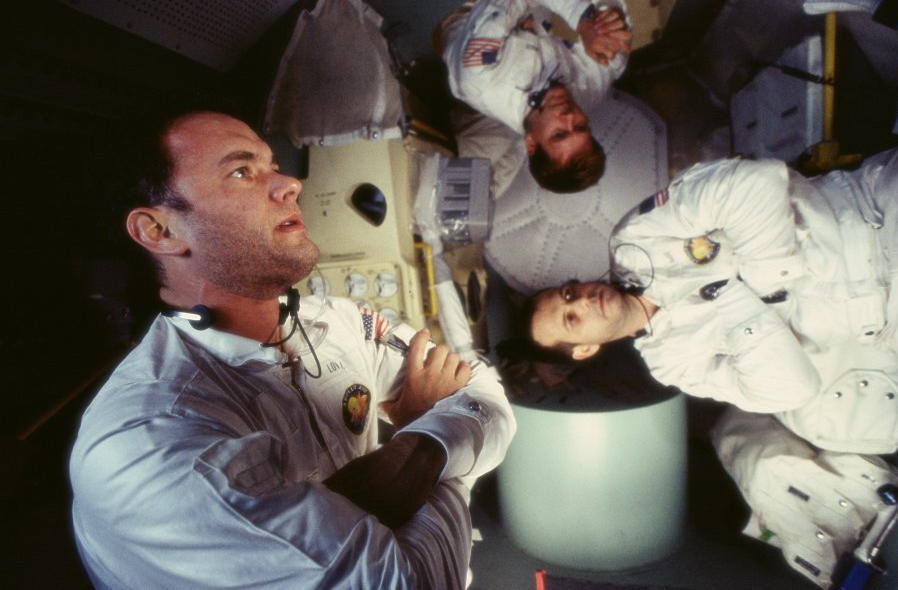
Inside a cramped replica of an Apollo spacecraft, Tom Hanks, Kevin Bacon, and Bill Paxton floated above the floor as cameras followed them through the cabin.
No wires held their bodies in place. No hidden platform supported them. The filmmakers were not waiting for visual-effects artists to create the illusion later.
The actors were genuinely weightless.
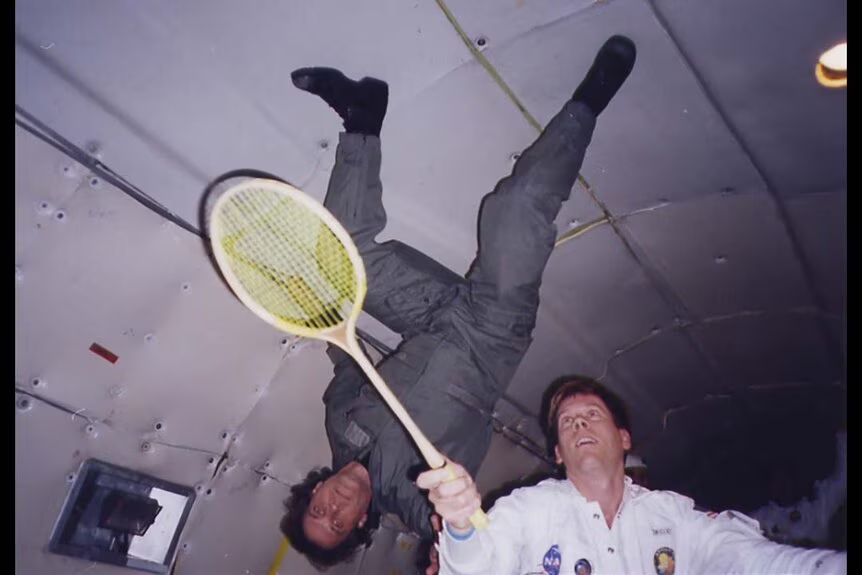
Far above Earth, a NASA KC-135 aircraft had reached the top of a carefully controlled parabolic arc. For approximately 23 seconds, the plane, its passengers, the camera crew, and the spacecraft set inside it were all falling together.
Then gravity returned.
Everyone dropped toward the floor, the crew reset the equipment, and the aircraft climbed again so they could capture another few seconds of footage.
Director Ron Howard repeated this exhausting process across hundreds of parabolas, transforming short bursts of free fall into some of the most convincing weightlessness ever shown in a Hollywood film.
Recreating a Mission the World Already Knew
Released in 1995, Apollo 13 dramatized NASA’s nearly disastrous lunar mission of April 1970.
Astronauts Jim Lovell, Jack Swigert, and Fred Haise were traveling toward the Moon when an oxygen tank exploded inside their spacecraft. The damage forced NASA to cancel the planned lunar landing and begin an urgent effort to bring the crew home.
With electrical power, oxygen, and water severely limited, the astronauts moved into the lunar module and used it as a temporary lifeboat. Engineers and flight controllers on Earth improvised procedures for navigation, carbon-dioxide removal, power conservation, and atmospheric reentry.
All three astronauts survived.
Howard’s film starred Hanks as Lovell, Bacon as Swigert, and Paxton as Haise. Gary Sinise portrayed astronaut Ken Mattingly, who had been removed from the mission shortly before launch, while Ed Harris played flight director Gene Kranz.
The filmmakers knew that audiences already understood the ending. The suspense would not come from hiding whether the astronauts returned alive.
It had to come from making viewers feel trapped inside the failing spacecraft with them.
That required authenticity.
Hollywood’s Usual Tricks Were Not Enough
Filmmakers had several established methods for portraying weightlessness.
Actors could be suspended from wires. Sets could be rotated while the camera remained fixed. Performers could move slowly and pretend that gravity did not exist. Later, computer-generated effects could remove visible equipment or digitally alter the images.
Howard was dissatisfied with those options.
Wire work could make a performer appear to float, but the body still behaved as though gravity were pulling it downward. Clothing hung in the wrong direction. Arms and legs moved differently. Objects did not drift naturally through the air.
Rotating a set could create impressive illusions, but it would not reproduce the uncontrolled freedom of actual weightlessness inside the narrow Apollo modules.
During a discussion about the problem, Steven Spielberg suggested that Howard investigate the aircraft NASA used for reduced-gravity training.
The idea sounded extreme.
It was also exactly what the movie needed.
The Aircraft That Made People Float
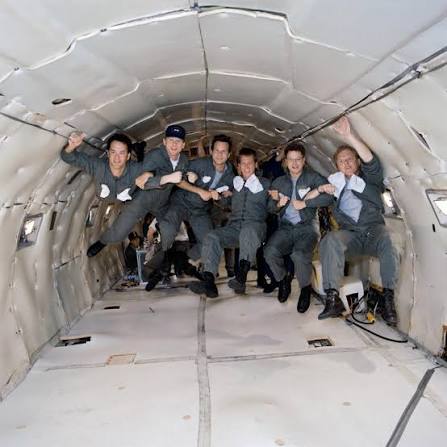
NASA’s KC-135 reduced-gravity aircraft was widely known by the uncomfortable nickname “Vomit Comet.”
The plane created temporary weightlessness by flying a series of parabolic arcs. It climbed steeply, then followed a curved path downward. During the descending portion, the aircraft and everything inside it accelerated toward Earth together.
Because the passengers and plane were falling at the same rate, the cabin briefly appeared to have no gravity.
The effect was real, although the aircraft was not switching gravity off. Everyone inside was experiencing free fall.
Each parabola provided only about 23 seconds of usable weightlessness. Before and after that window, the occupants experienced increased gravitational forces as the plane entered and recovered from the maneuver.
NASA had long used the method to prepare astronauts for the physical sensations of spaceflight.
Howard wanted to turn the trainer into a movie studio.
Building a Spacecraft Inside an Airplane
The production could not simply place the actors in an empty aircraft and pretend they were aboard Apollo 13.
Specially modified replicas of the command module and lunar module had to fit inside the KC-135. The sets needed to resemble the original spacecraft while remaining light, removable, and safe during repeated shifts between weightlessness and increased gravity.
SpaceWorks, a division associated with the Kansas Cosmosphere, constructed the interiors with close attention to NASA hardware. The actors also trained with astronauts and studied the spacecraft’s switches, procedures, and confined working conditions.
Tom Hanks was already deeply interested in the space program. Bacon later recalled that the cast attended flight school and Space Camp and received extensive instruction in operating the spacecraft systems.
Once the aircraft began its dive, however, technical knowledge was only part of the challenge.
The actors had seconds to hit their positions, deliver dialogue, operate controls, and interact with floating objects. Camera operators had to frame the action while their own bodies drifted through the cabin.
Nothing stayed where it had been placed.
Making a Movie 23 Seconds at a Time
A normal film scene may involve a continuous take lasting several minutes.
That was impossible aboard the KC-135.
Howard and his team divided the spacecraft sequences into small sections that could be completed within one period of weightlessness. Every movement had to be planned before the plane entered the parabola.
When free fall began, the crew worked quickly.
The actors floated into position. Cameras moved with them. Loose objects drifted through the cabin. Howard called the action, and the performers delivered as much of the scene as possible before gravity returned.
Then the plane pulled out of the dive.
Bodies, cameras, and equipment suddenly became heavy again. Anyone who failed to secure themselves properly risked colliding with the set or another crew member.
The production filmed aboard the aircraft for 13 days, sometimes completing two flights in a day. Howard recalled that a day could involve between 80 and 100 parabolas. Altogether, the production accumulated almost four hours of weightlessness across 612 maneuvers.
Four hours sounds generous until divided into fragments of less than half a minute.
Every mistake consumed another parabola.
The “Vomit Comet” Earned Its Name
The repeated transition between increased gravity and free fall could be physically punishing.
NASA provided medication to help control motion sickness, but reactions varied. Hanks, Bacon, and Paxton managed to perform through the flights, although the experience was not comfortable.
Bacon later recalled that Hanks and Paxton tried flying without medication on one occasion. They became visibly ill but avoided vomiting.
A cameraman was less fortunate.
According to Bacon, the man vomited during weightlessness. Instead of falling immediately, the material floated through the cabin before the aircraft recovered from the parabola and gravity pulled it down—onto Bacon.
The incident revealed the strange reality of filming in free fall. Even an unpleasant accident behaved according to the physics the movie was trying to capture.
Bumps and bruises were also common. Cast and crew members had to avoid hard surfaces when weightlessness ended, while cameras and equipment needed to be controlled so they did not become dangerous moving objects.
Yet the discomfort created images that no conventional studio technique could fully duplicate.
Why the Real Physics Mattered
The finished scenes possess a subtle realism that viewers may feel without consciously identifying.
The actors do not merely rise from the floor. Their entire bodies move without a fixed point of balance. Small gestures send them drifting in unexpected directions. A hand touching the wall changes the performer’s path through the cabin.
Objects float independently rather than hanging from invisible supports.
Clothing, checklists, cables, and bodies all respond to the same environment.
Howard did not use the KC-135 for every spacecraft shot. Many scenes were filmed on full-size soundstage replicas, particularly sequences after the explosion when the cabin became dangerously cold. The production lowered stage temperatures to make the actors’ breath visible and reinforce the loss of heat inside the damaged spacecraft.
Visual effects were also essential for exterior views of the Saturn V, the Moon, and the spacecraft in flight.
But the zero-gravity footage gave the interior scenes a physical foundation that made every other illusion easier to believe.
Accuracy Beyond Weightlessness
The production’s commitment to realism extended far beyond floating actors.
Jim Lovell worked closely with the filmmakers and appeared briefly as the captain of the recovery ship at the end of the film. NASA personnel advised the cast, while the spacecraft replicas reproduced the dense arrangement of switches, labels, and controls used during Apollo missions.
Howard also avoided relying on original mission footage as a substitute for newly created images. He wanted the visual language to remain consistent and the audience to feel present throughout the story.
Some dialogue was adjusted for dramatic clarity. The real message from the spacecraft was, “Houston, we’ve had a problem,” while the film used the more immediate “Houston, we have a problem.”
Yet the emotional truth of the mission remained grounded in the teamwork that brought the astronauts home.
The movie earned nine Academy Award nominations, including Best Picture, and won for Film Editing and Sound.
Falling Toward Earth to Recreate Space
The strangest achievement of Apollo 13 is that its most convincing images of space were created while everyone involved was falling toward Earth.
The actors never entered orbit. The KC-135 never escaped the planet’s gravity. Each moment of apparent freedom lasted only seconds before the cabin became heavy again.
But within those seconds, the performance and the physics became inseparable.
Hanks, Bacon, and Paxton did not have to imagine how a body moved without weight. They had to control their reactions while experiencing it for real.
That authenticity gave the film something visual effects alone could not provide: the unpredictable movement of human beings temporarily released from the floor beneath them.
The real Apollo 13 mission became famous for turning limited time, power, and equipment into a path home.
Twenty-five years later, the filmmakers faced their own severe limitation—less than half a minute to capture each shot.
They responded in the same spirit.
They prepared carefully, improvised when necessary, and made every second count.