A SpaceX Rocket Struck the Moon at 5,400 MPH — Now the First Images Reveal What It Left Behind
For more than a year, a piece of a SpaceX rocket had been circling Earth on an increasingly unusual journey.
Then, early on Wednesday, Aug. 5, 2026, that journey ended violently on the faraway surface of the moon.
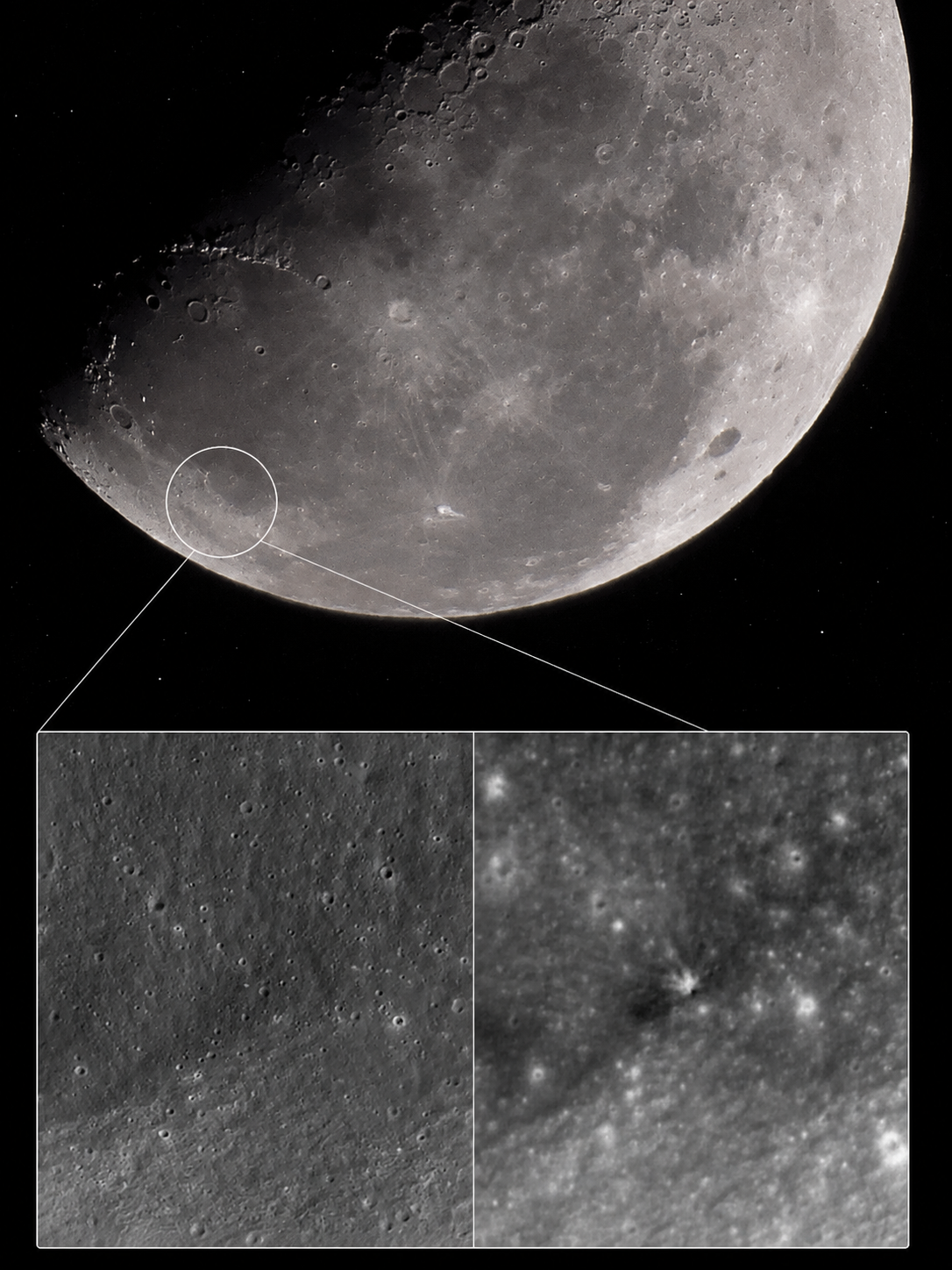
Traveling at roughly 5,400 mph, the rocket stage slammed into an area near the Einstein Crater on the moon’s northern side. Within a day, a spacecraft already orbiting the moon had captured the first images showing what changed after the collision.
The before-and-after pictures offer a rare look at the aftermath of an accidental lunar impact — and add an unusual twist to the story: the satellite that photographed the site had itself been launched into space aboard a SpaceX rocket.
A Sudden New Mark on the Moon
South Korea’s Danuri lunar spacecraft photographed the impact area from orbit, with the Korea Aerospace Research Institute releasing the images on Thursday, Aug. 6.
The pictures compare the lunar surface before and after the collision. An earlier view dated Oct. 1, 2015, can be placed beside imagery taken following the Aug. 5, 2026 impact, allowing scientists and viewers to see how the landscape was altered.
NASA’s Lunar Reconnaissance Orbiter is also expected to examine the site the following week, potentially providing researchers with another look at the consequences of the high-speed crash.
Long before impact, experts had anticipated that the rocket stage would create a fresh crater close to Einstein Crater. They also expected the collision to produce a brief flash and blast lunar material away from the point of impact.
Benjamin Fernando, a postdoctoral researcher at Los Alamos National Laboratory in New Mexico, had previously described the expected event as producing a “flash of light” along with a “plume of ejecta” made up of dust and other lunar surface material.:max_bytes(150000):strip_icc():focal(999x0:1001x2):format(webp)/Moon-080626-60d66f7570f74258ad677720640b9497.jpg)
The Rocket Stage Had Been Traveling for More Than a Year
The object did not begin its journey toward the moon in August.
It came from a January 2025 launch that carried a private lunar lander toward the moon. After completing its role in that mission, the rocket stage remained in orbit around Earth rather than immediately returning or escaping into deeper space.
According to the account, each orbit took about 26 days to complete. For months, the stage continued following that long looping path around Earth.
Eventually, however, its trajectory changed.
SpaceX said solar activity and gravity placed the upper stage on an accidental collision course with the moon. What had once been leftover hardware from a lunar mission became an incoming projectile moving thousands of miles per hour toward the lunar surface.
The impact had been predicted for approximately 2:35 a.m. ET on Wednesday, Aug. 5.
When the stage reached the moon, it was moving at around 5,400 mph, or roughly 8,700 kilometers per hour — more than seven times the speed of sound.
Despite the dramatic speed and the prospect of a new crater, NASA had confirmed ahead of the event that the collision posed no danger to Earth.
A Massive Piece of Space Hardware
The dimensions involved help explain why scientists expected the collision to leave a visible mark.
The rocket associated with the impact is listed as approximately 230 feet tall and 12 feet wide. At the speed involved, the crashing stage carried enough energy for experts to anticipate a noticeable disturbance on the moon’s surface.
Unlike impacts on Earth, however, there was no populated area below, no buildings and no atmosphere-filled sky where people could watch the object streak downward.
Instead, the event unfolded hundreds of thousands of miles away, leaving orbiting spacecraft to document the result.
Danuri provided the first major visual evidence.
And its role in the story comes with a remarkable connection.
The Spacecraft Photographing the Crash Was Also Launched by SpaceX
Danuri, South Korea’s lunar orbiter, was launched from Cape Canaveral, Florida, in 2022.
The rocket that carried it into space?
A SpaceX vehicle.
Four years later, the spacecraft found itself looking down at the aftermath of another SpaceX rocket component colliding with the world it had been sent to study.
That unusual connection gives the incident an almost circular quality: one mission helped place an observer around the moon, while hardware from a later mission eventually became the object being observed.
SpaceX had also launched a pair of private lunar landers the previous year. The upper stage connected with that mission was the hardware that ultimately struck the moon in August 2026.:max_bytes(150000):strip_icc():focal(749x0:751x2):format(webp)/SpaceX-moon-crash-080626-3e34f7b4a9c546ac86f6eaa0bc2e8eba.jpg)
Scientists Now Have a New Impact Site to Examine
The crash itself lasted only moments, but studying its mark on the moon could continue well afterward.
Danuri’s before-and-after photographs provide the first comparison of the affected area, while NASA’s Lunar Reconnaissance Orbiter is expected to make its own observations.
Those additional images could give researchers a closer opportunity to examine the newly altered landscape and the material disturbed by the collision.
The event also illustrates how complicated the paths of discarded spacecraft hardware can become.
A rocket stage launched in January 2025 spent more than a year repeatedly traveling around Earth. Small influences from gravity and solar activity eventually changed its fate, transforming a piece of mission hardware into an object headed directly for the moon.
By Aug. 5, 2026, there was no more orbit to complete.
The stage reached the lunar surface at 5,400 mph.
One day later, Danuri looked down from above and captured the aftermath — preserving the first images of a new mark on the moon created not by an asteroid or meteorite, but by a machine humans had sent into space.