Every Saturday, an 8-Year-Old Girl Returned to a Lonely Gorilla — Until He Finally Walked to the Glass
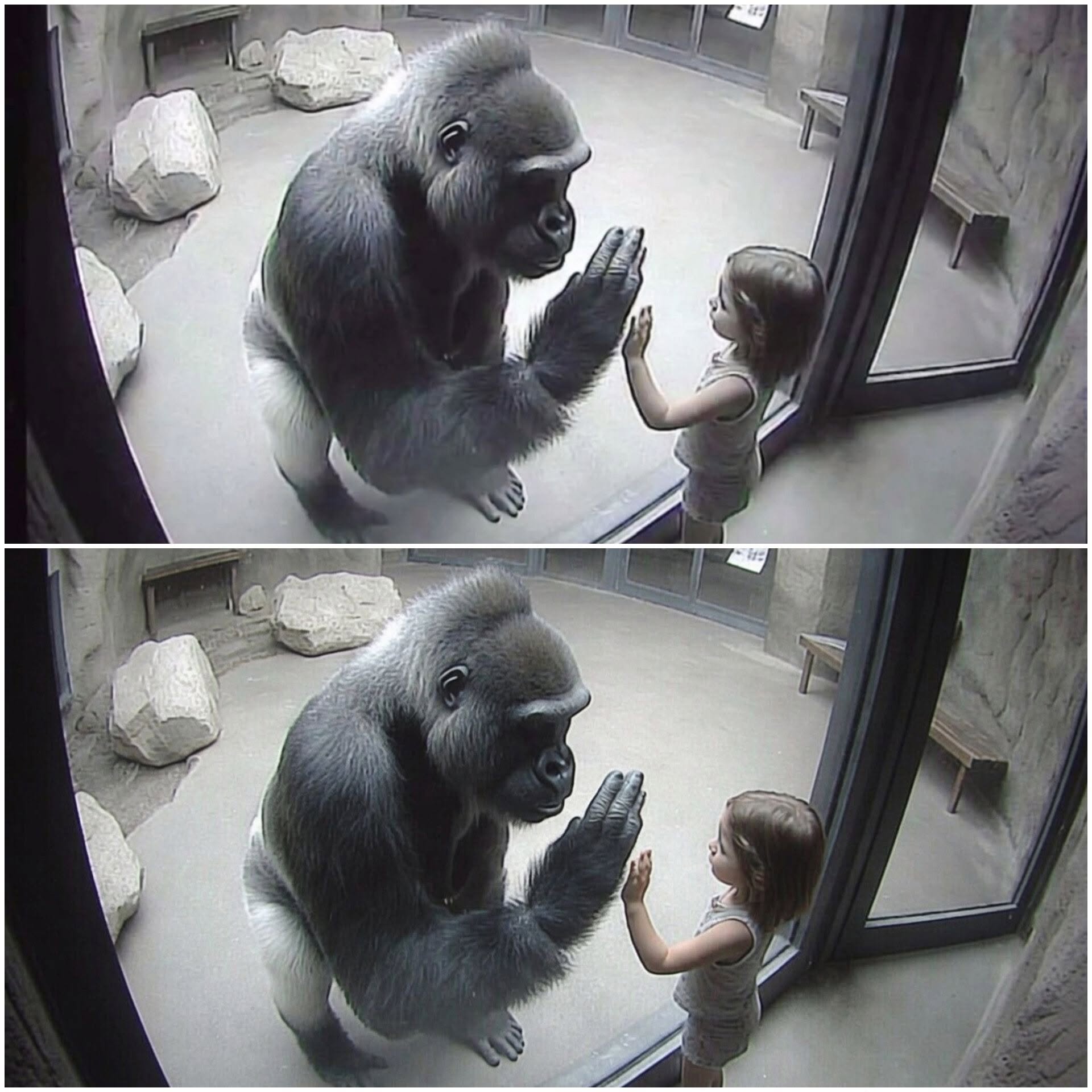
Every Saturday, an 8-year-old girl named Lily made her way through the zoo carrying something she had created at home.
It was never food. She brought no toy and expected no performance.
Instead, Lily carried a drawing.
Week after week, she passed the louder attractions and eventually reached the enclosure of Kito, an elderly silverback gorilla who had become noticeably withdrawn after losing his longtime companion.
Then she sat down and showed him what she had made.
For a long time, Kito barely responded.
But Lily kept coming back.
And one Saturday, the gorilla who had spent months keeping his distance did something that stopped visitors and keepers in their tracks.
Kito Had Once Been a Different Gorilla
Kito had spent decades around other gorillas and had once been remembered as an active, curious animal. He explored his surroundings and seemed interested in what was happening both inside and beyond his habitat.
That changed after the loss of his longtime companion.
Kito gradually became quieter. He spent extended periods sitting alone and appeared increasingly uninterested in the activity around him. Often, he stayed in the same corner while visitors moved through the exhibit.
To many families passing by, he may simply have looked like an aging gorilla resting by himself.
Lily saw something else.
She believed he was lonely.
Rather than accepting that observation and moving on, she decided to return the following Saturday.
And then the Saturday after that.
Soon, visiting Kito became a weekly ritual.
A Friendship Began With Children’s Drawings
Lily would sit on a wooden bench facing the enclosure and hold up that week’s picture.
The subjects changed.
Sometimes she drew flowers. Other weeks, bananas appeared on the page. She also made pictures of happy gorilla families.
The artwork was simple, but the routine behind it was remarkably consistent.
Lily wasn’t demanding Kito’s attention. She didn’t pound on the glass or shout in an effort to make him move closer.
She simply sat there.
As the visits continued, zoo employees began to notice the little girl who appeared every Saturday for the same animal.
Eventually, the keepers began saving her drawings and putting them in Kito’s indoor area, allowing him to see what she had brought for him.
Nothing dramatic happened at first.
Kito continued spending much of his time alone. There was no immediate transformation that proved Lily’s presence had changed his behavior.
Still, she returned.
That patience became the foundation of an unusual relationship: a child on one side of an enclosure and an elderly gorilla on the other, neither capable of speaking to the other, yet sharing the same quiet space every week.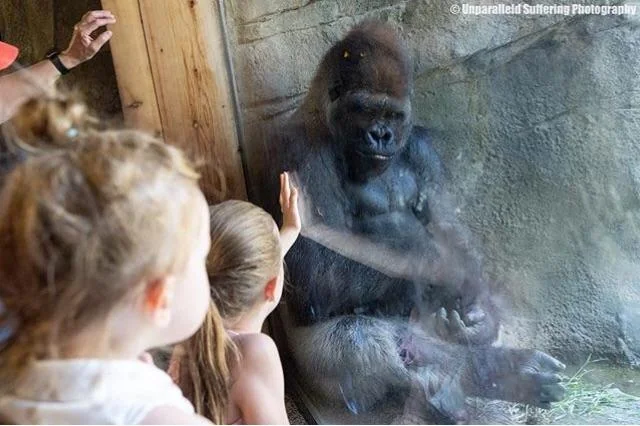
Then Kito Left His Corner
One Saturday, Lily arrived with another drawing and headed toward the enclosure just as she had many times before.
This visit would be different.
Kito was not remaining in his familiar spot.
The elderly silverback rose and began moving toward the viewing area.
People nearby noticed. So did the keepers.
For months, Kito had rarely approached the glass, according to the story. Yet now he was slowly walking directly toward the little girl who had repeatedly returned to see him.
Lily remained where she was.
Kito came closer.
Then the enormous gorilla lifted his hand and placed it against the glass.
Lily raised her much smaller hand and pressed it against the opposite side.
For a few seconds, the barrier became the meeting point between two completely different lives.
People around them reportedly fell quiet.
Even the keepers were surprised. They knew Kito’s personality from years of caring for him, but rarely saw him display that kind of direct interest in a visitor.
There had been no command and no reward waiting for him.
He had simply chosen to approach.
Saturdays Took on a New Meaning
That moment wasn’t the end of Lily’s visits.
She continued coming back.
And Kito’s connection with her became part of the Saturday routine.
There were no elaborate tricks or dramatic interactions required. The relationship remained remarkably simple: Lily showed up, Kito recognized her presence, and the two spent time near each other.
That simplicity was also what made their story resonate.
Gorillas are deeply social animals capable of forming important relationships, and the loss or disruption of those relationships can affect their behavior. The story presented Kito’s withdrawal after losing his companion as the emotional backdrop to Lily’s decision to keep returning.
Lily did not have the power to replace another gorilla or erase Kito’s loss.
What she could offer was consistency.
She noticed him when others walked past.
She returned when she had no obligation to do so.
And she gave her attention without requiring anything in exchange.
The Images Began Reaching People Far Beyond the Zoo
As photos of Lily and Kito’s relationship spread online, their unusual connection drew an emotional response.
On the surface, there wasn’t much happening.
A child visited a gorilla.
She brought pictures.
He eventually approached her.
Their hands met with a pane of glass between them.
But the image carried an idea almost anyone could recognize: the difference made when someone who seems forgotten discovers that another individual keeps returning.
The story also highlighted something children sometimes do instinctively. Lily wasn’t analyzing what she could gain from visiting Kito. She wasn’t searching for an exciting reaction.
She had noticed an animal who appeared alone and decided he needed company.
That was enough.
A Small Gesture That Became Something Larger
Lily never performed a spectacular rescue. She did not need money, special equipment or extraordinary influence to affect Kito’s world.
Her gesture was much smaller.
She showed up.
Again.
And again.
And again.
Eventually, the gorilla who had spent so much time sitting apart from the world crossed his enclosure and placed his hand against the glass in front of her.
Perhaps that is why the relationship between Lily and Kito connected with so many people.
Loneliness is easy to recognize, even when it cannot be explained in words. So is the feeling of realizing that somebody remembered you.
A child’s drawings could not remove the glass separating them. Lily and Kito would always belong to different worlds.
Yet each Saturday, for a little while, they met at the same place.
And sometimes friendship begins with nothing more complicated than noticing who is alone — and choosing to return.