Critics Called Spice World Disposable. Nearly 29 Years Later, Its Chaos Looks Like 1997 Preserved on Film
There is a moment near the end of Spice World when Victoria Adams — years before the world permanently knew her as Victoria Beckham — takes control of an enormous Union Jack double-decker bus and sends it flying across an opening Tower Bridge.
The effect is deliberately ridiculous. The filmmakers used a visibly miniature bus for the stunt, making almost no attempt to disguise the joke. It is loud, cheap-looking, absurd and completely comfortable with itself.
In other words, it may be the perfect image of Spice World.
When the Spice Girls’ first movie arrived in Britain in December 1997, followed by its U.S. release on January 23, 1998, many critics treated it as disposable pop merchandise. Roger Ebert awarded it just half a star. The Washington Post compared it unfavorably with other notorious music movies, while the film still sits at only 35% on Rotten Tomatoes and a 34 Metascore today.
Nearly 29 years later, however, something strange has happened.
Spice World has not disappeared.
Instead, the very things that made it seem hopelessly attached to its moment have become the reason it is so fascinating now. The platforms, animal prints, tabloid photographers, celebrity cameos, exaggerated Britishness, girl-power slogans and relentless pop-star branding no longer look merely excessive.
They look like 1997 trapped inside a 93-minute movie.

The Movie Arrived at Exactly the Right — and Wrong — Moment
By the time Spice World was being made, the Spice Girls were no longer simply a successful British group.
They were Spicemania.
“Wannabe” had spent seven weeks at No. 1 in Britain and turned the five women — Mel B, Emma Bunton, Melanie C, Geri Halliwell and Victoria Adams — into instantly recognizable characters: Scary, Baby, Sporty, Ginger and Posh. The group would ultimately collect nine U.K. No. 1 singles, more than any other girl group.
Their fame was accelerating so quickly that it affected the movie while it was being made. Producer Barnaby Thompson later remembered the extraordinary response when the group arrived at the 1997 Cannes Film Festival to promote the project. Screenwriter Kim Fuller said the production eventually had so many celebrities wanting appearances that new parts had to be created as filming continued.
That explains why watching Spice World today feels almost like opening a late-1990s celebrity yearbook.
Elton John appears. So do Roger Moore, Bob Hoskins, Jennifer Saunders, Bob Geldof, Elvis Costello and Jools Holland. Meat Loaf plays the Spice Girls’ bus driver. Richard E. Grant is their increasingly frantic manager, while Alan Cumming plays a filmmaker attempting to capture their lives.
At the time, the cameos could look like stunt casting.
Now they are part of the historical pleasure.
Its Almost Nonexistent Plot Is Part of the Point
There is technically a story.
The Spice Girls are rushing through an exhausting schedule while preparing for a major concert at London’s Royal Albert Hall. Their manager attempts to keep everything under control. A ruthless newspaper boss wants to damage their image. A paparazzo stalks them. Their pregnant friend Nicola needs them. Various bizarre fantasies, misunderstandings and adventures interrupt the journey.
But Spice World never behaves as though plot is particularly important.
That frustrated reviewers expecting a conventional feature film. Yet the people making it were looking backward to an earlier form of pop-star cinema, particularly the Beatles’ A Hard Day’s Night. Fuller has also identified This Is Spinal Tap as an influence, emphasizing the movie’s desire to mock celebrity machinery rather than present the Spice Girls solemnly.
The band had rejected an earlier Disney concept that would have given them a more conventional origin story. Instead, Fuller developed an exaggerated version of their lives with the women’s participation. He later described female friendship as central to what he saw in the group and what he tried to preserve in the film.
That distinction matters more with distance.
Spice World is not really trying to convince viewers that these women are serious dramatic actresses. It is presenting five amplified versions of public personas everyone already knew.
Even the machinery surrounding them becomes a joke: managers, record executives, movie producers, journalists and photographers are portrayed as ridiculous figures circling five young women who frequently seem more aware of the absurdity than the adults supposedly controlling them.
The Spice Bus May Be the Ultimate ’90s Artifact
Nothing captures that philosophy better than the Spice Bus.
Outside, it is a Union Jack-covered double-decker. Inside, physical reality disappears.
Production designer Grenville Horner created separate fantasy spaces reflecting each member’s identity: playful surroundings for Baby, exercise equipment for Sporty, sleek fashion for Posh, leopard-print and mystical elements for Scary, and retro touches for Ginger.
Horner later described the creation as essentially a mobile dollhouse. The interior was built at Twickenham Studios, where portions of the Beatles’ A Hard Day’s Night and Help! had also been filmed.
Today, the impossible bus seems almost more valuable as a cultural object than it did as a movie prop. It survived, was restored by a fan and has been kept on the Isle of Wight.
Its design contains nearly everything associated with Spice-era pop culture: loud individual identities, British iconography, fashion-as-personality and the belief that five different types of girls could belong in the same group without dressing or behaving identically.
Critics Saw Disposable Pop. Fans Saw Themselves
Contemporary critics were not universally hostile — The New York Times and San Francisco Chronicle were notably more receptive — but the overall response was poor. Critics repeatedly attacked the loose story, performances and calculated commercial nature of the project.
Audiences were less concerned.
The film opened with about $10.5 million in the United States and eventually earned roughly $29.3 million domestically and $56 million worldwide, according to The Numbers.
More importantly, the movie stayed with the generation that watched it as children and teenagers.
Later reassessments have increasingly focused on qualities that were easier to dismiss in 1997: its self-parody, female-centered friendships and refusal to build the women’s lives around romantic relationships. A 2017 Guardian retrospective argued that its girl-focused world offered young female viewers something unusual, while later retrospectives have described the film’s chaos as far more intentional and self-aware than its reputation suggested.
There is also an accidental poignancy to watching it now.
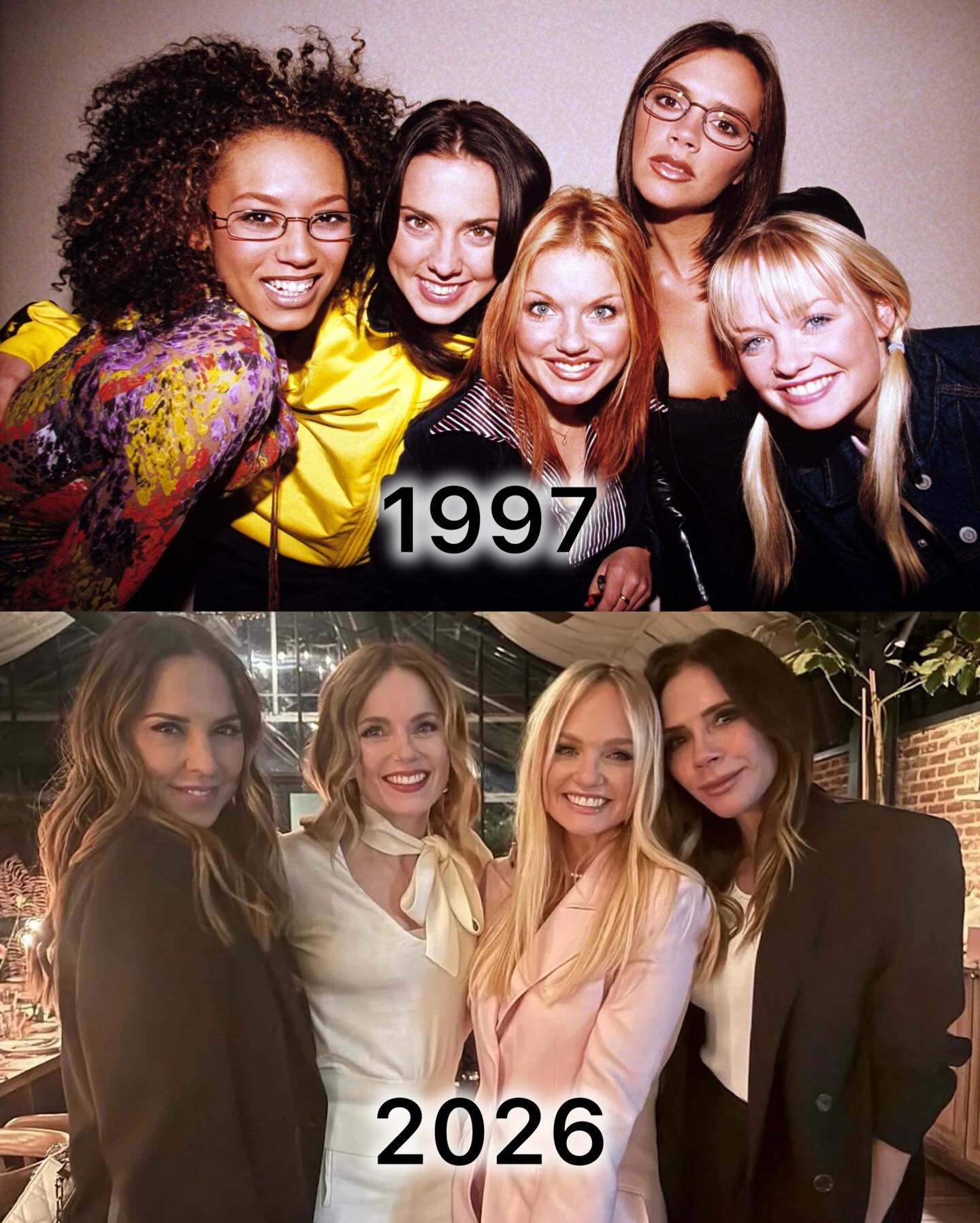
The five Spice Girls appear together at almost the exact peak of their original run, seemingly permanent and unstoppable. Yet Geri Halliwell left the group on May 31, 1998, only months after the movie’s release.
Even Victoria exists in a strangely preserved form. She is still credited as Victoria Adams. Behind the scenes in 1997, she was quietly beginning a relationship with David Beckham, a romance they initially kept private before the pair became one of the world’s most recognizable celebrity couples.
That is what time has given Spice World that no filmmaker could have deliberately created.
It captures the Spice Girls before anyone knew how the story would change.
The film was once mocked because it seemed destined to become outdated almost immediately. Instead, becoming outdated was its greatest gift.
Every platform shoe, celebrity cameo, tabloid joke, impossible bus interior and burst of Union Jack imagery now points back to an unusually specific cultural moment — one when five young women seemed capable of turning almost anything, including a critically mauled movie, into part of Spice World.
And nearly three decades later, we are still visiting.