19-Year-Old Goes in for Surgery to Remove 20-Centimeter Tumor on Her Ovary, but Things Didn’t Go as Planned
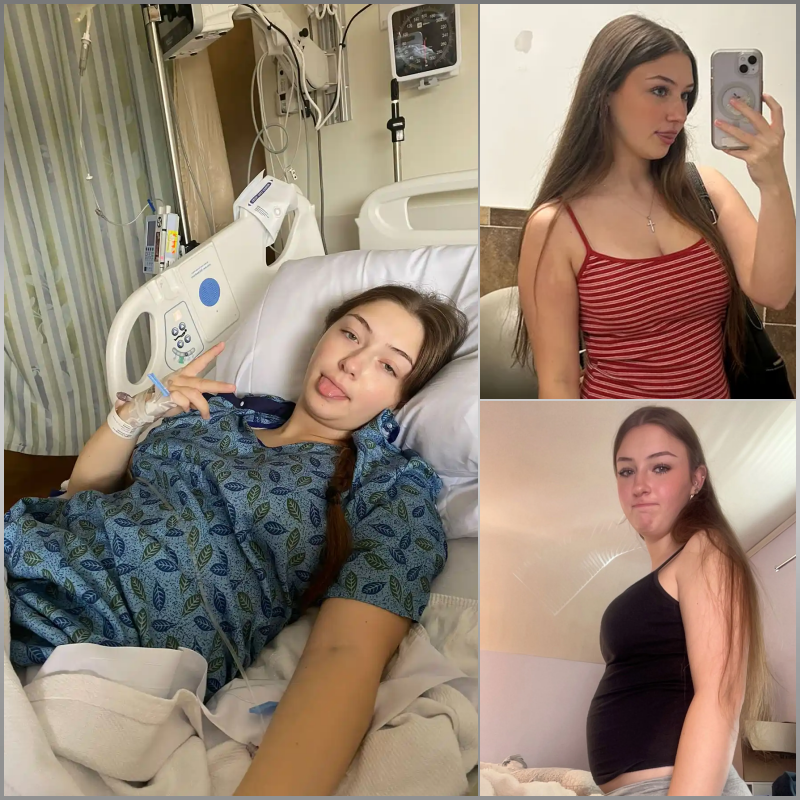
Elizabeth Langlais was going through her day-to-day as a college student in May 2026 when she started to feel a persistent pain in her appendix area and was having trouble walking.
When the pain didn’t go away, her roommates told her she needed to go to the hospital.
“I went to the hospital, and I told them that I thought it was my appendix. I was like, ‘This pain is so bad, I cannot move. I think it’s my appendix.’ I go to the pediatric wing, and I’m sitting there for a while,” she recalls.
When the doctor came in, he asked to press on her stomach and then told Langlais, 19, that she was likely just constipated.
“I got an X-ray, and it showed I was super constipated,” she continues. “I talked to the doctor, and he’s talking to me, and he’s said, ‘We’re going to give you some laxative treatment medication to take over the next couple of days and let you leave. But some of your symptoms sound like they could be caused by more than this. So if you want, we can do an ultrasound, but you have to stay here, use the bathroom, then do the ultrasound.’ “
Langlais and her roommate had class the next morning, and thinking it was just constipation, she went about her usual routine.
Elizabeth Langlais in the hospital.Elizabeth Langlais
After the school year ended, she went home to Rhode Island and went for a typical checkup with her doctor in June. During the appointment, she explained that she was still dealing with some of the same issues.
“I was getting bloated more often, but I chalked it up to just being because of the constipation,” she tells PEOPLE. “My doctor was concerned and had me get another X-ray, and then she prescribed me another laxative to take to get it all out of me.”
However, when she went for a follow-up shortly after, “the bloating was no longer temporary; it was constant.”
“My stomach was hard, and when I would lie on my back, it was lopsided,” she says. “You could see that there was something that was not supposed to be there, but she told me it was maybe a blockage, and that’s when we decided to get an ultrasound.”
Langlais went in for an ultrasound in early July, and they found a mass on her right ovary, measuring over 20 centimeters.
Doctors explained that, due to her age, it likely wasn’t cancer, but it could be.
“The constipation that I was having was caused because this mass was so huge, it was squishing my colon and not letting it work properly, which is why I was having so many issues,” Langlais shares.
Still, she would need surgery to remove it.
“The original plan was they were going to cut me from my pelvic bone to my belly button and then take it out. They were going to remove my right ovary. But then he said, ‘I’m going to do an abdominal exam on you if that’s okay,’” she remembers. “I lay down on the table, and he said, ‘This feels bigger than the 20 centimeters they had said.’ I was like, ‘What do you mean bigger?’ I was so shocked.”
“He said, ‘We might have to go up a little further with the incision, but it won’t be too bad,’” she continues. “I accepted it because I couldn’t dwell on that and be upset about that, but I wanted to get it out. I didn’t want to keep it.”
They scheduled the surgery for the following week, but it didn’t go as planned.
Elizabeth Langlais.Elizabeth Langlais
“They got in there, and they realized that I had one giant cystic tumor on my left ovary, which was 25 centimeters, and it was full of liquid because it was cystic,” she shares. “Then, I had a cluster of solid little masses on my right ovary.”
“So the plan to take out any of my ovaries is now completely out the window because you can’t do that now,” Langlais shares. “You can’t just take out both of someone’s ovaries without telling them. So they got the masses off of them.”
The doctors took out the cystic tumor and “popped it immediately.” They also were able to take a sample of the tumor and have the pathologist test it there for cancer.
“Mine was borderline, which means it can come back, and it probably will. When it does, it has a high likelihood of being cancer, but for now I don’t have cancer,” Langlais shares. “They said I have an 80% chance of recurrence, and they didn’t give me a number for cancer, but it’s highly likely.”
“They said, ‘Since we left both of your ovaries, that’s the reason it’s probably going to come back because it was only on my ovaries. If it comes back, we might have to take your ovary out, depending on whether it’s cancer, so we need you to freeze your eggs,’” she says.
Related Stories
A ‘Healthy’ Woman, 39, Had a Scan After a Car Crash. Doctors Then Discovered a 1.5-Inch Brain Tumor
Boy, 11, Gets Life-Changing Diagnosis After Noticing 2 Symptoms. Then Raises $1.2M for Other Kids with the Same Illness (Exclusive)
“I was so shocked. I’m 19 years old, and I have to go through IVF. That is genuinely insane,” she adds. “I think that was going to happen because you go to sleep thinking you’re just losing your ovary, you wake up finding out you’re going to be infertile soon, probably.”
“I was just so surprised,” she reiterates. “I was so shocked throughout that whole era. That was that for my diagnosis; they just told me that and then left me to recover.”
Langlais was in the hospital for six days and says she “got better, even though it was so hard.”
She notes that since her tumor was “borderline,” she doesn’t have to do chemo but is about to start fertility testing.
“I have to get some blood work in a month and do some appointments and talk to them and figure out when we actually want to start the hormone process with that,” Langlais shares.
Our new app is here! Free, fun and full of exclusives. Scan to download now!
Recently, Langlais posted about her tumor on TikTok and says she was able to connect with others who had something similar happen to them, which has helped her feel less alone in the process.
“I was living with it for so long, and then it’s just like I immediately get it out, and it’s over,” she says. “Even the long recovery that seemed so long when I was going through it, it’s like that was a week or two.”
“Sometimes get into a deeper mindset about it where I’m like, ‘This is a really sad thing that happened to me, and I’m going to have these side effects, and now I have to do these fertility things. I might have cancer in the future, I might become infertile.’ All this stuff that I could dwell on, but I really try not to,” she continues. “I’m not a serious person, so I don’t like to do that to myself and make myself feel bad thinking about the future when I could focus on how good it is now that at least that part of it is over and I’m feeling more back to normal again.”