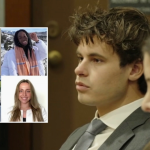
LUCY LETBY’S ‘MYSTERY BOYFRIEND’ FINALLY NAMED — THE MARRIED DOCTOR WHO WAS AT THE CENTRE OF A SHOCKING COURTROOM REVELATION
LUCY LETBY’S ‘MYSTERY BOYFRIEND’ FINALLY NAMED — THE MARRIED DOCTOR WHO WAS AT THE CENTRE OF A SHOCKING COURTROOM REVELATION
For years, his identity was protected.
He appeared in court behind a screen, known only by a letter.
He was the married doctor prosecutors described as being at the centre of Lucy Letby’s intense personal attachment — a man who exchanged more than 1,300 Facebook messages with the former neonatal nurse.
Now, for the first time, his name can be revealed.
Dr Mark Deakin, a 53-year-old married father of two, has been identified as the doctor previously referred to during Letby’s trial as her alleged “boyfriend”.
The revelation came after the Court of Appeal lifted the reporting restrictions that had protected his identity.
The decision followed his death earlier this year.
And behind the name is a complicated story involving Letby, confidential patient information, an internal hospital investigation and a relationship that prosecutors believed had become deeply significant to her.
 THE DOCTOR WHO COULD NOT BE NAMED
During Letby’s trial, Dr Deakin was known publicly only as Dr A.
His anonymity was ordered because he was a witness in the proceedings.
He had worked alongside Letby at the Countess of Chester Hospital during the period in which she was convicted of harming babies.
When he entered the witness box, Letby reportedly became emotional and attempted to leave the dock.
The prosecution argued that Letby had become infatuated with the doctor.
But Deakin did not describe their relationship in those terms.
He maintained that he had been misled and manipulated by Letby and that he did not understand the full extent of the concerns surrounding her at the time.
 MORE THAN 1,300 MESSAGES
Evidence presented during the wider investigation showed that Deakin and Letby exchanged more than 1,300 Facebook messages over a period of several months.
Their conversations went far beyond routine workplace communication.
They discussed their personal lives and patients, while Letby also sent affectionate messages to the doctor.
Police later found handwritten notes at Letby’s home in which she referred to Deakin as her “best friend” and expressed strong feelings for him.
The prosecution argued that the relationship was important to understanding Letby’s behaviour.
Prosecutors suggested that Letby may have created medical emergencies because she knew Deakin would be called to respond.
That was a prosecution theory, however, rather than a separate finding that Deakin knowingly encouraged or participated in her crimes.
THE BABY AT THE CENTRE OF THE MESSAGES
One of the most serious issues surrounding Deakin concerned a premature baby known in court as Baby N.
Letby was convicted of attempting to murder Baby N.
During their correspondence, Letby asked Deakin about the baby’s condition and whether she had done anything wrong while caring for him.
Deakin responded with reassurance.
Years later, the exchanges became part of a much broader examination of how information about babies in the neonatal unit had been shared.
An investigation at Alder Hey Children’s Hospital eventually concluded that Deakin had breached patient confidentiality by accessing Baby N’s medical records inappropriately.
THE ALDER HEY CONNECTION
The story did not end with the trial.
After Letby was removed from clinical duties at the Countess of Chester Hospital, Deakin later arranged for her to make several observational visits to Alder Hey Children’s Hospital in Liverpool.
The visits took place in December 2016, months after Letby’s final conviction-related incident and while she was working in a non-clinical role.
According to the investigation, she was allowed to attend meetings, ward rounds and clinics.
She also attended a hospital presentation involving insulin — a particularly sensitive detail given the prosecution’s case concerning insulin in two of the babies.
A letter approving the visits required Letby to be supervised and prohibited direct patient contact.
However, investigators later examined whether Deakin should have arranged the visits at all.
THE INVESTIGATION THAT ENDED HIS CAREER
Following Letby’s 2023 convictions, Deakin informed Alder Hey about his involvement in her trial and the visits he had arranged.
The hospital initially concluded that he had not known about the concerns surrounding Letby when he organised them.
But a complaint from the mother of Baby N prompted a formal investigation in January 2024.
That investigation lasted around 18 months.
According to findings reported by The Times, investigators concluded that Deakin had a very close relationship with Letby and was likely aware that colleagues had raised concerns about her.
They also concluded that he had accessed Baby N’s medical records improperly.
Deakin denied knowing that Letby was suspected of harming babies when he arranged the visits.
The disciplinary panel rejected his account.
On June 23, 2026, he was dismissed by Alder Hey for gross misconduct.
ONE DAY LATER, EVERYTHING CHANGED
Just one day after being dismissed, Deakin was found unconscious inside his car at a retail park around 20 miles from his home in Cheshire.
He was taken to hospital and admitted to intensive care.
He died nine days later in June 2026.
An inquest into his death is expected to take place.
His death ultimately changed the legal position surrounding his identity.
The Court of Appeal ruled that the anonymity order could no longer be maintained because the original justification for protecting his identity no longer applied.
The court also considered representations from his family before lifting the restriction.
WHY HIS NAME CAN NOW BE REPORTED
The decision was based on the principle of open justice.
Lord Justice Singh expressed sympathy to Deakin’s widow and family but concluded that the circumstances had fundamentally changed following his death.
That means the doctor once known simply as Dr A can now be identified publicly.
His name is Mark Deakin.
A name that had remained hidden throughout one of Britain’s most closely watched criminal trials can now be placed alongside the evidence surrounding Letby’s relationships and the subsequent investigation into his conduct.
LETBY REMAINS IN PRISON
Lucy Letby is currently serving multiple whole-life sentences after being convicted of murdering seven babies and attempting to murder seven others at the Countess of Chester Hospital between 2015 and 2016.
Her direct appeals have been exhausted, while her case is being considered by the Criminal Cases Review Commission.
The naming of Dr Deakin does not change those convictions.
Nor does it establish that he knew about or participated in Letby’s crimes.
Instead, it sheds new light on a previously anonymous figure whose relationship with Letby became an important part of the evidence and subsequent investigations.
For years, the public knew only “Dr A.”
Now they know who he was.
Dr Mark Deakin — a married father, a former paediatric consultant, a colleague of Lucy Letby, and the man prosecutors portrayed as the focus of her intense personal attachment.
His identity has finally emerged.
But the questions surrounding what he knew, what Letby told him and how their relationship influenced the events around the neonatal unit remain part of the much larger story that continues to surround the Lucy Letby case.