VOICE IN HER HEAD VS. PROSECUTION’S CASE — LINDSAY CLANCY TRIAL ENDS IN MISTRIAL AFTER JURY DEADLOCK
VOICE IN HER HEAD VS. PROSECUTION’S CASE — LINDSAY CLANCY TRIAL ENDS IN MISTRIAL AFTER JURY DEADLOCK
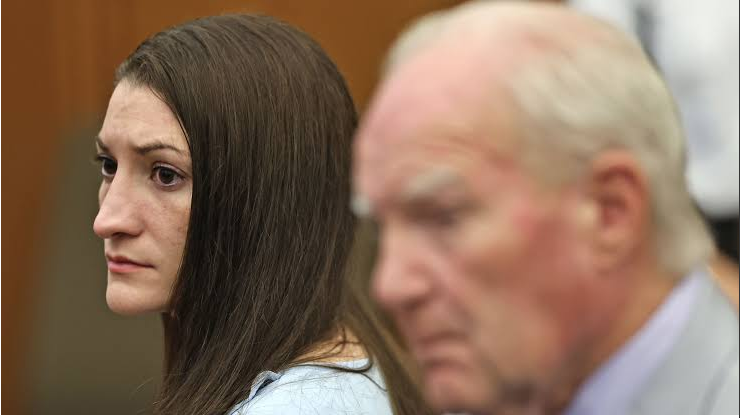
For nearly six weeks, the courtroom heard testimony about a mother, three children and a terrifying question: Was Lindsay Clancy criminally responsible for what happened inside her Massachusetts home?
On Friday, September 4, that question remained unanswered.
After seven days of deliberations and nearly 40 hours of discussion, the jury told the judge it could not reach a unanimous verdict.
Judge William Sullivan ultimately declared a mistrial, bringing one of the most closely watched criminal trials in Massachusetts to an extraordinary end without a verdict.
And at the center of the deadlock was a bitter dispute over one juror.
 A CASE BUILT AROUND ONE QUESTION
Lindsay Clancy, 36, did not dispute that she strangled her three children in January 2023.
Her defense, however, argued that she should not be held criminally responsible because she was experiencing postpartum psychosis and severe psychiatric illness at the time.
Her attorney, Kevin Reddington, argued that Clancy’s mind had deteriorated dramatically following the birth of her third child.
The defense described hallucinations, intrusive thoughts, medication problems and an overwhelming psychiatric crisis.
According to the defense theory, Clancy believed she was hearing a voice directing her to harm her children.
Prosecutors presented a radically different interpretation.
They argued that Clancy’s actions were deliberate and that she understood what she was doing.
The prosecution pointed to evidence suggesting that she sent her husband out of the house shortly before the children were harmed.
The two sides therefore presented the jury with two fundamentally different pictures of the same woman.
One was a mother experiencing a devastating psychotic episode.
The other was a woman who deliberately carried out an intentional act.
:max_bytes(150000):strip_icc():focal(702x512:704x514):format(webp)/lindsay-clancy-trial2-9326-a7de4e1d7cd84cf5aba0ee885aaec694.jpg) THE CHILDREN AT THE CENTER OF THE CASE
THE CHILDREN AT THE CENTER OF THE CASE
Clancy’s three children were Cora, 5, Dawson, 3, and Callan, 8 months old.
On January 24, 2023, the children were found in the basement of the family’s Duxbury, Massachusetts, home.
Prosecutors said Clancy used exercise bands to strangle them.
Afterward, Clancy attempted to take her own life by cutting her wrists and jumping from a second-story window.
She survived but suffered severe injuries that left her paralyzed and dependent on a wheelchair.
Throughout the trial, she appeared in court in that wheelchair.
The physical consequences of that day became an unavoidable backdrop to the proceedings.
THE DEFENSE: A MIND IN CRISIS
Reddington spent the trial trying to convince jurors that Clancy’s mental state was fundamentally different from that of a person consciously choosing to commit a crime.
The defense argued that she had developed postpartum psychosis after giving birth to Callan and that her psychiatric treatment had failed her.
Her lawyers also questioned the medications she had been prescribed and the care she received before the tragedy.
Experts testified about psychosis and the ways severe psychiatric illness can distort a person’s perception of reality.
The defense’s central argument was not simply that Clancy was depressed.
It was that she was so mentally impaired that she could not understand the wrongfulness of her actions.
That distinction was crucial.
The jury was not simply being asked whether Clancy had caused the children’s deaths.
It had to determine whether she was criminally responsible for them.
PROSECUTORS SAW SOMETHING VERY DIFFERENT
The prosecution acknowledged that Clancy had serious mental-health struggles.
But prosecutors argued that mental illness did not erase her responsibility.
They portrayed her actions as purposeful and pointed to evidence they said showed planning.
One of the prosecution’s key arguments was that Clancy had sent her husband away from the home shortly before the children were harmed.
Prosecutors argued that this was evidence of deliberate behavior rather than an uncontrollable psychotic episode.
The jury therefore faced a deeply complicated question:
Where does severe mental illness end and criminal responsibility begin?
After weeks of testimony, they still could not agree.
THEN CAME THE JUROR DISPUTE
The case took an extraordinary turn during deliberations.
The jury’s foreperson sent a note to Judge Sullivan indicating that one juror was allegedly refusing to follow the court’s instructions concerning reasonable doubt.
Reddington seized on the development.
He argued that the juror should be removed and replaced, saying the person was preventing the jury from reaching a unanimous decision.
According to Reddington, the jury was effectively split 11-1.
He later told reporters that one juror appeared to have acknowledged doubt but would not apply the legal standard instructed by the judge.
The defense’s request put the judge in an extraordinary position.
Removing a juror simply because that juror disagreed with the majority could itself interfere with the jury’s independence.
After questioning jurors individually, Sullivan declined to replace the man.
The judge concluded that the juror had acknowledged having doubts but had not demonstrated an unwillingness to follow the law.
THE LAST ATTEMPT TO SAVE THE VERDICT
As deliberations continued, the tension intensified.
The jury had already been told to continue working after earlier indications of deadlock.
Eventually, after more than 38 hours of deliberation spread across seven days, the jurors sent another note.
They were still unable to reach a unanimous decision.
The judge prepared to declare a mistrial.
But Clancy’s defense made one final attempt to stop it.
Reddington asked the Massachusetts Supreme Judicial Court to intervene and effectively allow the jury to continue deliberating.
The emergency request was rejected.
Judge Sullivan then formally declared the mistrial.
NO VERDICT — AND NO FINAL ANSWER
The mistrial means Lindsay Clancy has not been convicted or acquitted.
The charges remain unresolved.
Prosecutors must now decide what comes next.
They could seek a new trial, potentially pursue a different resolution, or consider other legal options.
A hearing has been scheduled for September 29 to address the next steps.
For Clancy’s defense, the deadlock represents something very different from a defeat.
Reddington has argued that the jury’s inability to agree demonstrates the complexity of the evidence surrounding Clancy’s mental state.
He has also sharply criticized the holdout juror, saying after the mistrial that Clancy had been “robbed” by the man he believed was the lone juror opposing acquittal.
But prosecutors have not accepted that interpretation.
The fact that a jury could not reach a verdict does not establish that Clancy was legally innocent, nor does it establish that the lone juror acted improperly.
It means only that the required unanimous verdict was not reached.
A TRIAL THAT LEFT ONE QUESTION UNANSWERED
The case began with an unimaginable tragedy.
Three children died inside their own home.
Their mother survived a suicide attempt and was left permanently paralyzed.
And for more than a month, a courtroom heard competing explanations for how a mother could commit such an act.
The defense said psychosis had taken control of Clancy’s mind.
The prosecution argued that she knew what she was doing.
Then, after weeks of evidence and nearly 40 hours of deliberation, twelve jurors could not agree.
The courtroom now moves into another uncertain chapter.
There is no verdict.
There is no final resolution.
And the question that dominated the trial remains unanswered:
Was Lindsay Clancy a mother overwhelmed by a devastating psychiatric illness — or was she criminally responsible for the choices she made that day?
For now, the law has no final answer.
The case is not over.