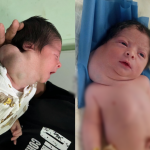
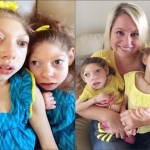
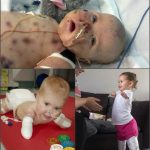
A RARE CONDITION THAT MAKES CHILDREN AGE FAR TOO SOON: THE 3-YEAR-OLD WHO LOOKS LIKE AN 80-YEAR-OLD AND THE 2-YEAR-OLD WHO WEIGHS LESS THAN 7KG
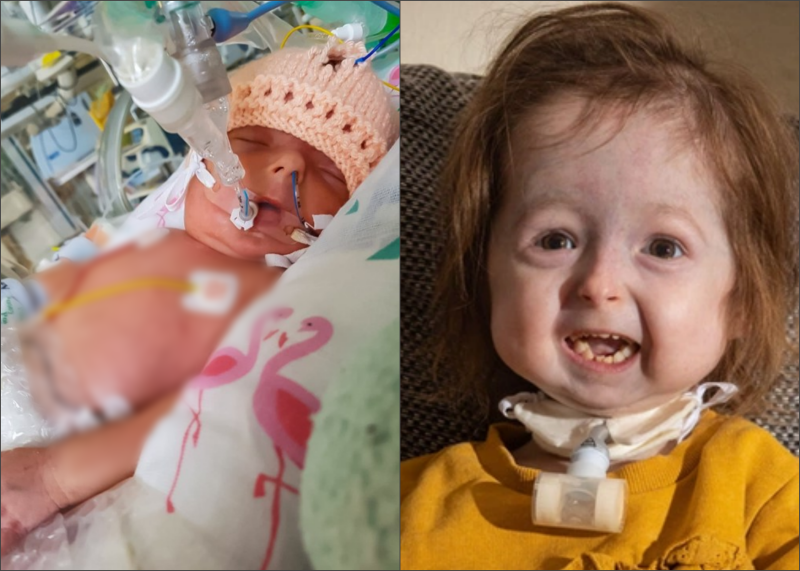
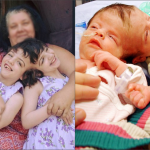
Little Isla Kilpatrick-Screaton from the UK is one of only a handful of people known to live with an extraordinarily rare condition sometimes described as “reverse aging.”
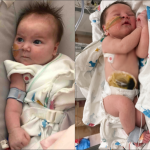
Isla was born in February, weighing around 2.6kg. Her mother, Stacey, 33, told British news agency SWNS that by October that year, Isla was diagnosed with mandibular hypoplasia – a genetic disorder characterized by underdevelopment of the lower jaw and collarbones, loss of bone at the tips of the fingers and toes, thinning of the skin and partial lipodystrophy – in which the body selectively loses fatty tissue from different areas.

“We nearly lost our little girl. Isla resisted everything the doctors tried to do. She had to spend her first five days in an incubator and was placed into a deep sleep. We couldn’t even hold or cuddle her,” her mother said.
Stacey recalled that just six days after bringing her daughter home, she and her husband Kyle, 36, had to call emergency services when Isla began struggling while feeding. “She was spluttering and her skin started turning blue when we gave Isla her bottle. One of us would perform CPR while the other stayed on the phone. At the hospital, doctors cleared her airway, and she remained there for another two weeks,” the mother recalled.

Six months later, the family finally received an answer about their daughter’s condition: “When we had the diagnosis in our hands, the genetic specialist told us that Isla was the only person in the world known to have this particular genetic change, and that it was the reason behind her condition. Only seven cases of mandibular hypoplasia had previously appeared in medical literature, but none involved this particular genetic change.”
The National Organization for Rare Disorders (NORD) says the condition “may be classified as a form of lipodystrophy or premature aging because of overlapping symptoms, including an appearance that can look older than expected.”
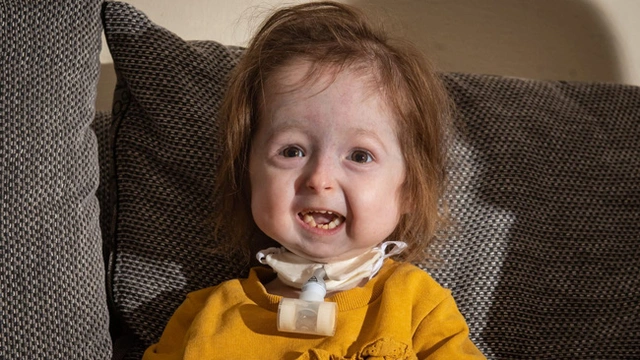
As a result, Isla has faced numerous health challenges from a very young age. She can only say a few words and mainly uses Makaton sign language to communicate with her family.
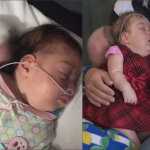
Isla has a heart condition and breathing difficulties caused by a narrowed airway. She currently has a tube, known as a tracheostomy tube, in her throat to help support her breathing. She cannot eat independently, so doctors performed a gastrostomy procedure to provide high-calorie milk as well as solid and other specially prepared foods.
Isla cannot cry, so when she sleeps, she is connected to a heart monitor, with an alarm sounding when she wakes. “That means we are able to get some sleep at night.”

Despite all these challenges, Isla’s mother proudly describes her daughter as “very expressive and communicative – a happy little girl.”
Her father, however, has also opened up about the condition affecting his “extremely tiny and fragile” daughter: “We were told that Isla’s condition is not expected to affect her lifespan, but we simply don’t know for certain because her particular case is so incredibly rare. In some ways, we feel like we have been left in the dark. We were told that mandibular hypoplasia usually has two types, A or B. But Isla doesn’t fit into either of those categories, so we have no idea where we stand. There really isn’t much support available, so we just keep doing our best, day after day.”