Tony Stark Gave Peter Parker Everything — Brand New Day Takes It All Away and Shows What Peter Can Build Alone
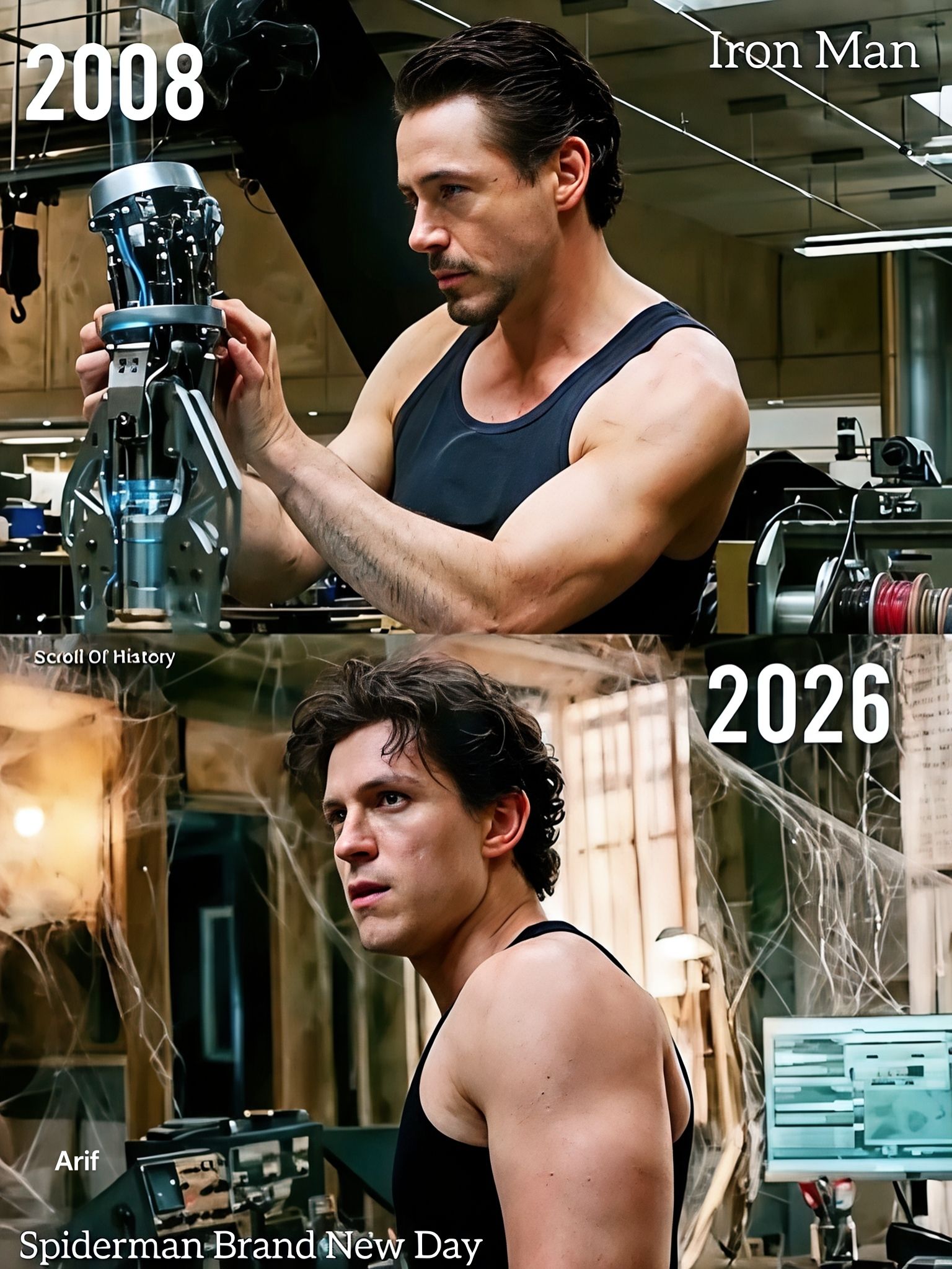
When Iron Man arrived in 2008, Tony Stark’s appeal was never just that he owned the most advanced armor in the room.
The movie made audiences watch him earn it.
Tony stood in his workshop surrounded by tools, unfinished components and robotic equipment, testing repulsors, crashing prototypes and correcting problems one failure at a time. The filmmakers deliberately emphasized the construction process, showing the Mark II and Mark III developing piece by piece so audiences could believe that the man inside the armor was genuinely an engineer.
Eighteen years later, Spider-Man: Brand New Day brings Peter Parker surprisingly close to that same image.
The difference is that Tony had an extraordinary laboratory and almost unlimited resources.
Peter has a battered apartment and whatever he can build himself.
And that may be one of the most important changes Tom Holland’s Spider-Man has undergone since entering the Marvel Cinematic Universe.

Peter Parker Grew Up Surrounded by Stark Technology
From the beginning, Holland’s Spider-Man was unusually connected to Tony Stark.
Tony recruited Peter in Captain America: Civil War and supplied him with upgraded equipment. In Spider-Man: Homecoming, Peter’s new costume was explicitly Stark technology, loaded with features far beyond the homemade suit he had created before meeting Tony. Marvel itself promoted the film around the idea that Stark had given Spider-Man an upgraded suit.
That relationship continued even after Tony’s death.
In Spider-Man: Far From Home, Peter gained access to E.D.I.T.H., Tony’s powerful augmented-reality system, and later used Stark equipment aboard Happy Hogan’s jet to design another Spider-Man suit.
There was always something important underneath that technology: Peter was smart enough to understand it.
But the machinery was still there waiting for him.
That fueled a long-running criticism of the MCU version of Spider-Man. For some viewers, Peter’s connection to Stark Industries made him feel less like the financially struggling young inventor traditionally associated with Spider-Man and more like a junior member of Iron Man’s technological world.
Then No Way Home destroyed that safety net.
No Way Home Took Away Peter’s Entire Support System
At the end of Spider-Man: No Way Home, Peter makes the devastating decision to let Doctor Strange erase everyone’s memory of Peter Parker.
MJ no longer knows him.
Ned no longer knows him.
Happy Hogan encounters him as a stranger.
Peter moves into a small apartment and begins his life again without the relationships that had defined his teenage years.
Brand New Day, released July 31, 2026, builds directly from that isolation. Sony’s official description presents Peter as a full-time Spider-Man operating in a world that no longer remembers him while watching his former friends continue their lives without him.
But the reset is not only emotional.
It is technological.
Costume designer Sanja Milkovic Hays explained that one of the fundamental ideas behind the new Spider-Man suit was that Peter was now on his own, without Stark Industries supplying the solution. He has to make the costume himself rather than relying on nanotechnology or Stark resources. Director Destin Daniel Cretton wanted the result to feel simpler, handmade and physically believable.
That decision changes the meaning of Peter’s equipment.
For years, audiences watched what Peter could do with Tony Stark’s technology.
Now they get to see what Peter Parker can invent when the billionaire is gone.

Peter Builds His Own Workshop From Scraps
One of the clearest symbols of that transformation sits inside Peter’s apartment.
It is called the Fabricator.
The machine is essentially Peter’s homemade manufacturing station, used to maintain and repair his equipment. Early material for the film described it as something resembling an extremely advanced 3D printer created by a brilliant young inventor working with limited money. One description compared the device to a combination of a sewing machine and a 3D printer.
Production designer Charles Wood approached the machine with the same philosophy.
Wood said the crew imagined something that could theoretically have arrived in hundreds of ordinary packages and then been assembled by an exceptional mind. The finished prop was deliberately mechanical and tactile. It moved, vibrated and functioned physically on the set instead of existing only as a digital effect.
The visual comparison with Tony Stark is difficult to miss.
Tony had robotic arms, holographic interfaces and a workshop worthy of a billionaire industrialist.
Peter has mismatched components and a machine that looks as though he built it from whatever he could afford.
But both characters do essentially the same thing.
They stand in front of a problem and engineer their way through it.
Even Spider-Man’s Imperfect Suit Is Part of the Story
The new Spider-Man costume follows that philosophy all the way down to its wrinkles.
Cretton and the costume team did not want Peter’s suit to appear impossibly smooth or digitally perfected. They wanted viewers to see fabric folding over a real human body.
The imperfections were intentional.
Hays said the simplicity actually made the costume more difficult to manufacture because flaws could not be hidden beneath layers of futuristic detailing. Her team tested more than 250 meters of fabric while searching for the right shades of red and blue on digital cameras.
And despite the story presenting the costume as Peter’s homemade creation, the production needed a remarkable number of real versions.
About 56 Spider-Man suits were constructed for Holland and the stunt performers because the costumes had to survive demanding action sequences, damage and repeated filming. Holland also spent roughly 80 percent of the movie in the Spider-Man suit, more than on his previous Spider-Man films, according to Hays.
There is something wonderfully ironic about the result.
A huge Hollywood production devoted enormous craftsmanship to making Spider-Man look like a young man who no longer has access to enormous resources.
The wrinkles matter.
The repairs matter.
The homemade machinery matters.
They tell the audience where Peter Parker is now.
Tony’s Most Important Gift Was Never the Suit
That makes Brand New Day an unexpected continuation of one of Tony Stark’s earliest lessons to Peter.
In Homecoming, Tony takes the Stark suit away after Peter’s recklessness and challenges the teenager to consider whether he can still be Spider-Man without it.
Peter eventually proves that he can.
But the MCU gradually gave him even more advanced technology afterward, culminating in equipment that sometimes made Spider-Man appear closer to a miniature Iron Man than the resourceful neighborhood hero Peter Parker traditionally represents.
Brand New Day pushes the character much further.
Peter does not simply lose one costume.
He loses the entire infrastructure behind it.
No Stark laboratory.
No nanotech solving every mechanical problem.
No billionaire mentor waiting to upgrade the next version.
No Happy Hogan who remembers Peter Parker.
Instead, he has his intelligence, his hands, whatever parts he can obtain and the responsibility of keeping Spider-Man functioning day after day.
That makes the new suit more than a costume change.
It is evidence.
Tony Stark began the MCU by proving he could build Iron Man with his own hands.
Eighteen years later, Peter Parker has been stripped of almost everything Tony once placed within his reach.
And strangely, losing Stark technology may be what finally shows how much Peter learned from Tony in the first place.