After Titanic, Leonardo DiCaprio Could Have Chased Another Jack Dawson — Instead, He Rebuilt His Career Around Risk
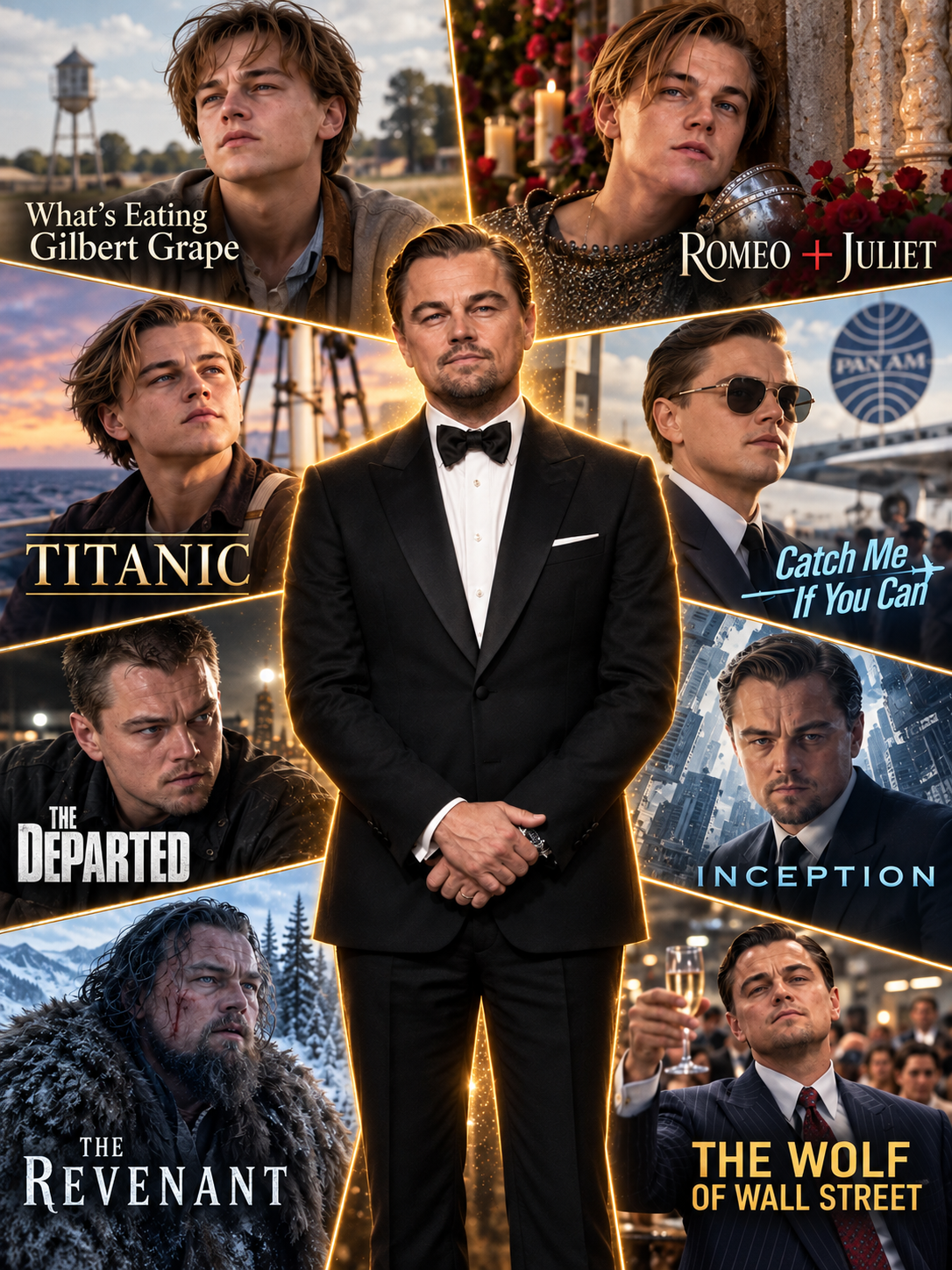
Before Leonardo DiCaprio became Jack Dawson, before Titanic turned his face into a global obsession, Hollywood already had evidence that he was much more than a future heartthrob.
He was still a teenager when his performance in What’s Eating Gilbert Grape earned him an Academy Award nomination for Best Supporting Actor at the 1994 Oscars. DiCaprio played Arnie Grape opposite Johnny Depp, and the role announced him as a serious dramatic talent years before blockbuster fame arrived.
Then came Baz Luhrmann’s Romeo + Juliet in 1996, which transformed Shakespeare’s tragic hero into a modern pop-culture icon.
A year later came Titanic.
And suddenly, DiCaprio’s career became something he had never planned for.
James Cameron’s disaster romance did not simply make him more famous. Jack Dawson became a cultural phenomenon, and DiCaprio found himself at the center of the kind of celebrity frenzy few actors ever experience.
The strange part was that he had not chosen the movie expecting that outcome.
Years later, DiCaprio explained that he had seen Titanic as a chance to try something different from the smaller films he had been making. He said he did not enter the project thinking it was his moment to become the “biggest young movie star in the world.”
Then the movie exploded.
Almost overnight, the actor who had built his reputation through performances in films such as This Boy’s Life and Gilbert Grape was suddenly being defined by Jack Dawson.

There Was No Manual for What Happened Next
The attention surrounding DiCaprio after Titanic became so intense that it eventually acquired its own nickname: “Leo-mania.”
Magazine covers followed him. Paparazzi followed him. His relationships became public entertainment. Every new movie faced inevitable comparison with one of the most successful films ever made.
In a 2002 interview with Barbara Walters, DiCaprio described one of the problems simply: there was “no handbook for fame.”
He said he had not had anyone who could really guide him through the sudden transformation of his life. At the same time, he made clear that he understood how fortunate he was to have the opportunities that success created.
What he did with those opportunities would determine the next phase of his career.
The obvious Hollywood strategy would have been to capitalize immediately on Jack Dawson.
More romances. More enormous studio productions. More roles designed around the image millions of new fans had fallen in love with.
DiCaprio did something less predictable.
He slowed down.
He did appear in The Man in the Iron Mask and Celebrity in 1998 and later starred in The Beach, but he did not spend the years after Titanic trying to manufacture another version of the same phenomenon.
Looking back, he said the intensity eventually pushed him to take a break for a couple of years so he could “recharge and refocus.”
The goal was not to escape acting.
It was to decide what kind of actor he wanted to become.

He Needed to Hear His Own Voice Again
DiCaprio later described that period in unusually revealing terms.
He said he needed to “learn to hear my own voice” when choosing roles and determining where he wanted his career to go.
That distinction mattered.
Titanic had given him extraordinary fame. But fame could easily have started making his decisions for him.
Instead, DiCaprio increasingly used his new commercial power to gain access to filmmakers and projects he genuinely wanted.
One movie demonstrates that shift better than almost any other: Martin Scorsese’s Gangs of New York.
Scorsese had wanted to make the sprawling historical drama for years, but the expensive project had struggled to come together. DiCaprio’s post-Titanic value helped make him the kind of star who could improve the financial prospects of an ambitious film.
DiCaprio later put the connection plainly: Gangs of New York probably would not have been financed without Titanic.
That may be the key to understanding his entire post-Titanic career.
Jack Dawson was not the destination.
Jack Dawson became leverage.

From Spielberg to Scorsese to Nolan
By 2002, the new strategy was becoming visible.
That year DiCaprio appeared in Steven Spielberg’s Catch Me If You Can, playing real-life con man Frank Abagnale Jr., while also starring as Amsterdam Vallon in Gangs of New York.
The Scorsese film became the beginning of one of the defining director-actor partnerships of DiCaprio’s career.
They followed it with The Aviator, The Departed, Shutter Island and The Wolf of Wall Street, with DiCaprio repeatedly moving toward complicated, unstable or morally compromised characters rather than trying to preserve his romantic-idol image.
The Departed placed him inside a brutal undercover crime story.
The Wolf of Wall Street turned his charisma into something more corrosive, allowing him to play Jordan Belfort as wildly entertaining while exposing the excess and damage surrounding him.
Between those Scorsese projects came Christopher Nolan’s Inception in 2010.
On paper, it was a giant summer blockbuster.
But it was hardly Titanic 2.0.
DiCaprio played Dom Cobb, a psychologically burdened thief navigating dreams, memory and guilt inside Nolan’s elaborate science-fiction structure.
By then, the pattern was clear. DiCaprio could still anchor enormous movies, but he was increasingly choosing them around directors and material rather than simply around conventional movie-star appeal.

The Oscar Took More Than Two Decades
There was one remarkable piece of unfinished business.
DiCaprio had received his first acting Oscar nomination at the 1994 ceremony.
More nominations followed for The Aviator, Blood Diamond and The Wolf of Wall Street.
But the win kept eluding him.
Then came Alejandro González Iñárritu’s The Revenant.
If Jack Dawson represented the polished young movie star DiCaprio had accidentally become, Hugh Glass seemed almost like his opposite.
There was no glamorous romance.
Much of the performance was physical rather than conversational. DiCaprio spent the film battered, filthy and exposed to a punishing wilderness.
The production itself became famous for its difficult conditions. DiCaprio described repeatedly entering freezing rivers and working in extreme cold.
And then there was the liver.
For one scene, the production had prepared a fake bison liver made from jelly. DiCaprio believed it did not look convincing enough, so he ate actual raw bison liver instead.
The reaction captured in the finished movie was genuine. DiCaprio later described it as an “instinctive reaction.”
On February 28, 2016, more than two decades after his first nomination, Leonardo DiCaprio finally won the Academy Award for Best Actor for The Revenant.
There is something fitting about the role that finally earned him the Oscar.
The teenage actor recognized for What’s Eating Gilbert Grape had become one of the most famous people in the world through Titanic. He could have spent the next phase of his career protecting that image.
Instead, he repeatedly complicated it.
Titanic gave Leonardo DiCaprio the kind of fame most actors spend their entire careers chasing.
What mattered was what he did after he got it.
Rather than spending the next 20 years attempting to recreate Jack Dawson, DiCaprio used Jack Dawson to buy himself something far more valuable: the freedom to become almost everyone else.