THEY SOLD MY DAUGHTER’S $120,000 INHERITANCE FOR MY SISTER’S EUROPEAN VACATION—BUT GRANDMA HAD ALREADY MADE IT LEGALLY HERS
PART 1 — THE DOCUMENT DATED MARCH FIFTEENTH
My parents sold my nine-year-old daughter’s antique jewelry set for $120,000—and used the money to send my sister’s family to Europe.
Then my mother looked me in the face and said:
“Zoe is nine. She doesn’t even understand what she lost.”
I didn’t yell.
I didn’t throw anything.
I just stood there with my daughter behind me and waited.
Because Grandma Eleanor was already on her way.
And she was bringing a leather document folder my parents knew nothing about.
“Before you say anything—” Dad began.
“Don’t.”
He stopped.
I looked directly at him.
“You opened the safe. You took the jewelry Grandma Eleanor left for Zoe. You sold it for one hundred twenty thousand dollars. Then you used the money to pay for Diane’s family vacation.”
Dad exhaled slowly.
“That is a very reductive way to describe a decision that took a great deal of thought.”
I almost laughed.
A decision.
Like they had moved money from one savings account to another.
Not taken a family heirloom belonging to a child.
Mom folded her arms.
“The jewelry was doing nothing.”
I stared at her.
Then at Diane, standing near the hallway.
My sister wouldn’t meet my eyes.
Three days earlier, Mom had called me at work sounding almost cheerful.
“We did something special for the family.”
Diane, Patrick, and their children were going to Europe for three weeks.
Flights.
Hotels.
Private tours.
The Amalfi Coast.
I remember smiling automatically.
“That sounds expensive.”
Then I asked:
“How did you afford it?”
Silence.
A beat too long.
Mom finally said:
“We made some adjustments.”
Those adjustments were my daughter’s inheritance.
The jewelry had been in our family for generations.
Grandma Eleanor was eighty-three.
Quiet.
Precise.
Almost impossible to rattle.
The set had been given to her by her own grandmother as a wedding gift.
A necklace.
Earrings.
A bracelet.
Gold filigree.
Diamonds.
Deep blue sapphires.
The latest appraisal put the value around $120,000.
But Eleanor never cared about the number.
She cared about the stories.
Her grandmother wore the necklace on her wedding day.
Her mother wore the earrings to a funeral.
Eleanor wore the bracelet at her daughter’s graduation.
Even the tiny bend in the necklace’s third link mattered.
“Your great-great-grandmother bent that with her own hands,” Eleanor had once told Zoe.
Zoe had stared at it like it was treasure.
Not because it was expensive.
Because it connected her to women she would never get to meet.
Two years earlier, Eleanor told me:
“This set belongs to Zoe when the time comes.”
Whenever she opened the velvet box, my daughter sat with her hands folded.
No touching unless invited.
No grabbing.
She listened to every story.
That was why what my parents did felt so obscene.
They hadn’t sold jewelry.
They had sold memory.
When Eleanor moved into assisted living, she couldn’t keep valuables of that level there.
My apartment didn’t meet the insurance requirements.
My parents’ suburban house did.
Dad had a certified fireproof safe bolted into the bedroom closet.
So Eleanor stored the set there.
Alongside it, she placed a sealed envelope.
ZOE was written across the front in red ink.
She told Dad the envelope contained important documentation.
She assumed he would respect that.
He didn’t.
Mom later admitted they had found a private buyer.
Taken the velvet case.
Sold everything.
Then booked Europe.
Her explanation made my stomach turn.
“Diane’s children may never get another opportunity like this.”
I stared at her through the phone.
“What does that have to do with Zoe?”
“She’s nine.”
“So?”
“She doesn’t understand jewelry.”
Then came the part I will never forget.
“When she’s older, we can buy her something equally lovely.”
I hung up.
Then called Eleanor.
I was crying so hard I could barely speak.
She listened.
No interruption.
No gasp.
No outrage.
When I finished, she asked one question.
“How much?”
“About $120,000.”
Silence.
Then:
“How long until Diane leaves?”
“Friday.”
“And today is Tuesday?”
“Yes.”
Her voice became very calm.
“Go to your parents’ house.”
“What?”
“Take Zoe with you.”
“Grandma—”
“I want her to see this.”
Something in her tone stopped me.
Then she added:
“I handled a few things months ago.”
I went still.
“What things?”
“I’ll be there in forty minutes.”
Then she hung up.
Now, inside my parents’ living room, Dad was still trying to explain.
“The jewelry was an asset.”
“It was Zoe’s.”
“It was sitting unused.”
“It was Zoe’s.”
Mom cut in.
“You’re being emotional.”
Then I noticed the mantel.
Three large framed photographs of Diane’s children were arranged in the center.
Zoe’s school picture sat on a tiny shelf near the edge.
Half-turned toward the wall.
My daughter was staring at it too.
And suddenly, I understood something I should have seen years earlier.
She had noticed.
The smaller gifts.
The forgotten recital.
The birthday card that arrived late.
The way Grandma Eleanor always had to remind everyone to include her.
Zoe had noticed long before I had.
That hurt more than the money.
Then headlights swept across the front windows.
A car door closed.
Dad looked toward the driveway.
His expression changed.
Grandma Eleanor entered a moment later.
Cream cardigan.
Dark trousers.
Cane in one hand.
Slim leather folder in the other.
She didn’t look angry.
That was what made Dad nervous.
She looked prepared.
“Hello, my love,” she said to Zoe.
My daughter ran to her.
Eleanor hugged her carefully.
Then looked at the rest of us.
“Dining room.”
Nobody argued.
Zoe sat beside me.
Mom took the chair across from us.
Dad stayed standing for several seconds before finally sitting.
Diane lingered near the doorway.
Grandma Eleanor placed the leather folder on the table.
Then opened it.
She removed one document.
Then another.
Then a third.
Dad’s face changed.
First confusion.
Then calculation.
Then fear.
I had never seen that expression on him before.
Eleanor rested both hands flat on the papers.
“There was a sealed envelope inside your safe.”
Dad said nothing.
“With Zoe’s name written in red.”
Still nothing.
“I told you it contained important documentation.”
Dad opened his mouth.
Nothing came out.
Grandma slid the first page across the table.
At the top was Zoe’s full legal name.
I leaned forward.
There were dates.
Signatures.
A notary seal.
Then Grandma said:
“Before anyone says another word, we need to discuss what legally happened on March fifteenth.”
Dad stopped moving.
Mom looked at him.
Diane’s face tightened.
I looked down at the document again.
And for the first time that afternoon, my father no longer looked like a man explaining a family decision.
He looked like someone realizing he may have sold something that was never legally his to touch.
PART 2 — IT WAS NEVER YOURS TO SELL
Grandma Eleanor tapped one finger against the first document.
“Read the heading.”
Dad didn’t move.
So I did.
IRREVOCABLE GIFT AND TRANSFER OF PERSONAL PROPERTY.
My stomach tightened.
Below that was Eleanor’s name.
Then Zoe’s.
Then a detailed description of every piece in the jewelry set.
Weight.
Gemstone count.
Hallmarks.
Serial appraisal references.
Even the tiny bend in the necklace.
I looked at Eleanor.
“What is this?”
“The reason I told you I handled things months ago.”
Dad reached for the paper.
Eleanor pulled it back.
“Don’t.”
The single word stopped him.
She turned to me.
“On March fifteenth, I transferred legal ownership of the entire set to Zoe.”
I stared at her.
“She already owned it?”
“Yes.”
“But you said she would get it when the time came.”
“She was supposed to physically possess it when she was older. That is different.”
Dad finally found his voice.
“You can’t just give six figures of jewelry to a nine-year-old.”
Eleanor looked at him.
“I didn’t.”
She removed a second document.
“I placed it under custodial control for her benefit.”
She pushed that page toward me.
This one named a legal custodian.
Not Dad.
Not Mom.
Me.
I felt the blood leave my face.
Eleanor continued.
“Until Zoe reaches the age specified in the documents, her mother is authorized to act on her behalf regarding the property.”
Mom leaned forward.
“That doesn’t make sense. The jewelry was in our safe.”
Eleanor looked at her.
“So if someone parks a car in your garage, you believe you own the car?”
Mom’s lips tightened.
“No.”
“If someone leaves a suitcase in your guest room, do you own the contents?”
“No.”
“Then why did having Zoe’s jewelry in your safe suddenly make it yours?”
Nobody answered.
Diane moved closer to the table.
“Mom told me Grandma had decided to sell it.”
Every eye turned toward her.
Mom’s head snapped up.
“Diane.”
“What?”
“You knew?” I asked.
Diane swallowed.
“I knew they were selling jewelry.”
“What jewelry?”
She hesitated.
That hesitation told me everything.
“Diane.”
She looked at me.
“I knew it was Grandma Eleanor’s set.”
Zoe shifted beside me.
I felt her hand slide into mine.
I squeezed it.
“Did you know it belonged to Zoe?”
Diane’s eyes filled.
“Mom said eventually it would be Zoe’s. She said Grandma hadn’t officially given it to her yet.”
Eleanor’s voice came quietly from across the table.
“That was a lie.”
Mom glared at Diane.
“You don’t need to participate in this interrogation.”
Eleanor turned toward her daughter.
“This is not an interrogation, Margaret.”
It was the first time anyone had used Mom’s first name all afternoon.
Somehow it changed the room.
Eleanor continued.
“It is a reckoning.”
Dad pushed back from the table.
“Enough with the theatrics. Fine. There was paperwork. We didn’t know.”
Grandma opened the folder again.
“You did.”
Dad froze.
She removed the third document.
And slid it toward him.
There was his signature.
His full signature.
Dated March eighteenth.
Three days after the transfer.
Dad stared at it.
My heart began pounding.
“What is that?” I asked.
Eleanor answered without looking away from him.
“A custody acknowledgment.”
Dad said nothing.
“You signed a statement confirming that the jewelry stored in your safe belonged to Zoe, that you were holding it solely for safekeeping, and that you had no authority to sell, pledge, transfer, lend, alter, or otherwise dispose of it.”
Mom slowly turned toward him.
“You signed that?”
Dad rubbed his forehead.
“It was months ago.”
“You signed that?” she repeated.
He looked up.
“I sign a lot of things.”
Eleanor almost smiled.
“No, Charles. You don’t.”
Silence.
“You read contracts three times before signing them. You argued with a roofing company for forty minutes over the definition of ‘weather damage.’ You once sent back a six-page landscaping agreement because the word ‘maintenance’ was insufficiently defined.”
She leaned forward.
“You knew exactly what you signed.”
Dad’s face hardened.
For the first time, he stopped pretending.
He looked at Eleanor and said:
“We needed liquidity.”
The room went quiet.
Mom whispered:
“Charles.”
He ignored her.
Diane’s face went pale.
“What do you mean, needed liquidity?”
Dad stood.
“Your mother promised this trip. Deposits had already been discussed. Patrick’s schedule was arranged. The children had been told.”
I stared at him.
“So?”
“So we were short.”
I almost couldn’t understand what I was hearing.
“You stole from my daughter because Diane’s children had been told they were going to Europe?”
“Don’t use that word.”
“What word?”
“You know what word.”
“Stole?”
Zoe flinched slightly.
I immediately regretted saying it in front of her.
But Eleanor didn’t.
She looked directly at Dad.
“Why shouldn’t she use it?”
Dad slapped his palm against the table.
“Because I’m her grandfather!”
Zoe jumped.
Grandma Eleanor didn’t move.
“And?”
Dad stared at her.
Eleanor’s voice was so soft I almost missed it.
“Being family does not give you ownership over a child.”
That landed harder than shouting ever could.
Then Eleanor looked toward Diane.
“When do you fly?”
“Friday morning.”
“How much of the trip has been paid?”
Diane shook her head.
“I don’t know exactly.”
“Find out.”
Mom interrupted.
“No. Absolutely not. The children are excited.”
Eleanor turned to her.
“Zoe was excited about something too.”
Mom blinked.
“What?”
“Belonging.”
Nobody spoke.
Eleanor’s hand moved toward Zoe.
Zoe took it.
“She believed those women in our family mattered. She believed the necklace meant she was connected to them.”
Then Eleanor looked directly at Mom.
“You decided your grandchildren needed photographs in Italy more than Zoe needed the one thing I had deliberately preserved for her.”
Mom’s eyes flashed.
“You always favored her.”
There it was.
Not about practicality.
Not about unused assets.
Not about opportunity.
Resentment.
Eleanor’s expression changed.
“Zoe?”
Mom shook her head.
“No. Her.”
She pointed at me.
“You always rescued her.”
I stared at my mother.
Suddenly every strange little imbalance from my childhood seemed to rearrange itself.
Diane’s larger bedroom.
Her paid graduate program.
Her wedding.
Her down payment.
Every time I struggled, I had been told hardship built character.
Every time Diane struggled, Mom called it an emergency.
Grandma Eleanor looked at her daughter for a long time.
Then said:
“I helped her when you refused to.”
Mom stood so quickly the chair scraped backward.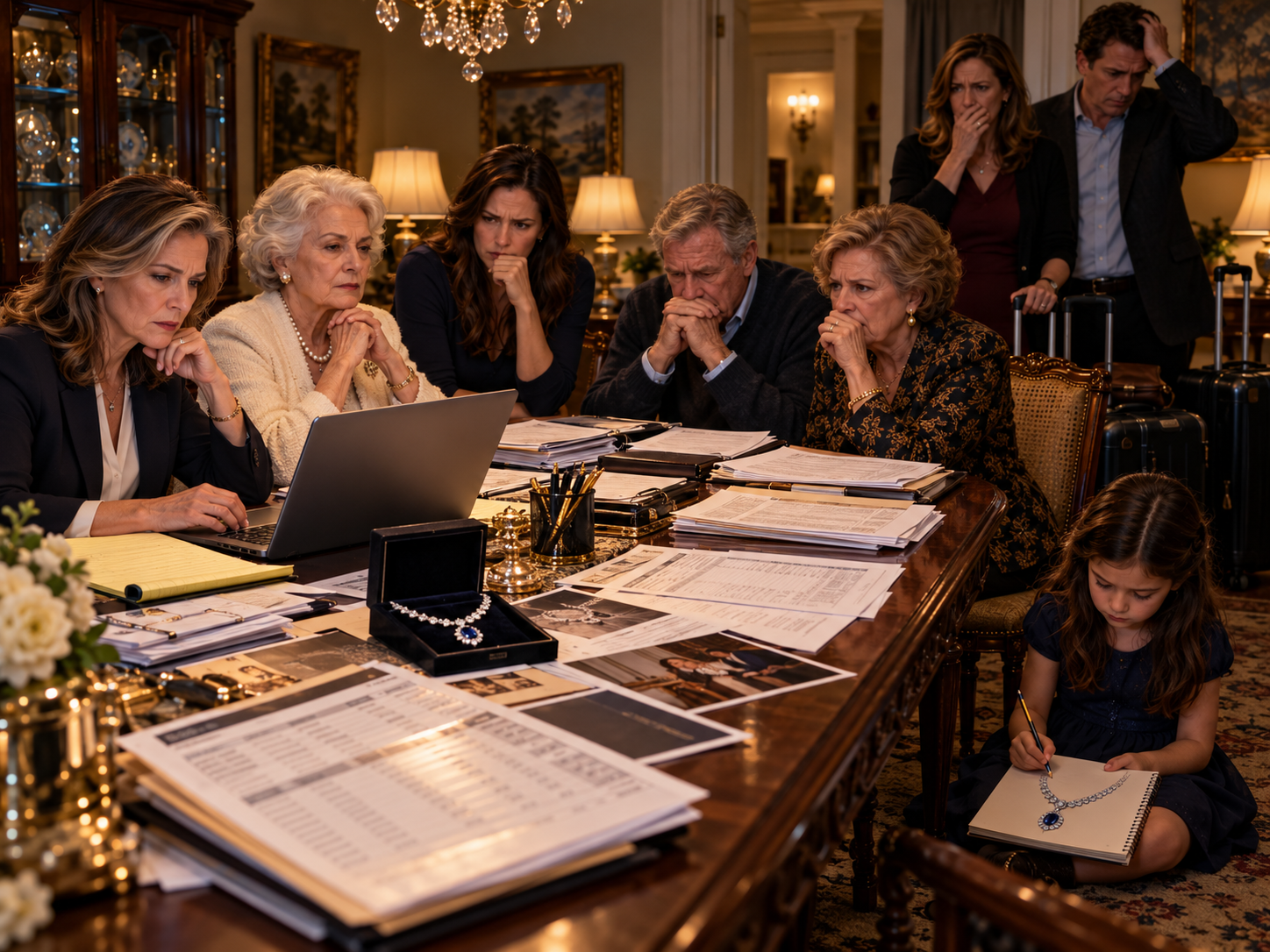
“You’ve been judging me for thirty years.”
“No,” Eleanor replied.
“I have been watching you.”
Mom’s face went white.
Then Eleanor closed the folder.
“We can discuss family history later.”
She looked at Dad.
“Right now we are finding the jewelry.”
Dad shook his head.
“It’s gone.”
“To whom?”
“A buyer.”
“Name.”
“I’m not giving you someone’s private information.”
Grandma Eleanor reached into her cardigan pocket and removed her phone.
“Then my attorney can request it.”
Dad laughed once.
“You brought an attorney into a family disagreement?”
“No.”
Eleanor glanced at the clock.
“I brought the family first.”
Then she looked at him.
“You have until six.”
“What happens at six?”
“If I do not have the buyer’s name, the payment records, and every document associated with the sale, Laura Bennett begins handling it.”
Dad knew the name.
I could tell immediately.
His jaw clenched.
“Your estate lawyer?”
“My attorney.”
Mom looked horrified.
“You would do that to your own son-in-law?”
Eleanor turned toward Zoe.
“No.”
Then back to Mom.
“I am doing it for my great-granddaughter.”
Dad stared at the documents for nearly a full minute.
Then, without another word, he stood and walked upstairs.
At 5:42 p.m., he came back carrying his laptop.
At 5:51, we had the name of the buyer.
At 5:56, Grandma Eleanor made a phone call.
And at 6:03, we learned something none of us expected.
The buyer hadn’t purchased the jewelry for himself.
He was an intermediary.
And the set was scheduled to be transferred to an auction broker the next morning.
PART 3 — THE NECKLACE WAS LEAVING IN TWELVE HOURS
Grandma’s attorney arrived twenty-eight minutes later.
Laura Bennett was probably in her late fifties, with silver-streaked hair and the kind of calm that made everyone else instinctively lower their voice.
She brought a laptop.
A legal pad.
And no patience for excuses.
Dad began explaining before she even sat down.
Laura stopped him.
“I’m not here to determine whether you had good intentions.”
Dad’s jaw tightened.
“Then why are you here?”
“To determine where the property is and whether it can be recovered before it changes hands again.”
She opened her laptop.
“Good intentions can be discussed later.”
For the next hour, the dining table stopped feeling like a family table.
It became evidence.
Bank records.
Emails.
Wire confirmations.
The appraisal.
The custody acknowledgment.
Photographs of the jewelry.
The original velvet case.
Dad admitted he had contacted a private jewelry dealer named Martin Keller.
Keller specialized in estates and high-value antique pieces.
Dad had told him Eleanor was downsizing.
Technically true.
He had said the family had authority to sell.
Not true.
Keller transferred $120,000.
Dad moved the money into a joint account.
Within eleven days, $78,400 had gone toward Diane’s trip.
Business-class airfare.
Two hotel suites.
A private villa deposit.
Tours.
Transfers.
Another $16,000 had covered credit card balances Mom and Dad had never mentioned.
The rest was still in their account.
Diane stared at the transaction list.
“You said the trip was your anniversary gift to us.”
Mom said nothing.
Patrick had arrived by then.
He looked at his wife.
“You told me your parents had been saving for this.”
Diane covered her mouth.
“I thought they had.”
“You knew about the jewelry.”
“I didn’t know it legally belonged to Zoe.”
Patrick stood.
“That isn’t what I asked.”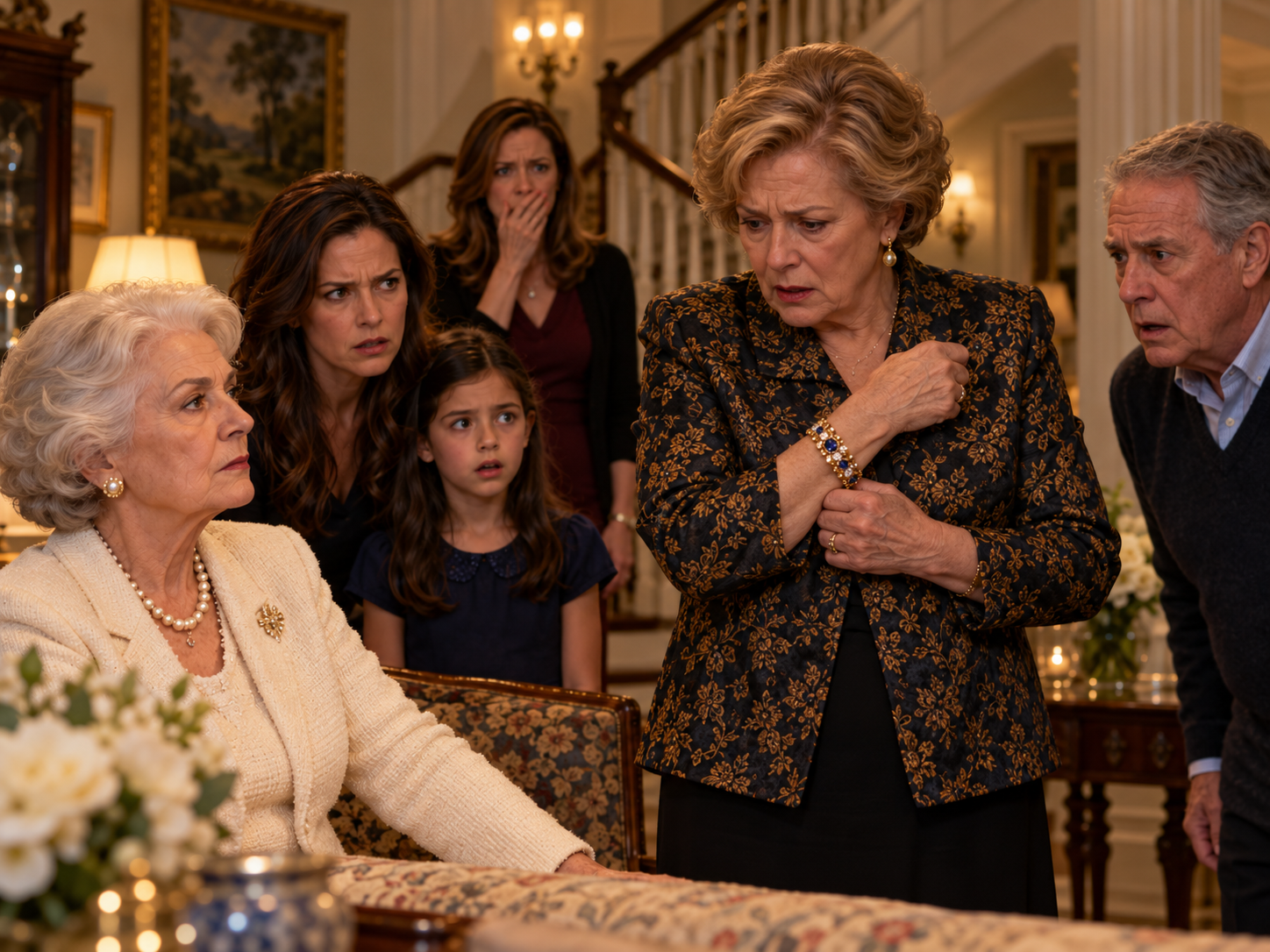
Their argument moved into the kitchen.
I could hear whispers turning sharp.
I didn’t care.
I was watching Zoe.
She sat on the floor near Eleanor’s chair drawing in a notebook Laura had given her.
A necklace.
Blue stones.
A crooked link.
My throat tightened.
Eleanor noticed.
She rested a hand on my arm.
“We’re going to try.”
Try.
It was the first word all evening that frightened me.
Not promise.
Try.
Laura made two calls.
Then a third.
Finally she removed her glasses.
“Keller still has possession tonight.”
My breath caught.
“But?”
“There’s always a but,” Dad muttered.
Laura ignored him.
“The set was purchased by a client through Keller and is scheduled to be delivered to an auction specialist tomorrow morning for authentication and possible resale.”
“So stop it,” I said.
“That’s what we’re attempting.”
“Can’t we just tell him it was stolen?”
Dad snapped:
“It wasn’t stolen.”
Laura slowly looked at him.
“Charles, now would be an excellent time to stop making categorical legal conclusions.”
He went silent.
Laura turned back to me.
“Keller purchased it believing your father had authority to sell. That complicates matters. It does not make recovery impossible.”
“What do we need?”
“First, proof of ownership.”
She tapped the documents.
“We have that.”
“Second?”
“Speed.”
She looked at Dad.
“And cooperation.”
Dad looked exhausted.
“What do you want?”
“Everything.”
Passwords.
Original correspondence.
Receipts.
Messages.
Identity of everyone involved.
“And,” Laura added, “you are not deleting anything.”
Dad gave a bitter laugh.
“You think I’m some criminal.”
Grandma Eleanor answered before Laura could.
“I think you are a man who convinced himself that being patriarch of a family meant everything inside that family was yours to allocate.”
Dad stared at her.
For once, he had no response.
At 9:17 p.m., Keller’s attorney called Laura back.
They talked for twenty-three minutes.
Nobody moved.
Finally Laura ended the call.
“The transfer tomorrow has been suspended.”
I closed my eyes.
Relief washed through me so fast my knees weakened.
But Laura wasn’t smiling.
“What else?”
“The client wants his money back before releasing his claim.”
Dad stared at her.
“What money?”
“The $120,000 he paid.”
Mom whispered:
“We don’t have all of it.”
“No,” Laura said. “You don’t.”
Diane returned from the kitchen.
Her eyes were red.
“How much do you need?”
Mom immediately said:
“You are not canceling your trip.”
Diane looked at her.
For the first time that day, something changed in my sister’s face.
“Mom.”
“We’ll solve this.”
“No.”
“Diane—”
“You used Zoe’s inheritance.”
Mom recoiled.
“I did it for you.”
“And that makes it better?”
Mom opened her mouth.
Nothing came.
Diane pulled out her phone.
“I’m canceling everything refundable.”
Her hands were shaking.
Patrick stood behind her.
“We both are.”
Mom stared at them like they had betrayed her.
“The children have been looking forward to this for months.”
Patrick spoke quietly.
“They’ll survive being disappointed.”
Then he looked toward Zoe.
“She shouldn’t have had to.”
For the next two hours, Diane and Patrick canceled what they could.
Flights came with penalties.
The villa deposit was partially refundable.
Several tours could be canceled.
Some money was gone.
But by midnight, they had recovered just under $52,000.
Dad transferred the remaining $25,600 still sitting in his account.
That left $42,400.
Dad looked at Mom.
She looked away.
I knew that look.
There was another secret.
“Where is it?” I asked.
Dad said nothing.
“Where did the rest go?”
Mom finally whispered:
“Credit cards.”
“We know about the sixteen thousand.”
She shook her head.
“Not those.”
Dad closed his eyes.
And I understood.
There were more debts.
Much more.
The European trip hadn’t created the financial problem.
It had exposed it.
For almost two years, my parents had been living beyond their means.
Renovations.
Cars.
Country club fees.
Vacations.
Gifts.
The image of generosity.
The image of success.
The image of having enough money to rescue Diane whenever she needed rescuing.
Dad had quietly accumulated debt.
Mom knew some of it.
Not all.
They saw the jewelry sitting in the safe.
And eventually, they stopped seeing it as Zoe’s.
They saw a solution.
Grandma Eleanor listened to the confession without interrupting.
When Dad finished, she said:
“You were drowning.”
Dad looked at her.
For a moment, I thought she might soften.
Then she continued.
“So you stood on a child.”
Dad’s eyes dropped.
By 1:00 a.m., Laura had negotiated a temporary arrangement.
Keller would hold the jewelry for seventy-two hours.
If the $120,000 was restored, ownership could be unwound without litigation involving the downstream buyer.
If not—
Things would become much uglier.
We left my parents’ house after one thirty.
Zoe fell asleep in the car.
Halfway home, she stirred.
“Mom?”
“Yes?”
“Are they mad at me?”
I nearly drove off the road.
“What?”
“Grandma and Grandpa.”
“No, baby.”
“Because Grandma Eleanor gave it to me?”
I pulled into an empty parking lot.
Turned off the engine.
Then climbed into the back seat.
I held her face gently.
“Listen to me. None of this happened because you did anything wrong.”
She looked down.
“Grandma said I didn’t understand it.”
My heart cracked.
“What do you understand?”
Zoe thought for a moment.
“That the necklace belonged to people before me.”
“Yes.”
“And someday I’m supposed to tell their stories.”
“Yes.”
“And the bent part shouldn’t be fixed.”
I smiled through tears.
“No. It shouldn’t.”
She looked at me.
“Then I understand enough.”
I pulled her against me.
And sitting in that dark parking lot, I realized my nine-year-old understood inheritance better than every adult who had tried to justify taking hers.
The next morning, at 8:12, Laura called.
I expected good news.
Instead she said:
“We have another problem.”
My stomach dropped.
“What?”
“The buyer examined the photographs again.”
“And?”
“There’s one piece missing.”
PART 4 — MY MOTHER HAD KEPT ONE PIECE
I was back at my parents’ house twenty minutes later.
Grandma Eleanor arrived shortly after me.
Laura came on speakerphone.
Dad was already waiting.
Mom wasn’t.
“Where is she?” I asked.
“Upstairs.”
“Why?”
Dad rubbed his face.
“I think I know where the bracelet is.”
The set had three primary pieces.
Necklace.
Earrings.
Bracelet.
The dealer had received the necklace and earrings.
Not the bracelet.
At first, I thought that should have been good news.
One piece hadn’t been sold.
Then I saw Dad’s expression.
“What happened to it?”
He looked toward the stairs.
“Ask your mother.”
Mom came down ten minutes later.
She was dressed.
Makeup done.
Hair perfect.
And on her wrist was Grandma Eleanor’s bracelet.
I couldn’t speak.
Diane, who had arrived behind me, actually gasped.
Grandma Eleanor didn’t.
She simply stared at her daughter’s wrist.
Mom instinctively covered it with her other hand.
That small movement said everything.
Eleanor asked:
“How long have you been wearing it?”
Mom’s chin lifted.
“I didn’t sell that piece.”
“That wasn’t my question.”
Mom looked away.
“Margaret.”
“A few months.”
Dad stared at her.
“You told me Keller had everything.”
“I couldn’t let all of it go.”
I almost laughed at the absurdity.
“You couldn’t let it go?”
She looked at me sharply.
“You don’t understand.”
“No, I think I finally do.”
Mom turned toward Eleanor.
“You were always going to skip me.”
Eleanor went very still.
“The set came from your grandmother. Then you had it. And instead of giving it to your daughter, you gave it to Zoe.”
There it was again.
The real wound.
Not Europe.
Not money.
Mom believed the jewelry should have been hers.
Eleanor placed her cane against the chair.
“I did not skip you.”
“Yes, you did.”
“No.”
“You never gave it to me.”
“Because you told me you hated it.”
Mom blinked.
“What?”
“You were twenty-six. I offered you the earrings for your wedding.”
Mom’s expression changed.
“You said they were old-fashioned.”
Silence.
“I offered you the bracelet after your father died. You said antique jewelry made you feel ancient.”
Mom shook her head.
“That was decades ago.”
“Yes.”
“And people change.”
Eleanor nodded.
“They do.”
Then she glanced around the expensive living room.
“Sometimes not for the better.”
Mom’s eyes filled with tears.
“You chose her.”
She pointed at Zoe, who had just entered behind Patrick.
My whole body tensed.
Eleanor immediately corrected her.
“I chose the person who loved the stories.”
Mom stared at her.
“You’re saying a nine-year-old deserved it more than your own daughter?”
Eleanor shook her head.
“I am saying it was mine to give.”
Then she held out her hand.
“Take it off.”
Mom didn’t move.
“Margaret.”
Slowly, my mother unclasped the bracelet.
For the first time, she looked at it rather than at everyone else.
Her thumb ran across a tiny scratch near the clasp.
“She wore this at my graduation.”
Eleanor’s face softened slightly.
“Yes.”
“You remember?”
“I remember everything about that day.”
Mom’s mouth trembled.
“You never told me.”
“You never asked.”
The room changed.
For one second, I saw something beneath Mom’s entitlement.
A daughter.
A wound.
Decades of assumptions.
But understanding why someone hurts you doesn’t erase what they did.
Mom placed the bracelet in Eleanor’s palm.
Eleanor closed her fingers around it.
“Thank you.”
Then she handed it directly to me.
“Keep this yourself until everything else is resolved.”
Mom watched.
She looked devastated.
But she didn’t protest.
By afternoon, the financial problem remained.
$42,400.
Dad had applied for a personal loan.
Denied.
Too much revolving debt.
Mom offered to sell her car.
It would take time.
Then Diane and Patrick arrived.
Patrick placed an envelope on the table.
Inside was a cashier’s check.
$30,000.
I stared at him.
“No.”
“Yes.”
“This isn’t your debt.”
Patrick looked toward his wife.
“Part of it is.”
Diane was crying.
“I knew enough to ask more questions.”
I shook my head.
“You were lied to.”
“I also liked the answer I was given because it benefited me.”
That stopped me.
She sat opposite me.
“For years, Mom made everything into a competition between us. And I let her because I was usually the one winning.”
I said nothing.
“When she said Grandma’s jewelry was being sold, I knew you’d be upset.”
“Then why didn’t you call me?”
Diane wiped her face.
“Because I didn’t want the trip to disappear.”
There it was.
Ugly.
But honest.
“I told myself it wasn’t really Zoe’s yet. I told myself Grandma had changed her mind. I told myself a hundred things because I wanted to sit in business class and take my kids to Italy.”
She slid the check toward me.
“We emptied the travel account and part of our savings.”
Patrick added:
“We’ll rebuild.”
I looked at Diane.
“What about the children?”
“They’re angry.”
She gave a sad little laugh.
“They think I’m the worst mother alive because we canceled Europe.”
Despite everything, I smiled slightly.
“They’ll recover.”
“I know.”
She looked at Zoe.
“That’s the lesson I should have understood earlier.”
Dad found the final $12,400 by selling a collection of vintage watches he had spent twenty years building.
He didn’t complain.
Maybe because Grandma Eleanor stood beside him when the dealer came.
Maybe because nobody would have cared if he did.
Seventy hours after the first confrontation, Laura Bennett walked into my apartment carrying a locked black case.
Zoe was sitting at the kitchen table doing homework.
She looked up.
Laura smiled.
“I believe these belong to you.”
Zoe didn’t jump from her chair.
She didn’t scream.
She looked at me.
“Can I?”
That almost broke me.
Even after adults had taken her property without asking, she still asked permission to approach her own things.
I nodded.
“Yes.”
Grandma Eleanor opened the case.
The velvet box was inside.
A little scuffed.
But intact.
Eleanor opened it.
The necklace caught the afternoon light.
Deep blue sapphires.
Small diamonds.
Old gold.
And there—
the tiny bend in the third link.
Zoe reached toward it.
Then stopped.
“May I touch it?”
Eleanor smiled.
“Of course.”
Zoe placed one finger against the crooked link.
For several seconds, nobody spoke.
Then she whispered:
“They didn’t fix it.”
“No,” Eleanor said.
“They didn’t.”
Zoe smiled.
And suddenly the entire fight became worth it.
Not because we had recovered $120,000.
Because one tiny imperfection had survived.
One small piece of evidence that the women before us had existed.
That their hands had touched these things.
That their stories could not be replaced by something “equally lovely.”
But our family wasn’t repaired.
Not even close.
Recovering the jewelry was the easy part.
What happened next was harder.
Because Grandma Eleanor had one final document inside that leather folder.
And this one wasn’t about jewelry.
PART 5 — WHAT GRANDMA CHANGED
Two weeks later, Eleanor asked the adults to meet at her assisted-living apartment.
No children.
Just me.
Diane.
Patrick.
Mom.
Dad.
And Laura Bennett.
The leather folder was on the table again.
Dad stared at it.
“Please tell me we’re finished with that thing.”
Eleanor smiled faintly.
“Almost.”
My parents had spent the previous two weeks in a strange limbo.
The jewelry had been recovered.
The transaction reversed.
No outside criminal complaint had been initiated by Eleanor or me.
But Laura had made something very clear:
Recovering the property did not make the conduct disappear.
Dad and Mom had signed a formal repayment agreement covering the costs, penalties, attorney fees, and losses created by the unauthorized sale.
Their finances were being reorganized.
The country club membership was gone.
Mom’s luxury SUV was listed.
The kitchen renovation scheduled for fall had been canceled.
Dad had begun meeting with a financial counselor.
For people who had spent years maintaining the appearance that they were effortlessly successful, consequences looked surprisingly ordinary.
Budgets.
Canceled subscriptions.
Smaller purchases.
No vacations.
No pretending.
Diane and I had barely spoken.
Not because I hated her.
Because I didn’t know what our relationship was without Mom arranging us on opposite sides of an invisible scoreboard.
Eleanor waited until everyone was seated.
Then she began.
“I am eighty-three years old.”
Dad shifted.
“Eleanor—”
“No. You will listen.”
He did.
“I do not intend to spend whatever years remain to me supervising grown adults.”
She looked at Mom.
“I cannot force you to understand why what you did was wrong.”
Then Dad.
“I cannot force you to stop equating financial control with authority.”
Then Diane.
“I cannot force you to stop accepting advantages simply because someone offers them.”
Finally she looked at me.
“And I cannot force you to stop tolerating mistreatment merely to preserve the appearance of family peace.”
That one hurt.
Because it was true.
For years, I had called silence maturity.
I had called avoidance forgiveness.
I had taught Zoe to be gracious around people who repeatedly showed her she mattered less.
Eleanor continued.
“So I have changed what I can control.”
Laura opened the folder.
Mom’s face tightened.
“Your will.”
Eleanor nodded.
“Yes.”
Dad exhaled.
“This is ridiculous.”
Eleanor gave him a look.
He stopped.
“I revised my estate plan six months ago.”
That surprised all of us.
“Before the jewelry?” Diane asked.
“Yes.”
“Why?”
Eleanor looked at us.
“Because families behave very differently around inheritance.”
She folded her hands.
“I wanted clarity before anyone had an incentive to influence me.”
Mom looked wounded.
“You thought we would manipulate you?”
“I thought everyone should know the rules.”
Laura distributed summaries.
I looked down.
The estate wasn’t enormous in the fantasy sense.
But it was substantial.
A house sold years earlier.
Investments.
Life insurance.
Savings accumulated across decades.
Grandma had divided much of it into trusts.
Educational funds for great-grandchildren.
Specific charitable gifts.
Personal items assigned by name.
No ambiguity.
No informal promises.
No safe full of things everyone could reinterpret.
Then I saw something.
Zoe’s name.
A trust.
Dad saw it too.
“You’re rewarding them.”
Eleanor looked exhausted.
“This is exactly why I wanted Laura here.”
Mom pushed her paper away.
“You’re leaving more to Zoe.”
“I am protecting assets for all of the great-grandchildren.”
“Not equally.”
“No.”
Mom laughed bitterly.
“At least you admit it.”
Eleanor looked at her daughter.
“You continue to confuse equality with fairness.”
Mom stood.
“Then explain the fairness.”
Eleanor did.
Some grandchildren already had substantial education accounts funded by Mom and Dad.
Zoe did not.
Some had received large gifts.
Zoe had not.
The trusts took those differences into account.
It wasn’t punishment.
It was accounting.
Then Eleanor said something I will never forget.
“Inheritance is not a prize for being my favorite. It is the final responsibility I have for what I leave behind.”
Nobody spoke.
She turned toward Mom.
“And there is one other change.”
Mom slowly sat down.
Eleanor placed a handwritten page on the table.
“This is not legally significant. It is simply a request.”
I picked it up.
At the top she had written:
THE STORIES GO WITH THE JEWELRY.
Below it was a list.
Each item.
Each woman who had worn it.
Dates where Eleanor remembered them.
Weddings.
Funerals.
Births.
Graduations.
Anniversaries.
One entry made my eyes blur.
Bracelet — worn at Margaret’s graduation. She looked terrified before walking onto the stage. I squeezed her hand and told her she had already made me proud.
Mom read it.
And broke.
Not dramatically.
No screaming.
Her face simply collapsed.
She covered her mouth with one hand.
“I don’t remember that.”
Eleanor’s eyes filled too.
“I do.”
Mom began crying.
“You never said these things.”
“I thought you knew.”
“Well, I didn’t.”
Eleanor nodded slowly.
“Then perhaps that is one of my failures.”
That surprised all of us.
Grandma Eleanor was capable of admitting when she had failed.
It was something none of us had seen our parents do.
Mom stared at the paper.
“I thought you loved her more.”
She nodded toward me.
Eleanor shook her head.
“I worried about her more.”
Mom looked up.
“Why?”
“Because you and Charles were always there when Diane needed something.”
Then Eleanor looked at me.
“But when she needed something, you often told her she should learn to handle it herself.”
The truth filled the room.
Not every family imbalance comes from hatred.
Sometimes it comes from a pattern repeated so often nobody questions it.
One child becomes “the capable one.”
Then everyone uses that capability as permission to neglect her.
One child becomes “the one who needs support.”
Then support becomes entitlement.
And children notice.
Even when adults insist they don’t.
Especially children.
Mom wiped her cheeks.
“I don’t know how to fix this.”
For the first time, I believed her.
Not because she apologized.
She hadn’t yet.
Because she finally stopped defending herself.
So I told her.
“You start with Zoe.”
Mom looked at me.
“You don’t explain.”
She nodded.
“You don’t tell her she misunderstood.”
Another nod.
“You don’t mention Europe.”
She whispered:
“Okay.”
“And you never ask her to forgive you.”
Mom’s face tightened.
“Why?”
“Because that’s hers to decide.”
Three days later, my parents came to my apartment.
No gifts.
No flowers.
No replacement jewelry.
I had specifically told them not to bring anything.
Zoe sat at the kitchen table.
Mom and Dad sat across from her.
I remained in the room but said nothing.
Dad went first.
“I took something that belonged to you.”
Zoe looked at him.
“I knew it belonged to you, and I convinced myself I had a right to make a different decision because I was an adult.”
He swallowed.
“I didn’t.”
Zoe said nothing.
Dad continued.
“I am sorry.”
Then Mom.
Her apology was harder.
She cried once.
Stopped.
Started again.
Finally she said:
“When I told your mother you were too young to understand what you lost, I was wrong.”
Zoe’s expression didn’t change.
Mom continued.
“You understood something I had forgotten.”
“What?”
Mom looked at her.
“That valuable doesn’t mean expensive.”
Zoe thought about that.
Then asked:
“Are you still mad that Grandma gave it to me?”
Every adult in the room froze.
Mom’s face went pale.
“No.”
Zoe waited.
Mom corrected herself.
“I was.”
That mattered.
“I was jealous. That wasn’t fair to you.”
Zoe looked down at her hands.
Then she said:
“You put my picture behind everyone else’s.”
Mom started crying again.
I looked away.
Because there it was.
The thing none of us realized had become evidence to a child.
“I know,” Mom whispered.
“Why?”
Mom had no clever answer.
No adult explanation.
No excuse.
“I don’t have a good reason.”
Zoe nodded.
“Okay.”
They did not hug that day.
I didn’t make her.
That was important.
Forgiveness forced upon children for adult comfort is not forgiveness.
It is another thing being taken from them.
Instead, my parents left after twenty minutes.
The next week, they attended Zoe’s school art show.
They arrived early.
No giant bouquet.
No performance.
They stood where she could see them.
Then came her piano recital.
Then soccer.
Then her tenth birthday.
They showed up.
Again.
And again.
Slowly.
Consistency doing what apologies couldn’t.
Diane and I took longer.
One night, almost four months after everything happened, she came over alone.
We sat on my balcony drinking coffee.
She looked exhausted.
“Do you hate me?”
“No.”
“That almost feels worse.”
I smiled faintly.
“I was furious.”
“You should be.”
“But I don’t want to spend the next twenty years reenacting Mom’s competition.”
Diane stared into her cup.
“Neither do I.”
“So we stop.”
“How?”
“I don’t know.”
That made both of us laugh.
It was probably the most honest conversation we had ever had.
Then she said:
“The kids ask about Europe sometimes.”
“I’m sure.”
“We started saving again.”
“For the trip?”
She shook her head.
“For all four of us. Slowly. With our own money.”
I smiled.
“Good.”
“We might go in two years.”
“I hope you do.”
Diane looked at me.
“You mean that?”
“Yes.”
The trip had never been the problem.
What they were willing to take from Zoe to make it happen was.
A year later, Grandma Eleanor turned eighty-four.
We held a small dinner.
Nothing extravagant.
Zoe asked if she could wear one piece of the set.
My first instinct was no.
Too expensive.
Too risky.
Then Eleanor looked at me.
“Why do we preserve things?”
I knew better than to answer quickly.
“So they survive?”
She smiled.
“Partly.”
Then she turned to Zoe.
“But what happens if something survives and nobody lives with it?”
Zoe grinned.
Twenty minutes later, Eleanor fastened the bracelet around her wrist.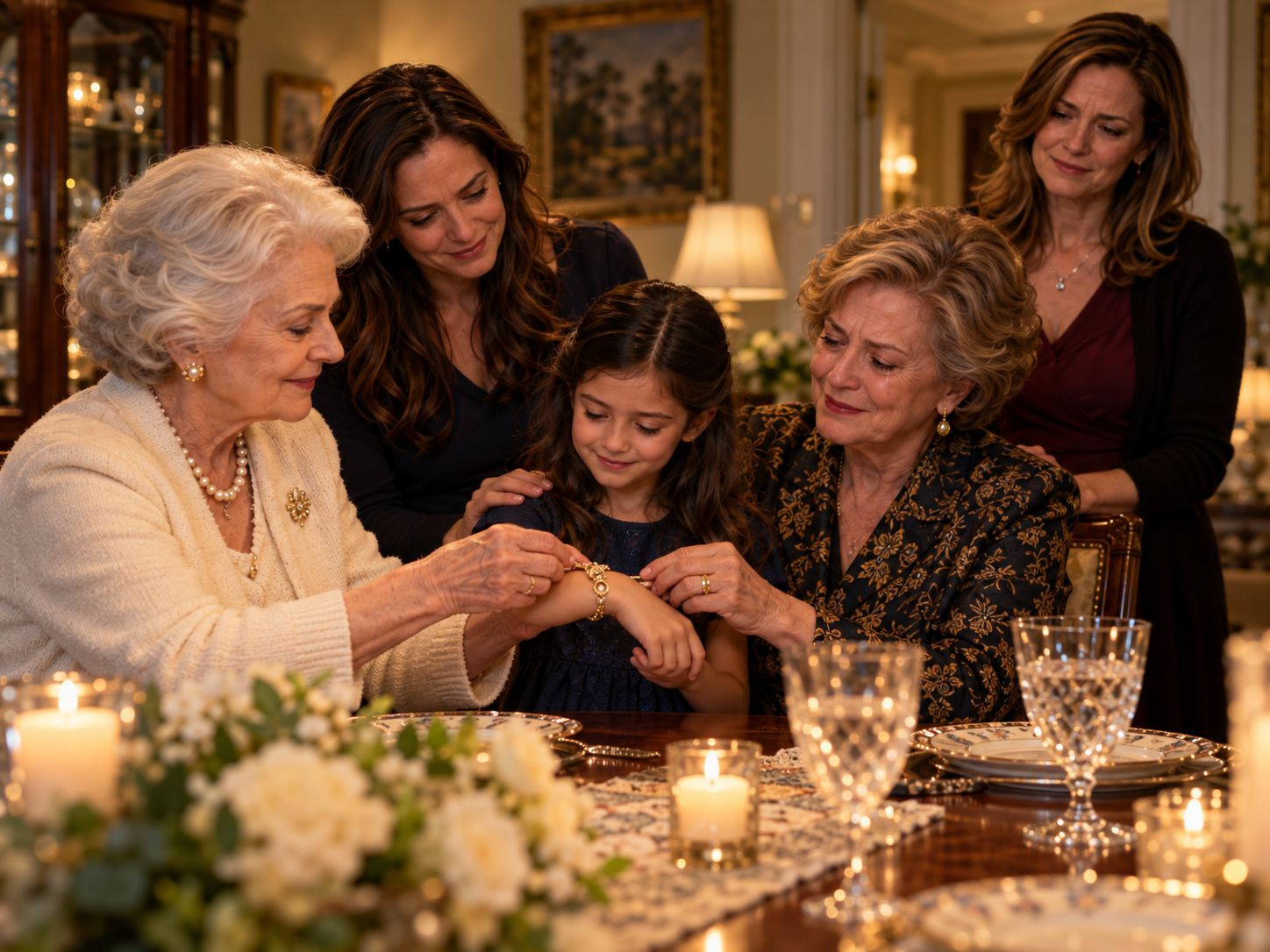
Not the necklace.
Not yet.
Just the bracelet.
The same one Eleanor had worn at Mom’s graduation decades earlier.
The same one Mom had secretly kept when the rest was sold.
Mom stood nearby.
For one second, I worried the sight might reopen something painful.
Instead she walked over.
“May I?”
Zoe nodded.
Mom adjusted the clasp.
Then said:
“Your great-great-grandmother had very small wrists. Grandma Eleanor always needed the clasp tightened.”
Eleanor smiled.
“You remember.”
Mom looked at her mother.
“Yes.”
That was the moment I realized the jewelry had finally become what Eleanor always wanted it to be.
Not an investment.
Not leverage.
Not a measure of favoritism.
A conversation.
Zoe looked down at the bracelet.
“Mom?”
“Yes?”
“When I have a daughter, can she wear it?”
“If you want her to.”
“What if I don’t have a daughter?”
Eleanor answered.
“Then find someone who cares about the stories.”
Zoe considered that seriously.
Then nodded.
“Okay.”
After dinner, we took a photograph.
For years, I kept that picture framed in our hallway.
Grandma Eleanor sitting in the middle.
Zoe beside her, wearing the bracelet.
Mom on the other side.
Me behind Zoe.
Diane beside me.
Four generations of women whose relationships had never been as simple as the jewelry passing between them.
Some had loved poorly.
Some had loved quietly.
Some had confused money with care.
Some had mistaken silence for strength.
But that night, for once, nobody was pushed to the edge of the frame.
Three years later, Grandma Eleanor died peacefully in her sleep.
Zoe was thirteen.
At the funeral, she asked to wear the earrings.
I said yes.
Before we left the house, she stood in front of the mirror and touched one gently.
“Grandma said someone wore these to a funeral before.”
“Her mother did.”
“For who?”
“Her sister.”
Zoe nodded.
Then she opened a small notebook.
I recognized it immediately.
Grandma Eleanor’s handwriting filled the first several pages.
After that came Zoe’s.
She had been recording the stories.
Names.
Dates.
Memories.
Who wore what.
Why.
Then she turned to a blank page.
At the top she wrote:
Eleanor — funeral — earrings worn by Zoe.
My eyes filled.
“What are you doing?”
She looked at me like the answer was obvious.
“Adding our part.”
Our part.
Not Eleanor’s.
Not mine.
Not hers.
Ours.
That was when I finally understood why Grandma had fought so hard.
People had called it jewelry worth $120,000.
My parents had looked at it and seen money.
Diane had looked at the money and seen Europe.
The dealer had looked at the pieces and seen resale value.
But Eleanor had seen something none of them could appraise.
Continuity.
A message moving through generations:
You came from somewhere.
Someone was here before you.
Someone remembered.
And someday, it will be your responsibility to remember too.
The original appraisal still sits in our safe.
So do the ownership documents.
Laura made certain of that.
Everything is insured.
Everything is photographed.
Nobody except me and Zoe has access.
But beside those papers sits something far more valuable.
A cheap blue notebook.
Maybe twelve dollars at most.
On the cover, Zoe wrote four words in black marker:
THE STORIES GO WITH IT.
That notebook contains every woman we can identify who touched the jewelry.
Every wedding.
Every funeral.
Every graduation.
Every photograph.
Even the ugly parts.
Including the year the jewelry was sold.
Zoe insisted on that.
I asked her once whether she really wanted the story included.
She was fifteen by then.
Old enough to understand far more than my mother once believed she could.
“Yes,” she said.
“Why?”
She closed the notebook.
“Because pretending something bad never happened doesn’t protect the family.”
Then she smiled slightly.
“Remembering why it was wrong does.”
Grandma Eleanor would have loved that answer.
My parents never went back to the way they were before.
Neither did we.
And that turned out to be a good thing.
Dad became quieter.
Mom became less concerned with appearances.
Diane stopped asking them to solve every financial inconvenience in her life.
I stopped confusing keeping the peace with being treated fairly.
And Zoe?
Zoe grew up knowing something I wish I had learned decades earlier.
Love without respect is not enough.
Family tradition without accountability is just repetition.
And being young does not mean you don’t know when someone has treated you as though you matter less.
My parents once believed they could take a nine-year-old girl’s inheritance because she was too young to understand what she had lost.
They were wrong.
Zoe understood perfectly.
They were the ones who didn’t.
Because the most valuable thing inside that velvet box was never the gold.
Never the diamonds.
Never the sapphires.
Not even the $120,000 appraisal.
It was the simple promise that one generation had made to the next.
This belongs to you now.
And thanks to Grandma Eleanor, that promise survived.