MY FATHER CALLED ME A CIVILIAN FAILURE AT HIS RETIREMENT PARTY
My father humiliated me as a civilian f.a.i.l.u.r.e in front of a room full of military officers at his retirement dinner.
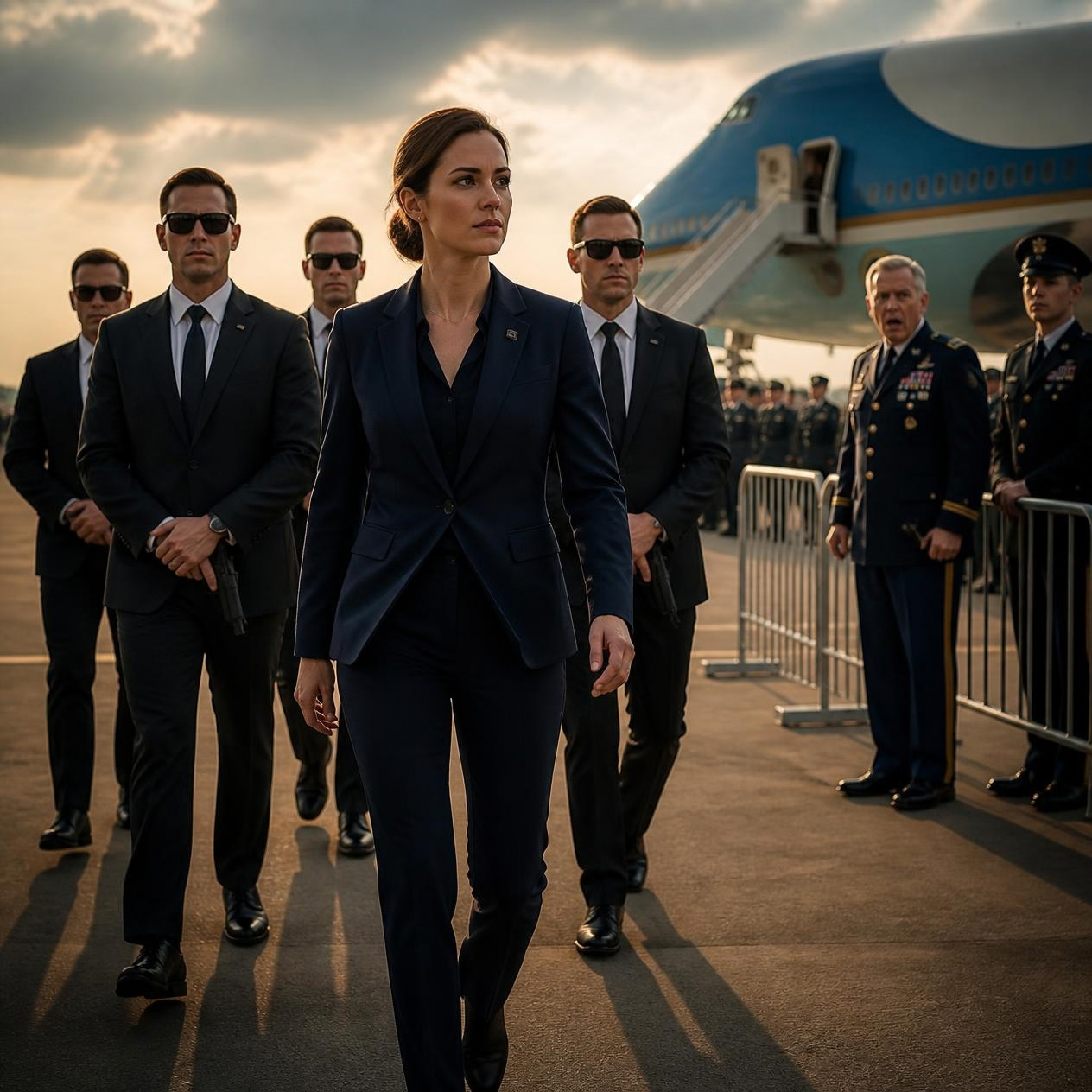
Forty-eight hours later, he was standing behind a security barrier at Joint Base Andrews, watching Air Force One lower its rear stairs for me.
And all because of a tiny black square pinned to my blazer.
At the retirement party, the VIP badge hanging from my neck felt heavier with every word my father said.
Colonel Rhett Mason stood at the head of the long table, raising a glass to my younger brother while nearly thirty officers listened.
According to Dad, Tyler was the future of the Mason family.
I was the disappointment who fixed printers.
What he couldn’t possibly know was that the secure device pressed against my leg had just received an emergency directive connected directly to the President’s communications operation.
And when I climbed over a restricted flight-line barrier two days later, my father genuinely believed he was watching me throw away what little future he thought I had left.
He was about to discover how wrong he had been.
PART 1
My father spent three decades believing one simple thing.
Uniforms mattered.
Ranks mattered.
Service mattered.
And if your career didn’t come with one of those things attached to it, then in his mind, you were standing somewhere below the people who had earned them.
That belief followed our family everywhere.
It followed us into birthdays.
Christmas dinners.
Graduations.
And eventually, into Colonel Rhett Mason’s retirement celebration.
The private dining room of the steakhouse had been decorated in military blue and silver. Framed photographs from Dad’s career lined one wall, and nearly every seat around the white-linen tables was occupied by active-duty officers, retired commanders, or families who had known my father for years.
Dad was exactly where he loved being.
At the center.
His uniform was perfect.
His decorations caught the light whenever he moved.
A glass of aged scotch rested in one hand.
His other hand sat proudly on the shoulder of my younger brother, Tyler.
Tyler was twenty-two.
Freshly commissioned.
Second lieutenant.
His dress shoes still looked as if they had never touched anything rougher than polished flooring.
But to my father, Tyler had already become the next great chapter of the Mason military legacy.
Dad lifted his glass.
The room quieted.
“To Tyler,” he announced.
My brother smiled awkwardly.
Dad continued.
“To the son who’s going to carry the Mason name forward. The one person in this family who understands what real service and sacrifice actually mean.”
Glasses rose immediately.
People cheered.
Someone slapped Tyler on the shoulder.
Dad looked happier than I had seen him in months.
I remained near the opposite end of the table.
Quiet.
Invisible.
Exactly where Dad seemed most comfortable having me.
I pushed a piece of lettuce around my plate with my fork.
To him, I was still Lena Mason—the daughter who had somehow wasted her intelligence by pursuing a doctorate in digital architecture rather than joining the Air Force.
My professional work had never interested him.
The classified projects certainly weren’t something I could explain.
So whenever anyone asked what I did, Dad usually answered for me.
“She works with computers.”
Sometimes he’d add:
“Office networks.”
If he was feeling especially amused, he’d say:
“She fixes the Wi-Fi when everybody else gives up.”
That evening was no different.
Then something vibrated against my thigh.
Three short pulses.
Pause.
One long pulse.
My body went rigid.
Nobody else noticed.
I slipped one hand beneath the tablecloth and pulled the secure device from the inside pocket of my blazer.
Government issue.
Encrypted.
Restricted.
I shielded the screen beneath my napkin and looked down.
The message was glowing red.
FLASH TRAFFIC.
My stomach tightened.
A second line appeared.
DEFCON STATUS UPDATE.
Then:
EYES ONLY.
I read the rest once.
Then again.
A diplomatic crisis had escalated overseas.
The President’s secure communications package was being placed on accelerated movement status.
My team was being activated.
Immediately.
The noise of the restaurant seemed to disappear around me.
My thumb moved toward the acknowledgment field.
Before I could touch it—
BANG.
Dad’s palm came down against the table.
Silverware jumped.
Several conversations stopped instantly.
I looked up.
He was staring straight at me.
“Put the d.a.m.n phone away, Lena.”
Every face nearby shifted toward us.
Dad pointed toward Tyler with his glass.
“We’re talking about sacrifice. We’re talking about people who’ve actually committed themselves to something bigger than their own careers.”
His voice hardened.
“The least you can do is show your brother some respect.”
I kept my expression neutral.
“I’m on call, Dad.”
For half a second, the room stayed silent.
Then Dad laughed.
Not warmly.
Not privately.
It was the kind of laugh intended to bring everyone else into the joke.
“On call?”
He looked around the table.
“For what?”
A few people smiled uncertainly.
Dad shook his head.
“Did somebody’s modem stop working?”
Someone near Tyler gave a quiet chuckle.
Dad leaned back in his chair.
“Go ahead, Lena. Keep staring at your little screen. Some of us have jobs where people actually depend on us.”
The heat hit my face instantly.
Not anger exactly.
Something older.
A feeling I had known since childhood.
That strange combination of humiliation and restraint that came from knowing the truth while being completely unable to defend yourself with it.
I looked at him.
Colonel Rhett Mason.
Thirty years of military service.
My father.
A man who believed he knew exactly what I had become.
I could have ended the argument with one sentence.
But that sentence would’ve violated federal law.
So I did what my job had trained me to do.
Nothing.
I dimmed the display.
Slid the secure phone back into my pocket.
Picked up my fork.
And let him believe he had won.
The people carrying the heaviest secrets are rarely the people allowed to explain themselves.
For the rest of dinner, I barely spoke.
Two days later, everything changed.
Our family had been invited to the annual Air Power Expo at Joint Base Andrews.
The afternoon heat rolled visibly above the runway, making the distant aircraft shimmer.
Dad looked completely at home.
He wore his ribbon rack and moved through the VIP section as though retirement hadn’t changed anything.
Tyler stayed close beside him.
Dad was pointing toward various security positions, proudly explaining flight-line procedures.
“See those access zones?”
Tyler nodded.
“Separate clearance levels. Nobody crosses without authorization.”
I stood several steps behind them.
Listening.
But not really.
My attention had moved somewhere else.
Four rooftop sniper positions.
Twelve tactical agents that I could identify.
Two hardened checkpoints.
Additional perimeter personnel beyond the hangars.
Everything was tighter than the public event required.
Something was moving.
Then the pager clipped inside my blazer vibrated.
Once.
I looked down.
ANGEL EYES MOVING.
Another line appeared.
WHEELS UP IN 15.
My pulse jumped.
The schedule had changed.
The presidential departure had been moved forward almost an hour.
There was no time to make a phone call.
No time for explanations.
No time for family.
If I failed to reach that aircraft, the VC-25 would leave without its primary cyber-defense lead.
And once the aircraft crossed into international airspace, the President’s mobile communications package would be operating without the person assigned to protect its most vulnerable digital layer.
I checked the distance to the runway.
Then the barrier.
Then the security teams.
Fifteen minutes.
Probably less now.
I reached into the inner pocket of my blazer.
My fingers closed around something no larger than a postage stamp.
A tiny enamel square.
Solid black.
No lettering.
No visible emblem.
Nothing that would mean anything to the average person.
I fastened it to my lapel.
Then I started walking.
Dad noticed almost immediately.
“Lena.”
I kept moving.
“The demonstration is about to begin,” he called. “Sit down.”
I didn’t turn.
“Lena.”
His tone sharpened.
“Stop wandering around.”
“I have to go, Dad.”
He sounded irritated.
“Go where?”
I reached the metal VIP barrier.
Dad took several steps after me.
“Lena, what are you doing?”
There was no time left.
I planted one hand on the top rail.
Then vaulted over.
My shoes struck the restricted side of the tarmac hard enough to send pain through my ankles.
Behind me, my father’s voice exploded.
“LENA!”
People gasped.
I started running.
Dad grabbed the barrier.
“STOP!”
Security personnel reacted immediately.
“GET DOWN!”
Dad’s voice cracked with panic.
“LENA, GET DOWN! THEY’LL F.I.R.E IF YOU KEEP GOING!”
Across the runway, four counter-assault rifles swung in my direction.
I kept moving.
Red aiming dots appeared across the front of my blazer.
One.
Two.
Then more.
Somewhere behind me, Dad was shouting at the officers beside him.
“My daughter!”
His voice sounded desperate now.
“She doesn’t know what she’s doing!”
I heard another fragment.
“Civilian—”
Then:
“Something’s wrong with her!”
I never looked back.
The lead Secret Service agent stepped into my path.
His hand was already near his weapon.
Then his eyes dropped.
He saw the black square.
His entire posture changed.
His hand went immediately to his earpiece.
A second later—
Every rifle lowered.
Dad stopped shouting.
The agent moved aside.
Two more agents approached from my right.
Another came from the left.
But they weren’t trying to stop me.
They formed around me.
Protective formation.
Moving with me.
Matching my pace.
The three agents tightened into a diamond as I crossed the tarmac.
Behind the fence, nobody in my family said a word.
Fifty yards ahead sat the unmistakable blue-and-white aircraft.
Air Force One.
Then something moved near the rear fuselage.
A hydraulic mechanism engaged.
Slowly, section by section, the rear stairs began descending toward the runway.
Not for the officers gathered behind the VIP ropes.
Not for my newly commissioned brother.
Not even for Colonel Rhett Mason.
They were lowering for the daughter he had spent thirty years dismissing as a civilian nobody.
The woman he thought fixed office Wi-Fi.
The woman he had just watched climb a security barrier while begging armed agents not to shoot.
And now, for the first time in my life, my father was about to discover what I actually did.
The only question was whether thirty years of arrogance could survive thirty seconds of classified truth.
PART 2
I reached the base of the stairs.
A man in a dark suit descended three steps toward me.
Deputy Special Agent Nolan Briggs.
I had worked with him for four years.
He didn’t greet me.
There wasn’t time.
“Primary package lost sync six minutes ago.”
“How many nodes?”
“Three confirmed. Possibly four.”
“Internal or external?”
“Unknown.”
That one word changed everything.
Unknown meant we didn’t yet know whether we were looking at foreign interference, equipment failure, compromised software—
or someone on the inside.
I started climbing.
Briggs followed.
Behind me, the stairs began retracting almost immediately.
Then I heard my name.
Not shouted.
Not screamed.
Just one stunned voice carrying across the runway.
“Lena?”
Dad.
I looked back.
Only once.
He stood behind the metal barrier.
His hands were still gripping it.
Tyler was beside him.
The expression on my brother’s face wasn’t jealousy.
It wasn’t anger.
It was absolute disbelief.
Dad’s face was different.
He looked like a man watching thirty years of certainty collapse in real time.
Then the aircraft door closed.
And my family disappeared from sight.
I didn’t have time to think about them again.
Inside the plane, the atmosphere had nothing in common with the ceremonial calm outside.
Two communications technicians were already waiting for me.
One had a laptop open.
The other held a printed fault report.
“Dr. Mason.”
That title would’ve stunned my father almost as much as the aircraft itself.
I took the report.
“Start talking.”
“Encryption handshake is failing intermittently across the secondary satellite channel.”
“When?”
“First anomaly fourteen minutes ago.”
“Logs?”
“Here.”
I moved toward the communications compartment.
The engine vibration deepened beneath my feet.
We were moving.
Somewhere beyond the sealed bulkheads sat the President of the United States, senior staff, military aides and enough secure communications equipment to coordinate the country’s response to an international crisis.
And the network I had helped redesign was behaving in a way it wasn’t supposed to behave.
I sat at the terminal.
The screen filled with system logs.
I scanned line after line.
Authentication requests.
Routing changes.
Handshake failures.
Certificate renewals.
Then I saw it.
One character.
Just one.
A timestamp that didn’t belong.
“Stop.”
Everyone around me froze.
I enlarged the entry.
02:14:07.
Then another.
02:14:07.
And another.
Three separate systems reporting different events at exactly the same millisecond.
Machines could synchronize.
But these systems weren’t supposed to.
Not like that.
I felt cold.
“This isn’t failure.”
Briggs leaned closer.
“What is it?”
“Injection.”
The technician beside me frowned.
“Malware?”
“No.”
I shook my head.
“Something better.”
I pulled up the architecture map.
Someone had created a synthetic heartbeat inside the secure network.
A tiny false signal.
Almost invisible.
Every seven minutes, it impersonated a maintenance process, obtained temporary privileges and disappeared before the monitoring software could flag it.
If the system hadn’t been placed under emergency load, we might never have noticed.
Briggs’ voice dropped.
“Can they read traffic?”
“Not yet.”
“Can they?”
I stared at the screen.
“Yes.”
That was when the aircraft began accelerating.
We were taking off.
Briggs braced one hand against the desk.
“How long do you need?”
“To understand it?”
“Yes.”
“Twenty minutes.”
“To stop it?”
I looked at the code again.
“I don’t know.”
His jaw tightened.
“We don’t have twenty minutes.”
Of course we didn’t.
We never did.
I opened a secure terminal.
“Take the secondary package offline.”
The technician stared at me.
“We’ll lose redundancy.”
“I know.”
“Protocol requires—”
“I wrote the protocol.”
He stopped.
“Take it offline.”
He obeyed.
Systems blinked amber.
A warning tone sounded.
Then another.
The President’s communications suite was now operating with reduced redundancy during an international crisis.
Exactly what the people behind the intrusion probably wanted.
I leaned toward the screen.
And then my secure phone vibrated.
Not the aircraft system.
My personal classified handset.
I ignored it.
It vibrated again.
I reached into my pocket.
One message.
FROM: MASON, TYLER.
Impossible.
Tyler couldn’t contact this device.
Nobody outside my program even knew the number existed.
I opened it.
Three words appeared.
WE SEE YOU.
My entire body went still.
Briggs saw my face.
“What?”
I turned the screen toward him.
His expression changed instantly.
“That’s impossible.”
“Yes.”
My brother had never sent the message.
Someone had spoofed his identity.
Which meant whoever was attacking us knew I was aboard.
Knew my family was at Andrews.
Knew Tyler’s name.
And wanted me to understand something.
This wasn’t random.
It was personal.
“Briggs.”
“Yes?”
“Lock my family down.”
He hesitated.
“What?”
“My father and brother are still at Andrews. Move them somewhere secure.”
“Why?”
“Because somebody just used my brother’s identity to contact a classified device.”
Briggs was already reaching for his radio.
I turned back to the terminal.
The screen suddenly went black.
For one second, nothing happened.
Then white text appeared.
HELLO, DR. MASON.
The communications technician whispered something I couldn’t hear.
A second line appeared.
YOUR FATHER WAS RIGHT ABOUT ONE THING.
My stomach twisted.
Then:
PEOPLE SHOULD KNOW THEIR PLACE.
I stared at the message.
The attacker hadn’t simply researched me.
They knew what happened at the retirement dinner.
Forty-eight hours earlier.
Thirty people had been in that restaurant.
Family.
Military officers.
Retired personnel.
Restaurant staff.
Someone had heard.
Someone had watched.
Or someone had already been watching me long before that night.
The terminal cleared itself.
Briggs lowered his radio.
“Your family is being moved.”
“Where?”
“Secure holding room.”
“Good.”
“Lena.”
I looked at him.
He didn’t call me Lena often on operations.
“What?”
“This person isn’t just inside the network.”
I nodded.
“I know.”
“They’re inside your life.”
The aircraft continued climbing.
And for the first time since I’d vaulted that barrier, my father’s opinion of my career became completely irrelevant.
Because somewhere below us, someone knew enough about my family to weaponize the worst moment between us.
And if they knew that much—
I had no idea what else they knew.
Back at Andrews, my father was furious.
I learned the details much later from Tyler.
Two Secret Service agents approached them almost immediately after Air Force One lifted off.
“Colonel Mason?”
Dad straightened instinctively.
“Retired.”
“You and Lieutenant Mason need to come with us.”
Dad looked toward the departing aircraft.
“Why?”
“Sir, please.”
That answer didn’t work well on a man who’d spent three decades giving orders.
“I’m not going anywhere until somebody tells me what the h.e.l.l just happened to my daughter.”
One of the agents glanced at Tyler.
“Sir, this concerns Dr. Mason’s operational security.”
Dad froze.
“Dr. Mason?”
Tyler apparently looked at him at that exact moment.
Dad stared back.
Then looked at the agent.
“My daughter?”
“Yes, sir.”
“Lena Mason?”
“Yes, sir.”
Dad’s voice dropped.
“Operational security?”
The agent said nothing.
That silence gave him more information than an explanation would’ve.
Dad’s face went pale.
They were escorted into a secure room inside the terminal.
No phones.
No outside communication.
No explanation.
For almost two hours, Colonel Rhett Mason—the man who had always believed information flowed toward him—sat in a windowless room while strangers refused to tell him what his own daughter was doing.
Tyler finally broke the silence.
“You really didn’t know?”
Dad stared at the wall.
“Know what?”
“That she was… whatever this is.”
“Of course I didn’t.”
“But you never asked.”
Dad turned.
“What is that supposed to mean?”
Tyler’s voice remained quiet.
“You never asked her anything.”
“I asked her about work.”
“No. You told her what her work was.”
Dad’s expression hardened.
“Be careful.”
Tyler laughed once.
Not mockingly.
Almost sadly.
“See? That’s what you do.”
Dad stood.
“What exactly am I doing?”
“Turning everything into rank.”
“I don’t have rank anymore.”
“You act like you do.”
Dad stared at him.
Tyler continued.
“You spent the entire dinner telling everyone I was the future of the family while Lena sat ten feet away.”
“You earned your commission.”
“And she apparently earned whatever gets Air Force One to lower stairs for her.”
That sentence landed hard.
Dad looked away.
Tyler wasn’t finished.
“You know what she said to me when I got commissioned?”
Dad didn’t answer.
“She told me she was proud of me.”
Silence.
“She never competed with me. You did that for us.”
My father sat back down.
For the first time all afternoon, he had nothing to say.
Then the secure room door opened.
A senior officer stepped inside.
Major General Ellis Grant.
Dad knew him.
They had served together years earlier.
Rhett immediately rose.
“Ellis.”
Grant’s expression wasn’t friendly.
“Sit down, Rhett.”
Dad did.
Grant looked toward Tyler.
“Lieutenant.”
“Sir.”
Then back at my father.
“There are things about your daughter I cannot discuss.”
Dad swallowed.
Grant continued.
“What I can tell you is that Lena has served this country for nearly eleven years in capacities that do not appear on public résumés.”
Dad said nothing.
“She has worked in combat-support environments without wearing a uniform. She has spent nights in hardened facilities you will never know existed. She has missed holidays because systems you take for granted could not be permitted to fail.”
Dad’s face changed slightly.
Grant leaned forward.
“So whatever Lena does or does not choose to tell you someday, understand this much.”
He paused.
“Civilian is not a synonym for insignificant.”
Dad lowered his eyes.
Major General Grant stood.
Then stopped at the door.
“And Rhett?”
Dad looked up.
“I was at your retirement dinner.”
Dad’s expression tightened.
Grant’s voice remained calm.
“I heard what you said.”
The door closed behind him.
And according to Tyler, my father didn’t speak again for forty-three minutes.
PART 3
At thirty-two thousand feet, we found the first real clue.
The malicious process wasn’t entering the network from outside.
It was waking up from hardware already approved for presidential transport.
That narrowed the nightmare considerably.
And made it worse.
“List every component replaced in the last ninety days.”
The technician pulled up the maintenance database.
Thirty-eight items.
I filtered communications hardware.
Eleven.
Security modules.
Four.
Then I saw it.
A signal-routing board replaced three weeks earlier during scheduled maintenance at a contractor facility in Virginia.
Manufacturer: Halcyon Vector Systems.
I knew the name.
Everyone in my field did.
They built hardened communications equipment for defense agencies.
“Pull the board manifest.”
The file opened.
Normal.
Too normal.
I checked the digital signatures.
All valid.
Then I checked the formatting.
There.
One space.
Not a character.
A blank space.
Most people would’ve missed it.
The procurement software certainly had.
But I recognized the formatting style.
My graduate adviser had taught me to read metadata the way investigators read fingerprints.
People had habits.
Systems had habits.
Fraud had habits.
“This manifest was recreated.”
Briggs came closer.
“How do you know?”
“Original government manifests don’t insert blank padding before the checksum.”
“Meaning?”
“Someone copied an authentic document, changed the hardware serial number, then regenerated it.”
“Can you identify who?”
“Not from this.”
A notification flashed.
SECURE VIDEO REQUEST.
AUTHORITY: NATIONAL SECURITY ADVISER.
Briggs looked at me.
“You ready?”
“No.”
He almost smiled.
“Good.”
The screen opened.
Three faces appeared.
The National Security Adviser.
The White House communications director.
And Major General Grant.
I hadn’t expected Grant.
“Dr. Mason,” the adviser began, “we’ve been briefed.”
“Yes, ma’am.”
“Can the aircraft maintain secure communications?”
“For now.”
“For now isn’t reassuring.”
“It shouldn’t be.”
Nobody reacted.
I continued.
“We’ve isolated the affected channel. Primary communications remain secure, but we’ve identified compromised hardware installed during recent maintenance.”
The communications director leaned toward his camera.
“Foreign actor?”
“Unknown.”
“Likelihood?”
“I don’t assign likelihood without evidence.”
Grant’s mouth moved slightly.
He had always liked that answer.
The adviser continued.
“What do you need?”
“Authority to shut down every Halcyon-manufactured routing module across the presidential communications support network until they’re physically inspected.”
The director shook his head.
“That would affect multiple sites.”
“Yes.”
“Possibly overseas operations.”
“Yes.”
“Do you understand the disruption?”
I looked straight into the camera.
“Do you understand what happens if the compromised modules aren’t limited to this aircraft?”
Silence.
The adviser answered.
“Approved.”
The communications director started to object.
She lifted one hand.
“Approved.”
The call ended.
Grant remained connected.
“Lena.”
“Yes, sir?”
“Your father is here.”
My fingers stopped over the keyboard.
I hadn’t expected those words either.
“He and Tyler are secure.”
“Thank you.”
“He knows nothing operational.”
“He shouldn’t.”
Grant studied me through the screen.
“You want me to tell him anything?”
For just a moment, the aircraft disappeared.
I saw the steakhouse.
Dad laughing.
Did somebody’s modem stop working?
I remembered being sixteen, sitting in the front row at an academic awards ceremony while Dad missed it because Tyler had a youth aviation event.
I remembered being twenty-four, trying to tell him I’d been accepted into a federal research fellowship.
He had replied:
“Good. Maybe it’ll lead to something practical.”
I remembered every moment I had swallowed.
Every explanation I hadn’t given.
Every time I had told myself it didn’t matter.
It mattered.
But revenge wasn’t what I wanted.
Not anymore.
“Tell him I’m working.”
Grant nodded.
“That all?”
“Yes.”
He paused.
Then said quietly:
“He looks scared.”
The words caught somewhere in my chest.
My father had looked angry plenty of times.
Disappointed.
Proud.
Impatient.
Commanding.
I couldn’t remember ever seeing him scared for me.
“Tell him I’m working,” I repeated.
The screen went dark.
I turned back to the network.
Then a red alert appeared.
SECONDARY NODE ACTIVATION DETECTED.
My blood ran cold.
We had isolated the compromised hardware aboard the aircraft.
This signal came from somewhere else.
“Location?”
The technician typed.
His face drained of color.
“What?”
He turned the display.
JOINT BASE ANDREWS.
The same base where my father and brother were being held.
The attackers had activated another compromised device on the ground.
“Briggs.”
He was already on his radio.
“What can it access?”
I traced the node.
Then stopped.
“Oh, no.”
“What?”
“It isn’t targeting the aircraft.”
“Then what?”
“The expo network.”
The Air Power Expo had thousands of visitors.
Temporary networks.
Vendor infrastructure.
Media feeds.
Display systems.
Emergency announcement equipment.
The compromised router was trying to bridge into the base’s event-control system.
Briggs asked the question I didn’t want to hear.
“Why?”
Then we found out.
Every television monitor at the expo went black.
Every public-address speaker emitted a sharp tone.
And then a recorded voice began playing.
At first, I couldn’t understand it.
Then I recognized it.
My father.
From the retirement dinner.
“For what?”
His laugh followed.
“Did somebody’s modem stop working?”
I stared at the screen.
The attackers had recorded us.
Another clip played.
“Some of us have jobs where people actually depend on us.”
Then a distorted synthetic voice followed.
DR. MASON.
YOU SHOULD HAVE LISTENED TO YOUR FATHER.
The message repeated across dozens of screens at Joint Base Andrews.
Thousands of people saw it.
They had turned my humiliation into a weapon.
Not because they cared about my father.
Because they wanted me emotional.
Distracted.
Angry.
Mistakes happened when people were angry.
I understood what they were doing.
And that understanding saved us.
“Everybody stop.”
The technicians froze.
“They want us chasing Andrews.”
Briggs looked at me.
“You think it’s a diversion?”
“I know it is.”
“How?”
“They had access weeks before my father’s dinner. That recording is fresh. Personal. Dramatic. But strategically useless.”
I turned toward the main terminal.
“The real attack is here.”
Right on cue—
The primary communications system flashed red.
AUTHENTICATION FAILURE.
Then:
CERTIFICATE REVOKED.
Then:
SECURE VOICE OFFLINE.
Someone cursed.
The President’s primary encrypted voice channel had just gone down.
“Backup!”
“Fails handshake!”
“Satellite two?”
“Unresponsive!”
Briggs looked at me.
“Lena.”
I was already moving.
The hidden process had activated.
But now I understood its architecture.
It wanted legitimate security systems to reject themselves.
Elegant.
Brutal.
No stolen passwords.
No obvious malware.
It poisoned trust.
The network still functioned.
It simply no longer trusted any of its own components.
I opened the lowest-level recovery console.
“What are you doing?” the technician asked.
“Breaking it.”
“Breaking what?”
“The trust chain.”
His eyes widened.
“You’ll invalidate every certificate.”
“Yes.”
“We’ll lose secure comms completely.”
“For sixty seconds.”
“If this doesn’t work—”
“We already lost them.”
I entered the first command.
The system demanded dual authorization.
Briggs inserted his credential.
I inserted mine.
WARNING:
GLOBAL TRUST RESET WILL DISABLE ALL ENCRYPTED COMMUNICATION.
PROCEED?
My hand hovered.
Then a White House military aide appeared behind us.
“Dr. Mason, the President needs secure voice immediately.”
I didn’t turn.
“How immediately?”
“Now.”
“Tell him sixty seconds.”
The aide stared at me.
“I don’t tell the President to wait.”
I looked over my shoulder.
“Today you do.”
Then I pressed ENTER.
Every screen went dark.
No encrypted communications.
No backup.
No secure voice.
Nothing.
For seven seconds, the presidential aircraft was digitally silent.
Fifteen seconds.
Twenty-two.
The reboot sequence began.
Thirty-one.
The forged heartbeat attempted to reappear.
I trapped it.
Deleted it.
Forty-four.
New trust anchors loaded.
Fifty-three.
Primary satellite handshake initiated.
Fifty-eight.
Come on.
Fifty-nine.
Then—
GREEN.
SECURE CHANNEL ESTABLISHED.
A second green indicator appeared.
Then a third.
The entire compartment exhaled at once.
I didn’t.
Not yet.
I ran another scan.
Clean.
Another.
Clean.
A voice sounded from behind me.
“Well done, Doctor.”
I turned.
The White House military aide had stepped aside.
A man stood in the doorway beyond him.
Not someone I had expected to see personally.
The President.
Every person in the compartment straightened.
I stood.
“Mr. President.”
He looked at the restored system.
Then at me.
“General Grant tells me you’ve been arguing with computers on my behalf for almost a decade.”
A few people smiled nervously.
“Something like that, sir.”
“Well.”
He glanced around the compartment.
“Apparently you won.”
“Today.”
His expression became serious.
“That’s usually the day that matters.”
Then he held out his hand.
I shook it.
“Thank you, Dr. Mason.”
“Sir.”
He started to leave.
Then stopped.
“I understand your family happened to be at Andrews.”
My stomach tightened.
“Yes, sir.”
“Interesting day for them.”
That might have been the understatement of my life.
“Yes, sir.”
He nodded once.
Then disappeared down the corridor.
I sat slowly.
Briggs leaned toward me.
“Your dad’s never going to believe that.”
I looked at the terminal.
“He doesn’t need to.”
But for the first time, I realized something.
Maybe I wanted him to.
Not because I needed his approval.
I had survived without it.
I wanted him to understand because I was tired of being a stranger to my own father.
PART 4
We landed seventeen hours later.
Not at Andrews.
Operational requirements had changed our route twice before the mission ended.
By the time I finally returned to Maryland, I had slept forty minutes in nearly two days.
My hair was tied badly.
My blazer had a coffee stain near the cuff.
My eyes burned.
The tiny black square was still attached to my lapel.
Briggs met me at the secure entrance.
“They’re still here.”
I knew immediately who he meant.
“My family?”
“Your brother refused to leave.”
“And Dad?”
Briggs gave me a strange smile.
“Your father tried to leave four times.”
“That sounds right.”
“We wouldn’t let him.”
“That also sounds right.”
He walked beside me.
The attack investigation was already expanding.
Federal agents had raided two contractor facilities overnight.
Three Halcyon Vector employees had been detained for questioning.
The manipulated hardware appeared to be part of a broader supply-chain compromise.
We still didn’t know whether the people responsible had targeted me personally before learning about my family or had simply exploited the retirement dinner after surveillance picked it up.
There would be months of investigation.
Maybe years.
But the immediate threat was contained.
I reached the secure family holding area.
Then stopped.
Through the glass, I saw Dad.
He looked older.
Not physically.
Something in his posture had changed.
Colonel Rhett Mason had always occupied rooms.
Even seated, he somehow seemed to command space.
Now he sat with his elbows on his knees, staring at the floor.
Tyler noticed me first.
He stood so quickly his chair scraped backward.
“Lena.”
Dad’s head lifted.
Our eyes met through the glass.
For several seconds, neither of us moved.
Then the door unlocked.
Tyler reached me first.
He wrapped his arms around me.
Hard.
“You scared the h.e.l.l out of me.”
I laughed against his shoulder.
“Sorry.”
“No, you’re not.”
“No.”
He pulled back.
His eyes moved to the black square on my blazer.
“So…”
I raised an eyebrow.
He pointed.
“What is that?”
“Something you’re not cleared to ask about.”
Tyler grinned.
“Okay.”
Dad hadn’t moved.
Tyler looked between us.
Then made the smartest decision of his young military career.
“I need coffee.”
He left.
The door closed.
Dad and I were alone.
For the first time since the retirement dinner.
He stood.
Neither of us spoke.
I expected questions.
What do you really do?
Who do you work for?
Why didn’t you tell me?
How long?
Instead, Dad said:
“I thought they were going to shoot you.”
I hadn’t expected that.
His voice cracked slightly.
“At the barrier.”
I looked down.
“I know.”
“I saw those rifles turn toward you.”
“Dad—”
“I thought…”
He stopped.
Thirty years of military discipline couldn’t help him finish the sentence.
I softened.
“They knew what they were doing.”
“I didn’t.”
“No.”
His eyes shifted toward the black square.
“So that’s why?”
“Yes.”
“What does it mean?”
“I can’t tell you.”
He nodded.
Normally, that would’ve frustrated him.
This time, he accepted it.
“I understand.”
Silence returned.
Then he said:
“General Grant told me you’ve been serving for eleven years.”
I looked at him carefully.
“He shouldn’t have said much.”
“He didn’t.”
Dad swallowed.
“He said enough.”
I didn’t respond.
“He said you’ve missed holidays because of your work.”
“Yes.”
“Christmas two years ago?”
I nodded.
Dad had complained for months about that one.
He had accused me of prioritizing work over family.
“Thanksgiving in Germany?”
“Yes.”
“Your grandmother’s eightieth birthday?”
I looked away.
“Yes.”
His face tightened.
“I told everyone you couldn’t be bothered to show up.”
“I remember.”
“You never corrected me.”
“I couldn’t.”
“You could’ve told me it was government work.”
“I did.”
That stopped him.
His forehead creased.
“When?”
“Many times.”
He opened his mouth.
Then closed it.
I continued.
“When I joined the Cyber Infrastructure Directorate, I told you I had accepted a federal position.”
Dad looked away.
“You said computer security.”
“Yes.”
“I thought—”
“I know what you thought.”
The words came out sharper than I intended.
But after thirty years, perhaps they needed to.
“You decided what my life meant before I got the chance to explain any part of it.”
Dad didn’t defend himself.
That made continuing harder.
But I did.
“You never needed classified information to respect me.”
His eyes returned to mine.
“I couldn’t tell you about Air Force One. I couldn’t tell you where I traveled. I couldn’t tell you what systems I worked on. But I told you I loved my job.”
My throat tightened.
“You could’ve respected that.”
Dad sat slowly.
I remained standing.
“You know what the worst part was?”
He shook his head.
“It wasn’t the jokes.”
I felt eleven years of swallowed sentences gathering behind my ribs.
“It wasn’t even the dinner.”
I took a breath.
“It was watching you love Tyler for becoming exactly what you wanted while treating me like I had failed because I became exactly what I wanted.”
Dad’s face changed.
“Lena—”
“No.”
I held up one hand.
“I love Tyler. He earned his commission. I’m proud of him. And you made me feel guilty for not being jealous.”
Dad stared at me.
“I never wanted—”
“You didn’t have to want it.”
That silenced him.
I sat across from him.
“We were children, Dad.”
My voice was quieter now.
“We didn’t need a commanding officer.”
His eyes lowered.
“We needed a father.”
That one landed.
I saw it.
His shoulders shifted.
His jaw tightened.
For several seconds, the only sound in the room was the ventilation system.
Then Dad did something I had almost never seen him do.
He cried.
Not dramatically.
No sobbing.
Just one tear that slipped down the side of his face before he wiped it away.
“I thought I was teaching you strength.”
I looked at him.
“You were teaching me silence.”
He closed his eyes.
“I don’t know how to fix that.”
There it was.
Not an order.
Not an excuse.
A confession.
I leaned back.
“You don’t fix thirty years in one conversation.”
He nodded.
“I know.”
“You don’t get to apologize and expect everything to disappear.”
“I know.”
“And I don’t want you telling people about what you saw today.”
His head lifted.
“I wouldn’t.”
“Not at the country club. Not to your old unit. Not to friends.”
“I understand.”
“I’m serious.”
“So am I.”
I studied him.
Something really had changed.
Maybe not enough.
But something.
Then Dad reached into the inside pocket of his jacket.
He placed a folded piece of paper on the table.
I recognized the steakhouse stationery.
“What is that?”
His face tightened with embarrassment.
“I wrote it while you were gone.”
I unfolded it.
There were only seven lines.
Lena,
I spent years believing that because I could not see your service, it was less real.
That was arrogance.
Worse, it was laziness.
I judged the daughter I never took the time to know.
I am sorry.
—Dad
I read it twice.
Then folded it again.
“You spelled arrogance correctly.”
His mouth twitched.
Barely.
“I checked.”
For some reason, that almost broke me.
I laughed.
Then cried.
Then Dad stood.
But he didn’t hug me.
He waited.
That mattered.
So I stood too.
And I hugged him first.
Not because everything was forgiven.
It wasn’t.
But because for the first time in my adult life, my father had entered a conversation without insisting he already knew the answer.
Sometimes that is where repair begins.
The investigation didn’t end with the mission.
Three weeks later, the Department of Justice announced charges against four individuals tied to an illegal defense-supply infiltration network.
The public version was deliberately vague.
No mention of presidential communications.
No mention of the synthetic heartbeat.
No mention of me.
Exactly how I wanted it.
One person arrested was Halcyon Vector’s deputy director of hardware certification.
Another was a subcontractor responsible for transport-chain verification.
The third had previously worked in military event logistics.
That was how they’d gotten close enough to monitor the Air Power Expo.
And the retirement dinner?
That was simpler.
One of the restaurant’s temporary audio contractors had been paid to install a modified recording unit three days before the event.
They hadn’t targeted my father.
They’d targeted me.
My attendance had been predictable from family communications.
The attackers knew almost nothing about my relationship with Dad until they listened.
Then Dad handed them a weapon for free.
That fact haunted him.
When investigators eventually told him the unclassified portion, he called me.
“I helped them.”
“No.”
“They used my words.”
“You didn’t know.”
“I humiliated you in public and strangers found it useful.”
I didn’t know what to say.
Dad continued.
“I keep hearing myself.”
I closed my eyes.
“So did I.”
Silence.
Then he whispered:
“I’m sorry.”
This time, I believed he understood what he was apologizing for.
But the real test came later.
At Tyler’s commissioning reception.
PART 5
Six months after Dad’s retirement dinner, Tyler completed advanced officer training.
My family gathered at Maxwell Air Force Base.
The ceremony wasn’t enormous.
Maybe eighty people.
Parents.
Spouses.
Officers.
Friends.
Dad sat beside me in the second row.
Not ahead of me.
Beside me.
That small detail would’ve meant nothing to anyone else.
To me, it meant everything.
Tyler crossed the stage.
Dad applauded louder than anyone.
So did I.
When the ceremony ended, everyone gathered outside for photographs.
Tyler looked sharp in uniform.
Mom would’ve loved seeing him.
I thought about her more than usual that day.
She had died when I was fourteen.
Before either Tyler or I had become whatever Dad imagined we might become.
Maybe things would’ve been different if she’d lived.
Maybe not.
There was no point building lives around maybes.
Tyler pulled me into a photo.
“Come here.”
“I hate photos.”
“You literally jumped a security barrier in front of hundreds of people. You’ll survive.”
Dad laughed.
A real laugh.
Not at me.
With me.
We posed.
Then one of Dad’s former colleagues approached.
Brigadier General Marcus Cole.
He shook Tyler’s hand.
“Congratulations, Lieutenant.”
“Thank you, sir.”
Cole turned toward Dad.
“Rhett, you’ve got to be proud. Military legacy continues.”
Dad smiled.
Then Cole looked at me.
“And Lena. Still working IT?”
There it was.
Six months earlier, my stomach would’ve tightened.
Dad would’ve answered first.
Maybe made a joke.
Maybe smiled knowingly.
Instead, he looked at me.
And waited.
That alone nearly made me smile.
I answered.
“I work in federal cybersecurity.”
Cole nodded casually.
“Keeping printers alive?”
Before I could reply, Dad spoke.
But not the way I expected.
“No.”
His voice was calm.
Cole looked at him.
Dad continued.
“I spent years making jokes like that.”
He glanced at me.
“I was wrong.”
Cole’s smile faded slightly.
Dad placed one hand on Tyler’s shoulder.
Then looked at me.
“I have two children who serve their country in different ways.”
He didn’t mention Air Force One.
Didn’t exaggerate.
Didn’t reveal anything classified.
He simply told the truth.
“And I’m proud of both of them.”
For a second, I couldn’t speak.
Tyler looked at me.
He knew.
Dad knew.
Nobody else needed to.
Cole nodded.
“Well said.”
Then moved away.
Tyler waited until he was out of earshot.
“Was that painful, Dad?”
Dad sighed.
“Extremely.”
I laughed.
Tyler grinned.
“Personal growth hurts.”
“Lieutenant Mason.”
“Yes, sir?”
“Walk away.”
Tyler saluted dramatically and disappeared toward his friends.
Dad shook his head.
“He gets that from you.”
“No. Definitely you.”
We stood together for a while.
Then Dad looked at me.
“Can I ask you something?”
“You can ask.”
“What does the black square mean?”
I smiled.
“No.”
“Worth trying.”
“Yes.”
He nodded toward the parking area.
“Lunch?”
“I’ve got an hour.”
He stopped walking.
“Before what?”
I gave him a look.
Dad raised both hands.
“Right. Classified.”
“Learning quickly.”
We started walking again.
My secure phone vibrated.
Dad heard it.
Six months earlier, he would’ve rolled his eyes.
Or made a joke.
This time he simply stopped.
“Do you need to get that?”
I looked at him.
Such a small question.
Such an ordinary question.
But sometimes love is measured in the small places where disrespect used to live.
I checked the screen.
Routine update.
“No.”
I put the phone away.
“Lunch first.”
Dad smiled.
“Good.”
But the story didn’t end there.
Because eight months after the Air Power Expo incident, Colonel Rhett Mason received an invitation.
A formal envelope.
Embossed government seal.
He called me immediately.
“Lena.”
I heard the panic in his voice.
“What happened?”
“I got something.”
“What kind of something?”
“An invitation.”
I relaxed.
“To what?”
He read silently for several seconds.
Then:
“A federal cybersecurity resilience symposium.”
I smiled.
“Okay.”
“It says you’re receiving an award.”
I closed my eyes.
Someone in Washington had apparently decided operational secrecy could bend just enough for a sanitized public commendation.
The citation said nothing about Air Force One.
Nothing about the President.
Nothing about the real attack.
Only:
For exceptional leadership in securing critical national communications infrastructure during a major cyber incident.
Dad’s voice became quiet.
“Can I come?”
The question hurt in a completely different way than his old words had.
There was no assumption.
No command.
No expectation.
Just:
Can I come?
“Yes.”
The ceremony took place in Washington.
Small auditorium.
No media.
Maybe sixty people.
Tyler came in uniform.
Dad wore a suit.
For once, he left every ribbon and medal at home.
I noticed immediately.
“You didn’t wear your miniature medals.”
Dad adjusted his tie.
“Today isn’t about my service.”
I looked at him.
He smiled.
“See? Growth.”
I laughed.
During the ceremony, several civilians received awards.
Engineers.
Analysts.
Cryptographers.
Emergency infrastructure specialists.
Men and women who would never become household names.
People whose careers would never appear in movies.
People who protected things most citizens never had to know were in danger.
Dad watched every one of them.
Really watched.
Then my name was called.
“Dr. Lena Mason.”
I walked onto the stage.
The citation was read.
Nothing classified.
Nothing dramatic.
No mention of the moment I stood over a terminal while secure presidential communications disappeared.
No mention of the countdown.
No mention of the fear.
Just enough truth to honor the work without exposing it.
When the medal was placed into my hand, I looked toward the audience.
Tyler was standing.
Applauding.
Then Dad stood too.
Our eyes met.
And suddenly I was back at the steakhouse.
Only this time, Dad wasn’t raising a glass to the child who had followed his path.
He was applauding the daughter who hadn’t.
Afterward, he found me in the hallway.
For several seconds, he said nothing.
Then he held out his hand.
I stared at it.
“What?”
He smiled.
“Congratulations, Dr. Mason.”
I shook his hand.
“Thank you, Colonel.”
“Retired Colonel.”
“Still annoying.”
“Apparently permanent.”
Tyler appeared beside us.
“Group photo.”
I groaned.
“No.”
“Yes.”
“No.”
Dad looked at me.
“Orders.”
I raised an eyebrow.
He immediately corrected himself.
“Suggestion.”
“Better.”
We stood together.
A photographer lifted the camera.
Tyler in uniform.
Dad in his plain dark suit.
Me holding a small federal commendation.
Three members of one family.
Three different definitions of service.
Right before the camera clicked, Dad leaned toward me.
Very quietly, so only I could hear, he said:
“I wasted a lot of years being proud of the wrong things.”
I looked at him.
“No.”
He frowned.
I continued.
“You were proud of good things.”
Tyler.
His career.
His own service.
Those things had always deserved pride.
“You just thought they were the only things that counted.”
Dad absorbed that.
Then nodded.
“Fair.”
The camera flashed.
That photograph still sits in my house.
Not because of the medal.
Not because of the ceremony.
Not even because it was the first time Dad publicly recognized what I had built.
I keep it because of what happened afterward.
We went to dinner.
Nothing fancy.
Just the three of us.
Tyler told terrible stories about training.
Dad interrupted twice.
Then caught himself.
“Sorry. Continue.”
I nearly fell out of my chair.
Later, Tyler went to the restroom.
Dad and I sat across from each other.
He stared at his coffee.
Then smiled.
“You know what’s funny?”
“What?”
“At my retirement dinner, I thought I was teaching you something.”
I waited.
He shook his head.
“I thought I was teaching you that service requires sacrifice.”
“And?”
“You already knew.”
His eyes met mine.
“I was the one who didn’t understand.”
I didn’t need to say anything.
Dad continued.
“I spent my career believing visible sacrifice was the highest kind. Uniform. Rank. Deployment ribbons.”
He paused.
“But there are people nobody applauds because nobody knows what they did.”
I thought about dark rooms.
Secure terminals.
Missed birthdays.
Silent phone calls.
Friends I couldn’t explain.
Work I could never post about.
“Yes.”
Dad looked down.
“I wish I’d understood sooner.”
“So do I.”
There was no reason to lie.
Regret was part of our story too.
Then I smiled.
“But you understand now.”
He nodded.
“I’m trying.”
That was enough.
Not forever.
Not automatically.
But for that night.
Enough.
A year later, Dad volunteered with a foundation that helped retiring service members transition into civilian careers.
The irony wasn’t lost on any of us.
His first workshop was called:
SERVICE AFTER THE UNIFORM.
Tyler sent me a photograph of the poster.
I called Dad immediately.
“Seriously?”
“What?”
“You spent half my life acting like civilian employment was contagious.”
“I have evolved.”
“You’ve become unbearable in a completely new direction.”
“Progress.”
But the program mattered.
Dad worked with veterans who felt lost without rank.
People who believed taking off the uniform meant losing value.
He told them something I never expected to hear from him.
“Your service doesn’t end when people stop saluting you.”
And sometimes:
“A title can tell people what you do. It can’t tell them what you’re worth.”
He never mentioned me.
He didn’t need to.
I knew where he’d learned it.
Three years after his retirement dinner, Dad and I returned to the same steakhouse.
Not intentionally.
Tyler chose it for his engagement dinner.
When I walked into the private dining room, memories hit me immediately.
Same silver fixtures.
Same white tablecloths.
Same wall where Dad’s retirement photographs had hung.
I stopped near the doorway.
Dad noticed.
He came over.
“You okay?”
“Yeah.”
He followed my eyes toward the table.
Then understood.
His face tightened.
“Lena.”
“Don’t.”
“I need to say something.”
“You’ve apologized.”
“I know.”
He looked around the room.
“But this is where I embarrassed you publicly.”
I waited.
Dad picked up his glass.
Then tapped it gently with a spoon.
Conversation faded.
Tyler looked confused.
His fiancée laughed.
“Rhett, we haven’t even ordered.”
“I’ll be quick.”
Dad stood.
There were maybe twenty-five people around the table.
Family.
Friends.
A few officers.
Some of the same people who had attended his retirement dinner years earlier.
Dad looked toward me.
My heart started pounding.
“Several years ago, in this room, I gave a toast.”
Nobody moved.
“I praised my son.”
He smiled toward Tyler.
“And everything I said about being proud of him was true.”
Tyler nodded.
Dad continued.
“But I used that pride as an excuse to diminish my daughter.”
The room became completely silent.
I wanted to disappear.
But I also couldn’t look away.
“I made jokes about Lena’s career because I didn’t understand it.”
Dad’s voice remained steady.
“And instead of asking questions, I treated my ignorance as proof that her work didn’t matter.”
A few people shifted uncomfortably.
They remembered.
“I was wrong.”
Dad looked directly at me.
“Some mistakes deserve private apologies.”
He paused.
“Some deserve public ones.”
My eyes burned.
Dad raised his glass.
“To my son Tyler, who chose a uniform.”
Then he looked at me.
“And to my daughter Lena, who taught me that service has never required one.”
Nobody laughed.
Nobody needed to.
Glasses rose.
Tyler raised his highest.
I picked mine up.
Dad smiled.
This time, I smiled back.
People sometimes ask when my relationship with my father changed.
They expect me to say it happened on the runway.
When Air Force One lowered its stairs.
When armed agents stepped aside.
When the black square on my lapel told trained professionals something my own father had never understood.
But that isn’t true.
The runway shocked him.
It embarrassed him.
It destroyed an assumption.
But shock doesn’t change people.
Choices do.
My father changed when he stopped demanding explanations he wasn’t entitled to.
When he learned that secrecy wasn’t disrespect.
When he started asking instead of assuming.
When he apologized without expecting immediate forgiveness.
When he learned to be proud without turning his children into competitors.
And eventually, when he understood that no uniform, rank, degree, clearance or job title determines whether a person’s life has value.
As for the tiny black square?
Dad still asks occasionally.
Usually at Thanksgiving.
“What does it mean?”
I always give him the same answer.
“Nice try.”
He laughs now.
Then lets it go.
Because some secrets are still secrets.
And some lessons don’t need classified clearance.
The last time he asked, Tyler was sitting across the table with his wife and their newborn son.
Dad looked at the baby.
Then at us.
“You know what?”
“What?” I asked.
He leaned back.
“I hope this kid becomes whatever he wants.”
Tyler smiled.
“So no pressure to join the Air Force?”
Dad shook his head.
“No.”
“Army?”
“No.”
“Navy?”
“No.”
I crossed my arms.
“What if he fixes printers?”
Dad looked at me.
For one dangerous second, I thought he might make the old joke.
Instead, he smiled.
“Then I hope he’s the best d.a.m.n printer technician in America.”
We all laughed.
Dad raised his glass.
No audience of officers.
No decorated uniform.
No speeches about legacy.
Just family.
“To becoming who you’re supposed to be.”
I lifted mine.
Tyler did the same.
And for once, nobody needed to carry the Mason name anywhere.
We were enough exactly where we were.
I spent most of my life believing the day my father finally understood me would be the day I could tell him everything.
I was wrong.
He finally understood me when he learned he didn’t need to know everything in order to respect me.
And maybe that was the real victory.
Not the aircraft.
Not the security clearance.
Not even the crisis I helped stop.
It was sitting across from the man who once called me a civilian f.a.i.l.u.r.e and realizing he no longer measured me against his life.
He finally saw mine.
And I finally saw something in him too.
Not Colonel Rhett Mason.
Not the decorated officer.
Not the father whose approval I’d once spent years chasing.
Just a flawed man who had been given the chance to change—
and, slowly, imperfectly, chose to take it.
That was enough.
More than enough.
Because the greatest thing my father ever gave me wasn’t his approval.
It was the day he finally stopped asking me to earn it.
THE END