MY FATHER TOLD ME NOT TO COME HOME FOR CHRISTMAS—THEN THE NATIONAL NEWS SAID MY NAME
PART 1 — THE CHRISTMAS I WAS TOLD TO DISAPPEAR
My father told me not to come home for Christmas because my Army career might “overshadow” my stepbrother’s promotion.
So I quietly canceled the flight I had already paid for and volunteered for overnight duty instead.
I never imagined that, hours later, my father and every guest at his Christmas dinner would be watching the national news and discover exactly where I had spent Christmas Eve.
“Don’t come home this year.”
Dad said it three nights before Christmas while I was locking my office at an Army base in Colorado.
For a second, I thought I had misunderstood him.
“What?”
He sighed.
“Jason’s going to be here.”
I waited.
“People will start asking you about deployments. Your rank. Your work. Jason just got promoted, and this is important to him.”
My hand tightened around the phone.
“So you think me sitting at the same dinner table is going to embarrass him?”
“That’s not what I said.”
“It sounds like it.”
Another sigh.
“I’m saying you’ll take attention away from him.”
That hurt more than I wanted to admit.
For eighteen years, I had served without asking my family to rearrange their lives around my career.
I had missed birthdays.
Funerals.
Thanksgiving dinners.
Christmas mornings.
I had learned long ago that duty didn’t care whether the date mattered to you.
And now, for the first time in years, I had actually managed to arrange leave.
I had purchased a flight.
Traded holiday shifts.
Made plans to come home.
And my father was asking me to disappear because my presence might make his favorite son feel less important.
I stood alone in the hallway outside my office.
Then I said the only thing I trusted myself to say.
“I understand.”
I didn’t mention the plane ticket.
I didn’t tell him how many favors I had traded to get those days off.
I didn’t argue.
After we hung up, I canceled the flight.
Two days later, Sergeant Alvarez caught me leaving the operations building.
“Aren’t you supposed to be heading to the airport?”
“Plans changed.”
She studied my face.
“My sister has an extra chair at her table.”
I shook my head.
“I’m taking the overnight shift.”
Her eyebrows rose.
“Major—”
“Half this unit has children waiting at home.”
She didn’t argue after that.
Because I stayed, two younger soldiers were able to leave for Christmas.
One had a six-month-old daughter he had barely seen.
The other had promised his mother he would make it home before Christmas dinner.
That was enough for me.
At least, I thought it was.
By late Christmas Eve, the light snow forecast over Colorado had become something much worse.
Wind speeds climbed.
Visibility dropped.
The interstate began disappearing beneath blowing snow.
Cars slid into ditches.
Traffic stopped in several places.
Shortly after 1800 hours, the call came.
Our unit was being activated to assist state and county responders.
Near mile marker 214, a charter bus carrying almost forty people had rolled onto its side.
A pickup truck had jackknifed nearby.
Farther uphill, a fuel tanker sat at a dangerous angle against the frozen shoulder.
We reached the scene before most of the organized rescue assets.
Snow hit us sideways.
Headlights barely cut through it.
People were shouting from inside the overturned bus.
I stepped out of the vehicle and started issuing orders.
“Alvarez, coordinate with State Patrol.”
“Yes, ma’am.”
“Get the ambulances downhill where they can stage safely.”
She nodded.
I pointed toward the tanker.
“Nobody goes near that until we know whether it’s stable.”
Then I moved toward the bus.
Its passenger side was buried against the snow.
The exposed side was slick with ice.
Inside, terrified adults were calling names.
Children were crying.
I climbed onto the side panel, forced open the emergency exit, and lowered myself inside.
“Everyone listen to me!”
Faces turned.
“We’re getting you out one at a time.”
A man near the front was bleeding from his forehead.
A woman was holding a little girl against her chest.
Someone in the back kept asking whether the bus was going to roll again.
“It’s stable for now,” I said.
That was all they needed to hear.
We formed a chain.
One passenger at a time.
One hand.
One body.
One frightened person passed down into the snow.
Near the middle of the bus, a little boy grabbed my sleeve and wouldn’t let go.
His face was wet with tears.
“I’m scared.”
I crouched beside him.
“You’re safe.”
He shook his head.
“I messed up.”
“No.”
I looked directly at him.
“You did everything right.”
His breathing slowed.
Then someone outside shouted.
“Tanker driver’s alive!”
I climbed back out.
The driver was still trapped in the cab.
His name was Walt.
He looked to be in his sixties.
One leg was pinned beneath twisted dashboard metal.
The entire tanker rocked slightly whenever the wind hit it.
Under normal conditions, waiting for the hazardous-materials team would have been the safer choice.
But Walt was fading.
His face had turned gray.
I looked at the truck.
Then at the road.
Then at him.
And climbed up.
“Stay with me.”
He groaned.
“My leg.”
“I know.”
I reached toward the crushed metal.
“Tell me about your family.”
He blinked at me.
“What?”
“Family. Kids? Grandkids?”
His breathing came unevenly.
“Four grandkids.”
“Which one causes the most trouble?”
For the first time, he almost smiled.
“The youngest.”
“How old?”
“She just learned to walk.”
“Then you’re going to tell me her name.”
While he talked, I worked.
Slowly.
Carefully.
Metal shifted.
Snow collected across my sleeves.
Someone below kept calling out measurements from the tanker.
I ignored everything except Walt’s voice and the angle of his trapped leg.
Finally, the crushed panel gave enough.
“Now.”
Two soldiers helped pull him free.
We dragged him through the snow.
Ten seconds later, the tanker shifted farther toward the shoulder.
Everyone stopped.
For the first time that night, I noticed my hands were shaking.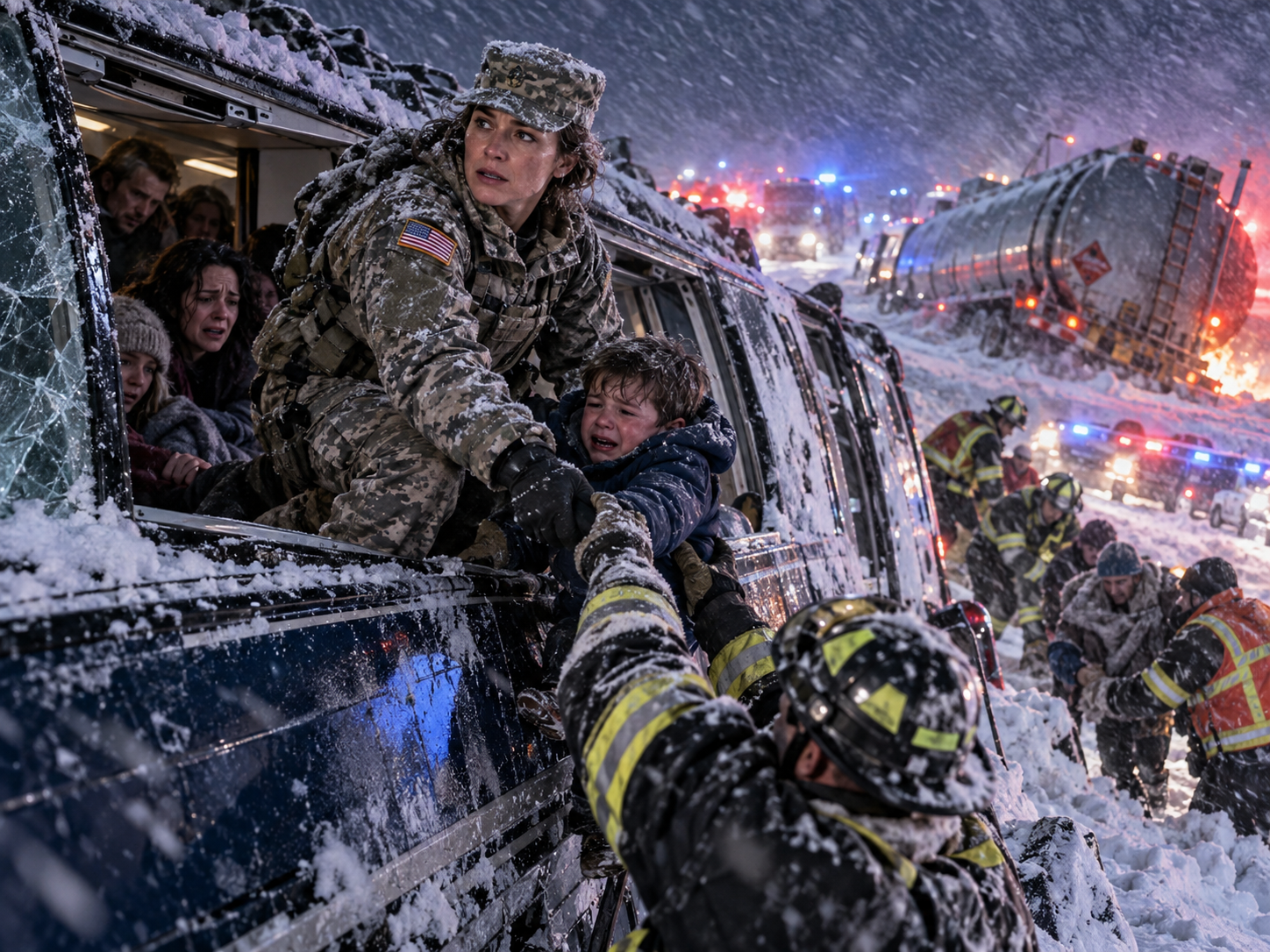
What I didn’t notice was the camera crew farther down the road.
A national news team had been trapped behind the accident.
They had filmed almost everything.
By the time a medical helicopter finally punched through the storm, every passenger from the bus was alive.
Walt was alive.
And the worst part of the scene was finally under control.
We returned to base a little after eleven.
I was sitting with a cup of cold coffee when Sergeant Alvarez suddenly looked up at the television.
“Major.”
I kept drinking.
“Major.”
Something in her voice made me turn.
My face filled the screen.
Snow covered my uniform.
The footage showed me standing on the overturned bus.
Then directing responders.
Then helping passengers through the emergency exit.
Then climbing toward Walt’s tanker.
Across the bottom of the screen ran the headline:
Breaking: Army Officer Leads Highway Rescue During Colorado Blizzard
My phone began vibrating almost immediately.
One message.
Then another.
Then dozens.
I stared at it.
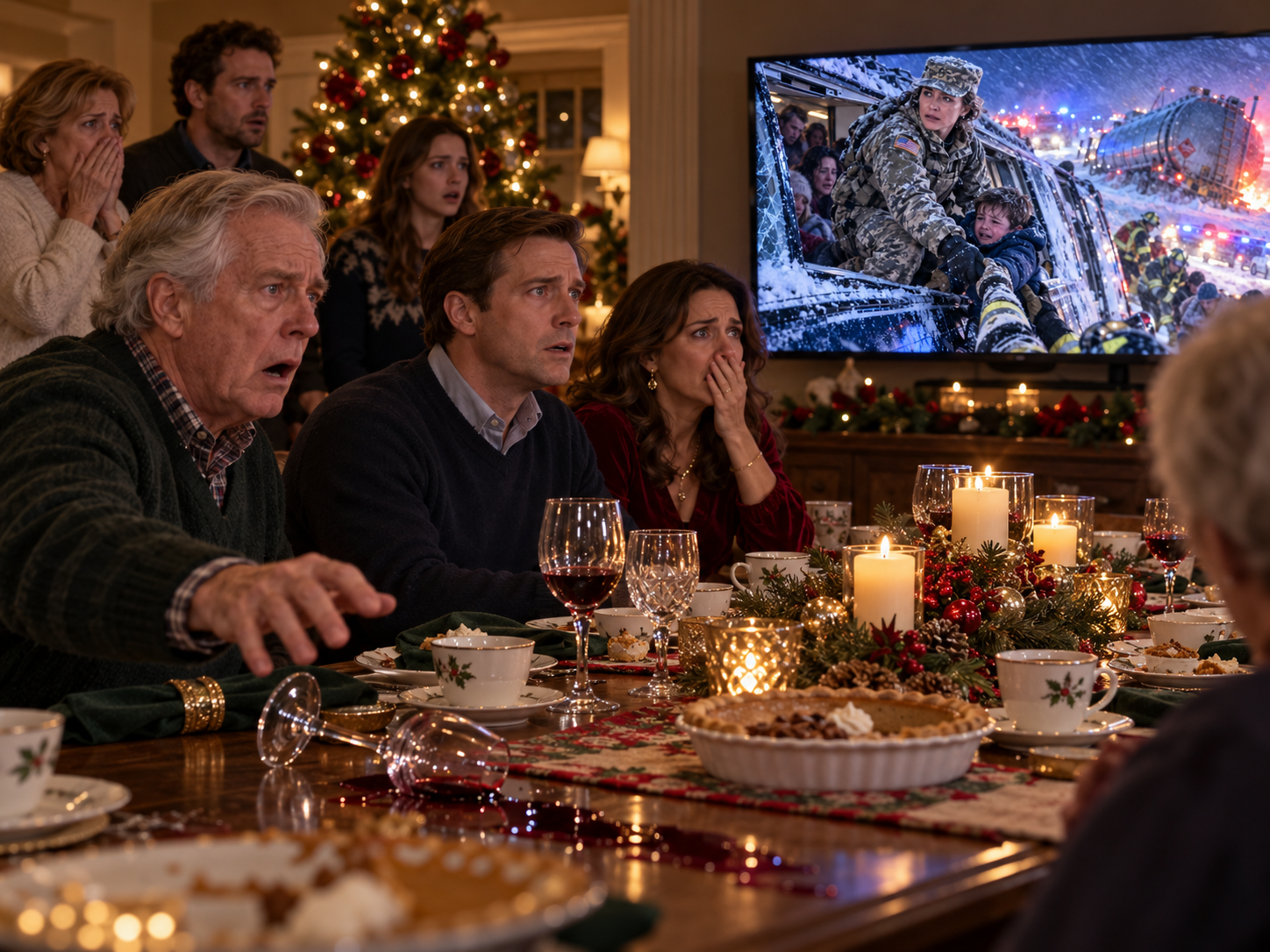
What I didn’t know was that forty minutes away, my father’s Christmas dinner had already reached dessert.
Pie.
Coffee.
Wine.
Jason sitting near Dad while relatives talked about his promotion.
Then someone turned on the national evening news.
And there I was.
According to Aunt Melissa, the entire room went quiet.
The television showed me covered in snow, directing emergency crews through the storm.
Then helping an injured passenger.
Then crawling toward the unstable tanker.
Jason lowered his phone.
My father stopped speaking.
The anchor began explaining the rescue.
Then he said my full name.
And my rank.
Dad’s wineglass slipped from his hand.
It hit the carpet.
Nobody moved to pick it up.
But Jason wasn’t looking at Dad.
He was staring at the television.
And as the report continued, all the color slowly disappeared from his face.
Then he turned toward his wife.
His voice was barely audible.
“Erica.”
One word.
But according to everyone who was there, Erica froze immediately.
And that was the moment Christmas dinner truly began to fall apart.
PART 2 — THE NAME ON THE TELEVISION CHANGED EVERYTHING
My name is Major Claire Dawson.
And until that Christmas night, I thought the worst thing my family had done was ask me not to come home.
I was wrong.
The first person from my family to call me wasn’t Dad.
It was Jason.
His name appeared on my screen at 11:26 p.m.
I stared at it until it stopped ringing.
Then it rang again.
I declined it.
A message arrived.
Claire, please call me. I didn’t know.
Three seconds later:
I swear to God, I didn’t know Dad told you not to come.
That made me sit straighter.
Alvarez was across the room completing an incident report.
She glanced at me.
“Everything okay?”
“No.”
Another message.
Erica told Dad you agreed not to come because you wanted me to have one Christmas without everything being about the Army.
I read it twice.
Then a third time.
My chest felt strangely hollow.
I typed:
I never said that.
Jason called immediately.
This time I answered.
The sound behind him was chaos.
People talking.
Someone crying.
A door slamming.
Then Jason’s voice.
“Claire.”
He sounded nothing like the confident man I remembered from family gatherings.
“What happened?”
“What happened?” I repeated.
“Here.”
“At dinner.”
I closed my eyes.
“I know where you are.”
“No. I mean what happened between Dad and you?”
“He called me three nights ago.”
Silence.
“And?”
“He told me not to come home.”
Another silence.
Longer this time.
“Because of me?”
“He said my career might take attention away from your promotion.”
Jason swore.
I had never heard my stepbrother swear at our father before.
“Claire, I didn’t ask him to do that.”
“I didn’t say you did.”
“But someone did.”
His voice changed.
I heard him move away from the room.
A door closed.
“Did Erica talk to you?”
“No.”
“She told Dad that I had been nervous about you coming.”
I looked through the dark window at the snow whipping beneath the base lights.
“Were you?”
Jason didn’t answer immediately.
Then:
“Yes.”
I appreciated that he didn’t lie.
“But not because I wanted you gone.”
“Then why?”
“Because every time you’re home, Dad turns us into a competition.”
That stopped me.
Jason continued before I could respond.
“He compares my job to yours. My promotion to yours. My house to whatever base you’re stationed at. He tells people you’re the strong one and then tells me I should be more like you.”
I almost laughed.
Not because it was funny.
Because it was so absurd.
“He tells me the opposite.”
“What?”
“He spent half my life explaining why your accomplishments mattered more because you stayed close to the family.”
Jason went quiet.
“He told you that?”
“Repeatedly.”
I could hear him breathing.
Suddenly eighteen years of resentment shifted shape.
Maybe Jason and I hadn’t been standing on opposite sides of the same room.
Maybe Dad had put us there.
“What did Erica say?” I asked.
Jason exhaled.
“That you called her two weeks ago.”
“I haven’t spoken to Erica since October.”
“I know that now.”
He sounded sick.
“What did she claim I said?”
“That you didn’t want to come because you knew people would focus on you. She said you thought it would be better if Christmas was my night.”
I closed my eyes.
For one foolish second, the lie almost sounded kind.
Then I remembered Dad’s words.
Don’t come home this year.
“What happened when the news came on?”
Jason gave a bitter laugh.
“That depends on where you want me to start.”
“Start with why you said Erica’s name.”
Another silence.
Then Jason said something I wasn’t expecting.
“Because this wasn’t the first lie.”
I stood.
“What does that mean?”
For several seconds, all I heard was his breathing.
Then:
“Three months ago, you were supposed to come to Dad’s retirement dinner.”
“I was deployed.”
“That’s what Erica told us.”
My skin prickled.
“I wasn’t deployed.”
“What?”
“I was in Colorado.”
Jason stopped breathing for a second.
I remembered that weekend.
Dad had retired after thirty-two years managing a regional construction company.
I had mailed him a watch.
Called twice.
Texted four times.
Nobody answered.
Two days later Dad returned my call and told me he understood that “the Army came first again.”
I had assumed someone forgot to tell him my leave request had been denied for training.
Now I wasn’t so sure.
“Jason.”
His voice dropped.
“She told everyone your deployment was extended.”
“Why?”
“I don’t know.”
“Yes, you do.”
He didn’t answer.
I pressed.
“Why?”
“Because she didn’t want you there.”
There it was.
Simple.
Ugly.
Honest.
Before I could answer, a voice behind Jason shouted his name.
Erica.
“Jason, stop talking to her!”
The phone went muffled.
Then I heard Jason clearly.
“No.”
“Give me the phone.”
“No.”
“You don’t understand what she’s doing.”
“What she’s doing?”
His voice rose.
“She pulled forty people out of a bus while we were eating pie!”
“That is exactly what I mean!”
The room behind him went silent.
Even through the phone, I could feel it.
Erica’s voice came again, sharper now.
“Every single time something happens in this family, Claire becomes the story.”
I stared at the wall.
Jason spoke quietly.
“She wasn’t even here.”
“That doesn’t matter.”
“She wasn’t here because Dad told her not to come.”
“He was protecting you!”
“I didn’t ask him to!”
“You didn’t have to.”
Then Dad’s voice cut through.
“Enough.”
Jason ignored him.
“How many times?”
Erica didn’t answer.
“How many times did you lie about Claire?”
“Jason—”
“How many?”
The next words came from Aunt Melissa.
I knew her voice instantly.
“Her birthday.”
Silence.
Then another voice.
My cousin Paul.
“Thanksgiving two years ago.”
My hand tightened around the phone.
Another relative spoke.
“The lake weekend.”
I felt suddenly cold.
Events I thought I had missed because of schedules.
Invitations that had supposedly been sent.
Family photographs I had discovered online afterward.
One by one, forgotten wounds surfaced.
Jason sounded stunned.
“What are they talking about?”
Aunt Melissa answered.
“Erica told us Claire didn’t want to come.”
My throat closed.
I sat down slowly.
For years, I had believed my family had simply grown used to my absence.
Maybe some of them had.
But apparently someone had been helping.
“Why?” Jason asked.
Erica started crying.
Not quietly.
“You don’t understand what it was like!”
“What was like?”
“Being married to you while everyone compared you to her!”
Nobody answered.
“You got promoted,” Erica continued. “You worked for twelve years for this. And what did your father talk about? Claire’s deployments. Claire’s medals. Claire’s command. Claire, Claire, Claire.”
Jason’s voice became dangerously calm.
“So you made sure she wasn’t invited?”
“I was trying to give you one night.”
“You lied to me.”
“I was protecting you.”
“From my sister?”
“From living in her shadow!”
That sentence changed something.
Not just for Jason.
For me.
Because suddenly I understood the cruelty of what had happened.
Erica hadn’t removed me because she hated me.
She had removed me because she thought my existence diminished her husband’s.
Dad had done the same thing.
And neither of them had ever bothered asking Jason whether he wanted to win a competition I didn’t know we were having.
Then Dad took the phone.
“Claire.”
I almost hung up.
“Claire, please.”
I waited.
“I made a mistake.”
I looked at the television.
The report was replaying.
Onscreen, snow-covered soldiers moved around the overturned bus.
“A mistake?”
“I shouldn’t have asked you not to come.”
“No.”
My voice surprised even me.
It was calm.
“You shouldn’t have wanted to.”
Dad went silent.
“I thought I was helping Jason.”
“You were choosing him.”
“That’s not fair.”
“Isn’t it?”
“I’ve always been proud of you.”
“Quietly.”
He said nothing.
“You’re proud of me when there’s an audience,” I continued. “When someone asks what I do. When you can tell your friends your daughter is an Army major.”
“That isn’t true.”
“But when being proud of me becomes inconvenient, you ask me to disappear.”
His breathing changed.
“That isn’t what I intended.”
“Intent doesn’t change what you did.”
“Claire—”
“Did you know I already had a plane ticket?”
Silence.
That was my answer.
“I traded four shifts to get Christmas leave.”
“Claire, I didn’t know.”
“You didn’t ask.”
My voice finally cracked.
“I haven’t been home for Christmas in five years, Dad.”
He whispered my name.
“I was coming home because I thought you wanted me there.”
Across the operations room, Alvarez looked away, pretending not to hear.
“I’m sorry,” Dad said.
I believed he meant it.
That didn’t fix anything.
Behind him, someone called his name.
Then Jason took the phone again.
“Claire?”
“Yeah.”
“Are you safe?”
The question nearly broke me.
Not Are you angry?
Not Are you coming home?
Safe.
I looked at my scraped hands.
My bruised wrist.
The dried salt on my boots.
“I’m fine.”
“Good.”
His voice shook.
“Because the news just said the tanker was carrying eight thousand gallons of fuel.”
I looked at Alvarez.
She raised an eyebrow.
“That wasn’t in our briefing.”
Jason laughed once, but it turned into something close to a sob.
Then he said quietly:
“I’m sorry you spent Christmas saving strangers because your own family made you feel unwelcome.”
I didn’t know what to say to that.
So I said nothing.
And sometimes silence is the first honest thing a family shares.
PART 3 — THE THINGS WE HAD BEEN TOLD ABOUT EACH OTHER
Christmas morning began with forty-seven missed calls.
I ignored forty-six of them.
The one I answered came from the hospital.
Walt had asked for me.
When I arrived, his daughter met me outside his room.
She looked exhausted.
She hugged me before I could introduce myself.
“My father says you bullied him into staying alive.”
I smiled.
“That sounds dramatic.”
“He’s dramatic.”
From inside the room came a rough voice.
“I heard that.”
Walt was pale, but awake.
His left leg was elevated and wrapped.
He looked at me and grinned.
“Major.”
“Walt.”
“You never let me finish telling you about Emma.”
“Your youngest granddaughter.”
His grin widened.
“You remembered.”
“You talked about her for twenty minutes.”
“Because you kept asking questions.”
“Because you kept trying to pass out.”
His daughter laughed through tears.
For twenty minutes, I wasn’t Major Dawson from the news.
I was just Claire.
Walt showed me photographs.
Four grandchildren.
Three adult children.
One wife who had died six years earlier.
Then his expression changed.
“You got family?”
I looked toward the window.
“Yes.”
“See them for Christmas?”
“No.”
He studied me.
Unlike relatives, reporters, and superior officers, Walt didn’t ask why.
He simply nodded.
“Families can be complicated.”
“You have no idea.”
“Oh, I have four children.”
That made me laugh.
When I left his room, three reporters were waiting near the hospital entrance.
So was my commanding officer, Colonel Rebecca Shaw.
She folded her arms when she saw me.
“You enjoy creating paperwork on holidays, Major?”
“No, ma’am.”
“Because I’m going to be signing paperwork until Valentine’s Day.”
I almost smiled.
Then her expression softened.
“You did good work.”
“The team did.”
“I know.”
She stepped closer.
“That’s why your first statement to every reporter will include their names.”
“Already planned on it.”
“I know.”
That was Colonel Shaw.
Praise lasted approximately fourteen seconds before becoming an order.
Then she handed me her phone.
“You may want to see this first.”
It was a video from another passenger.
Not the national news footage.
A phone recording from inside the bus.
The screen shook violently.
People were crying.
Then my voice came through the darkness.
Everyone listen to me.
The camera turned.
I barely recognized myself.
My hair was wet with melted snow.
A cut ran across my cheek.
I was holding the little boy’s hand.
The video caption had already been shared hundreds of thousands of times.
But it wasn’t the numbers that caught my attention.
It was one comment.
That’s my son. Whoever this officer is, thank you for giving him his mother back.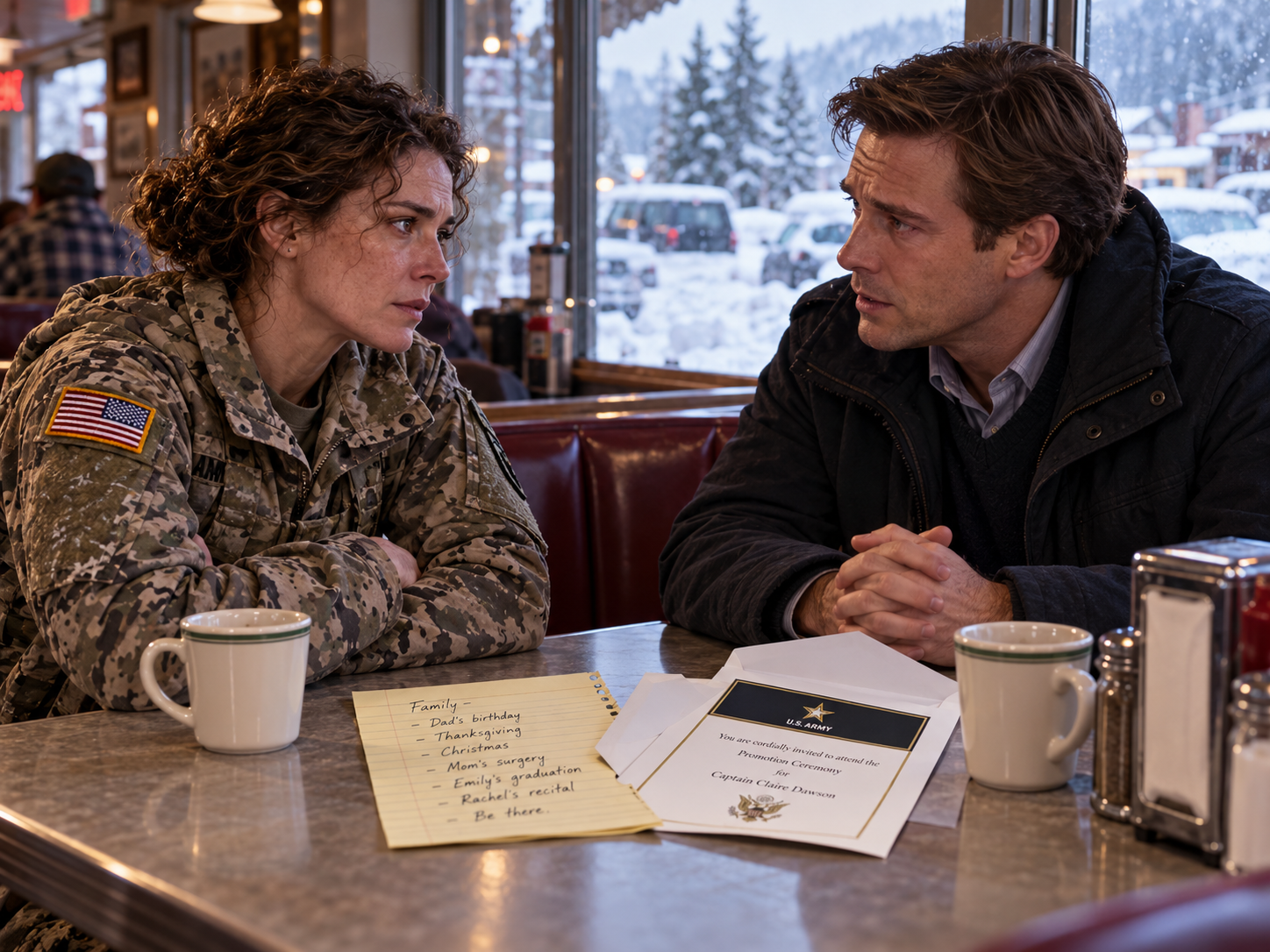
I stared.
Colonel Shaw said nothing.
The bus hadn’t carried strangers.
Not really.
Nobody’s life is filled with strangers once you know who waits for them at home.
My phone buzzed.
Jason.
Can I come see you? Alone.
I thought about it for several minutes.
Then replied.
Tomorrow. Noon.
He arrived in Colorado the next day.
No Erica.
No Dad.
No relatives.
Just Jason.
We met at a diner off base where nobody cared about uniforms or family history.
For the first few minutes, neither of us knew how to speak.
He looked older than I remembered.
Not physically.
Tired.
Finally he said:
“I brought something.”
He placed his phone on the table.
A list.
Dates.
Birthdays.
Holidays.
Family gatherings.
Beside each was an explanation he had been given for why I wasn’t there.
Deployment.
Training.
Work.
Canceled leave.
Didn’t want to attend.
Could not be reached.
I scrolled slowly.
“You made this?”
“Last night.”
“Why?”
“Because I started asking people questions.”
My stomach tightened.
“How many?”
“Nine.”
I looked up.
“What?”
“Nine events in four years where Erica told somebody you weren’t coming before anyone had actually spoken to you.”
I leaned back.
“And Dad?”
Jason swallowed.
“Sometimes he knew.”
I said nothing.
“He didn’t know she was lying about everything.”
“But he didn’t call me.”
“No.”
“He didn’t check.”
“No.”
That hurt differently.
Erica’s lies were deliberate.
Dad’s failure was passive.
Sometimes passive betrayal cuts deeper because it tells you how little effort someone was willing to make.
Jason looked down at the table.
“There’s something else.”
Of course there was.
“Dad and I have been doing this for years.”
“Doing what?”
“Competing.”
“I wasn’t competing with you.”
“I know that now.”
His eyes filled with shame.
“When I made regional manager, Dad said it was good, but not exactly Army command.”
I closed my eyes.
“When I made captain, he told me you bought your first house.”
Jason gave a bitter smile.
“When I bought that house, he told me you had just returned from Afghanistan.”
“I wasn’t in Afghanistan that year.”
“What?”
“Kuwait.”
For the first time, we both laughed.
It wasn’t happiness.
But it was something.
Jason rubbed his face.
“I resented you.”
“I resented you too.”
His eyes met mine.
“Why?”
“Because Dad showed up for you.”
He went still.
“Soccer games. Graduation. Your first job. Your engagement.”
“He showed up for your commissioning.”
“He left before dinner.”
Jason stared at me.
“He told us you had duty.”
“No.”
The word sat between us.
Another lie.
Maybe Dad had told it to protect himself.
Maybe Erica had repeated it.
Maybe by then the truth no longer mattered to anyone.
“I spent years thinking you were the child he chose,” I said.
Jason looked devastated.
“I spent years thinking the exact same thing about you.”
We sat there looking at each other.
Two adults in our forties.
Two people who had built successful lives.
Two people who still carried the injuries of children competing for approval from the same father.
“How stupid is this?” Jason whispered.
“Very.”
“I don’t hate you.”
“I don’t hate you either.”
He nodded.
Then he slid an envelope across the table.
“This came to Dad’s house in October.”
I recognized the Army seal.
My heart sped up.
“Why do you have that?”
“Erica had it.”
I opened it.
Inside was a copy of a formal invitation.
A ceremony scheduled for January.
My name appeared in bold beneath the Army emblem.
MAJOR CLAIRE DAWSON
Below it:
Recognition of Selection for Promotion to Lieutenant Colonel
I stared at the page.
My promotion list had been released months earlier, but I had deliberately avoided making a big deal about it.
I had planned to tell Dad in person at Christmas.
Jason whispered:
“She knew.”
I looked up.
“Since October?”
He nodded.
“She opened the letter.”
“She opened mail addressed to me?”
“It was addressed to Dad.”
I looked again.
He was right.
The command had invited my father as family.
“He never told me he got this.”
“He says he never saw it.”
My stomach dropped.
“Erica took it?”
Jason nodded.
“I found it in her desk this morning.”
For several seconds, anger completely replaced hurt.
“She knew I was being promoted.”
“Yes.”
“And then she convinced Dad to keep me away from Christmas because my career might overshadow yours.”
Jason’s jaw tightened.
“Yes.”
I folded the invitation carefully.
“Why?”
“I asked her.”
“And?”
“She said she panicked.”
“That isn’t an answer.”
“I know.”
He looked toward the window.
“She said my promotion had been the first thing in years that felt completely mine.”
I waited.
“And she thought if you came home and announced lieutenant colonel…”
“Everyone would forget about you.”
“Yes.”
There was the competition again.
Only this time Jason wasn’t defending it.
He looked disgusted by it.
“My promotion isn’t worth this.”
“No.”
“I told her I’m moving out.”
That surprised me.
“Jason.”
“I’m not doing it because of you.”
“Good.”
“I’m doing it because she looked me in the face for years and convinced me my sister didn’t care about us.”
His voice broke.
“And I believed her because believing it was easier than calling you.”
That was the most honest thing he had ever said to me.
I reached for my coffee.
“So what happens now?”
“With Erica?”
“With us.”
Jason looked at me.
“I don’t know.”
Neither did I.
But for once, we didn’t need Dad to decide.
PART 4 — MY FATHER CAME TO COLORADO
Dad arrived four days later.
He didn’t warn me.
Security called my office shortly after nine.
“Ma’am, there’s a Robert Dawson at the visitor center asking for you.”
My stomach tightened.
I nearly told them to send him away.
Then I remembered something Colonel Shaw had said after the rescue.
You don’t have to avoid difficult ground just because someone else created it.
So I went.
Dad looked smaller than I remembered.
Not physically.
The certainty was gone.
No Christmas sweater.
No booming voice.
No stories.
He stood holding a paper bag and staring at the floor.
“You flew here?”
He nodded.
“Why?”
“To apologize.”
“You could have called.”
“I tried.”
“I wasn’t ready.”
“I know.”
That answer surprised me.
Dad had spent most of my life treating boundaries like negotiations.
We drove to a coffee shop.
For several minutes, he said nothing.
Then he placed the paper bag on the table.
Inside was a small wrapped box.
“I bought this before Christmas.”
I didn’t touch it.
“What is it?”
“Open it whenever you want.”
I left it there.
He swallowed.
“I watched the bus footage.”
“I figured.”
“I’ve watched it probably twenty times.”
“Why?”
His eyes lowered.
“Because I keep trying to understand how I could watch my daughter climb onto an overturned bus in a blizzard and realize I didn’t even know she had been working that night.”
Neither of us spoke.
“I didn’t know where you were.”
“You told me not to come home.”
“I know.”
“You didn’t ask where I would go.”
“I know.”
Every time he said those words, some part of my anger lost its edge.
Not because he was forgiven.
Because he had finally stopped defending himself.
“I thought you were strong,” Dad said.
I almost laughed.
“That was the problem?”
“In a way.”
He rubbed both hands together.
“You never seemed to need me.”
“Dad, children shouldn’t have to look weak to deserve their parents.”
His eyes closed.
“I know that now.”
I stared at him.
“When Mom died, you told me I had to be strong.”
My mother had died when I was seventeen.
Eight months later, Dad remarried.
Jason was sixteen.
Two grieving teenagers suddenly became step-siblings.
Neither of us knew what we were doing.
Neither did Dad.
“You told me Jason had already been through enough,” I continued. “You asked me to be patient with him. Then you asked me to give him space. Then you asked me to understand when you spent more time with him.”
Dad looked sick.
“I thought I was helping him adjust.”
“And I adjusted by myself.”
“Yes.”
He whispered it.
No excuse.
Just yes.
“I joined the Army partly because I needed somewhere that expectations made sense.”
Dad stared at me.
“You never told me that.”
“You never asked.”
That sentence hurt him.
I could see it.
Good.
Some truths should hurt.
Not because pain is revenge.
Because pain tells us where damage occurred.
“After you commissioned,” he said, “I started bragging about you to everyone.”
“I know.”
“I was proud.”
“I know.”
“But somewhere along the way, I started using your success.”
I frowned.
“What do you mean?”
“To make myself feel like I’d done something right.”
That was unexpected.
“When people asked about you, I could say my daughter was an Army officer. Later a captain. Then major.”
His voice cracked.
“I told people about deployments I never asked you about. Awards I couldn’t explain. Units I couldn’t name.”
He looked at me.
“I loved being the father of Major Claire Dawson.”
I waited.
“But I wasn’t doing much of the work required to actually be Claire Dawson’s father.”
The anger inside me shifted again.
Not gone.
Never erased.
But named.
That mattered.
Dad wiped his eyes.
“When Jason succeeded, I did the same thing. Then I started comparing you because it gave me something to talk about.”
“You hurt both of us.”
“I know.”
“You made Jason think I looked down on him.”
“I know.”
“You made me think Jason mattered more.”
“I know.”
“And when Erica suggested keeping me away from Christmas?”
Dad looked down.
“I agreed too quickly.”
“Why?”
He took a long time to answer.
“Because it was easier.”
There it was.
The real answer.
Not protection.
Not family peace.
Convenience.
“It was easier to ask the child who had always adjusted to adjust one more time.”
I felt tears threaten.
Dad continued.
“You’ve always been the one who said, ‘I understand.’”
I looked away.
“So I told myself you would.”
“I did.”
“That doesn’t mean I had the right to ask.”
“No.”
He pushed the paper bag toward me.
“I can’t undo Christmas.”
“No.”
“I can’t undo the other years.”
“No.”
“But I’d like to stop adding to them.”
That was as close to the right apology as he could give.
I opened the box.
Inside was a watch.
Not expensive.
Not military.
The back was engraved.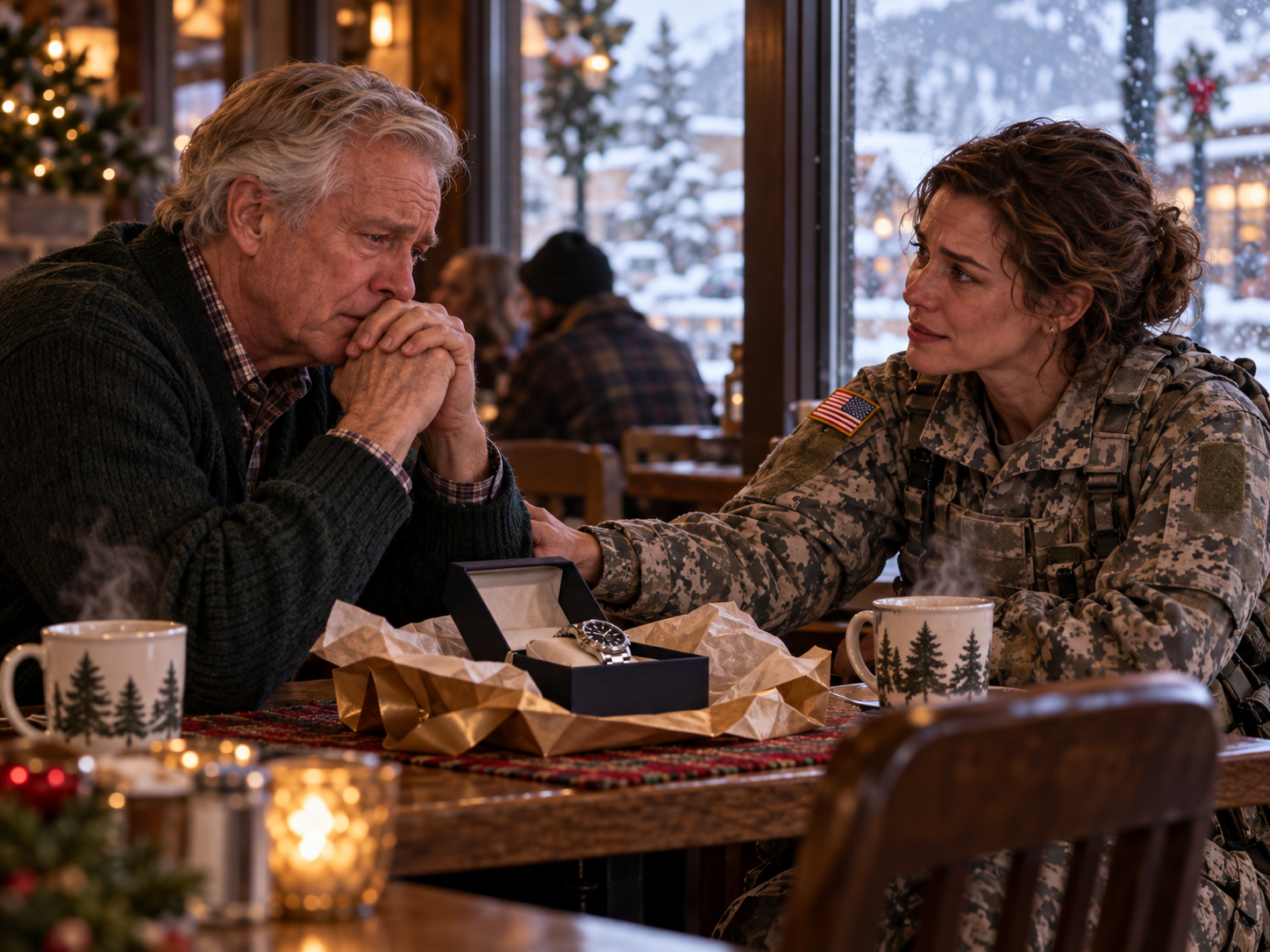
FOR ALL THE TIME I SHOULD HAVE GIVEN YOU.
DAD.
I stared at it.
“That is painfully sentimental.”
He laughed through tears.
“I know.”
“You’ve been practicing that line.”
“For three days.”
I smiled despite myself.
Then my phone rang.
Hospital.
Walt’s daughter.
My smile disappeared.
I answered.
“Claire?”
“Yes?”
“Dad’s being taken back into surgery.”
I stood immediately.
Dad stood too.
“What happened?”
The doctors had discovered vascular complications in Walt’s injured leg.
The next hour became a blur.
I drove to the hospital.
Dad came with me but stayed in the waiting room without being asked.
Walt’s daughter paced.
His oldest grandson sat with his head in his hands.
The youngest granddaughter—the one who had just learned to walk—wasn’t there.
And strangely, that was what I kept thinking about.
Emma.
Walt had stayed awake in a wrecked tanker because I kept asking about Emma.
Hours later, the surgeon came out.
They had saved his leg.
His daughter collapsed into my arms.
And standing several feet away, my father quietly began crying.
Not because the patient was family.
Because he finally understood.
Every stranger is someone’s family.
And family is a verb long before it is a title.
PART 5 — THE EMPTY CHAIR
My promotion ceremony took place three weeks later.
I expected maybe twenty people.
The auditorium held nearly two hundred.
Some were soldiers.
Some were families from the bus.
Several were first responders.
Walt arrived in a wheelchair despite his doctor’s objections.
He claimed the doctor had “strongly recommended” rest.
His daughter told me the actual phrase had been, “Absolutely not.”
Alvarez stood in the front row.
Colonel Shaw was beside her.
Then I saw Jason.
Alone.
He had moved into an apartment.
He and Erica had begun counseling separately.
He didn’t tell me whether their marriage would survive.
I didn’t ask.
That was their decision.
What mattered to me was that Jason had finally stopped using me as the explanation for problems that existed inside his own life.
He caught my eye.
Raised one hand.
I smiled.
Then I saw Dad.
He was standing near the aisle holding the old invitation Erica had hidden.
Not waving.
Not calling attention to himself.
Just there.
For once, presence was enough.
The ceremony began.
Colonel Shaw spoke about service.
Responsibility.
Leadership.
Then, to my horror, she mentioned the blizzard.
I had specifically asked her not to make the ceremony about the rescue.
She ignored me.
Colonels have that privilege.
“Major Dawson has repeatedly insisted,” she told the audience, “that what happened on Christmas Eve was a team effort.”
I could hear Alvarez whisper:
“Because it was.”
Shaw glanced at her.
“Sergeant Alvarez, I have the microphone.”
Laughter moved through the room.
Then Shaw continued.
“And Major Dawson is correct.”
She named every soldier.
Every medic.
Every state trooper.
Every firefighter.
Every dispatcher.
The room applauded.
That mattered more to me than anything that followed.
Then came the promotion.
The insignia.
The oath.
The moment I officially became Lieutenant Colonel Claire Dawson.
When it was over, I stepped away from the stage and found Jason waiting.
He looked at the insignia on my uniform.
“Lieutenant Colonel.”
“Regional vice president.”
He laughed.
“Please never call me that.”
“Then stop calling me Lieutenant Colonel at family dinners.”
“Deal.”
He hugged me.
Not the awkward half-hug we’d used for fifteen years.
A real one.
When we separated, his eyes were wet.
“I’m proud of you.”
The old version of me might have deflected.
Made a joke.
Changed the subject.
Instead I said:
“Thank you.”
Then:
“I’m proud of you too.”
Jason looked surprised.
“For what?”
“For finally choosing your own life.”
He nodded.
Dad waited until everyone else had spoken to me.
Then he approached.
“Congratulations.”
“Thanks.”
He looked around.
“Quite a crowd.”
“Apparently rescuing a bus ruins your chances of having a quiet ceremony.”
He smiled.
Then his expression changed.
“I saved you a seat.”
“What?”
“At home.”
I stared at him.
“For what?”
“Christmas.”
“Dad, Christmas was three weeks ago.”
“I know.”
His eyes softened.
“I’m talking about next Christmas.”
I didn’t answer.
He continued quickly.
“No pressure. No expectations. No speeches about careers. No comparing anybody. I’m not even allowed to mention rank unless someone is actively invading the house.”
I laughed.
“Very specific.”
“Jason helped write the rules.”
“Of course he did.”
Dad became serious again.
“There will be a chair for you.”
I looked at him.
“And if I can’t come?”
“The chair is still yours.”
That sentence nearly undid me.
Because that was what I had wanted all along.
Not attention.
Not applause.
Not everyone talking about my career.
A place.
A chair.
The certainty that whether I occupied it or not, nobody would give it away.
Months passed.
The news moved on.
The rescue footage disappeared beneath new stories.
Walt learned to walk again with a cane.
The little boy from the bus sent my unit a drawing of an overturned bus surrounded by soldiers who looked suspiciously like superheroes.
Alvarez framed it in our operations building.
Jason and I started calling each other every Sunday.
Not every conversation was deep.
Most weren’t.
We argued about football.
He complained about work.
I complained about Army paperwork.
Sometimes healing looks surprisingly boring.
Dad tried too.
He didn’t become perfect.
Neither did I.
There were moments when he slipped into old habits.
Once, during dinner, he started comparing Jason’s salary to mine.
Jason and I both stared at him.
Dad stopped halfway through the sentence.
“Right.”
We burst out laughing.
That might have been the moment I realized our family had changed.
Not because nobody made mistakes.
Because mistakes were no longer protected by silence.
The following Christmas, I managed to get leave.
My flight landed shortly after noon.
Dad was waiting near baggage claim.
So was Jason.
Dad had made a sign.
Jason looked embarrassed.
The sign said:
WELCOME HOME, CLAIRE.
Nothing else.
No rank.
No decorations about the Army.
No accomplishments.
Just my name.
I walked toward them.
Dad hugged me first.
Jason grabbed my suitcase.
And for once, nobody asked what I had done recently.
Nobody mentioned promotions.
Nobody talked about deployments.
We went home.
The house smelled like cinnamon, roasted turkey, and the slightly burned dinner rolls Dad always insisted weren’t burned.
When I entered the dining room, I stopped.
There was my chair.
Same place it had been when I was seventeen.
A small folded card rested on the plate.
CLAIRE
That was all.
I touched the back of the chair.
Dad noticed.
“I told you.”
“What?”
“It would stay yours.”
I looked around the table.
Jason.
Dad.
Aunt Melissa.
Cousins.
Friends.
Even Sergeant Alvarez, whose sister’s house had apparently become “too peaceful” for her taste.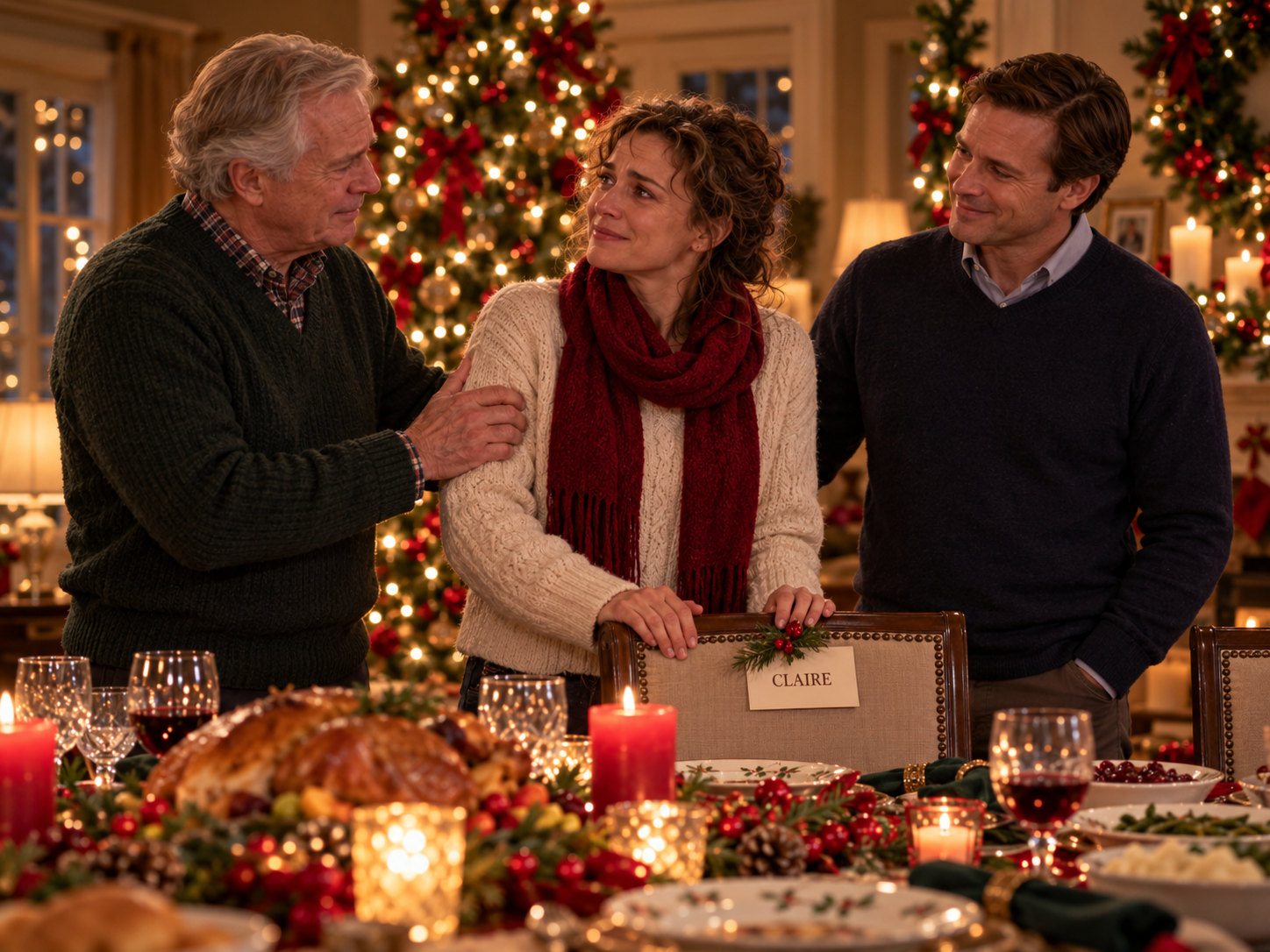
There were empty places too.
People who had moved on.
Relationships that hadn’t survived.
Not every broken thing had been repaired.
Erica and Jason had separated permanently that spring.
I didn’t celebrate it.
I didn’t hate her.
I eventually understood that Erica had lived in the same poisonous competition Dad created.
Understanding wasn’t forgiveness.
But it allowed me to stop carrying her choices.
Before dinner, Dad tapped his glass.
Jason immediately pointed at him.
“No speeches.”
Dad raised both hands.
“Not a speech.”
“That’s how your speeches always begin.”
Everyone laughed.
Dad looked at me.
“I just wanted to say I’m glad everyone who could be here is here.”
Then he sat down.
That was it.
No hero daughter.
No successful son.
No comparison.
No ranking.
Just family.
Later that night, snow began falling outside.
Not a blizzard.
Just soft December snow.
I stood near the window holding a cup of coffee.
Dad walked up beside me.
“Thinking about last year?”
“A little.”
“Worst Christmas I ever had.”
I looked at him.
“Interesting. Mine turned out pretty meaningful.”
He laughed.
Then his expression grew serious.
“I’ve wanted to ask you something for a year.”
“What?”
“Why didn’t you tell me you had canceled your flight?”
I thought about that.
The answer came easily now.
“Because I wanted you to change your mind without needing to know how much you’d hurt me.”
Dad swallowed.
“I wish I had.”
“So do I.”
He nodded.
Then I added:
“But if I hadn’t canceled it, I wouldn’t have been on duty.”
He looked out at the snow.
“The bus.”
“The bus.”
“Walt.”
“Walt.”
“The kids.”
I nodded.
Dad was quiet for a moment.
“Do you ever think things happen for a reason?”
“No.”
He looked surprised.
I smiled.
“I think things happen.”
Then I looked back toward the dining room where Jason was accusing Alvarez of cheating at cards.
“And afterward, we decide what kind of people we’re going to be because of them.”
Dad considered that.
“I like that better.”
“So do I.”
A year earlier, my father had told me not to come home because he thought my presence would cast a shadow over someone else.
That decision broke something in me.
But the storm that followed exposed something I had needed to understand for years.
My brother had never been my enemy.
His success didn’t diminish mine.
Mine didn’t diminish his.
Love was never supposed to be a competition.
And family was never supposed to require one person to become smaller so another could feel tall.
I spent Christmas Eve rescuing people I had never met.
But in a strange way, that night rescued me too.
It forced every hidden resentment into the light.
It made Jason and me finally speak honestly.
It forced my father to see the difference between bragging about his daughter and actually showing up for her.
And it taught me something I should have learned much earlier.
Being strong does not mean accepting every wound quietly.
Understanding someone does not require excusing them.
Forgiveness is not pretending something never happened.
And love without respect is not enough.
Near midnight, everyone gathered around the tree.
Dad handed me one final envelope.
Inside was my canceled airline itinerary from the previous year.
I stared at him.
“How did you get this?”
“You forwarded it to me after we talked.”
I had forgotten.
He had printed it.
Across the bottom, he had written one sentence.
I will never again ask you to give up your seat in this family.
I looked at him.
He didn’t say anything.
Neither did I.
I simply hugged him.
And over his shoulder, I saw Jason standing beside the dining table.
He quietly pulled out my chair.
Waiting.
This time, I went home.
And nobody asked me to disappear.