They Thought the Ceremony Was for My Brother—Until the General Called My Name
PART 1 — THE NAME THEY NEVER EXPECTED
For twenty years, Emily Carter had watched her brother Daniel receive every proud smile their mother seemed capable of giving.
So when the family arrived at what everyone assumed was Daniel’s military ceremony, Emily already knew what role she was expected to play.
Stay quiet.
Sit at the edge.
Don’t take attention away from him.
Her mother leaned close while keeping a pleasant expression for the people around them.
“Please don’t embarrass us today.”
Emily didn’t answer.
She simply moved to the far end of the row.
A few seats away, her mother carefully straightened Daniel’s sleeve and adjusted his uniform like he was the only soldier in the family worth noticing.
Emily had seen that look her entire life.
Pride.
Warmth.
Approval.
All of it reserved for Daniel.
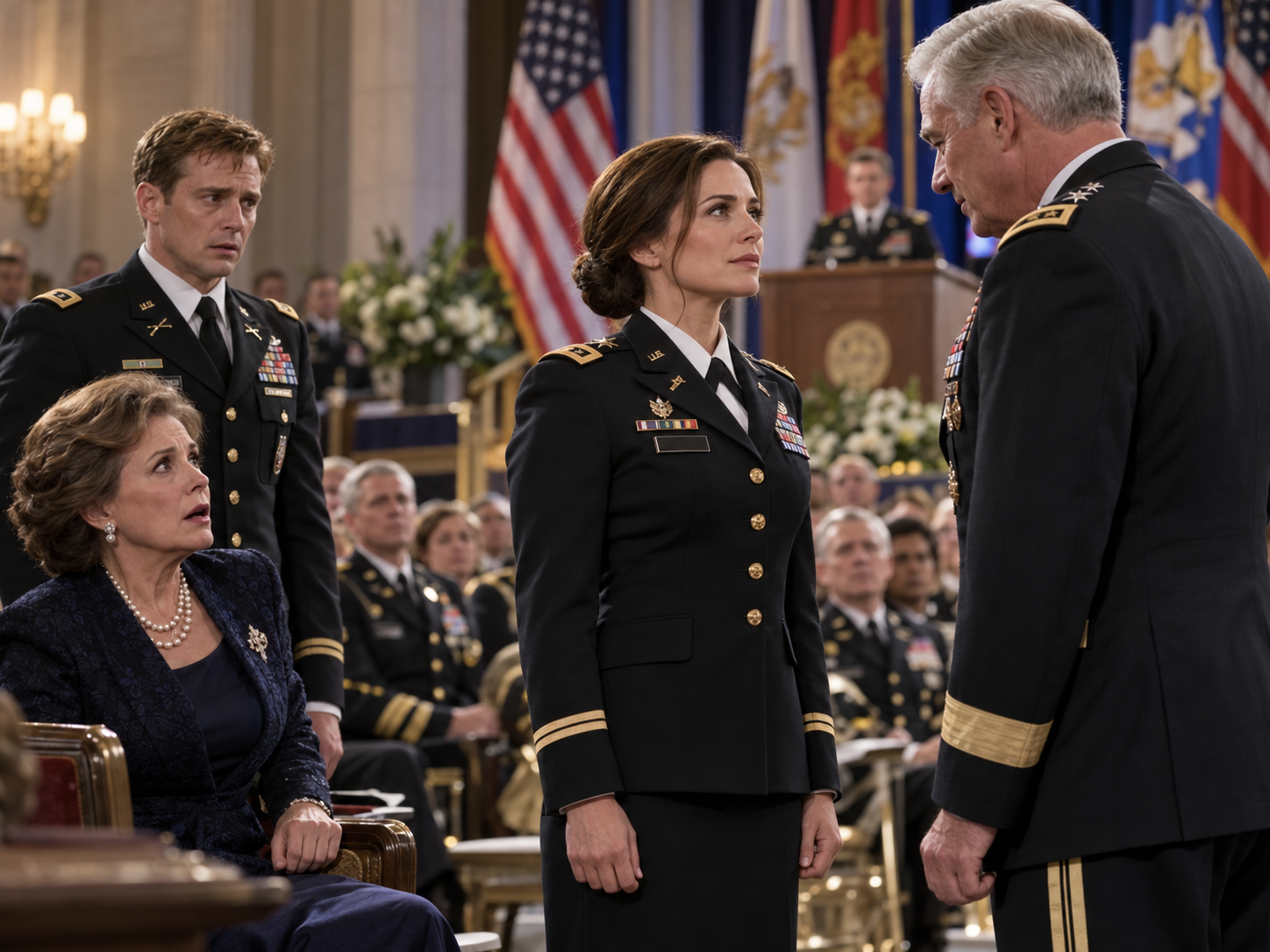
Then Major General Hale stepped behind the podium.
The room slowly quieted.
He began reading a service record.
At first, Emily’s mother smiled toward Daniel.
Combat deployments.
Complex assignments.
High-risk operations.
Every new detail seemed to make her sit a little straighter.
Then the General described a mission involving a command structure that had nearly collapsed under pressure.
The hall became quieter.
He continued.
One officer had been forced to make a critical decision under impossible conditions.
A decision that ultimately brought forty-six American service members home alive.
Emily’s mother looked toward Daniel with unmistakable pride.
She was certain the General was describing her son.
Daniel, however, wasn’t smiling.
His face had gone strangely still.
Then General Hale finished speaking.
He stepped away from the podium.
And began walking toward the front row.
Emily’s mother straightened.
Daniel shifted in his chair.
The General approached him.
Then walked right past.
He didn’t slow down.
Didn’t stop.
Didn’t even turn.
The room seemed to freeze.
General Hale continued along the row until he reached the far end.
Until he stopped directly in front of Emily.
His expression softened.
Then he lowered his voice.
“Colonel Carter.”
Emily’s mother rose halfway from her chair.
Confusion spread across her face.
“Wait…”
She looked from the General to Emily.
“What did you just call her?”
Daniel’s face lost its color.
But Emily noticed something important.
He didn’t look shocked.
He looked afraid.
Like a man who had always known this moment might come.
And had spent years hoping it never would.
General Hale turned slightly toward the room.
Then began explaining the truth.
Operation Glass Lantern.
A mission Emily had never been permitted to discuss.
A mission whose details had remained classified long after she returned home.
He described the breakdown in command.
The danger.
The decision that had to be made in minutes.
Then he said what Emily’s family had never known.
Colonel Emily Carter had made the call.
Her decision had saved forty-six lives.
The hall was completely silent.
Emily’s mother slowly turned toward Daniel.
For the first time, the pride on her face had been replaced by uncertainty.
Then fear.
“What convoy are they talking about?”
Daniel swallowed.
His eyes dropped.
“Mom…”
His voice barely worked.
“Please. Not here.”
Emily said nothing for several seconds.
She simply looked at the brother who had spent years accepting praise that apparently came with a truth he had never shared.
Then she spoke.
Calmly.
“Tell her.”
Daniel looked up.
Emily held his gaze.
“Tell her the truth.”
And that was the moment Daniel finally broke.
PART 2 — THE LIE HE NEVER CORRECTED
Daniel Carter had spent half his life being praised for things he had actually done.
That was what made the truth so much uglier.
He had never needed to steal from Emily.
He had simply discovered that taking what belonged to her was easier than correcting the people who offered it to him.
His hands tightened against his knees.
“Mom,” he whispered. “You misunderstood.”
Margaret Carter stared at him.
For years, Daniel had been the one person in her family she never questioned.
Emily saw it happening in real time—the tiny fractures forming inside a belief Margaret had protected for decades.
“What did I misunderstand?”
Daniel glanced toward the stage.
Nearly four hundred people filled the hall.
Officers.
Enlisted personnel.
Spouses.
Veterans.
Civilian officials.
People who understood enough about ceremony to realize that whatever was happening in the front row was deeply personal.
General Hale intervened quietly.
“Mrs. Carter, perhaps this conversation should wait until after the presentation.”
Margaret barely seemed to hear him.
She was still staring at Daniel.
“The convoy.”
Daniel rubbed a hand across his jaw.
“You assumed I was involved.”
“Because you said you were.”
“No.”
His answer came too quickly.
Emily almost laughed.
Margaret blinked.
Daniel looked down.
“I never actually said that.”
There it was.
Not an apology.
A technical defense.
Emily had heard versions of it her whole life.
I didn’t say you couldn’t come.
I only forgot to tell you.
I didn’t tell Mom you failed.
She assumed.
I didn’t take your credit.
People just misunderstood.
Margaret’s voice sharpened.
“You came home after that deployment and I asked you about those soldiers.”
Daniel said nothing.
“You told me you couldn’t discuss operational details.”
“I couldn’t.”
“And I said I was proud of you.”
Daniel swallowed.
“Yes.”
“You thanked me.”
“Yes.”
Emily looked away.
That single word hurt more than she expected.
Not because she needed Margaret’s praise.
She had stopped needing that years ago.
Or convinced herself she had.
But she remembered the exact phone call.
She had been sitting alone outside a temporary operations building, exhausted after thirty-one hours without real sleep.
Her hands had still been shaking.
Forty-six people were alive.
Three were critically wounded.
Two helicopters had returned damaged.
A vehicle had been abandoned.
One medic had performed an emergency procedure on a floor slick with fuel and blood.
Emily had wanted to hear something familiar.
So she had called home.
Margaret answered on the fourth ring.
Emily said, “Hi, Mom.”
And Margaret had replied, “Emily, I can’t talk long. Your brother finally called. He’s safe.”
Emily had closed her eyes.
“That’s good.”
“He’s doing important work over there.”
“I know.”
“I worry about him every day.”
Emily remembered looking across the compound at a row of exhausted soldiers climbing from vehicles she had just helped bring home.
“I worry too.”
Margaret had sighed.
Then came the sentence Emily never forgot.
“I wish you two had more in common. Daniel has always had such a strong sense of purpose.”
Emily nearly laughed that night.
Instead, she had said goodnight.
The next morning, she went back to work.
Now, years later, General Hale’s voice brought her back to the ceremony.
“Colonel?”
Emily looked up.
He was holding a presentation case.
The room had waited long enough.
She rose.
Every person in the hall stood with her.
The sound of hundreds of chairs moving backward rolled across the room.
Margaret remained seated.
Not because she intended disrespect.
She simply seemed unable to move.
Daniel stood slowly.
Emily stepped into the aisle.
General Hale returned to the podium and asked her to join him.
She walked toward the stage beneath a standing ovation that felt more uncomfortable than any hostile briefing she had ever endured.
Praise had always embarrassed her.
It seemed especially strange now.
Operation Glass Lantern had not felt heroic.
It had felt terrifying.
There had been no swelling music.
No polished speech.
No certainty.
Just incomplete information, bad communications, smoke, screaming through radios, and a shrinking window in which every available decision seemed capable of getting people killed.
General Hale explained only what had recently been cleared for public release.
An American convoy moving through a remote corridor had been redirected after intelligence indicated the planned route had been compromised.
Minutes later, communications with the senior field commander failed.
A second unit had suffered mechanical losses.
An evacuation route became unusable.
Higher headquarters hesitated because the information was contradictory.
Emily, then a lieutenant colonel coordinating operations from a joint command post, recognized that waiting for perfect clarity would destroy the remaining window for extraction.
She ordered a route change.
She redirected air support.
She reassigned two units without waiting for the normal approval chain.
And when challenged, she took personal responsibility.
The convoy broke contact with less than six minutes to spare.
Forty-six Americans returned.
General Hale paused.
“Colonel Carter was later investigated for exceeding her authority.”
A murmur spread through the hall.
Emily’s mother looked up sharply.
Hale continued.
“The investigation concluded that Colonel Carter’s actions were not only justified but decisive. Multiple commanders stated that without her intervention, the outcome would almost certainly have been catastrophic.”
He turned toward Emily.
“She refused public recognition while the operation remained classified.”
Then he opened the case.
Inside rested the Distinguished Service Medal.
Emily’s breath caught despite herself.
She had known there would be recognition.
She had not known exactly what form it would take.
General Hale pinned the medal against her uniform.
Then he saluted.
Emily returned it.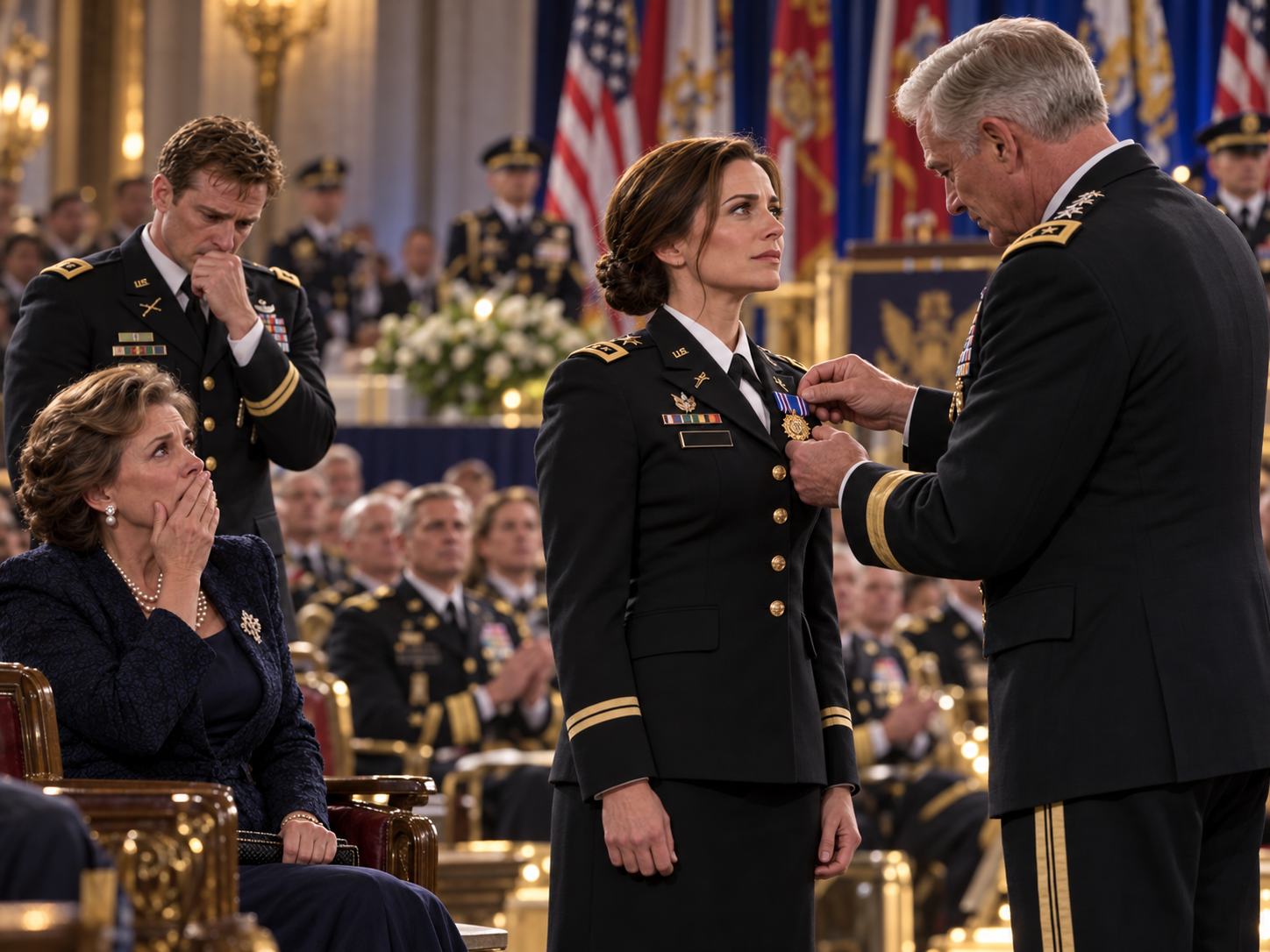
The applause rose around her.
But when she looked beyond the stage, she saw only her family.
Margaret was crying.
Daniel was not.
Daniel looked like a man watching a wall collapse toward him.
Their father, Richard, sat two seats down from Margaret.
He had hardly spoken since they arrived.
Unlike Margaret, he was not staring at Emily.
He was staring at Daniel.
And Emily understood immediately.
Her father knew something too.
The reception afterward took place in a smaller hall decorated with unit banners and framed photographs.
Emily tried to disappear near a window.
She failed.
People kept approaching her.
A retired sergeant major shook her hand and said his nephew had been part of the convoy.
A woman in her sixties hugged Emily without asking permission, then apologized through tears.
“My son was twenty-four,” she said. “He came home because of you.”
Emily shook her head.
“He came home because a lot of people did their jobs that night.”
“But you made the decision.”
Emily had no answer to that.
Across the room, Margaret watched.
Each person who approached Emily seemed to deepen the shock on her face.
For once, Emily wasn’t invisible because she had chosen secrecy.
She was invisible only to the people who had spent years refusing to look.
Daniel eventually approached.
“We need to talk.”
Emily took a sip of water.
“No.”
His eyebrows lifted.
“Emily.”
“You’ve had years.”
“I know.”
“You had every Christmas.”
His jaw tightened.
“You had birthdays, Thanksgiving dinners, Dad’s retirement party, your promotion dinner, your wedding reception, Aunt June’s funeral, Mom’s sixtieth birthday.”
“Keep your voice down.”
Emily smiled faintly.
There he was.
The real Daniel.
Even cornered by his own dishonesty, he was still concerned about appearances.
“I am keeping my voice down.”
“People are watching.”
“They’ve been watching me all afternoon. I survived.”
He exhaled hard.
“I never told Mom I saved that convoy.”
“You let her believe it.”
“That’s different.”
“No.”
For the first time, anger entered Emily’s voice.
“It isn’t.”
Daniel looked away.
“She needed something to be proud of.”
Emily stared at him.
“And I didn’t?”
“That’s not what I meant.”
“Then explain it.”
He hesitated.
Emily waited.
Daniel finally lowered his voice.
“When you joined, you didn’t need them.”
Emily almost laughed.
“You decided that?”
“You left. You built your own life. You never called asking for anything. You never came home crying when something went wrong.”
“Do you know why?”
Daniel’s expression changed.
Emily stepped closer.
“Because every time I came home, you were already the reason everyone was celebrating.”
“That wasn’t my fault.”
“No. Not when we were children.”
She held his gaze.
“But you stopped being a child a long time ago.”
Daniel flinched.
Margaret appeared beside them.
“What else?”
Neither sibling answered.
Margaret looked directly at Daniel.
“What else have I believed that wasn’t true?”
“Mom, not here.”
Her face hardened.
“Stop saying that.”
Daniel fell silent.
Richard arrived behind her.
Emily studied her father.
He seemed older than he had that morning.
“Richard,” Margaret said, “did you know?”
Richard’s eyes closed briefly.
That was answer enough.
Margaret stepped backward.
“Oh my God.”
“Margaret—”
“You knew?”
“Not everything.”
“How much?”
Richard looked at Emily.
She suddenly wished he wouldn’t.
“I knew Emily was senior to Daniel.”
Margaret’s mouth opened.
“I knew she had been promoted to colonel.”
Emily felt the air leave her lungs.
She had told Richard four years earlier.
One phone call.
She had asked him not to make a fuss because part of her work remained sensitive.
He had promised he would tell Margaret when the timing was right.
Apparently, the timing had never become right.
Margaret’s voice became almost inaudible.
“You knew our daughter was a colonel?”
“Yes.”
“And you let me talk about Daniel being the highest-ranking person in the family?”
Richard looked down.
“Yes.”
Margaret turned toward Emily.
Something inside her expression broke completely.
“Why didn’t you tell me?”
Emily stared at her mother.
Of all the questions Margaret could have asked, that one carried the least self-awareness.
“I tried.”
Margaret froze.
“Three times.”
Emily could see each moment.
Her promotion to lieutenant colonel.
Margaret interrupted because Daniel had just been selected for a prestigious course.
Emily’s command assignment.
Margaret asked if she could call back because Daniel’s children were arriving.
Her promotion to colonel.
Emily started explaining during Thanksgiving dinner.
Margaret smiled and said, “That’s wonderful, honey,” before turning to Daniel and asking everyone to toast his upcoming promotion.
“You congratulated me,” Emily said softly. “You just never asked what I’d been promoted to.”
Margaret covered her mouth.
Daniel walked away.
No one stopped him.
But Emily noticed another man watching from the far side of the room.
Brigadier General Marcus Voss.
Emily knew him immediately.
And the moment she saw his expression, she understood the family drama was no longer the biggest problem in the room.
Voss had been deputy commander during Glass Lantern.
He was one of the men whose hesitation had nearly cost forty-six lives.
He had also been one of the loudest voices demanding that Emily be investigated afterward.
Now he was walking toward her.
And he did not look like a man coming to congratulate her.
PART 3 — OPERATION GLASS LANTERN
“Colonel Carter.”
General Voss stopped a few feet away.
Emily straightened instinctively.
“General.”
His smile looked appropriate from a distance.
Up close, it did not reach his eyes.
“Congratulations.”
“Thank you, sir.”
“I imagine today is satisfying.”
Emily understood the question hiding inside the statement.
“No, sir.”
Something flickered across his face.
“No?”
“I’m glad the soldiers came home. Everything after that is paperwork.”
General Hale appeared beside them.
“Haven’t heard you call a medal paperwork before, Carter.”
Emily smiled.
“It’s engraved paperwork, sir.”
Hale laughed.
Voss did not.
Then Hale’s phone vibrated.
He checked it and frowned.
“Excuse me.”
Once he moved away, Voss stepped closer.
“You should be careful.”
Emily studied him.
“With what?”
“Stories have a way of becoming cleaner with time.”
“I agree.”
His eyes narrowed.
“That night was not as simple as Hale made it sound.”
“No, sir.”
“You acted outside authority.”
“Yes.”
“You disregarded the deputy commander.”
“Yes.”
“Me.”
“I remember who you were, sir.”
His jaw tightened.
Emily wondered whether he had expected fear.
Years earlier, she might have given him some.
Not now.
Voss lowered his voice.
“Your decision worked.”
Emily said nothing.
“But good outcomes do not retroactively make reckless decisions correct.”
There it was.
The argument he had made in the investigation.
The argument that almost ended her career.
Before Emily could answer, another voice interrupted.
“They do when every approved alternative would have left my platoon dead.”
A man stood behind Voss.
Late thirties.
Dark suit.
Prosthetic left leg visible below the trouser cuff.
Emily recognized him after a second.
Sergeant First Class Aaron Pike.
He had been a twenty-six-year-old staff sergeant during Glass Lantern.
One of the forty-six.
Pike looked at Voss.
“I remember your voice on the radio, General.”
Voss stiffened.
“This is not the place.”
Pike smiled without warmth.
“That phrase seems popular today.”
Emily nearly smiled.
Voss glanced between them.
Then walked away.
Pike watched him go.
“He still hates you.”
“Apparently.”
“He should send you a fruit basket every year for not telling people exactly what happened.”
Emily’s expression changed.
“Aaron.”
“I know.”
“What do you know?”
“That some things are declassified.”
He paused.
“And some aren’t.”
Emily studied him carefully.
Pike had always been intelligent.
He had also been one of the few survivors interviewed during the investigation who refused to adjust his statement when pressured.
“What are you doing here?”
“Hale invited me.”
“For the medal?”
Pike hesitated.
“For that too.”
Emily caught the distinction.
Before she could ask, Hale returned.
“Colonel, we need a private room.”
Something in his voice made her follow immediately.
The conference room contained Hale, Pike, Emily, and a military attorney named Colonel Sarah Kim.
The door closed.
Emily remained standing.
“What happened?”
Kim opened a folder.
“Three weeks ago, during the final declassification review of Glass Lantern, analysts discovered inconsistencies between the archived command logs and the copy used during your administrative investigation.”
Emily felt cold.
“What kind of inconsistencies?”
“Deleted timestamps.”
Hale answered.
“Altered transmission summaries.”
Emily stared at him.
“And?”
Kim met her eyes.
“One voice recording that was catalogued as corrupted wasn’t corrupted.”
Emily slowly sat down.
Pike leaned against the wall.
Hale continued.
“The original recording shows that approximately eight minutes before you issued the route change, a field report reached headquarters confirming enemy movement along Route Copper.”
Emily remembered.
She had argued Route Copper was compromised.
Voss insisted the report was unverified.
The official investigation concluded no confirmed warning had been received until after Emily acted.
She had been cleared because her decision proved sound based on incomplete information.
But if a verified warning existed—
“Who received it?” she asked.
Silence.
Kim looked toward Hale.
Hale answered.
“General Voss.”
Emily’s pulse slowed instead of speeding.
That was what happened when information became dangerous.
Her mind became calm.
Precise.
“What did he do?”
“He acknowledged it.”
“And then?”
“Nothing.”
Pike looked at the floor.
Hale continued.
“Six minutes later, the recording captures Voss telling operations personnel not to log the report until he verified it personally.”
Emily leaned back.
The room suddenly felt smaller.
Her investigation had not been about whether she had made an aggressive decision.
It had protected a senior officer who already knew she was right.
“Why?”
Kim opened another document.
“We’re still determining that.”
“No.”
Emily shook her head.
“Why tell me today?”
Hale glanced at Pike.
Because today wasn’t simply an awards ceremony.
Emily understood.
“You were waiting to see if he approached me.”
Hale nodded.
“We expected he might.”
“So I was bait.”
“Not exactly.”
She gave him a look.
Hale sighed.
“A little.”
Pike muttered, “Definitely bait.”
Kim continued.
“There is another complication.”
Of course there was.
Emily folded her arms.
“What?”
“Daniel.”
The name struck harder than Voss’s.
Emily sat very still.
“What does my brother have to do with this?”
Hale’s face changed.
“You tell us.”
“I can’t.”
“During Glass Lantern, Captain Daniel Carter was assigned to the communications support detachment at Forward Site Mercer.”
Emily knew that.
Daniel had been fifty miles from her command post.
They had deliberately avoided discussing overlapping work.
Hale placed a page on the table.
“Daniel was one of three officers with access to the communication archive.”
Emily stared at the paper.
“No.”
Pike looked uncomfortable.
Colonel Kim remained clinical.
“We’re not saying he altered anything.”
“But you’re saying he could have.”
“Yes.”
Emily stood.
“I want to speak to him.”
“Emily,” Hale warned.
It was the first time that day he used her first name.
She looked at him.
“If my brother touched those files, I need to hear it from him.”
Kim shook her head.
“We need to interview him formally.”
“You can interview whatever is left after I talk to him.”
“Colonel—”
But Emily was already walking toward the door.
She found Daniel outside behind the reception hall.
He was standing alone near a row of trees.
His jacket was unbuttoned.
For once, he did not look polished.
He looked tired.
Emily stopped ten feet away.
“Were you part of my investigation?”
Daniel turned.
The fear in his eyes gave her the answer before his mouth could.
Emily felt something inside her go silent.
Not break.
Breaking implied noise.
This was different.
Like a door closing.
“Emily.”
“Were you?”
“I didn’t know what they were doing at first.”
Her throat tightened.
“That is not an answer.”
Daniel looked toward the building.
“Voss’s staff requested archived communications after the operation.”
“You had access.”
“Yes.”
“What did you give them?”
“The archive package.”
“Complete?”
Daniel didn’t answer.
Emily stepped closer.
“Complete?”
“No.”
The word barely existed.
Emily looked at the brother she had defended for years.
When Margaret criticized his first divorce, Emily had told her to stay out of it.
When Daniel struggled after deployment, Emily had quietly connected him with a counselor.
When he needed a recommendation for a command position, Emily wrote one without telling anyone they were related.
And he had helped construct the case that almost ended her career.
“What did you remove?”
“Nothing personally.”
“Daniel.”
“They sent me file numbers. They told me certain items were duplicative and shouldn’t be included.”
“Who?”
“Voss’s executive officer.”
“And you complied?”
“I was a captain.”
Emily stared at him.
“So was I once.”
“He was a general officer’s staff.”
“And?”
Daniel’s voice rose.
“And I was scared!”
The admission echoed through the empty courtyard.
For several seconds, neither spoke.
Daniel ran both hands through his hair.
“I had a promotion board coming. I had two kids. Lauren was pregnant again. Voss’s office called and told me the review was routine. They said your decision had embarrassed senior leadership and the investigation needed a clean evidence package.”
Emily’s voice became dangerously quiet.
“You knew what that meant.”
“Not at first.”
“When did you know?”
Daniel said nothing.
“When?”
“Before your hearing.”
Emily shut her eyes.
She remembered the hearing.
Six officers at a long table.
Questions about judgment.
Authority.
Temperament.
Whether she had acted emotionally.
Whether she had ignored senior leadership because she believed herself smarter.
She had sat there alone for nine hours.
Richard had known about the investigation but not the details.
Margaret had called once during that week.
To ask whether Emily could send Daniel a congratulatory message because he had been selected for promotion to major.
Emily laughed then.
One short, disbelieving sound.
Daniel flinched.
“You knew before I walked into that room?”
“Yes.”
“And you said nothing?”
“I thought they’d give you a reprimand.”
“You thought?”
“I didn’t think they’d end your career.”
“They nearly did.”
“I know.”
“No. You know now.”
“I knew then.”
That hurt more.
Daniel looked desperate.
“I tried to fix it.”
“How?”
“After the hearing, I submitted an anonymous statement.”
Emily stared.
“What statement?”
“I said the archive might be incomplete.”
Suddenly she remembered.
Three weeks after the hearing, the investigation had reopened one issue.
An unnamed witness raised concerns about record completeness.
The evidence was deemed insufficient.
But it created enough doubt to prevent a formal finding against her.
That anonymous statement might have saved her career.
Daniel stepped closer.
“I couldn’t tell them everything without admitting what I had done.”
“So you told them just enough to protect yourself.”
“And you.”
Emily looked at him.
“No.”
He stopped.
“Do not turn cowardice into sacrifice.”
Daniel’s face crumpled.
She had never seen her brother cry.
Not when their grandfather died.
Not at his divorce.
Not even when his best friend was killed overseas.
But tears filled his eyes now.
“I was jealous of you.”
Emily said nothing.
“I knew how good you were.”
His voice cracked.
“Everyone at home thought I was the successful one. But every time I crossed paths with someone who knew you professionally, I heard the same thing.”
He laughed bitterly.
“Emily Carter? Your sister is exceptional.”
Emily’s anger sharpened.
“So you let Mom believe Glass Lantern was yours.”
“At first, I thought I’d correct her later.”
“When?”
“I don’t know.”
“Christmas?”
He lowered his eyes.
“My promotion?”
Silence.
“Dad’s retirement?”
Nothing.
“After ten years?”
Daniel whispered, “I don’t know.”
Emily looked toward the hall.
Through the glass doors she could see Margaret speaking to Richard.
For years, Emily had imagined there must be some complicated explanation for why her family treated her as secondary.
Maybe she was too distant.
Maybe her work secrecy made connection difficult.
Maybe Daniel simply needed more support.
The truth was less elegant.
Margaret had chosen a favorite.
Richard had chosen silence.
Daniel had chosen convenience.
And Emily had chosen endurance.
None of them had been innocent.
A black government sedan pulled around the building.
Colonel Kim stepped outside.
Two investigators followed.
Daniel saw them.
His face changed.
Emily looked at him one last time.
“You need to tell them everything.”
His lips trembled.
“Will you stand with me?”
Emily’s answer came immediately.
“No.”
Daniel looked devastated.
She continued.
“But I won’t lie about you either.”
He nodded slowly.
“That’s more than I deserve.”
The investigators approached.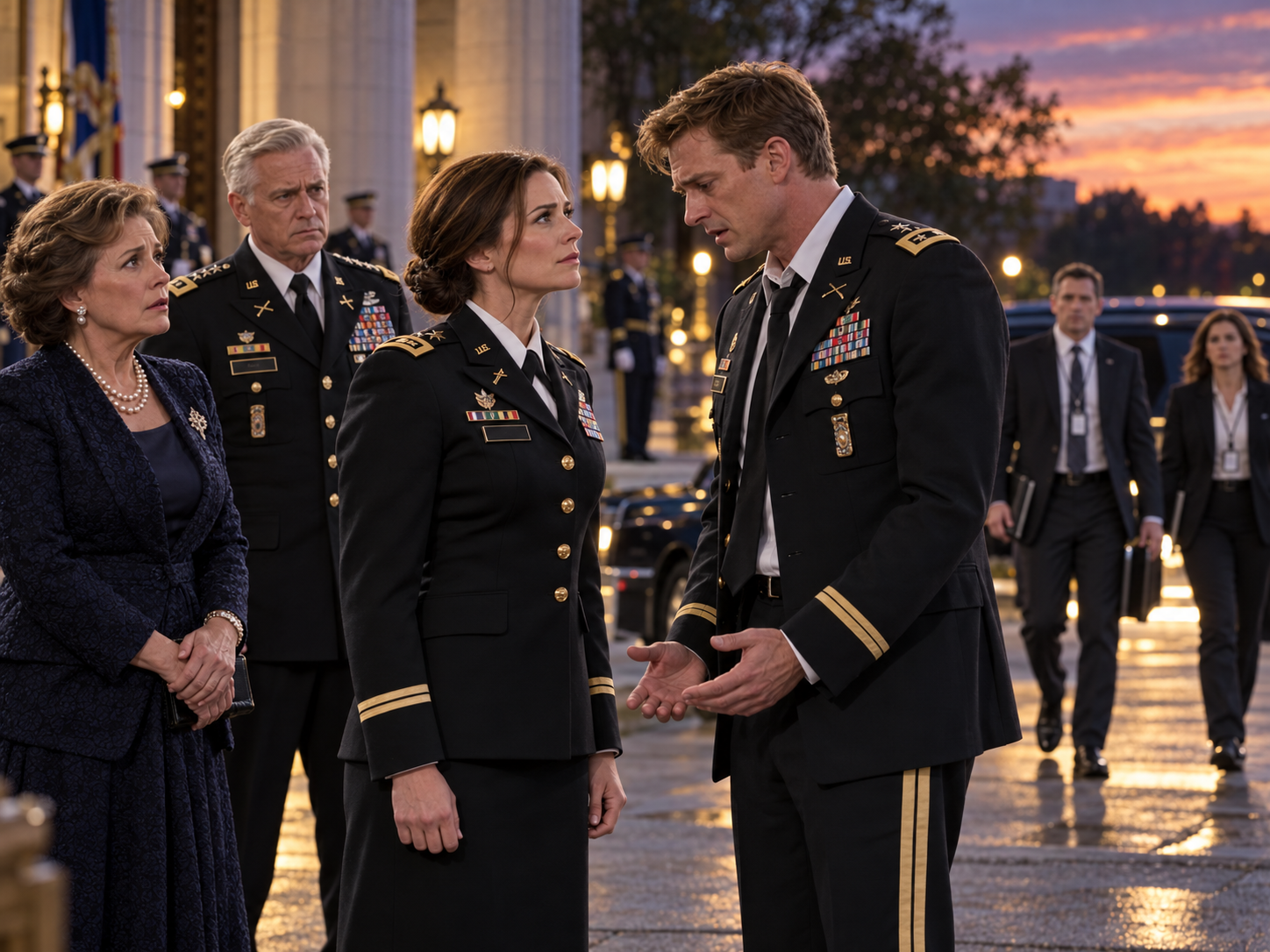
Emily walked away before they reached him.
She did not look back.
That evening, Margaret knocked on Emily’s hotel room door.
Emily considered pretending she wasn’t there.
Then she opened it.
Margaret stood in the hallway holding a small cardboard box.
“What is that?”
“Things I should have given you years ago.”
Emily almost closed the door.
Margaret placed a hand against it.
“Please.”
Emily looked at her mother.
For the first time she could remember, Margaret did not look controlling.
Or proud.
Or certain.
She looked small.
Emily stepped aside.
Margaret entered and placed the box on the desk.
Inside were newspaper clippings, programs, photographs, military newsletters.
Emily picked up one.
A ceremony from twelve years earlier.
Daniel’s promotion.
Another.
Daniel receiving a unit award.
Another.
Daniel speaking at a veterans event.
Then she found something else.
A photograph of herself at age seventeen.
Standing alone beside a high school track.
Medal around her neck.
Margaret had not attended that race.
She had been at Daniel’s baseball tournament.
Emily stared at the photo.
“Where did you get this?”
“Your coach sent it to me.”
“When?”
“After the race.”
“You never showed me.”
“I know.”
Emily placed it down.
Margaret began crying.
“I kept everything.”
Emily looked at the box.
“You kept evidence.”
Margaret flinched.
“That’s not the same as being there.”
“I know.”
“No, Mom.”
Emily’s voice stayed calm.
“You keep saying that today. I know. I know. I know.”
Margaret wiped her face.
“But knowing after twenty years doesn’t give me those twenty years back.”
“I understand.”
“Do you?”
Emily pointed to the photograph.
“That girl spent half her childhood wondering what was wrong with her.”
Margaret’s face crumpled.
“There was nothing wrong with you.”
“But you taught me there was.”
The words landed between them.
Margaret sank into the chair.
Emily remained standing.
“Why Daniel?”
Margaret stared at her hands.
The answer came slowly.
“When you were nine, Daniel got very sick.”
Emily remembered.
Pneumonia.
Hospital.
Two frightening weeks.
“I thought we were going to lose him.”
Margaret swallowed.
“After that, I watched him constantly. Every achievement felt like proof he was okay.”
Emily waited.
“And you…”
Margaret looked up.
“You were always strong.”
There it was again.
The compliment that had functioned as permission to neglect her.
“You didn’t need me the same way.”
“You never checked.”
Margaret nodded.
“No.”
For once, no excuse followed.
She simply said it.
“No, I didn’t.”
Emily sat across from her.
Margaret continued.
“Then it became habit. Daniel told us everything. You became private. The more private you became, the more I told myself that was simply who you were.”
“You made me private.”
Margaret closed her eyes.
“Yes.”
Neither woman spoke for a while.
Then Margaret looked toward the medal case on the desk.
“Did you really save all those people?”
Emily considered the question.
“No.”
Margaret frowned.
“I made one decision. Pilots flew into danger. Medics treated people under fire. Drivers kept vehicles moving. Soldiers covered each other.”
She paused.
“I was part of it.”
Margaret nodded.
Then came a question Emily had waited almost her entire life to hear.
“Will you tell me about your career?”
Emily stared at her mother.
She could have said yes.
She could have opened the door immediately and rewarded the first sign of effort.
But healing was not supposed to mean pretending damage never happened.
“Not tonight.”
Margaret looked hurt.
Then nodded.
“Okay.”
She stood.
At the door, she turned.
“I am proud of you.”
Emily looked away.
Margaret’s voice broke.
“I know I’m twenty years late.”
Emily did not answer.
Her mother left.
Emily closed the door.
And for the first time since the ceremony, she cried.
Not because Margaret had finally said the words.
Because part of Emily had once needed them so badly.
PART 4 — WHEN THE HERO STORY COLLAPSED
The investigation lasted four months.
Daniel cooperated.
General Voss did not.
That surprised nobody.
What did surprise Emily was how quickly the truth expanded once someone finally stopped protecting it.
The missing Glass Lantern files were only the beginning.
Investigators discovered that Voss’s staff had altered administrative records after at least three operations.
Nothing suggested he had deliberately endangered troops.
His motive was less dramatic.
And in some ways more disturbing.
He had built a career by ensuring failures belonged to subordinates and successes traveled upward.
Reports were rewritten.
Warnings became “uncorroborated.”
Delays became “deliberate assessments.”
Junior officers appeared reckless.
Senior officers appeared measured.
Emily’s case had simply been the one that almost killed people.
Daniel’s cooperation provided the bridge investigators needed.
He turned over old emails.
Notes.
A personal journal.
And eventually, a copy of an instruction he had kept hidden for seventeen years.
REMOVE ITEMS 4C, 7A, AND 9F FROM THE REVIEW PACKAGE. DUPLICATIVE MATERIAL. AUTHORIZED BY DCO STAFF.
Item 7A was the warning Voss had received.
Daniel admitted he suspected it mattered.
He admitted he removed it anyway.
No criminal charge ultimately came from his action because prosecutors could not prove he understood the document was being concealed to obstruct the investigation.
But his career was finished.
He submitted his retirement paperwork before the administrative board could decide whether to remove him from his current position.
The Army accepted his retirement at a reduced grade.
The news devastated Margaret.
Emily learned about it because Richard called.
Not to ask her to fix anything.
That mattered.
“Your mother is worried about him,” Richard said.
Emily stood on the balcony of her apartment overlooking a gray morning.
“I’m sure she is.”
“She wants to go stay with him.”
“Okay.”
Richard was quiet.
Then he said, “She’s afraid doing that will hurt you.”
Emily almost smiled.
Twenty years earlier, Margaret would never have asked.
“Daniel losing his career doesn’t mean Mom has to stop being his mother.”
“I told her that.”
“Then why are you calling?”
Richard sighed.
“Because I’m trying to stop deciding things for everyone.”
Emily leaned against the railing.
That was perhaps the most honest thing her father had ever said.
“Go help him.”
“You’re sure?”
“No.”
Richard paused.
Emily continued.
“But I’m not responsible for managing your guilt.”
Silence.
“Right.”
Her father sounded almost relieved.
“Right.”
Daniel lived outside Fayetteville in a brick house at the end of a quiet street.
Emily did not visit.
Not then.
Three weeks later, a package arrived.
No return address.
Inside was an old photograph.
Emily and Daniel as children.
She was eleven.
He was thirteen.
They were standing in the backyard with wooden swords their father had made from scrap lumber.
Daniel had one arm around Emily’s shoulders.
Both were laughing.
Behind the photo was a letter.
Emily almost didn’t read it.
Then she did.
I spent years telling myself I never took anything from you because you still had your career.
That was a lie.
I took the chance for Mom and Dad to understand you.
I took credit I didn’t earn simply by failing to return it.
And during Glass Lantern, I chose my future over telling the truth when it mattered.
You were right about something else.
My anonymous statement wasn’t courage.
It was guilt with a safety mechanism.
I don’t expect forgiveness.
I am going to cooperate with every investigation, accept every consequence, and stop asking you to make me feel better about what I did.
But there is one thing I need you to know.
You were never the lesser Carter.
I knew that before anyone else did.
Maybe that’s why I was so afraid of you.
Daniel.
Emily folded the letter.
Placed it back into the envelope.
And went to work.
Six months after the ceremony, Emily was selected for a major command assignment.
The position placed thousands of service members under her responsibility.
General Hale called personally.
“You’re the best candidate.”
Emily looked through the window of her office.
“Does Voss’s scandal affect the selection?”
“No.”
“Sir.”
Hale sighed.
“It made some people look at your record more carefully.”
“That’s what I thought.”
“And after they looked, they still selected you.”
Emily remained silent.
Hale knew her well enough to understand.
“You don’t need to apologize because the truth finally became useful to you.”
“I’m not apologizing.”
“You’re doing that thing where you become emotionally constipated.”
Emily nearly choked.
“Sir.”
“I’m retired in forty-eight days. I can say what I want.”
She laughed.
It surprised her.
Hale’s voice softened.
“Take the command, Emily.”
“I intend to.”
“Good.”
Then he added, “Your family coming to the ceremony?”
Emily stared at the desk.
“I don’t know.”
She invited them.
All of them.
Richard replied first.
We’ll be there.
Margaret called instead.
“Are you sure?”
“Yes.”
“I don’t want you to think we’re coming only because—”
“Mom.”
Margaret stopped.
“Just come.”
Daniel did not respond.
Two days passed.
Then three.
Finally, Emily received a message.
Thank you for the invitation. I don’t think I belong there.
She stared at it for several minutes.
Her first instinct was anger.
Not because he declined.
Because once again Daniel had made a decision on behalf of everyone and disguised it as humility.
Emily typed.
Stop deciding what I need.
The reply came ten minutes later.
Do you want me there?
Emily considered it.
Then answered honestly.
I want you to decide whether you can sit in a room where nobody thinks the ceremony is about you.
An hour passed.
Daniel replied.
Yes.
The command ceremony took place on a bright Friday morning.
The parade field stretched beneath a clear blue sky.
Rows of soldiers stood in formation.
Emily arrived early.
She had spent most of her life arriving early.
Control was easier before crowds appeared.
At 0830, families began filling the seats.
She saw Richard first.
He waved.
Margaret stood beside him.
She looked nervous.
Then Emily saw Daniel.
He wore a dark civilian suit.
No uniform.
No ribbons.
No rank.
Just Daniel.
He chose a seat in the second row.
At the end.
Emily almost smiled at the symmetry.
Before the ceremony began, a young captain approached her.
“Ma’am, there’s an issue with the family seating.”
Emily’s stomach tightened.
“What issue?”
“The protocol staff moved Colonel—sorry, Mr. Carter—to the VIP section because of his prior service.”
Emily looked across the field.
Daniel was arguing quietly with an usher.
Then he simply walked back to his original chair.
The far end.
Second row.
He sat down.
And stayed there.
No drama.
No complaint.
Emily turned to the captain.
“Leave him.”
“Yes, ma’am.”
When Emily took command, no one in her family misunderstood whose ceremony it was.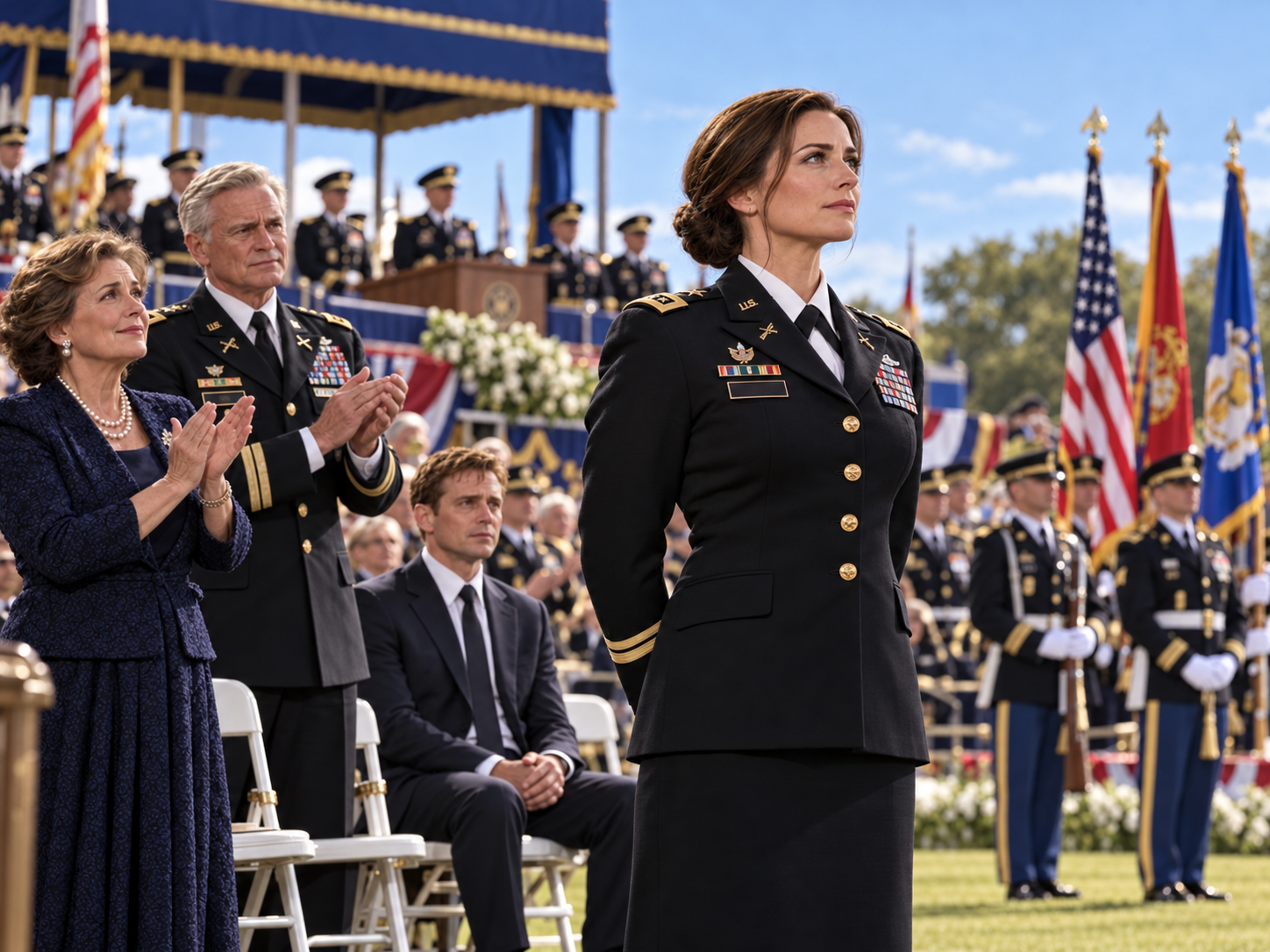
No one adjusted Daniel’s sleeve.
No one whispered that Emily should remain quiet.
When her name was announced, Margaret stood before almost everyone else.
She clapped until her hands were red.
Emily saw her.
Of course she did.
But this time, the applause did not repair the past.
It simply belonged to the present.
And that was enough.
Afterward, Daniel waited until everyone else had congratulated her.
Then he approached.
“Colonel.”
Emily raised an eyebrow.
He smiled faintly.
“Old habit.”
“How are you?”
The answer took him a moment.
“Not great.”
She appreciated that.
“But better.”
“How are the kids?”
“They’re angry with me.”
Daniel looked toward the ground.
“They read about the investigation.”
“Give them time.”
“I told them the truth.”
“All of it?”
“Yes.”
Emily nodded.
Daniel looked toward Margaret and Richard.
“Mom wants us all to have dinner.”
“I know.”
“She told me not to pressure you.”
That surprised Emily.
“She’s learning.”
“So am I.”
Silence settled between them.
Then Daniel reached into his jacket.
Emily stiffened.
He held out a small object.
Not a medal.
Not a letter.
A brass compass.
Emily recognized it.
Their grandfather’s.
“He gave this to me when I commissioned.”
Emily remembered.
She had been furious.
Their grandfather had served in Korea.
The compass was the only military object he kept from those years.
Daniel had received it.
Emily received a leather journal.
At the time, she told herself she preferred the journal.
She hadn’t.
Daniel extended the compass.
“He should’ve given it to both of us.”
Emily didn’t take it.
“No.”
Daniel frowned.
“You keep it.”
“Emily—”
“Giving me things won’t balance the ledger.”
His hand lowered slowly.
She continued.
“If you want to fix something, fix how you live.”
Daniel looked at her for several seconds.
Then nodded.
“Okay.”
He returned the compass to his pocket.
Emily glanced toward the dining hall.
“Dinner starts in twenty minutes.”
His eyebrows lifted.
“Is that an invitation?”
“It’s information.”
Daniel laughed.
Emily walked away.
After a moment, he followed.
Dinner was awkward.
Painfully awkward.
Which made it real.
Richard asked about Emily’s command.
Then actually listened to the answer.
Margaret started to interrupt with a story about Daniel.
She caught herself.
“I’m sorry. Emily, continue.”
Daniel looked down at his plate.
Emily continued.
Nobody collapsed.
Later Margaret asked Daniel about his civilian job search.
Emily listened.
That mattered too.
Equality was not replacing one favorite with another.
It was making room.
During dessert, Richard raised his glass.
Everyone tensed.
He noticed.
“No speech.”
Daniel laughed.
“Thank God.”
Richard smiled.
“Just this.”
He looked at Emily.
Then Daniel.
“I spent too many years believing silence kept peace.”
His eyes settled on his daughter.
“It didn’t.”
Then on his son.
“It just protected the wrong things.”
Richard raised the glass.
“To telling the truth sooner.”
Daniel lifted his.
Margaret followed.
Emily hesitated.
Then raised hers.
“To telling it before a general has to.”
For one stunned second, everyone stared.
Then Daniel laughed so hard he nearly spilled his water.
Margaret started laughing too.
Richard shook his head.
Emily smiled.
It was the first Carter family dinner in years that did not feel like a performance.
But one problem remained.
General Voss.
And he was not going quietly.
Three weeks after Emily took command, she received notice that Voss had requested her testimony at his administrative hearing.
His defense was simple.
He intended to argue that Emily had rewritten history to advance her career.
And Daniel Carter was going to be his primary example.
If Voss succeeded, Daniel might lose what remained of his reputation.
If Emily testified, the most painful night of both their careers would become public in detail.
For the first time, the siblings would have to stand on the same side.
Not as children.
Not as rivals.
As witnesses.
PART 5 — FORTY-SIX CAME HOME
The hearing convened in Virginia.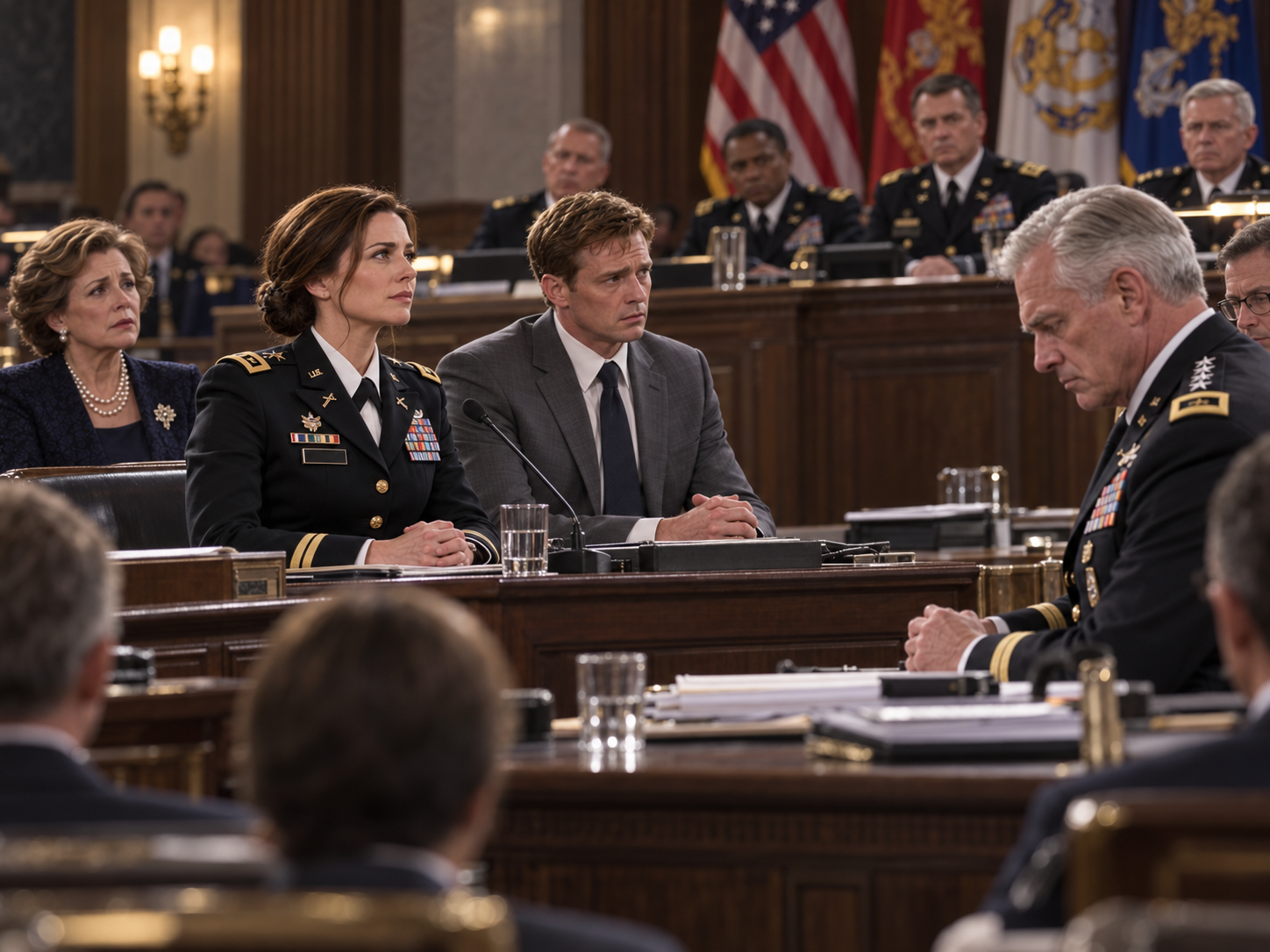
Emily wore her service uniform.
Daniel wore a gray suit.
They arrived separately.
Margaret and Richard wanted to attend.
Emily told them no.
Some battles belonged to the people who had made them.
Inside the hearing room, General Voss looked smaller than Emily remembered.
Not physically.
Power had simply stopped amplifying him.
He sat beside two attorneys with a stack of binders arranged neatly in front of him.
Daniel was called first.
Emily watched from the corridor on a closed video feed.
Voss’s attorney began gently.
“Mr. Carter, you were a captain during Operation Glass Lantern?”
“Yes.”
“And you participated in assembling archived communications?”
“Yes.”
“Did Colonel Emily Carter ever instruct you to alter those communications?”
“No.”
“Did she ever ask you to conceal anything?”
“No.”
“Did she know the package was incomplete?”
“Not to my knowledge.”
The attorney paced.
“You have admitted that your family believed your sister’s accomplishments were yours.”
Daniel’s face tightened.
“Yes.”
“So you have a history of misleading people regarding Colonel Carter.”
Daniel paused.
Emily could almost hear his old instincts demanding a defense.
Technically, I never said—
He didn’t use them.
Instead he answered.
“Yes.”
The attorney looked momentarily surprised.
“You admit dishonesty?”
“I admit cowardice.”
Emily stared at the screen.
Daniel continued.
“I allowed my mother to believe things about me that were not true because correcting her would have reduced her opinion of me.”
“Then why should this panel believe you now?”
Daniel leaned toward the microphone.
“You shouldn’t because I ask you to.”
He looked toward the members of the board.
“You should believe the records.”
The attorney stopped pacing.
Daniel continued.
“I kept the written request directing us to exclude communication items from Colonel Carter’s review package.”
“Seventeen years later.”
“Yes.”
“Convenient.”
“No.”
Daniel’s voice remained steady.
“Cowardly.”
The room became silent.
“I kept it because I knew what I had done was wrong. I told myself I might need it someday if the truth came out.”
He swallowed.
“That is not integrity. It is insurance.”
Emily felt something unexpected in her chest.
Not forgiveness.
Respect.
Small.
New.
But real.
The attorney tried again.
“Did General Voss personally order you to alter evidence?”
“No.”
“So you cannot testify he knew.”
Daniel looked directly at him.
“No. I can testify that his executive officer sent the order and that the omitted recording was the only item proving General Voss received confirmation about Route Copper before my sister acted.”
“Your sister.”
“Yes.”
“A woman whose reputation you are now trying to repair because your family is angry with you.”
Daniel shook his head.
“My sister doesn’t need me to repair her reputation.”
Emily looked away from the monitor.
For some reason, that sentence nearly undid her.
Emily testified after lunch.
Voss watched her approach.
For seventeen years, she had imagined what it would feel like to confront him without rank shielding him.
She expected satisfaction.
There was none.
Only tiredness.
The panel counsel walked through the timeline.
The warning.
Voss’s acknowledgment.
His instruction to delay logging it.
Emily’s route-change order.
The extraction.
The investigation.
Then Voss’s attorney stood.
“Colonel Carter, you have benefited considerably from recent attention surrounding Glass Lantern.”
Emily looked at him.
“Have I?”
“You received a major decoration.”
“Yes.”
“You were selected for command.”
“Yes.”
“Your story has been discussed publicly.”
“Yes.”
“Would it be fair to say your reputation improved?”
Emily considered it.
“My reputation among people who didn’t know my record probably improved.”
“Exactly.”
“But those people didn’t select me.”
The attorney paused.
Emily continued.
“The officers responsible for my career had access to my record before Glass Lantern was declassified.”
Voss shifted in his seat.
The attorney changed direction.
“Colonel, during the operation, did you violate standard command procedure?”
“Yes.”
The answer startled the room.
“You admit that?”
“I have never denied it.”
“You issued orders without required approval.”
“Yes.”
“You redirected assets assigned elsewhere.”
“Yes.”
“You bypassed General Voss.”
“Yes.”
“So General Voss was correct to question your judgment.”
Emily looked at him.
“He was correct to question it.”
The attorney smiled.
Then Emily added:
“He was not correct to hide evidence because he disliked the answer.”
The smile disappeared.
“Colonel Carter, you sound very certain.”
“No.”
That answer surprised him again.
Emily leaned slightly toward the microphone.
“I was not certain during Glass Lantern.”
The room quieted.
“I was terrified.”
Voss looked up.
Emily continued.
“I had incomplete information. People were asking me questions faster than I could answer them. I knew every order I gave could put someone in greater danger.”
She paused.
“But leadership does not mean waiting until fear disappears.”
Her voice remained calm.
“It means making the best decision available while fear is still sitting beside you.”
No one moved.
“The difference between General Voss and me is not that I was certain and he was uncertain.”
Emily turned slightly toward him.
“We were both uncertain.”
Then she looked back at the panel.
“The difference is that after the outcome, I accepted responsibility for what I did.”
Silence.
“And he changed the record of what he knew.”
The attorney sat down.
The hearing lasted another two days.
The findings came a month later.
Voss was formally censured.
His retired rank was reviewed.
Several of his decorations tied to command performance were referred for administrative reconsideration.
The Army issued a corrected historical record for Operation Glass Lantern.
Emily read it once.
Then closed the file.
It listed the timeline accurately.
It named the units.
It described the decisions.
And near the final page, beneath a paragraph explaining the extraction, were the words:
All forty-six personnel were successfully recovered from the engagement area.
That sentence mattered more than every medal.
Forty-six.
They had children now.
Spouses.
Careers.
Gray hair.
Mortgages.
Divorces.
Birthday parties.
Ordinary frustrations.
Lives.
That was the whole point.
One year later, Emily stood in a high school auditorium in Ohio.
Not a military hall.
No generals.
No flags beyond the one near the stage.
She had been invited to speak at a leadership program.
Emily hated inspirational speeches.
General Hale, now fully retired and apparently determined to annoy her indefinitely, had recommended her.
“You need hobbies,” Emily told him by phone.
“Ruining your weekends is my hobby.”
The students asked predictable questions.
Was she ever scared?
Yes.
Did she always want to serve?
Mostly.
Had she ever wanted to quit?
Several times.
Then a girl in the third row raised her hand.
She looked about sixteen.
“My older brother is kind of the favorite in my family.”
Emily froze.
The audience chuckled lightly.
The girl didn’t.
“He’s really good at everything.”
Her hands twisted in her lap.
“My parents always say I’m stronger so I don’t need as much help.”
Emily stared at her.
Somewhere inside, seventeen-year-old Emily Carter was standing alone beside a track, holding a medal while waiting for parents who never came.
Emily left the podium.
She walked to the edge of the stage.
“What’s your name?”
“Rachel.”
“Rachel, being capable does not mean you deserve less care.”
The auditorium became silent.
Emily continued.
“And someone else being celebrated does not reduce the value of what you accomplish.”
Rachel nodded.
Emily smiled.
“But there’s something else I wish somebody had told me at your age.”
“What?”
“Don’t spend your whole life waiting for people who overlook you to become the judges of your worth.”
Rachel wiped one eye.
Emily returned to the podium.
Her hands were shaking slightly.
For once, she let them.
Outside the school, Daniel waited beside a rental car.
Emily stopped.
“What are you doing here?”
“Mom told me where you were speaking.”
“You flew to Ohio?”
“I live two hours away now.”
Emily had forgotten.
Daniel had accepted a civilian position managing emergency logistics for a nonprofit organization.
Lower pay.
No rank.
No uniform.
He told her he liked it.
Most days.
“I thought we could get coffee.”
Emily checked her watch.
“I have a flight.”
“Then bad airport coffee.”
She smiled despite herself.
“Fine.”
They drove.
Halfway to the airport, Daniel said, “Do you remember Grandpa’s compass?”
“Yes.”
“I gave it to Nathan.”
Emily turned.
Daniel’s oldest son had recently commissioned as an Army officer.
“You did?”
“He asked why I never carried it anymore.”
Daniel looked ahead.
“So I told him the story.”
“What story?”
“All of it.”
Emily went still.
Daniel continued.
“I told him Grandpa gave it to me because everyone assumed I was the military success in the family.”
He smiled faintly.
“I told him the best officer in our generation was actually his aunt.”
Emily shook her head.
“Don’t do that.”
“What?”
“Replace one myth with another.”
Daniel glanced at her.
“I’m not.”
“You were a good officer for many years.”
“I also made a terrible decision.”
“Both can be true.”
Daniel was quiet.
Emily realized she meant it.
That was perhaps forgiveness in its earliest form.
Not erasing.
Not forgetting.
Allowing two truths to exist at once.
Daniel had betrayed her.
Daniel had also eventually told the truth.
He had been jealous.
He had also loved her.
He had been a coward.
And later, when the cost became real, he had finally found courage.
Human beings were inconvenient that way.
At Christmas, all four Carters met at Margaret and Richard’s house.
It was the first time Emily willingly spent Christmas there in eleven years.
Margaret had changed the walls.
That was the first thing Emily noticed.
For decades, the hallway contained photographs of Daniel.
Daniel’s baseball team.
Daniel at commissioning.
Daniel’s wedding.
Daniel holding his first child.
Emily appeared in three family photographs, always somewhere near the edge.
Now the arrangement was different.
Not absurdly so.
Margaret had not turned the hall into an Emily shrine.
She had simply made it equal.
A photograph of Emily graduating.
Daniel commissioning.
Emily in command.
Daniel with his children.
Emily with soldiers from one of her previous units.
A childhood photograph of both siblings holding wooden swords.
Emily stood in front of that one.
Margaret approached quietly.
“Too much?”
“No.”
“I found boxes of pictures I never framed.”
Emily looked at her.
“Mom.”
Margaret tensed slightly.
“You don’t need to correct twenty years in one hallway.”
Margaret smiled sadly.
“I know.”
That phrase no longer irritated Emily as much as it once had.
Because Margaret had finally begun proving it.
She volunteered at a military family support organization now.
Not because Emily asked.
Because she said she had spent too many years assuming strong people required no support.
Richard attended therapy.
He announced this at Thanksgiving with the embarrassed expression of a man confessing to tax fraud.
Daniel replied, “About time.”
Richard threw a bread roll at him.
They laughed.
The Carter family had not become perfect.
Perfect families belonged in advertisements.
Real healing was messier.
Sometimes Margaret still mentioned Daniel first.
Then caught herself and apologized.
Sometimes Emily became distant without explaining why.
Sometimes Daniel tried too hard to accept blame for things nobody blamed him for.
Sometimes Richard retreated into silence until someone reminded him that silence was how they got into trouble in the first place.
But now they talked.
Not elegantly.
Not always successfully.
They talked.
After Christmas dinner, Margaret brought out a small velvet box.
Emily groaned.
“If that’s jewelry, I’m leaving.”
Daniel laughed.
“Same.”
“It isn’t.”
Margaret placed the box between them.
Inside was their grandfather’s old unit insignia.
Not valuable.
Just worn brass.
“I found it with his things.”
Margaret looked at both children.
“I was going to decide who should have it.”
Emily exchanged a glance with Daniel.
Margaret smiled.
“Then I realized that was exactly the sort of thing I used to do.”
Daniel leaned back.
“Progress.”
Margaret ignored him.
“So neither of you gets it.”
Emily laughed.
“What?”
“I’m framing it here.”
Margaret touched the old piece of brass.
“Because both of you belong to this family.”
No ceremony.
No speech.
No ranking.
Just a small object between them.
Emily reached for her wine.
Daniel raised his glass.
“To Mom finally learning diplomacy.”
Margaret pointed at him.
“I can still remove you from Christmas.”
Emily raised her glass too.
“To equal-opportunity removal.”
Richard laughed from the kitchen.
For a moment, everything felt normal.
Not the old normal.
Something better.
Something built instead of inherited.
Two years after Operation Glass Lantern became public, Emily attended a reunion she had avoided for nearly two decades.
Thirty-one of the forty-six survivors came.
Others joined remotely.
Aaron Pike organized it.
“You owe me,” he told her.
“For what?”
“Seventeen years of unanswered emails.”
“I answered some.”
“You replied ‘received’ four times.”
“That is an answer.”
“That is evidence you may actually be a robot.”
The reunion took place at a lakeside retreat in North Carolina.
No uniforms were required.
Some people wore them anyway.
Emily did not.
She wore jeans and a blue sweater.
At sunset, they gathered near the water.
A former medic brought photographs.
Someone produced an old map.
Arguments immediately started over which road had been worse.
Then Aaron’s wife called everyone for dinner.
Emily lingered near the shore.
A man approached with a little girl beside him.
Emily recognized him as former Sergeant Luis Mendoza.
He had been twenty-two during Glass Lantern.
Now he was forty-one.
“This is Sofia,” he said.
His daughter hid behind him.
“She’s eight.”
Emily smiled.
“Hi, Sofia.”
The girl looked at her.
“My dad says you saved him.”
Emily looked at Mendoza.
He shrugged.
“I simplified.”
Emily crouched slightly so she could speak to Sofia.
“Your dad and a whole lot of other people saved each other.”
Sofia considered this.
Then held out a friendship bracelet made of blue and white thread.
“This is for you.”
Emily took it.
“Thank you.”
Sofia ran toward the others.
Mendoza remained.
“My oldest starts college next year.”
Emily smiled.
“Congratulations.”
“He wasn’t born yet.”
She knew what he meant.
Mendoza looked toward his children.
“I met my wife eleven months after we came back.”
Emily swallowed.
“All this exists because we got home.”
He looked at her.
“You can keep telling us it wasn’t only you.”
Emily said nothing.
“We know.”
He walked away.
Emily stared at the bracelet.
Forty-six people.
But never only forty-six lives.
Parents who had not buried children.
Children who had eventually been born.
Marriages.
Friendships.
Whole branches of family trees that continued because one terrible night ended differently.
Emily sat on a bench.
For the first time in years, she allowed herself to feel proud without immediately turning the emotion into discomfort.
Not superior.
Not heroic.
Simply proud.
She had been there.
She had been afraid.
And when the moment came, she had acted.
That was enough.
Her phone vibrated.
A message from Margaret.
A photograph.
Richard and Daniel attempting to assemble a backyard pergola.
It was leaning badly.
Margaret had written:
Your father says the instructions are wrong.
A second message arrived.
Daniel says your father is wrong.
Emily laughed.
She typed:
Both statements can be true.
Margaret replied almost immediately.
Come save us.
Emily stared at those three words.
Years ago, her family assumed Daniel was the one who saved people.
Then they learned about Glass Lantern and swung briefly toward believing Emily was the hero.
But Emily understood something now that she had not understood at thirty.
Families did not need heroes.
Heroes created spectators.
Families needed people willing to show up.
People willing to admit when they were wrong.
People willing to tell unpleasant truths.
People willing to stay for the conversation after the applause ended.
Emily looked across the lake.
Thirty-one survivors were arguing near the picnic tables.
Aaron Pike shouted that dinner was getting cold.
A child laughed.
Somebody opened another bottle of wine.
Ordinary life.
Beautiful, complicated, ordinary life.
Emily typed one final message to her mother.
I’ll be home tomorrow.
Margaret responded with a heart.
Emily put the phone away.
The following afternoon, she pulled into her parents’ driveway.
The pergola looked even worse than the photograph.
Daniel stood on a ladder.
Richard held a level upside down.
Margaret sat on the patio drinking lemonade as though she had abandoned hope.
Emily stepped out of the car.
Daniel pointed at Richard.
“Before you say anything, this is his fault.”
Richard protested.
“You measured the post!”
“You cut it!”
“You told me where!”
Margaret saw Emily and smiled.
Not past her.
Not toward Daniel.
At her.
A simple thing.
Once, it would have meant everything.
Now it meant something healthier.
It meant home.
Daniel climbed down.
“You going to help or judge?”
Emily walked toward them.
“Both.”
He handed her the level.
For several minutes, the four of them argued about measurements.
Nobody mentioned rank.
Nobody mentioned medals.
Nobody mentioned Glass Lantern.
Eventually Margaret went inside for more lemonade.
Richard searched the garage for a missing wrench.
Emily and Daniel remained beside the crooked structure.
Daniel looked up at it.
“You think we can save this?”
Emily studied the beams.
“One post has to come down.”
Daniel groaned.
“Dad is going to lose his mind.”
“He’ll survive.”
Daniel smiled.
Then his expression became serious.
“Emily?”
“Yeah?”
He hesitated.
“I am proud of you.”
She looked at him.
Years ago, those words from her family might have cracked open something desperate inside her.
Now they simply settled gently.
No hunger.
No bitterness.
No need to measure them against everything that came before.
Emily nodded.
“I’m proud of you too.”
Daniel blinked.
“For what?”
“For finally becoming someone who asks that question.”
He laughed quietly.
Richard returned carrying three completely wrong tools.
Emily stared.
“Dad, none of those are a wrench.”
“I know.”
“Then why—”
“I couldn’t find the wrench.”
Daniel looked at Emily.
Emily looked at Daniel.
And for the first time in decades, brother and sister burst out laughing at exactly the same moment.
Margaret appeared in the doorway.
“What happened?”
Neither could answer.
They laughed harder.
Richard looked offended.
The pergola remained crooked.
Dinner was late.
Nobody cared.
Because the Carter family had finally learned the lesson that medals, ranks, ceremonies, investigations, and twenty years of misplaced pride had failed to teach them.
Love was not supposed to be awarded to the most impressive person in the room.
It was not a prize.
It was not a spotlight.
And it was never meant to run out simply because more than one person deserved it.
Years earlier, forty-six Americans had come home because Emily Carter refused to wait for someone else to make the right decision.
It took much longer for her own family to find its way home.
But eventually—
they did.
THE END.