THE GENERAL MY FATHER NEVER KNEW
PART 1 — THE SECOND SLAP
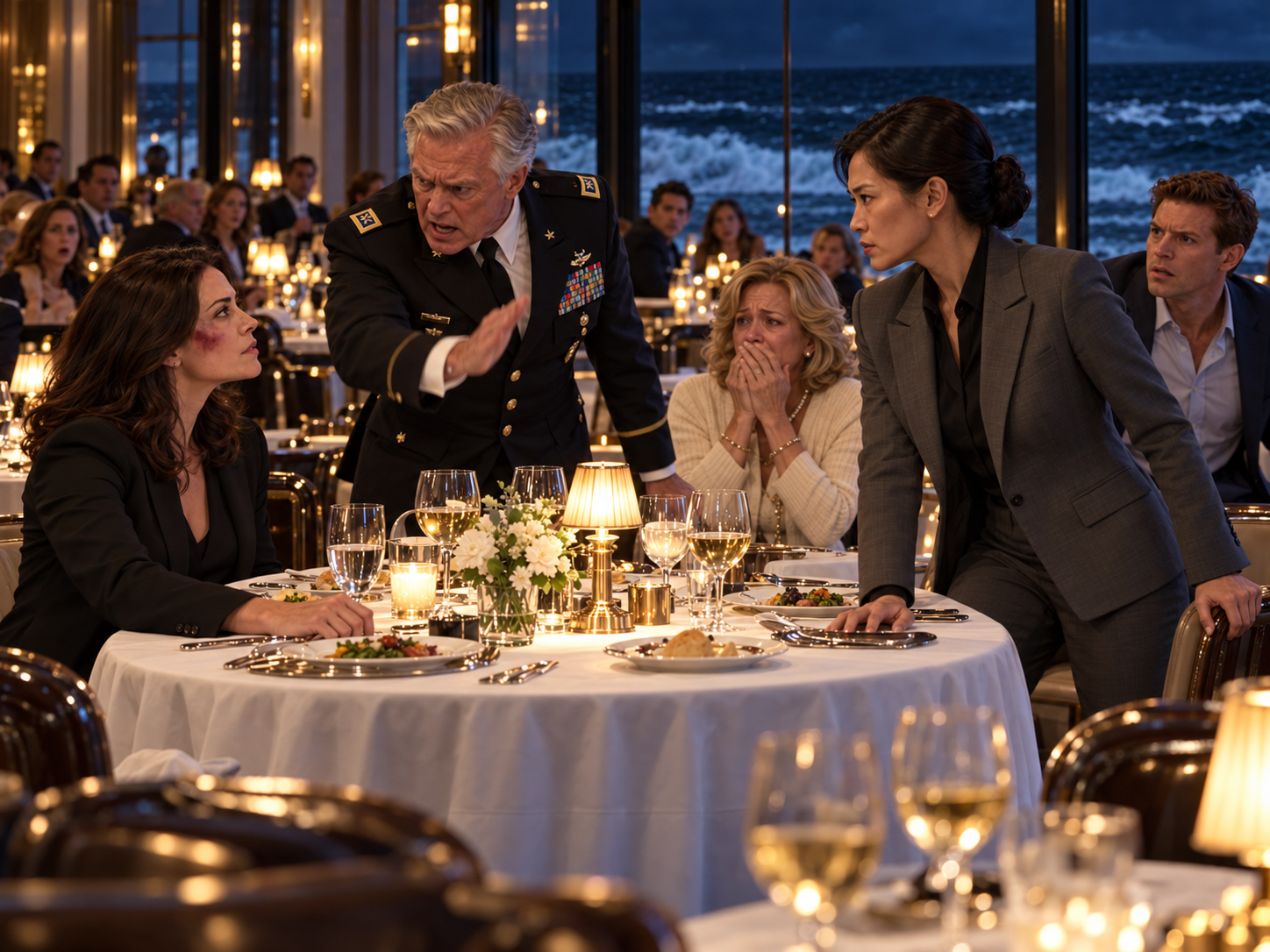
My father struck me across the face at his birthday dinner because I interrupted grace to help my mother turn off an oven she had accidentally left running.
The first hit stunned the entire restaurant.
The second made my younger brother stand halfway from his chair.
But it was the moment Colonel Quinn Park slowly rose across the table that finally made my father stop.
He still had no idea who I really was.
And he definitely had no idea why his own colonel was looking at him like his career had just ended.
My father had chosen the Ocean House because its massive windows faced the Atlantic and because he liked places where people noticed him.
That was how Colonel Richard Mercer approached birthdays.
Not as another year with family.
As proof that he was still winning.
Polished brass lamps reflected against spotless wineglasses.
White tablecloths covered every table.
Dark waves crashed against the seawall beyond the windows.
The hostess recognized his reservation immediately.
“Mercer party?”
Dad lifted his chin.
“That’s us.”
Then he walked ahead without checking whether anyone followed.
My mother came next.
Evelyn Mercer.
Cream cardigan held closed at her throat despite the warmth inside the restaurant.
Two steps behind my father, as usual.
My younger brother Nathan followed with his shoulders slightly curved and his jaw tight.
I came last.
Beside me walked Colonel Quinn Park.
As far as Dad knew, Quinn was simply a friend from work.
That was all I had told him.
Not because I feared his reaction.
Because I had learned something during twenty-four years of military service:
Certain truths are strongest when revealed at exactly the right moment.
The hostess led us toward a long table beside the windows.
Dad immediately took the chair at the head.
Then tapped the seat beside him.
“Lila.”
I stared at the chair.
Forty-two years old.
And somehow my father still believed pointing at a seat meant I would automatically obey.
I sat anyway.
Not because he ordered me to.
Because I wanted to see how the evening unfolded.
Quinn sat directly across from me.
Gray jacket.
Hair secured neatly at the nape of her neck.
Calm posture.
My father glanced at her once.
Then dismissed her.
“So what did you say you do?”
“Defense administration,” Quinn answered.
Technically true.
Dad gave a little grunt.
“So paperwork.”
Quinn raised her water glass.
“Sometimes paperwork is important.”
I looked down before Dad noticed the corner of my mouth moving.
He had absolutely no idea.
Dinner started exactly the way I expected.
Dad talked about leadership.
Discipline.
How younger generations were supposedly becoming soft.
Mom laughed half a second after each joke.
Not because they were funny.
Because she always looked at his face first to see whether she was supposed to laugh.
Nathan nodded through the stories.
I did what I had always done in unfamiliar rooms.
Counted exits.
Main entrance.
Two kitchen doors.
Side hallway near the restrooms.
Fire alarm behind a potted palm.
One nervous waiter carrying oysters.
A little girl with a red bow swinging her legs under the neighboring table.
Small details.
Predictable details.
They kept me calm.
Then the bread arrived late.
Mom suddenly stiffened.
“Oh no.”
I turned.
“What?”
Her voice dropped almost to a whisper.
“The rolls.”
“What rolls?”
“At home.”
Her fingers tightened around her napkin.
“I left them warming.”
Her face was already losing color.
“I don’t think I turned off the oven.”
I had seen that expression before.
Fear before anything had even happened.
Dad had just lowered his head to begin grace.
Hands folded.
Eyes closed.
His favorite performance of humility.
I leaned slightly toward Mom.
“Call Mrs. Lane.”
She looked at me.
“Ask her to use the spare key and switch it off.”
That was all.
A practical solution.
Quiet enough that almost nobody else should have heard.
Dad did.
His eyes opened.
The atmosphere changed instantly.
“What did you say?”
I turned toward him.
“Mom left something in the oven. I told her to call the neighbor.”
His jaw tightened.
“We are saying grace.”
“I know.”
His stare hardened.
“You interrupted me.”
“I was helping Mom.”
Nobody moved.
Quinn’s eyes lifted from her glass.
Nathan stared at his plate.
Mom whispered:
“Richard, it’s fine.”
Wrong thing to say.
Dad’s hand moved so quickly that the candle flame bent sideways.
The strike caught me across the cheek.
A sharp crack tore through the quiet restaurant.
Someone gasped.
My face turned with the impact.
For one second, I tasted blood where my teeth caught the inside of my cheek.
The entire table froze.
Dad leaned toward me.
“When I’m speaking—”
I turned my face back slowly.
His expression changed.
Probably because I wasn’t crying.
Wasn’t apologizing.
Wasn’t afraid.
“Don’t,” I said quietly.
His eyes narrowed.
“What?”
“I said don’t.”
Nathan pushed his chair backward.
“Dad—”
“Sit down.”
Nathan froze.
Mom reached toward my father.
“Richard, please.”
He shook her hand away.
Then he looked at me.
The same way he had looked at me when I was seventeen and told him I wanted a military career he considered inappropriate.
The same way he looked at anyone who questioned his authority.
“You’ve always had a problem with respect.”
I felt heat burning across my cheek.
Still, my voice remained level.
“No.”
He leaned closer.
“You think because you work around military people you understand discipline?”
Across the table, Quinn became completely motionless.
Dad continued.
“You never understood real service.”
I almost laughed.
Almost.
He pointed toward me.
“You walked away from the path I gave you.”
I looked directly into his eyes.
“The path you gave me?”
“Yes.”
His voice grew louder.
People at nearby tables had stopped pretending not to listen.
“You embarrassed this family for years.”
Mom whispered:
“Richard.”
He ignored her.
Then he said the sentence that finally changed Quinn’s expression.
“You’re forty-two years old, Lila, and you still need someone to remind you where you belong.”
I saw Quinn’s jaw tighten.
I gave her the smallest shake of my head.
Not yet.
Dad noticed.
“What was that?”
“Nothing.”
“No. You looked at her.”
He turned toward Quinn.
“You have something to say?”
Quinn placed her napkin beside her plate.
“No, Colonel.”
Dad paused.
He had apparently forgotten she knew his rank.
Then he smiled.
“Good.”
He turned back toward me.
“Maybe your friend understands military courtesy better than you do.”
I said nothing.
That silence enraged him.
He struck the table.
Glasses jumped.
Then his hand came toward me again.
This time, I caught his wrist.
The room went completely silent.
Dad stared at my hand.
Then at me.
“Let go.”
I did.
Slowly.
He stood.
Nathan stood too.
Mom began crying.
“Richard, stop.”
But Dad was beyond listening.
He looked down at me.
“You think you’re tough now?”
Quinn rose.
Not quickly.
Not dramatically.
She simply stood.
And somehow that controlled movement silenced the entire table.
Dad looked at her.
“Sit down.”
Quinn’s face showed absolutely nothing.
Then she reached inside her jacket.
My father’s expression changed.
She removed a military identification wallet.
Opened it.
Placed it on the table.
Dad stared.
Colonel Quinn Park.
His posture shifted.
Not much.
But I saw it.
So did Nathan.
“What is this?”
Quinn looked directly at him.
“Colonel Mercer, I strongly recommend that you stop talking.”
My father’s face darkened.
“You don’t give me orders at my own dinner.”
Quinn’s voice stayed quiet.
“No.”
Then her eyes moved toward me.
“But she does.”
Dad actually laughed.
“What?”
Quinn stepped away from her chair.
“Sir, you have just physically assaulted a senior officer.”
His smile disappeared.
Mom looked at me.
Nathan stopped breathing.
Dad stared between Quinn and me.
“What senior officer?”
Quinn’s voice carried clearly across the table.
“Her.”
My father shook his head.
“No.”
Quinn took one step toward him.
“General Lila Mercer.”
The color drained from his face.
And before he could say another word, Quinn reached for her phone and said:
“Colonel Mercer, do not leave this restaurant. Military police are already on their way.”
PART 2 — THE NAME ON THE UNIFORM
For several seconds, my father did not move.
People describe shock as confusion.
That was not what I saw.
I saw calculation.
His eyes went first to Quinn.
Then to me.
Then to the tables surrounding us.
He was not asking himself whether what he had done was wrong.
He was asking himself who had seen it.
That distinction told me more than anything else could have.
“You’re lying,” he said.
Nobody answered.
Dad looked directly at me.
“Lila.”
I had heard my name spoken in dozens of ways.
Under fire.
Across briefing rooms.
During promotions.
Through radio static.
By soldiers who thought they would never see home again.
But my father said it as though my name itself had betrayed him.
“You are not a general.”
I reached into my handbag.
Nathan whispered:
“Lila…”
I removed my identification.
Not theatrically.
I had no desire to humiliate him.
Despite everything, that mattered to me.
I placed the card beside Quinn’s.
Dad stared at it.
His eyes stopped on the rank.
Brigadier General.
United States Army.
For the first time in my life, Richard Mercer had no answer.
Mom covered her mouth.
Nathan sank back into his chair.
“General?” he whispered.
I looked at him.
His eyes were wet.
Not because he was upset I had hidden it.
Because somewhere inside him, a decade of family history was rearranging itself all at once.
Dad finally spoke.
“You told us you worked in logistics.”
“I did.”
“You said you were assigned overseas doing support work.”
“I was.”
“This is ridiculous.”
“It’s accurate.”
His breathing became harder.
“What unit?”
I told him.
His expression changed again.
He knew the unit.
Everyone in his branch did.
A command responsible for joint sustainment operations that stretched across several theaters.
Not glamorous work.
Not the kind of thing that appeared on recruitment posters.
But wars stopped moving when logistics failed.
People died when supplies arrived late.
Evacuations collapsed when transport planning failed.
Entire operations depended on decisions made by people my father had spent dinner calling paper pushers.
He stared at Quinn.
“You knew?”
“Yes, sir.”
“How long?”
“Five years.”
He looked back at me.
“Five years?”
I said nothing.
His face reddened.
“My own daughter becomes a general and decides not to tell me?”
Mom’s eyes moved between us.
“Lila… why?”
That question hurt more than the slap.
Because she sounded genuinely lost.
I looked at her.
“I tried.”
Dad laughed sharply.
“No, you didn’t.”
“Yes.”
“When?”
“Three years ago.”
He frowned.
I watched the memory try to return.
Then I helped him.
“Thanksgiving.”
Nathan closed his eyes.
He remembered.
Dad did too.
That Thanksgiving, I had come home after learning that my name was on the promotion list.
I had not wanted to announce anything prematurely.
So I told Dad I had been selected for increased command responsibility and wanted to discuss it with him.
He had interrupted before I finished.
“You’re almost forty, Lila. Aren’t you tired of pretending this is a career?”
Then he spent forty minutes explaining why Nathan’s new position at a civilian engineering firm was a more meaningful achievement.
I had gone upstairs.
Folded the promotion notification back into my bag.
And never mentioned it again.
Mom stared at him now.
Richard’s face tightened.
“That wasn’t the same thing.”
“It was exactly the same thing.”
“You should have told me directly.”
“I tried.”
“I’m your father.”
“And that does not make me responsible for forcing you to listen.”
A siren sounded outside.
Not loud.
Just close.
Dad turned toward the window.
Two government vehicles had stopped near the restaurant entrance.
His posture changed instantly.
The father vanished.
The officer appeared.
Shoulders squared.
Face controlled.
Voice quieter.
“Lila.”
“No.”
He stared at me.
“You don’t even know what I’m about to say.”
“Yes, I do.”
He glanced at the approaching officers.
“You can stop this.”
There it was.
Not an apology.
A request for protection.
I had been waiting my entire life to see whether, when consequences finally arrived, my father would choose regret or self-preservation.
Now I knew.
Two military police officers entered with a civilian officer from the local department.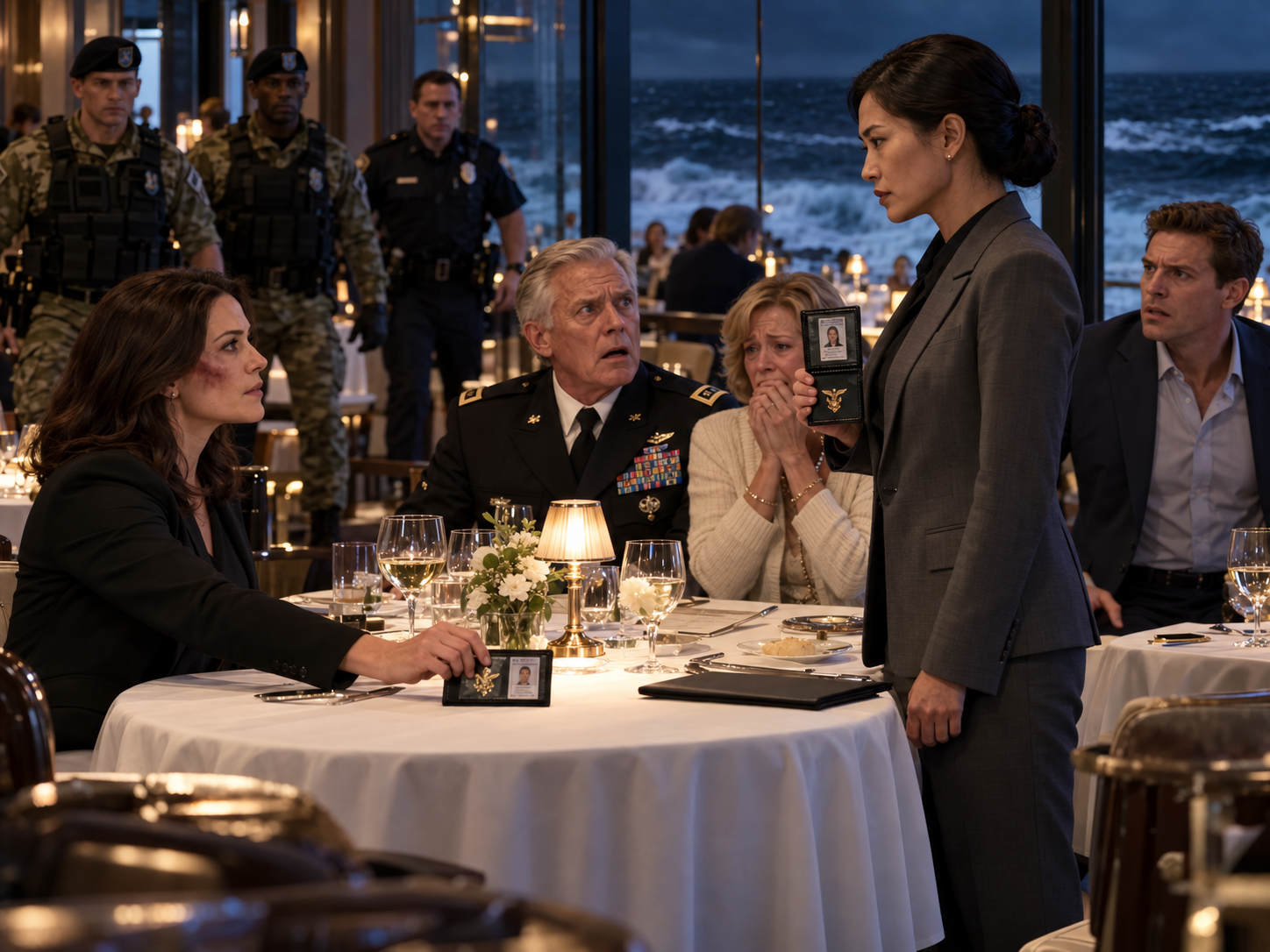
Restaurant management had apparently called local law enforcement at nearly the same time Quinn contacted the installation.
The senior MP approached.
“General Mercer?”
I nodded.
“Ma’am, are you injured?”
“My cheek is bruised. Small cut inside the mouth.”
“Do you require medical assistance?”
“No.”
“Were you struck?”
“Yes.”
“More than once?”
“Yes.”
Dad stepped forward.
“This is a family misunderstanding.”
The MP looked at him.
“Sir, please remain where you are.”
“I’m Colonel Richard Mercer.”
“Yes, sir. We’re aware.”
Dad’s jaw tightened.
“Then you understand there is no need to turn a private family dispute into a spectacle.”
The civilian officer glanced around the restaurant.
“With respect, Colonel, it stopped being private when it happened in front of fifty witnesses.”
Dad looked at me.
The accusation in his eyes was extraordinary.
As though I had invited witnesses.
As though the restaurant had caused his hand to move.
As though consequences were an ambush.
Mom suddenly said:
“It was my fault.”
I turned so quickly my chair moved.
“What?”
Her hands were trembling.
“I left the oven on. If I hadn’t—”
“No.”
The word came out harder than I intended.
Everyone looked at me.
I reached across the table and touched her wrist.
“Mom. No.”
“But—”
“You forgetting the oven did not make him hit me.”
Dad gave an exhausted sound.
“For God’s sake, Lila.”
I turned toward him.
“What?”
“You make everything sound dramatic.”
I stared at the bruise already darkening across my cheek.
Nathan did the same.
Then he stood.
This time when Dad looked at him, Nathan did not sit.
“Actually,” Nathan said, “she doesn’t.”
Dad’s eyes narrowed.
“What did you say?”
Nathan swallowed.
I could see his hands shaking.
He had always been afraid of confrontation.
Dad knew that.
Dad had relied on it.
Nathan drew in a breath.
“She doesn’t make things dramatic.”
“Nathan.”
“You do.”
Silence.
Dad stared at his son.
Nathan’s voice cracked but continued.
“You break things. You scream. You make Mom apologize when you lose your temper.”
“Sit down.”
“No.”
“Sit down.”
“No.”
Dad stepped toward him.
The MP moved between them.
“Colonel.”
That one word stopped him.
Nathan looked at Mom.
“Tell them.”
She stared at him.
His face crumpled slightly.
“Mom. Please.”
Dad’s voice changed.
“Evelyn.”
Quiet.
Dangerously quiet.
Mom visibly flinched.
Quinn noticed.
So did both officers.
So did I.
I had seen my mother flinch before.
But perhaps I had been too young.
Or too accustomed to it.
Or too desperate to get out of that house.
Now I saw the reaction for what it was.
Conditioning.
“Evelyn,” Dad repeated, “we are leaving.”
Mom did not move.
The civilian officer stepped closer.
“Ma’am, would you like to speak somewhere privately?”
Dad answered for her.
“No.”
The officer never looked at him.
“Mrs. Mercer?”
My mother stared down at her wedding ring.
Then something happened that I had not expected.
She removed it.
Not all the way.
She only pulled it past the first knuckle.
Then stopped.
A tiny act.
Almost nothing.
But Dad saw it.
His face changed more dramatically than it had when he discovered my rank.
“Evelyn.”
She looked up.
“I’d like to speak privately.”
Dad went white.
The officers escorted him toward a separate waiting room near the restaurant lobby.
He was not handcuffed.
Not then.
His career did not end in some cinematic moment with metal cuffs around his wrists.
Real consequences are usually quieter.
Forms.
Statements.
Witnesses.
Phone calls.
Investigations.
Doors closing one by one.
As he walked away, he turned back toward me.
For one second, I saw something in his face I had not seen since childhood.
Fear.
Not fear of me.
Fear that his version of himself might no longer survive contact with the truth.
Mom was taken into another room with a female officer.
Nathan remained beside me.
Quinn sat down again.
The restaurant manager brought ice wrapped in a clean towel.
I pressed it against my cheek.
Nathan stared at the floor.
“You’re a general.”
Despite everything, I laughed.
A tiny, painful laugh.
“Yes.”
He looked at me.
“How?”
“That’s usually how promotions work, Nate. They keep giving you jobs until eventually you get one nobody sensible would volunteer for.”
He almost smiled.
Then his expression collapsed.
“I should’ve stopped him.”
“You stood up.”
“After he hit you twice.”
“Nathan.”
“I should have stopped him years ago.”
That sentence changed the air between us.
I lowered the ice.
“What do you mean?”
He looked toward the hallway where Mom had disappeared.
Then back at me.
“Lila, tonight wasn’t the first time.”
I stopped breathing.
Nathan’s eyes filled.
“It just might be the first time he did it where anyone important could see.”
Nathan gave his statement before midnight.
Mine took longer.
Quinn stayed.
Of course she did.
At one point I told her she could go.
She looked at me as if I had suggested she swim home across the Atlantic.
“You promoted me twice.”
“That is irrelevant.”
“You once stayed awake thirty-one hours during an evacuation because one of our captains had a missing son.”
“That was different.”
“No, ma’am.”
She folded her arms.
“People who spend their lives carrying everyone else are notoriously bad at letting anybody carry them.”
I gave her a look.
She smiled.
“General.”
“Colonel.”
“Drink your water.”
I drank the water.
Around one in the morning, Mom emerged.
She looked twenty years older.
But something about her posture had changed.
She had removed the ring completely.
It rested inside her closed fist.
I stood.
“What did you tell them?”
Her eyes found mine.
“The truth.”
I waited.
She looked at Nathan.
Then at me.
“More of it than I have ever said out loud.”
Dad was placed on administrative restriction pending investigation.
His weapon access was suspended.
He was ordered not to contact Mom without permission and not to contact me regarding the incident.
But as we walked toward the parking lot, my phone vibrated.
Unknown number.
I opened the message.
Three words.
YOU DESTROYED ME.
I stared at the screen.
Then deleted it.
Nathan saw.
“What did he say?”
I slipped the phone into my pocket.
“The same thing he’s believed for years.”
“What?”
“That whatever happens after he hurts somebody is somehow their responsibility.”
I looked back at the restaurant.
At the ocean beyond its enormous windows.
At the table where a birthday dinner had split open our family.
Then I looked at Mom.
She was standing beside Quinn’s car with no wedding ring on her finger.
For the first time, I wondered whether something had ended that night.
Or whether, after forty-four years, something else had finally begun.
PART 3 — THE HOUSE THAT LEARNED TO WHISPER
The next morning, I went back to my parents’ house.
Not alone.
Nathan drove Mom.
Quinn came with me.
A local officer met us at the property because Dad had been instructed to remain elsewhere while Mom collected anything she needed.
I had grown up in that house.
Red brick.
White shutters.
A maple tree beside the driveway Dad trimmed obsessively every spring.
Everything was immaculate.
It always had been.
That was part of the illusion.
Nobody suspects fear inside a home with polished silver and freshly cut grass.
Mom stood outside the front door for nearly a minute before putting the key into the lock.
“You okay?” I asked.
She nodded automatically.
Then stopped.
“No.”
It was such a small answer.
But it felt enormous.
“Okay,” I said.
She looked at me.
“That’s all?”
“That’s enough for now.”
Inside, the house smelled like coffee, furniture polish, and the cinnamon rolls she had forgotten in the oven.
Mrs. Lane had switched it off in time.
The rolls were still inside.
Blackened.
Hard.
Ruined.
Mom stared at them through the glass door.
Then started laughing.
Nathan and I looked at each other.
At first it sounded almost joyful.
Then the laughter turned into crying.
She sat on the kitchen floor.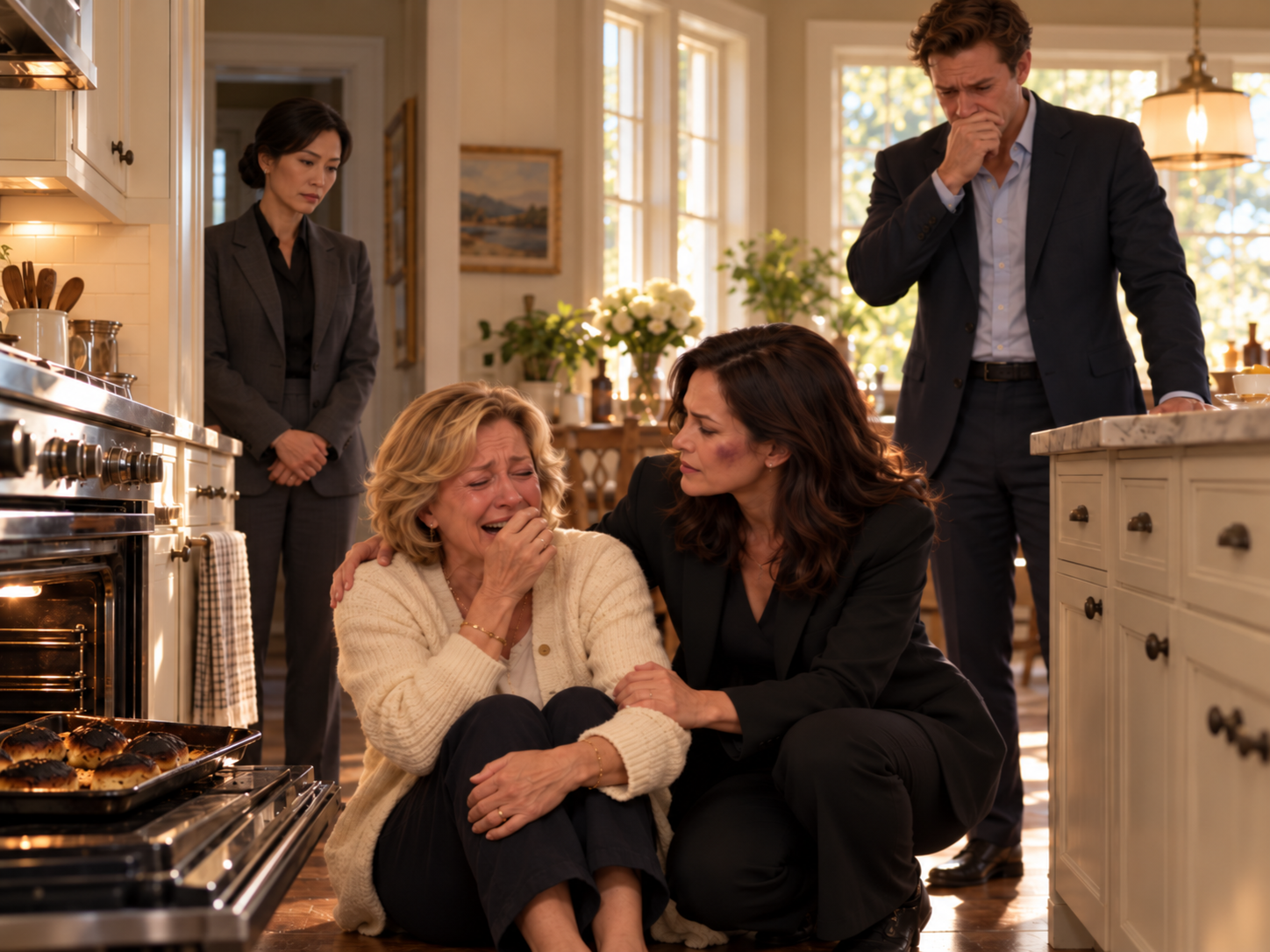
I knelt beside her.
“All these years,” she said.
“All these years I made sure dinner was ready exactly when he wanted it. Towels folded the right way. Coffee at six. Church clothes ironed. Birthday cards mailed.”
Her voice broke.
“And everything fell apart because I forgot rolls.”
“No.”
She shook her head.
“Yes.”
“No, Mom.”
I took her hands.
“Everything fell apart because he hit me.”
She stared at me.
“Those are not the same thing.”
Slowly, she nodded.
Nathan leaned against the counter.
“Why didn’t you tell us?”
Mom looked at him for a long time.
“Because you already knew.”
He frowned.
“We didn’t.”
“You knew enough.”
Neither of us answered.
She continued.
“You knew not to make noise when he was angry.”
I remembered.
“You knew to check his face before telling a joke.”
I remembered that too.
“You knew if he slammed a cabinet, dinner was going to be bad.”
Nathan looked down.
“You knew not to bring friends home after he had a difficult day.”
Every sentence unlocked a room inside my memory.
Dad throwing a plate against the sink when I was thirteen.
Dad gripping Nathan’s shoulder until he cried because he had dropped a baseball.
Dad punching a hole through the garage wall.
Dad apologizing afterward with gifts.
Flowers for Mom.
A model aircraft kit for Nathan.
A new field jacket for me.
Never the words I’m sorry.
Only objects.
Only resets.
Only silence.
“Did he hit you?” I asked.
Mom closed her eyes.
“Yes.”
Nathan turned away.
“How often?”
“Not often.”
Quinn, standing discreetly near the doorway, said nothing.
Mom immediately corrected herself.
“Listen to me.”
She shook her head.
“I’m still defending him.”
I squeezed her hands.
“You don’t have to answer everything today.”
She looked at me.
“He hit me the first year we were married.”
My chest tightened.
“He apologized. Cried. Said deployment stress had changed him.”
She swallowed.
“The next time was two years later.”
Nathan sat at the table.
I remained beside her.
“He never hit where people would see.”
Her hand moved to her ribs.
“Usually.”
I understood the cardigan then.
Warm restaurant.
High collar.
Sleeves.
Not modesty.
Camouflage.
I felt anger move through me.
Not hot anger.
Cold.
Focused.
The kind I had learned was more dangerous.
Mom saw it.
“Lila.”
“I’m fine.”
“No.”
She touched my face below the bruise.
“You look exactly like him when you’re angry.”
The words hurt.
I pulled away slightly.
She immediately looked ashamed.
“I’m sorry.”
“No.”
I forced myself to breathe.
“You’re right.”
Nathan looked surprised.
I stood.
“I spent half my life trying not to become him.”
Quinn finally spoke.
“You didn’t.”
I glanced at her.
“How do you know?”
“Because angry men like your father ask how to avoid consequences.”
She nodded toward Mom.
“You’re asking how to avoid becoming him.”
That stayed with me.
We packed two suitcases for Mom.
Then three.
Then five.
Each time she said, “That’s enough,” she found something else she did not want to leave.
Family photographs.
Her mother’s quilt.
A recipe box.
A ceramic bird Nathan made in elementary school.
The blue dress she wore to my commissioning ceremony.
I stopped when I saw it.
“You kept that?”
Mom looked surprised.
“Of course.”
“You cried the entire drive home.”
“Because your father was furious.”
I remembered.
Dad had wanted me to attend the academy he had chosen.
I had taken another path into the Army.
At my commissioning, he shook my hand and told me quietly:
“You could have done something worthy of this family name.”
Mom had not defended me.
For years I remembered only that.
Now she touched the blue fabric.
“I was proud of you.”
I stared at her.
“Why didn’t you say it?”
Her eyes filled.
“Because I was afraid he would hear me.”
That was the moment I realized I had made my mother simpler than she was.
In my memories, she had become the woman who never defended us.
That was true.
But another truth existed beside it.
She had been surviving.
Survival did not erase the damage she allowed.
But perhaps understanding was not the same thing as excusing.
My phone rang.
Quinn checked the screen before handing it to me.
“General Reed.”
I answered.
“Sir.”
Lieutenant General Malcolm Reed was my immediate superior.
He skipped every social courtesy.
“Are you secure?”
“Yes, sir.”
“How is your mother?”
I looked at her.
“Safe.”
“And you?”
“I’m fine.”
He was quiet.
“Park says you have visible bruising.”
I shot Quinn a look.
She ignored me.
Reed continued.
“Lila, I’m not asking whether you can still perform your duties. I know you can. I’m asking whether you’re fine.”
That question landed differently.
“No, sir.”
“Good.”
I blinked.
He continued.
“Because if you told me you were fine, I’d know you were lying.”
A pause.
“Your father has retained counsel.”
“I expected that.”
“He is also claiming the incident resulted from provocation and that your undisclosed rank created confusion regarding authority.”
I almost admired the creativity.
“Apparently my cheek provoked his hand.”
“Pretty much.”
Despite everything, I smiled.
Then Reed’s voice changed.
“There’s more.”
I turned away from Mom.
“What?”
“His command has initiated a review of prior complaints.”
I froze.
“What prior complaints?”
“That’s what they’re determining.”
A chill moved through me.
“Sir?”
“Three personnel matters over the last seven years. Two were closed. One was reassigned.”
“What kind?”
“Abusive leadership. Retaliation. Improper influence.”
I looked at Quinn.
She could read the answer on my face.
Reed continued.
“Your father has been temporarily relieved of command.”
I closed my eyes.
That should have felt like victory.
It didn’t.
It felt like someone had opened a door into a room I did not want to enter.
“What happens now?”
“Now investigators do their job.”
He paused.
“And you stay out of it.”
“I understand.”
“I mean completely out, Lila.”
“Yes, sir.”
“You are the complainant’s daughter, a potential witness, and a general officer with enough influence that merely asking the wrong person a question could contaminate this investigation.”
“I know.”
“Good.”
He softened.
“Take care of your family.”
When I hung up, Quinn already knew.
“He’s relieved?”
“Yes.”
Nathan heard.
“So he’s finished?”
“No.”
I looked at him.
“An investigation isn’t a conviction. Facts still matter, even when we don’t like the person being investigated.”
Nathan shook his head.
“You still sound like you’re defending him.”
“I’m defending the process.”
“Why?”
“Because if rules only matter when they help people we like, they’re not rules.”
Mom looked at me.
And for the first time that morning, she smiled.
A real smile.
Small.
Sad.
Proud.
“You really are a general.”
Nathan laughed.
I did too.
Then he noticed an envelope beneath a stack of mail.
His expression changed.
“What?”
He pulled it free.
The return address belonged to an attorney.
Not Dad’s current attorney.
An office in Virginia.
The envelope had been opened.
Addressed to Mom.
Six months earlier.
She frowned.
“I’ve never seen that.”
I looked at Nathan.
Then at the envelope.
He handed it to Mom.
Inside was a letter.
She read the first page.
Her face went pale.
“What is it?”
She handed it to me.
The attorney represented a former captain named Aaron Bell.
Captain Bell alleged that Richard Mercer had interfered with his career after Bell reported irregularities involving a procurement program.
The letter requested cooperation from Evelyn regarding a personal email account Dad had apparently used from their home computer.
Mom whispered:
“He told me Aaron was unstable.”
Quinn’s expression hardened.
Nathan read over my shoulder.
“What procurement program?”
I scanned the page.
The name stopped me.
Silver Meridian.
I knew it.
Every senior logistics officer did.
A high-value modernization program delayed two years earlier after contracting inconsistencies surfaced.
Millions of dollars.
Maybe more.
My father’s name had never appeared publicly.
Mom stood.
“There’s something you need to see.”
She led us to Dad’s study.
I had not entered that room since I was sixteen.
Back then, touching anything on his desk was nearly a capital offense.
Mom opened a cabinet.
Behind several binders sat an old laptop.
“He told me to throw it away last year.”
“Why didn’t you?”
“I forgot.”
Nathan gave a strange laugh.
“Apparently forgetting things is having a pretty good week.”
Mom almost smiled.
I stopped both of them before anyone touched the computer.
“No.”
Nathan looked at me.
“If that contains evidence—”
“Then we preserve it.”
I called the investigator assigned to Dad’s command.
Forty minutes later, two agents arrived.
The laptop went into an evidence bag.
One of them photographed the cabinet.
Another documented the attorney letter.
As they prepared to leave, the senior investigator asked Mom:
“Mrs. Mercer, did your husband ever mention Captain Aaron Bell?”
She nodded.
“Many times.”
“In what context?”
Mom hesitated.
“He said Captain Bell betrayed him.”
“Did he ever explain how?”
She looked at me.
Then answered.
“He said the Army needed to learn what happened to people who tried to destroy good men.”
The investigator wrote that down.
I felt something cold settle in my stomach.
Because I knew my father.
I knew what he considered betrayal.
Disagreement.
Questions.
Resistance.
And now, for the first time, I began to understand that our family might not have been the only place where Richard Mercer had punished people for refusing to stay afraid.
The investigation widened quickly.
Too quickly for Dad’s lawyer.
Too slowly for Nathan.
Exactly as quickly as investigations are supposed to.
Captain Aaron Bell had reported questionable contract changes involving Silver Meridian.
Afterward, his evaluation dropped sharply.
A promotion recommendation disappeared.
A disciplinary complaint was opened against him and later dismissed for lack of evidence.
He left active duty eleven months later.
Two other officers had similar stories.
A civilian contracting specialist had one too.
My father denied everything.
Then investigators recovered emails from the laptop.
Not proof of financial theft.
Something almost more predictable.
Influence.
Pressure.
Requests disguised as suggestions.
Messages to commanders.
Questions about loyalty.
A note describing Bell as “not aligned with organizational priorities.”
Another:
“People who challenge leadership without understanding the full picture should not expect leadership to protect their careers.”
I read none of them officially.
I stayed away from the investigation as ordered.
But Dad’s attorney made sure the family heard his version.
I received a letter.
Not a message.
Not a phone call.
A letter delivered through counsel.
Three pages.
It began:
Lila,
I hope you are satisfied.
I stopped reading.
Nathan finished it.
He found me later on Mom’s rented porch.
She had taken a small cottage three miles from the water.
Nothing impressive.
Yellow siding.
Two bedrooms.
Tiny kitchen.
She loved it.
Nathan sat beside me.
“He says the investigation is your revenge.”
“Of course he does.”
“He says you planned the whole dinner with Quinn.”
I laughed once.
“That’s creative.”
“He says you humiliated him because you were jealous he never respected your career.”
That one hurt.
Nathan noticed.
“You know that’s insane.”
“I know.”
“Then why do you look like that?”
I stared at the road.
“Because there’s usually a small piece of truth inside the lies people use against us.”
Nathan waited.
“I did want him to know.”
“Know what?”
“That I outranked him.”
Nathan blinked.
I continued.
“I invited Quinn because I knew eventually he’d start talking about the Army.”
“You didn’t know he’d hit you.”
“No.”
“But you wanted the reveal.”
“Yes.”
“Okay.”
I looked at him.
“That doesn’t bother you?”
Nathan shrugged.
“You spent twenty-four years becoming everything he said you couldn’t become.”
A faint smile touched his face.
“You were allowed to enjoy five minutes of being right.”
I laughed.
Then cried.
Not dramatically.
Just one tear.
Then another.
Nathan pretended not to notice until I leaned against his shoulder.
After a while he said:
“I’m glad you came home.”
“I almost didn’t.”
“I know.”
That surprised me.
He looked toward the ocean.
“Mom used to tell me every year that you might come for Christmas.”
“I did come some years.”
“For dinner.”
He shook his head.
“That’s not the same as coming home.”
I knew what he meant.
“I didn’t know how to be here.”
“Neither did I.”
We sat quietly.
Then Nathan said:
“I’m leaving too.”
“Leaving what?”
“My job.”
I turned.
He worked for an engineering company forty minutes away.
Good salary.
Good benefits.
Dad had bragged about it constantly.
“I hate it.”
“Since when?”
“Since the second week.”
“Nathan, you’ve been there six years.”
“Exactly.”
I stared.
He smiled sadly.
“Dad knew the company president. Said it was stable. Respectable.”
“What do you want to do?”
He looked embarrassed.
“I want to teach.”
“Engineering?”
“High school physics.”
A laugh escaped me.
“That’s it?”
“What do you mean, that’s it?”
“I thought you were going to tell me you wanted to join the circus.”
“Dad basically reacted like I had.”
I leaned back.
“Then teach physics.”
Nathan looked at me.
“You make it sound simple.”
“It isn’t.”
I pointed toward Mom’s cottage.
“But simple and easy are not the same thing.”
He nodded slowly.
Another life beginning.
Another rule breaking.
Another Mercer learning that wanting something was not an act of disobedience.
Then my phone buzzed.
A message from Quinn.
Call me.
I called.
Her first words erased the calm from the porch.
“Lila, your father disappeared.”
PART 4 — THE LAST ORDER
“He what?”
Nathan immediately turned toward me.
Quinn’s voice came through the phone.
“His attorney says he failed to appear for a scheduled interview this morning. His assigned liaison went to the temporary residence. He wasn’t there.”
“Vehicle?”
“Gone.”
“Phone?”
“Off.”
“When?”
“Possibly last night.”
I stood.
“Does he have access to weapons?”
“His registered service weapons were surrendered.”
“That wasn’t my question.”
Silence.
Quinn knew why I asked.
A man who had spent decades in the military could find another weapon.
“Unknown,” she said.
“Mom.”
Nathan was already moving.
We went inside.
Mom was in the kitchen watering a basil plant.
She saw our faces.
“What happened?”
I did not soften it.
“Dad’s missing.”
The watering can slipped.
Nathan caught it.
“Did he contact you?”
“No.”
“Email? Unknown number? Anything?”
“No.”
Her face changed.
Then she looked toward the bedroom.
“What?”
She walked quickly down the hall.
We followed.
Her suitcase sat in the corner.
She opened the top drawer of her nightstand.
Empty.
“What was there?”
She whispered:
“A picture.”
“Of what?”
“The cabin.”
Nathan and I looked at each other.
Dad owned a hunting cabin in western Virginia.
Technically it had belonged to his father.
Twenty acres surrounded by trees.
No close neighbors.
Minimal cell coverage.
“Why would he take a picture of the cabin?”
“He didn’t.”
Mom looked at me.
“I did.”
“When?”
“When I packed.”
She pressed a hand against her forehead.
“I put it here yesterday.”
Nathan was already calling Quinn.
I stopped him.
“We tell investigators. Nobody goes there.”
Mom looked at me.
“He’ll think I’m coming.”
“What?”
Her voice shook.
“He told me once that if I ever left him, he’d go there.”
Nathan froze.
“What exactly did he say?”
Mom swallowed.
“That the cabin was the only place nobody could take away from him.”
My skin went cold.
“Anything else?”
She hesitated.
“Mom.”
“He said if our family ever abandoned him, that was where he would wait until we remembered our duty.”
Duty.
Dad’s favorite word.
The word he used when love did not produce obedience.
Within an hour, law enforcement was moving toward the cabin.
Nobody allowed me to join the search team.
Correctly.
I was too personally involved.
Still, waiting was unbearable.
Mom paced.
Nathan checked his phone every thirty seconds.
I stood at the cottage window watching rain begin over the water.
Quinn arrived after dark.
“No contact yet.”
“Cabin?”
“Vehicle is there.”
Mom sat.
“Is he alive?”
“We believe so. Smoke from the chimney. Movement observed through a window.”
Nathan exhaled.
“Then go get him.”
“They’re trying.”
Quinn looked at us.
“He has a firearm.”
Mom closed her eyes.
Nathan swore.
My voice stayed steady.
“What does he want?”
“You.”
“No.”
Mom stood.
“No.”
Quinn held up one hand.
“Nobody is sending Lila inside.”
“What does he want?” I repeated.
“He called the negotiator fifteen minutes ago.”
“And?”
“He says he’ll speak only to General Mercer.”
Nathan laughed bitterly.
“Of course.”
Mom came toward me.
“You are not going.”
“I know.”
She gripped my arm.
“You don’t owe him that.”
“I know.”
But part of me did not believe it.
That was the problem with fathers like mine.
Even after you escaped the house, a voice remained.
Be useful.
Fix it.
Keep the family together.
Do not embarrass him.
Do not make it worse.
I had commanded thousands of people.
Briefed senior leaders.
Made decisions with lives attached to them.
And still, standing inside my mother’s tiny rented cottage, part of me became seventeen again.
Trying to figure out which words would keep Dad calm.
Quinn seemed to read it in my face.
She took me aside.
“You don’t have to save him.”
“I know.”
“Do you?”
I looked at her.
“What do you mean?”
“You’ve spent the last forty-eight hours worrying about contamination of the investigation, your mother, Nathan, his subordinates, your father’s career.”
She moved closer.
“When exactly do you plan to worry about yourself?”
“I’m fine.”
She gave me a look.
“Poor choice of words.”
I almost smiled.
Then my phone rang.
Unknown number.
Every person in the room froze.
Quinn reached toward me.
“Don’t answer.”
The phone rang again.
Investigators had Dad’s number.
This was different.
On the third ring, I answered.
“Hello?”
Breathing.
Then his voice.
“You finally destroyed everything.”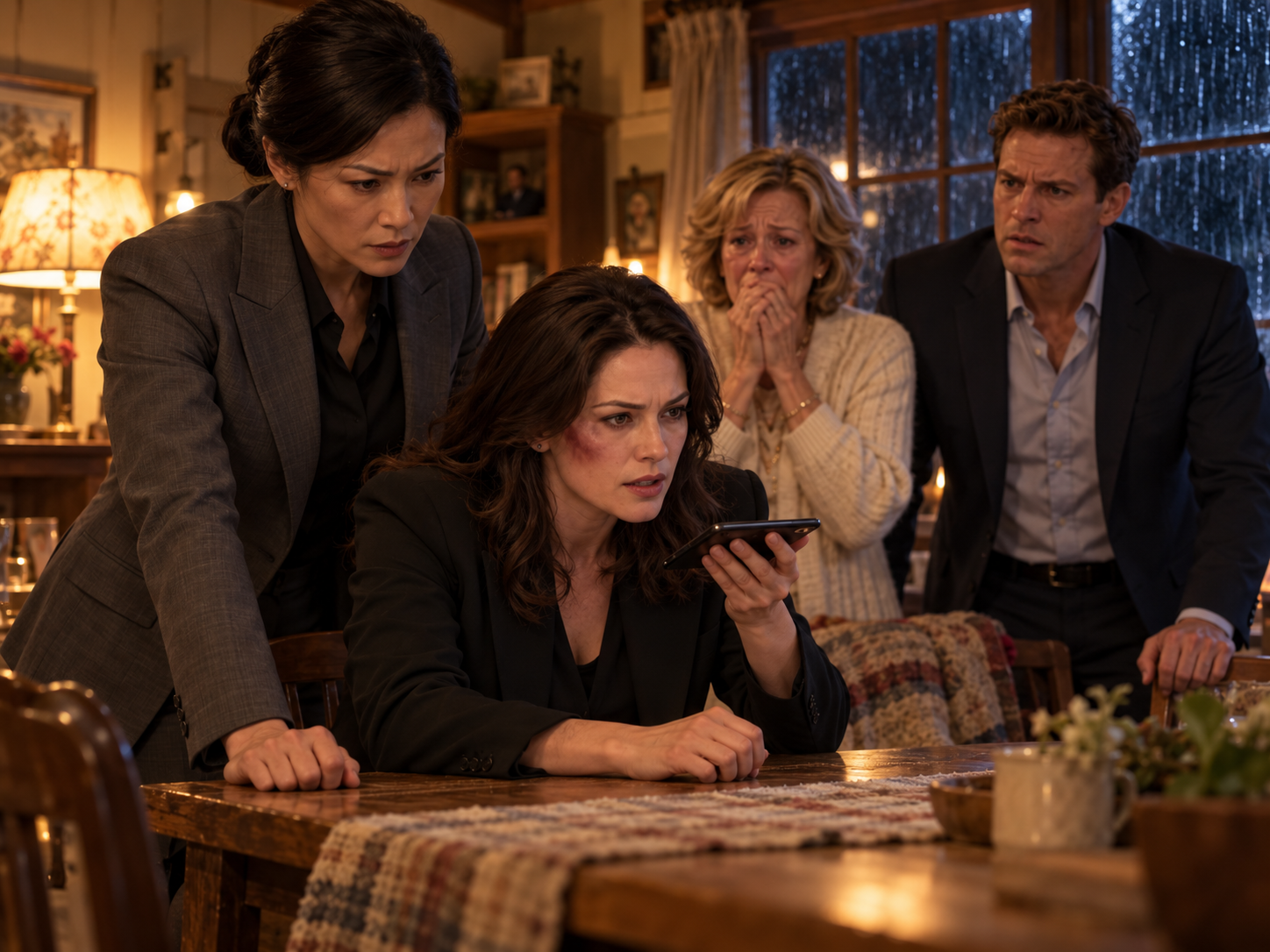
Quinn’s eyes widened.
She motioned for Nathan to contact the investigators.
I put the phone on speaker.
“Dad.”
“Don’t call me that.”
His voice sounded wrong.
Not slurred.
Hollow.
“You wanted to be above me so badly.”
“This isn’t about rank.”
“Everything is about rank.”
“No.”
“You invited Park to humiliate me.”
“No.”
“You hid your promotion.”
“Because you never listened.”
“You turned your mother against me.”
“She left because she was afraid of you.”
Silence.
Then:
“I gave that woman everything.”
I stared at Mom.
She was crying silently.
“A house,” Dad continued. “Cars. Vacations. Security.”
“You also hurt her.”
“I never—”
“Don’t.”
I heard my own voice harden.
“Not tonight.”
He went quiet.
“You want me to confess?”
“I want you to put the gun down.”
Quinn stared at me.
Apparently the negotiator had not told us whether Dad knew officers had seen the firearm.
I had guessed.
Dad laughed softly.
“You always were clever.”
“Put it down.”
“So they can drag me away?”
“So nobody dies tonight.”
“Nobody was supposed to.”
The room became still.
I chose every next word carefully.
“Then prove it.”
He breathed.
Rain struck the windows.
I could hear something similar on his end.
Cabin roof.
“What’s the point?” he asked.
“The point is tomorrow.”
“There is no tomorrow.”
“There is.”
“You think I can walk back onto a base after this?”
“No.”
He stopped.
Quinn looked at me sharply.
I continued.
“You may lose your command.”
“You think?”
“You may lose your career.”
His breathing changed.
“You’re supposed to tell me everything can be fixed.”
“I’m not going to lie to you.”
“You always hated me.”
“No.”
That answer surprised both of us.
I sat down.
“I spent years wishing I hated you.”
Mom looked at me.
“It would have been easier.”
Dad said nothing.
“I loved you.”
My voice cracked.
“I wanted you at every promotion.”
Nathan lowered his eyes.
“I wanted to call you from Kuwait. From Germany. From Fort Lewis. Every time something good happened, I thought maybe this would be the thing you’d finally respect.”
Silence.
“I kept collecting achievements like maybe enough of them could buy one sentence from you.”
My father’s breathing was the only sound on the line.
“Then I realized there was no rank high enough.”
Mom covered her mouth.
“You weren’t disappointed in my career because I failed.”
I wiped my face.
“You were disappointed because I chose it without your permission.”
A long silence followed.
Then Dad said:
“You think you understand me.”
“No.”
“Then stop pretending.”
“I don’t understand you.”
I leaned forward.
“But I understand what you did.”
His voice hardened again.
“I built my family.”
“No.”
Mom looked up.
“You controlled it.”
His breathing became faster.
“Put your mother on.”
“No.”
“Lila.”
“No.”
“I said put Evelyn on.”
“And I said no.”
The old pattern collided with something new.
He had issued an order.
I had refused.
Nothing happened.
The world did not end.
He could not make my hand move.
Could not force the phone toward Mom.
Could not decide who spoke.
That might have been the first time he truly understood what he had lost.
“You always needed the last word,” he whispered.
“No.”
I looked at Mom.
“I just need everyone alive when this conversation ends.”
A noise came through the phone.
Metal against wood.
Quinn’s hand tightened around the back of a chair.
“Dad?”
Nothing.
“Richard?”
Mom gasped.
Then his voice returned.
Smaller.
“I put it on the table.”
I closed my eyes.
“Good.”
“Happy?”
“No.”
Another long silence.
Then he whispered:
“I don’t know who I am if I’m not Colonel Mercer.”
I had no prepared answer for that.
So I gave him the truth.
“Then maybe it’s time to find out.”
Twenty minutes later, Richard Mercer walked out of the cabin with empty hands.
He was taken into custody without injury.
No dramatic charge.
No final speech.
Just rain.
Flashlights.
Mud.
A man who had spent his entire adult life demanding control finally walking toward people who were not going to give it back.
The military investigation lasted four months.
The criminal matters lasted longer.
The birthday assault was straightforward.
Witnesses.
Security footage.
Visible injury.
Dad’s attorney eventually stopped arguing that it had not happened and started arguing context.
The command investigation was more complicated.
Captain Aaron Bell testified.
So did several others.
Some allegations could not be substantiated.
Others could.
Dad had used his authority to retaliate against officers who challenged him.
He had improperly influenced evaluations.
He had pressured subordinates involved in the Silver Meridian review.
Investigators found no evidence that he personally stole money.
That mattered.
Truth mattered even when a more dramatic lie would have made a better story.
But his conduct was serious enough.
He was removed permanently from command.
His promotion eligibility ended.
Retirement proceedings began under conditions far different from the celebration he had once imagined.
I attended none of the hearings unless required.
When I was required, I testified.
No anger.
No speeches.
Just answers.
Yes.
No.
I remember.
I do not remember.
I witnessed that.
I did not witness that.
It was strange how powerful facts could be when nobody decorated them.
Mom filed for divorce.
That caused the largest explosion.
Not Dad losing command.
Not Captain Bell.
Not the investigators.
The divorce.
He sent her twelve letters.
She opened the first.
Then asked her attorney to retain the rest unopened.
One afternoon, she called me.
“Do you think I’m cruel?”
“No.”
“I spent forty-four years with him.”
“I know.”
“He has nobody.”
“That’s not true.”
“Who?”
“Himself.”
She frowned.
I continued.
“And whatever kind of man he becomes next is his responsibility.”
She looked unconvinced.
So I added:
“You are allowed to stop serving a sentence just because he doesn’t know how to live outside the prison he built.”
Mom cried.
Then signed the papers.
Nathan left engineering.
Dad refused to speak to him for two months after learning he had enrolled in a teacher certification program.
Nathan celebrated by sending me a photograph of his first classroom.
Twenty-eight desks.
A whiteboard.
A homemade sign above the door:
PHYSICS: BECAUSE THE UNIVERSE HAS RULES EVEN WHEN PEOPLE DON’T.
I called immediately.
“That sign is terrible.”
“My students love it.”
“You don’t have students yet.”
“Future students love it.”
“You’re becoming unbearable.”
“I learned from a general.”
Mom moved permanently into the yellow cottage.
She painted the front door blue.
It was the first time in her adult life she chose a color without asking anyone.
When she told me that, I had to step away from my desk because I started crying in front of three colonels.
Quinn pretended not to notice.
She had become excellent at pretending not to notice things.
Then, five months after the Ocean House dinner, I received a letter.
Not from Dad’s attorney.
From Dad.
Handwritten.
One page.
No accusation.
No explanation.
It said:
Lila,
I have rewritten this thirteen times.
Every version became an excuse.
You did not destroy my career.
I did.
You did not turn your mother against me.
I taught her to fear me.
You did not embarrass me at the restaurant.
I embarrassed myself.
I do not know whether I am writing this because I have finally understood those things or because I have lost enough that I have no choice but to look at them.
Maybe both.
I remember your commissioning.
I remember the blue dress your mother wore.
I remember thinking everyone in that auditorium was watching to see whether my daughter measured up to me.
I understand now that you were never supposed to.
You were supposed to become yourself.
I am sorry I made that feel like betrayal.
Richard
I read it three times.
Then put it inside my desk.
Quinn asked:
“Are you going to answer?”
“I don’t know.”
“That’s allowed.”
I looked at her.
“I keep waiting to feel better.”
“About what?”
“Everything.”
She sat opposite me.
“Closure is probably another word people invented because reality takes too long.”
I smiled.
“That’s surprisingly philosophical for defense administration.”
“Sometimes paperwork is important.”
I laughed so loudly my aide opened the door to make sure nothing was wrong.
For the first time in months, nothing was.
PART 5 — WHERE WE BELONG
A year after my father’s birthday dinner, I stood behind a podium at Fort Monroe facing nearly six hundred soldiers, civilians, family members, and guests.
The ceremony was not for me.
That was important.
It was for Captain Aaron Bell.
Except he was not Captain Bell anymore.
He was Lieutenant Colonel Aaron Bell.
After the investigation, a correction board reviewed portions of his record.
Not everything could be repaired.
Lost years are still lost years.
Careers do not simply rewind because injustice is discovered.
But the Army could correct what remained within its authority.
His record was restored where appropriate.
A retaliatory evaluation was removed.
He returned to service in a reserve capacity.
And that afternoon, surrounded by his wife and two teenage daughters, he was finally receiving the promotion he should have been competitive for years earlier.
I had been asked to preside.
At first, I declined.
Too close to my family.
Too much symbolism.
Bell called me personally.
“General, I didn’t ask because of your father.”
“Then why?”
“Because you stayed out of the investigation.”
I laughed.
“That’s an unusual compliment.”
“I’m serious.”
“So am I.”
He continued.
“People kept expecting you to use your rank to shape what happened.”
“I would’ve been removed if I tried.”
“Yes.”
A pause.
“That didn’t stop other people before.”
I knew exactly what he meant.
He asked again.
This time, I accepted.
Now he stood in front of me wearing his uniform.
His wife held his old rank insignia.
His daughters were trying not to cry.
I looked toward the audience.
Nathan sat in the second row wearing a tie printed with tiny equations.
Beside him sat Mom.
No cardigan buttoned to her throat.
No eyes darting toward a husband for permission to smile.
Blue dress.
The same blue dress she wore to my commissioning twenty-five years earlier.
She had altered it slightly.
But I recognized it immediately.
When our eyes met, she smiled.
Proudly.
Without checking anyone else first.
For one dangerous second, I nearly lost my composure.
Then I continued.
“Lieutenant Colonel Bell, there are moments in military service when the institution asks people to trust that truth will eventually matter.”
The audience became quiet.
“That trust is not automatic.”
Bell watched me.
“It must be earned.”
I glanced toward the soldiers standing behind him.
“And when leadership fails, the answer is not to pretend the failure never happened. The answer is to confront it, correct what can be corrected, and ensure the next person does not pay the same price.”
Bell’s wife wiped her eyes.
I stepped down.
Pinned his new rank.
Saluted.
He returned it.
Then his daughters hugged him so hard the entire audience laughed.
Afterward, Mom found me near the edge of the parade field.
“You were wonderful.”
“Thanks.”
She touched my sleeve.
“I should have said that twenty-five years ago.”
I looked at her.
“You can say it now.”
Her eyes filled.
“I’m proud of you.”
There it was.
Four words.
I had spent half a lifetime believing I needed them from my father.
It turned out I had been waiting for them from her too.
I hugged her.
Not politely.
Not carefully.
I held on.
She did too.
When we separated, Nathan walked over carrying three paper cups.
“Coffee.”
Mom took one.
I looked at mine.
“This isn’t coffee.”
“Technically it contains coffee.”
“It’s ninety percent caramel.”
“You outrank me professionally, not nutritionally.”
“Unfortunately, I outrank you in common sense too.”
Mom laughed.
A full laugh.
No hesitation.
No fear.
I realized I had never heard that sound from her as a child.
Not like that.
Freedom has sounds.
I learned that one that day.
Dad retired six weeks later.
There was no large ceremony.
No ballroom.
No wall of photographs.
No speech about legacy.
He asked for none.
According to his attorney, he declined the traditional gathering entirely.
He moved into a modest apartment outside Richmond and began court-ordered counseling associated with the domestic assault case.
For months, I heard almost nothing about him.
Then on my forty-third birthday, a package arrived.
Inside was an old wooden box.
I recognized it.
Dad had kept it in his study throughout my childhood.
Inside were medals, coins, photographs, and letters from his career.
But most of those things were gone.
Only one item remained.
A photograph.
Me.
Twenty-two years old.
Second lieutenant bars on my uniform.
Standing at my commissioning ceremony.
Mom in the blue dress beside me.
Dad on the other side.
I remembered that photograph.
His expression had seemed stern.
Disappointed.
Now I turned it over.
There was handwriting on the back.
His.
June 14.
Lila commissioned today.
She looked fearless.
I have never been more proud and I have never been more terrified that she no longer needs me.
I stared at the sentence.
Read it again.
Then again.
For decades, I had believed he had not been proud.
The truth was worse.
And sadder.
He had been proud.
He had simply experienced my independence as a threat.
Under the photograph was a newer note.
I confused being needed with being loved.
I think that mistake cost me my family.
I am trying to learn the difference.
Happy birthday.
Dad.
Not Richard.
Dad.
I sat alone in my office long after sunset.
Eventually Quinn knocked.
“You’re still here.”
“So are you.”
“I have an excuse.”
“What?”
“I work for a general who refuses to go home.”
She noticed the wooden box.
“Oh.”
I handed her the photograph.
She read the back.
“What are you going to do?”
“I don’t know.”
She returned it.
“Still allowed.”
I leaned back.
“Do you think people really change?”
Quinn considered the question.
“Yes.”
“That sounded too easy.”
“I didn’t say they change enough.”
I smiled faintly.
“That sounds more like you.”
She sat.
“Some people change completely. Some change five percent. Some learn the right words and nothing else.”
“And Dad?”
“You won’t know from letters.”
I knew she was right.
Words were cheap in the Mercer household.
Action mattered.
For the next year, I watched from a distance.
Dad remained in counseling even after the court requirement ended.
He did not challenge Mom’s settlement.
When Nathan sent a boundary letter saying he wanted no contact for six months, Dad respected it.
No surprise visits.
No messages through relatives.
No guilt.
When the six months ended, Dad sent Nathan one email:
If you ever want to talk, I will listen. If not, I understand.
Nathan waited another two months.
Then met him for coffee.
I did not ask what happened.
Nathan told me anyway.
“He looks smaller.”
“Older?”
“No.”
He searched for the word.
“Smaller.”
Then he explained.
Dad had asked about teaching.
Not salary.
Not benefits.
Not when Nathan planned to return to engineering.
He asked what age group he liked working with.
What subjects students struggled with.
Whether Nathan enjoyed the classroom.
Then he listened.
For forty minutes.
“He didn’t interrupt?” I asked.
“Not once.”
“That’s alarming.”
Nathan smiled.
“He apologized.”
“How?”
“No speech.”
His smile disappeared.
“He said, ‘I made you afraid to disappoint me, and then I called that respect.’”
I felt something move inside me.
Nathan continued.
“I’m not pretending everything’s okay.”
“You shouldn’t.”
“But I might see him again.”
“That’s your choice.”
“You won’t be angry?”
“No.”
“What if Mom is?”
“That’s between you and Mom.”
Nathan stared at me.
“You know, you’re really annoying when you’re emotionally healthy.”
“I’m putting that on my next evaluation.”
My opportunity came unexpectedly.
Two years after the birthday dinner.
I had been promoted again.
Major General.
The ceremony was small by choice.
Mom attended.
Nathan attended with his fiancée, Maya, another physics teacher who could destroy him in arguments about thermodynamics.
Quinn stood beside me.
General Reed pinned the second star.
Applause filled the hall.
Afterward, as people gathered near the reception tables, my aide approached.
“Ma’am?”
“Yes?”
“There’s someone downstairs asking if he can leave something for you.”
I knew before she said the name.
“Richard Mercer.”
Mom heard.
Her expression changed but she did not panic.
That alone told me how far she had come.
Nathan walked over.
“What do you want to do?”
I looked through the glass doors toward the stairwell.
“Did he ask to come inside?”
My aide shook her head.
“No, ma’am. He specifically said he would not enter unless invited.”
That mattered.
A little.
Not enough.
But a little.
I looked at Mom.
“You okay?”
She considered it.
“Yes.”
Not automatic this time.
Real.
Nathan said:
“You don’t have to see him.”
“I know.”
I thought about all the years I had wanted Dad to witness a promotion.
Then I thought about the first restaurant.
About the slap.
About the cabin.
About his letters.
About Nathan’s coffee.
About Mom’s blue front door.
About change.
Not forgiveness.
Not erasure.
Change.
“I’ll meet him downstairs.”
Quinn started to follow.
I shook my head.
“I’m okay.”
She raised an eyebrow.
“Poor choice of words again.”
I smiled.
“This time I mean it.”
Dad stood near the lobby entrance.
No uniform.
Navy sport coat.
Gray hair thinner than I remembered.
Hands clasped in front of him.
When I walked toward him, he seemed uncertain whether to stand straighter.
Old instinct.
He stopped himself.
His eyes went to the stars on my shoulders.
For a second, neither of us spoke.
Then he said:
“Major General Mercer.”
“Dad.”
His face changed.
He looked away.
When he looked back, his eyes were wet.
“I brought you something.”
He held out a small box.
Inside was his old brass compass.
He had carried it throughout his early military career.
I remembered being six years old and begging to play with it.
He never allowed me to touch it.
“Why?”
“Because I used to think leadership meant knowing the direction and making everyone follow.”
He gave a sad smile.
“I was wrong.”
I closed the box.
“I can’t make this easy for you.”
“I know.”
“I can’t tell you everything is forgiven.”
“I know.”
“I don’t know whether we’ll ever have the relationship you want.”
He nodded.
“I know.”
Three times.
No argument.
No correction.
No demand.
It might have been the most convincing apology he had ever given me.
I looked toward the staircase.
“You can come upstairs for ten minutes.”
His eyes widened.
“You don’t have to—”
“I know.”
A small smile crossed my face.
“You’ve said that a lot.”
“I’m practicing.”
Despite myself, I laughed.
Then I grew serious.
“Dad.”
“Yes?”
“If you come upstairs, you don’t make Mom talk to you.”
“I understand.”
“You don’t ask Nathan anything about his old job.”
“Understood.”
“You don’t turn my ceremony into your story.”
His face tightened.
Not in anger.
Pain.
Fair pain.
“I won’t.”
I nodded.
“Then come upstairs.”
We entered the reception together.
Nobody applauded.
Nobody gasped.
Real healing is rarely cinematic.
Mom saw him.
He stopped several feet away.
“Evelyn.”
“Richard.”
That was all.
No hug.
No reconciliation.
And that was okay.
Nathan walked over next.
Dad smiled.
“How are the students?”
Nathan looked surprised.
“Loud.”
“I imagine.”
“They’re good.”
Dad nodded.
“I’m glad.”
Then he saw Quinn.
For perhaps one half second, the old Colonel Mercer flickered across his face.
Embarrassment.
Authority.
Pride.
Then he walked toward her.
“Colonel Park.”
“Mr. Mercer.”
He accepted the correction.
“I owe you an apology.”
Quinn said nothing.
“I treated you disrespectfully.”
“Yes.”
I almost choked on my drink.
Dad nodded.
“I also placed you in an impossible position that night.”
“You did.”
“I’m sorry.”
Quinn studied him.
Then said:
“Thank you.”
Not forgiveness.
Acknowledgment.
Enough.
Dad stayed exactly ten minutes.
When the time was up, he approached me.
“I should go.”
I glanced at the clock.
“You actually counted?”
“I’m learning boundaries.”
“Dangerous habit.”
He smiled.
Then looked at me in uniform.
“You know what I regret most?”
I expected something about the restaurant.
Or the investigation.
Or his command.
Instead he said:
“I spent so much time worrying you’d become someone I couldn’t control that I missed watching you become someone extraordinary.”
I looked at him.
Part of me wanted to absorb those words.
Another part wanted to reject them because twenty-five years earlier they would have meant everything.
Now?
Now they meant something.
But not everything.
That difference was freedom.
“Thank you,” I said.
He nodded.
Then walked away.
I did not chase him.
He did not turn around.
That evening, our family gathered at Mom’s cottage.
Not Dad.
Not yet.
Maybe someday.
Maybe never.
Healing did not require putting every broken piece back where it started.
Sometimes healing meant building a different shape.
Mom cooked dinner.
Nathan burned the garlic bread.
Maya opened the wine.
Quinn somehow ended up invited and immediately started arguing with Nathan about whether physics teachers were more useful than logisticians.
The blue front door remained open to the evening breeze.
After dinner, Mom brought out a birthday cake.
I frowned.
“My birthday was eight months ago.”
“It isn’t for your birthday.”
Nathan grinned.
On the cake, in crooked icing, were the words:
TO NEW BEGINNINGS.
“That is incredibly sentimental,” I said.
Mom lit the candles.
“You’ll survive.”
Nathan switched off the lights.
Everyone started singing anyway.
Wrong song.
Wrong occasion.
Nobody cared.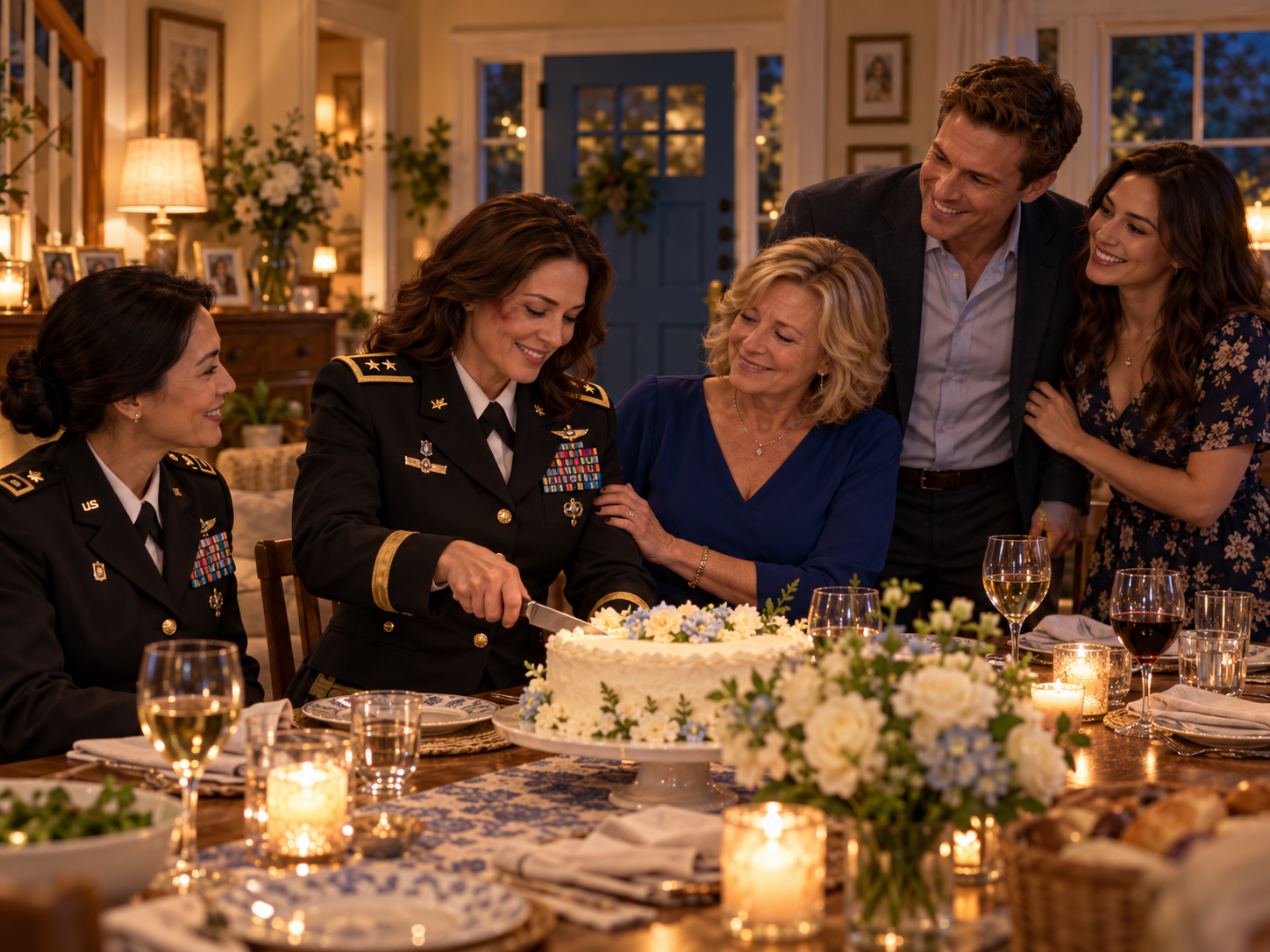
As I looked around the table, I thought about the Ocean House.
Another table.
Another dinner.
Another version of our family.
Dad at the head.
Mom waiting for permission to laugh.
Nathan afraid to speak.
Me counting exits.
That night I had believed strength meant being the person who did not flinch when struck.
I knew better now.
Strength was Mom choosing a blue door.
Nathan walking into a classroom.
Aaron Bell wearing the rank someone tried to take from him.
Quinn standing up when silence became complicity.
Dad putting a weapon down.
Dad entering therapy.
Dad leaving a room when ten minutes were over.
And me?
My strength was no longer measured by how much pain I could absorb without reacting.
It was measured by what I refused to pass forward.
Mom handed me the knife.
“You cut it.”
I looked at the cake.
“Why me?”
Nathan raised his glass.
“Highest-ranking officer.”
Everyone laughed.
I cut the first slice.
Then another.
Nobody sat at the head of the table.
There was no head.
Just six chairs arranged around something warm and imperfect.
Later, after everyone left, I stood on Mom’s porch looking toward the Atlantic.
The wind was cold.
She came outside carrying two blankets.
“You always loved the ocean,” she said.
“I like things that make people feel small.”
“That sounds healthy.”
“It is.”
She wrapped a blanket around herself.
For a while we watched the dark waves.
Then she asked:
“Are you happy?”
The question surprised me.
I thought about answering automatically.
Fine.
Busy.
Good.
Instead I considered it.
“My work is exhausting.”
“I know.”
“Nathan annoys me.”
“Also known.”
“You call me too often.”
She smiled.
“I can stop.”
“Don’t.”
Her smile softened.
I looked toward the water.
“I think I am.”
“Happy?”
“Yes.”
She rested her head against my shoulder.
A year earlier, I might have thought happiness would look like victory.
Dad punished.
Career restored.
Family vindicated.
Everything neatly balanced.
But life had refused to be that simple.
My father lost things because of what he did.
He also began becoming someone else.
My mother had not recovered forty-four lost years.
She had simply decided the years remaining belonged to her.
Nathan had not become the son Dad once imagined.
He became himself.
And I did not become strong because my father struck me twice in a restaurant and discovered I outranked him.
I had been strong long before that.
The restaurant only forced us all to finally see it.
Mom squeezed my arm.
“Do you remember what your father told you that night?”
“Unfortunately, yes.”
“He said you needed someone to remind you where you belong.”
I laughed quietly.
“He did.”
She looked at me.
“Do you know now?”
I watched the waves roll through the darkness.
Thought about the Army.
My family.
My soldiers.
The little yellow cottage.
The compass sitting inside my desk.
All those years I had believed belonging was something somebody powerful could grant or revoke.
A father.
A commander.
A rank.
A family name.
I finally understood.
“Yes,” I said.
Mom waited.
I smiled.
“Wherever I choose.”
And this time, nobody told me otherwise.