THE DOG THEY ORDERED TO DIE
PART 1 — THE WORD THAT STOPPED TITAN
The first thing they told me was that Titan needed to die.
The second thing they did was laugh when I asked to see him.
The third thing they did was release ninety-five pounds of military-trained rage directly at me.
My name is Dr. Claire Bennett.
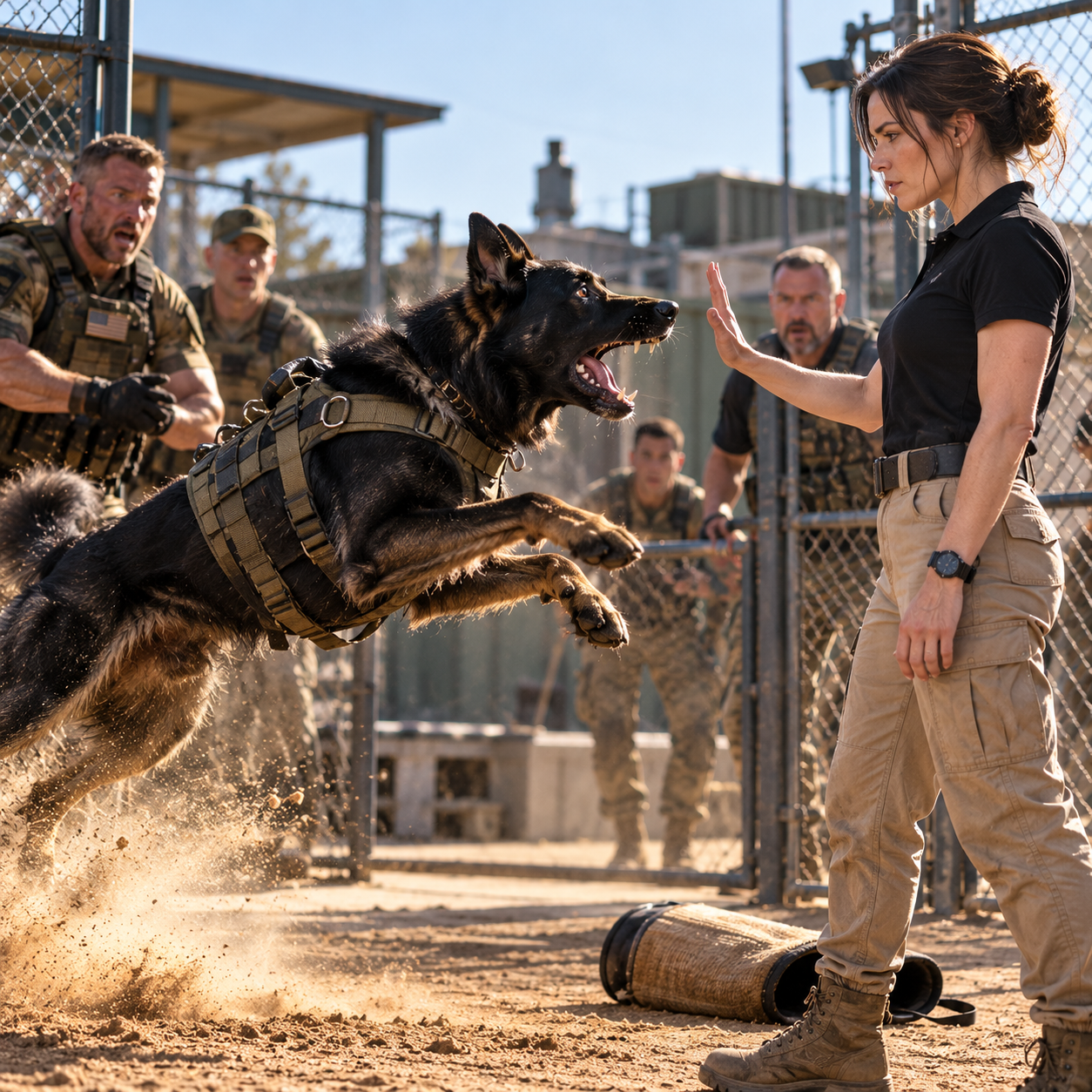
When I stepped into the K9 training yard at Atlantic Special Operations Annex in Virginia, nobody there considered me a threat.
Nobody recognized my authority.
And nobody saw the woman who had spent sixteen years developing combat dogs capable of doing things soldiers, machines, and surveillance systems sometimes could not.
What they saw was a five-foot-four woman wearing khaki pants, a black polo shirt, worn boots, and carrying a leather clipboard beneath one arm.
To them, I looked administrative.
Like paperwork with legs.
That was their first mistake.
The afternoon heat hung heavily over the training yard.
Dry wind pushed dust along the ground and rattled the chain-link fences surrounding the enclosure.
Operators in tactical gear stood near the cages with the easy confidence of men who had survived situations most civilians would only ever see in movies.
And inside one of those cages, something was already going wrong.
A massive black German Shepherd had an operator pinned to the dirt.
The man wore a reinforced bite sleeve.
Titan had ignored it completely.
Instead, his jaws were locked onto the padded shoulder of the man’s training jacket.
The operator twisted beneath him, boots digging trenches into the dirt.
“Get him off!”
Two Navy operators rushed in.
Control lines.
Break sticks.
Commands.
Nothing worked immediately.
Titan fought every attempt to move him.
It took nearly three minutes before they finally managed to drag him away.
The moment the control line tightened, Titan threw himself backward with enough force to make the steel tether post bend.
Foam gathered at the corners of his mouth.
His amber eyes looked wild.
Frantic.
Almost empty.
The men around him saw an animal becoming uncontrollable.
I saw something else.
I saw grief with teeth.
Senior Chief Daniel Voss slammed the cage door shut.
Then ripped off his gloves.
“He’s done.”
His voice carried across the yard.
“Third incident this week. He ignores commands. Ignores correction. Ignores the collar. He’s a liability now.”
The man beside him, a broad-shouldered operator named Briggs, looked toward Titan.
“Ever since Hale died, something’s been wrong with him.”
Hale.
The name struck harder than I expected.
Staff Sergeant Ethan Hale.
Titan’s handler.
His partner.
His anchor.
The one person Titan had been conditioned to trust above everyone else.
And Ethan was dead.
I had read the report twice during the flight to Virginia.
Ambush overseas.
Smoke.
Confusion.
Gunfire.
One fatal round.
Titan had stayed beside Ethan’s body after the shooting.
He refused to leave him.
When the extraction team arrived, Titan would not let anyone approach.
Not friend.
Not medic.
Not teammate.
Anyone who came close became a threat.
From that moment on, the pattern continued.
Every new handler.
Every trainer.
Every person who tried to force control.
Titan rejected them.
That didn’t mean he was broken.
It meant he was still loyal to someone who was never coming back.
“Excuse me.”
Three men turned.
Voss looked me over once.
From my boots to the clipboard.
He dismissed me almost immediately.
“The administration building is about half a mile that way, ma’am.”
I met his eyes.
“I know where I am.”
He waited.
“I came for Titan.”
Briggs gave a short laugh.
“They sent you to evaluate him?”
“I asked for the assignment.”
That made Voss look at me again.
This time longer.
Then he stepped closer.
He was tall.
Scarred.
Tattooed.
The kind of man used to people making room when he walked through it.
“Ma’am, that dog has put two men in the hospital this month.”
He pointed toward the medic bench.
“He nearly tore Lawson’s shoulder apart ten minutes ago.”
Then his face hardened.
“He’s scheduled for euthanasia at seventeen hundred.”
I looked through the fence.
Titan had started pacing.
Back.
Turn.
Forward.
Turn.
Back again.
Everyone else saw agitation.
I watched the rhythm.
It wasn’t random.
It was controlled.
Searching.
Scanning.
Calculating.
“He isn’t feral.”
Voss stared at me.
“He is grieving.”
His jaw tightened.
I continued.
“And every one of you keeps treating him like a weapon that suddenly malfunctioned.”
Briggs exhaled sharply.
“You seriously believe that?”
I turned toward him.
“Titan is not an ordinary working dog.”
Nobody answered.
“His conditioning was built around a primary bond with one handler.”
I looked toward the cage again.
“When that bond was taken from him violently, you tried replacing trust with pressure.”
Voss crossed his arms.
“And?”
“And he doesn’t recognize your authority.”
I faced him.
“He sees your control attempts as threats.”
Voss stepped closer until only inches separated us.
“I was handling military dogs before you were out of college.”
I didn’t move.
“I was preparing dogs for classified deployments before you earned those stripes.”
Silence.
The entire yard seemed to stop breathing.
Briggs looked at Voss.
Lawson, still sitting on the medic bench, lifted his head.
Voss’s eyes narrowed.
“If you know so much…”
He gestured toward the cage.
“…go in there and prove it.”
There it was.
The challenge.
It wasn’t really about Titan anymore.
It was about me.
He expected me to hesitate.
To step backward.
To remember that I was smaller than him.
That I was surrounded by armed operators.
That the dog inside that cage had just taken a man to the ground.
He wanted me to sign the euthanasia recommendation, pick up my clipboard, and leave.
Instead, I set the clipboard on the bench.
“All right.”
Voss blinked.
“Give me a bite sleeve.”
Nobody moved.
Lawson pushed himself upright.
“Chief, she doesn’t have armor.”
I kept looking at Voss.
“I said give me a sleeve.”
For the first time, he hesitated.
The sarcasm left his expression.
“Listen. I was making a point.”
“So am I.”
I opened my canvas duffel.
Reached inside.
And pulled out my own Kevlar-lined bite sleeve.
Old.
Worn.
Faded around the seams.
Painfully familiar.
Titan had trained with it years earlier.
Back when he was still a puppy.
Back when his paws looked absurdly large compared with the rest of him.
Back when one ear stood up and the other seemed permanently undecided.
I slid the sleeve over my left arm.
Secured it.
Voss stared at it.
Then at me.
“You go five feet past that gate.”
I said nothing.
“If he lunges, drop the sleeve.”
Still nothing.
“We pull you out.”
“You won’t need to.”
Briggs moved toward the gate.
He opened it just far enough for me to step through.
I entered.
The steel door slammed closed behind me.
Sixty feet away, Titan stopped pacing.
Instantly.
His head snapped toward me.
The transformation was immediate.
His body lowered.
The fur along his spine lifted.
A deep growl rolled from his chest.
Low enough that I could feel it against my ribs.
His amber eyes locked on me.
Not my face.
My center.
Assessing.
Behind the fence, Voss muttered,
“Let her learn.”
Then I heard something I had not agreed to.
Clack.
The tether disengaged.
My eyes shifted toward Titan.
Someone behind me shouted.
Another man cursed.
The gate latch rattled as operators suddenly realized what had happened.
Titan was free.
For less than a second, he stood completely still.
Then he exploded forward.
He didn’t run.
He launched.
Dust erupted behind his paws.
Forty feet.
Thirty.
Twenty.
Every instinct in the human body is designed to react to something like that.
Raise your arms.
Turn away.
Protect your throat.
Move.
I did none of those things.
Instead, I loosened the Kevlar sleeve.
Pulled it free.
And let it fall beside my boots.
Lawson shouted from behind the fence.
“No!”
Titan kept coming.
Fifteen feet.
Ten.
His teeth were exposed now.
His entire body was committed to the charge.
Ninety-five pounds of muscle, fury, training, and grief came straight toward my chest.
I stayed still.
Then Titan jumped.
For one suspended instant, he was airborne.
I could see his eyes.
Could hear the breath tearing through his throat.
Could feel the air move as he came toward me.
And in the final second before impact, I spoke one word.
A word nobody in that training yard had heard before.
“Northstar.”
Titan stopped in the middle of his lunge as if the entire world had suddenly seized him by the throat.
His front paws struck the dirt less than three feet from me.
Dust rolled between us.
His hind legs skidded.
Then silence fell.
Not ordinary silence.
The kind that follows something impossible.
Titan stood frozen.
His chest rose and fell rapidly.
His ears moved forward.
And for the first time since I arrived, the fury disappeared from his eyes.
Confusion replaced it.
Then recognition.
He gave a tiny sound.
Barely audible.
Not a bark.
Not a growl.
A whine.
I lowered myself slowly onto one knee.
Behind the fence, someone whispered,
“What the hell?”
Titan took one cautious step.
I extended no hand.
Made no command.
I simply said the word again.
“Northstar.”
His ears flattened.
And the massive German Shepherd who had resisted six trained handlers walked forward and pressed his forehead against my shoulder.
I closed my eyes.
My throat tightened immediately.
“Hello, little man.”
Titan shuddered.
He remembered.
Not everything.
But enough.
Eight years earlier, he had been a six-week-old puppy with oversized paws and a tendency to attack shoelaces.
He had been born in a breeding program I designed.
I had selected his bloodline.
Monitored his neurological development.
Built his early scent-conditioning routines.
And for the first fourteen months of his life, I had been the person he saw nearly every day.
Before Ethan Hale.
Before deployment.
Before war.
Before loss.
Northstar had been our emergency reset cue.
Not an attack command.
Not obedience.
A memory command.
A cue designed to cut through overstimulation and bring the dog back to the oldest stable emotional association in his training history.
We rarely used it.
Titan had not heard it in almost seven years.
But memory in a dog is not stored only in sound.
It lives in scent.
Rhythm.
Emotion.
Safety.
Titan pushed harder against me.
I placed one hand against the thick fur beneath his neck.
Behind me, the yard remained perfectly still.
Then Voss found his voice.
“How?”
I looked over Titan’s back.
“You never read his foundation file.”
Voss said nothing.
“Did you?”
His silence answered me.
Briggs glanced at him.
I rose slowly.
Titan remained against my leg.
“You read the incident summaries. Deployment evaluations. Bite reports. Handler assessments.”
I looked at the men surrounding the fence.
“But not his original conditioning history.”
Voss recovered some of his composure.
“Because dogs change.”
“Yes.”
I stroked Titan once.
“They also remember.”
Then the clinic door opened behind them.
A woman in medical scrubs stepped into the yard carrying a red folder.
“Senior Chief?”
Voss turned.
“Sir, the veterinarian is ready.”
She glanced at Titan.
Then at the clock mounted beside the building.
“Euthanasia authorization is scheduled for seventeen hundred.”
It was 4:41.
Voss looked at me.
For several seconds, neither of us spoke.
Then he said quietly,
“You have nineteen minutes.”
I shook my head.
“No.”
His eyes hardened.
“You misunderstand. That authorization came from command.”
“So did I.”
I reached into the back pocket of my cargo pants.
Removed a folded document.
And held it through the fence.
Voss took it.
His eyes moved across the first line.
Then stopped.
Briggs leaned closer.
The expression on Voss’s face changed completely.
The paper was signed by Rear Admiral Thomas Mercer, commanding officer of the Joint Special Operations Veterinary and Working Animal Directorate.
It gave me full temporary authority over Titan’s medical, behavioral, and operational disposition.
Including authority to suspend euthanasia.
Including authority to remove personnel from his evaluation.
Including authority to investigate the circumstances contributing to his behavioral deterioration.
Voss looked up.
I opened the gate.
Titan walked out beside me.
No leash.
No collar.
No hesitation.
“You wanted me to prove something,” I said.
I picked up my clipboard.
“Now I want the complete record of Staff Sergeant Ethan Hale’s final mission.”
Voss’s face tightened.
“That file is restricted.”
“I know.”
“You don’t have clearance.”
I met his eyes.
“I wrote part of the program that classified Titan in the first place.”
That finally erased every trace of amusement from Briggs’s face.
But Voss did not move.
Something else appeared in his expression.
Not anger.
Fear.
And that was when I understood.
Titan wasn’t the only reason these men had been waiting for five o’clock.
Someone wanted the dog gone.
And suddenly I needed to know why.
PART 2 — WHAT TITAN REMEMBERED
At 5:03 p.m., Titan was still alive.
That fact alone made several people on the annex deeply unhappy.
I moved him into an unused veterinary recovery room at the far end of the K9 facility, away from the main kennels and training yard.
No chains.
No electronic collar.
No rotating handlers.
Just water, a padded mat, dim light and me.
For the first twenty minutes he refused to lie down.
He stood between me and the door.
Always facing outward.
Every sound in the hallway made his ears lift.
Every passing bootstep made his body tense.
Protection behavior.
Not aggression.
He was guarding me.
Or perhaps guarding the only thing he had left that smelled remotely like his life before Ethan disappeared.
I sat on the floor.
My back against the wall.
Eventually Titan turned.
Our eyes met.
“You’re waiting for him.”
His ears shifted.
I swallowed.
“So am I.”
The official report said Ethan had died instantly.
What the report did not explain was why Titan had become unstable only after returning to Virginia.
During the flight home, he had been subdued but manageable.
During initial quarantine, he accepted food.
He allowed medical examinations.
Then, four days after arriving at Atlantic Annex, he attacked his first replacement handler.
Two days later, another.
Then another.
Something here had triggered the change.
Dogs do not understand classified intelligence.
But they understand places.
People.
Smells.
And fear.
I opened Ethan’s behavioral log.
Most entries were routine until six weeks before his death.
Then a pattern emerged.
Ethan had begun recording unusual stress signals.
Titan refusing a transport crate.
Titan alerting on equipment before missions.
Titan showing sustained interest in one particular logistics vehicle.
Titan repeatedly pawing at a black hard-shell equipment case belonging to support personnel.
Three separate notes.
Same case.
The fourth note ended with one sentence.
Titan is not confused. Check the equipment.
No follow-up.
No inspection report.
Nothing.
A knock came at the door.
Titan was standing before I could move.
A low rumble came from his chest.
“Easy.”
The door opened six inches.
Voss looked through.
“Can I come in?”
“No.”
His eyebrows rose.
“You asked for the mission file.”
“I asked for the complete mission file.”
“That’s what I brought.”
He held a thick gray folder.
“Slide it through.”
He stared at me.
“You really going to make me kneel in the hallway?”
“Yes.”
For a second I thought he might argue.
Instead, he crouched and pushed the folder through the gap.
Titan watched every movement.
Voss studied him.
“Never seen him like that.”
“Because you’ve been trying to dominate him.”
“He’s a military dog.”
“He’s also alive.”
Voss’s jaw tightened.
“You think we don’t know that?”
“I think grief makes people impatient.”
His eyes changed.
Something in that landed.
He looked down.
“Hale was mine.”
I stopped.
Voss rested one forearm against his knee.
“I recommended him for the K9 program nine years ago. Watched him become one of the best handlers we had.”
He glanced toward Titan.
“I was supposed to bring them both home.”
The hardness in his face cracked slightly.
“I only got one.”
That changed the room.
Not enough for trust.
Enough for complexity.
“Who released Titan at me?”
I asked.
Voss looked back.
“I thought Briggs did.”
“Did he?”
“No.”
His voice became quieter.
“The release control was triggered from the secondary panel.”
“Who had access?”
“Training supervisors. Veterinary officers. Two operations staff.”
“And you?”
“Yes.”
“Briggs?”
“Yes.”
“Lawson?”
“No.”
I opened the mission folder.
“Then find out.”
Voss stood.
Before closing the door he said, “There’s something else.”
I looked up.
“The euthanasia order wasn’t mine.”
“I assumed that.”
“It came down unusually fast.”
“How fast?”
“After the first serious incident.”
That made no sense.
Military working dogs with Titan’s value were not casually destroyed.
Retirement.
Rehabilitation.
Transfer.
Specialized evaluation.
There were options.
Voss continued.
“I argued against it.”
“You?”
“Yes, Doctor. Me.”
He almost smiled.
“I may be an arrogant bastard, but I don’t enjoy killing dogs.”
Then he closed the door.
For the next two hours I read.
At 7:18 p.m., I found the first lie.
The mission debrief claimed Ethan’s team entered the target compound at 02:11 local time.
Titan’s telemetry collar showed the dog crossed the outer perimeter at 02:03.
Eight minutes earlier.
Impossible unless the mission timeline had been altered.
I kept reading.
At 7:41, I found the second.
The report said Ethan was shot during the initial breach.
Titan’s biometric data showed sustained high-speed movement for another seventeen minutes before registering prolonged immobility beside Ethan’s position.
Which meant Ethan had likely survived the first contact.
At 8:09, I found the third.
Extraction logs reported Titan sedated at 02:38.
His veterinary report showed sedative administered at 03:27.
Forty-nine minutes missing.
I looked toward the dog.
Titan was watching me.
“What happened during those forty-nine minutes?”
His ears lifted at my voice.
Then he stood.
Walked toward the gray folder.
And began sniffing.
Not casually.
He pressed his nose against the documents.
Moved past the paper.
Toward the folder itself.
Then froze.
His body stiffened.
A growl started.
“What is it?”
Titan pawed at the folder.
Once.
Twice.
Then bit the corner and pulled it away from me.
“Titan.”
He shook it.
Documents scattered.
Something small struck the floor.
A black plastic square.
No larger than my thumbnail.
I stared at it.
A microSD card.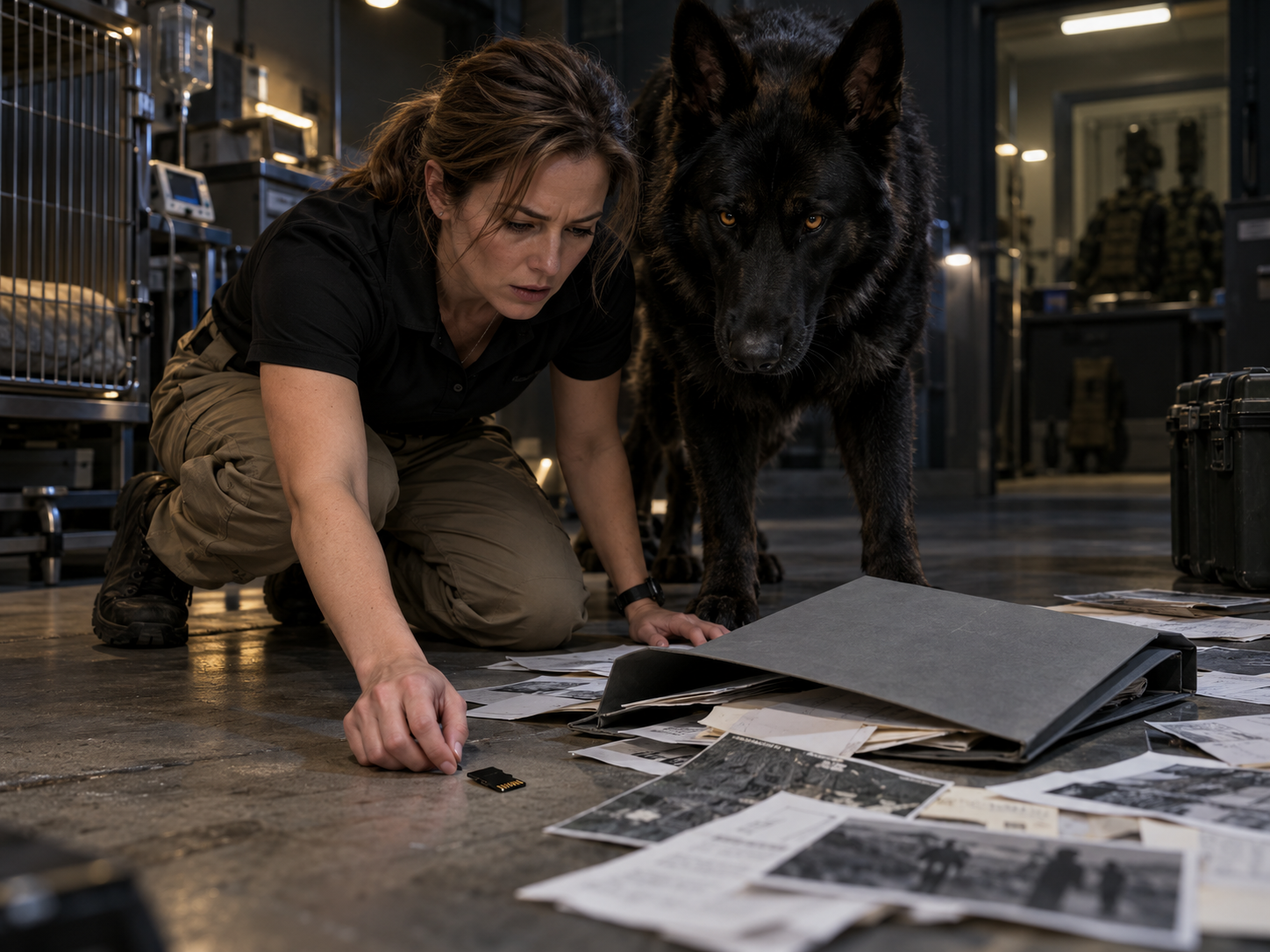
It had been taped inside the folder spine.
My heart began pounding.
Ethan.
I picked it up.
There was no reason for operational media to be hidden inside a physical behavioral file.
Unless someone wanted it missed.
Or someone wanted it found by exactly the right person.
I inserted the card into my encrypted laptop.
One file appeared.
Video.
Duration: 06:42.
The recording began in darkness.
Then movement.
Helmet-camera footage.
Ethan’s breathing.
Titan’s silhouette ahead.
A whisper.
“Easy, buddy.”
The image stabilized.
I heard distant gunfire.
Then Ethan spoke again.
Not to Titan.
To someone through his radio.
“Control, we have a problem.”
Static.
“The package isn’t where intelligence said it would be.”
A voice answered.
Too distorted to identify.
Ethan continued.
“Titan alerted on our support case again.”
My hand tightened around the laptop.
The video shifted.
A black equipment case sat against a wall.
Exactly like the one described in Ethan’s logs.
Titan approached it.
Sniffed.
Then sat.
A trained alert.
Ethan opened the case.
Inside were communications relays.
Batteries.
Medical supplies.
At first nothing unusual.
Then he removed the foam lining.
Beneath it was a compact tracking transmitter.
Military issue.
Active.
Someone on their own side had been broadcasting the team’s position.
Ethan whispered one word.
“Jesus.”
The footage jumped.
Shooting.
Running.
Shouting.
Ethan fell behind a low concrete wall.
Titan remained beside him.
“Control! We were compromised!”
No response.
Then a different voice came over the radio.
“Abandon position.”
Ethan looked directly toward the helmet camera.
“No. Someone tagged our equipment.”
A pause.
Then the same voice said:
“Sergeant Hale, terminate transmission.”
Ethan’s expression changed.
He recognized the voice.
Before he could answer, gunfire erupted behind him.
Not from the enemy compound.
From the extraction side.
The camera spun.
Ethan collapsed.
Titan attacked someone outside the frame.
A man shouted.
Then came one final sentence.
“Get that dog off him!”
The image cut.
I sat absolutely still.
Titan was breathing against my knee.
The mission had not simply gone wrong.
Someone had betrayed the team.
And Titan had seen them.
A noise came from the hallway.
A metallic click.
Titan’s head snapped toward the door.
His lips pulled back.
The lights went out.
Emergency darkness swallowed the room.
Then the electronic door lock released.
I was on my feet immediately.
Titan moved in front of me.
The door opened.
A silhouette entered.
Tall.
Gloved.
Holding something in one hand.
A syringe.
Titan lunged.
The intruder jumped backward and slammed the door.
“Stop!”
I ran after them.
By the time I reached the hallway, emergency lights had activated.
A figure disappeared around the far corner.
Titan strained forward.
“Stay!”
He stopped.
Barely.
Footsteps approached from the opposite direction.
Voss appeared with Briggs behind him.
“What happened?”
“Someone came in here.”
Briggs looked toward the empty corridor.
“Who?”
“I didn’t get a face.”
Voss saw the syringe lying near the wall.
He picked it up carefully.
The label had been removed.
Briggs stared.
“Maybe veterinary—”
“No.”
I held up the laptop.
“Someone knows what I found.”
Voss looked at the screen.
Then at me.
“What did you find?”
I turned the laptop toward him.
“Ethan Hale did not die the way your report says he did.”
For the first time since meeting him, Daniel Voss looked frightened.
Not for himself.
For what came next.
Because if the recording was authentic, then the person responsible for Ethan’s death had not disappeared overseas.
They were here.
At Atlantic Annex.
And Titan knew exactly who they were.
PART 3 — THE MAN TITAN HATED
By midnight, the K9 building was under restricted access.
Rear Admiral Mercer joined us through secure video.
He watched the six-minute recording twice.
Never interrupted.
Never asked us to replay anything.
When it ended, he removed his glasses.
“Who else has seen this?”
“Dr. Bennett, Senior Chief Voss and Briggs,” I said.
Mercer looked at Briggs.
“Petty Officer Briggs, leave the room.”
Briggs stiffened.
“Sir?”
“That was not a request.”
Briggs left.
Mercer waited until the door shut.
Then looked at Voss.
“Senior Chief, from this moment forward, Dr. Bennett has operational authority over anything involving Titan.”
Voss nodded.
“Yes, Admiral.”
“Your facility may be compromised.”
Another nod.
Mercer continued.
“No electronic distribution of the video. No standard reporting channels. Whoever altered Hale’s mission record may still have access to internal systems.”
He looked at me.
“Claire.”
The use of my first name told me how serious things had become.
“Can Titan identify the person who attacked Hale?”
“Possibly.”
“Reliably enough for an investigation?”
“Recognition and legal identification are not the same thing.”
“I know.”
“But his response could give us a direction.”
Mercer leaned back.
“Then find one.”
The connection ended.
Voss remained silent.
I glanced at him.
“You’re thinking something.”
“Hale’s extraction team.”
“How many?”
“Six.”
“Names?”
He crossed the room and opened a secure workstation.
“Commander Nathan Cole. Lieutenant Harris. Chief Petty Officer Ramirez. Specialist Webb. Corpsman Tyler James.”
He paused.
“And Captain Reed.”
“First name?”
“Gavin.”
Something in his voice changed.
“You know him?”
“Everyone here knows Reed.”
I waited.
Voss turned.
“He oversees operational readiness for the annex.”
My stomach tightened.
“Would he have access to Titan’s euthanasia order?”
“Yes.”
“The secondary release panel?”
“Yes.”
“Ethan’s deployment logs?”
“Yes.”
Another silence.
Then Voss shook his head.
“No.”
I understood.
“You don’t believe it.”
“I’ve known Reed for twelve years.”
“That doesn’t make him innocent.”
“It doesn’t make him guilty.”
“Good. Then we test facts, not friendship.”
At 6:30 the next morning, I began what looked like a routine behavioral evaluation.
Titan wore no tactical harness.
No muzzle.
A loose training lead hung from his collar.
We placed him inside the observation room behind one-way reinforced glass.
One by one, personnel passed through the adjacent corridor.
Titan barely reacted.
Lieutenant Harris.
A glance.
Ramirez.
Nothing.
Webb.
A sniff.
Tyler James.
Titan’s ears rose, then relaxed.
Commander Cole entered next.
Titan stood.
Watched.
No aggression.
Then came Captain Gavin Reed.
I knew the moment Titan smelled him.
The dog transformed.
Not wildly.
Not uncontrollably.
That would have been easier.
Instead, he became perfectly still.
His head lowered.
Tail stopped moving.
Every muscle hardened.
A quiet growl rolled through the room.
Reed stopped outside the glass.
He couldn’t see us.
But Titan could see him.
Then Titan backed away.
That frightened me more than a lunge.
“What is that?” Voss whispered.
“Fear.”
He looked at me.
“Titan doesn’t fear anyone.”
“He fears Reed.”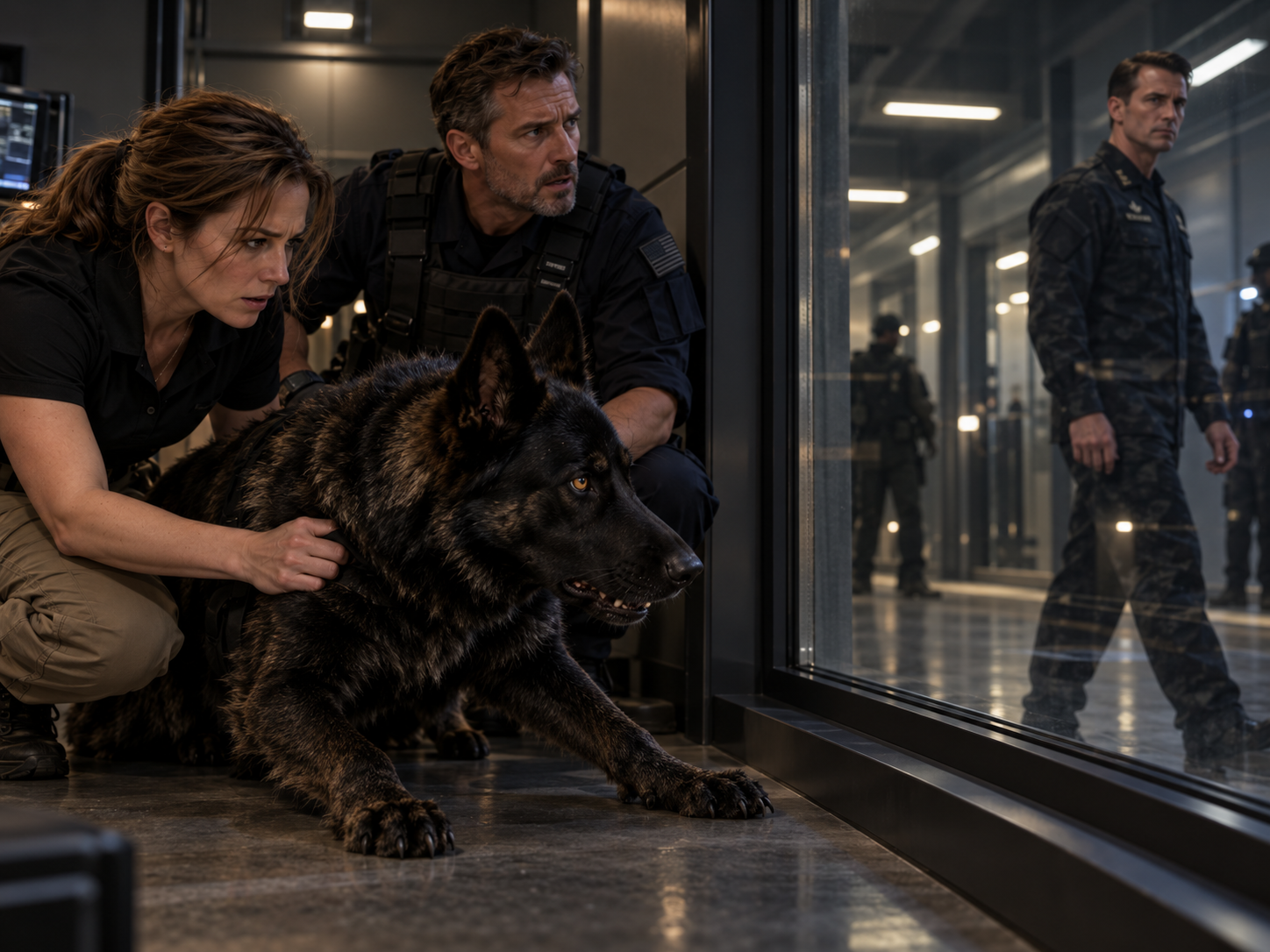
Titan retreated into the corner.
Then did something I had never seen him do.
He lay down.
Placed one paw over his muzzle.
And whined.
I felt cold.
Voss stared through the glass.
“What does that mean?”
“I don’t know.”
But I almost did.
Memory.
Trauma.
A specific association.
Reed walked away.
Titan refused to move for several minutes.
Finally I entered.
He pressed against me immediately.
His pulse was rapid.
“Northstar.”
His breathing slowed.
That afternoon I requested Captain Reed’s administrative records.
Denied.
I requested medical access logs.
Denied.
I requested mission-planning records.
Delayed.
Every path led to the same wall.
Captain Reed.
At 3:10 p.m., he came to see me himself.
He was nothing like I expected.
Mid-forties.
Clean haircut.
Calm gray eyes.
No swagger.
No intimidation.
He entered the veterinary conference room carrying two cups of coffee.
“Dr. Bennett.”
“Captain.”
He placed one cup near me.
“I heard you’ve made extraordinary progress with Titan.”
“I have.”
“That’s good news.”
“Is it?”
His smile remained.
“I would prefer not to destroy an eight-hundred-thousand-dollar working asset.”
Asset.
Not dog.
“You signed the euthanasia recommendation.”
“I signed the medical recommendation placed in front of me.”
“Without independent evaluation.”
“He attacked personnel.”
“So do soldiers under traumatic stress.”
“They generally don’t have ninety-five-pound bodies and teeth capable of crushing bone.”
I didn’t touch the coffee.
Reed sat opposite me.
“You think we failed him.”
“I think someone was in a hurry.”
He studied me.
“To do what?”
“Erase a problem.”
The room seemed smaller.
Reed’s expression did not change.
“You’re a behavioral scientist, Doctor.”
“Yes.”
“Then behave like one.”
I almost smiled.
“Meaning?”
“Don’t turn incomplete evidence into conspiracy.”
“Interesting word.”
He stood.
“You have forty-eight hours to complete Titan’s evaluation.”
“I have authorization from Admiral Mercer.”
“And I have responsibility for safety on this installation.”
He leaned slightly toward me.
“If Titan attacks another person, I will end the evaluation myself.”
Then he walked out.
Titan was waiting in the hall with Voss.
The moment Reed passed, Titan pressed himself against the wall.
Again.
Not attack.
Avoidance.
I watched Reed disappear.
“Daniel.”
“Yeah?”
“I need Ethan’s personal effects.”
Voss looked at me.
“Why?”
“Because Titan’s response isn’t just about Reed.”
“How do you know?”
“He’s expecting something.”
“What?”
I looked at Titan.
“I need to find out.”
Ethan’s belongings remained in a sealed storage locker awaiting release to his family.
Uniforms.
Boots.
Photographs.
Books.
A broken watch.
His handler equipment.
And a small wooden box.
Titan smelled everything.
When I opened the box, he pushed forward immediately.
Inside was a worn leather tug toy.
A whistle.
And a red nylon wristband.
Titan sniffed the band.
Then pawed at the wooden box.
Once.
Twice.
Exactly as he had with the mission folder.
I removed the contents.
Nothing.
Titan pawed again.
I ran my fingers beneath the felt lining.
Loose.
I pulled it free.
A folded piece of waterproof paper was taped beneath.
Voss stared.
“You have got to be kidding.”
I opened it.
Ethan’s handwriting.
Only twelve lines.
Claire—
If this gets back to you, something happened.
Titan keeps alerting on our support equipment.
I reported it.
Reed told me the dog was overstimulated.
He ordered me to stop documenting it.
I didn’t.
Yesterday Titan found a transmitter.
Reed took it.
Said it belonged to intelligence.
I checked.
It didn’t.
If anything happens, trust Titan.
Northstar still works.
You taught us that memory survives pressure.
Maybe loyalty does too.
—Ethan
I read the note twice.
Voss turned away.
He pressed both hands against the storage table.
For several seconds he said nothing.
Then:
“He told Reed.”
“Yes.”
“And Reed told him to stop.”
“Yes.”
Voss shut his eyes.
“My God.”
There was another line on the back.
Almost missed.
Ask about Shepherd Seven.
We searched internal databases.
Nothing.
Then legacy mission archives.
Still nothing.
Finally, an old K9 procurement database produced a match.
Shepherd Seven was not a mission.
It was a dog.
A Belgian Malinois named Argo.
Assigned to an operation six years earlier.
Handler killed overseas.
Dog developed aggression after returning home.
Recommended for euthanasia.
Authorization signed by Captain Gavin Reed.
My skin went cold.
I pulled the full record.
Argo had attacked two handlers after deployment.
Exactly like Titan.
His original handler had also reported unexplained tracking equipment before his death.
Three years later, another dog.
Rex.
Same pattern.
Handler killed.
Dog unstable.
Dog destroyed.
Reed authorization.
This was not about one mission.
It was a system.
Voss whispered,
“How many?”
We kept searching.
By sunrise, we had found four.
Four dogs.
Four dead handlers.
Four behavioral collapses.
Four euthanasia orders.
Every case connected to compromised operations.
Every file touched by Gavin Reed.
Titan would have been number five.
I leaned back.
The truth was no longer difficult to see.
Working dogs had been detecting something human investigators missed.
Unauthorized transmitters.
Tampered equipment.
Changes in scent.
People who should not have been present.
And when their handlers noticed, someone ensured neither handler nor dog remained able to explain.
“We need Mercer.”
Voss reached for the secure line.
Before he could touch it, the fire alarm erupted.
Red lights flashed.
A voice sounded overhead.
“Security incident. Building Three. All personnel evacuate.”
Titan barked once.
Hard.
Voss opened the door.
Smoke already rolled through the hallway.
Not fire.
Canister smoke.
“Claire, move!”
We ran toward the rear exit.
Then gunfire cracked outside.
Not live rounds.
Training blanks.
Chaos.
A deliberate distraction.
Voss stopped.
“TITAN’S KENNEL.”
We turned.
The emergency protocol automatically released fire-safe kennel doors into secondary holding runs.
Someone knew that.
We reached the yard just as Titan’s gate opened.
A man in tactical gear appeared through the smoke.
He threw something.
Titan caught the scent.
Then staggered.
Chemical aerosol.
Sedative.
I ran.
“Titan!”
The dog tried to stay upright.
The masked man dragged him toward a waiting utility vehicle.
Voss tackled him.
They hit the dirt.
The man rolled free.
I saw his face when the mask shifted.
Briggs.
For one terrible second nobody moved.
Voss stared at the man he had worked beside for years.
“You?”
Briggs’s face collapsed.
“I didn’t have a choice.”
“You released Titan at Claire.”
Briggs looked toward me.
“I was told she would sign the order after he attacked.”
“Who told you?”
Briggs said nothing.
Voss grabbed his vest.
“WHO?”
A new voice answered behind us.
“I did.”
Captain Gavin Reed stood beside the open gate.
Two security officers with him.
His weapon was pointed directly at Voss.
“Step away from Briggs.”
And suddenly everything made sense.
Reed smiled faintly.
“You should have let the dog die.”
PART 4 — ETHAN’S LAST COMMAND
Nobody moved.
Smoke drifted across the yard.
Titan lay twenty feet away, conscious but struggling against the sedative.
Captain Reed held his weapon steadily.
The two security officers beside him looked uncomfortable.
Not loyal.
Confused.
That mattered.
I raised my hands slightly.
“Captain, what exactly do you think happens now?”
Reed glanced toward me.
“The same thing that always happens.”
“And what is that?”
“People believe the official report.”
Voss stared at Briggs.
“How long?”
Briggs looked ashamed.
“Two years.”
“Two years doing what?”
“Moving equipment. Changing manifests. Access codes.”
“For Reed?”
Briggs’s face tightened.
“I had debts.”
Voss laughed once.
There was no humor in it.
“Hale died because you had debts?”
“No.”
Briggs’s voice broke.
“No. I never knew people were going to die.”
Reed’s expression hardened.
“Stop talking.”
And there it was.
The shift.
One of the security officers glanced at him.
Reed noticed.
“Officer, restrain Voss.”
Neither moved.
“Captain,” the younger one said carefully, “what exactly are we responding to?”
Reed turned slightly.
That half-second was enough.
Titan moved.
Drugged.
Weak.
Barely able to stand.
But he moved.
Not toward Reed.
Toward me.
He pushed himself between us.
Reed looked down.
Something flashed across his face.
Recognition.
Then hatred.
“That dog.”
Titan growled.
Reed raised the weapon.
“NO!”
I stepped forward.
Voss did too.
The security officers immediately aimed at Reed.
“Captain, lower it!”
Reed froze.
For several long seconds, the yard balanced on the edge of disaster.
Then Titan collapsed.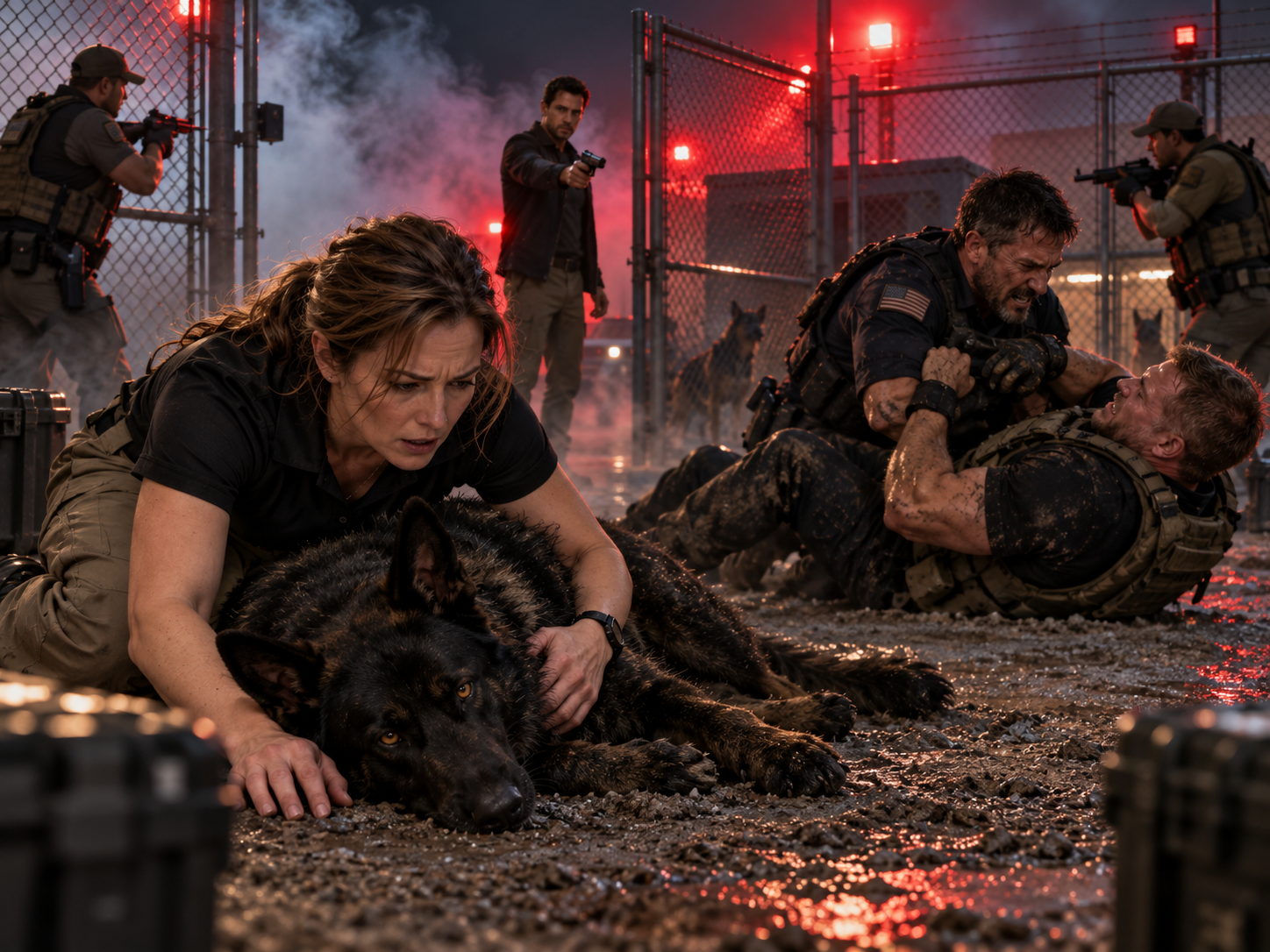
I dropped beside him.
“Titan.”
His eyes remained open.
Pulse fast.
Breathing shallow.
“Get a veterinarian!”
The younger security officer ran.
Reed was disarmed.
Briggs sank to his knees.
And for the first time, Captain Gavin Reed looked less like a powerful officer and more like an ordinary man who had reached the end of his lies.
But the case was not finished.
Not remotely.
Because Reed had spent years protecting himself.
He had contingency plans.
Files disappeared within minutes of his detention.
Servers were remotely wiped.
Two operations databases went offline.
A storage office caught fire.
Someone had prepared.
The video Ethan hid gave us evidence of one compromised operation.
The old K9 files established a pattern.
But to prove the network, investigators needed more.
And Reed knew it.
During preliminary questioning, he denied everything.
The transmitters were intelligence tools.
The altered timelines were classified necessities.
Briggs was acting independently.
Titan was unreliable.
Ethan was confused during combat.
Every answer had just enough plausibility to create doubt.
Forty-eight hours later, Reed’s attorney filed motions challenging seizure of several records.
Briggs refused to speak further without immunity.
Command staff became nervous.
No one wanted to discover how many operations might have been compromised.
I spent those two days beside Titan.
The sedative had not caused permanent harm.
Physically, he recovered quickly.
Emotionally, something had changed.
Once Reed disappeared from the facility, Titan slept.
Really slept.
Not the shallow, alert rest of an animal waiting for danger.
He curled on his side and dreamed.
His paws moved.
Sometimes he made small sounds.
I wondered whether he dreamed about Ethan.
On the third morning, I carried Ethan’s red wristband into the room.
Titan stood immediately.
He sniffed it.
Then looked toward the door.
“I know.”
I sat beside him.
“You want him to come back.”
Titan pressed his head into my chest.
“I’m sorry.”
For years, I had trained professionals to understand the difference between obedience and trust.
I had lectured rooms full of handlers about stress, attachment, trauma and recovery.
Yet sitting there with Titan, none of my professional vocabulary felt sufficient.
Loss was loss.
No matter how scientifically we described it.
A knock interrupted us.
Voss entered.
He no longer tried to dominate Titan.
He waited.
Titan looked at him.
Voss turned sideways.
Relaxed posture.
No eye contact.
After several seconds, Titan allowed him to enter.
Progress.
Voss sat against the opposite wall.
“They may release Reed from military custody pending the formal inquiry.”
I stared at him.
“You’re joking.”
“His lawyer is arguing that Briggs acted alone.”
“The recording—”
“Doesn’t show Reed’s face.”
“Ethan’s note names him.”
“Defense says it’s unverified handwriting and the interpretation lacks context.”
I felt anger building.
“What about the four other handlers?”
“Circumstantial.”
I stood.
“Four dead handlers and four destroyed dogs is not coincidence.”
“I know.”
“Then what are we missing?”
Voss looked at Titan.
“Whatever Ethan found before the transmitter.”
“What?”
“Hale didn’t hide things randomly.”
I thought of the microSD card.
The note.
Shepherd Seven.
Layers.
Each clue pointing toward another.
Ethan expected someone to erase his evidence.
So he distributed it.
Paper.
Video.
Dog.
Memory.
I suddenly looked at Titan.
“His harness.”
Voss frowned.
“What?”
“Where is Ethan’s deployment harness for Titan?”
Storage inventory listed two harnesses.
One had returned from the mission.
The second was missing.
Voss checked the equipment locker.
Nothing.
We searched the retired gear room.
Nothing.
Then Titan led us there himself.
He walked past rows of shelves.
Stopped beside a ventilation grate.
And sat.
Alert.
I stared at him.
“You’ve smelled this before.”
Voss removed the grate.
Behind it was a sealed waterproof pouch.
Inside was Titan’s missing harness.
One strap had been cut open and resewn.
We opened it.
A tiny solid-state recorder fell into my hand.
Six hours of audio.
Ethan had recorded the entire mission.
The crucial conversation occurred forty-three minutes before the attack.
Reed’s voice was unmistakable.
“We need the route left open.”
Ethan:
“You mean exposed.”
Reed:
“I mean follow orders.”
“You put a transmitter in our support case.”
Silence.
Then Reed:
“You saw nothing.”
Ethan:
“Titan found it.”
“He’s a dog.”
“He’s right.”
A longer silence.
Then the sentence that destroyed Gavin Reed’s defense.
“Then make sure neither of you comes back talking about it.”
Voss shut his eyes.
I felt sick.
The remainder was worse.
Ethan contacted another officer and explained his discovery.
He was attempting to abort the mission.
Reed prevented the withdrawal.
The ambush followed.
During the chaos, Ethan repeatedly called for extraction.
None came.
Eventually Reed himself entered the radio channel.
“Leave the handler.”
Someone protested.
Then Reed said:
“That is an order.”
The recording continued.
Ethan breathing.
Titan whining.
Shots in the distance.
Then Ethan’s final minutes.
He knew he was dying.
His voice was weaker.
Titan stayed beside him.
“Hey, buddy.”
The dog in the room with us lifted his head.
The recorded Ethan continued.
“You did good.”
Titan walked toward the speaker.
My vision blurred.
“You hear me?”
Titan touched his nose to the laptop.
“You did good.”
A long pause.
Then Ethan whispered:
“Northstar.”
Titan whimpered.
I covered my mouth.
Ethan’s final command had not been attack.
Not protect.
Not stay.
Northstar.
Return to safety.
Return to the oldest place in Titan’s memory.
Return to me.
Ethan had been dying, and his last act was to give Titan permission to survive.
The recording ended with four words.
“Go home, big man.”
Titan lay beside the speaker.
Head between his paws.
Voss turned his face away.
I sat on the floor beside Titan and cried.
Not quietly.
Not professionally.
I cried for Ethan.
For four handlers before him.
For dogs destroyed because humans mistook trauma for guilt.
For years of loyalty repaid with paperwork and needles.
Titan crawled into my lap as much as a ninety-five-pound German Shepherd could.
And we stayed that way until neither of us had anything left.
The recorder changed everything.
Gavin Reed was transferred into formal military investigative custody.
Briggs accepted a cooperation agreement.
He described a network built around unauthorized information sales, compromised routes, manipulated equipment shipments and falsified readiness data.
Reed had not been acting alone.
Two contractors were arrested.
A logistics officer was suspended.
Several cases reopened.
Families were notified that the deaths of their sons and daughters were being reinvestigated.
Nothing could restore what had been taken.
But the lies had finally stopped controlling the story.
For Titan, however, another decision remained.
A review board assembled one week later.
Seven people.
Veterinary officers.
Operational commanders.
Behavioral specialists.
Legal counsel.
They watched Titan through reinforced glass.
One colonel spoke first.
“Even with the circumstances understood, he remains unsuitable for operational deployment.”
“I agree,” I said.
Several faces turned.
They expected me to fight.
I didn’t.
Titan had nothing left to prove.
The colonel continued.
“Returning him to duty would present unnecessary risk.”
“I agree with that too.”
“Then what are you proposing?”
I looked through the glass.
Titan sat quietly.
Waiting.
“Retirement.”
A veterinarian shook his head.
“He has an extensive bite history.”
“During a documented traumatic period while being repeatedly exposed to a person associated with his handler’s death.”
“He still requires specialized management.”
“I know.”
“Few civilian homes qualify.”
“I know one.”
The colonel leaned forward.
“Whose?”
I smiled.
“Mine.”
Silence.
Then Voss, sitting at the far end of the table, raised his hand.
Every head turned.
He cleared his throat.
“For whatever it’s worth, I support Dr. Bennett.”
I looked at him.
He continued.
“I thought Titan had become dangerous.”
His eyes met mine.
“I was wrong.”
That probably cost him more pride than anything else he had done.
“And I treated his grief like insubordination.”
He looked toward Titan.
“I was wrong about that too.”
The colonel glanced through the medical file.
“And if Dr. Bennett cannot continue his care?”
Voss answered before I could.
“Then I will.”
Titan looked through the glass toward him.
And for the first time, his tail moved.
Once.
Only once.
But everyone saw it.
The vote was unanimous.
Titan would live.
PART 5 — GO HOME, BIG MAN
Three months later, Titan discovered squirrels.
This was apparently more shocking to him than gunfire, helicopters, explosives or military bureaucracy.
The first squirrel appeared on the oak tree behind my farmhouse at 6:12 one Saturday morning.
Titan froze on the porch.
One paw lifted.
His entire body became rigid.
I stood in the doorway holding coffee.
“Don’t.”
The squirrel descended two feet.
Titan’s ears moved forward.
“Titan.”
Another foot.
“Absolutely not.”
The squirrel flicked its tail.
Titan launched.
Not toward an enemy.
Not toward danger.
Toward the greatest threat currently facing rural Virginia.
A twelve-ounce rodent.
“Titan!”
He reached the tree.
The squirrel escaped.
Titan stared upward in complete disbelief.
I laughed harder than I had in months.
He turned and looked at me.
Offended.
Then trotted back toward the porch.
His muzzle was gray around the edges now.
I had not noticed how much until the sunlight caught it.
Seven years of operational work had left marks no medical report could fully measure.
But he was healing.
Not perfectly.
Healing rarely looks perfect.
He still disliked enclosed transport crates.
Thunderstorms made him patrol the house.
Men wearing a certain type of tactical cologne could trigger immediate tension.
When helicopters passed low, he searched the sky until the sound disappeared.
But he also slept upside down on my living-room rug.
Stole socks.
Learned exactly which cabinet contained treats.
And developed the deeply manipulative habit of resting his enormous head on my knee whenever I ate chicken.
Titan was learning to be a dog.
Just a dog.
It might have been the hardest assignment of his life.
Daniel Voss visited every Thursday.
The first few times Titan tolerated him.
Then accepted him.
Eventually trusted him.
Their relationship grew slowly.
Correctly.
No forcing.
No dominance games.
Voss would sit on the porch.
Titan would decide whether to approach.
One afternoon, six weeks after retirement, Titan brought him the old leather tug toy from Ethan’s box.
Voss stared at it.
Then at me.
“Is he asking me to play?”
“I think so.”
“I haven’t earned that.”
“Maybe he thinks you have.”
Voss took the toy.
Titan gripped the other end.
For several seconds, neither moved.
Then Voss pulled gently.
Titan pulled back.
Voss smiled.
It was the first genuine smile I had seen from him.
“Strong old bastard.”
Titan pulled harder and nearly dragged him from the chair.
I laughed.
“Careful. He still has ninety-five pounds of opinion.”
Life should have become quiet after that.
For a while, it did.
Then came the letter.
The envelope carried the seal of the Department of Defense.
Inside was a notice.
Staff Sergeant Ethan Hale was to be posthumously awarded for actions taken during his final deployment.
His mother had requested Titan attend the ceremony.
I read the sentence twice.
Titan was asleep beside my desk.
I looked at him.
For months, I had avoided exposing him to anything resembling his former operational environment.
Uniforms.
Ceremonies.
Crowds.
Too many potential triggers.
Yet Ethan’s mother had specifically asked.
I called her.
Margaret Hale answered on the second ring.
Her voice was gentler than I expected.
“Dr. Bennett?”
“Yes.”
“I’ve wanted to thank you.”
“You don’t owe me thanks.”
“Yes, I do.”
Silence.
Then:
“You brought his partner home.”
I looked at Titan.
“He brought himself home.”
She laughed softly through tears.
“That sounds like Ethan.”
We spoke for almost an hour.
She told me stories I had never heard.
Ethan as a child bringing injured birds into the kitchen.
Ethan hiding a stray puppy in his bedroom.
Ethan at thirteen insisting he could train the neighbor’s impossible Labrador.
Then Margaret asked:
“Did he suffer?”
The question every grieving parent asks.
The question no one wants to answer incorrectly.
I closed my eyes.
“He knew Titan was beside him.”
A quiet breath came through the phone.
“And his last thoughts were about getting Titan somewhere safe.”
Margaret began crying.
So did I.
A week later, I made the decision.
Titan would attend.
The ceremony took place at a quiet military memorial courtyard, smaller than I expected.
No huge public crowd.
No cameras inside the main area.
Ethan’s family.
Members of his former team.
Senior leadership.
Several handlers.
Voss.
Me.
Titan wore a simple black leather collar.
No tactical equipment.
No medals.
No vest.
I wanted him there as Ethan’s friend, not as military property.
When we approached the courtyard, Titan slowed.
His body tightened.
I stopped.
“Northstar.”
His ears moved.
I crouched.
“You don’t have to do this.”
He looked toward the entrance.
Then stepped forward.
Inside, photographs of Ethan stood near the podium.
One showed him kneeling beside Titan in Afghanistan.
Another showed Titan as a young dog biting Ethan’s oversized training sleeve while Ethan laughed.
A third stopped me.
Ethan and me.
Eight years earlier.
Titan between us.
One ear standing.
The other bent sideways.
I had forgotten the photograph existed.
Titan walked toward it.
He sniffed the frame.
Then sat.
Margaret Hale approached slowly.
Titan watched her.
She carried Ethan’s scent faintly.
Perhaps in ways I could not detect.
Laundry detergent.
House.
Genetics.
Memory.
She crouched several feet away.
“Hi, Titan.”
His ears moved.
“I’m Ethan’s mom.”
Titan stared at her.
Margaret’s hands trembled.
“He talked about you more than he talked about people.”
A few people laughed softly.
Titan took one step.
Then another.
Margaret did not reach.
She waited.
Titan leaned forward.
Sniffed her sleeve.
Then placed his head against her chest.
Margaret broke.
She wrapped her arms around him.
“Oh, sweetheart.”
The courtyard became silent.
“You waited for him.”
Titan closed his eyes.
“So did I.”
I turned away because watching felt almost too private.
Voss stood beside me.
His eyes were red.
He didn’t bother pretending otherwise.
When the ceremony began, Titan lay beside Margaret’s chair.
The citation described Ethan’s courage.
His refusal to abandon team members.
His attempts to expose compromised intelligence.
His final actions protecting operational personnel despite catastrophic injury.
Then came a sentence that made my breath stop.
“Staff Sergeant Hale’s actions also ensured the survival of his military working dog, Titan, whose retained evidence became instrumental in exposing the network responsible for the compromise of multiple operations.”
Margaret accepted Ethan’s medal.
She held it against her chest.
Then looked down at Titan.
When the ceremony ended, she walked toward me carrying a small envelope.
“This was in Ethan’s personal files at home.”
“What is it?”
“Something he wrote before his last deployment.”
She handed it to me.
My name was on the front.
Claire.
I opened it carefully.
The letter was short.
Claire,
If you’re reading this, either I forgot to mail it or something happened.
You were right about Titan.
Not the training part. I’ll never admit that in writing.
You were right that trust matters more than obedience.
He’s saved me more times than the reports will ever show.
But here’s the deal.
If anything ever happens to me and Titan makes it home, don’t let them turn his grief into evidence against him.
He’ll wait for me.
He’ll probably wait too long.
Tell him he did enough.
Then make him retire.
Preferably somewhere with grass, terrible squirrels and someone who will spoil him more than I did.
And Claire—
Thank you for giving me my best friend.
—Ethan
For several seconds, I could not breathe.
Then I laughed.
A wet, broken laugh.
Voss looked concerned.
“What?”
I handed him the letter.
He read it.
Then stared at Titan.
“Terrible squirrels?”
I wiped my face.
“You have no idea.”
Six months after Reed’s arrest, military prosecutors announced charges connected to compromised operations, falsification of records, conspiracy, obstruction and actions that contributed to multiple deaths.
I did not attend every hearing.
I didn’t need to.
Reed had already taken enough time from Titan.
Briggs testified.
Several other people cooperated.
Old cases reopened.
Two families received corrected records explaining that their loved ones had raised concerns before they died.
Three retired handlers contacted me after the story moved quietly through the working-dog community.
They described dogs labeled unstable after losing partners.
Dogs pushed too quickly.
Dogs corrected harder when what they needed was time.
We began building something from that.
A small program at first.
Then larger.
The Hale-Titan Initiative.
Its mission was simple:
No working dog would be condemned solely because grief looked like aggression.
Dogs returning from traumatic handler loss would receive decompression periods, independent behavioral review and trauma-informed rehabilitation before disposition decisions.
Senior Chief Voss became one of the first operational instructors.
People found that amusing.
Especially me.
During his opening lecture to the first group of handlers, he stood in front of thirty experienced military personnel and said:
“I used to believe leadership meant forcing compliance.”
Then he pointed toward Titan, who was sleeping beside my chair.
“That dog taught me sometimes leadership means shutting up long enough to understand why someone stopped listening.”
I almost fell out of my chair.
Afterward I said:
“Daniel Voss discussing emotional intelligence. Should I contact a physician?”
He gave me a look.
“Don’t ruin the moment.”
Titan opened one eye.
I swear he looked amused.
A year passed.
Then another.
Titan slowed.
The black fur around his muzzle turned silver.
His hips became stiff on cold mornings.
He stopped chasing squirrels all the way to the oak tree.
Eventually he would simply stand on the porch and bark once, as though delegating the pursuit to younger animals.
But every night he made the same patrol.
Kitchen.
Hallway.
Front door.
My bedroom.
Only after checking everything would he lie down.
Always facing the door.
Some habits were too deeply written to disappear.
On the third anniversary of Ethan’s death, Margaret visited.
We sat beneath the oak tree.
Titan lay between us.
She brought Ethan’s medal.
Not because Titan understood medals.
Because she did.
She placed it gently beside his paw.
“He should have gotten one too.”
I smiled.
“He got retirement.”
Titan lifted his head at the word.
Margaret laughed.
“Which one of us spoiled him this badly?”
“Ethan started it.”
“You finished it.”
We stayed until sunset.
Later that evening, after Margaret left, Titan and I walked toward the far edge of the property.
It had become our routine.
Slow now.
No leash.
He no longer needed one.
The field stretched gold beneath the fading light.
Titan stopped near the fence.
His ears lifted.
For a second, his posture changed.
Young again.
Alert.
Listening.
I followed his gaze.
Nothing there.
Only grass moving in the wind.
Maybe he heard a deer.
Maybe a bird.
Maybe nothing.
Or maybe some part of him still expected footsteps he remembered better than any voice.
I stood beside him.
“You know he’s not coming back.”
Titan looked at me.
I scratched behind his ear.
“But you kept your promise.”
His tail moved.
“You stayed.”
Another slow wag.
“You survived.”
He leaned against my leg.
And I finally understood something Ethan had understood before all of us.
Loyalty was not refusing to move on.
Loyalty was carrying love forward after the person who gave it to you was gone.
For months, Titan had believed surviving meant abandoning Ethan.
He had guarded the memory so fiercely that everyone mistook his pain for danger.
But Ethan’s final command had never asked him to keep waiting.
It had asked him to live.
Northstar.
Come back.
Find safety.
Go home.
I crouched beside him in the grass.
Titan rested his silver muzzle against my shoulder.
“Good boy.”
His eyes closed.
“You did enough.”
The wind moved softly through the field.
Far behind us, the porch light came on automatically.
Warm.
Steady.
Waiting.
I stood.
Titan looked toward the house.
Then toward me.
For once, he didn’t scan the tree line.
Didn’t search the horizon.
Didn’t wait for a man who could no longer return.
He simply turned toward the light.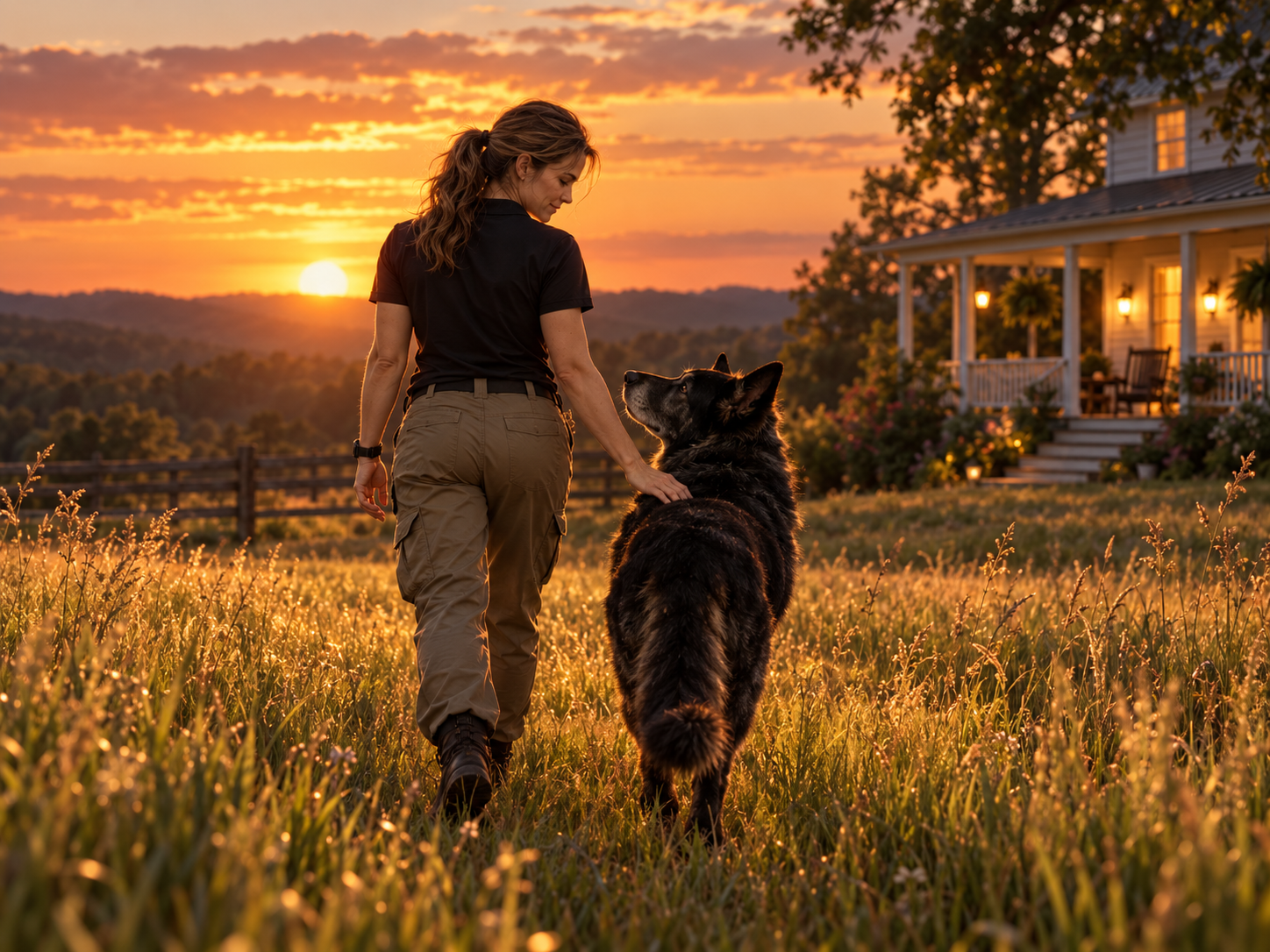
I walked beside him.
Halfway across the field, he slowed.
I slowed with him.
No commands.
No corrections.
No hurry.
Just two old friends making their way home.
And as we reached the porch, I opened the door and repeated the last words Ethan Hale had ever given his partner.
This time they were not a goodbye.
They were a promise finally fulfilled.
“Go home, big man.”
Titan walked inside.
And I followed.
THE END