My Navy Brother Mocked My Two-Star Admiral Uniform in Front of His Crew—Then a One-Star Admiral Saw His Hand on My Shoulder
PART 1 — THE HAND THAT SHOULD NEVER HAVE TOUCHED MY UNIFORM
For thirty years, my father celebrated my younger brother’s military career while treating every promotion I earned as though it meant nothing.
Brandon was the family’s pride.
I was Sandra, the daughter who supposedly worked somewhere around important officers.
Even when I earned two stars on my shoulders, Dad dismissed my achievement with a sarcastic remark.
But the morning I arrived at San Diego Naval Base for an official inspection of my brother’s ship, Brandon made a mistake that no amount of family favoritism could protect him from.
He laughed at my uniform.
Accused me of wearing a costume.
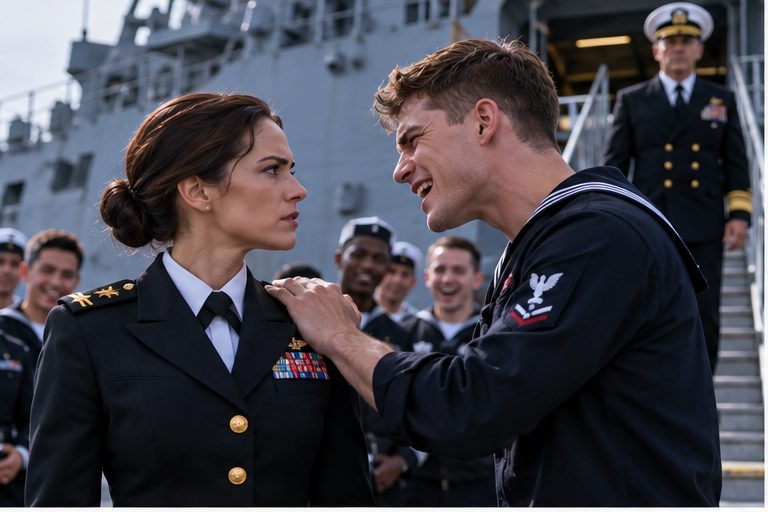
Then grabbed my shoulder in front of several sailors and ordered me to leave.
“Take your hand off me, Petty Officer,” I warned.
He only laughed harder.
“Or what? You’re going to report me to the PTA?”
Then the hatch above us opened.
A one-star admiral appeared on the gangway.
He looked at my uniform.
Then at Brandon’s hand gripping my sleeve.
And the expression on his face changed instantly.
The pier at San Diego Naval Base was cold and damp that morning.
Saltwater hung in the air, mixed with diesel exhaust and the bitter smell of burned coffee.
Beside the gangway, the enormous gray hull of the USS Sterett rose above the water.
Chains rattled somewhere overhead.
Metal fixtures creaked in the morning breeze.
I’d spent enough years in uniform to be familiar with places like this.
I’d stood on decks in far worse weather.
I’d endured difficult assignments, exhausting inspections, and rooms filled with people who would rather challenge my authority than accept it.
But none of those experiences had drained me quite as thoroughly as dealing with my own family.
Especially my father and younger brother.
Brandon enlisted in the Navy immediately after high school.
From the moment he put on his first uniform, my father treated him like a decorated war hero.
Dad was retired Army Sergeant Major Owens.
He’d spent much of his life talking about discipline, honor, and military tradition.
And whenever anyone in the neighborhood was willing to listen, he proudly announced that Brandon was carrying on the family’s legacy.
My brother’s smallest accomplishments became stories worth repeating.
My achievements received considerably less attention.
When I graduated with honors, Dad nodded and said:
“That’s nice.”
When I received my first command, he asked whether the job came with an office.
And when he saw a photograph of me wearing two stars on my shoulders, he gave a dismissive laugh.
“I guess they give out titles differently these days.”
I still remembered the way he’d said it.
As though years of service, responsibility, and sacrifice could be dismissed with one careless sentence.
Eventually, I stopped trying to convince him.
I stopped explaining every promotion.
Stopped expecting him to understand what my assignments required.
And stopped believing that another achievement would finally make him proud.
At family dinners, Brandon could spend an hour describing his experiences, and Dad would listen as though every word belonged in a military history book.
If I mentioned my own responsibilities, the conversation quickly moved elsewhere.
Dad introduced Brandon as “my Navy man.”
But when it came to me, his description was almost insulting.
“This is Sandra. She works around officers.”
That was how he chose to describe his daughter.
Even after I’d earned the rank displayed on my shoulders.
For years, my family had made the same excuse whenever Brandon belittled me.
“He’s sensitive about your career.”
Sensitive.
Apparently, that meant he could mock my medals, dismiss my accomplishments, and turn my service into a family joke.
And I was expected to tolerate it.
I learned something from those years.
Sometimes arguing accomplishes nothing.
Sometimes the best response is to let people believe what they want.
Until their own assumptions put them in a situation they can’t talk their way out of.
At exactly 0810 that morning, my inspection orders were already registered in the system.
My name appeared on the visitor manifest.
The watch desk had received my scheduled arrival information.
My staff documentation and safety checklist had been submitted.
Everything necessary for the inspection was in place.
This wasn’t a casual visit.
I hadn’t come to surprise Brandon at work for entertainment.
I was there to carry out an official responsibility.
The inspection was authorized, documented, and properly scheduled.
The relevant personnel had access to the information.
There was only one problem.
Brandon had apparently never bothered to check.
I was approaching the gangway when his voice rang out behind me.
“Well, look who’s here!”
I recognized that tone immediately.
It was the same mocking voice he’d used since we were children.
Then he called louder:
“You’ve got some nerve showing up dressed like that, Sandra!”
I stopped.
He continued.
“Did Mom let you borrow her ironing board to put those fake creases in your sleeves?”
Several sailors laughed.
I didn’t turn around immediately.
I already knew he had an audience.
And Brandon had always enjoyed having one.
My younger brother had a particular talent for making cruelty sound like a joke.
He’d say something insulting.
Wait for other people to laugh.
Then act offended if anyone challenged him.
It left everyone nearby with an uncomfortable choice.
Laugh along.
Remain silent.
Or risk becoming his next target.
That morning, several sailors chose to laugh.
I could hear them behind me.
I stopped at the base of the gangway.
Before I could speak, Brandon approached.
Then his hand landed on my shoulder.
It wasn’t a friendly tap.
He gripped me firmly.
His fingers closed around my sleeve, directly over the gold braid.
Then he turned me toward him.
The movement was sharp enough that my heels struck against the concrete.
I looked at his hand.
Then at his face.
He was smiling.
Of course he was.
“The guys think this is hilarious, Sis,” Brandon said.
He glanced toward the sailors.
“They think you’re pulling some kind of Halloween prank.”
Another laugh came from behind him.
He leaned closer.
“What are you actually doing here?”
I didn’t answer.
He continued.
“Looking for a husband? Or are you playing dress-up because you want people to think you’re somebody important?”
Someone gave a low whistle.
A young sailor holding a clipboard stared down at his paperwork.
I noticed the way he avoided looking at us.
I understood why.
Brandon was making a spectacle of the situation, and nobody wanted to become involved.
I kept my voice controlled.
“Remove your hand, Petty Officer.”
Brandon blinked.
For a moment, I thought he might finally understand the seriousness of what he was doing.
Then his grin widened.
“Or what?”
He laughed.
“You’re going to report me to the PTA?”
He pushed my shoulder backward.
Not far.
Just enough to make sure the sailors watching could see it.
His fingers tightened around the sleeve I’d carefully pressed earlier that morning.
At 5:30, I’d stood in my hotel room preparing for the inspection.
My uniform was immaculate.
Every detail was arranged properly.
My phone had been lying facedown nearby.
Three missed calls from Dad appeared on the screen.
I hadn’t returned them.
I already knew what he would say.
Go easy on your brother.
Don’t embarrass Brandon.
You know he’s sensitive about your career.
I’d heard those warnings for years.
My father never seemed interested in whether Brandon embarrassed me.
That possibility apparently didn’t deserve consideration.
I was always expected to be the reasonable one.
The patient one.
The daughter who understood that her brother needed encouragement.
Even if encouraging him meant pretending my own career mattered less.
Brandon was still holding my sleeve.
I could feel the fabric bunching beneath his fingers.
Around us, the sailors had grown quieter.
He leaned toward me.
“Go back to your office, Sandra.”
His tone sharpened.
“Before you cause trouble for both of us.”
I looked directly at him.
I could have told him that my inspection orders were already on file.
I could have reminded him that the uniform he was mocking represented a rank considerably above his own.
But none of that would have changed the expression on his face.
He wasn’t listening.
He was performing.
Just as he’d always performed at family gatherings when Dad was there to laugh at his jokes.
Except this wasn’t our parents’ dining room.
This was a naval installation.
We were standing beside an active warship.
And the people watching weren’t relatives who could dismiss his behavior as harmless sibling teasing.
They were sailors.
Military personnel.
Witnesses to everything he was doing.
Brandon seemed to have forgotten that distinction.
Then a sudden metallic sound came from above us.
The hatch opened.
Metal scraped against metal.
I looked toward the gangway.
A one-star admiral stepped into the morning light.
Another sailor followed immediately behind him.
But the admiral stopped so abruptly that the sailor nearly collided with his back.
For a moment, nobody moved.
The admiral looked directly at me.
His eyes traveled across my uniform.
Then his attention shifted.
To Brandon’s hand.
My brother was still gripping my sleeve.
The admiral studied the scene.
Then glanced toward the sailors gathered along the pier.
They had been watching.
Some had laughed.
Others had lowered their eyes.
But now everyone seemed aware that the situation had changed.
The admiral’s expression hardened.
Brandon still wore half a smile.
He hadn’t yet understood what was happening.
Throughout his life, he’d been able to rely on confidence.
A quick joke.
A dismissive remark.
A room full of people willing to laugh along.
Whenever I was involved, he assumed he could humiliate me without consequences.
Our father had taught him to expect exactly that.
But the man standing at the top of the gangway wasn’t our father.
And the scene unfolding before him wasn’t a harmless family disagreement.
The admiral began walking down toward us.
His eyes remained fixed on Brandon’s fingers.
One step.
Then another.
His expression didn’t soften.
The sailors nearby stood noticeably straighter.
Brandon finally seemed to register the change in atmosphere.
His smile weakened.
But his hand was still on my shoulder.
I remained motionless.
There was no reason to pull away.
No reason to raise my voice.
My orders were already recorded.
My identity was documented.
And the inspection I had come to conduct was a legitimate part of my duties.
Brandon had decided to treat it like a joke.
He’d mocked my uniform, questioned my presence, and physically turned me around in front of his shipmates.
Now a senior officer had witnessed the result.
The admiral came another step closer.
I watched my brother’s face.
For the first time that morning, he looked uncertain.
Then Brandon finally lifted his eyes toward the officer approaching us.
And I could see the first hint of realization in his expression.
For thirty years, he’d believed that making me look small would always make him appear important.
But on that pier, beside the USS Sterett, the rules of our childhood no longer applied.
And the one-star admiral walking toward us had seen exactly whose uniform Brandon was holding.
PART 2 — THE ADMIRAL WHO DIDN’T LAUGH
“Petty Officer.”
The single word cut through the morning air.
Rear Admiral Thomas Whitaker stood six feet away, his expression so controlled that it was almost frightening.
I’d known Whitaker for eleven years.
We’d served together during a difficult deployment in the Pacific, back when he’d been a captain and I’d been responsible for coordinating operations across several ships. He was a careful man, respected for his fairness and notorious for remembering details others overlooked.
He wasn’t easily impressed.
And he almost never raised his voice.
“Petty Officer,” he repeated. “Remove your hand from the admiral.”
Brandon’s fingers loosened.
But they didn’t immediately release my sleeve.
“The admiral?” he repeated.
Whitaker didn’t blink.
“Yes.”
Brandon looked at me.
Then back at Whitaker.
For one astonishing second, he appeared ready to argue.
“Sir, there’s been a misunderstanding. This is my sister.”
“I didn’t ask who she was.”
“Sir, she’s just—”
“Finish that sentence carefully.”
The silence that followed was absolute.
Even the gulls seemed distant.
Brandon finally removed his hand.
I smoothed my sleeve.
A faint wrinkle remained where he’d gripped it.
Whitaker stepped forward, came to attention, and saluted.
“Vice Admiral Owens. Welcome aboard. I apologize for the reception.”
I returned his salute.
“Good morning, Admiral Whitaker.”
Behind Brandon, someone inhaled sharply.
The young sailor with the clipboard raised his head.
Another sailor whispered something I couldn’t distinguish.
Brandon looked as though the pier had shifted beneath his feet.
Whitaker turned toward the assembled personnel.
“Attention on deck.”
The sailors straightened.
Brandon’s heels snapped together a fraction too late.
I could see the realization moving through his expression.
Confusion.
Disbelief.
Fear.
And finally, the terrible understanding that the woman he’d just shoved was not pretending to be an admiral.
She was one.
“Sir,” Brandon began, his voice suddenly unsteady, “I didn’t realize—”
Whitaker interrupted.
“You didn’t realize what?”
“That she was here officially.”
Whitaker’s jaw tightened.
“Would her being here unofficially have made your conduct acceptable?”
Brandon opened his mouth.
Nothing came out.
“Would you have put your hands on a civilian visitor in the same manner?”
“No, sir.”
“Would you have mocked an unfamiliar senior officer?”
“No, sir.”
“Then explain why you believed you could do either to Vice Admiral Owens.”
Brandon stared straight ahead.
I knew that expression.
He was searching for an answer that would make someone else responsible.
He’d done it since childhood.
When he broke a window, I’d distracted him.
When he failed a class, the teacher disliked him.
When he crashed Dad’s truck, the road had been slippery.
And whenever his explanation failed, our father supplied another.
But Whitaker wasn’t interested in excuses.
“Petty Officer Owens, answer the question.”
Brandon swallowed.
“She’s my sister, sir.”
Whitaker stared at him.
Then he said something I’d remember for the rest of my life.
“That makes your behavior worse. Not better.”
For the first time, I saw my brother’s confidence collapse completely.
Whitaker turned toward the lieutenant standing behind him.
“Lieutenant Chen, notify the commanding officer that we have an incident requiring documentation. Have the command master chief report to the quarterdeck. Preserve any relevant security footage and identify the witnesses.”
“Aye, sir.”
Brandon’s face drained of color.
“Sir, is that really necessary?”
Whitaker looked at him.
“Did you just question an order?”
“No, sir.”
“Then remain where you are.”
I stepped forward.
“Admiral Whitaker.”
He turned immediately.
“Yes, ma’am?”
“I’d like the inspection to proceed as scheduled. The incident should be handled through the appropriate command process, independently of my inspection findings.”
Whitaker studied me for a moment.
He understood what I was saying.
I wasn’t going to use my position to punish my brother personally.
But I wasn’t going to protect him from accountability either.
“Understood, ma’am.”
Brandon looked toward me.
For a moment, something like hope crossed his face.
“Sandra—”
“Vice Admiral Owens,” Whitaker corrected.
I raised a hand slightly.
“Admiral Whitaker, that’s sufficient.”
Then I looked at my brother.
“Petty Officer Owens, you will cooperate with your chain of command. You will give an accurate account of what happened. And you will not contact any of the witnesses about their statements.”
His eyes widened.
“You’re really going to let them investigate me?”
I held his gaze.
“You made that decision when you put your hands on me.”
He looked away.
I walked toward the gangway.
The sailors stepped aside.
No one laughed.
At the top, the ship’s commanding officer, Commander Elena Ramirez, waited beside the quarterdeck watch.
Her expression was professional, but I could see the tension in her eyes.
“Vice Admiral Owens, welcome aboard Sterett.”
“Thank you, Commander.”
She glanced briefly toward the pier.
“I apologize for what occurred.”
“Commander, we’ll address that through proper channels. Right now, I want to understand the condition of your ship.”
“Yes, ma’am.”
I stepped aboard.
The familiar smell of steel, cleaning solution, and machinery surrounded me.
And with it came a feeling I hadn’t expected.
Relief.
Not because Brandon had been humiliated.
Not because someone had finally recognized my rank in front of him.
But because, for once, I hadn’t been required to pretend that his behavior was harmless.
Unfortunately, the morning was far from over.
The inspection had been requested after a series of maintenance discrepancies raised concerns about the ship’s readiness reporting.
Most were routine.
A few were not.
Three weeks earlier, a maintenance review had identified inconsistent documentation involving an emergency power transfer test.
The discrepancy had been corrected on paper.
But a follow-up report suggested that the underlying problem might not have been resolved.
I was there to determine whether the ship’s records matched its actual condition.
As Commander Ramirez led us toward the wardroom, she handed me a briefing folder.
“Ma’am, we’ve prepared the documentation you requested.”
I opened it while walking.
The first pages contained familiar material.
Maintenance schedules.
Personnel readiness summaries.
Equipment inspection results.
Then I reached the section concerning the emergency electrical system.
A signature caught my attention.
B. Owens.
I stopped.
“Commander, who supervised this maintenance verification?”
Ramirez glanced at the page.
“Petty Officer First Class Brandon Owens, ma’am.”
I looked at the signature again.
My brother.
Of course.
“What was his responsibility?”
“He was assigned to coordinate the maintenance documentation and confirm completion with the appropriate technicians.”
“And the discrepancy?”
“Reported corrected, ma’am.”
“Has the correction been independently verified?”
There was a pause.
“Not to the extent we’d like.”
I closed the folder.
“Then that’s where we’ll begin.”
Ramirez nodded.
But I noticed the way her expression changed.
She was worried.
Not about my brother’s behavior on the pier.
About something else.
We reached the wardroom, where several officers waited around a long table.
Maps and technical diagrams covered the display screen.
I greeted the team and took my seat.
The briefing began normally.
For twenty minutes, everything appeared orderly.
Then Lieutenant Chen placed a separate document beside my folder.
A discrepancy report.
Unsigned.
Submitted anonymously through a protected reporting channel.
I read the first paragraph.
Then the second.
By the third, my stomach tightened.
The report alleged that a maintenance record had been marked complete despite an unresolved fault.
It also alleged that a junior sailor had been pressured to stop raising questions about the discrepancy.
At the bottom was a sentence written in plain, almost desperate language.
If this equipment fails during an emergency, someone could get hurt. I tried to report it the right way.
I looked up.
“Commander Ramirez, when did you receive this?”
“Yesterday afternoon, ma’am.”
“Who has reviewed it?”
“The executive officer and I. We initiated a preliminary assessment and notified the appropriate maintenance authorities.”
“Good. Preserve the original submission and its access records.”
“Yes, ma’am.”
I glanced at the signature on the maintenance sheet.
B. Owens.
The coincidence was impossible to ignore.
But coincidence wasn’t proof.
I had spent too many years making difficult decisions to confuse suspicion with evidence.
Still, something troubled me.
My brother had spent the morning demonstrating how easily he dismissed people he considered beneath him.
Now I was looking at an allegation that someone under his supervision had been pressured into silence.
I turned to Commander Ramirez.
“I want to speak with the technicians involved in this maintenance action. Separately. No supervisors present.”
“Yes, ma’am.”
“And Commander?”
“Yes?”
“Make sure everyone understands that truthful reporting is expected. No one is to be punished for raising a legitimate safety concern.”
Ramirez nodded firmly.
“Understood.”
My phone vibrated inside my briefcase.
I ignored it.
Then it vibrated again.
And again.
During a short break, I glanced at the screen.
Seven missed calls.
All from Dad.
One message appeared beneath them.
Brandon says you’re trying to destroy his career. Call me immediately.
I stared at the words.
It had taken less than an hour.
My brother had already called home.
And somehow, even now, my father believed I was the problem.
I turned the phone facedown.
Then Lieutenant Chen entered the room.
“Ma’am, the junior sailor who submitted the maintenance concern has agreed to speak with the review team.”
“Good.”
Chen hesitated.
“There’s something else.”
“What is it?”
“He says Petty Officer Owens warned him that reporting the issue would end his career.”
For a moment, I didn’t move.
The humiliation on the pier had been personal.
This was different.
This involved the safety of sailors entrusted to their leaders.
I stood.
“Arrange the interview.”
Chen nodded.
Then he added quietly, “Ma’am, the sailor is frightened.”
I looked through the wardroom window toward the gray water beyond the ship.
I thought about the young man holding the clipboard that morning.
The way he’d stared at the ground.
The way everyone had laughed because remaining silent was easier than becoming Brandon’s next target.
“Then let’s make sure he understands,” I said, “that telling the truth is not something he should fear.”
And for the first time that day, I began to wonder whether my brother’s behavior on the pier was only the smallest part of a much larger problem.
PART 3 — THE LIE THAT ALMOST COST A SAILOR HIS FUTURE
The sailor’s name was Daniel Mercer.
He was twenty-three years old, from a small town outside Boise, Idaho, and had been aboard Sterett for less than two years.
When he entered the interview room, he stood so rigidly that I could see his hands trembling.
He was tall, with sandy hair and tired blue eyes.
He looked like someone who hadn’t slept properly in days.
“Seaman Mercer,” I said, “please sit.”
“Yes, ma’am.”
He lowered himself into the chair.
Commander Ramirez had assigned an independent officer to document the interview. I remained present as the senior inspection official, but I made clear that the maintenance investigation would be handled through the appropriate technical and command authorities.
Mercer looked from one officer to another.
“Am I in trouble?”
“No,” I said. “You’re here because you raised a safety concern. We want to understand what you observed.”
He nodded, but his shoulders remained tense.
I opened the report.
“Tell us about the emergency power transfer test.”
Mercer took a breath.
“During the scheduled verification, the system didn’t respond the way it was supposed to.”
“What happened?”
“There was a delay during the transfer sequence. We stopped the test and reported it to the work center.”
“Was the issue corrected?”
“Not while I was there, ma’am.”
I made a note.
“Then why does the maintenance record show the test completed satisfactorily?”
Mercer looked at his hands.
“I don’t know.”
The independent officer leaned forward.
“Seaman, we’re asking what you personally know. Don’t speculate.”
Mercer nodded.
Then he said, “Petty Officer Owens told me the problem was already being handled. He said I needed to stop asking questions.”
I kept my expression neutral.
“What exactly did he say?”
Mercer hesitated.
“He said people who make their supervisors look bad don’t get good evaluations.”
The room became very quiet.
“And what did you do?”
“I went back to the equipment space. I checked the fault log. The same issue was still there.”
“Did you report that?”
“Yes, ma’am.”
“To whom?”
“To my work center supervisor.”
“And what happened?”
Mercer’s voice lowered.
“Petty Officer Owens called me into the office.”
I waited.
“He said I was embarrassing the division. He told me the Navy needed people who solved problems, not people who complained about them.”
Mercer swallowed.
“Then he said if I kept pushing, he’d make sure I never got recommended for advancement.”
I watched the young sailor struggle to keep his composure.
He reminded me of someone I’d known many years earlier.
A junior lieutenant who had been told she was too aggressive when she asked questions.
Too emotional when she objected.
Too ambitious when she worked harder than the men around her.
That lieutenant had been me.
“Seaman Mercer,” I said, “did you change any records?”
“No, ma’am.”
“Did you personally witness anyone change them?”
He shook his head.
“No, ma’am. But I saw the completed entry later.”
“Then that’s what we’ll document. What you observed, not what anyone assumes.”
He looked surprised.
“You believe me?”
“I believe your concern deserves a proper investigation.”
His eyes reddened.
For a moment, he seemed embarrassed by his own reaction.
Then he said something that stayed with me.
“My dad told me the Navy would teach me what honor means.”
He paused.
“I just didn’t think doing the right thing would make me feel this alone.”
I leaned forward.
“Honor isn’t always rewarded immediately, Seaman. Sometimes it costs you something before anyone recognizes it.”
He looked at me.
“But you still do the right thing.”
“Yes, ma’am.”
“Because the people who depend on that equipment deserve the truth.”
He nodded.
After the interview, I requested a technical verification of the reported fault.
The ship’s engineering personnel coordinated with the appropriate maintenance specialists.
The testing was conducted under controlled conditions.
And the results were troubling.
The emergency transfer system did not perform consistently.
The discrepancy was real.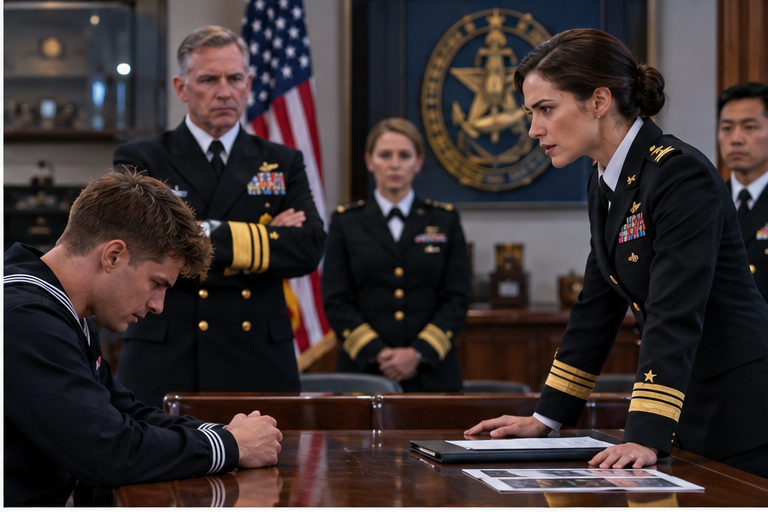
More importantly, the maintenance documentation did not accurately reflect the equipment’s verified condition.
That finding triggered an immediate operational review.
Commander Ramirez acted quickly.
The affected equipment was placed under appropriate restrictions pending corrective maintenance and further verification.
Additional records were secured.
Personnel involved in the earlier testing were interviewed.
And the ship’s command began determining how an unresolved problem had been reported as corrected.
By late afternoon, it became clear that the documentation discrepancy was not simply a clerical mistake.
Someone had certified completion without the required supporting verification.
But who had done it, and why, remained unresolved.
I was reviewing the preliminary findings when Whitaker entered the wardroom.
He closed the door behind him.
“Admiral, do you have a moment?”
“Of course.”
He sat across from me.
For a while, neither of us spoke.
Then he said, “This has become complicated.”
I gave a tired smile.
“That’s one way of putting it.”
“The command has referred the personnel allegations for formal review. Your brother’s role will be examined.”
“I expected that.”
Whitaker studied me.
“You know you can step back from the portions involving him.”
“I intend to. I’ll continue overseeing the authorized readiness inspection, but I won’t participate in determining Brandon’s individual responsibility.”
He nodded.
“That’s the right decision.”
I looked down at the report.
“Tom, I’ve spent thirty years separating my personal feelings from my professional responsibilities.”
“I know.”
“But today, for the first time, I’m struggling.”
He waited.
“I wanted my brother to be better than this.”
Whitaker’s expression softened.
“Maybe he still can be.”
I looked up.
“After what he did?”
“People can change, Sandra. But not while everyone around them keeps protecting them from the consequences of their choices.”
I thought of Dad.
Of every excuse.
Every family dinner.
Every time I’d been told to be patient.
“You sound like my mother,” I said.
Whitaker smiled faintly.
“Then she must be a wise woman.”
“She was.”
The word slipped out before I could stop it.
Whitaker’s smile faded.
“I’m sorry. I forgot.”
“It’s all right.”
My mother had died six years earlier.
Cancer.
By the time we discovered it, the disease had already spread.
During her final months, I took leave whenever I could and traveled home to sit beside her.
Dad spent most of those visits talking about Brandon’s latest assignment.
Mom listened patiently.
But whenever Dad left the room, she’d reach for my hand.
One evening, two weeks before she died, she gave me a small wooden box.
Inside was a silver compass.
It had belonged to my grandfather.
“He wanted you to have this,” she whispered.
I frowned.
“Grandpa gave that to Dad.”
She shook her head.
“Your grandfather gave it to me. He said I’d know when you needed it.”
I opened the compass.
The needle moved, then settled.
On the inside of the lid, someone had engraved four words.
Hold your own course.
Mom watched me read them.
Then she said, “Your father has never known how to handle a daughter who doesn’t need his permission to become extraordinary.”
I remember crying.
Not because she called me extraordinary.
But because she’d finally named something I’d spent my whole life trying to understand.
“Why doesn’t he see me?” I asked.
She squeezed my hand.
“Because sometimes people look at their children and see their own fears instead.”
I carried that compass in my briefcase on important assignments.
It was there that morning.
Just a few feet away.
Whitaker rose from his chair.
“Go get some rest, Sandra.”
I shook my head.
“I still have work.”
“You’ve been working since before sunrise.”
“So have you.”
He gave me a look.
“That’s why I’m qualified to recognize a bad decision.”
Despite everything, I laughed.
He smiled.
Then his expression became serious.
“One more thing. Your father contacted the base public affairs office.”
I stared at him.
“He did what?”
“He apparently demanded to know why his son was being persecuted by a senior officer.”
I closed my eyes.
Of course he had.
Whitaker continued.
“The office directed him to the appropriate channels. No information was released.”
“Thank you.”
“I’m telling you because I suspect this won’t remain a private family matter.”
He was right.
At 6:42 that evening, my phone began receiving messages from relatives I hadn’t spoken to in years.
An aunt in Ohio.
A cousin in Florida.
My father’s older brother.
All asking variations of the same question.
Why are you trying to ruin Brandon?
Then my cousin Melissa sent me a screenshot.
Dad had posted on Facebook.
The post contained a photograph of Brandon in uniform and a long paragraph describing him as a dedicated sailor being unfairly targeted after a family misunderstanding.
It didn’t mention the physical confrontation.
It didn’t mention the inspection.
It certainly didn’t mention the maintenance concerns.
Instead, Dad wrote that a powerful relative had allowed personal jealousy to interfere with his son’s career.
I stared at the screen.
Personal jealousy.
I was a vice admiral in the United States Navy.
My brother was a petty officer under review for his conduct.
And somehow, according to our father, I was jealous of him.
I almost laughed.
But then I read the comments.
People were angry.
Some accused me of abusing my rank.
Others called me vindictive.
Several demanded that the Navy investigate me.
Dad had turned a situation he barely understood into a public accusation.
And he had used the one thing he knew would hurt me.
My reputation.
I called him.
He answered on the second ring.
“Well,” he said coldly, “you finally found time for your family.”
“Dad, take down the post.”
“Why? Afraid people will find out what you’re doing?”
“You don’t know what’s happening.”
“I know my son called me in tears.”
I gripped the phone.
“Did he tell you he physically grabbed a senior officer in front of witnesses?”
“He grabbed his sister.”
“That doesn’t make it acceptable.”
“You’ve always been dramatic.”
I stared out the hotel window.
The harbor lights shimmered against the dark water.
“Dad, this is not about childhood arguments.”
“No. It’s about you using your fancy title to humiliate your brother.”
I felt something inside me go still.
For years, his words had hurt.
Now they simply sounded familiar.
“Did you ask Brandon what he said to me?”
“He was joking.”
“Did you ask whether he knew I was there on official orders?”
“He said you showed up trying to make him look bad.”
“Did you ask why he thought putting his hands on someone was appropriate?”
Silence.
Then Dad said, “You’re his older sister. You should have handled it privately.”
I closed my eyes.
There it was.
The same rule.
Always.
No matter what Brandon did, I was responsible for protecting him from the consequences.
“Dad,” I said quietly, “there are other issues being reviewed. I can’t discuss them with you.”
“Other issues?”
“Yes.”
“What have you accused him of now?”
“I haven’t accused him of anything. The command is examining documented concerns.”
He scoffed.
“Brandon would never do anything dishonorable.”
I thought of Daniel Mercer.
Of his shaking hands.
Of the equipment that hadn’t performed correctly.
“You don’t know that,” I said.
My father’s voice hardened.
“I know my son.”
I took a slow breath.
“You have two children, Dad.”
He said nothing.
“You’ve always had two.”
Then I ended the call.
I stood by the window for a long time.
When I finally turned away, another message appeared.
This one was from an unfamiliar number.
Admiral Owens, my name is Chief Petty Officer Nathan Brooks. I need to speak with someone outside my immediate chain of command about the maintenance records. I have information that may change everything.
I read it twice.
Then I called the number.
A man answered immediately.
“Admiral?”
“Chief Brooks?”
“Yes, ma’am.”
“Tell me what you know.”
He hesitated.
Then he said, “Ma’am, I don’t think your brother was the only person involved.”
And suddenly, the story became much bigger than Brandon.
PART 4 — THE TRUTH MY FATHER NEVER WANTED TO HEAR
Chief Nathan Brooks had served in the Navy for nineteen years.
He was a quiet, deliberate man with a reputation for technical competence and an almost stubborn commitment to procedure.
We met the following morning in a secure conference room.
He arrived carrying a folder.
Not a thick folder.
Just a few pages.
But the expression on his face told me those pages mattered.
“Chief,” I said, “before we begin, I need you to understand that any allegation you raise must be reviewed through the proper channels. I can’t promise a particular outcome.”
“Yes, ma’am.”
“And because my brother may be involved, I won’t make personnel determinations concerning him.”
“I understand.”
He sat down.
Then he opened the folder.
“Ma’am, the maintenance discrepancy started six weeks ago.”
I looked at the first document.
A work order.
Then another.
And another.
Brooks pointed to a series of entries.
“The equipment fault was reported during routine testing. The technicians recommended additional troubleshooting.”
“What happened?”
“The work center was under pressure to close several overdue maintenance actions before a readiness review.”
“Pressure from whom?”
Brooks hesitated.
“Senior personnel within the department.”
I waited.
He continued.
“Petty Officer Owens was responsible for coordinating the paperwork. He was told the discrepancy needed to be resolved before the report went forward.”
“Did he perform the technical verification?”
“No, ma’am.”
“Was he authorized to certify it independently?”
“No.”
I looked at the records.
“Then why was his signature attached to the completion package?”
Brooks exhaled.
“That’s what I tried to ask.”
He showed me an email.
The message instructed the work center to finalize documentation before the reporting deadline.
The language was vague.
But the urgency was unmistakable.
A second email was more troubling.
It referenced the unresolved fault and suggested that the paperwork should reflect the expected corrected condition while additional checks were being arranged.
I read the sentence twice.
“Who sent this?”
“Lieutenant Commander Patrick Sloan, ma’am. The department head at the time.”
I looked up.
“Where is he now?”
“Temporarily assigned ashore for a separate training requirement.”
The room was silent.
Brooks continued.
“I’m not saying Petty Officer Owens was innocent. He knew the test hadn’t been properly completed.”
“Then why didn’t he refuse?”
“I don’t know, ma’am.”
He paused.
“But I know he was afraid of disappointing the people above him.”
Something about those words struck me.
Afraid of disappointing.
I’d spent my childhood afraid of disappointing our father.
Brandon had spent his trying desperately to impress him.
Different responses.
Same source.
But understanding why someone behaved badly didn’t erase the harm they caused.
I looked at Brooks.
“Why didn’t you come forward earlier?”
He lowered his eyes.
“I did raise the issue within the department. I was told it was being handled. When the record was closed anyway, I should have escalated sooner.”
He swallowed.
“That’s on me.”
I respected that answer.
It wasn’t easy to admit a failure when others had made larger ones.
“Chief, make sure these documents go directly to the independent review team. Preserve the originals and provide a complete account of how you obtained them.”
“Yes, ma’am.”
“And don’t discuss the substance with anyone who doesn’t have an official need to know.”
“Understood.”
He gathered his papers.
Then paused.
“Ma’am, there’s one thing I think you should know about your brother.”
I waited.
“He’s not always the man you saw on the pier.”
I said nothing.
Brooks continued.
“He’s helped junior sailors through family emergencies. He’s stayed late to train people. I’ve seen him take responsibility when others wouldn’t.”
“Then why did he threaten Mercer?”
Brooks looked down.
“I think he got scared.”
“Fear doesn’t excuse intimidation.”
“No, ma’am. It doesn’t.”
He stood.
“I just thought you should know there’s more to him than that moment.”
After he left, I remained seated.
For the first time since arriving in San Diego, I wondered whether I’d spent so many years seeing Brandon through the lens of our family history that I’d forgotten he could be more complicated than the person who tormented me.
Then I remembered his hand on my shoulder.
His laughter.
The young sailor staring at his clipboard.
And I reminded myself of something important.
A person could have good qualities and still be responsible for serious wrongdoing.
Both things could be true.
By the end of the week, the independent review had established a clearer sequence of events.
The maintenance fault had been identified.
Additional testing had been recommended.
Pressure to close the discrepancy had come from above Brandon.
But Brandon had still participated in forwarding documentation he knew was incomplete.
And when Daniel Mercer questioned the records, Brandon had attempted to silence him.
He hadn’t created the entire problem.
But he’d helped conceal it.
That distinction mattered.
It didn’t absolve him.
It made the truth more precise.
The command took appropriate administrative and disciplinary steps while the broader review continued.
Brandon was temporarily removed from duties involving maintenance certification and supervisory responsibility.
His advancement prospects were placed in jeopardy.
He faced formal accountability for his treatment of Mercer and for his role in the inaccurate documentation.
The separate confrontation on the pier was also documented and addressed.
I was not part of the decisions concerning his punishment.
I received only the information necessary for my inspection responsibilities and later learned the remainder from Brandon himself.
But Dad didn’t know any of that.
And he was getting angrier.
On Friday afternoon, he arrived in San Diego.
Unannounced.
I discovered this when the hotel front desk called my room.
“Admiral Owens, there’s a gentleman downstairs insisting he’s your father.”
I closed the report I was reading.
“Did he give his name?”
“Richard Owens.”
I sighed.
“Yes. He’s my father.”
“He says it’s urgent.”
Of course he did.
I went downstairs.
Dad stood near the lobby windows wearing a faded Army veterans’ jacket.
At seventy-four, he was still broad-shouldered, with closely cropped gray hair and the posture of a man who had spent decades expecting people to stand straighter when he entered a room.
He turned when he saw me.
His expression hardened immediately.
“So there you are.”
“Hello, Dad.”
“Don’t ‘hello, Dad’ me.”
Several guests glanced over.
I kept my voice low.
“Let’s sit somewhere private.”
“I didn’t come here to sit.”
“Then why did you come?”
He stepped closer.
“I came to stop you from destroying your brother.”
I looked at him.
For a moment, I saw the man who’d taught me to polish my shoes before my first military ceremony.
The man who’d shown me how to fold the American flag.
The man who’d told me, when I was nine years old, that honor mattered more than popularity.
I wondered when he’d stopped applying those lessons to his own family.
“Dad,” I said, “Brandon’s command is handling his conduct. I don’t control the outcome.”
He scoffed.
“You expect me to believe that?”
“It’s the truth.”
“You’re a two-star admiral. Don’t tell me you can’t make a phone call.”
I stared at him.
“You want me to interfere in an official process?”
“I want you to protect your family.”
“By abusing my authority?”
“By remembering where you came from.”
Something in his tone made me stop.
“Where I came from?”
He folded his arms.
“You’ve forgotten what this family stands for.”
I felt thirty years of disappointment gather behind my ribs.
“No, Dad. I remember exactly what you taught me.”
“Then act like it.”
I took a breath.
“You taught me that rank carries responsibility. That integrity matters when nobody’s watching. That you never ask someone beneath you to do something you wouldn’t do yourself.”
He looked away.
“You’re twisting my words.”
“No. I’m repeating them.”
He shook his head.
“Brandon made a mistake.”
“Yes.”
“He doesn’t deserve to lose everything over it.”
“Then he needs to accept responsibility and work to repair what he can.”
Dad’s voice rose.
“He’s your brother!”
“And Daniel Mercer is someone’s son.”
Dad stopped.
I continued.
“He’s a young sailor who was afraid to report a safety problem because Brandon threatened his future. What would you say if that were your grandson?”
Dad’s jaw tightened.
“Brandon says the kid exaggerated.”
“The review will determine the facts.”
“You’re taking a stranger’s side over your own blood.”
“No, Dad. I’m taking the side of a fair process.”
He stared at me.
Then his expression changed.
Not to understanding.
To something colder.
“You’ve always resented him.”
I felt the words land.
“You think this is about jealousy?”
“You couldn’t stand that I was proud of him.”
I looked at my father.
Really looked at him.
The man who had celebrated every ribbon Brandon earned.
Who’d missed my promotion ceremony because Brandon had a weekend training event.
Who’d once told a room full of relatives that women in the military had it easier now.
Who’d never asked what it cost me to reach the position I held.
“Dad,” I said quietly, “I never wanted you to be less proud of Brandon.”
He said nothing.
“I wanted you to be proud of me too.”
For a moment, his expression flickered.
I thought he might finally hear me.
Then he looked away.
“You’ve done fine for yourself.”
I almost smiled.
Fine.
Thirty years of service.
Commands at sea.
Years away from home.
Friends buried.
Decisions that kept me awake at night.
And the highest compliment my father could manage was that I’d done fine.
I reached into my briefcase.
My fingers touched the small wooden box.
I hadn’t planned to show him.
But something told me the moment had come.
I placed the box on the table between us.
Dad frowned.
“What’s that?”
“Mom gave it to me before she died.”
I opened it.
The silver compass caught the afternoon light.
Dad went still.
“Where did you get that?”
“From Mom.”
He stared at it.
“That was your grandfather’s.”
“I know.”
“He gave it to me.”
“No, Dad. He gave it to Mom. He asked her to pass it on to me.”
Dad looked up sharply.
“What?”
I opened the compass.
The engraving was visible.
Hold your own course.
Dad read it.
His face changed.
I watched the color slowly leave his cheeks.
“He told Mom he wanted me to have it,” I said.
Dad didn’t answer.
“Do you know why?”
He shook his head.
I swallowed.
“Because he knew I was going to spend my life trying to earn something you were never willing to give me.”
Dad looked at me.
For once, he had no immediate response.
I closed the compass.
“Mom saw it, Dad. Grandpa saw it. Everyone saw it except you.”
His mouth tightened.
“You don’t understand what it was like raising you.”
I stared at him.
“Then tell me.”
He looked toward the windows.
For a long time, he said nothing.
Finally, he spoke.
“When you were little, you were good at everything.”
I blinked.
“That bothered you?”
“No.”
He rubbed his forehead.
“Your mother was always saying how smart you were. Teachers called. Coaches called. You never needed much help.”
I waited.
“Brandon was different.”
His voice softened.
“He struggled. He was always trying to catch up.”
“So you encouraged him.”
“Yes.”
“And somewhere along the way, encouraging him became diminishing me.”
Dad’s eyes filled.
He looked startled by his own emotion.
“I didn’t think you needed me the same way.”
I felt a sharp ache in my chest.
“Dad, I was your daughter.”
He looked down.
“I know.”
“No,” I whispered. “I don’t think you did.”
For the first time in my adult life, my father seemed old.
Not physically.
Emotionally.
As though the certainty he’d carried for decades had finally become too heavy.
But understanding wasn’t the same as change.
And I wasn’t ready to pretend everything was repaired.
I stood.
“I have to return to work.”
Dad looked up.
“What about Brandon?”
“He’ll have to face what he’s done.”
“And us?”
I hesitated.
“I don’t know yet.”
Then I picked up the compass.
And walked away.
That evening, Brandon called me.
It was the first time he’d contacted me directly since the incident on the pier.
I stared at his name for several seconds before answering.
“Hello, Brandon.”
His voice sounded different.
Smaller.
“Sandra.”
I waited.
He took a breath.
“I need to tell you something.”
“What?”
A long silence.
Then he said, “I knew the maintenance paperwork wasn’t right.”
I closed my eyes.
“I understand that’s under review.”
“I kept telling myself it wasn’t a big deal. That someone else would fix it. That I was just following instructions.”
He swallowed.
“Then Mercer started asking questions.”
“And you threatened him.”
“Yes.”
The word came out barely above a whisper.
I looked at the compass on my desk.
“Why?”
Brandon didn’t answer immediately.
Then he said something I hadn’t expected.
“Because I was terrified.”
“Of what?”
“Of failing.”
I remained silent.
He continued.
“Dad’s always telling everyone I’m the one carrying on the family tradition. Every time I go home, he’s got another story about me. Half of them aren’t even that impressive.”
His voice cracked.
“And I started believing I had to be the guy in those stories.”
I felt my throat tighten.
“That doesn’t excuse what you did.”
“I know.”
“Mercer could have been hurt. Other sailors could have been hurt.”
“I know.”
“And you humiliated me in front of your crew.”
He exhaled shakily.
“I know that too.”
For several seconds, neither of us spoke.
Then Brandon said, “I saw your uniform that morning, and I knew.”
I frowned.
“What?”
“I knew it was real.”
My fingers tightened around the phone.
“You knew?”
“I recognized the stars. I recognized the insignia.”
I stared at the wall.
“Then why did you call it a costume?”
His answer came slowly.
“Because everyone was watching.”
The words made something inside me ache.
“I’d spent years telling those guys my sister was basically a desk officer. That you exaggerated your job. That Dad said you were just good at getting promoted.”
He paused.
“And then you showed up wearing two stars.”
I couldn’t speak.
“I panicked,” he whispered. “I thought if I made everyone laugh, maybe nobody would ask why I’d been lying.”
I sat down.
For thirty years, I’d assumed Brandon simply didn’t understand what I’d accomplished.
But he’d understood enough.
He’d just preferred the version of me that made him feel superior.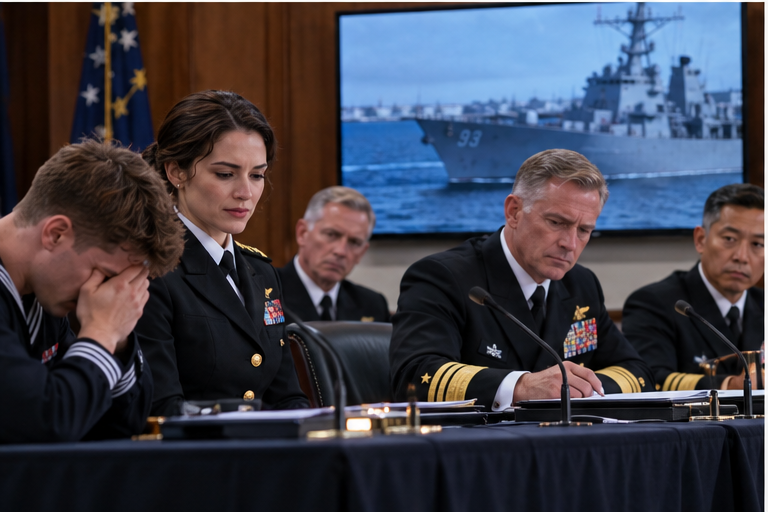
“Brandon,” I said, “you weren’t protecting your reputation.”
“I know.”
“You were protecting a lie.”
He began crying.
Quietly at first.
Then harder.
I’d never heard my brother cry like that.
Not when he broke his arm at twelve.
Not when his first marriage ended.
Not even at Mom’s funeral.
“I don’t know how to fix this,” he said.
I stared at the darkness beyond my hotel window.
“Start by telling the truth.”
“I already gave a full statement.”
“Then accept whatever comes next.”
He breathed unevenly.
“And Mercer?”
“You owe him an apology. Whether he chooses to accept it is his decision.”
“I know.”
I waited.
Then he said, “Sandra?”
“Yes?”
“I’m sorry.”
I closed my eyes.
For most of my life, I’d imagined hearing those words.
I’d thought they’d bring relief.
Vindication.
Maybe even happiness.
Instead, I felt grief.
For the brother I could have had.
For the years we’d wasted.
For all the ordinary family moments we’d turned into competitions neither of us needed.
“I hear you,” I said.
He waited.
I knew what he wanted.
Forgiveness.
Immediate and complete.
The kind our father had always given him.
But that wasn’t something I could honestly offer yet.
“I need time, Brandon.”
He was silent.
Then he said, “Okay.”
And for the first time I could remember, he accepted an answer he didn’t like without arguing.
Before hanging up, he added one final sentence.
“I think Dad’s been wrong about you our whole lives.”
I looked down at the compass.
“Maybe,” I said. “But now you have to decide what kind of man you’re going to be without him telling you.”
After the call, I sat alone for a long time.
I thought the worst was behind us.
I was wrong.
Because the following Monday, the independent review team uncovered evidence that Lieutenant Commander Sloan had directed multiple inaccurate maintenance closures.
And Brandon’s written statement was about to become the evidence that exposed him.
PART 5 — THE TWO STARS THAT FINALLY MEANT SOMETHING
The next six weeks changed my family in ways thirty years of arguments never had.
The review expanded beyond the original maintenance discrepancy.
Investigators examined additional records, interviewed personnel, and compared documented completion dates with available technical evidence.
Several entries required correction.
Some discrepancies were administrative.
Others raised serious concerns about the integrity of the reporting process.
Lieutenant Commander Sloan’s role came under formal scrutiny.
The evidence showed that he had repeatedly pressured subordinates to present maintenance work as complete before all required verification had been performed.
He maintained that he had been trying to meet operational deadlines.
But operational pressure did not eliminate the obligation to report equipment conditions accurately.
The command referred his conduct for appropriate action.
Brandon’s statement became an important part of establishing what had happened.
He admitted that he had known the documentation was incomplete.
He acknowledged that he’d passed it forward anyway.
He also admitted threatening Daniel Mercer after Mercer raised concerns.
It was the first time in my brother’s life that I could remember him telling the truth when a lie might have protected him.
And it cost him.
He received formal disciplinary and administrative consequences.
He was removed from his supervisory responsibilities and reassigned to duties under closer oversight.
His advancement was delayed.
He was required to complete remedial training and demonstrate that he could be trusted with greater responsibility again.
The exact consequences were determined by his command, not by me.
But I knew they were serious.
For a man who had built his identity around being admired, losing the confidence of his superiors was devastating.
Yet something unexpected happened.
Brandon didn’t quit.
He didn’t blame Mercer.
He didn’t blame me.
And when Dad tried to convince him to fight every finding, Brandon refused.
I learned about that conversation several days later.
Dad called me on a Sunday afternoon.
His voice was subdued.
“Your brother told me to stop.”
I was sitting at my kitchen table, reviewing plans for an upcoming assignment.
“Stop what?”
“Trying to defend him.”
I set down my pen.
“What did he say?”
Dad cleared his throat.
“He said I was making it harder for him to become the kind of sailor he should have been.”
I stared at the phone.
“He said that?”
“Yes.”
A long silence followed.
Then Dad added, “He told me you were right.”
I didn’t answer.
“He said he’d spent his whole life trying to impress me, and somewhere along the way, he’d forgotten why he joined the Navy.”
I looked out the window.
The afternoon sunlight lay across my backyard.
For years, I’d wondered what it would take for Brandon to stop performing for our father.
Apparently, it had taken losing the audience he valued most.
Dad sighed.
“I don’t know how to talk to him anymore.”
“Try listening.”
He was quiet.
Then he said, “I suppose I haven’t done much of that.”
I almost laughed.
But there was no bitterness left in the moment.
Only exhaustion.
“Dad, why did you really come to San Diego?”
He hesitated.
“I was afraid.”
“Of what?”
“That Brandon would lose his career.”
“And?”
Another pause.
“That people would think I’d raised a dishonorable son.”
There it was.
The fear beneath the anger.
My father had spent his life believing that his children’s achievements reflected his worth.
Brandon’s successes were proof he’d been a good father.
My successes were more complicated.
Because I had achieved them without the encouragement he’d given my brother.
Perhaps that was why he’d minimized them.
If he acknowledged how far I’d come, he’d have to acknowledge how little he’d helped.
“Dad,” I said, “Brandon’s choices belong to Brandon.”
“I know.”
“And mine belong to me.”
He exhaled.
“I know that too.”
I waited.
Then he said something I’d never heard from him before.
“I was unfair to you.”
Four words.
Simple.
Almost painfully inadequate.
But they were real.
I closed my eyes.
“Yes, Dad. You were.”
His voice trembled.
“I don’t know how to make up for thirty years.”
“You can’t do it with one conversation.”
“I know.”
“You can’t do it by telling everyone you’re proud of me now, either.”
He was silent.
“You have to treat me differently. Even when nobody’s watching.”
Dad swallowed.
“I’d like to try.”
I looked at the compass resting beside my coffee cup.
For years, I’d imagined my father apologizing.
I’d pictured some dramatic moment when he would finally recognize everything I’d accomplished.
But the reality was quieter.
An old man on the telephone.
A daughter who no longer needed his approval.
And the possibility that they might still have time to know each other.
“I’d like that,” I said.
It wasn’t forgiveness.
Not yet.
But it was a beginning.
Three months later, I received an invitation to attend a small recognition ceremony at Naval Base San Diego.
The event honored sailors and civilian personnel who had contributed to improving maintenance reporting and safety procedures.
Daniel Mercer was among them.
His original report had helped identify a serious problem before it resulted in an emergency.
He’d also participated in the follow-up technical work that verified the repairs.
When I saw his name on the program, I smiled.
I hadn’t spoken with him since the inspection.
But I remembered his question.
You believe me?
I hoped he understood now that his willingness to speak had mattered.
I attended the ceremony in my official capacity.
The auditorium was modest.
Rows of chairs faced a small stage decorated with American and Navy flags.
Families filled the back of the room.
A few children whispered excitedly.
Someone dropped a program.
The ordinary sounds of a military ceremony.
I took my seat beside Rear Admiral Whitaker.
He leaned toward me.
“It’s good to see you back.”
“It’s good to be here.”
He smiled.
“Your brother’s making progress, I hear.”
I glanced at him.
“From what Brandon tells me, he’s learning.”
Whitaker nodded.
“Sometimes that’s the most important thing.”
The ceremony began.
Several sailors received recognition for technical improvements and professional excellence.
Then Daniel Mercer’s name was called.
He walked onto the stage wearing his dress uniform.
His posture was straight.
His expression serious.
But I noticed something different about him.
He no longer looked frightened.
When the commanding officer presented his recognition, Mercer accepted it with a firm handshake.
The audience applauded.
I stood with the others.
And I clapped until my hands hurt.
Afterward, Mercer approached me near the reception area.
“Admiral Owens?”
I turned.
“Seaman Mercer.”
He smiled.
“It’s Petty Officer Third Class Mercer now, ma’am.”
I looked at his insignia.
“Well, congratulations.”
“Thank you.”
He hesitated.
Then he said, “I wanted to thank you.”
“For what?”
“For listening.”
I shook my head.
“You did the difficult part.”
He smiled faintly.
“I wasn’t sure anyone would take me seriously.”
“People should have taken you seriously from the beginning.”
He nodded.
Then he glanced toward the crowd.
“Petty Officer Owens apologized to me.”
I looked at him.
“Did he?”
“Yes, ma’am.”
“What did you say?”
Mercer considered the question.
“I told him I appreciated it. But I also told him it would take time before I trusted him again.”
I smiled.
“That sounds reasonable.”
“He said he understood.”
I looked across the room.
Brandon stood near a table speaking with another sailor.
He wasn’t wearing a decoration.
He wasn’t telling a dramatic story.
He was listening.
And for some reason, that ordinary sight moved me more than any of the ceremonies Dad had celebrated over the years.
Mercer followed my gaze.
“He’s been different lately,” he said.
“How so?”
“He asks questions now. And when somebody reports a problem, he doesn’t act like they’re attacking him.”
I nodded.
“That’s a good start.”
Mercer smiled.
“Yes, ma’am.”
Then he excused himself to join his family.
I watched him walk away.
His parents embraced him.
His younger sister threw her arms around his waist.
And I felt something settle inside me.
The inspection had never been about proving I was more important than my brother.
It had been about ensuring that sailors like Daniel Mercer could do their jobs safely and honestly.
That mattered more than any family argument.
I was about to leave when I heard a familiar voice behind me.
“Sandra?”
I turned.
Brandon stood a few feet away.
He looked nervous.
Not the exaggerated nervousness he used when he wanted sympathy.
Something quieter.
More sincere.
“Hello, Brandon.”
He glanced at my uniform.
Then met my eyes.
“Vice Admiral Owens,” he said with a small smile.
I raised an eyebrow.
“Are you making fun of me?”
“No.”
He shook his head.
“Not anymore.”
For a moment, neither of us spoke.
Then he said, “I wanted to tell you something.”
“All right.”
“I’ve been thinking about that morning on the pier.”
I waited.
“I keep remembering how you looked at me.”
“How did I look?”
“Like you weren’t surprised.”
His voice grew quiet.
“That’s the part that bothers me most.”
I felt my chest tighten.
“Brandon—”
“You expected me to treat you that way.”
I couldn’t deny it.
He looked down.
“I spent so many years making you feel small that when I did it in front of my crew, you barely reacted.”
I swallowed.
He continued.
“I thought being respected meant making sure nobody could laugh at me.”
He glanced toward Mercer.
“But all I did was make people afraid to tell me the truth.”
I studied my brother.
For the first time, I saw a man who wasn’t trying to win.
He was trying to understand.
“I can’t change what happened,” he said.
“No.”
“And I can’t give you back all those years.”
“No.”
“But I’d like to be your brother again. If you’ll let me.”
I looked at him for a long time.
Then I said, “You never stopped being my brother, Brandon.”
His eyes filled.
“But being family doesn’t mean you get unlimited chances to hurt me.”
He nodded.
“I understand.”
“I need you to respect my boundaries.”
“I will.”
“And I need you to stop treating everything I accomplish as a threat to you.”
He laughed softly through his tears.
“Considering your rank, I think I’m going to have to get used to being the less impressive sibling.”
I shook my head.
“There you go again.”
He froze.
Then he understood.
I wasn’t asking him to admit I was better.
I was asking him to stop comparing us.
“Right,” he said quietly.
“Right.”
We stood in silence.
Then he held out his hand.
It was an awkward gesture.
Almost formal.
I looked at it.
The same hand that had gripped my shoulder on the pier.
The same hand that had turned me toward an audience and tried to make me feel ridiculous.
Now it was open.
Waiting.
I took it.
His grip was gentle.
“I’m proud of you, Sandra,” he whispered.
I felt tears rise unexpectedly.
Not because I needed the words.
But because, for once, I believed he meant them.
“I’m proud of the changes you’re making, Brandon.”
He nodded.
Then he stepped forward and hugged me.
I hesitated for a fraction of a second.
Then I hugged him back.
It wasn’t a magical repair.
Thirty years of hurt didn’t disappear because of one embrace.
But it was the first hug we’d shared in years that didn’t feel like a performance.
When we separated, Brandon wiped his eyes.
“Dad’s here,” he said.
I blinked.
“What?”
“He wanted to come. I told him he needed to behave himself.”
I almost laughed.
“You told Dad that?”
Brandon smiled.
“Yeah. It didn’t go over well.”
I looked toward the auditorium entrance.
Dad stood near the doorway.
He wore a dark suit and held a folded program in his hands.
He looked uncertain.
Almost shy.
I’d never seen my father look shy.
Brandon glanced between us.
“I’ll give you two a minute.”
Then he walked away.
Dad approached slowly.
“Hello, Sandra.”
“Hi, Dad.”
He looked at my uniform.
His eyes lingered on the two stars.
For years, he’d looked at them as though they were decorations someone had handed me by mistake.
Now he seemed to be seeing them for the first time.
“I watched the ceremony,” he said.
“It was a good one.”
“That young sailor deserved his recognition.”
“Yes, he did.”
Dad nodded.
Then he looked toward Brandon.
“He’s trying.”
“I know.”
“He’s not the same man he was a few months ago.”
“No.”
Dad looked back at me.
“Neither am I.”
I didn’t answer.
He reached into his jacket pocket.
For a moment, I thought he was going to produce another photograph of Brandon.
Instead, he handed me a folded piece of paper.
“What is this?”
“Something I should have given you a long time ago.”
I opened it.
It was a photograph.
Old.
Slightly faded.
A young girl stood in front of a military academy building, smiling nervously at the camera.
Me.
At twenty-two.
On the day I received my commission.
Dad stood beside me in the picture.
His expression was stern.
I remembered that day.
I’d been desperate for him to tell me he was proud.
Instead, he’d spent most of the ceremony talking about how Brandon was considering enlistment.
I turned the photograph over.
There was writing on the back.
My father’s handwriting.
Sandra’s commissioning day. The beginning of something extraordinary.
I stared at the words.
“When did you write this?”
Dad swallowed.
“That night.”
I looked up.
“You never told me.”
“I know.”
“Why?”
He stared at the floor.
“Because I was a fool.”
The words were so unexpected that I almost laughed.
Dad continued.
“I was proud of you, Sandra. I was proud from the beginning.”
My throat tightened.
“But every time you accomplished something, I felt like you were moving farther away from me. You were becoming someone I didn’t know how to guide.”
He paused.
“And instead of admitting that, I acted like what you did didn’t matter.”
I looked at the photograph again.
“You made me think I wasn’t enough.”
Dad’s eyes filled.
“I know.”
“For thirty years.”
A tear slipped down his cheek.
“I know.”
He took a shaky breath.
“I’m sorry.”
I closed my eyes.
There it was.
The apology I’d waited most of my life to hear.
No excuses.
No comparison.
No demand that I understand.
Just two words.
I’m sorry.
I looked at him.
“I needed you, Dad.”
His face crumpled.
“I know, sweetheart.”
It was the first time he’d called me sweetheart in decades.
I stepped toward him.
He opened his arms.
And I let him hold me.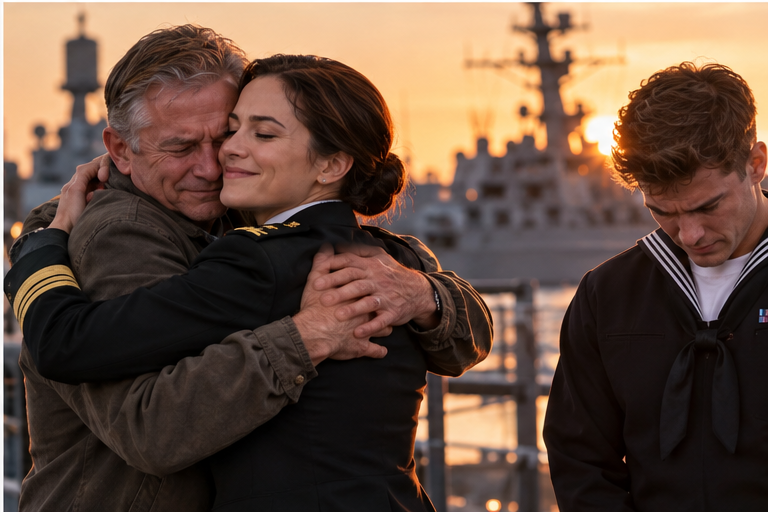
For a moment, I wasn’t a vice admiral.
I wasn’t an inspector.
I wasn’t the woman who’d spent thirty years proving she belonged in rooms where people doubted her.
I was simply a daughter.
Holding her father.
Grieving the years we’d lost.
And grateful that, somehow, we still had time left.
When we separated, Dad wiped his eyes with a handkerchief.
Then he did something that surprised me even more.
He straightened.
Brought his heels together.
And raised his right hand in a crisp salute.
I stared at him.
“Dad?”
His voice trembled.
“Vice Admiral Sandra Owens.”
He swallowed.
“Your service has brought honor to this family.”
I felt tears spill down my cheeks.
Then he added, “And I should have told you that a long time ago.”
I returned his salute.
“Thank you, Sergeant Major.”
He smiled through his tears.
For the first time, the title sounded like a bridge between us instead of a wall.
Later that afternoon, the three of us went to dinner.
Not a formal dinner.
Not a celebration filled with speeches and exaggerated stories.
Just a small seafood restaurant overlooking the harbor.
Dad ordered grilled salmon.
Brandon ordered fish tacos.
I ordered clam chowder and a glass of iced tea.
We talked about ordinary things.
The weather.
Dad’s garden.
Brandon’s plans for the coming year.
My upcoming assignment.
And something remarkable happened.
When I mentioned my work, Dad asked questions.
Real questions.
He listened to the answers.
Brandon did too.
At one point, Dad asked how many sailors had served under my command throughout my career.
I gave him a rough estimate.
He stared at me.
“That many?”
I smiled.
“Over the years, yes.”
He shook his head slowly.
Then he looked at Brandon.
“Your sister’s had quite a career.”
Brandon smiled.
“She sure has.”
I waited for the joke.
The sarcastic remark.
The familiar attempt to make my accomplishments seem smaller.
It never came.
Instead, Brandon raised his glass.
“To Sandra.”
Dad raised his.
“To Sandra.”
I looked at them both.
Then I raised mine.
“To doing better.”
We clinked glasses.
And laughed.
Not because everything was fixed.
But because, for the first time, we were all trying.
Six months later, I returned to San Diego for another official engagement.
It wasn’t an inspection.
There were no maintenance discrepancies to review.
No angry relatives waiting in hotel lobbies.
No sailors standing awkwardly on a pier while my brother mocked my uniform.
I was there to deliver remarks at a leadership development event.
The topic was accountability.
I stood before a room filled with officers, chief petty officers, and junior sailors.
Among them sat Daniel Mercer.
Chief Brooks.
Rear Admiral Whitaker.
And, near the back, Brandon.
My father had come too.
He sat beside my brother, holding a program.
When I stepped to the podium, I looked out at the audience.
Then I began.
“Leadership is often misunderstood.”
The room grew quiet.
“People think it means having authority. Giving orders. Being the most confident person in the room.”
I paused.
“But authority and leadership are not the same thing.”
I looked toward Brandon.
He met my eyes.
“Authority can be granted by rank. Leadership must be earned through conduct.”
Several people nodded.
I continued.
“A good leader doesn’t punish people for telling the truth. A good leader doesn’t confuse loyalty with silence. And a good leader understands that accountability is not the enemy of respect.”
I glanced toward Mercer.
“Sometimes the most courageous person in a room is the junior sailor willing to say that something is wrong.”
He sat straighter.
“Sometimes it’s the supervisor who admits making a mistake.”
My eyes moved toward Brandon.
“And sometimes it’s the person who realizes that being right matters less than becoming better.”
I paused.
“Every one of us will make mistakes. Some will be small. Some will have serious consequences. What defines us is not whether we can avoid embarrassment, but whether we can face the truth and take responsibility for what comes next.”
The auditorium was silent.
Then I finished.
“Your rank may tell people where you stand in the chain of command. Your character tells them whether they can trust you.”
For a moment, nobody moved.
Then the applause began.
I stepped away from the podium.
As I walked toward the side of the stage, I saw Dad standing.
He was clapping.
So was Brandon.
Neither was trying to draw attention.
Neither was making a performance of the moment.
They were simply proud.
And this time, I let myself enjoy it.
After the event, Whitaker approached me.
“Excellent speech, Admiral.”
“Thank you, Tom.”
He smiled.
“You know, I still remember that morning on the pier.”
I laughed softly.
“Unfortunately, so do I.”
He shook his head.
“I’ve spent a lot of years in this Navy. I’ve seen people use their rank to humiliate others. I’ve seen people use their influence to avoid consequences.”
He paused.
“But that morning, you could have made the situation entirely about yourself.”
I looked at him.
“You didn’t,” he continued. “You let the process work. And because of that, a real safety problem was addressed.”
I glanced toward Mercer and Brooks.
“They did the hard part.”
Whitaker nodded.
“They did.”
Then he smiled.
“But someone had to make sure they were heard.”
I looked across the room.
Dad was talking with Daniel Mercer’s parents.
Brandon stood beside them.
He was listening as Mercer’s father described his son’s promotion.
When Mercer joined the group, Brandon extended his hand.
Mercer shook it.
There was no dramatic embrace.
No instant friendship.
Just a respectful exchange between two sailors who understood that trust had to be rebuilt through actions.
And somehow, that felt more meaningful than a perfect reconciliation ever could.
Later, as I walked toward the parking lot, Brandon caught up with me.
“Hey, Sandra.”
I turned.
“What’s up?”
He smiled.
“Remember what I said on the pier?”
I raised an eyebrow.
“Unfortunately, you said quite a few things.”
He winced.
“Fair.”
Then he laughed.
“The part where I asked if you were going to report me to the PTA.”
I shook my head.
“Brandon.”
“I know. Terrible joke.”
“Extremely.”
He grew serious.
“I was thinking about that today.”
“Why?”
“Because back then, I thought the worst thing that could happen was people finding out I wasn’t as important as I pretended to be.”
I waited.
“Now I think the worst thing would be becoming that guy again.”
I studied him.
He looked different.
Not because of his uniform.
Not because of his rank.
But because he no longer seemed desperate to prove something.
“You’ve come a long way,” I said.
He nodded.
“Still got a long way to go.”
“We all do.”
He smiled.
Then he reached toward my shoulder.
For a split second, the memory of that morning flashed through my mind.
His fingers gripping my sleeve.
The laughter.
The humiliation.
But this time, he stopped.
“Can I?” he asked.
I looked at his hand.
Then at his face.
And I smiled.
“Yeah, Brandon. You can.”
He rested his hand gently on my shoulder.
No pressure.
No performance.
No audience he was trying to impress.
Just my younger brother.
Standing beside me.
Then he said, “I’m glad you’re my sister.”
I felt my eyes sting.
“I’m glad you’re finally acting like my brother.”
He laughed.
And we walked toward the parking lot together.
Dad was waiting near the car.
He waved when he saw us.
The afternoon sun hung low over San Diego Harbor.
A breeze carried the smell of saltwater across the pavement.
Somewhere in the distance, a ship’s bell rang.
I stopped for a moment and looked back toward the gray silhouettes of the warships.
Thirty years earlier, I’d entered the Navy believing that if I worked hard enough, achieved enough, and proved myself often enough, my father would eventually see me.
I’d spent decades collecting responsibilities, promotions, and accomplishments.
I’d commanded sailors.
Made difficult decisions.
Endured losses.
And carried the weight of leadership through some of the hardest moments of my life.
But the truth was that no rank could force someone to love me properly.
No medal could make a parent fair.
And no promotion could heal a wound that had been created long before I put on a uniform.
That healing required something else.
Truth.
Accountability.
The courage to admit wrongdoing.
And the willingness to change.
I reached into my pocket and took out my grandfather’s compass.
The silver casing was worn smooth.
I opened it.
The needle settled.
Hold your own course.
I smiled.
For years, I’d believed those words meant I had to walk alone.
Now I understood them differently.
Holding your own course didn’t mean refusing to let anyone walk beside you.
It meant knowing who you were, whether they chose to follow or not.
Dad called from the car.
“Sandra! We’re going to be late for dinner!”
I looked up.
Brandon grinned.
“Come on, Admiral. The old man’s getting impatient.”
I laughed.
“Some things never change.”
“Yeah,” Brandon said.
Then his smile softened.
“But some things do.”
I closed the compass.
Slipped it back into my pocket.
And walked toward my family.
Not the family I’d spent thirty years wishing we could be.
The family we were finally learning to become.
And as I reached the car, my father opened the passenger door for me.
He smiled.
Not at my stars.
Not at my rank.
Not at the uniform that had once seemed to make him uncomfortable.
He smiled at me.
His daughter.
“Sandra,” he said, “I’m proud of you.”
I looked into his eyes.
And for the first time in my life, I didn’t need to wonder whether he meant it.
“I know, Dad.”
I smiled.
“I finally know.”
THE END